If this question, asked in a tone of desperation, has been rising more frequently from within you in this summer of multiple disasters, you are not alone. Even for people of deep faith in the Love that permeates the Universe, it is difficult to maintain hope and trust as our home planet burns and drowns in record breaking fires and floods. Injuries and deaths from earthquakes, tornadoes and hurricanes force hundreds of thousands of people from their homes. pushing suffering and casualties from ongoing wars out of the headlines.
If only we could turn to someone who lived through a time like ours without losing hope, trusting still in the Love that we have known….
Even as I write this, I recall someone who lived on our planet in a time of immense suffering: the one hundred years’ war between France and England; a schism in the Church with two popes in contention: one in Rome, one in France; three outbreaks of Black Plague, more deadly than our years of COVID, reduced the population of England by one half.
A woman whose name we do not even know, born in 1342, became an anchoress in her early thirties. She chose a life of solitude, prayer, and reflection, offering a service of guidance to those who came to her open window with their sorrows and confusion, their desires and longings.
To our immense benefit this woman wrote of her experiences, becoming the first woman to write a book in English.. Her book, “Revelations of Divine Love” tells of the teachings she received from one night of visions in which Jesus appeared, offering her love and a deep understanding of the role of suffering, of the call to live in love and joy.
This woman we know as Julian of Norwich, a name she was given when she became anchoress of the Church of St. Julian in Norwich, England.
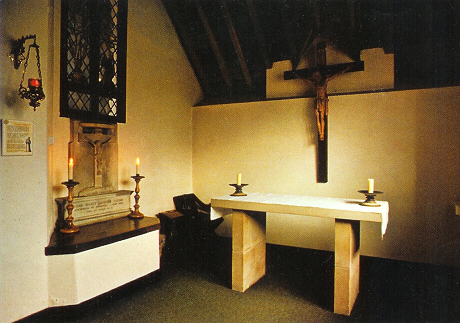
The reconstructed anchorhold of Julian of Norwich
Julian’s death in the early years of the 15th century came as the Reformation was sweeping through Englnd It is believed that her handwritten copy of “Revelations of Divine Love” was lost in transit to a monastery in France where it was being sent for safe-keeping.
A few copies survived of the shorter text , written shortly after her visions. Copies of the longer text, containing the fruit of her twenty years of reflection, survive. These are the sources for the dozens of versions, with various translations from Julian’s “Middle” English, which have been printed in the last decades of the twentieth century. Thomas Merton is credited with the wider knowledge of Julian’s writing. In his book, Seeds of Destruction, he wrote of Julian as “one of the most wonderful of all Christian voices.” TS Eliot quotes Julian in “Little Gidding”: All shall be well andAll manner of thing shall be well…
The first words I ever read from Julian were in a small book entitled “Enfolded in Love” with Julian’s words translated by Sheila Upjohn. In 1992, I was visiting the small Church of St. Julian in Norwich, completely rebuilt after a bombing in WW 2.
These words seemed to leap from a page :
He did not say, ‘You shall not be tempest-tossed, you shall not be work-weary, you shall not be discomforted.’ But he said, ‘You shall not be overcome.’ God wants us to heed these words so that we shall always be strong in trust, both in sorrow and in joy.
Julian answers the question we began with. I believe that we may seek and find the wisdom of Sophia in the words of the Mystics, many of whom are being discovered or rediscovered in and for our time.
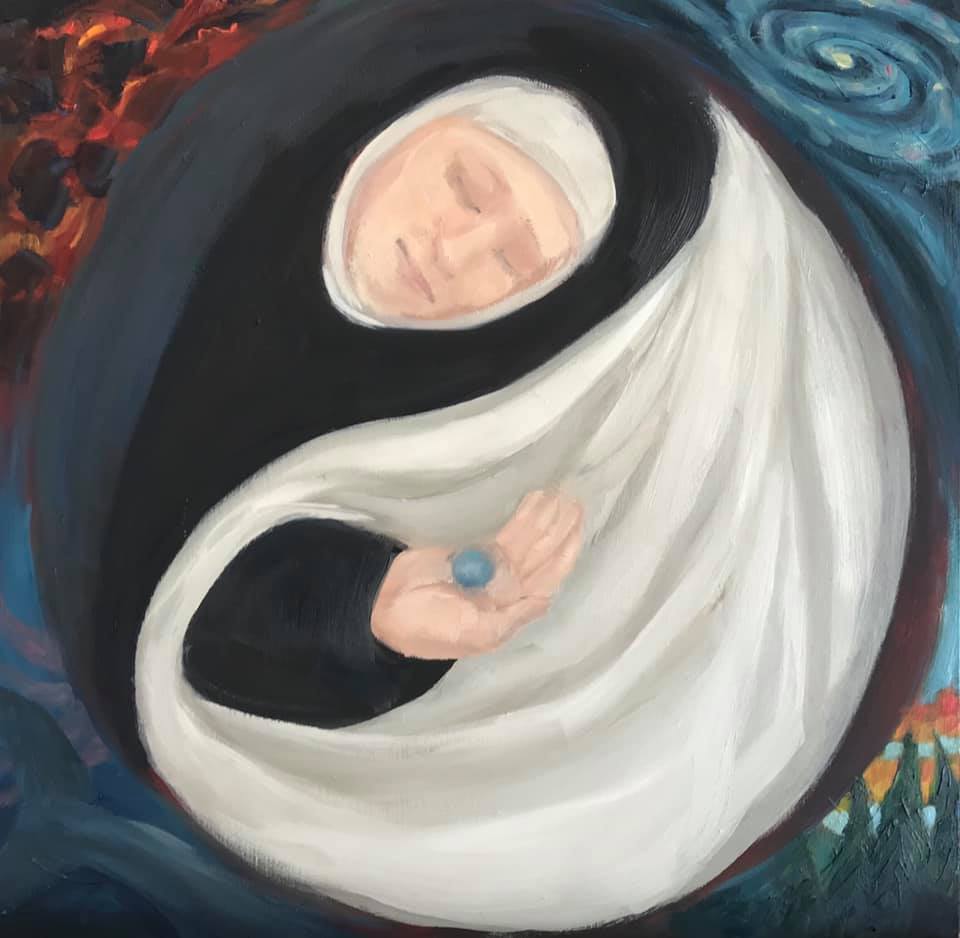
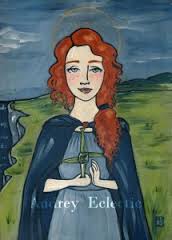
This painting of Julian of Norwich is by Jane Joyner, a contemporary artist whose life was given healing and comfort by Julian.
Today, my heart and mind hold love and gratitude for Jean Houston, teacher, mentor, friend. Jean died one month ago, on May 16th, in Ashland Oregon. Despite the many ZOOM conversations, tributes, poems and expressions of love, it still feels strange to think of our planet without her among us. Yet, Jean often reminded us that we are surrounded by numinous luminous beings just beyond our sight.
Jean, I trust that you are now among them. Stay near, and continue to guide us into wisdom.
Jean Houston
Thoughts of Jean led me to her Reflection: “A Visit to the Sophia” from Godseed, 1992 (Theosophical Publishing House, Wheaton IL. 60189-0270)I have written a shortened version of this visualization for you today, as a gift from Jean. Settle yourself comfortably, take a few deep breaths, prepare for this sacred encounter. What question do you wish to ask when you come before the Sophia?
When you have your question ready, begin the imaginal journey. If you’ve heard Jean speak, imagine these words in her mellifluous tones:
After a long spiralling journey upwards, you find yourself at the very top of a high mountain. You go inside the mountain to a path that travels downward in a spiral. Moving along the path down and around within the inner mountain, you pass scenes of your own life, from your earliest infancy.
You see or sense yourself being born. Continuing on the path down and around, to your earliest childhood, see yourself taking your first steps, forming words, reaching out and grasping things, learning to feed yourself. Further down, see yourself learning to tie your own shoes, attending your first days at school, learning to read. Continuing down, you see yourself playing games and reaching out to other children. As you continue, see yourself growing up fast and learning many things. You see your adolescence. Further along you observe stages of your life until today………..
pause to remember (three minutes of clock time)
Suddenly you find yourself at the very bottom of the inside of the mountain. There you discover a door of baked mud. Going through it, you find that it leads to a hallway and to a door of water. You pass through the door of water, and it leads to a door of fire. You pass through the door of fire, and it leads to a door of winds. You lean against the winds and pass through. This door leads to a door of bronze, and you pass through. This door leads to a door of silver. You pass through the door of silver and find a door of gold.
At the door of gold there is a shining figure who says to you: “Through this door is the Wise One Herself. Enter now. When you pass through this door, you will be in the presence of the Sophia. You may see Her or you may sense Her. Approach Her with confidence.Know that She who is Wisdom awaits you with Love. When you are in Her ambience, whether you see Her or hear Her or sense Her nearness, ask your question. Wait for Her response. It may come in words or in images or in a question. It may come with a warmth that spreads though your Heart, with a deep knowing that you are loved.
You now have four minutes of clock time, equal to all the time you need, to be in the presence of the Sophia. Now, ask and receive…receive…receive…..
Thank the Sophia for Her wisdom. If Her response is puzzling, ask Her for greater clarity. Stay in Her presence until you come to peace with what you’ve received.
Knowing that you can always return to visit Her again, begin now to go back through the door of gold, the door of silver, the door of bronze, beyond the doors of winds, of fire, of water, of earth, beyond the spiral of the stages of your own life, reaching the top of the mountain. Now take the spiral path back down from the side of the mountain.
Find yourself here in this moment, in your own room. Open your eyes, sit up and stretch. You may you wish to write of your experience in a journal, or to draw with coloured pencils. Perhaps a poem or a song will rise from your heart.
(Hafiz The Subject Tonight Is Love trans. Daniel Ladinsky)
Twelve years ago, I began posting on “Sophiawakens.” I felt drawn to make the Sacred Feminine Presence better known, even as She was Herself rising in the hearts of women and men who are longing for Her. My journey has led me through moments of deep joy, though awareness of being held in love, through clear guidance when the path seemed to vanish. There have been times of emptiness, doubt, and darkness when all I could do was cling blindly to memories of light and love, to my deep longing to find Sophia within me.
This morning, I was surprised by an unexpected call: to return to the beginning of my journey, to find memories to offer to you, who may be on a similar journey, seeking Sophia, aware of our need for Her guidance, Her love, Her wisdom as we wander in a time and place like the garden of Briar Rose, overgrown with thorn trees so that no way lies open.
When we set out in search of Sophia, the missing feminine aspect of the Holy, we prepare for a long journey, following tracks that are millennia old. We learn to be adept at time travel, exploring deep dusty caverns of pre-history, unravelling, reweaving, threads of ancient stories.
Sophia is nowhere precisely, yet everywhere subtly. Mythologies of many cultures abound with tales of her presence, her power, her sufferings, her admonishments. Old fairy tales hold glimpses of her that are both tender and terrifying. We will need to look into sacred wells, old ritual sites, ruined temples and sanctuaries. We will carefully examine fragments of poetry, shards of pottery, pieces of drums, tiny perfect feminine figures carved of stone, buried in the depths of the earth.
We are living today in the time of the great recovery. What has been hidden is being revealed to us. Scholars of ancient civilizations are writing of their findings: the traces of a sacred feminine presence within the stories, myths and ritual practices of people long vanished.
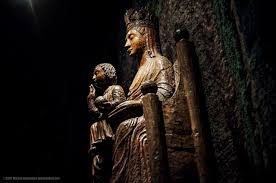
The Black Madonna. Chartres Catherdral, France
In A Brief History of The Celts, Peter Berresford Ellis writes of the Great Mother Goddess of the Ancient Celts, revealing the connection between the Celtic Goddess and the great rivers of Ireland, a sacred connection also found in India’s mythology:
“… the Celts believed their origins lay with the mother goddess Danu, ‘divine waters from heaven’. She fell from heaven and her waters created the Danuvius (Danube), having watered the sacred oak tree Bile. From there sprang the pantheon of the gods who are known as the Tuatha de Danaan (Children of Danu) in Irish and the Children of Don in Welsh myths.” (p. 162)
“The story associated with the Danuvius, which is arguably the first great Celtic sacred river, has similarities with myths about the Boyne, from the goddess Boann, and the Shannon, from the goddess Sionan in Ireland. More important, it bears a close resemblance to the Hindu goddess Ganga, deity of the Ganges. Both Celts and Hindus worshipped in the sacred rivers and made votive offerings there. In the Vedic myth of Danu, who exists as a deity in Hindu Mythology as well, the goddess appears in the famous Deluge story called “The Churning of the Ocean.” (p.7)
Celtic writer Jen Delyth writes of the goddess Anu, also known as Danu and Aine: “An ancient figure, venerated under many names, she is known as the womb of life. She is the spark and vitality of life. She is the seed of the sun in our veins. The Great Earth Mother is more ancient than the god of the Celtic Druids. She is the Mother whose breasts are the Paps of Anu in Ireland. Her hair is the wild waves, the golden corn. Her eyes are the shining stars, her belly the round tors or earth barrows from which we are born. Like the cat, the sow, the owl, she eats her young if they are sick or dying. She is the cycle of life, the turning of the seasons.”
In rivers, waves, and corn, in stars and earth barrows, in the very seasons of our land, this sacred presence is embodied, immersed, implanted in the universe, around, above, within us.
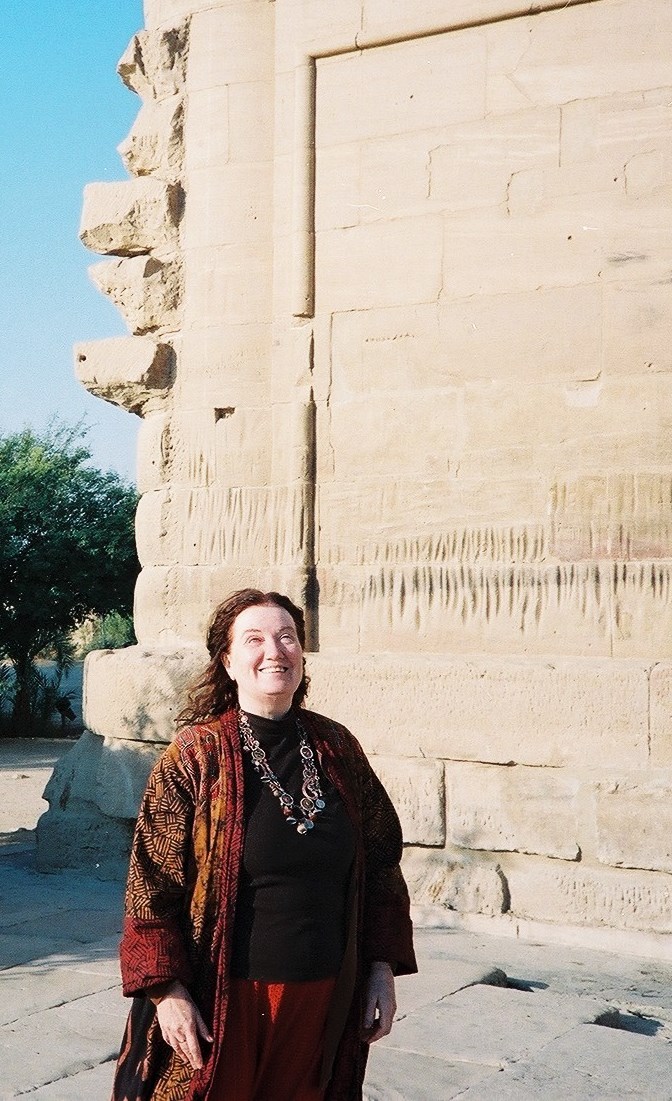
I cherish a memory from my own search for Sophia. It is predawn, November 13, 2008, during the journey I made to Egypt with a group led by Jean Houston. We are gathered in the tiny sanctuary sacred to the goddess Isis on the Island of Philae in the Nile River. Jean is reading something about Isis, a series of sacred names. The writing is from “The Golden Ass’’ written by Apuleius, a first or second century Roman, not a Christian. In the story, an unskilled magician named Lucius has accidentally turned himself into a donkey. In despair, he cries out to the Goddess Isis for help.
The Sacred One identifies herself to Lucius with these words:
“I, the natural mother of all life, the mistress of the elements, the first child of time, the supreme divinity…. I, whose single godhead is venerated all over the earth under manifold forms, varying rites, and changing names…. Behold, I am come to you in your calamity. I am come with solace and aid. Away then with tears. Cease to moan. Send sorrow packing. Soon through my providence shall the sun of your salvation rise. Hearken therefore with care unto what I bid. Eternal religion has dedicated to me the day which will be born from the womb of this present darkness.
After that reading in the Isis sanctuary, we were asked to call out all the names by which we have known the Sacred Feminine. I remember hearing voice after voice calling out wonderful names. Many of those names were familiar to me, titles I’d learned as a child, and they referred to Mary. Mystical Rose. Tower of Ivory. Gate of Heaven. I hear now in memory my own voice call out: “Star of the Sea.” I hear Jean’s voice, strong, certain: “Mary in all her forms.”
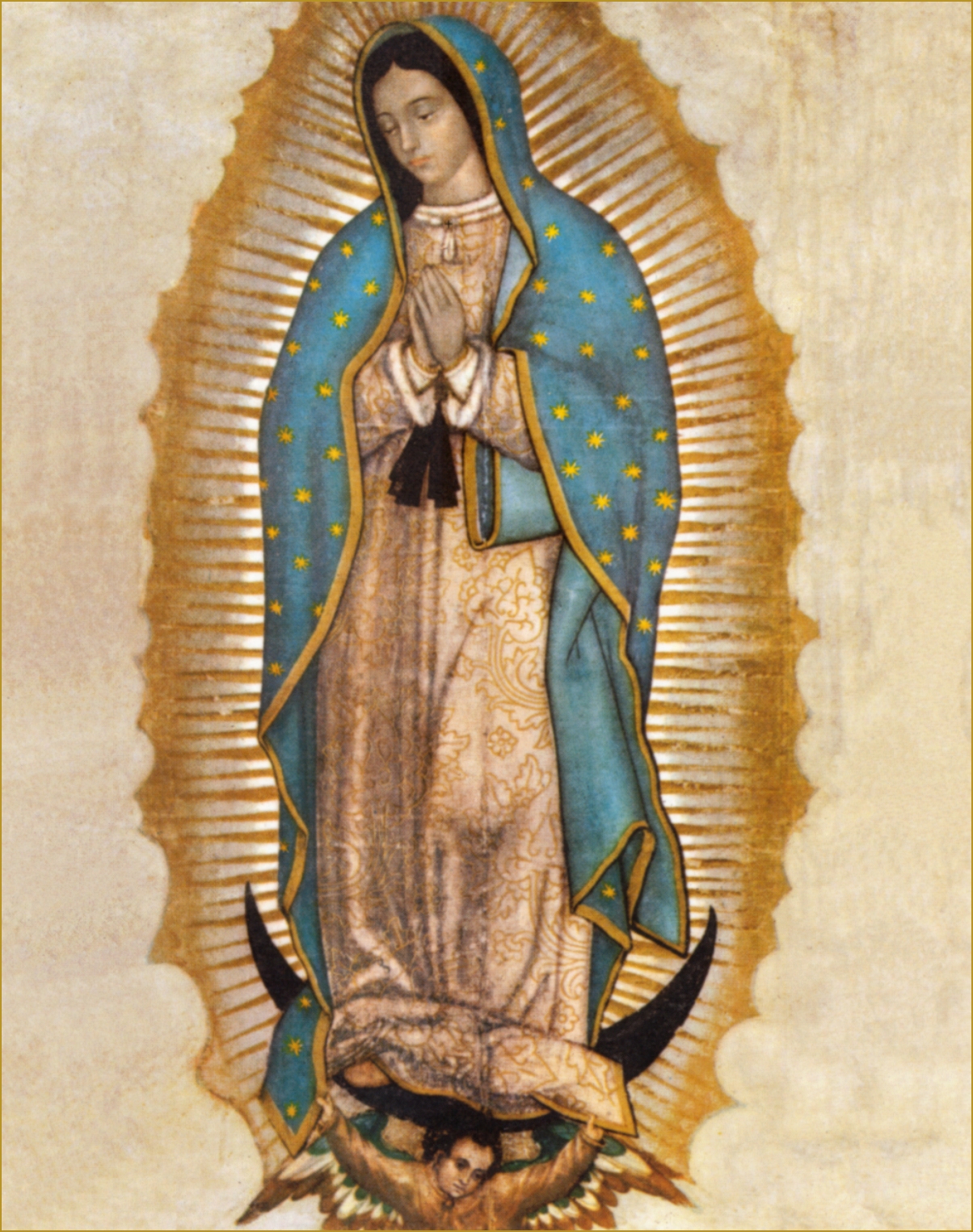
Our Lady of Guadalupe
As our group emerges from the Sanctuary, our Egyptian guide is waiting, looking distressed, apologetic: “I am sorry. I made a mistake. I never should have allowed your whole group to go inside at the same time. The sanctuary is too small to hold so many.”
Yet we had all found room for joy.
In Women of the Celts, Jean Markale offers an overview of the decline of the Sacred Feminine presence as the Jewish/Christian religions became dominant, but he also hints at how her presence survives: “Within the patriarchal framework (goddesses) were often obscured, tarnished and deformed, and submerged into the depth of the unconscious. But they do still exist, if only in dormant state, and sometimes rise triumphantly to rock the supposedly immovable foundations of masculine society. The triumph of Yahweh and Christ was believed sanctified forever, but from behind them reappears the disturbing and desirable figure of the Virgin Mary with her unexpected names: Our Lady of the Water, Our Lady of the Nettles, Our Lady of the Briars, Our Lady of the Mounds, Our Lady of the Pines. But in spite of the veneration accorded her over the centuries and the public declaration of successive dogmas related to Mary, the authorities of the Christian Church have always made her a secondary character, overshadowed and retiring, a model of what women ought to be. Now the pure and virginal servant of man, the wonderful mother who suffers all heroically, she is no longer the Great Goddess before whom the common herd of men would tremble, but Our Lady of the Night.”
Such an appropriate name for the presence we seek, the One who has so many different names… yet is being rebirthed now in our time, from the “womb of this present darkness”.
The pathways we follow in our search for her may seem arduous, but the starting place is deep within our souls. As Hafiz hints in his poem, the search begins with our longing for her.
(Photo) Anne Kathleen on Philae Island November 13, 2008
On this day in late April, the morning sun was shining with comforting brilliance and a promise of warmth here in the Ottawa Valley. After weeks of false starts, followed by wind, rain, and more snow, hope is rising that spring has finally arrived in time for Earth Day. As the pale blue sky darkens into evening, I share with you a treasure found in my Archives, a Prayer Service created for an earlier Earth Day. Here it is for your joy:
Who is Brigid for us today? We take inspiration from her, and yet we are separated from her life by a millennium and a half. We don’t live in a monastery, or in a way of life intimately tied to the land and its cycling seasons.
In her book Praying with Celtic Holy Women Bridget Mary Meehan writes that “the force of (Brigid’s) Celtic soul is a rich lodestone of the Celtic feminine which continues to challenge each new generation.” (p.29) Consider the word Meehan chooses: lodestone, a magnet, a thing that attracts….
What is it in Brigid’s story that so attracts us after so many centuries? One story from Brigid’s life tells of Old Bishop Mel, as he prepared to read the words that would consecrate Brigid as a spouse of Christ, by accident read the prayer over her for the consecration of a bishop. When the error was pointed out to him, Bishop Mel declared it was the work of the Holy Spirit. “Let it stand,”he said. . Thus Brigid became the Abbess of the Monastery of Kildare.
Kildare was a double monastery, housing consecrated women and men, as was the way in the Celtic expression of Christianity. Brigid would have governed as Abbess/Bishop to both women and men. The development of Irish Monasticism appears to have been richly differentiated, a garden of wild profusion and endless variety. So there is no way of knowing how or when or why Brigid’s monastery of women began to welcome men. But here is a story I found that tells how it may have happened:
One day a group of men, for whom Brigid’s faithful spirit and generous heart were as a lodestone, came knocking at the door of the Kildare Monastery, requesting that they be allowed to join the community. Brigid consulted with her Sisters. They were aghast! What? Men! Noisy, unruly, bothersome. No way! Brigid’s first assistant sealed the matter with the words that have frequently put an end to something new: “It’s never been done before.”
Still not at ease with the decision, Brigid went outside and sat near the holy well. Something urged her to look deeply into its dark waters, recalling as she did so that imagination dwells in the dark places. Brigid picked up a tiny stone and dropped it into the well. Down, down it fell, until a small splash in the deep told her it had reached the water. But there was still nothing to be seen in the well’s depths. She picked up another stone and dropped it into the well. Just at that moment the noonday sun, from its highest place in the sky, illumined the water where the stone had struck. Brigid saw tiny circles rippling out from where the stone had pierced the water.
In the depths of her own imagination, Brigid saw a circle widening. She thought about this: “Because it’s never been done before does not mean it can never be done.” And it was so. Kildare become a monastery for both men and women, drawn by the depth of Brigid’s holiness.
Seeking a meaning for the word lodestone I notice another word: lodestar. This refers to the star by which a ship navigates, usually the pole star. Symbolically it refers to a guiding principle. This illumines something for me, shining into the wells of legend and story that flow around Brigid’s life. Under the tales there is a guiding principle that will illumine our lives if we look deeper.
What was the lodestar of Brigid’s life, the star by which she navigated the uncertainties and challenges that faced her each day
In another legend, a sea creature in great danger had cried out to Brigid for help and she came to its aid. Brendan the Navigator was much offended and asked Brigid why the creature did not cry out to him instead.
“What do you think of when you are out in your boat, Brendan?”
He answered that he thought about the waves, the tides, the movement of the fish, the weather… all the things a fisherman must be aware of….
Brigid said to him, “From the first moment I met the Christ, my thoughts have never left him. That is why the sea creature called to me instead of to you.”
Such focus is important in our lives. I have to admit to Brigid how easily I lose focus, forget the One who began this work in me, let the Holy One slip from my gaze, from my path, from my heart. I realized that it is the fire of a passionate love for the Holy that has been lit within me, a fire I must tend faithfully. A fire tender must first of all take care that the flame of her love burns bright. All else, for each one of us, flows from that.
February 1st is now a National holiday in Ireland, honouring Brigid. Why not take time on Brigid’s Day to speak or write a dialogue with her, asking what for you, is the most important focus, the flame you must faithfully tend?
What is it about January and especially the Feast of the Epiphany that sends us into the heart of our lives with questions? What is my deepest desire for this New Year? What star am I to follow? How can I, like Brigid of Kildare, FOCUS on what matters most?
Artwork by Jan Richardson
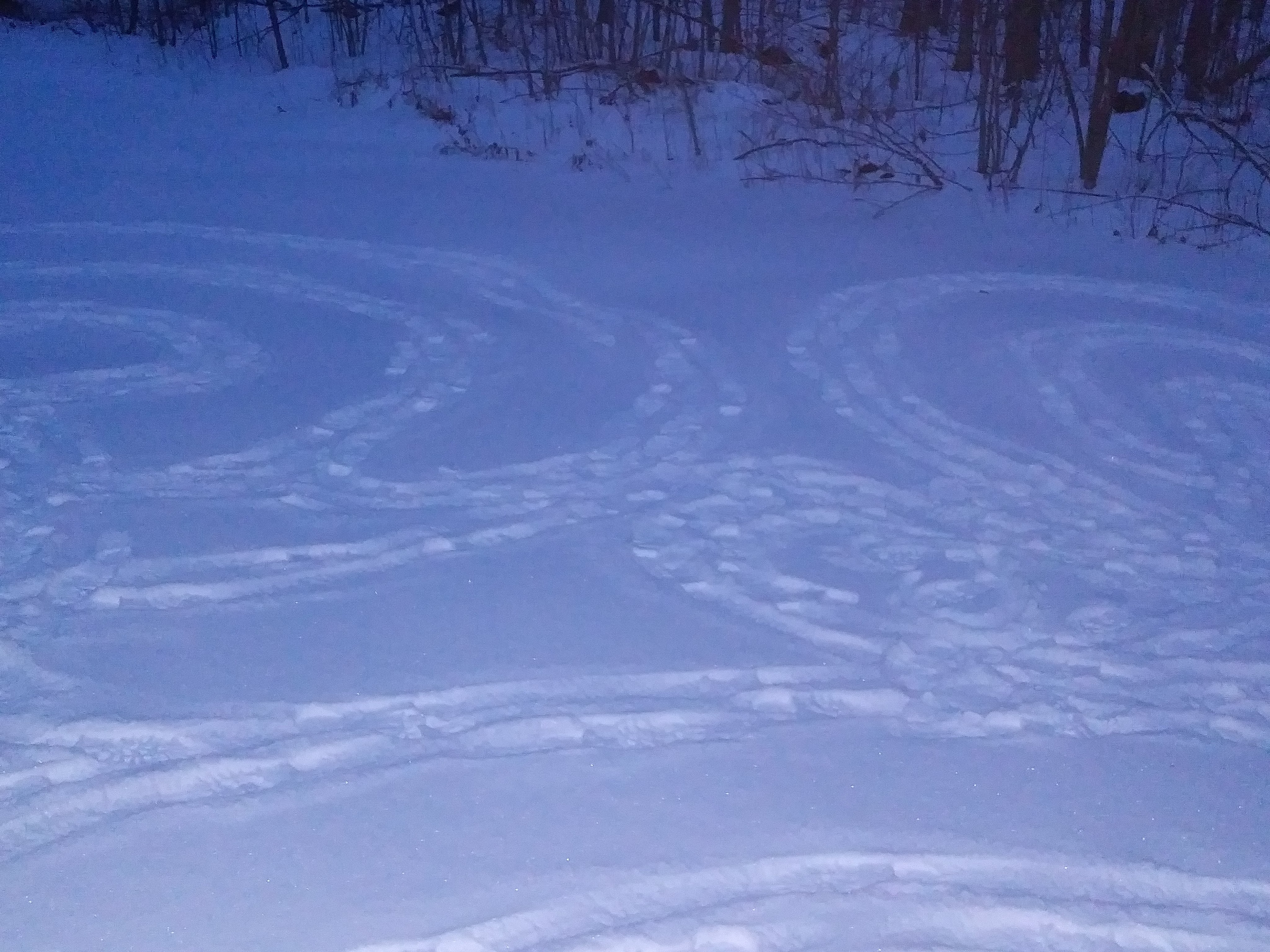
When a snowfall created a white wonderland around my home, I paced out a snow labyrinth, with three intersecting spirals. I walked it, holding my confusion, asking, “What am I to do? Where shall I focus my energy?What is most important in my life?”
I reached the heart centre of the labyrinth, stood listening, still unsure. Then as I retraced my steps, an answer arose, so simple I might have dismissed it… the labyrinth itself showed me. Choose from your heart centre. What do you most desire?
I, and those who share my longing, desire a new spirituality for our time, one that recognizes that from the beginning, evolution has been a spiritual process. At the heart of our Universe is Love. To live from this understanding calls for strength courage to hold to our trust in a Universe that is permeated with Divine Love
As the ancient weavers worked at their looms, they created and shared stories that wove meaning through their lives. The fragments of these tales that still remain reveal their understandings of love, of wisdom, of darkness, of suffering. Remembering these tales lends enchantment, as well as clarity as we sit down at our looms and choose the coloured yarns for the weaving of a spirituality for our time.
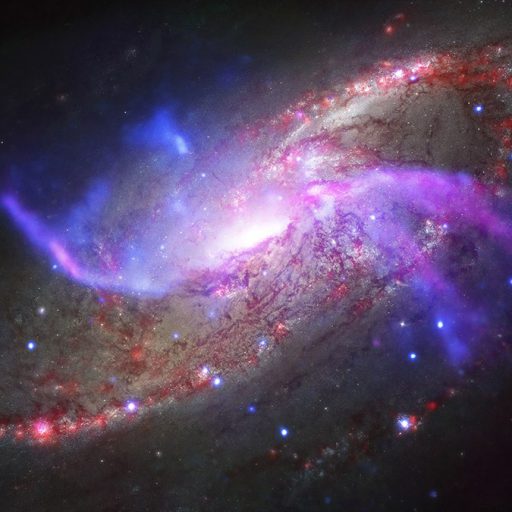
We know what we are about, our hands are strong, supple, as we select the shades, the textures, the combinations that harmonize best. We include the dark threads as well as the golden, the soft fibers as well as the tough. We know this weaving requires it all… the warm rose madder of love, that stretches across the universe for three trillion miles in a NASA photograph… the gold of wisdom, polished to glowing through times of suffering and loss… the deep purple threads that remind us that 96% of the universe, including ourselves, dwells in darkness. Invisible threads of beauty wind themselves into the spaces between the weaving: music, song, dance, poetry, stories, the threads of the relationships that give meaning to our lives… Our shuttle moves with ease between ancient wisdom, and the edges of mystic knowings offered by today’s physicists.
The old Scottish tale: “The Stolen Bairn and the Sidh” is a story that never fails to inspire me anew to commit my life to what matters most.
By the fireside of an ancient gypsy woman, there sits a young woman, barely twenty. Exhaustion and grief have bowed her, stolen light from her lovely sea-green eyes. For weeks, she has been wandering the moors, knocking on every croft door, walking through towns, seeking everywhere for her small son. His father is dead. The little boy is all she has left in the world and she loves him desperately. This gypsy woman, known for her deep wisdom, is her last hope.
The old woman stands, takes a handful of dried herbs from a cauldron at her side, throws them on the fire. After studying the dim patterns of smoke, she reaches for the young woman’s hand. Holding it between her two gnarled ones, she speaks gently: “Prepare yourself for great sorrow. Your child has been taken by the Sidh, the fairy folk of Ireland. What goes into the Sidhean seldom emerges.”
The young woman begins to weep. “I may as well die, for without my child, I have nothing to live for.”
“Do not despair. I see one hope. The Sidh have a great love of beautiful things; yet, for all their cleverness, they are unable to create anything. They must steal or bargain for what they desire. If you could find an object of immense beauty, you might be able to bargain with them to regain your son.”
“But how shall I get inside their Sidhean?” the woman asked.
“Ah,” said the gypsy. “You shall need a second thing of great beauty to bargain your way inside.”
Then the gypsy woman gave her directions to find the Sidhean, blessing her with a protection against harm by fire, wind, water and earth. The young woman slept deeply that night. When she wakened, the old Gypsy woman and all her people were gone, and the place of encampment was an empty field.
The young woman drank water from a stream, ate some bread given her by the gypsies. Then she lay in the grass and wept. How could she do this impossible thing that was asked of her? After a time, the flow of tears dried, and a light wakened within her. She thought: “ I shall need not one but two things of incomparable beauty.” She set her mind to remembering all the lovely things she had heard about. Of all, she chose two: the white cloak of Nechtan, and the golden harp of Wrad.
With sudden clarity, she knew what she must do. She stood, and began walking towards the sea.
She clambered among the rocks at the shore, gathering the down left by the ducks. And the blessing of the gypsy protected her from harm by the waves, the wind, the sun’s fire and the sharp rocks.
She sat on a large stone to weave the down into a cloak. She cut a strand of her hair with a sharp rock. Using her golden hair as thread, she wove a pattern of fruits, flowers and vines through the cloak’s hem. The cloak was so beautiful it might have been a white cloud fallen from the sky. She hid the cloak behind a gorse bush, then walked the shoreline until she found a frame for her harp. The large curved backbone of some creature of the sea was just the right size and shape. With strands of her hair, she tied the strings to the frame, then tightened and tuned them.
The lovely melody she played caused the birds of the air to pause in mid-flight to listen.
She wrapped the cloak around her. Carrying her harp, she out for the Sidhean.
A Sidh woman, arriving late, rushing towards the opening in the hill, saw her. Mouth agape, eyes burning with greed, the fairy gazed at the cloak. A bargain was struck. The fairy woman allowed her to enter the Sidhean in exchange for the cloak. The other Sidh folk were so enthralled at the sight of the fairy woman wrapped in the cloak that they did not notice as the young woman walked into the throne room. She stood before the kIng who was seated on his throne. She began to play..
The king’s eyes grew wide in amazement, then narrow in greed.
“I have many harps,” said the King, pretending disinterest,yet I have a mind to add your harp to my collection. What will you take in exchange for it?”
The young woman said,“Give me the human child you have here.”
The King whispered to his servants who brought a great cauldron of jewels. They poured the shining gems at her feet. Not bothering to look at them, the young women gazed steadily at the king.
“Only the child,” she said. The servants came a second time with a cauldron of gold pieces. Again she did not look. She played on her harp a tune of such love and longing that the King was overcome.
The servants were sent out and returned carrying the child. When he saw his mother, he gurgled with delight, and stretched out his arms to her. Letting the harp be taken from her, she lifted her arms to receive him. Then she walked with him out of the Sidhean.
In this new year of 2026, a question rises with urgency. How may my life, how might your life, offer the incomparable gifts of great beauty: compassion, light and hope to others in the midst of planetary darkness? Might I, might you, begin each day asking that same question?
Perhaps we shall find, as Rilke suggests, that we are living into the answer….
Perhaps, like the young mother in this tale, we have what we need within us: in our imagination, our heart, our very essence.
In JRR Tolkien’s Lord of the Rings, Gandalf has just revealed to Frodo that he must accept responsibility for a ring of power left to him by Bilbo. Gandalf continues, “This is the Master-ring, the One Ring to rule them all. This is the One Ring that (the Dark Lord) lost many ages ago, to the great weakening of his power. He greatly desires it– but he must not get it.”
Frodo sat silent and motionless. Fear seemed to stretch out a vast hand, like a dark cloud rising in the East and looming up to engulf him. “I wish it need not have happened in my time,” said Frodo.
“So do I,” said Gandalf, “and so do all who live to see such times. But that is not for them to decide. All we have to decide is what to do with the time that is given us. And already, Frodo, our time is beginning to look black.”
Remove the wrappings from Tolkien’s tale. Its heart speaks to us. Fear “like a dark cloud rising in the East” engulfs our planet with a series of climate crises, wars, disasters. We hear ourselves echoing Frodo’s words: “I wish it need not have happened in my time.”
Gandalf’s wisdom also echoes: All we have to decide is what to do with the time that is given us.
To decide that will require wisdom as well as courage. Yet we also need a sense of hope, as well as sources of solace…. This I wish to offer especially in one area of our current darkness: the depredation of our planet, Gaia. And for this I turn to poets who, as Teilhard de Chardin has written, also serve us as mystics and philosophers. To find hope in Gaia even in the midst of our suffering, it’s good to remember the words of Kahlil Gibran in The Prophet: When you are sorrowful, look again in your heart, and you shall see that in truth you are weeping for that which has been your delight.
The poet Alfred K LaMotte reminds us that even now Gaia has delight to offer us, to sustain us:
YOU ASKED
When you asked,
How can I face
such a dark world?
the answer was all around you.
The wands of pine
in rain-laden breeze answered,
bell-throated, blackbirds
ringing over the wetland
answered, stars
floating on a still pond
answered,
dancing
snow of milkweed,
pearl-eyed mushrooms
seeing through midnight
in the forest answered:
This world is not the seat of sorrow.
This world is sunlight
playing in a risen mist
over the fountain of beauty.
The seat of sorrow is your heart
aching, thirsting
for its own illumination.
But the healing is easy.
Turn your gaze around
and see into your source.
You are that fountain, that
refraction of prism’d beauty.
Listen to the raindrop fall,
how it finds its way home,
as fallen things do,
to the hidden spring
under pungent green moss
where it was born.
Even the raindrop answers,
Yes.
Jude Currivan in “The Story of Gaia” describes a mystical moment of beauty and wonder during a solar eclipse:
On August 1, 2008, together with some fellow travelers, I climbed one of the high peaks of mount Huashan, located about 120 kilometers from the city of Xian in China, to witness a total Solar eclipse. Across from me was another of the five summits of this sacred mountain.
With their rocks delving deep into Gaia and their peaks reaching high to the heavens, mountains have held spiritual significance for millennia, inviting pilgrims to undertake journeys of inner and outer discovery and revelation. Indeed, the Chinese phrase for pilgrimage, h’ao-shan chin-hsiang, means “to offer respect to a mountain.” And from ancient times this particular massif, carved from a single huge block of granite, and the precipitous and dangerous paths to its crests have held especial meaning, offering hard-won opportunities for insight and guidance.
Peaks of Mount Huashan
Its five-peaked shape spreads open like the lotus after which it’s named – symbolizing a flower that rises from its roots in mud, through water, to open its blossoms to Sol. Representing purity of heart and mind, the lotus and thus the mountain embodies the sacred seat of Buddha, as attested to by the many shrines and temples adorning its flanks and heights.
After a spectacular cable car ride to near the top of the peak and a steep climb to its crest, we arrived in the late afternoon of a beautiful, warm late-summer day. In the pale blue sky above the mountain, Luna in her fullness was slowly but inexorably extending her shadow over the disk of Sol.
One small cloud was visible in an otherwise clear sky. But as the eclipse continued to proceed to its few minutes of totality, when Luna completely covered Sol, the arc of their combined path, to my consternation, dipped behind the cloud.
After journeying so far to witness one of the most glorious of cosmic phenomena, it seemed that I was destined for it to be out of sight and only to sense its occurrence. So, I closed my eyes, aiming to attune with the coming few minutes of totality, when Gaia, Sol, and Luna perfectly aligned.
With my conscious mind having surrendered to whatever I might experience, I had no further expectations. A few moments later, though, I heard … a message to “open your eyes.”
When I did, I literally began to shake with emotion and tears began to flow down my face. My gaze took in an amazing scene. Across the valley beneath me and upward to the pointed mountain peak beyond, the disk of Sol was now exactly covered by that of Luna. Fully clear of the small cloud and with no sunlight to reflect off Luna’s face, the total eclipse created a perfect circle of utter blackness against the backdrop of bright sky.
Of itself, this incredible sight is one of the most extraordinary phenomena of our Soular System. Yet, in a further miracle, the eclipse appeared almost impossibly poised: perfectly balanced, exactly and only for its few minutes of totality, on the very tip of the mountain.
This trinity of Sol, Luna, and Gaia experienced uniquely, only at this precise moment and at this exact vantage point, and shared only with my fellow travelers and a few young and local Chinese people was, as yet, the most wonder-full sight of my life.
It was as though the galaxy had sent an emissary to remind me of the vast black hole at its center and even, perhaps, as a sense of connecting to its sentience through the totality of the eclipse.
I watched this miracle in silence, along with the world around us that also seemed spellbound, as, in their cosmic dance, Sol and Luna, majestically sashaying together, slipped behind the peak. Moments later, now hidden from our view, as they silently parted to go their separate ways until their next communion, the sky behind the mountain crest before us exploded into light.
Solar eclipses as seen from Gaia certainly appear like nothing else in our Soular System and may be exceedingly rare or even unique throughout our galaxy and even entire Universe. The striking image of what black holes might look like when seen up close, may be nearest to this celestial phenomenon that occurs with awe-full regularity a few times every year. It’s a vision that on a profound level inspires in me a sense of the “black whole” of no-thingness and yet al-thingness.
Let us set our hearts to find what we are called to do with this, our time. And let us sustain our courage, our joy with the beauty that still exists on Gaia.
If you grew up Catholic in the years before the Second Vatican Council, chances are Mary was at the very heart of your faith. You prayed the “Hail Mary” many times daily; you sang hymns to Mary as you walked in May processions carrying flowers to decorate her statue; in every trouble and doubt, in every dark moment of your own life, you turned to her as to a mother whose love for you was unconditional. You probably knew by heart the “Memorare”, a prayer to Mary that says, in part, “Remember…Mary, that never was it known that anyone who fled to your protection, implored your help or sought your intercession was left unaided…”
At the call of Pope John 23rd, 2600 Roman Catholic Bishops gathered in Rome for the Second Vatican Council in the mid-1960’s. Believing they were restoring a balance, they invited Mary to step from her throne, and guided her gently to a place among the faithful, the followers of her son, Jesus. The “excesses” of Marian devotion were curbed… and then what happened?
Over the past sixty years since the closing of the Vatican Council, we have seen a burgeoning of interest in the “Sacred Feminine”; a recovery of ancient stories of the Goddess; archaeological finds that create renewed interest in the time when the Sacred One was honoured as a woman; an explosion of writing among theologians, historians, cultural storytellers, seeking to understand the power and presence of “Mary” in the Christian story. I will cite a few here: The Virgin by Geoffrey Ashe; Missing Mary by Charlene Spretnak; Untie the Strong Woman by Clarissa Pinkola Estes and Truly Our Sister by Elizabeth Johnson.
Though I am no theologian, I have a consuming interest in the many aspects of this mystery. What I glimpse is this: the human heart longs for a divine mothering presence. Ancient cultures honoured a feminine divine who over millennia was called by many names: Isis in Egypt; Inanna in Sumeria; Ishtar in Babylon; Athena, Hera and Demeter in Greece, Anu or Danu among the ancient Celts; Durga, Kali and Lakshmi in India; for the Kabbalists, Shekinah; for the gnostics, Sophia or Divine Wisdom. Christianity had no “Mother God” to put in the place of the Goddesses whose worship it was determined to eradicate. Geoffrey Ashe’s theory is that Mary’s gradual ascension in Christianity was not an initiative of Church Leadership, but rather a response to the hunger of the early Christians for a sacred feminine presence.
Mary became for us an opening to a loving feminine sacred presence. Or, put another way, a loving sacred feminine presence responded to the cries of her people when they called her “Mary”, just as that presence had responded over the millennia to other names cried out in love or sorrow or desperate need.
Over these darkening days as we descend to the longest night of the year at the Winter Solstice, Mary will be our companion. We reflect on her pregnancy, her waiting, her uncertainty, the doubts of those who love her, the trust that sustains her “while she opens deeper into the ripple in her womb…”
No man reaches where the moon touches a woman.
Even the moon leaves her when she opens
Deeper into the ripple in her womb
That encircles dark to become flesh and bone.
Someone is coming ashore inside her.
A face deciphers itself from water
And she curves around the gathering wave,
Opening to offer the life it craves.
In a corner stall of pilgrim strangers,
She falls and heaves, holding a tide of tears.
A red wire of pain feeds through every vein
Until night unweaves and the child reaches dawn.
Outside each other now, she sees him first.
Flesh of her flesh, her dreamt son safe on earth.
John O’Donohue Connemara Blues
Doubleday, Great Britain, 2000; Bantam Books, 2001
This is profound mystery. For Mary. For each one of us who carries the Holy within us, seeking a place of birth. We walk the dark road, with Mary, in trust.
We walk companioned by one who knows our struggles to maintain our trust in the face of inner doubts and outer calamity. We walk with one who loves us and encourages us until we are ready to welcome “the day which will be born from the womb of this present darkness.”
What mystery is “Coming Ashore” inside you?
awakening to the sacred feminine presence in our lives