
Teilhard came to know Sophia as the cosmic Love that is holding
all things together. ( Kathleen Duffy)
Born in 1881, Teilhard lived, studied, worked and wrote mainly in the
first half of the twentieth century. As a scientist, he knew Darwin’s
work in Evolution; as a paleontologist, he spent time excavating the
story of evolution inscribed within the earth; as a mystic he was
captivated with the wonder of an unfinished universe being drawn from
within into a radiant future by a sacred presence of love.
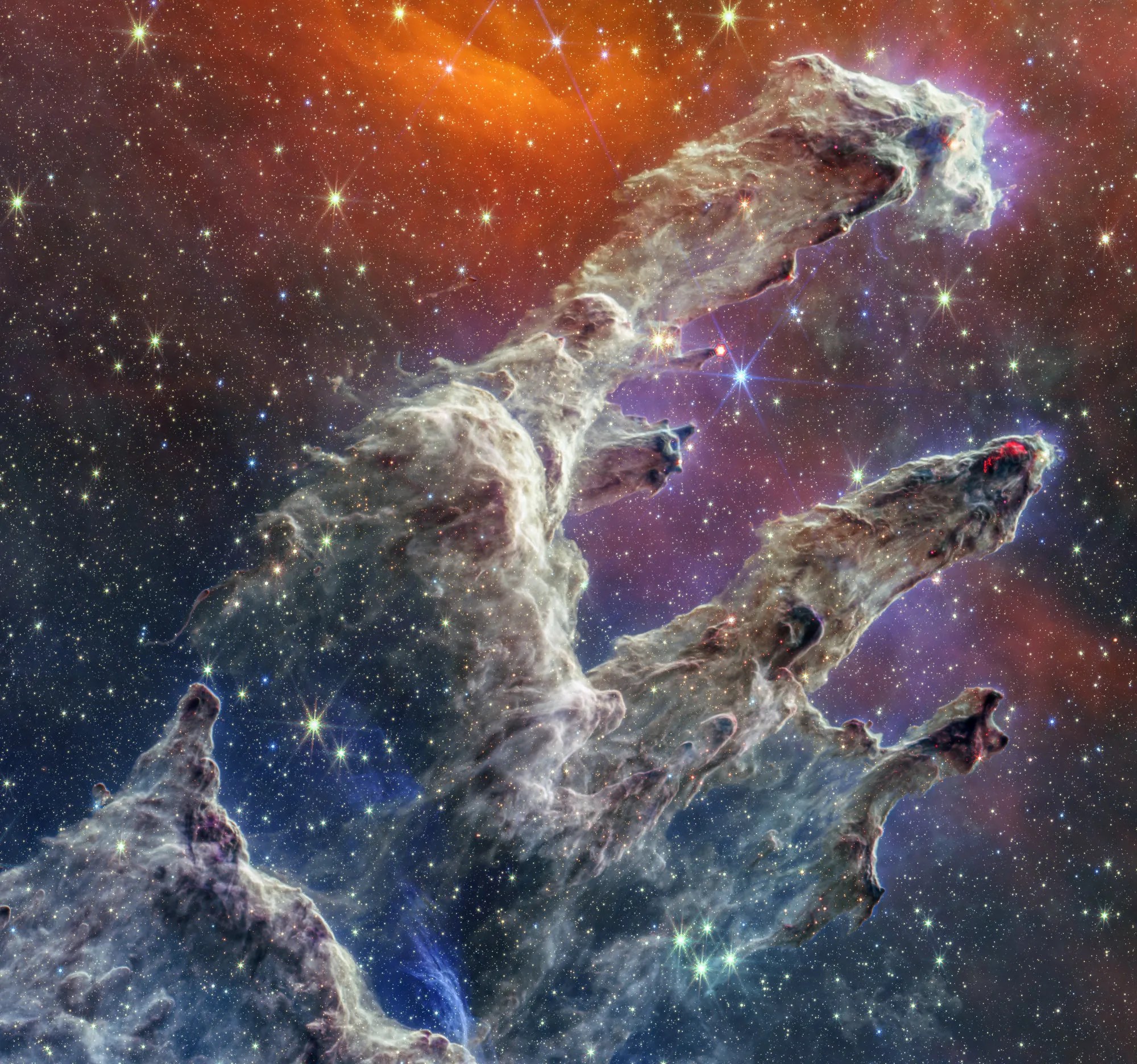
Image from the James Webb Telescope shows the early Universe with its uncombined elements in a swath that stretches across seven light years.
Teilhard was convinced that until theology fully embraced the concept
of an evolving universe, it would remain inadequate, crippled by its
outdated worldview. He wrote: “Who will at last give evolution its own
God?”
In the nearly seventy years since Teilhard’s death, science has taken
massive leaps of understanding, and theology is only beginning to catch
up. In From Teilhard to Omega (edited by Ilia Delio, Orbis Books,
Maryknoll, New York 2014), thirteen scholars take up Teilhard’s
challenge. This week, we look at “Sophia: Catalyst for Creative Union and Divine Love” by Kathleen Duffy, SSJ.
Though a dedicated scientist, Teilhard calls on his mystic and poetic
gifts to describe divine love at work in the cosmos. In his book
Writings in Time of War (translated by Rene Hague, London: Collins,
and New York: Harper & Row, 1968), Teilhard writes of a feminine
presence drawn from the wisdom literature of the Bible, particularly
the Book of Proverbs, (8: 22-31).
Teilhard’s poem opens at the beginning of time, at the moment when
Sophia is embedded into the primordial energy that is already
expanding into the space-time of the early universe. Only half formed
and still elusive, she emerges as from the mist, destined to grow in
beauty and grace (WTW, 192). As soon as the first traces of her
presence become apparent, she assumes her mandate to nurture
creation, to challenge it, to unify it, to beautify it, and ultimately to
lead the universe back to God. With this mission as her guide, she
attends to her work of transforming the world, a world alive with
potential. (Duffy p. 27)
Duffy reweaves Teilhard’s poem, working through its shining threads
new insights from science, wisdom literature and the work of many
“who have contemplated the divine creativity at work at the heart of
matter”. Duffy names the feminine presence in Teilhard’s poem
“Sophia”, from the Greek word for Wisdom.
“Who then is Sophia?” Duffy asks. Her magnificent response to this
question is worth the price of the whole book. Here are segments:
She is the presence of God poured out in self-giving love, closer to us
than we are to ourselves, ever arousing the soul to passion for the
Divine. From the very depths of matter, she reveals herself to us as
the … very nature of God residing within the core of the cosmic
landscape.
Attempting always to capture our attention, Sophia peers out at us
from behind the stars, overwhelms us with the radiance of a glorious
sunset, and caresses us with a gentle breeze…

Sunset at Stella Maris
Shining through the eyes of the ones we love, she sets our world ablaze.
Sophia is the mercy of God in us….She sits at the crossroads of our
lives, ever imploring us to work for peace, to engage in fruitful
dialogue, and to find new ways of connecting with the other. She longs
to open our eyes to the presence of pain and suffering in the world, to
transform our hearts and to move us to action. (pp. 31-32)
Duffy says that Teilhard experienced this presence “with nature, with
other persons, and with the Divine”:
He began gradually to recognize her everywhere — in the rocks that
he chiseled, in the seascapes and landscapes that he contemplated, and
in the faces of the dying soldiers to whom he ministered during the
war….Teilhard came to know Sophia as the cosmic Love that is holding
all things together. (p. 33)
Teilhard came to understand that Sophia can be known “only in
embodied human actions”.
Duffy concludes her illuminative essay with these words:
Sophia was the source of Teilhard’s life…. Her constant care for
creation during so many billions of years gave him confidence she would
continue to be faithful… Teilhard vowed to steep himself in the sea of
matter, to bathe in its fiery water, to plunge into Earth where it is
deepest and most violent, to struggle in its currents, and to drink of its
waters. Filled with impassioned love for Sophia, he dedicated himself
body and soul to the ongoing work needed to transform the cosmos to a
new level of consciousness and to transformative love. (p. 34)
That final sentence might serve as a calling to each of us.
 sophiawakens
Thanks Anne Kathleen for sharing Kathleen Duffy’s thoughts on Teilhard.
LikeLike
Stunning reflections, Anne Kathleen…Teilhard’s work is finally, finally opening out into this emerging world, and you are one of the best presenters of his thinking…
LikeLike