Member of Community of Grey Sisters of Pembroke; Masters Degree in Religious Communication, Loyola University, Chicago;
Author: Called to Egypt on the Back of the Wind (2013) Planted in the Sky (2006) both published by Borealis Press, Ottawa Canada www.borealispress.com
Retreat facilitator: The Wooing of the Soul (2013)
The Sophia Salons, beginning in February 2016, offer journeys to one's own inner wisdom for small groups of women. For information: amclaughlin@sympatico.ca
For several weeks, we have been companioned by the presence of Pierre Teilhard de Chardin through the inspired and inspiring writings of Kathleen Duffy (Teilhard’s Mysticism, Orbis Books, Maryknoll, New York, 2014).
This week we will see Teilhard through the eyes of someone who knew him, walked with him for a time, engaged in conversation with him, encountering his transformative view of reality. In her autobiography, A Mythic Life (Harper Collins, New York, 1996), Jean Houston gives us a perspective on Teilhard that is deeply personal and insightful. The great palaeontologist and mystic becomes for us, through Jean’s experience, a warm, enchanting, human presence.
At the time of their tumultuous first meeting in the early 1950’s, Teilhard was living in a Jesuit Residence in New York City, having been exiled from his native France, silenced, forbidden to write or to teach his advanced ideas about evolution.
Jean, a high school student, heartbroken over her parents’ impending divorce, had taken to running everywhere. Then, one day…
…on 84th Street and Park Avenue, I ran into an old man and knocked the wind out of him. This was serious. I was a great big overgrown girl, and he was a rather frail gentleman in his seventies. But he laughed as I helped him to his feet and asked me in French-accented speech,
“Are you planning to run like that for the rest of your life?”
“Yes, sir,” I replied, thinking of my unhappiness. “It sure looks that way.”
“Well, bon voyage!” he said.
“Bon voyage!” I answered and sped on my way. About a week later, I was walking down Park Avenue with my fox terrier, Champ,and again I met the old gentleman.
“Ah,” he greeted me, “my friend the runner, and with a fox terrier.I knew one like that many years ago in France. Where are you going?”
“Well, sir,” I replied, “I’m taking Champ to Central Park. I go there most afternoons to … think about things.”
“I will go with you sometimes,” he informed me. “I will take my constitutional.”
And thereafter, for about a year and a half, the old gentleman and I would meet and walk togetheras often as several times a week in Central Park.
He had a long French name but asked me to call him by the first part of it, which as far as I could make out was Mr. Tayer.The walks were magical and full of delight. Mr. Tayer seemed to have absolutely no self-consciousness, and he was always being carried away by wonder and astonishment over the simplest things.
He was constantly and literally falling into love. I remember one time he suddenly fell on his knees in Central Park,his long Gallic nose raking the ground, and exclaimed to me, “Jeanne, look at the caterpillar. Ahhhhh! ”
I joined him on the ground to see what had evoked so profound a response.
“How beautiful it is,” he remarked, “this little green being with its wonderful funny little feet. Exquisite!Little furry body, little green feet on the road to metamorphosis.”
He then regarded me with interest.“Jeanne, can you feel yourself to be a caterpillar?”
“Oh, yes,” I replied with the baleful knowing of a gangly, pimply-faced teenager.
“Then think of your own metamorphosis,” he suggested. “What will you be when you become a butterfly? Un papillon, eh?What is the butterfly of Jeanne?”
What a great question for a fourteen-year-old girl, a question for puberty rites, initiations into adulthood,and other new ways of being. His comic-tragic face nodded helpfully until I could answer.“I …don’t really know anymore, Mr. Tayer.”
“Yes, you do know. It is inside of you, like the butterfly is inside of the caterpillar.”
He then used a word that I heard for the first time, a word that became essential to my later work.“What is the entelechy of Jeanne? A great word, a Greek word, entelechy. It means the dynamic purpose that is coded in you.It is the entelechy of this acorn on the ground to be an oak tree. It is the entelechy of that baby over there to be grown-up human being.It is the entelechy of the caterpillar to undergo metamorphosis and become a butterfly. So what is the butterfly, the entelechy, of Jeanne?“You know, you really do.”
“Well… I think that…” I looked up at the clouds, and it seemed that I could see in them the shapes of many countries.
A fractal of my future emerged in the cumulus nimbus floating overhead.
“I think that I will travel all over the world and … and … help people find their en-tel-echy.”
Mr. Tayer seemed pleased. “Ah, Jeanne, look back at the clouds! God’s calligraphy in the sky! All that transforming, moving, changing, dissolving, becoming. “Jeanne, become a cloud and become all the forms that ever were.” (A Mythic Life, 141-3)
Years later, as Jean looked back on Teilhard’s effect on her life, as well as that of a few other such beings, she would write:
To be looked at by these people is to be gifted with the look that engenders.You feel yourself primed at the depths by such seeing. Something so tremendous and yet so subtle wakes up inside that you are able to release the defeats and denigrations of years.
If I were to describe it further, I would have to speak of unconditional love joined to a whimsical regarding of you as the cluttered house that hides the holy one.
(The Possible Human, 123, Jeremy P. Tarcher/Putnam, New York, 1982)
We have been travelling with Teilhard for several weeks, spiralling with his writings and wisdom, through the five circles that he visited over and over in his life, seeking wisdom.
From his childhood longing to find a substance that would last, through his growing awareness of a mysterious presence within all that exists on earth,through his explorations as a scientist into the secrets of energy, to his yearning to know the spirit within all of life, within himself, Teilhard spiralled to the deepest level where he encountered the presence of a love that would stay with him all his days.
What have we learned?
Do you, as I do, sense a desire to go back to the beginning? To revisit these explorations of Teilhard’s insights, longings and discoveries through which we have been expertly guided by Kathleen Duffy?
Might we on a second reading begin to grasp the sacred wonder, the unspeakable gift Teilhard has offered us through his life’s work?
I would like to propose something different by telling you of an unexpected “Teilhardian” experience I had a few days ago.
Here in the Valley of the Madawaska River, after days of slow emergence from a branch here and there of golden yellow, fiery orange and deep blood red, suddenly every deciduous tree around me exploded into full vibrant colour.
The day was warm and sunny. It might have been early summer, but for the absence of mosquitoes, black flies and high levels of sun-radiation.
I was walking in the nearby field delighting in the colours, camera at the ready, aimed high to catch the lofty golden crowns where they rested against the sky’s deep blue.
I was about to move on when I sensed something drawing me back. I lowered my gaze from tree tops towards the cluster of birches and lower trees to seek the source of this drawing. I found I was looking at a slender birch. As clearly as if it had a human voice, it was saying, “Look at me. Take my picture!” So I did.
one birch stands tall
What just happened? I wondered, as I continued on to the lake taking more photos. Now I ask that question again, dimly grasping that to take Teilhard at his word, we may acknowledge some mysterious presence of spirit in all that exists on our planet and in our universe.
Teilhard himself honoured the questions that arose, rather than demanding answers to every mystery, as Kathleen Duffy tells us in her final chapter:
Each branch of the spiral brought him into contact with new questions, questions that arose from life….Each time his knowledge of the physical world expanded, he found it necessary to reshape his understanding of the transcendent to the shape of the universe that was being revealed to him. He discovered that “truth …can be preserved only by being continually enlarged” (Writings in Time of War, 140). By engaging questions that were so intimate and by remaining faithful to his inner voice, he unearthed hidden mystical treasures as well as insights that have universal appeal. (Teilhard’s Mysticism, 126)
As I write this, a different question arises, as it has also arisen for others in my country, over these recent weeks of increasingly divisive, and at times aggressively hostile, political discourse as we prepare for next Monday’s Federal Election.
Where is all this coming from?
“By chance,” (if such a moment ever comes “by chance”) while I was reading this final chapter in Kathleen Duffy’s book, I came upon these words from Teilhard:
Let us look at the earth around us. What is happening under our eyes with the mass of peoples? What is the cause of this disorder in society, this uneasy agitation, these swelling waves, these whirling and mingling currents and these turbulent and formidable new impulses? Mankind is visibly passing through a crisis of growth. Mankind is becoming dimly aware of its shortcoming and its capacities…. It sees the universe growing luminous like the horizon just before sunrise. It has a sense of premonition and of expectation.(The Divine Milieu, 153)
Teilhard‘s earthly life ended on Easter Sunday, 1955. Where had his questing spirit brought him through a lifetime of seeking?
Kathleen Duffy responds in the closing paragraph of her luminous book: In the end, nothing was lost. Everything of value found a place in his unique synthesis. Everything held together in the light of the Cosmic Christ. Each insight represented a spiritual advance that led finally to a tangible awareness of the Divine Grasp…Teilhard’s inner music sustained him, his love for Earth nurtured him, his interactions with others supported him, and his love for God compelled him to remain faithful. It was fidelity to his questions that made it possible for him, near the end of his life, to say to his fellow Jesuit and good friend, Pierre Leroy, “I really feel that now I’m always living in God’s presence.” (Teilhard’s Mysticism, 126)
I wonder what advice Teilhard would give for our lives today on Planet Earth? These words of his might guide our way of experiencing life, looking deeply at what is, and asking the questions that arise in the depths of our being:
(People) of earth, steep yourself in the sea of matter, bathe in its fiery waters, for it is the source of your life and your youthfulness.
Purity does not lie in separation from, but in a deeper penetration into the universe. It is to be found in the love of that unique, boundless Essence which penetrates the inmost depths of all things and there, from within those depths, deeper than the mortal zone where individuals and multitudes struggle, works upon them and moulds them. Purity lies in a chaste contact with that which is “the same in all”.
‘Oh, the beauty of spirit as it rises up adorned with all the riches of the earth!
‘Bathe yourself in the ocean of matter; plunge into it where it is deepest and most violent; struggle in its currents and drink of its waters. For it cradled you long ago in your preconscious existence; and it is that ocean that will raise you up to God.’
(Pierre Teilhard de Chardin from The Hymn of the Universe, 1919)
The “piece of iron” of my first days has long been forgotten. In its place it is the Consistence of the Universe, in the form of Omega Point, that I now hold, concentrated …into one single indestructible centre, WHICH I CAN LOVE. (Pierre Teilhard de Chardin, The Heart of Matter, 39)
Teilhard describes his mystical journey as a spiral through which he moves into a deepening reality, visiting, revisiting, five circles that map his journey into the heart of matter and the heart of God (“The Mystical Milieu”, Writings in Time of War, 115-49).
We have already explored, with Kathleen Duffy as our travel guide (Teilhard’s Mysticism, Orbis Books, Maryknoll, New York, 2014), Teilhard’s Circles of Presence, Consistence, Energy and Spirit. Now at the deepest swirl of the spiral we come to his Circle of Person.
Seeking the elusive force that animates the cosmos, Teilhard stepped into the fifth circle, searching for its source. What image might assist?
Devotion to the Sacred Heart of Jesus had once allured him but now, as he sought a more universal image, the figure of Christ and the world began to meltbefore his eyes into a single vibrant surface (Hymn of the Universe, 42-43). Surrounded by a cosmic tapestry of intricately woven thread,Christ’s face shone with exquisite beauty.Trails of phosphorescence gushed forth and radiated outward toward infinity. “The entire universe was vibrant ” (HU, 43);the cosmos had acquired a nervous system, a circulatory system, a heart.Teilhard was consumed by the fire streaming from this universal center and resolved to go deeper (Teilhard’s Mysticism, 110).
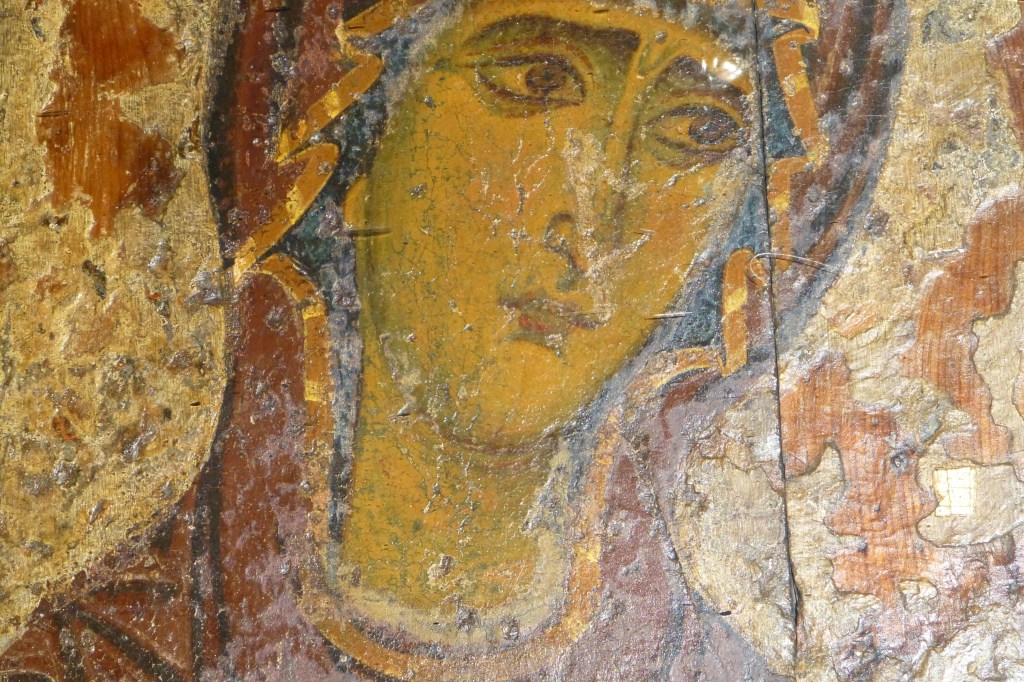
Stepping into the fifth circle, Teilhard encountered a shadowy figure, a feminine presence: The figure of Sophia emerged from the mists.
Icon of Sophia on a Church wall in Greece
She was radiant; her facial expression comforting. Teilhard recognized her as “the beauty running through the world….” (Writings in Time of War, 192)….
It is through her power, the power of love, that all things come together. Hidden within the very heart of matter,she ”bestirred the original mass, almost without form…and instilled even into the atoms…a vague but obstinate yearning to emerge from the solitude of their nothingness.”
She is “the bond that thus held together the foundations of the universe“ (W, 192-3),and she continually draws Earth into “passionate union” with the Divine. (W, 200)….
She is the raiment who is forming as she is being formed, continually creating the mystical milieu in which the forces of loveencourage all things to become one….The radiance from her countenance becomes brighter still when it shines out from the eyes of each human face….
The tenderness of her compassion and her holy charm aroused Teilhard’s passion for the Divine and sensitized his heart.He was enthralled with “the beauty of spirit as it rises up adorned with all the riches of the earth,” as it flows into the heart of the cosmos, toward its very center. He yearned to take hold of her, yet whenever he tried, he found that she eluded his grasp.
With great alacrity, he followed her lead as she guided him through the “luminous mist hanging over the abyss”and propelled him toward the heights into freedom. (Teilhard’s Mysticism, 110-111)
Teilhard brought the heart of a mystic, the eyes and sensibilities of a poet, the rigorous training of a scientist to his observations, his intuitions, his deep knowing so that his “vague intuition of universal unity became over time a rational and well-defined awareness of a presence…the presence of a radiant center that has all along been alluring the cosmos into deeper and deeper union…”(TM, 112)
Lured by the passionate love that this presence awakened within him, Teilhard experienced the universe “ablaze with the fire of divine love, suffused with the elements of a presence which beckons, summons and embraces” all of humanity, so that he was himself living “steeped in its burning layers” (Divine Milieu, 112).
Re- reading the letters of Saint Paul, Teilhard saw more clearly Christ’s evolutionary role: In “an explosion of dazzling flashes” (The Heart of Matter, 50),Cosmic Convergence coupled with Christic Emergence and became two phases of a single evolutionary movement.
The implosion caused by the coincidence of Christ with the Omega of the Universe releases “a light so intense that it transfigured…the very depths of the World” (HM, 82-3). All of the knowledge and love that Teilhard had for the universe was suddenlytransformed into knowledge and love for the God who is embedded within every fragment of matter (TM, 113).
Teilhard’s mysticism, now grounded in the Circle of Person, completed his synthesis. He was convinced that the universe would both continue to complexify, and become more centered in the Body of Christ until all would be one in Christ.
He now yearned to adore, which for him meant to “lose oneself in the unfathomable…to give of one’s deepest to that whose depth has no end” ( D, 127-8).
His desire was that all humanity might open their arms “to call down and welcome the Fire” as…” a single body and a single soul in charity” (Divine Milieu, 144).
“Drawn to follow the road of fire” (The Heart of Matter, 74) Teilhard “dedicated himself body and soul to the ongoing work needed to transform the cosmos to a new level of consciousness and of love” (TM, 116).
“The universe, as a whole, cannot ever be brought to a halt or turn back in the movement which draws it towards a greater degree of freedom and consciousness” (Pierre Teilhard de Chardin Christianity and Evolution, 109).
How did Teilhard move from examining rock layers to exploring the inner dynamics of the universe and of the human spirit?
How did he reach his conviction that matter is moving towards spirit, that everything is “driven, from its beginning, by an urge toward a little more freedom, a little more power, more truth?” (Writings in Time of War)
Kathleen Duffy writes that Teilhard “began by plumbing the depths of his own being, plunging into the current that was his life so that he could chart the development of his person from the very beginning. He wanted to see whether, and if so, how, the principle of Creative Union was operating in his own cosmic story.” (Teilhard’s Mysticism, 83)
Teilhard himself tells us of that inner journey:
And so, for the first time in my life…I took the lamp and, leaving the zone of everyday occupations and relationships where everything seems clear, I went down into my inmost self, to the deep abyss whence I feel dimly that my power of action emanates. But as I moved further and further away from the conventional certainties by which social life is superficially illuminated, I became aware that I was losing contact with myself. At each step of the descent a new person was disclosed within me of whose name I was no longer sure, and who no longer obeyed me. And when I had to stop my exploration because the path faded from beneath my steps, I found a bottomless abyss at my feet, and out of it came — arising I know not from where – the current that I dare to call my life. (Divine Milieu 76-77)
artwork by Mary Southard, CSJ
On this deep inner journey, Teilhard felt “the distress characteristic to a particle adrift in the universe” (DM, 78).
Kathleen Duffy describes his experience: The immensity and grandeur of the universe overwhelmed him. As he descended back through the eons of time, the landscape became less and less familiar; patterns came and went at random and then disappeared. Finally, near the beginning of time, all cosmic structure dissolved into a sea of elementary particles. Troubled, at first, by the apparent lack of unity, Teilhard reversed his direction, exploring instead the cosmic becoming. As he moved forward through time, he watched elementary particles fuse into fragile streams. Amazed by how these streams continued to coalesce, he focused on those that would eventually form his own current, noting the way they converged. Extending “from the initial starting point of the cosmic processes…to the meeting of my parents” (Writings in Time of War, 228), rivulets were growing in strength and beauty. As time progressed, they came alive – they began cascading in torrents, swirling in eddies, pulsating with life and with spiritual power. Teilhard could feel the energy of life gushing from his core. (Teilhard’s Mysticism, 84)
From this mythic/mystical inner journey through his own being Teilhard began to trace the evolution of spirit within matter.
It became clear to him that “a certain mass of elementary consciousness becomes imprisoned in terrestrial matter at the beginning” (Human Phenomenon, 37).
Contemplating the first cells bubbling up from the ocean floor, Teilhard was aware of more than the evolution of matter; he realized that he was also witnessing the evolution of spirit…. The more complex matter becomes, the more capable it is of embodying a more developed consciousness or spirit (TM 87).
We hear an excitement in Teilhard’s words as he sees the implications of this: And here is the lightning flash that illuminates the biosphere to its depth …. Everything is in motion, everything is raising itself, organizing itself in a single direction, which is that of the greatest consciousness (The Vision of the Past, 72).
Seeing the evolutionary process moving in this way, Teilhard is assured that: The universe as a whole, cannot ever be brought to a halt or turn back in the movement which draws it towards a greater degree of freedom and consciousness (Christianity and Evolution, 109).
If we also feel that “lightning flash”, that stirring of excitement and promise, how will our everyday lives change?
For starters, we must free ourselves from that tangle of despair and helpless that ensnares us when we look only at the challenges (immense and awe –inspiring as they are), and free up our energies to look at the 14.8 billion years of evolution that have brought us to this threshold.
We may trust that we are made for these times, that we have evolved to face this crisis, that we have all that we require to do what is demanded of us.
For why else was Teilhard sent to us as a guide in this moment in human history?
The internal face of the world comes to light and reflects upon itself in the very depths of our human consciousness. Pierre Teilhard de Chardin
We continue our spiral journey, guided by Kathleen Duffy, (Teilhard’s Mysticism, Orbis Books, Maryknoll, New York, 2014) through Teilhard’s Circles of Presence, Consistence and Energy towards his discoveries in the Circle of Spirit. As I begin today’s Reflection, lured by Teilhard’s vision for our planet, his hope for the spiritualization of consciousness, I hear another voice that breaks through: the voice of teenager Greta Thunberg who crossed the Atlantic Ocean on a boat without the aid of fossil fuels to address World Leaders at the UN yesterday.
16-year-old Swedish Climate activist Greta Thunberg speaks at the 2019 United Nations Climate Action Summit at U.N. headquarters in New York City, New York, U.S., September 23, 2019. REUTERS/Carlo Allegri – HP1EF9N1AIFX9
Her words to us: “HOW DARE YOU?” weave themselves through Teilhard’s words as counterpoint, a drumbeat, a call to action, a reminder of how little we have advanced on the path that Teilhard showed us. There was anguish on her face, passion in her words, a tone of despair as she cried out, “This is all wrong. I should not be here. I should be back in school on the other side of the ocean.”
“People are suffering. People are dying. Entire ecosystems are collapsing. We are in the beginning of a mass extinction. And all you can talk about is money and fairytales of eternal economic growth. How dare you!”Greta Thunberg
Asking why governments have failed to act on thirty years of scientific evidence that show the earth hurtling towards disaster, Greta expressed her inability to believe those who claim they understand the crisis. If you have truly understood, she told the assembly, and yet have not acted, “then you are evil”, and that she refuses to believe.
With Greta’s words still echoing, I begin, not with Teilhard’s own journey through the darkness of feeling himself like “a particle adrift in the universe”, before he became aware of the consiousness within matter, but instead with the ending of Kathleen Duffy’s Chapter on “The Circle of Spirit” . Here I find hope strong enough to support this NOW moment in our planetary story, a moment for which Teilhard intended to prepare us.
Inspired by Kathleen Duffy’s research into Teilhard’s thought, I would like to suggest what he might have said to young Greta had they walked together in Central Park.
“Greta,” (I hear Teilhard say) “you showed great courage in your words today to the UN. You challenged the pretence of understanding as well as the despair that leads to paralysis by demanding that if the leaders understand the crisis, they must act. You told them they must not look to young people for hope because this is now their own task, their Great Work. You have shown them the face of courage, matched with deeds, by crossing the ocean on a long journey unaided by fossil fuels.
“I believe firmly that nothing is more dangerous for the world than resignation and false realism. Though you are deeply distressed, you have chosen courageous action over despair. Know this, Greta; the Universe is drifting towards spirit in a forward movement that cannot ever be stopped. It is moving towards greater freedom and consciousness.
“The Internet, a technology I glimpsed in my lifetime, has allowed people around the planet to hear your words, even to watch your expression, your eyes, as you spoke yesterday. And yet not only your words, but your deep passion, your challenge, have entered the hearts of those who listened, and have entered the noosphere, a weaving of soul I imagined that gently wraps itself around the planet, its golden threads of spirit, its crimson threads of matter, intricately entwined. You, my dear brave Greta, are a weaver in the noosphere.
“The noosphere is conscious of itself, capable of collaboration, of spiritual relationship, and of sympathy, and thus of counteracting the dissolution brought on by individualization …though it is a fragile envelope, because of its capacity for relationship, it can overcome the tendency to fragmentation. I see it as the sphere of the conscious unity of souls…. I would call it “the Soul of the Earth”. You yourself are living the same vision, a young woman who understands that it is the capacity for relationship, for union, that brings about growth, that must be our greatest source of hope.
“Moving from the individual to the collective is the most crucial challenge facing human energy. For the work can be done only if humanity participates in the forward movement and each person can be saved only by becoming one with the universe.
“My dear Greta, may you keep a zest for life, a passion for the whole and above all a flame of expectation for the awakening of full human potential. Only faith in the future will give us the motivation and the energy to overcome the obstacles to unity. We shall direct our energy to the creativity required to live the dream of the future.
“Keep developing a deep sense of yourself, Greta, the true self that allowed you to speak truth to power before the United Nations, unshaken by applause or criticism or any need for adulation. In your growth, be free to move beyond all boundaries, all structures and strictures that no longer serve the Great Work. Be like the cosmos as you continually develop new forms. I so look forward to what you shall become Greta, and to what you will achieve with your passion as you weave with the noosphere.
“And trust me in this, Greta, for I have passed through great darkness to come into the light that does not grow dim. Earth’s story is not ended. The Universe is not yet finished. Earth is moving towards wholeness, her people towards oneness.”
In gratitude to Kathleen Duffy for her own great work in bringing the essence of Teilhard’s spirit to us, I close with her words:
As co-creators in the ongoing evolution of life and spirit, the future of the cosmos depends on the choices that we make, the effort that we exert, the work that we do….The Great Work consists in providing impetus for the transformation into greater consciousness, promoting the cultural transition through which we as a species are slowly moving, fostering the next major phase transition in human history. It calls us to assess our impact, to take responsibility for our actions, and to forward the cosmic project in the direction of spirit. (TM 97, 106)
Kathleen Duffy’s exploration of Teilhard’s Circle of Energy (Teilhard’s Mysticism, Orbis Books Maryknoll, NY 2014) shows the uniqueness of his mystic path.
Rather than fleeing the earth, Teilhard seeks the sacred in the deep heart of life on Earth in all its wonder and terror, and in the fiery depths of the cosmos, as it cycles through destruction and rebirth.
Touched by the intricate and beautiful structure of the cosmos and yearning to be possessed by the Sacred Presence that fills it…Teilhard continued his mystical journey, ever searching for the supreme tangible reality. As he stepped into the third circle, he found the cosmos ablaze with activity. The Divine Presence that had been alluring him had suddenly acquired a new aspect—Energy. (TM 55)
Teilhard was stirred by the evolutionary story, a story whose creativity and energy were shown to him in the layers of rock, in the depths of the earth, as he worked as a geologist and paleontologist. Enthralled by the emergence of living organic matter from inorganic, Teilhard writes:
See how (Earth’s) shades are changing. From age to age its colors intensify.Something is going to burst out on the juvenile Earth. Life! See it is life!” (The Human Phenomenon, 38, translation Sara Appleton-Weber, Portland OR: Sussex Academic Press, 1999)
Teilhard imaged evolution as a tapestry whose threads revealed “the amazing energy at work at the heart of the cosmos” (TM 59).
He describes this tapestry as: endless and untearable, so closely woven in one piece that there is not one single knot in it that does not depend upon the whole fabric (Science and Christ, 79, trans. Rene Hague New York, Harper and Row, 1968).
Teilhard saw that since the beginning of time complex structures have been emerging from the union of simpler ones: “a thrust towards union seems to be coded into the very fabric of the cosmos” (TM 60).
As his awareness of the complexity and interconnectedness of the Universe deepened, Teilhard could see that these qualities lead to understanding our global life:
…No elemental thread in the universe is wholly independent…of its neighboring threads (The Future of Man, 87, trans. Norman Denny, New York: Harper and Row, 1964). For just as the simplest vibration of a single cosmic tapestry thread affects the whole fabric, so local interactions can be felt on a global scale (TM, 70).
Teilhard came to know the importance of considering the whole in order to grasp the order that lies under the appearance of disorder.
He intuitively understood that “deep down there is in the substance of the cosmos a primordial disposition …for self-arrangement and self-involution” (Heart of Matter, 33).
Yet Teilhard knew in his life what today’s scientists continue to explore: the “transition region between the two extremes of ordered stability and chaotic instability called the edge of chaos” (TM 73). In the trenches of World War 1, the horror in which he was immersed still allowed for “feelings of freedom, unanimity, and exhilaration” (TM 75).
Because he understood that “the self-organization of the world progresses only by dint of countless attempts to grope its way” (Christianity and Evolution, 187, trans Rene Hague, New York: Harcourt Brace Jovanovich, 1969), Teilhard saw the mystic must also “test every barrier, try every path, plumb every abyss” (The Divine Milieu, 70, New York, Harper and Row, 1960).
Moving through the Circle of Energy, Teilhard became aware of the universe as “alive, vibrant, filled with Divine Energy and solidly enduring….undergoing a cosmogenesis…slowly moving it toward greater complexity and deeper union” (TM, 75).
This deep knowing led Teilhard to see his own sufferings as part of the larger story: Putting his personal suffering into a cosmic perspective, he turned his attention to the pain and suffering that pervades the evolutionary story, a story that is rife with misfortune, struggle, disease, and death: natural disasters beset Earth on every side; predators prey on more vulnerable species;changing environmental conditions cause many species to become extinct; within the human community, war and oppression continue to rage.It is not only humans who suffer. Every part of the cosmos bears the scars of the chaos and tragedy that accompany the evolutionary process (TM, 76-7).
Within the cosmic story, Teilhard’s mystic path would become one of uniting with “the Divine Fire at work at the heart of matter” (TM 78)
Earth’s story had shown Teilhard that the Divine is continuing to shape the universe and therefore human action may “channel … the whole of the World’s drive towards the Beautiful and the Good” (Heart of Matter, 204).
Seeing the “sacred duty” of working with Divine Energy, Teilhard vowed: “I shall work together with your action…. to your deep inspiration… I shall respond by taking great care never to stifle nor distort nor waste my power to love and to do” (The Divine Milieu, 79).
In a letter written to a friend during his work as a geologist, Teilhard describes a moment of mystic knowing:
… this contact with the real does me good. And then, amid the complexity and immobility of the rocks, there rise suddenly toward me “gusts of being,”sudden and brief fits of awareness of the laborious unification of things, and it is no longer myself thinking, but the Earth acting. It is infinitely better (Letters to Two Friends 1926-1952, 73, translated by Helen Weaver, edited by Ruth Nanda Anshen, New York: New American Library, 1967).
Teilhard’s mystic path led him to the heart of the earth:
He was convinced that he must steep himself in the sea of matter, bathe in its fiery water,plunge into Earth where it is deepest and most violent, struggle in its currents, and drink of its waters. Earth was the source of his life:through the world Divine Energy enveloped him, penetrated him, and created him. Because Earth had cradled him long ago in his preconscious existence, he knew that the Earth would now raise him up to God. (TM 80-1)
Everywhere there are traces of, and a yearning for,
a unique support, a unique and absolute soul,
a unique reality in which other realities are brought together in synthesis,
as stable and universal as matter, as simple as spirit.
Pierre Teilhard de Chardin Writings in Time of War (translated by Rene Hague, New York, Harper and Row, 1968)
a unique and absolute soul … in which other realities are brought together in synthesis
Teilhard’s Life Journey spiralled through five circles. We have glimpsed his discoveries in the Circle of Presence where the loveliness of earth lured and enchanted him. Guided by Kathleen Duffy through her book Teilhard’s Mysticism (Orbis Books, Maryknoll, NY 2014), we now explore Teilhard’s search in the Circle of Consistence where “he focused not only on the beauty of nature but also on the properties and structure of the cosmos as a whole “(39).
Pierre is four years old, living in a family deeply grieving the loss of a child, his sibling.His mother is cutting his hair, tossing the shorn locks into the fire.Before his eyes, the boy sees part of himself vanish.
In such moments a life’s work may begin. For Teilhard, it began with a search for what can last… He began to collect bits of iron, until rust betrayed his trust in metal. Walking with his father over the hills of the Auvergne near his home, he found something that would endure. He fell in love with rocks.
Duffy writes that “his choice to abandon his collection of iron scraps for rock was fortunate since it led him from mere rock collection to the study of the Earth’s crust and eventually expanded his thinking to the planetary scale”(40).
Later in life, Teilhard would reflect: It was precisely through the gateway that the substitution of Quartz for Iron opened for my groping mind into the vast structures of the Planet and of Nature, that I began, without realizing it, truly to make my way into the World—until nothing could satisfy me that was not on the scale of the universal”. (The Heart of Matter)
Teilhard was seeking “an ultimate Element in which all things find their definitive consistence“(Teilhard’s Mysticism, 40). Though field work in geology and palaeontology in China, Africa and North America allowed him to enter Earth’s body, his brief time studying physics opened his wondering eyes to the cosmos. Still asking What holds everything together? Teilhard wondered if the answer was gravity.
Duffy notes that “throughout his journey along the Circle of Consistence, Teilhard focused his attention on matter in all of its intricacy without much consideration of spirit….The Divine Presence in which he felt himself bathed seemed to be not some vague spiritual entity, but rather, a supreme tangible reality”( 41).
Observing unity and interconnectedness within matter, Teilhard wrote: “The further and deeper we penetrate into matter with our increasingly powerful methods, the more dumbfounded we are by the interconnection of its parts”. (The Human Phenomenon)
Over time Teilhard would reconcile his childhood abhorrence for what perishes with his love for the strength and beauty that he found in what cannot last: This crumbling away, which is the mark of the corruptible and the precarious, is to be seen everywhere. And yet everywhere there are traces of, and a yearning for…a unique and absolute soul. (Writings in Time of War)
Teilhard came to “distinguish in the Universe a profound, essential Unity, a unity burdened with imperfections…but a real unity within which every ‘chosen’ substance gains increasing solidity”. (Teilhard’s Mysticism, 53)
Spiralling through the Circle of Consistence, experiencing the cosmic structure as “intimate, intricate and profound”, seeing himself as ”part of an interdependent and interconnected reality, sharing the one life that is in everything”, Teilhard realized that a search for consistency in what is visible would ever disappoint him.
Now at last he began to see: the very consistency of the World …welling up …like sap, through every fibre… leaping up like a flame .(The Heart of Matter)
Duffy’s conclusion to her chapter on the Circle of Consistence pulses with life and beauty, drawn in part from Teilhard’s Writings in Time of War (W):
Divine Presence, so powerfully real to him as he traveled along the first circle, had acquired a new power for him. At the very heart of matter, Divine Consistence was, by its very presence, holding all things together. Once he became aware of “the unifying influence of the universal Presence” (W, 124), he was no longer distressed by the mutability of things: “Beneath what is temporal and plural, the mystic can see only the unique Reality which is the support common to all substances, and which clothes and dyes itself in all the universe’s countless shades without sharing their impermanence”. (W, 125) He knew that Divine Consistence is trustworthy (W, 123):
“Having come face to face with a universal and enduring reality to which one can attach those fragmentary moments of happiness that…excite the heart without satisfying it” (W, 124), ”a glorious, unsuspected feeling of joy invaded my soul” (W,126).
He longed to surrender, to drive his roots into matter so that he could become united with Ultimate Reality. (Teilhard’s Mysticism, 54)
Universe became apparent to me as a great rising surge,
in which all the work that goes into serious enquiry,
all the will to create, all the acceptance of suffering,
converge ahead into a single dazzling spear-head –
now, at the end of my life,
I can stand on the peak I have scaled and continue
to look ever more closely into the future,
and there, with ever more assurance,
see the ascent of God.
Pierre Teilhard de Chardin, The Heart of Matter, 52
Teilhard’s life journey along the mystic path was not for himself alone. His writings, published only after his death, are a gift to us. They are a travel guide of such depth and wisdom that even in our own complex, sometimes terrifying, often mystifying reality, his footsteps shed a light that we may follow into a future filled with hope.
For this exploration of his climb to the peak where he could “look ever more closely into the future”, I rely on the July 2019 retreat experience led by Kathleen Duffy, SSJ and her book, Teilhard’s Mysticism (Orbis Books, Maryknoll, New York, 2014).
Teilhard left us a road map, a set of five circles, stages of his mystical growth.
These circles, which are more properly imaged as loops of a spiral that he revisits throughout his life, provided him with steeping stones into an ever-deepening reality, a reality informed as much by the science of his time as by his religious tradition. They plot his growth and development as he sinks ever more deeply into the heart of matter and into the heart of God….Stepping with him through each of these circles…we come to understand ….how we too can be drawn more and more deeply into that privileged point where the depths of our hearts and the heart of the cosmos converge with the heart of God. (Kathleen Duffy, Teilhard’s Mysticism 4, 5)
Of the first of these spiralling loops, the Circle of Presence, Teilhard writes: There were moments, indeed, when it seemed to me that a sort of universal being was about to take shape suddenly in Nature before my very eyes. (The Heart of Matter, 26)
Duffy tells us that “something as simple as a song, a sunbeam, a fragrance, or a glance would pierce his heart and heighten his awareness of an unexplained presence.” (23) These encounters with beauty in sensations elicited by encounters with nature, with music, with persons, drew from Teilhard a wonder and a joy that illumined his life. At times they occurred in settings that hardly seem the stuff of poetry. In the midst of a long, arduous voyage to China, he wrote to his beloved cousin Marguerite:
Yesterday I could never tire of looking to the east where the sea was uniformly milky and green, with an opalescence that was still not transparent, lighter than the background of the sky. Suddenly on the horizon a thin diffuse cloud became tinged with pink; and then with the little oily ripples of the ocean still open on one side and turning to lilac on the other, the whole sea looked for a few seconds like watered silk. Then the light was gone and the stars began to be reflected around us as peacefully as in the water of a quiet pool.(Letter cited in Teilhard’s Mysticism, 25-6)
While serving as a stretcher bearer in the First World War, Teilhard “…had occasion to look into the eyes of many a dying soldier. Just before the moment of death, a strange light would often appear in a soldier’s eyes. Teilhard was never sure whether the eyes were filled with “unspeakable agony or…with an excess of triumphant joy” (HM 65). Each time the light went out and the wounded soldier died, Teilhard was overcome with deep sense of sadness. (Teilhard’s Mysticism 34-35)
Teilhard discovered light in other eyes when he came to know his cousin Marguerite as a kindred spirit with whom he could share the depths of his own soul. “A light glows for a moment in the depths of the eyes I love….under the glance that fell upon me, the shell in which my heart slumbered, burst open”. (Writings in Time of War, 117-8)
Of Teilhard’s relationship with Marguerite, Duffy writes: A new energy emerged from within, causing him to feel as vast and as rich as the universe. Marguerite had awakened the feminine aspect of his being. His love for her drew him out of himself, sensitized him, and stimulated his capacity for deeper and more intimate relationships. (Teilhard’s Mysticism 34)
Teilhard tells us that his encounters with beauty in the Circle of Presence, “drew me out of myself, into a wider harmony than that which delights the senses, into an ever richer and more spiritual rhythm” (Writings in Time of War, 117).
Duffy comments: Having invaded his being and penetrated to its core, having pierced through to his depths, Beauty drew him into that single privileged point where Divine Presence exists equally everywhere, and where all diversities and all impurities yearn to melt away.(36)
photo credit: Brenda Peddigrew
Teilhard saw that underlying Earth’s surface charms a vivid Presence lies hidden within and penetrates all things. This was the only source that could give him light and the only air that he could ever breathe (Writings in Time of War, 123). He yearned to sharpen his sensibilities so that he could see ever more deeply into the heart of matter. Along the first circle, the palpable world had truly become for him a holy place, a divine milieu, permeated with a vast, formidable, and charming presence. (Teilhard’s Mysticism 38)
Teilhard understood that the duty of a mystic is to be aware of the inner rhythm of the universe, and to listen with care for the heartbeat of a higher reality…. At this privileged place, he tells us, “the least of our desires and efforts…can…cause the marrow of the universe to vibrate.” (Teilhard’s Mysticism 32)
As Teilhard wrote in Human Energy: Indeed we are called by the music of the universe to reply, each with his own pure and incommunicable harmonic. (HE, 150 in Teilhard’s Mysticism 38)
Five sun-soaked, star-speckled days walking, listening, speaking, learning, even dreaming of a sacred- earth centered spirituality, inspired by the writings of Teilhard de Chardin have filled my writer’s quiver with fresh insights into the mystic path for our time. Kathleen Duffy, SSJ, brought her own love for Teilhard, her years of deep pondering on his life and writings, to Jericho House in Ontario’s Niagara Region from July 24-29, 2019, in her Retreat on “Teilhard’s Mysticism”.
Teilhard de Chardin, Jesuit priest, palaeontologist, mystic, France 1881-1955
Wondering how I might share this experience with you, I was drawn back to the words of theologian Margaret Brennan, IHM:
Mystics are people who come in touch
with the sacred source of who they really are and are able to realize and
experience that in their lives.
Teilhard’s life path led him to the sacred source not only of
himself but of the entire Universe. Beginning with his childhood enchantment
with rocks, through his work delving into the depths of the earth as a
palaeontologist in China, and, while he volunteered as a stretcher bearer in
the First World War, through watching the light that briefly illumined the eyes
of a dying soldier, Teilhard grew into knowing a divine presence at the heart
of all that exists. He wrote:
During my life, as a
result of my entire life, the world gradually caught fire for me and burst into
flames until it formed a great luminous mass lit from within.
The Diaphany of the
Divine at the heart of a glowing Universe, as I have experienced it through
contact with Earth – the Divine radiating from blazing Matter: this it is that
I shall try to disclose and communicate. (The Divine Milieu, translated by Bernard Wall, New York,
Harper and Row, Publishers, 1960)
During my life, as a result of my entire life, the world gradually caught fire for me and burst into flames until it formed a great luminous mass lit from within. (Teilhard de Chardin).
Thinking back to Kathleen Duffy’s unfolding of Teilhard’s story, I see in that quote above the significance of the word: “gradually”. Mystics are not born that way! And for Teilhard the path was truly a “long and winding road”.
I was touched by his struggles as a young Jesuit novice reading the book The Imitation of Christ by the fifteenth-century writer Thomas a Kempis. That spiritual handbook counselled that one must love ONLY Christ. Teilhard feared that his great love for the natural world would draw him away from his love for the Christ. His life experiences would gradually bring those two loves into a deep harmony so that he could finally write with deep joy:
Now Earth can certainly
clasp me in her giant arms. She can swell me with her life or take me back into
her dust. She can deck herself out for me with every charm, with every horror,
with every mystery. She can intoxicate me with her perfume of tangibility and
unity. She can cast me to my knees in expectation of what is maturing in her
breast. But her enchantments can no longer do me harm, since she has become for
me, over and above herself, the body of him who is and of him who is coming. (The Divine Milieu)
Of all that
I learned of Teilhard during Kathleen Duffy’s Retreat, this revelation of his
personal struggle and its resolution is what stirred me most. It reveals
Teilhard as a mystic not only OF our
time but FOR our time. He recognized
the allurement of the Universe for the people of our time:
The great temptation of
this century is (and will increasingly be) that we find the World of nature, of
life, and of humankind greater, closer, more mysterious, more alive than the
God of Scripture. (The Heart of Matter, translated
by Rene Hague, New York, Harcourt Brace Jovanovich, Inc., 1978)
Sun-blessed path through the woods at Jericho House
Yet that allurement was what he saw as most needed for spiritual healing: Our age seems primarily to need a rejuvenation of supernatural forces, to be effected by driving roots deep into the nutritious energies of the Earth. Because it is not sufficiently moved by a truly human compassion, because it is not exalted by a sufficiently passionate admiration of the Universe, our religion is becoming enfeebled…(Writings in Time of War translated by Rene Hague, New York, Harper and Rowe, Publishers, 1968)
Teilhard looked at the earth with the eyes of a mystic, with the heart of a lover. Finding the Holy Presence at the deep heart of all that exists, he could echo Rumi’s wonder-filled exclamation: “Is the one I love everywhere?”
Through
Teilhard’s eyes, we can learn to see what mystic-poet Catherine de Vinck calls
“the fire within the fire of all things”. Once we see that fire, we know the
call that Teilhard knew to put our hearts at the service of the evolution
towards love that is the call of the Universe, as well as our personal call
within the universal call, for the two are inseparable.
Teilhard
shows us that our deepest call is to love, that evolution is advanced by union
on every imaginable level of being. And, as another poet, Robert Frost observed:
Earth’s the right place for love: I don’t know where it’s likely to go better.
Nothing that lives on our planet is outside of us. We can no longer accept lines of division between religions, between cultures, between nations, between species. This Universe is evolving as one.
Our place within it, like Teilhard’s, is to be its eyes of wonder, its heart of love, its allurement toward union. In co-creative partnership with the Love at its heart, everything that we do contributes towards that great comingled work of the evolution of the Universe, the evolution of ourselves.
This article was prepared for the Winter 2014 issue of LCWR Occasional Papers, published by The Leadership Conference of Women Religious, Silver Spring, MD, USA. It is reprinted with permission from the editor, Annmarie Sanders, IHM and the author, Kathleen Duffy, SSJ.
Although science continues to astound us with ever more detail about the cosmic story, we often miss its inner spiritual dimension. Cosmic processes happen slowly by our standards, making the emergence of novelty difficult to imagine. Despite the beauty of the story, we are often left wondering how to relate what we are learning about the cosmos to our daily lives, to the mission of our congregations and to the life of the world. Yet mystics who have contemplated Earth processes and spent time in intimate contact with Earth have been able to sense a parallel spiritual energy operating at the heart of matter.
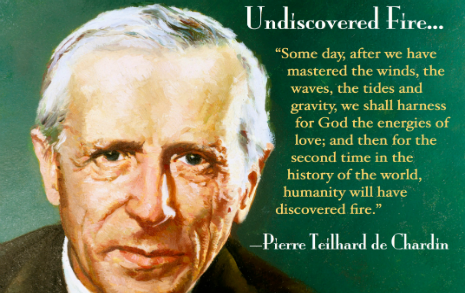
Pierre Teilhard de Chardin
While searching for fossils, Pierre Teilhard de Chardin was often overwhelmed by the spiritual power at work within earth’s rocky layers. Within Earth’s crust, he was able not only to read Earth’s amazing story but also to sense the Divine Presence at the very heart of matter, a personal Presence that kept him aware of the mystery of the world around him and sustained him in his vocation.
Thomas
Merton suggests that the art of seeing the inner dimension of things requires a
spark of religious imagination: “Our faith ought to be capable of filling our
hearts with a wonder and a wisdom which see beyond the surface of things and
events, and grasp something of the inner… meaning of the cosmos which, in all
its movements and all its aspects, sings the praises of its Creator.” (2) Since
metaphor carries with it a raft of nuances and associations and provides
connections between entities that otherwise seem paradoxical, mystics often
rely on poetic expression to describe experiences that are unspeakable. For
Teilhard and Merton, contemplation of Sophia, the wisdom of God so beautifully
portrayed in scripture, integrated the beauty and power of the outer world with
the beauty and power that reside within. (3) Sophia became a powerful personal
image of God, one that suggests ways to co-operate with Divine Energy.
According to scripture, Sophia is the “breath of the power of God, a pure emanation of the glory of the Almighty… a reflection of eternal light, a spotless mirror of the working of God and an image of (God’s) goodness.” (Wisdom 7:25-27)
(Sophia) is the dynamic wisdom and life force…infused into every elementary particle…
She is the dynamic wisdom and life force that has been infused into every elementary particle from the beginning, the presence of God poured out in self-giving love. She is closer to us than we are to ourselves, ever arousing us to passion for the Divine. From the heart of matter, she gazes at us lovingly, urging us always towards greater union and deeper love
From the
very beginning, when she first became immersed in the fiery plasma, she has
been catalyzing a process that Teilhard calls Creative Union, a process that
encourages union at every level of the cosmos, a process that creates novelty,
beauty, and eventually, the ultimate form of union which is love. She begins by
instilling into the protons a desire to become more. She urges them to open to
the other, to overcome their resistance, to let down their repulsive
barriers. And when they do, they are
transformed by the process of fusion into something greater than themselves
without ever losing their identity. Their courageous response prepares the way
for ever more diversity. Because fusion, like so many creative processes, is
violent, Sophia remains close at hand to motivate the protons to persist
despite inherent difficulties.
Encouraged
by the fruitfulness of her initial attempt to foster union, Sophia searches for
more ways to carry out her mission. Protons fuse, atoms form, then simple
molecules. Sophia thrills to see the amazing variety developing as matter responds
to her call for unification. Soon, her creative efforts become pervasive. She
gathers in clumps the gas and dust scattered throughout space and whirls them
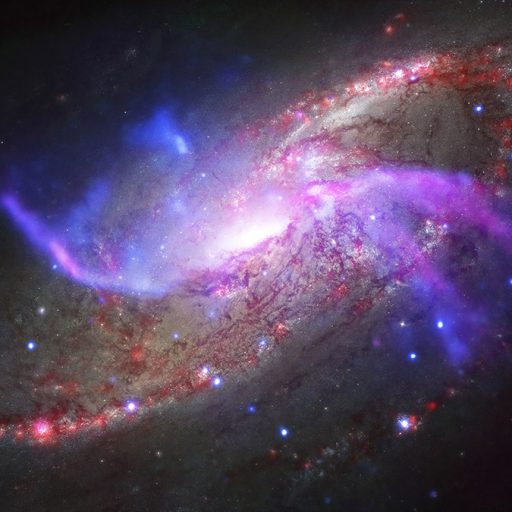
in spirals. Eventually, the newly-formed galaxies are ablaze with the
brilliance of star light. Satisfied that stars have learned to produce new
elements, she moves on to the newly-forming planets to begin her next project.
life appears on planet Earth
After years of Sophia’s urging, life appears on planet Earth. Organisms take advantage of their potential for creativity by adapting to their changing environments and evolving into more and more conscious forms. Earth comes alive in a pattern of constant change. The brilliant greens of plant life, the delicate hues of flowers, and the graceful movements of animals are evidence for Sophia that her mission of Creative Union is being fulfilled. However, like the protons that struggle in their innate repulsion for other protons as they participate in the unification process, new life forms often find survival difficult. Crises such as earthquakes, volcanoes, and the bombardment of Earth by asteroids cause incredible changes in Earth’s environment making it difficult for some of them to adapt. However, under Sophia’s loving guidance, the extinction of some species often allows other species to flourish.
The
emergence of human life is a special moment for Sophia. We are able to
recognize her face and respond more fully to her impulses and her love. We
appreciate her handiwork and delight in her beauty. Through the ages she has
been with us as our inspiration and as the driving force of our developing
consciousness.
Sophia is “the fullness of participation in the life of God.”(4) To be aware of her presence, to experience her gracious smile, is to know that we are loved. When we are discouraged, she consoles us. When we encounter her, we are energized. She is always there at our fingertips ready to support us.
(Sophia) is at play in the splendour of a sunset
She is at play in the splendour of a sunset, in the gentle breeze, in the rustling leaves, in the songs of the birds. She shines out from the face of every human being, asking for love and mercy. Once we recognize her, we know that we are blessed. We want to be like her, to be with her, to work on her projects.
(Sophia) delights at the way humans participate more consciously and more creatively in her mission
As we contemplate her loving gaze and feel the pulsations of her creative energy, we realize that we too are called to effect union in whatever circumstances we find ourselves. To ready us for the profound and sometimes difficult work of union, Sophia draws us out of our ego self and into our broken world. She encourages the kind of creativity that will find ways to comfort others. She delights at the way humans participate more consciously and more creatively in her mission. Some respond to the needs of the homeless; others lobby for immigration reform; still others research cures for cancer; and many more care for those who live on the fringes of society. Artists and scientists, social workers and nurses, teachers and political leaders – the possibilities are endless.
As women
religious, we are not alone in our efforts to transform the world. Sophia’s
concern extends to all – from the most exquisite galaxy to the smallest
bacterium, and to each and every person on Earth. Guided and urged forward by
Sophia, we are impelled to respond by embracing all peoples of the world, by
encouraging civil dialogue in the midst of hostility, and by caring for our
beloved Earth. Sophia is particularly pleased with our efforts at
reconciliation. When, like the protons, we are overwhelmed by resistance toward
the other, she remains close to us and urges us forward. She focuses our
activity on her next major task in the evolutionary process—to learn how to
bear the burden of a greater consciousness, how to harness psychic energy, and
how to transform this energy so that all may be one. She continues to draw the
human family into freedom.
Coupling the story of our universe with an understanding of Sophia’s work in the world of matter provides “a way to gain our bearings in the inner world.” (5) We begin to sense the spiritual power alive at every level of the cosmos and to trust its guidance. As we continue to critique the present structure of religious life and to seek new ways to live the Gospel message, we find comfort and inspiration in Sophia’s presence in our lives. At this critical time in the history of religious life, Sophia seems to be asking us to look more deeply at the roots of our call, to rediscover the rediscover the purpose of religious life, to refashion our lives so that they respond more clearly to the needs of our world.
For almost 14 billion years, she has been faithfully accompanying the cosmos as it has been responding to the desire to become “the more” that she has instilled into all of creation.
We can rely on her help as we discern the way. Although some of our congregations may become extinct, others will flourish. In either case, Sophia will always guide us toward what will bring forth greater life. As “the hidden wholeness in all visible things,”(6) she is the constant and loving presence of God at the heart of the world. She is our hope. For almost 14 billion years, she has been faithfully accompanying the cosmos as it has been responding to the desire to become “the more” that she has instilled into all of creation. She will certainly be with us at this moment, to help us to discern our way, and to challenge us just as she continues to challenge the protons in the core of the stars. Her voice will awaken in us the desire and the creativity to move forward. And she will be by our sides as we struggle to respond to the needs of marginalized persons, to the needs of a church in crisis, and to the needs of a broken world. Now, more than ever, we need her inspiration, her support and her energizing presence.
Kathleen Duffy, SSJ, PhD, is
professor emerita of physics at Chestnut Hill College where she directs the Institute for Religion and Science.
Endnotes
Adapted from Kathleen Duffy, “Sophia:
Catalyst for Creative Union and Divine Love,” in Ilia Delio, From Teilhard to Omega (Maryknoll, NY:
Orbis Books, 2013). I became interested in this approach after reading
Christopher Pramuk, Sophia: The Hidden
Christ of Thomas Merton (Collegeville: Liturgical Press, 2009), especially
Merton’s poem, “Hagai Sophia,” which Pramuk quotes at the end of his book (301-305).
See John Dear’s critique of Pramuk’s book at http://teilhard.com/2013/10/20/stages-of-cosmic-consciousness/ (October 5, 2010)
Patrick Hart, ed. The Literary Essays of Thomas Merton,
New York, New Directions, 1981, p. 345
See particularly Teilhard’s essay,
“The Eternal Feminine” in Pierre Teilhard de Chardin, Writings in Time of War trans. Rene Hague, New York, Harper &
Rowe, Publisher, 1965, pp. 191-202 and Merton’s
poem, “Hagai Sophia” in Pramuk, Sophia,
pp. 301-305
Pramuk, Sophia,
xxvi
Mary Conrow Coelho, Awakening Universe, Emerging Personhood: The
Power of Contemplation in an Evolving Universe, Lima, OH, Wyndam Hall
Press, 2002
Pramuk, Sophia, p. 301
awakening to the sacred feminine presence in our lives