All posts by amclaughlin2014

Member of Community of Grey Sisters of Pembroke; Masters Degree in Religious Communication, Loyola University, Chicago; Author: Called to Egypt on the Back of the Wind (2013) Planted in the Sky (2006) both published by Borealis Press, Ottawa Canada www.borealispress.com Retreat facilitator: The Wooing of the Soul (2013) The Sophia Salons, beginning in February 2016, offer journeys to one's own inner wisdom for small groups of women. For information: amclaughlin@sympatico.ca

Part Two: Our Journey Towards Radiance

Teilhard de Chardin (Jesuit 20th c.) This is what I have learnt from my contact with the earth… the diaphany of the divine at the heart of a glowing universe, the divine radiating from the depths of matter aflame.

Vincent Van Gogh’s painting “Starry Night” with an image of the Universe from the James Webb telescope superimposed

Last week I Invited you to consider the dreams you hold for your life as we look together at the unfolding of the Universe through the ten powers described by Cosmologist Brian Swimme.

We saw that the path of the mystics of many faith traditions reveal a surprising harmony with the scientific discoveries made in our time about the evolution of the Universe itself. Like the mystics, the Universe moves through a process that leads towards radiance.

This is our process as well, our story, and our most urgent call of this, our time on the planet.

Through the dark weeks of Samhain, we’ll make a journey into radiance guided by Brian Swimme’s DVD series: “Powers of the Universe.” Like his mentor, Thomas Berry, Brian was inspired by the vision of Teilhard de Chardin. For these weekly reflections, I will be drawing on Jean Houston’s teachings as well as the writings of poets and mystics such as John O’Donohue, Etty Hillesum, Caryll Houselander, Hildegard of Bingen, Julian of Norwich and Angela of Foligno.

We’ll begin by looking more closely at Seamlessness, Centration, Allurement and Emergence.

Seamlessness:The universe is bound together in communion, each thing with all the rest. The gravitational bond unites all the galaxies; the electromagnetic interaction binds all the molecules; the genetic information connects all the generations of the ancestral tree of life. (Brian Swimme)

Jean Houston expands onSwimme’s description: All the powers of the universe are seamlessly one, trying to bring forth radiance. These powers can be understood mystically as within ourselves waiting to assist us to bring forth a world that works for everyone.

To illustrate seamlessness, Jean turns to an ancient story from India: A great ruler named Indra asked aritificers to create for him a magnificent web as large as the Universe itself. At every crossing in this web there is a jewel. As each jewel shines its light is reflected in every other jewel. Thus Indra’s Net symbolizes the interconnectedness of all that exists.
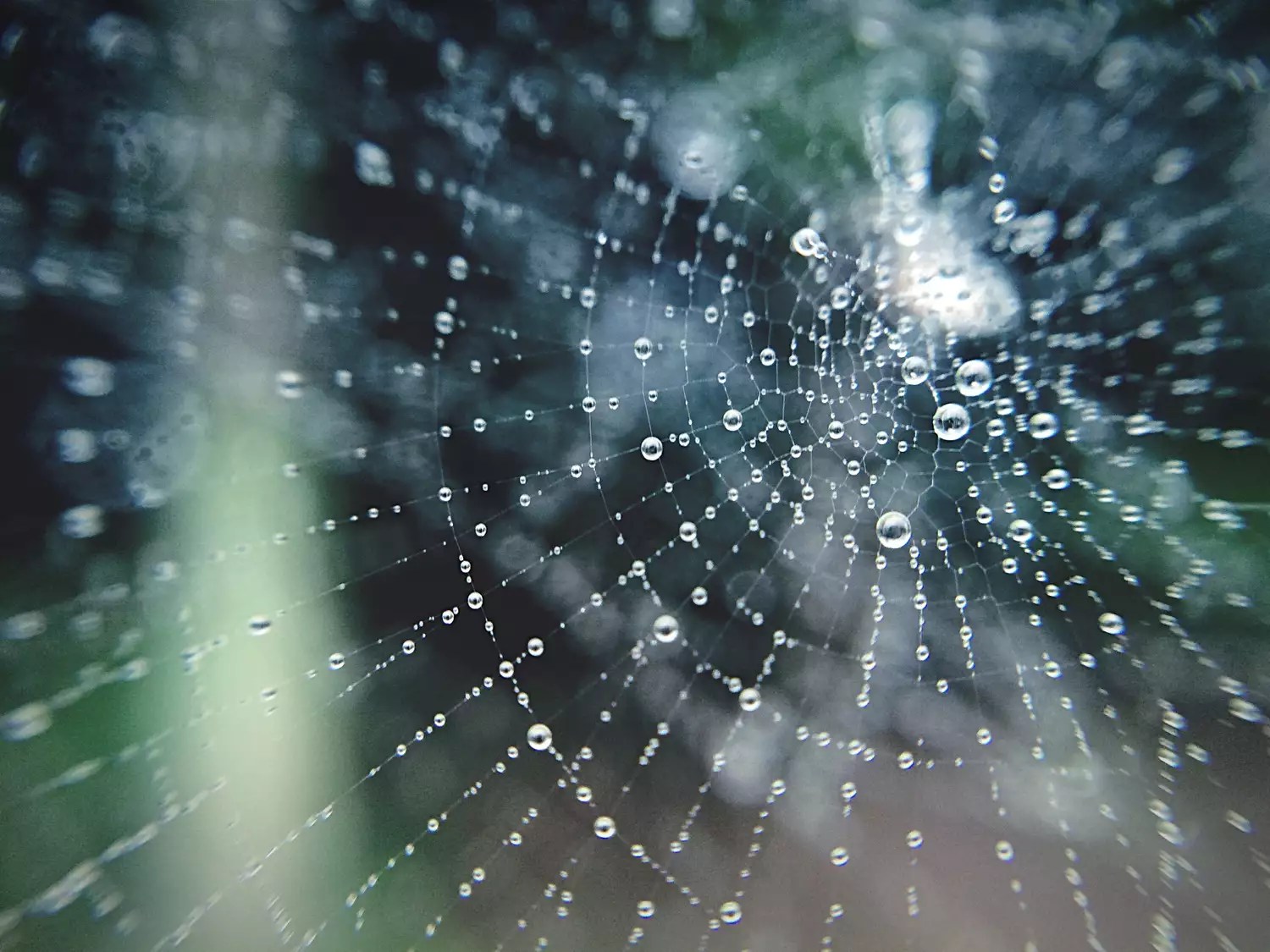
Alan Watts offers an image from nature to illustrate the concept of Indra’s Net:“Imagine a multidimensional spider’s web in the early morning covered with dew drops. And every dew drop contains the reflection of all the other dew drops. And, in each reflected dew drop, the reflections of all the other dew drops…. And so ad infinitum. That is the Buddhist conception of the universe in an image.” 

Centration: We are the gathered-in-ness of 13.8 billion years. Brian Swimme teaches that we are the Universe conscious of itself, self-aware of WHO we really are and of all that we are.

Margaret Brennan teaches: Mystics are people who come in touch with the sacred source of who they really are and are able to realize and experience that in their lives. When we have come in touch with the deep centre of ourselves/our lives we realize that we are more than what we seem to be, that there’s something deeper in ourselves than meets the eye.

John O’Donohue writes: For millions of years, before you arrived here, the dream of your individuality was carefully prepared. You were sent to a shape of destiny in which you would be able to express the special gift you bring to the world. Sometimes this gift may involve suffering and pain that can neither be accounted for nor explained. There is a unique destiny for each person. Each one of us has something to do here that can be done by no one else. If someone else could fulfill your destiny, then they would be in your place, and you would not be here.

Allurement: As the mystics did, we draw unto ourselves, are lured towards, the love that holds the Universe together; we allure all we require to grow in that love, within the calling, the shape of destiny that is uniquely ours; we ourselves can be principles of allurement.

Jean Houston advises us to have leaky margins, to be able to fall in love with everything. If fears and worries are blocking allurement, bring in an inner guide to care for them, to set you free… be aware of the negative quality of allurement: notice what you draw to yourself.

It is in the depths of your life that you will discover the invisible necessity that has brought you here. When you begin to decipher this, your gift and giftedness come alive. (O’Donohue)

Emergence: the Universe flares forth out of darkness Our lives begin to blossom with gifts that grow through our co-creative love relationship with the Holy; we begin to see what is possible as we open to joy.

Jean Houston teaches: We can learn how to work with the Universe in what is trying to emerge within us. Set up a schedule. Show up at the page, or in the listening or prayer place regularly to signal our intent to be open. We can create internal structures that are ready to receive what wants to emerge in us. Then we drop in an idea that puts us in touch with essence, creates in us a cosmic womb so the universal power can work in us, so that, like Hildegard we become a flowering for the possible, attracting the people and resources that we need.

Your heart quickens and the urgency of living rekindles your creativity. (O’Donohue)

To be continued on November 27, 2023: Part Three: Our Journey towards Radiance
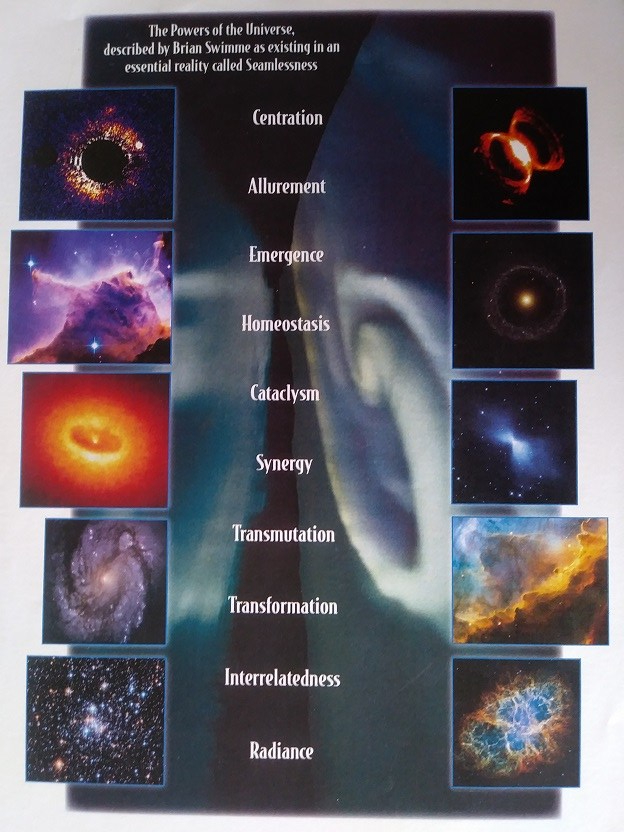
Journey into Radiance

What dreams do you hold for your own unfolding?

Teilhard de Chardin (Jesuit 20th c.) This is what I have learnt from my contact with the earth… the diaphany of the divine at the heart of a glowing universe, the divine radiating from the depths of matter aflame.

The Mystics of the Christian tradition as well as those of other faith paths show us the radiance of a life fully realized, though their paths may seem harsh, even unattainable, to our twenty-first century eyes.

The journey to fullness of life can be found in other images, other metaphors now available to us. We can follow the footprints that lead to wholeness through ancient stories, myth, poetry, and the writings of the great mystics. These are in surprising harmony with the scientific discoveries made in our time about the unfolding of life on the planet, the unfolding of the universe itself. Like the Mystics, the Universe moves through a process of unfolding into radiance. It is our process as well, our story, and our most urgent call in this time.

During the dark weeks of Samhain, I invite you to make a journey into radiance guided by the teachings of Brian Swimme in his DVD series: “Powers of the Universe.” Like his mentor, Thomas Berry, Brian was inspired by the vision of Teilhard de Chardin. I will be drawing on Jean Houston’s presentations related to the ten powers that Brian describes, as well as by writings of poets and mystics such as John O’Donohue, Etty Hillesum, Caryll Houselander, Hildegard of Bingen, Julian of Norwich and Angela of Foligno.

All the powers of the universe are seamlessly one, trying to bring forth radiance. These powers can be understood mystically as within ourselves waiting to assist us to bring forth a world that works for everyone. (Jean Houston)

Here is an overview of the Powers we shall be exploring together :

Seamlessness: The universe is bound together in communion, each thing with all the rest. The gravitational bond unites all the galaxies; the electromagnetic interaction binds all the molecules; the genetic information connects all the generations of the ancestral tree of life. (Brian Swimme)

Centration: We are the gathered-in-ness of 13.8 billion years: the universe conscious of itself; it is also important that we are self-aware of WHO we really are and of all that we are; the mystics knew themselves in the presence of the Holy: Mystics are people who come in touch with the sacred source of who they really are and are able to realize and experience that in their lives. (Margaret Brennan)

Allurement: As the mystics did, we draw unto ourselves, are lured towards, the love that holds the universe together; we allure all we require to grow in that love, within the calling, the shape of destiny that is uniquely ours; we ourselves can be principles of allurement. Jean Houston advises us to have leaky margins, to be able to fall in love with everything.

Emergence: the universe flares forth out of darkness Our lives begin to blossom with gifts that grow through our co-creative love relationship with the Holy; we begin to see what is possible as we open to joy.We can learn how to work with the universe in what it is trying to emerge within us.

Homeostasis: Here what has been developed is sustained, maintained… The goddess Sarasvati in India plays only one note on her long-stringed instrument; body temperature stays at 98.6F…. We may reach a level of sameness in our prayers and practices, our work and relationships, the structures of our lives, our liturgies…. but if kept too long, safety leads to stagnation.

Cataclysm: For the next level of growth, of deepening, something has to wake us up, shake us up. It may take a tornado to blow us all the way to Oz…. Trust in the darkness and loss finally brings us through to the light. Jean Houston says that the call is to “radical reinvention” in order to speciate, to become a deepening spirit of the earth for her new emergence.

Synergy: mutually enhancing relationships. The writings of the mystics can offer synergistic energy, the guidance and wisdom we need; now we are more deeply aware of the earth and its living beings, of the universe itself as offering shared energies to us; the bio-mimicry that teaches us how creatures on our planet survive cataclysm; the characters in the Wizard of Oz, representing heart and brain and courage are a splendid example of synergy.

Transmutation: slow but deep change over time; releasing us from old powers that hold us in check: the personal unconscious (Freud); the collective unconscious (Jung); the whole biological nature (Bateson). The universe is at work within us: we are part of the cosmological unconscious (Swimme); the universe reflecting upon itself through us (Teilhard).

Transformation: Sudden. Go looking for guidance in the mystics, writers and poets who have experienced this. Welcome beauty into our lives. We have within us a visionary process which is a source for the recoding of the planet. All the codings for the life of the unborn future are available in us. We are the recoding, the reset button.

Interrelatedness : a vision of caring with a sense of the whole an invitation from the cosmos to see all of life as interconnected, as did the mystics, and the astronauts and now the physicists. We need an overarching vision that is so simple and alluring that we can see what the world can be…. What does a world look like that really works for everyone? This is an incredible grace and opportunity for us, born on this beautiful planet at this time in history.

Radiance: the power of wisdom: The sun gives off messages as gravitons that pull us towards its light; the sun interacts with the moon and new gravitons feed us; the earth responds with a flood of gravitons…We are frozen light… Brian Swimme says that every being you meet holds fourteen billion years of radiance. Radiance is the primary language of the universe. We develop a container that can respond to the beauty of the other. We enter into resonance with the radiance of the universe, and that is the primary form of prayer.

Teilhard’s Vision: A Participatory Universe

We live in a universe where everything that exists shines “like a crystal lamp illumined from within”, as we saw in our earlier reflections on “Teilhard and the New Spirituality” (From Teilhard to Omega edited by Ilia Delio, Orbis Books, Maryknoll NY 2014 Chapter Ten). This reality calls us to respond with wonder, awe, gratitude.

Yet Teilhard believed that much more is required from us. The same essay goes on to describe the way Teilhard saw our involvement in the evolutionary process:

(Teilhard) envisioned the evolutionary process as one moving toward evolution of consciousness and ultimately toward evolution of spirit, from the birth of mind to the birth of the whole Christ. He urged Christians…to risk, get involved, aim toward union with others, for the entire creation is longing for its fulfillment in God. (Delio and Dinges p. 174)

Beyond recognizing evolution, we are called to work towards it in ourselves. This is a spirituality that calls for immersion in the world:

plunging our hands into the soil of the earth and touching the roots of life….a “mysticism of action,” involvement in the world compenetrated by God. (Teilhard) held that union with God is not withdrawal or separation from the activity of the world but a dedicated, integrated, and sublimated absorption into it. (p.174)

Teilhard understood the Gospel call to “leave all and follow me” meant seeing the Christic presence in the heart of matter, then working to bring that presence into greater fullness.

The world is still being created and it is Christ who is reaching his fulfillment through it….We are to harness the energies of love for the forward movement of evolution toward the fullness of Christ. This means to live from the center of the heart where love grows and to reach out to the world with faith, hope and trust in God’s incarnate presence. (p. 175)

In this new incarnational vision of the relationship between God and the universe, a relationship that spans the whole evolutionary journey leading towards the future, Teilhard offers three fresh perspectives. These are described by Delio and Dinges:

First, his love of matter and spirit is a dual commitment to God and to the world; second, his inclusion of suffering and evil in the forward movement of evolution offers a realistic approach to evil as part of unfolding life; and third, the participation of humans is essential to the process of Christogenesis, that is, the evolution of Christ in the world and the world in Christ. “If we are to remain faithful to the gospel,” he says “we have to adjust its spiritual code to the new shape of the universe….It has become the great work in process of completion which we have to save by saving ourselves”. (p. 175)

Teilhard looked at the earth/ the universe with the eyes of a mystic, with the heart of a lover.

In love with Holy Presence at the deep heart of all that exists, he could echo Rumi’s wonder-filled exclamation: “Is the one I love everywhere?” Through Teilhard’s eyes, we can learn to see what mystic-poet Catherine de Vinck calls “the fire within the fire of all things”. Once we see that fire, we know the call that Teilhard knew to put our hearts at the service of the evolution towards love that is the call of the universe, as well as our personal call within the universal call, for the two are inseparable.

Teilhard shows us that our deepest call is to love, that evolution is advanced by union on every imaginable level of being. And, as another poet, Robert Frost observed: “Earth’s the right place for love: I don’t know where it’s likely to go better.”

Teilhard wrote: I merge myself through my heart with the very heart of God….God is, in a sense, at the point of my pen, my pick, my paint-brush, my needle—and my heart and my thought. It is by carrying to its completion the stroke, the line, the stitch I am working on that I shall lay hold on that ultimate end towards which my will at its deepest levels tends. (p. 176)

Nothing that lives on our planet is outside of us. We can no longer accept lines of division between religions, between cultures, between nations, between species. This universe is evolving as one. Our place within it, like Teilhard’s, is to be its eyes of wonder, its heart of love, its allurement toward union. Everything that we do contributes towards that great comingled work of the evolution of the universe, the evolution of ourselves. As we approach the Feast of Christmas, may we choose as our preparation a deeper seeing, a heartfelt listening to the songs of the universe, its joy-filled melodies, its grief-laden cries. This is not a time to look for a new coming of the Holy, but rather a time to seek the “shining of God through creation, the diaphany of God radiating through a world that becomes transparent.” (p.176)

Teilhard invites us to:

establish ourselves in the divine milieu. There we shall find ourselves where the soul is most deep and where matter is most dense. There we shall discover, where all its beauties flow together, the ultra-vital, the ultra-sensitive, the ultra-active point of the universe. And, at the same time, we shall feel the plenitude of our powers of action and adoration effortlessly ordered within our deepest selves. (Divine Milieu quoted by Delio and Dinges on p.179)

Sophia at Samhain: The Womb of This Present Darkness

The call to awaken to the presence of Sophia comes at a time when much of our planet struggles with darkness. Live-streaming news gives us an immediate knowing of disasters, disease, wars, weather-related devastation that can be overwhelming.

Yet the greater the darkness, the greater is our awareness of the need for light, the deeper our appreciation for it, the more compelling our own call to be co-creators of light.

As these shorter days in autumn prepare us for the yearly plunge into winter’s darkness, we are entering into the sacred time of Sophia. Our ancient ancestors, who knew almost nothing of events beyond their immediate homes, knew about the rhythms of the earth, the apparent movements of sun, moon and stars, the cycle of the seasons, with an accuracy of observation that fills us with awe. The early peoples of Ireland were so deeply attuned to the shifting balance of light and darkness that they could build a monument to catch the first rays of sunrise on the winter Solstice. The Newgrange mound in Ireland, predating the Egyptian Pyramids, receives the Solstice light through a tiny aperture above the threshold.

Like the Egyptians and other ancient peoples, the Celts wove their spirituality from the threads of light and darkness that shaped their lives. Their spiritual festivals moved through a seasonal cycle in harmony with the earth’s yearly dance, associating the bright sunlit days with masculine energy, the darker time with contemplative feminine energy. For the Celts, the days we are entering this week, days we name Halloween, All Saints’ and All Souls’, were one festival known as Samhain (Saw’ wane). These three days marked the year’s end with a celebration that served as a time-out before the new year began. 1The bright masculine season with its intense activity of planting, growing, harvesting was over. The quieter days of winter were ahead, 1 “the time of darkness, the realm of the goddess where the feminine energy principle is experienced and the season of non-doing is initiated.” (Dolores Whelan: Ever Ancient, Ever New pp. 98-9) www.doloreswhelan.ie

We in the twenty-first century may still draw on this ancient wisdom to live in harmony with the earth as the Northern Hemisphere of our planet tilts away from the sun. We can welcome this time of darkness as a season renewal when earth and humans rest. Our energy can be gathered inwards to support what is happening deep within the earth and deep within our souls. The energy gathered in this season will be used when the winter has passed and spring has brought new life to the land and the people.

We too can accept the invitation of Samhain to release whatever is not completed at this time, letting go of the light and the activity of sun-time, surrendering ourselves to the restful moon-time, the darkness of holy waiting. Living within the wisdom of the earth’s seasons, we move towards the rebirth of the sun at the winter solstice, embracing a journey of deep surrender. This is Sophia time. Within her sacred cauldron, our lives and our desires for our planet find a place of gestation, a safe darkness where, as with the caterpillar in a chrysalis, the great work of transformation of our souls and of all of life can happen.

Sylvia Shaindel Senensky writes:

We are being called upon by the sorrowing and powerful Dark Feminine to know our own darkness and the profound richness of all dark places, even when they are laden with pain. Through her we know the mystery of existence and the sacredness of the cycles of life. We learn how important the destruction of the old ways is to the rebirth of the new. When she steps into our lives and awakens us, we can be shattered to our core, and we know, as we see the tears streaming down her face, that she too is holding us in her compassionate and loving embrace.

. She is calling upon us, each in our way to do our inner work, to become her allies, to become the best human beings we know how to be; to allow our creativity, our compassion and our love to flow to ourselves and to all life forms on this planet…. Love attracts love. If we flood our planet with loving and transformative energy, our actions will begin to mirror our feelings. We will come home to ourselves. (Healing and Empowering the Feminine Chiron Publications, Wilmette Illinois 2003)

Let us enjoy this sacred season, this womb-time, as we curl up near the fireside of our hearts. From Sophia’s cauldron, we shall emerge in springtime in an interdependent co-arising with the earth, knowing ourselves renewed in soul, body and spirit.

Teilhard and the New Spirituality

We are each aware that recent decades have brought about a sea change in spirituality. If you are like me, you have been happily swimming through new oceans, enchanted by the brilliantly coloured coral, the exotic fish, the sunlight that filters down into the water, the buoyant feeling of being held in love. For Teilhard, this newness was more than an experience: it was a call birthed out of the discovery that we live within a universe that is, and has been, in a state of continuous evolution. For Teilhard, such a universe reveals a God never glimpsed in a world seen as static, unchanging, complete.

And this God is to be found at the very heart-core of the universe itself. A universe with God at its heart, as its principle of evolution, is holy. Sacred. Entirely so. This was Teilhard’s deepest conviction, the source of his understanding that a new spirituality involved a new way of relating to both God and the universe. Such a God in such a universe requires us as co-creators.

As we continue to explore Teilhard’s thought through reflections on his writings by contemporary theologians in From Teilhard to Omega edited by Ilia DeLio (Orbis Books, Maryknoll, New York 2014), we consider this week the essay in Chapter 10 by William D. Dinges and Ilia Delio. In “Teilhard de Chardin and the New Spirituality”, the authors describe the new spirituality that emerged in the latter half of the twentieth century as “diverse, eclectic, multi-cultural, diffused, decentered, and often uncoupled from traditional religious sources, particularly from more hierarchical, orthodox and theistic ones”. Rather than requiring individuals to turn aside from their own development to conform to an authority that is outside themselves, the new spirituality is “more located within the internal control and consciousness of individuals”. Arising from a “complex array of historical, social, and cultural sources”, some of which are outside Western culture, the new spirituality is part of “a contemporary global religious megasynthesis that includes a colonization of the Western mind by Eastern esoteric psychologies, philosophies, and religious traditions.”

This new pluralistic and holistic spirituality, the authors believe, reflects

the subjective turn of modernity and post-modernity; emphasizes feelings, experience and the quest for human authenticity; accentuates human fulfillment in this world; reveres and affirms the cosmos and our belonging to it; finds the sacred in the secular; promotes a recomposed and embodied spirituality; and recognizes the infusion of nature and matter with spirit, consciousness, or life force.

Teilhard, were he to have read these 21st century words, would, I believe, have nodded his head in agreement. But he would have then added such a depth of passion, beauty and spiritual force that we would, in our turn, have been enchanted, enlivened, empowered by his deep conviction that the discovery of evolution changes everything. Once we accept evolution as the process of unfolding life, the way that new life emerges over deep time, we see that God is at the heart of the universe. To overcome the old divide between earth and heaven, matter and spirit, secular and sacred, Teilhard saw that we must “rid ourselves of the old God of the starry heavens and embrace the God of evolution.”

Teilhard saw the universe as permeated with love in the person of the Risen Christ, towards whom he saw all of life evolving. “Through his penetrating view of the universe, he found Christ present within the entire cosmos, from the least particle of matter to the convergent human community. The whole cosmos is incarnational.”

Teilhard’s is “an embodied perspective that sees human flourishing as embedded in the flourishing of the Earth community in which both are manifestations of the emergent universe story”. In The Divine Milieu, Teilhard wrote: “there is nothing profane here below for those who know how to see.” (DM, 66)

Of Paul’s words in his letter to the Colossians, “Before anything was created, (Christ) existed, and he holds all things in unity”, Teilhard writes: “it is impossible for me to read St. Paul without seeing the universal and cosmic domination of the Incarnate Word emerging from his words with dazzling clarity.”

For Teilhard Christ is the evolver in the universe.

The one who is coming to be in evolution through the process of creative union… As Omega, Christ is the one who fills all things and who animates and gathers up all the biological and spiritual energies developed by the universe. Since Christ is Omega, the universe is physically impregnated to the very core of its matter by the influence of his superhuman nature. The material world is holy and sacred. Through grace, the presence of the incarnate Word penetrates everything as a universal element. Everything — every leaf, flower, tree, rabbit, fish, star– is physically “christified”, gathered up by the incarnate Word as nourishment that assimilates, transforms, and divinizes. The world is like a crystal lamp illumined from within by the light of Christ. For those who can see, Christ shines in this diaphanous universe, through the cosmos and in matter.

We immerse ourselves in this glorious sea, seeking the diaphany of God in dolphin, in coral, in squid and shark, each held, like us, in love.

Teilhard’s Spiritual Gift to Us

Teilhard de Chardin in The Divine Milieu

When a visionary scientist, a mystic, a priest, sees luminous fire at the heart of the universe, drawing us into a unity of love, how is his life’s purpose altered? If that man, though forbidden to teach, writes what he has come to understand, to cherish, ensuring that his writings survive after his death, how might his spiritual vision sustain our hope and transform our darkness at this moment in the history of the earth, nearly ninety years after his death? For that is the gift that Teilhard de Chardin left us when he died on Easter Sunday, 1955.

“One of Teilhard’s greatest contributions to modern religious thought is his conception of reality as composed of both spirit and matter.” Mary Evelyn Tucker, in her Foreword to Teilhard de Chardin, A Book of Hours, (edited by Kathleen Deignan, cnd, and Libby Osgood, cnd, Orbis Press, Maryknoll, New York, 2022)

Writing of Teilhard’s insights on the implications of this view of reality, Tucker offers us foundation stones for a 21st century spirituality. Teilhard saw that this ”interior and numinous dimension of reality” present from the inception of the universe, “radically alters our perspective of matter itself which for (Teilhard) was not dead and inert but dynamic and evolving.” It calls us to shift our religious quest from ”otherworldly goals such as personal salvation after death,” redirecting our vision to ”what is close at hand and yet coextensive with the birth of the universe itself.”

This “numinous reality that infuses matter brings us face-to-face with the immanence of the divine in all things.” This is cosmic spirituality. Its implications are worth considering…

For Teilhard, without this presence in matter of an interior aspect, “consciousness could not emerge in the human” for the human emerges from all that preceded us since the birth of the universe. As Tucker writes: “To understand that all reality from the tiniest atom to the entire Earth community is composed of a within and a without gives us a very different perspective on our universe and our spiritual journey.”

It was Teilhard’s belief that understanding this spiritual immanence in the depth of matter as part of “a dynamic evolutionary perspective” would lead humans to “appreciate the fundamental unity of life.” As the discoveries of science evoke a sense of unity, our collective imagination is awakening to a sense of the cosmos, and of the Earth as alive, even as they have been so for millennia in the imaginations of indigenous peoples.

Teilhard himself writes: “The cosmic sense must have been born as soon as man found himself facing the forest, the sea and the stars. And since then, we find evidence of it in all our experience of the great and unbounded: in art, in poetry, in religion. Through it we react to the world a whole as with our eyes to the light.” (Human Energy, translation J.M. Cohen, New York, Harcourt Bruce Jovanovich, 1971, 82.)

As Tucker points out, “In terms of cosmic perspective…Teilhard offers a vision of unity that resituates the human in the whole evolutionary journey. It provides a means of reciprocity and reverence with the universe and Earth….Our capacity for communication with nature is greatly enlarged and revitalized when we recognize its essential connectedness with ourselves.”

What effect does this have on contemporary spirituality? Tucker responds: “If spirit and matter are the dynamics of evolution, we have a radically new perspective for situating the whole idea of purpose.” Human emergence, far from a random event, is “intrinsically linked to the evolution of spirit and matter in the universe as a whole.”

Moreover, “we are at a moment in history when we are taking responsibility for guiding this evolutionary process in a sympathetic awareness of its profound connection to ourselves.”

Tucker sees that Teilhard invites us “to embody this explicit consciousness of being an atom or a citizen of the universe.”

Now we are called to recognize the divine as “present and acting in the world.” We move “to seeing human lives and destinies intertwined in evolution.” We begin “to discover an ordering principle (LOGOS) at the heart of all matter.”

The effect of this new insight, writes Tucker, is to reorient our spiritual goals “from a quest toward otherworldly perfection and goodness to a quest toward alignment with the dynamic evolutionary processes close at hand. Our spiritual purpose is expanded to embrace and to understand both four and a half billion years of Earth history and the contemporary environmental challenges to the planet and the evolution of its life forms.”

Teilhard and the Circle of Spirit

The internal face of the world comes to light and reflects upon itself in the very depths of our human consciousness. Pierre Teilhard de Chardin, (The Human Phenomenon, 29)

We have already begun to explore Teilhard’s “Circle of Spirit”, discovering the hope and passion it offers in these perilous times for our planet. How did Teilhard move from examining rock layers to exploring the inner dynamics of the universe and of the human spirit? How did he reach his conviction that matter is moving towards spirit, that everything is “driven, from its beginning, by an urge toward a little more freedom, a little more power, more truth?” (Writings in Time of War)

Kathleen Duffy tells us that Teilhard “began by plumbing the depths of his own being, plunging into the current that was his life so that he could chart the development of his person from the very beginning. He wanted to see whether, and if so, how, the principle of Creative Union was operating in his own cosmic story.” (Teilhard’s Mysticism, 83)

Teilhard tells us of that inner journey:

And so, for the first time in my life…I took the lamp and, leaving the zone of everyday occupations and relationships where everything seems clear, I went down into my inmost self, to the deep abyss whence I feel dimly that my power of action emanates. But as I moved further and further away from the conventional certainties by which social life is superficially illuminated, I became aware that I was losing contact with myself. At each step of the descent a new person was disclosed within me of whose name I was no longer sure, and who no longer obeyed me. And when I had to stop my exploration because the path faded from beneath my steps, I found a bottomless abyss at my feet, and out of it came — arising I know not from where – the current that I dare to call my life. (Divine Milieu 76-77)

On this deep inner journey, Teilhard felt “the distress characteristic to a particle adrift in the universe” (DM, 78). Kathleen Duffy describes his experience:

The immensity and grandeur of the universe overwhelmed him. As he descended back through the eons of time, the landscape became less and less familiar; patterns came and went at random and then disappeared. Finally, near the beginning of time, all cosmic structure dissolved into a sea of elementary particles. Troubled, at first, by the apparent lack of unity, Teilhard reversed his direction, exploring instead the cosmic becoming. As he moved forward through time, he watched elementary particles fuse into fragile streams. Amazed by how these streams continued to coalesce, he focused on those that would eventually form his own current, noting the way they converged. Extending “from the initial starting point of the cosmic processes…to the meeting of my parents” (Writings in Time of War, 228), rivulets were growing in strength and beauty. As time progressed, they came alive – they began cascading in torrents, swirling in eddies, pulsating with life and with spiritual power. Teilhard could feel the energy of life gushing from his core. (Teilhard’s Mysticism, 84)

From this mythic/mystical inner journey through his own being Teilhard began to trace the evolution of spirit within matter. It became clear to him that “a certain mass of elementary consciousness becomes imprisoned in terrestrial matter at the beginning” (Human Phenomenon, 37).

Contemplating the first cells bubbling up from the ocean floor, Teilhard was aware of more than the evolution of matter; he realized that he was also witnessing the evolution of spirit…. The more complex matter becomes, the more capable it is of embodying a more developed consciousness or spirit (TM 87).

We hear an excitement in Teilhard’s words as he sees the implications of this:

And here is the lightning flash that illuminates the biosphere to its depth …. Everything is in motion, everything is raising itself, organizing itself in a single direction, which is that of the greatest consciousness (The Vision of the Past, 72).

Seeing the evolutionary process moving in this way, Teilhard is assured that:

“The universe as a whole, cannot ever be brought to a halt or turn back in the movement which draws it towards a greater degree of freedom and consciousness” (Christianity and Evolution, 109).

If we also feel that “lightning flash”, that stirring of excitement and promise, how will our everyday lives change? For starters, might we free ourselves from that tangle of despair and helplessness that ensnares us when we look only at the challenges, immense and awe inspiring as they are, and free up our energies to look also at the 13.8 billion years of evolution that have brought us to this threshold. We may trust that we are made for these times, that we have evolved to face this crisis, that we have all that we require to do what is demanded of us.

For why else was Teilhard sent to us as a guide in this moment in human history?

Teilhard Spirals into the Circle of Person

The “piece of iron” of my first days has long been forgotten.

In its place it is the Consistence of the Universe, in the form of Omega Point,

that I now hold, concentrated …into one single indestructible centre,

WHICH I CAN LOVE. (Pierre Teilhard de Chardin, The Heart of Matter, 39)

Teilhard describes his mystical journey as a spiral through which he moves into a deepening reality, visiting, revisiting, five circles that map his journey into the heart of matter and the heart of God (“The Mystical Milieu”, Writings in Time of War, 115-49). We have already explored, with Kathleen Duffy as our travel guide (Teilhard’s Mysticism, Orbis Books, Maryknoll, New York, 2014), Teilhard’s Circles of Presence, Consistence, Energy and Spirit. Now at the deepest swirl of the spiral we come to his Circle of Person.

Seeking the elusive force that animates the cosmos, Teilhard stepped into the fifth circle, searching for its source. What image might assist? Devotion to the Sacred Heart of Jesus had once allured him but now, as he sought a more universal image, “the figure of Christ and the world began to melt before his eyes into a single vibrant surface (Hymn of the Universe, 42-43). Surrounded by a cosmic tapestry of intricately woven thread, Christ’s face shone with exquisite beauty. Trails of phosphorescence gushed forth and radiated outward toward infinity. The entire universe was vibrant (HU, 43); the cosmos had acquired a nervous system, a circulatory system, a heart. Teilhard was consumed by the fire streaming from this universal center and resolved to go deeper” (Teilhard’s Mysticism, 110).

Stepping into the fifth circle, Teilhard encountered a shadowy figure, a feminine presence:

The figure of Sophia emerged from the mists. She was radiant; her facial expression comforting. Teilhard recognized her as “the beauty running through the world….” (Writings in Time of War, 192)…. It is through her power, the power of love, that all things come together. Hidden within the very heart of matter, she ”bestirred the original mass, almost without form…and instilled even into the atoms… a vague but obstinate yearning to emerge from the solitude of their nothingness.” She is “the bond that thus held together the foundations of the universe“(W, 192-3), and she continually draws Earth into “passionate union” with the Divine. (W, 200)….She is the raiment who is forming as she is being formed, continually creating the mystical milieu in which the forces of love encourage all things to become one….The radiance from her countenance becomes brighter still when it shines out from the eyes of each human face….

The tenderness of her compassion and her holy charm aroused Teilhard’s passion for the Divine and sensitized his heart. He was enthralled with “the beauty of spirit as it rises up adorned with all the riches of the earth,” as it flows into the heart of the cosmos, toward its very center. He yearned to take hold of her, yet whenever he tried, he found that she eluded his grasp. With great alacrity, he followed her lead as she guided him through the “luminous mist hanging over the abyss” and propelled him toward the heights into freedom. (Teilhard’s Mysticism, 110-111)

Teilhard brought the heart of a mystic, the eyes and sensibilities of a poet, the rigorous training of a scientist to his observations, his intuitions, his deep knowing so that his “vague intuition of universal unity became over time a rational and well-defined awareness of a presence…the presence of a radiant center that has all along been alluring the cosmos into deeper and deeper union…”(TM, 112)

Lured by the passionate love that this presence awakened within him, Teilhard experienced the universe “ablaze with the fire of divine love, suffused with the elements of a presence which beckons, summons and embraces” all of humanity, so that he was himself living “steeped in its burning layers”(Divine Milieu, 112).

Re- reading the letters of Saint Paul, Teilhard saw more clearly Christ’s evolutionary role: In “an explosion of dazzling flashes” (The Heart of Matter,50), Cosmic Convergence coupled with Christic Emergence and became two phases of a single evolutionary movement. The implosion caused by the coincidence of Christ with the Omega of the Universe releases “a light so intense that it transfigured… the very depths of the World” (HM, 82-3). All of the knowledge and love that Teilhard had for the universe was suddenly transformed into knowledge and love for the God who is embedded within every fragment of matter. (TM, 113).

Teilhard’s mysticism, grounded in the Circle of Person, completed his synthesis. He was convinced that the universe would both continue to complexify and become more centered in the Body of Christ until all would be one in Christ. He now yearned to adore, which meant to “lose oneself in the unfathomable… to give of one’s deepest to that whose depth has no end.” ( D, 127-8).

Pietro Cavallini, Mosaics on Arch and Apse, ca. 1291

His desire grew that all humanity might open their arms “to call down and welcome the Fire” as…”a single body and a single soul in charity.” (Divine Milieu, 144).

“Drawn to follow the road of fire” (The Heart of Matter, 74) Teilhard “dedicated himself body and soul to the ongoing work needed to transform the cosmos to a new level of consciousness and of love.” (TM, 116).

Teilhard in The Circle of Energy

Kathleen Duffy’s exploration of Teilhard’s Circle of Energy (Teilhard’s Mysticism, Orbis Books Maryknoll, NY 2014) shows the uniqueness of his mystic path. Neither a hermit in a cave nor a desert father escaping reality, Teilhard seeks the sacred in the deep heart of life on Earth in all its wonder and terror, and in the fiery depths of the cosmos, as it cycles through destruction and rebirth.

Touched by the intricate and beautiful structure of the cosmos and yearning to be possessed by the Sacred Presence that fills it…Teilhard continued his mystical journey, ever searching for the supreme tangible reality. As he stepped into the third circle, he found the cosmos ablaze with activity. The Divine Presence that had been alluring him had suddenly acquired a new aspect—Energy. (TM 55)

Teilhard was stirred by the evolutionary story, a story whose creativity and energy were shown to him in the layers of rock, in the depths of the earth, as he worked as a geologist and paleontologist. Enthralled by the emergence of living organic matter from inorganic, Teilhard writes:

See how (Earth’s) shades are changing. From age to age its colors intensify. Something is going to burst out on the juvenile Earth. Life! See it is life!”(The Human Phenomenon, 38, translation Sara Appleton-Weber, Portland OR: Sussex Academic Press, 1999)

Teilhard imagined evolution as a tapestry whose threads revealed “the amazing energy at work at the heart of the cosmos” (TM 59). He describes this tapestry as endless and untearable, so closely woven in one piece that there is not one single knot in it that does not depend upon the whole fabric (Science and Christ, 79, trans. Rene Hague New York, Harper and Row, 1968).

Teilhard saw that since the beginning of time complex structures have been emerging from the union of simpler ones: “a thrust towards union seems to be coded into the very fabric of the cosmos” (TM 60).

As his awareness of the complexity and interconnectedness of the Universe deepened, Teilhard could see how these qualities lead to understanding important aspects of our global life: We have gradually come to understand that no elemental thread in the universe is wholly independent…of its neighboring threads (The Future of Man, 87 trans. Norman Denny, New York: Harper and Row, 1964). For “just as the simplest vibration of a single cosmic tapestry thread affects the whole fabric, so local interactions can be felt on a global scale” (TM, 70). Teilhard came to know the importance of considering the whole in order to grasp the order that lies under the appearance of disorder. He intuitively understood that “deep down there is in the substance of the cosmos a primordial disposition …for self-arrangement and self-involution” (Heart of Matter, 33).

Yet Teilhard knew in his life what today’s scientists continue to explore: the “transition region between the two extremes of ordered stability and chaotic instability called the edge of chaos” (TM 73). In the trenches of World War 1, the horror in which he was immersed still allowed for “feelings of freedom, unanimity, and exhilaration” (TM 75).

Because he understood that “the self-organization of the world progresses only by dint of countless attempts to grope its way” (Christianity and Evolution, 187, trans Rene Hague, New York: Harcourt Brace Jovanovich, 1969), Teilhard saw the mystic must also “test every barrier, try every path, plumb every abyss” (The Divine Milieu,70,New York, Harper and Row, 1960).

Moving through the Circle of Energy, Teilhard became aware of the universe as “alive, vibrant, filled with Divine Energy and solidly enduring……..undergoing a cosmogenesis…slowly moving it toward greater complexity and deeper union” (TM, 75).

This deep knowing led Teilhard to see his own sufferings as part of the larger story:

Putting his personal suffering into a cosmic perspective, he turned his attention to the pain and suffering that pervades the evolutionary story, a story that is rife with misfortune, struggle, disease, and death: natural disasters beset Earth on every side; predators prey on more vulnerable species; changing environmental conditions cause many species to become extinct; within the human community, war and oppression continue to rage. It is not only humans who suffer. Every part of the cosmos bears the scars of the chaos and tragedy that accompany the evolutionary process (TM, 76-7).

Within the cosmic story, Teilhard’s mystic path would become one of uniting with “the Divine Fire at work at the heart of matter” (TM 78) Earth’s story had shown Teilhard that the Divine is continuing to shape the universe and therefore human action may “channel … the whole of the World’s drive towards the Beautiful and the Good” (Heart of Matter, 204). Seeing the “sacred duty” of working with Divine Energy, Teilhard vowed: “I shall work together with your action…. to your deep inspiration…I shall respond by taking great care never to stifle nor distort nor waste my power to love and to do” (The Divine Milieu, 79).

In a letter written to a friend during his work as a geologist, Teilhard describes a moment of mystic knowing:

this contact with the real does me good. And then, amid the complexity and immobility of the rocks, there rise suddenly toward me “gusts of being,” sudden and brief fits of awareness of the laborious unification of things, and it is no longer myself thinking, but the Earth acting. It is infinitely better (Letters to Two Friends 1926-1952, 73, translated by Helen Weaver, edited by Ruth Nanda Anshen, New York: New American Library, 1967).

Teilhard’s mystic path led him to the heart of the earth: He was convinced that he must steep himself in the sea of matter, bathe in its fiery water, plunge into Earth where it is deepest and most violent, struggle in its currents, and drink of its waters. Earth was the source of his life: through the world Divine Energy enveloped him, penetrated him, and created him. Because Earth had cradled him long ago in his preconscious existence, he knew that the Earth would now raise him up to God. (TM 80-1)

Teilhard’s Search for Consistence

”What Holds Everything Together?”

Everywhere there are traces of, and a yearning for,

a unique support, a unique and absolute soul,

a unique reality in which other realities are brought together in synthesis,

as stable and universal as matter, as simple as spirit.

Pierre Teilhard de Chardin Writings in Time of War (translated by Rene Hague, New York, Harper and Row, 1968)

Teilhard’s Life Journey spiralled through five circles. We have glimpsed his discoveries in the Circle of Presence where the loveliness of earth lured and enchanted him. Guided by Kathleen Duffy in her book Teilhard’s Mysticism (Orbis Books, Maryknoll, NY 2014) we now explore Teilhard’s search in the Circle of Consistence where “he focused not only on the beauty of nature but also on the properties and structure of the cosmos as a whole “(39).

Pierre is four years old, living in a family deeply grieving the loss of a child, his sibling. His mother is cutting his hair, tossing the shorn locks into the fire. Before his eyes, the boy sees part of himself vanish.

In such moments a life’s work may begin. For Teilhard, it began with a search for what can last… He began to collect bits of iron, until rust betrayed his trust in metal. Walking with his father over the hills of the Auvergne near his home, he found something that would last. He fell in love with rocks.

Duffy reflects that “his choice to abandon his collection of iron scraps for rock was fortunate since it led him from mere rock collection to the study of the Earth’s crust and eventually expanded his thinking to the planetary scale.” (40).

Later in life, Teilhard would reflect:

It was precisely through the gateway that the substitution of Quartz for Iron opened for my groping mind into the vast structures of the Planet and of Nature, that I began, without realizing it, truly to make my way into the World—until nothing could satisfy me that was not on the scale of the universal”. (The Heart of Matter)

Teilhard Working as a Paleontologist in China

Teilhard was seeking “an ultimate Element in which all things find their definitive consistence. ” (Teilhard’s Mysticism, 40). Though field work in geology and paleontology in China, Africa and North America allowed him to enter Earth’s body, his brief time studying physics opened his wondering eyes to the cosmos. Still asking What holds everything together? Teilhard for a time wondered if the answer was gravity.

Duffy notes that “throughout his journey along the Circle of Consistence, Teilhard focused his attention on matter in all of its intricacy without much consideration of spirit….The Divine Presence in which he felt himself bathed seemed to be not some vague spiritual entity, but rather, a supreme tangible reality.”(41).

Observing unity and interconnectedness within matter, Teilhard wrote: “The further and deeper we penetrate into matter with our increasingly powerful methods, the more dumbfounded we are by the interconnection of its parts.”(The Human Phenomenon)

Over time Teilhard would reconcile his childhood abhorrence for what perishes with his love for the strength and beauty that he found in what cannot last:

This crumbling away, which is the mark of the corruptible and the precarious, is to be seen everywhere. And yet everywhere there are traces of, and a yearning for…a unique and absolute soul. (Writings in Time of War)

Teilhard came to “distinguish in the Universe a profound, essential Unity, a unity burdened with imperfections…but a real unity within which every ‘chosen’ substance gains increasing solidity”. (Teilhard’s Mysticism, 53)

Spiralling through the Circle of Consistence, experiencing the cosmic structure as “intimate, intricate and profound”, seeing himself as “part of an interdependent and interconnected reality, sharing the one life that is in everything”, Teilhard realized that a search for consistency in what is visible would ever disappoint him.

Now at last he began to see:

the very consistency of the World …welling up …like sap, through every fibre… leaping up like a flame. (The Heart of Matter)

Duffy’s conclusion to her chapter on the Circle of Consistence pulses with life and beauty, drawn in part from Teilhard’s Writings in Time of War (W):

Divine Presence, so powerfully real to him as he travelled along the first circle, had acquired a new power for him. At the very heart of matter, Divine Consistence was, by its very presence, holding all things together. Once he became aware of “the unifying influence of the universal Presence” (W, 124), he was no longer distressed by the mutability of things: “Beneath what is temporal and plural, the mystic can see only the unique Reality which is the support common to all substances, and which clothes and dyes itself in all the universe’s countless shades without sharing their impermanence.”(W, 125) He knew that Divine Consistence is trustworthy. (W, 123): “Having come face to face with a universal and enduring reality to which one can attach those fragmentary moments of happiness that…excite the heart without satisfying it” (W, 124) ”a glorious, unsuspected feeling of joy invaded my soul” (W,126). He longed to surrender, to drive his roots into matter so that he could become united with Ultimate Reality. (Teilhard’s Mysticism, 54)

“(Teilhard) longed to drive his roots into matter so that he could become united with Ultimate Reality.”