Category Archives: Jean Houston

Our Journey Towards Radiance: Part Two

We continue our reflections on the Powers of the Universe as described by Brian Swimme with elucidating teachings from Jean Houston and quotes from the mystics.

Cataclysm: For the next level of growth, of deepening, something has to wake us up, shake us up. It may take a tornado to blow us all the way to Oz…. because “there is no way to that place” where the greatest gifts await us. “But thither (we) shall come, soon or never” as the old fairy tales say.


We must orchestrate the breakdown for the breakthrough to occur.

The mystics endured cataclysm in different ways: Julian of Norwich was sustained in her near-death experience by the presence of love; Angela of Foligno, who lived in Spoleto, Italy just after the time of Francis of Assisi, learned in the darkness where she lost everything that love would never leave her.

Afterwards did I see him darkly, and this darkness was the greatest blessing that could be imagined and no thought could conceive aught that would equal this. Then was there given unto the soul an assured faith, a firm and certain hope, wherein I felt so sure of God that all fear left me. For by that blessing which came with the darkness I did collect my thoughts and was made so sure of God that I can never again doubt but that I do of a certainty possess him.

Trust in the darkness and loss finally brings us through to the light.

Etty Hillesum, the 20th c. Jewish mystic who died in Auschwitz, wrote:

I shall try to help you, God, to stop my strength ebbing away, though I cannot vouch for it in advance. But one thing is becoming increasingly clear to me: that you cannot help us, that we must help you to help ourselves. And that is all we can manage these days, also all that really matters: that we safeguard that little piece of you, God, in ourselves. And in others as well. Alas, there doesn’t seem to be much you yourself can do about our circumstances, about our lives. Neither do I hold you responsible. You cannot help us but we must help you and defend your dwelling place inside us to the end.

Jean Houston says that the call is to “radical reinvention” in order to speciate, to become a deepening spirit of the earth for her new emergence.

Like the seed, the mystic must go down into the darkness of the earth, let go of the success of walking in the midday sun of her own achievements, her own goals and triumphs.

images (5)

The mystic sinks down to earth, down to the ground of our being, so that there results a letting go, a giving up of all control. The mind stops grinding out thoughts and becomes simple. The most primitive feelings emerge. The practice and the behaviour are meant to bring one into the deepest introversion and to release all attachments to and projections on external objects or persons. With that the inner world becomes enriched and enlivened. There comes a reunion of what is human with the divine. (Here All Dwell Free by Gertrude Mueller Nelson p. 142)

We ask, but it must be for nothing – nothing that belongs to the world of power or ego. We seek passionately, we knock madly. We weep. We pray. We call out. When everything is given up and opened out, we empty ourselves. And God fills in. ( Nelson p.141)

Synergy: mutually enhancing relationships allow us to recreate after cataclysm

images (1)

Life at the Benedictine Monastery of Helfta was an illustration of this: four mystics lived there in the 12th century, sustaining one another in faith and love and their mystical experiences. The writings of the mystics can offer synergistic energy, the guidance and wisdom we need; now we are more deeply aware of the earth and its living beings, of the universe itself as offering shared energies to us; the bio-mimicry that teaches us how creatures on our planet survive cataclysm; the characters in the Wizard of Oz, representing heart and brain and courage are a splendid example of synergy.

Transmutation: slow but deep change over time releases us from old powers that hold us in check: the personal unconscious (Freud); the collective unconscious (Jung); the whole biological nature (Bateson). The universe is at work within us: we are part of the cosmological unconscious (Swimme); the universe reflecting upon itself through us. (Teilhard de Chardin)

On the mystic journey, our own efforts to be still, to listen, to pray, to seek inner guidance seem small and yet slowly bring a change in our sensibilities, opening us to the Powers of the Universe that are within, awaiting our engagement.

Terese of Lisieux said our efforts are like a child trying laboriously to lift her feet to climb high steps until at last love scoops her up in her arms, carries her to the top…

We know of the slow evolution of species; the ancient tale of the earth gradually being created by bits of soil being placed on the back of a turtle… we recognize transmutation taking place in us when we no longer fit into old patterns, relationships, structures. Then we must seek out others to help us to keep going.

(Next: The Power of Tranformation)

Our Journey Towards Radiance

What dreams and desires do you hold for your own unfolding?

images

All the Powers of the Universe are seamlessly one, trying to bring forth Radiance.

The Mystics of the Christian tradition as well as those of other faith paths show us the radiance of a life fully realized, though their paths may seem harsh, even unattainable, to our twenty-first century eyes.

The journey to fullness of life can be found in other images, other metaphors now available to us. We can follow the footprints that lead to wholeness through ancient stories, myth, poetry, and the writings of the great mystics. These are in surprising harmony with the scientific discoveries made in our time about the unfolding of life on the planet, the unfolding of the universe itself. Like the Mystics, the Universe moves through a process of unfolding into radiance. It is our process as well, our story, and our most urgent call in this time.

Seamlessness: All the powers of the universe are seamlessly one, trying to bring forth radiance. These powers can be understood mystically as within ourselves waiting to assist us to bring forth a world that works for everyone. (Jean Houston)

The universe is bound together in communion, each thing with all the rest. The gravitational bond unites all the galaxies; the electromagnetic interaction binds all the molecules; the genetic information connects all the generations of the ancestral tree of life. (Brian Swimme)

Centration:We are the gathered-in-ness of 13.8 billion years: the universe conscious of itself; it is also important that we are self-aware of WHO we really are and of all that we are; the mystics knew themselves in the presence of the Holy.

Theologian Margaret Brennan, IHM, teaches that

Mystics are people who come in touch with the sacred source of who they really are and are able to realize and experience that in their lives. When we have come in touch with the deep centre of ourselves/our lives we realize that we are more than what we seem to be, that there’s something deeper in ourselves than meets the eye.

John O’Donohue, Irish mystic poet writes: For millions of years, before you arrived here, the dream of your individuality was carefully prepared. You were sent to a shape of destiny in which you would be able to express the special gift you bring to the world. Sometimes this gift may involve suffering and pain that can neither be accounted for nor explained. There is a unique destiny for each person. Each one of us has something to do here that can be done by no one else. If someone else could fulfill your destiny, then they would be in your place, and you would not be here.

Allurement: As the mystics did, we draw unto ourselves, are lured towards, the love that holds the universe together; we allure all we require to grow in that love, within the calling, the shape of destiny that is uniquely ours; we ourselves can be principles of allurement.

Jean Houston advises us to have leaky margins, to be able to fall in love with everything. If fears and worries are blocking allurement, bring in an inner guide to care for them, to set you free… be aware of the negative quality of allurement: notice what you draw to yourself.

It is in the depths of your life that you will discover the invisible necessity that has brought you here. When you begin to decipher this, your gift and giftedness come alive. (O’Donohue)

Emergence: the universe flares forth out of darkness Our lives begin to blossom with gifts that grow through our co-creative love relationship with the Holy; we begin to see what is possible as we open to joy. We can learn how to work with the universe in what it is trying to emerge within us. Set up a schedule. Show up at the page, or in the listening or prayer place regularly to signal our intent to be open. We can create internal structures that are ready to receive what wants to emerge in us. Then we drop in an idea that puts us in touch with essence, creates in us a cosmic womb so the universal power can work in us, so that, like Hildegard of Bingen we become a flowering for the possible, attracting the people and resources that we need.

Your heart quickens and the urgency of living rekindles your creativity. (O’Donohue)

Homeostasis: Here what has been developed is sustained, maintained… The goddess Sarasvati in India plays only one note on her long-stringed instrument; body temperature stays at 98.6F…. We may reach a level of sameness in our prayers and practices, our work and relationships, the structures of our lives, our liturgies…. but if kept too long, safety leads to stagnation. We reach a plateau as the urgency subsides, the joy fades into the commonplace; what seemed wonderful becomes the everyday, the expected. Our lives slip in to the “nothing-happening” of an Austen novel, and we may not even notice how dull it is. The universe gets bored with us. That was Dorothy’s life when we first meet her in the Wizard of Oz. Grey skies, grey land, grey telephone poles.The only thing really alive was Toto; then he was taken away.

(Next week: What follows: Cataclysm)

Sophia:Discipline as a Way of Love

Of (Wisdom) the most sure beginning is the desire for discipline,
care for discipline means loving Her… (Wisdom 6:17 Jerusalem Bible)

These words about discipline from the Wisdom Literature of the Bible have been with me in recent days. As I thought about them, I noticed how I have come full circle with the concept of discipline. When I was young, I accepted it as a denial of pleasure, like giving up candy for Lent, harsh but ultimately good for me. Later, I rejected that self-denying approach to life, embracing joy and a sense of being loved without having to “earn” it through sacrificing what I enjoyed. In recent years, I have discovered discipline in a new way, a commitment to “showing up” in a relationship with the Beloved each day…

Reflecting on this, I recalled a story that shows discipline as a requirement of love. Here is an excerpt from The Little Prince :
The fox…gazed at the little prince for a long time. “Please tame me!” he said.
“I’d love to,” replied the little prince, “but I don’t have much time. I’ve got friends to find and lots of things to understand.”
“You only understand the things you tame,” said the fox. “People no longer have the time to understand anything….If you want a friend, tame me!”
“What do I have to do?” said the little prince.
“You must be very patient,” replied the fox. “Sit down in the grass a little way away from me, like this. I’ll watch you out of the corner of my eye and you won’t say a word. Language is a source of misunderstanding. And each day, you can sit a little closer.”
The next day, the little prince returned.
“It would have been better if you’d come back at the same time,” said the fox. “If you come at four o’clock in the afternoon, then from three o’clock I’ll start feeling happy. The later it gets, the happier I’ll feel….but if you come at any old time, I’ll never know when to feel glad in my heart…we need rituals.”
“What’s a ritual?” said the little prince.
“Something else that is too readily forgotten,” said the fox. “It is what makes one
day different from another, or one hour different from the other hours.”
(from The Little Prince by Antoine de Saint-Exupery, 1943; English translation, 2010 by Ros and Chloe Schwartz)

This wisdom from the fox echoes the teaching of spiritual writers that we must be willing to show up, at the same time each day, or at least at some time each morning and evening, for perhaps a quarter hour. During this time, we need to be willing to wait, to listen, to quiet the inner chaos of anxiety or questioning, of self-reproach or self-justification, just to allow ourselves to be in the silent presence of Love.

In her magnificent book, The Search for the Beloved (Tarcher/Putnam New York, 1987) Jean Houston writes:
While the realm of the Beloved may still remain “other”, the distance can be bridged by bringing the extraordinary into the ordinary….
Although being porous to the Beloved increases the capacity to live in two realms, the growth and maintenance of this capacity seems to depend upon the faithful practice of a discipline. Discipline has had a very bad press. We must recognize that the high practice of a discipline gives enormous freedom, and with this freedom comes a greatly increased capacity to love. Often we do not love others, much less the Divine Beloved, because we are caught up with every whim, irritant, and distraction….Discipline, conscious and mindful orchestration of the pieces of our lives, gives us a capacity to live in the depths as well as on the surface. Ideally, a discipline has a physical, mental, and spiritual component and is practiced each day. If, however, your discipline becomes compulsive…then it is time to consciously change it and do something funny or ironic. (pp. 132-3)

Shapiro cites words from Proverbs where Wisdom/Chochma/Sophia again speaks of discipline:
Listen to Me:
Follow Me and be happy.
Practice My discipline and grow wise….
(Proverbs 8: 32-33 NRSV Bible)

Commenting on this, he writes:
To listen you must first be silent. When you are silent, the narrow mind, the small self of thought and language, melts into the spacious self of clarity and compassion. To be mindful is to be present. When you are present, the distracted self recedes and the greater self emerges. With this comes Wisdom, joy and happiness.

Sometimes, and I find this usually happens just at the end of the brief listening time, Love surprises us with a fresh thought, a somersault of insight, that lifts us to new place. And when Love is wholly silent and I long for words, I open my book of poems by Hafiz, to find at times a gift that eases my heart. Like this verse, found on day when my soul was dark and troubled:


I wish I could show you,
When you are lonely or in darkness,
The Astonishing Light
Of your own Being!
(I Heard God Laughing trans. Daniel Ladinsky)

Truly, as Wisdom/Sophia/Chochma assures us in Proverbs:

I bring joy to those who listen;
I bring happiness to those who are mindful of Me…
Find Me and find life,
Find Me and find grace…
(Proverbs 8 NRSV Bible)

The Little PrinceThe

Sophia in Egypt: Thirty-Six

Following the Ritual of Blessing and Anointing by each goddess, Ellyn speaks in her role as Hathor: “We will now give bodily expression to the joy within us as we dance to the music of Tchaikovsky’s Sleeping Beauty. Our dance will be an awakening to new life.”

As the last chords of the magnificent music fade, the dancers, like graceful glass figures adorning music boxes, slowly swirl down to stillness, each standing alone, scattered across the room.

A new voice speaks. She does not identify herself as a goddess.There is no need. The women in the room know this voice, a voice that has guided them through many deep journeys.

Jean Houston speaks: “I invite you now to join with your essence self, your own higher patterning, that dynamic purposive self to whom you are connected. Raise your hands, palms outwards, to connect with that essential self, who loves you, who honours you, who charges you, who cherishes you, and in whose presence you are utterly known, deeply loved, empowered, affirmed, enhanced. Let the connection be so close that you and the entelechy become one.

“Now, breathing from the heart space with this enhanced self, think of two people in this room. From your heart space make a bonding with them. Now ask those two people to make a connection with two people who are not in this room, and at the same time, you make a connection with two people who are not in this room, perhaps people back home, and you ask them, through the heart space, to make a connection to two others and they to two others and they to two others and they to two others and in a few moments, it is true, literally everyone in this world is now connected through your heart space.

“Now think of two creatures, two animals that you know and love, and because it’s heart space, it transcends language but the intention to them is to connect with two others and they to two others and they to two others until finally all sentient creatures are connected.

“Now connect with two plants or trees from the heart space, and know that they are connected to two others, and they to two others and they to two others and in a moment all of earth and all its creatures are connected.

“Now speak to our beautiful planet and ask her to connect with two other planets and they to two others, all from the heart space, and they to two others and they to two others until all the planets in this part of the galaxy are connected.

“Now speak to our sun, our sun who has a deep relationship with all the other suns, and invite it to connect with two other suns, and they to two others and they to two others. Now the 100 to 200 billion suns are connected.

“Speak to our galaxy, from your heart space, and ask our galaxy to connect with two other galaxies, and they to two others and they to two others and soon what is now known to be about 190 billion galaxies in our universe are connecting.

“Now ask our universe to connect to two other universes, in your heart space, and they to two others and they to two others and very soon all known and unknown universes including their multiple dimensions are connecting.

“And now you find that you are connected to what some call God or the cosmos, and you are connected to the mind and heart of all being and the mind and heart of all being is connected back to you in your heart space, and the mind and heart of all being is sending this loving resonance to you and through you to all the creatures and beings and planets and dimensions in all the universe, and they are flowing back to you with love and affirmation and deep knowing. And you can feel your own head and heart and beingness in this great expansion, so that you are now from this moment forth hyper-connected in the great hologrammatic universe. You are ubiquitous through the stars. All of reality shines back in and through you and from your heart space to all of reality and from all of reality back to you. And you are bonded in this deep empathy, in this exchange of essence with all others.

“In the future when you need to connect at a deeper level, do so in this manner, connect with the universe through your heart space and then with a particular human person, one with whom your soul requires to connect. This connection is now amplified through your entelechy to their entelechy, through that which transcends any negativity or any difficulty or alienation. From this day forward, whenever you need to, you may connect in this way, through your entelechy to their entelechy, to a particular life, to all of life.”

And now another loved voice speaks, one that evokes memories of many rituals in Egypt. Peg says, “I offer you, as a blessing and as a summons, the words of the poet Rainer Maria Rilke. I give them to you as though they are coming to you from the great Goddess, the Holy One to whom our lives are now given. This is her blessing as you go forth from here, with your life-made-new.”

You, sent out beyond your recall,
Go to the limits of your longing.
Embody Me.
Flare up like flame
And make big shadows I can move in.
Let everything happen to you: beauty and terror.
Just keep going. No feeling is final.

Don’t let yourself lose Me.
Nearby is the country they call life.
You will know it by its seriousness.
Give Me your hand.

This concludes the series of excerpts I have shared with you from my book,
Called to Egypt on the Back of the Wind. To order your own copy, simply contact:
http://borealispress.com

Thank you for sharing the Mysteries of Egypt with me. Next week, on this blog, we begin a new series of reflections: “Sophia in Ireland”. We will be exploring the Sacred Feminine as she was known and honoured in Ancient Ireland, as she is known and honoured today.

Sophia in Egypt: Thirty-Four

The four of us respond enthusiastically to Ellyn’s suggestion for a ritual.

“Let’s ask Jean and Peggy now, before we break for lunch,” Rosemary suggests, as she gestures to our teachers, inviting them to join us.

When Ellyn tells them her idea, Jean groans theatrically. “I don’t have a single song, dance, poem or prayer left in me, but maybe Peggy does.”

I look at Peg, see her fatigue, mingled with her wish to help us. “No need,” I say quickly. “We’ll plan it ourselves. The two of you only need to show up, at, let’s say, 7:30?”

“Over lunch, we’ll talk to the rest of the group,” Ellyn says. “We’ll invite them to work with us on this.”

“I have something you may wish to use in your preparations,” Peg tells us. “Normandi Ellis has a book of Rituals based on the Egyptian Mysteries. It’s called Feasts of Light.”

Towards the end of lunch, Ellyn makes an announcement about the ritual, inviting everybody who wants to take part in the planning to gather in the Meditation Room at four o’clock, bringing their Egyptian robes, the galabiyyas given us by Mohamed, as well as any perfumed oils, jewellery and small statues from Egypt that could be used in the ritual. Then the five of us agree to meet around three o’clock to look through the Normandi Ellis book, and do some pre-planning.

There is something I must do first. I find a pair of thin cotton socks to wear inside my sandals, put on my long cotton coat, and venture out into the wintry universe. The sun by now has melted the snow on the roadway so that, with care, I can make my way to the parking lot. My car is still buried under a foot of fresh soft snow, which I sweep off the trunk with the sleeves of my coat. I open the trunk and reach inside, fumbling around until I locate the heavy fleece-lined boots I’ve brought from home. With a graceless, one-footed dance I manage to step out of my sandals, into the boots.

I feel around again in the depths of the trunk, pull out a cloak of thick cotton fleece. Grateful for its weight, though the fabric is ice-cold to the touch, I pull it on.

The Garrison Institute sits on a height of land that rolls downwards in a gentle sweep from the driveway at its front entrance to the cliff atop the Hudson River. On Mystery School weekends, in spring, summer and early autumn, my companions and I often walked here on the grass, among the flowers, beside trees so ancient that they still hold memories of Benedict Arnold’s famous flight. On a stroll one spring morning, I had discovered an empty stone grotto, tucked in under the stones that support the driveway, hidden by a richly verdant vine of three-lobed leaves. The Capuchin Monastery was named in honour of Mary Immaculate. The monks must have built this grotto. Her statue must once have graced it.

Today, I make my careful way down the snowy stairs to find the grotto. Its vines are barren of leaves, brittle, yet blossoming! Snow has settled on the tiny twigs in soft puff balls, creating an illusion of branches budding with May flowers. A hymn from my childhood, one I’ve not sung in decades, comes back to me: Oh Mary, we crown thee with blossoms today . . . Queen of the Angels, Queen of the May . . .

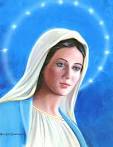
Mary

I stand here for a long while, thinking, wondering. The love I’d known both for and from the spiritual presence whom I called Mary found me and touched me in Egypt under names that were strange to me. But I do not now doubt that the love I experienced there had the same source. Nor do I now doubt that my life has been transformed by that love. This mystery seems to me now so deep, so vast, that I can’t begin to comprehend its ramifications for my life, for my faith, for the planet, for the universe. But a mystery does not ask for understanding. It asks only for trust. And trust is the gift I carry home from Egypt.

It is after three o’clock when I return to the Meditation Room where my friends are gathered, already excitedly making plans. Ellyn waves the Normandi Ellis book at me. “I’ve been reading this ever since Peg gave it to me just after lunch. It’s all here, what we were sharing together about how we were each connected to different aspects of the goddess, the sacred feminine. So here’s what we’ve been thinking. . .”

I listen, growing as excited as my friends. This is truly amazing, a last great gift from Egypt. “So, each of us will portray a face of the goddess, and invite everyone to carry aspects or gifts of the goddess out into the world?”

They nod enthusiastically. “Kathleen has agreed to portray Nephthys, Rosemary will be Ma’at, Suzanne will be Isis, I’ll be Hathor. . .” Ellyn pauses. “And you can represent—”
“. . . Sekhmet!” I am ridiculously pleased.

But there is something missing. “What about music?” I ask. “Shouldn’t there be dancing?”
I wait, and when no one else seems to have a suggestion, I say, “What about Tchaikovsky’s Sleeping Beauty? Remember that night at Sharms, watching a film of the ballet under the stars?”

And already others of our companions are arriving, ready to join in the planning.

(to be continued)

Sophia in Egypt: Thirty-Three

Remembering the Gifts of Egypt

When I pull open the large door to Garrison’s Meditation room, I see brilliant sunlight making its multi-coloured way through the stained glass windows, caressing the dark wood choir stalls on either side of the long room that was once a Monastic Chapel, echoing with psalmody. The sun spreads light over the toffee-coloured floor. Already our group has formed a circle at the front of the room, under the beatific smile of a golden Buddha, who sits at ease on the altar. I join the circle.

“Egypt was an experience of utter felicity,” Jean begins. “We entered sacred sites: tombs, temples, pyramids, reactivating spiritual energies that may have lain dormant for millennia. We know what we did there together: the rituals, the songs, the dances, the prayers, the promises we made to embrace a joyous fullness of life, a life of deep partnership with the masculine and feminine energies within and outside of us. We entered a sacred partnership with the Beloved for the healing and wholing of the planet.

“How do we strengthen this new story? How do we keep it alive in outrageous conditions? For the first time in human history, we have to think like a planet.

“That is the work for the rest of our lives. But for now, think about what happened for you personally in Egypt. What newness opened within you? What was birthed within you through your encounter with the spiritual energies of Egypt? What sacred places touched you most? I’m going to play Bruch’s first Violin Concerto. I need you to dance the answers to these questions.”

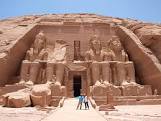
The sound system erupts with Bruch’s wondrous music and we dance, a dancing that takes us back to Egypt, deep inside our hearts and souls. I am again under the night sky at Abu Simbel, watching a shooting star; I am sitting on a rock wall on the Island of Philae as the earth rolls under the sun at the edge of the waters of the Nile; I am inside the tomb of the Pharaoh Queen Tausret, feeling immense tenderness embrace me as I gaze at the wall painting of an ibex. I see once more the glint of light in the eyes of Isis, in the wall painting; I am standing again before the statue of Sekhmet at Karnak, only now she is smiling, pleased I have finally let go of my fears, sent sorrow packing. My dancing is wilder, freer, more joyous, as though all the gifts of Egypt are reweaving themselves into my heart and soul.

As the music ends, Jean invites us to form groups to share what has returned to us during the dance. Suzanne, Rosemary, Kathleen, Ellyn and I gather chairs to form a circle.

Ellyn begins: “It was Hatshepsut who convened the Feasts of Light at Hathor’s temple at Dendera. That place held special meaning for me when we visited it. My name, Ellyn, means light.”

“Dendera,” I say now, remembering. “That’s where you were blowing the motes of light in the air towards Suzanne and me. You were filled with joy that night. ”

“I recognized a deep, energetic connection to Hathor. While we were visiting the Temple of Isis on the island of Philae before dawn, I focused my photography on the round face of Hathor on each pillar’s capital.” I watch Ellyn as she shares this, noticing that her face bears an uncanny resemblance to the carvings of the face of Hathor.

goddess-hathor

Hathor

“At the Temple of Horus in Edfu, there were many images of her in the birthing room,” Ellyn continues.

“The power spot for me at Edfu was the birthing room,” Suzanne adds. “A guard took me aside to show me an image of Isis breast-feeding Horus.”

“Kathleen,” I ask, “which face of the goddess do you identify with most?”

“Isis, I suppose. But also Sekhmet whom I encountered years ago on another trip with Jean. We were in France in the Louvre Museum. When I touched the statue of Sekhmet, I felt energy travelling from her hand and the ankh she held, up my own hand and arm. Why do you ask?”

“I think of you as Nephthys, the goddess of the in-between, of the dream time and of the other worlds, in touch with them, drawing them into our time,” I say. “And I know now that Ellyn relates most to Hathor, and Suzanne, I am guessing, to Isis. What about you, Rosemary?”

“For me, it’s also Isis,” Rosemary says.

“I see you especially as Isis in her role as Ma’at,” I say. “There were times on the trip when you spoke a truth I needed to hear.”

“Which face of the sacred feminine do you relate with?” Suzanne asks me.

“It surprises me to say this now, but it was the fierce Sekhmet who taught me what I most needed to learn,” I tell my friends. “There were times on the journey when I felt caught up in old grief, feelings I thought I’d long ago outgrown. Those were the times when I seemed to hear the voice of Sekhmet saying, Send sorrow packing! When we were in the tiny shrine in Karnak, I stood before the statue of Sekhmet, looked up at her fierce, tender, lion’s face, and prayed for strength to be my godded self. I asked for a fire within me that would become love given freely. And I knew at once that the gift demanded a price . . .” I stop here, wondering if I can share more.

XIR218945
Statue of the lion-headed goddess Sekhmet, from the Temple of Mut, Karnak, New Kingdom, c.1391-1353 BC (diorite)

“What was the price?” Kathleen asks, as calmly as if she were asking the price of a cup of coffee.

“I knew I had to give up my—” I pause, seeking the words—“my allurement to tragedy.”

I can see puzzled expressions on the faces of my friends. I smile to soften the words, “I’ve always believed more readily in darkness than in light, expected the worst in relationships, doubted love without constant reassurances . . .”

“So what does it mean to give that up?” Ellyn asks.

The answer that leaps to my mind is so clear that I am surprised as I answer. “Trust. Trust in love and joy. Trust that I am loved, that I can be a giver of love and joy to others.”

“That sounds like Hathor,” Ellyn says. “And it’s giving me an idea. What if we celebrated a ritual of gratitude tonight, for all that we’ve received from Egypt?”

This and the previous “Sophia in Egypt” posts are excerpts from Called to Egypt on the Back  of the Wind by Anne Kathleen McLaughlin, Borealis Press, Ottawa, Canada, 2013. To order online go to http://borealispress.com

Sophia in Egypt: Thirty-Two

Unpacking Egypt’s Gifts

With a thump, a rush of speed, a sudden stillness as engines cut, we are in New York. JFK Airport is a different kind of shock, like a dowsing in cold water. Part of me still feels the embrace of Egypt’s warm air, an atmosphere already moving into memory, into mythic time. Here amidst the jostling for position at the luggage carrels, then the locking of trolley wheels, the search for the customs exits, everything feels out of place, out of time, wrong. I am beside Ellyn when a woman in the uniform of security staff rudely orders her to hurry along. I see the look of shock on Ellyn’s face, realize she will not let this pass.

“We are human beings,” Ellyn says with quiet strength. She holds the woman’s gaze, but there is only bored insolence in those official eyes. I whisper calming words to Ellyn, hurrying her past the woman, seeing in memory the security guard in the Cairo Museum who gave me a thumbs up, a joyous smile. In this instant I know the impossibility of bringing our Egyptian experience back into a culture that hasn’t time for courtesy.

Somehow despite exhaustion, despite having flown backwards several hours in time, despite the culture shock of our arrival, our group manages to make its slow, ragged, luggage-burdened way to the transportation area. In the last light of afternoon, we find the bus that will return us to Garrison already waiting. The driver takes our luggage, stows it in the underbelly bins.

There is a quick headcount, each of us asked to look around, to be sure there is no one missing, and we are on our way. I close my eyes, lean against the headrest, try to sleep, grateful that we shall have time at Garrison to recollect the wonders of Egypt.

Though the journey can’t have been much more than an hour, the early darkness of late November is already enveloping the grounds and buildings of our beloved “Hogwarts” by the time we arrive. There is just enough light to see that the trees, radiant in autumn colours when we left, are now almost bare. But there is no evidence yet of snow, and the faint glint of light remaining on the surface of the Hudson River far below us shows that it has not yet frozen.

Inside, we check the list for our room assignments. Seasoned travellers that we now are, we stow our heavier luggage near the coat racks in the hallway, carry up to our rooms only a small bag with what we need for two nights. I have just made up my bed
with the crisp cotton sheets provided, hung my long cotton coat in the closet, and am making my way towards the washroom when I hear the gong announcing supper.

The long polished wood buffet table offers up a thick creamy mushroom soup, a salad of mixed greens, a steaming hot veggie lasagna. There is, as ever, a basket of homemade bread and wheat rolls, a plate of butter squares, a pitcher of iced peppermint tea. Beside the bread and rolls I see a dessert plate of chocolate brownies.

I call upon just enough energy to serve my plate, take a napkin and cutlery, and seek a place at one of the long wooden dining tables. I slide in along the polished bench
beside Kathleen, across from Ellyn and Rosemary. In a few minutes, Suzanne joins us. Suzanne can at least summon a smile, and say “the sounds of silence.” It’s true, I realize. Our whole group is here now in the dining room, and there is barely enough sound to vibrate the air. I see in my companions’ faces that we are all in a state of non-feeling, tiredness, the shock of arrival.

Slowly, as we are warmed and nourished by the food, life returns. Kathleen asks the question that has been on my mind as well. “What do you suppose we’ll be discussing when we gather with Jean and Peg?”

“I think we’ll need to have some sort of decompression exercise, like the astronauts,” Ellyn says. “A chance to speak about what we’ve learned and experienced.”

“Right now, I don’t think I could form a sentence, let alone say anything profound,” Rosemary says.

Suzanne and I are both agreeing when a voice says, “You won’t need to.” We look up to see Peg beside our table. “Jean is telling the groups at the other tables that it would be best to go to bed and have a good night’s sleep. We’ll gather at nine-thirty, immediately after breakfast.”

That night I fall into a deep sleep, after a brief ragged prayer that I might awaken with a feeling of gratitude. In a dream, I am with my travelling companions, all of us asleep in a sort of dormitory of narrow cots, with our belongings stowed under our beds. Jean wakens us, singing, “We are all made of stardust . . .” When the others have gotten up and gone to take showers, Jean hands me a huge ancient-looking iron key, like something out of a fairy tale.
“Have you written about this?” she asks me.
“You mean, made up a story?” I ask, uncertain.
“NO,” Jean responds with a fierceness that would not shame a fairy tale potentate. “I don’t want TALES. Write about your life as it weaves around this.”

When I do truly awaken, just after sunrise, it is to a world transformed. The light coming into my room from the direction of the Hudson River holds a memory . . . “Snow!” I must have said it out loud, climbing out of bed, moving to the window. Not stardust, but snow dust, a magic carpet, laid with exquisite care over tree and rock, river and roadway. The one magic that Egypt cannot create has fallen as we slept.

“Welcome home,” it whispers. And gratitude swells within me.

The level of sound at breakfast assures me that my companions have slept well. Not pomegranate seeds, but steaming porridge awaits us. I find Kathleen, wanting to share my dream.
“Why a key?” I ask her, “and write about WHAT???” But even as I ask, I think I know the answer.

Kathleen is thinking deeply. This is her milieu, her homeplace, the in-between place of dreams and words in the night, the subtle energies that weave in, around and between our lives. “Keys unlock things. Did Egypt unlock something in your life for you?”

“Yes,” I say, unwilling, unready to say more.

Kathleen smiles, her eyes telling me that she is hearing the more. “Then that’s what you need to write about.”

Sophia in Egypt: Thirty-One

On our final night in Egypt, the sacred Sufi dances of ecstasy end. A wilder, joyous exuberance takes over within our group, an explosion of emotion, of deep gratitude, sharpened by awareness of the approaching ending.
Some of our company have prepared songs, rituals, presentations to honour our leaders, Jean and Peg, to thank Mohamed for his provision of private time for us in sacred places where we might experience prayer and ritual and to show our gratitude to Samai, our guide through Egypt.
Soon the audience spills onto the stage, and the Sufis are offering lessons in dance and movement. I watch the wildness of dance, wishing I felt free enough to express all the feelings that dance within me.

After we board the bus to return to the Mena House, I pass by Jean. I ask her if there might be a moment to talk with her before we leave Egypt.
The next morning, at breakfast in the Mena House dining room, I look for Jean, see that she is in conversation with someone. I have left my request too late. We are to leave immediately after breakfast for the airport. There will not be time to speak
with her, to share this sense that things have somehow come together in me. I feel a sharp disappointment. I want this resolution to happen
here in Egypt. I want to leave Egypt whole.

I am walking away from the dining room when Jean joins me. “You wanted to talk? Sit with me on the bus to the airport.”

And so it is that as Cairo’s exquisite ornamented mosques and modern buildings march past the bus windows, like a speeded-up time film moving from past to present, I speak with Jean.

Cairo_tcm294-2363745

Cairo, Egypt

This time I am telling her a story, one I finally understand in my heart, can see in my soul, where its separate pieces are quilted together in a pattern: beautiful, harmonious,
whole.

I begin by diving into the deep end of the pool, trusting that Jean will understand if I frame my experience in terms of durative and punctual time. I speak of my experience of an ending in Mystery School, at the final session of the year before, when I had then no hope of returning. How I came home grieving, aware only when I thought it was over, how important Jean’s presence was in my life. How I had been walking in the
woods beside my home when quite suddenly without thought or intent, I was aware of her presence with me, so real that I could converse with her. And how that presence has returned at rare moments, offering me guidance, words of direction when I lose focus, most often when I am leading retreats, sessions in spirituality with women. I have come to know this as a profound gift of her presence in durative time.

Then I tell her how difficult it is for me to reconcile the real Jean in punctual time, whose energies must flow in so many directions, with the Jean who, in durative time, is wholly present to me. I share the sacred experience at sunset on the deck of the Moon
Goddess. I tell her how I spoke with her imaginal presence even as I saw her clearly across the deck, in conversation with someone else.

I pause. This all sounds rather strange even to my ears. I wonder if Jean can receive it.  I look at her, seeking some sign of understanding. I see attentive presence. I see calm receptiveness.

But I see too the woman whom I wrapped in a shawl because she was cold and grieving outside the tomb at Abu Simbel. I see the woman who one evening had fallen into an
exhausted sleep on the felucca that was taking us back to the Moon Goddess. Then, I had looked at her, as surprised as if a statue of Isis had suddenly closed her eyes and nodded off into sleep. That night when we left the felucca, I had guided her up
the steps to the ship, fearing she would fall asleep again on her
feet. Leonard Cohen’s words come to me now, something about
there being a crack in everything that lets the light in.

This is an ordinary human beside me, extraordinarily gifted,
yes, a woman who has opened her life to be a passageway for the
Holy. My glimpses of the Holy in her have drawn me to her. She
has become for me, especially here in Egypt, an experience of
the sacred feminine, real in a way that Isis or Sekhmet or Hathor
could not be. I feel a deep gratitude along with a searing awareness
that to demand, even to expect, more than a glimpse is unfair, unloving.

No one, no matter how wise and generous and loving, can live always  in a state of being awash with divinity. And in that instant of knowing, I realize something else. This is
a woman whom I would choose as a friend, someone whom I will support with prayer and grateful love all my days.

The journey from the Mena House to the airport takes about an hour, but I have now no sense of time. I know (I have been well taught!) that there will be enough time, all the time I need, so I unfold the whole story. And Jean listens, receives.

“You are a very loving person,” Jean says. “Is that what attracted you to religious life?”
I am startled into complete honesty. “No. I came to find love.”

Later, I will understand that these words are the essence of my journey to Egypt. I came to find love. Later, I will write this discovery in a poem:

Egypt is where I learned about love.
Not a lost coin, forever sought in vain,
Not a boon for which I begged, helpless, empty,
Not a burden I placed on others who could not receive.
Rather, a gift, poured into me from Love
Until, overflowing with joy, I poured it forth.

That is Egypt’s gift to me. I know it has its origins in the Love within the Universe that I have come to call the feminine face of God, the tender love that brought me here, that revealed itself in so many ways, as Isis, as Hathor, as Sekhmet, as Jean, in tomb and temple, in pyramids, in the depths of the Red Sea, here on the bus approaching the Cairo Airport.

Now I know in my whole being the call from that sacred presence to finally Send Sorrow Packing, to release the inauthentic constructs of sorrow that have
clouded my relationships. I feel the harmony of a symphony whose opening chords in September have moved through darkness and light, to finally resolve in closing notes of quiet beauty.

I feel held by love.

Sophia in Egypt: Thirty

In the late afternoon we gather in one of the hotel’s lounges for a session, the last we shall have in Egypt. Tomorrow morning the community will part, like the fronds in fireworks, each soaring through a different place in the sky. Some of the group will journey on to countries in Europe; others, will return home to their own countries. Our own group who gathered at Garrison will return there for a final session.

Jean has invited a Muslim woman, Aisha Rafel, a renowned scholar of modern-day Egypt, to speak to us. We have seen few women in our travels throughout Egypt, other than the young girls, wearing the hijab, offering smiling service in the perfume, papyrus and clothing shops. On that dark night when we travelled by horse and buggy through the streets of Luxor to the Temple, we saw clusters of men out walking, conversing, sitting in groups outside houses, but we only glimpsed a few women, swathed in layers of black, in the doorways of their homes.

An intelligent, peaceful presence, dressed with the self-confident ease of a twenty-first century professional, Aisha incarnates what she tells us of the Egyptian woman. I wonder at her words, for she speaks of holding within her memory an ancient culture where a woman might rule as Pharaoh. (I think of the tomb in the Valley of Kings, where we experienced the resonant trembling as we sang, where I felt the presence of the feminine holy. It was dedicated to Queen Tausret, a woman who ruled as pharaoh in the nineteenth dynasty. I think of Hatshepsut, of Cleopatra . . .)

Yet the Egyptian woman, Aisha tells us, also holds the reality of the Ottoman culture that followed, an Arab culture that had a very different concept of woman. In her calm wise presence, in her words, I see no trace of rebellion, of anger, of resentment.

This is a woman who knows who she is, and where her strength resides.

Briefly, she speaks of her work, her writing, which is focussed on seeking interfaith understanding among the Muslims and Coptic Christians of Egypt. Aisha’s goal is a unity where all are seen as one, and a diversity that respects difference.  “This is all we write about,” she says.

After Aisha leaves, Jean offers some concluding thoughts on our own journey into the still-breathing spirit of a culture that stretches back more than five thousand years. “Here you have come home to durative Egypt,” Jean tells us, “an archetypal reality, a quality of mind and presence that continues in the midst of punctual time.” This is an enduring reality that contributes to a rising spirituality. Everybody borrowed from ancient Egypt, “the source-place of spirituality, sensitivity, sensibility.”

“Did things happen for you here?” Jean asks us. “The human essence is being remembered through personal dramatization of the human psyche, a sense of picking up memory . . . I was here before. Take home the sense of the mystery that you received here, that really is implicit in you: things are as they seem and they are not. There is within you a coded reality. Egypt will never desert you.”

Our last day in Egypt is swallowed by night. Like exotic flowers that bloom only in darkness, we gather in the lobby of the Mena House, a flaring forth of colour, the women in shawls, flowered dresses, or long skirts, the men in loose brightly patterned tunics over trousers. Mohamed refuses to tell us where we are going for dinner, promising a surprise.

In the restaurant, somewhere in downtown Cairo, we find places at long tables that extend in vertical lines outwards from a large stage. The food is Egyptian, served on platters, plentiful and delicious. Eggplant slices to dip in hummus, warm soft flatbreads, roasted lamb and chicken, bowls of rice. We eat hungrily, wanting to take inside of us as much of Egypt as we can . . .

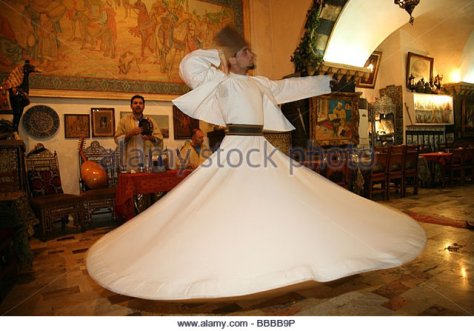
After we are sated with food, the performance begins. A man comes onto the stage dressed all in white, loose trousers, flowing tunic top. His dark luminous eyes, copper skin, raven wings of hair remind me of someone, of something . . . I realize he looks like a gypsy. Suddenly I understand the source of the generic name. He looks at us, his eyes full of joy. He begins a dance, accompanied by a singer, and four other men who play flutes, drums, other ancient sounding instruments. Slowly the dancer moves, circles, twirls . . . his eyes closed, his concentration rapt. He is dancing into ecstasy.


sufi-dancer-or-whirling-dervish-at-a-traditional-restaurant-damascus-bbbb9p

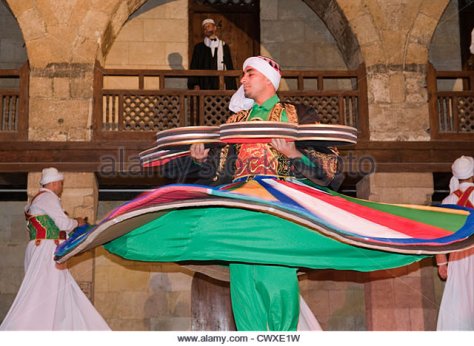
We are watching a Sufi dancer, a whirling dervish. It is spell-binding. We lose track of time, drawn into the majesty, into the beauty, into the other-place of the dance. Several young boys come onstage, wearing rainbow-hued tunics over their white robes. They enter into the dance and as the music swells, their colourful over-skirts twirl, lift up and over, becoming flying tents.

Watching, I am again in the King’s Chamber, and the feelings of that time arise within me, return in full force. The utter emptiness I felt, the sense of not being wanted, of being overlooked.

These emotions take over, filling my inner space.

Suddenly I recall a session in Mystery School at Garrison. Peg was speaking to us about Michael Singer’s book The Untethered Soul, about how there is within us a truer deeper self that is untouched by the pain of passing emotion. I try to recall the teaching, try to summon that untethered soul within me. As the overskirts twirl, lift, fly, my own soul uncertain, shy, eager, follows.

whirling dervish Sufi dancer

As the colourful tents are released into the air, some part of me is set free, an “I” who looks down upon that brooding presence in the King’s Chamber, knows that she is part of me, but not the deepest part of my soul. Slowly, slowly the pain clears. Slowly the happiness sidles in, and with it the hope that my prayers have been heard, my prayers that the Crocodile god Sobek would devour the darkness in me that prevents my loving freely, my prayers for the healing of the wounds of love that have been with me all my life. My senses, thoughts, feelings lift with
the music, the colour, the dance, transforming themselves into peace and recovered joy.

(from Called to Egypt on the Back of the Wind by Anne Kathleen McLaughlin Borealis Press Ottawa, Canada 2013) to order online go to: http://borealispress.com

Sophia in Egypt: Twenty -Nine

Inside the King’s Chamber (continued)

When everyone has been inside the sarcophagus, Jean invites us into a time of silence. I stay where I am, leaning against the base. I am neither praying nor thinking. Hope, desire, love… they seem to belong to another life, another time. I had read that sometimes initiates in this ceremony have felt an electrical charge surge through their bodies. I wonder if any of them had felt this utter nothingness. No thing ness.

Some words come at last, though I do not heed them, do not even know how to understand them. They are the stern, strong words I heard in the sanctuary of Isis, and before that in the ritual in our Community’s prayer room:  Send Sorrow Packing.

After an unmeasured time, I become aware of movement. My companions have begun to rise, to move towards the door. Peg is standing there, speaking to each one who leaves the chamber. I cannot hear what she is saying, but it sounds as though she is asking something. When I reach the door, Peg asks, “Anne Kathleen, is your heart now as light as a feather?”

Ah. It is the question put to the soul after death, when it is led to the great goddess of truth, its heart weighted against a feather on her scales. If the heart is heavier than that feather, the soul faces many difficult tasks ahead.

I know I should be able to say “yes”. But I cannot tell a lie to the goddess of truth. Because I cannot acknowledge the full truth, cannot bear to say “no”, I waver.

“It’s getting there,” I say, and walk out of the chamber, begin the descent.

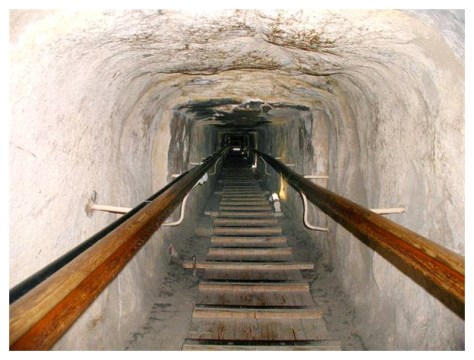
The way down is no less treacherous than the climb upwards has been, though less taxing on the breath. We move with great care, having to resist gravity, the pull to hurry down, perhaps to stumble, fall, collide with those ahead of us.

Pyramid of Giza Passage 39m 26 degrees

descent from the King’s Chamber

At last, still with backs bowed, we each emerge into the light, surprised to see the sun, surprised to see it is still morning. Surprised, too, to see a photographer with a serious-looking camera waiting to take a photo as each one of us appears.

The same photographer is now shepherding us into more or less tidy rows in front of the Great Pyramid. Jean comes to stand just behind me, and, though she has no shawl to place there, rests her hand lightly on my shoulder. I have the first feather-like hope that the deeper desire was also heard.

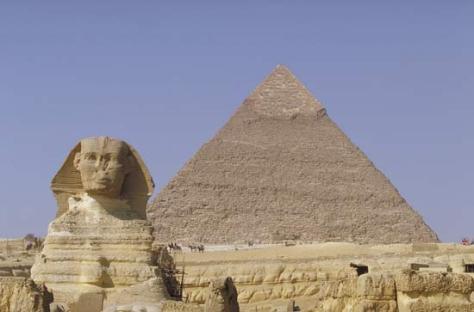
And in a beautiful play of Egyptian magic, the photo, when we receive it that evening, shows our group with the Sphinx, posing proudly behind us. Egyptian magic, assisted by photo-shop.

99590-004-9A5DCF21

We return to the Mena House where a late, longed-for, bounteous breakfast awaits. I join Suzanne at a table, and between mouthfuls of pomegranate, oranges, yogurt, sweet rolls and coffee, share my experience of the ritual, my feeling of being five years old, left out of the Christmas play. Suzanne tries to comfort me, saying that perhaps Valarie and Deirdre had offered to play the roles. I don’t believe this, though I appreciate Suzanne’s kindness in suggesting it. There is a pause.

Suddenly, I begin to smile, then to giggle, to laugh. The utter ridiculousness of my grief explodes within me, and soon we are both laughing, like schoolgirls.


We have the afternoon free to enjoy the hotel grounds, the glorious turquoise swimming pool. But Suzanne has a better idea. The Funky Store, where we shopped on our first day in Cairo, is just across the street from the hotel. Though Samai has warned us against leaving the hotel grounds, it seems the perfect way to leap over the traces, have a final Egyptian fling.  After all, I reason, if the Sphinx left me cold, and the King‘s Chamber left me empty, perhaps shopping will hold bliss.

We make our escape, walking easily out the front gate at the foot of the hotel’s entrance way. But when we see the store, our hearts waver. It beckons from the far side of a wide avenue that is alive with six erratic lanes of traffic. We stand still as small cars and trucks full of produce hurtle past.

Suddenly a uniformed Egyptian policeman is beside us. With knightly courtesy, he offers to assist us across.

Inside the store, I go directly to the place where the shawls hang in rich colours, in soft and silky fabrics. I choose two for friends, one in shades of turquoise and red, the other in a medley of greens. I check my remaining Egyptian pounds, decide I may choose one more.

I look for something that will draw me, something magical. Then I see it.  A white silken shawl patterned in the swirling rose I saw in my prayer to Isis. Some of my inner emptiness quietly fills.

We return to Mena House. I shall spend these final afternoon hours in Egyptian sunlight, first sitting beside the pool under the palm trees, writing in my journal, then swimming in the luscious tingling waters. The pool is as large as a ballroom, and I am the only dancer.

(If you are enjoying these excerpts from Called to Egypt on the Back of the Wind, why not go to http://borealipress.com to order the book?)