Category Archives: masculine/feminine balance

Sophia in Egypt: Ten

As we have been listening to the story of Isis and Osiris, the Moon Goddess has been carrying us down the Nile to Edfu, a journey of sixty-five miles. We don warmer layers. Tonight we are to make a private visit to the temple dedicated to Horus. Edfu is one of Egypt’s newer temples, built during the time of the Ptolemies after the conquest by Alexander the Great. It has been restored to magnificence, one of the greatest achievements of the Minister of Antiquities, Dr. Hawass.

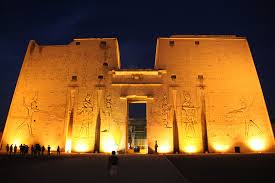
As we approach the temple we see it shimmering gold, majestic against the black night, lit from below with what might be a hundred torches. In another story, in another time, it would have been a fairytale castle. The ascending light illumines great carved figures stretching up along its outer walls. They call out their names, through the symbols they wear as crowns: Osiris, Seth, Horus… but I still cannot be certain who they are in the darkness of night, in my unknowing.
images

The Temple at Edfu

Inside, a statue of the falcon-headed god Horus, wearing a pharaoh’s crown, stands on a small pedestal, at our eye level, welcoming us to his temple.

horus-image

the falcon-headed god Horus


We wander through, find in one of the chambers the Sky Goddess Nut painted across the ceiling, her arms reaching along one side, her legs with a ballerina’s pointed toes, stretching to the other side. This is the first sight that would have greeted the dead king upon his awakening to eternal life. Nut would be there hovering above him, stars shining across her body. The Mother Goddess who births Ra at dawn and swallows him at dusk. The Mother Goddess who brings joy with sunrise, darkness with evening.


Samai shows us the Graeco-Roman bas-relief carvings, created by cutting around the figures, releasing them from stone. This requires great skill as it is far more difficult than cutting the figures into the stone. In one carving the king is wearing a transparent overskirt. Stone on stone with the delicacy of silk.

Some of the reliefs show parts of the story of Isis and Osiris, the great battles between Seth and Horus. Others show the annual festival of the first fruits at the time of the new moon which celebrated the sacred marriage of Horus and Hathor. The rejoicing lasted for fourteen days, until the waning of the full moon, when the statue of Hathor was returned to Dendera.

In the inner sanctuary we see the boat that was carried here by the king and the priests for the Celebration of the Royal Marriage. Made of wood, with poles on either side for ease in carrying, the boat is small, very like the conveyances used to carry statues of Mary in procession. On the front of the boat, a stone figurehead leans forward, wearing a carved pectoral, its once glorious colours faded to a small patch of blue.

“You are all here but your ancestors were here,” Jean Houston begins. “So we bring together the context of our ancestral lives. All of these things on the wall are the ancestral lives as they are coded not just to priests and priestesses, and kings and queens, but in the very gods, the great creative principles themselves…. Christ is certainly a descendent of Osiris. Buddha is a descendent of Thoth and so it goes, Athena of Neith, Mary of Hathor and of Isis. They’re all here and they’re here with us now.

“Look at your right hand and consider that to contain the world of the fathers, the males of the ancestry. Look at your left hand. Consider that to be the world of the mothers, and the grandmothers and the great grandmothers, going all the way back to those ancestors. Somehow between the worlds of the fathers on the right and the worlds of the mothers on the left, they got to meet each other, through the centuries, through the generations, yes, even through the millennia.
“Somehow they found each other to ultimately result in this unique pattern in space and time called you.

“We celebrate the coming together as we celebrate the coming together of Hathor and Horus, the coming together of your ancestral mothers and your ancestral fathers. But we do it with consciousness now.”

“We’ll meet them with their joyous meeting, their divine hieros gamos, their sacred marriage, their great conjunction.”

“Feel the merriment of the men and women finding each other, so that you may be. Feel the marriage celebrations, feel the birth of the babies, feel the dying and the reborning.

“ You are sending the message back to that world of the fathers on the right, and the world of the mothers on the left, and you are saying, Remember. Remember me. I come forth from you.”

For me, images of ancient Ireland replace those of Egypt, forefathers and foremothers going about the tasks of their daily lives, fisher folk, farmers, shepherds in that green land of soft mists, their faces bearing contours of my remembered aunts and uncles. I see Celtic versions of myself, a young woman in love, a storyteller, a wise older woman, a herbalist…

Jean invites us to look ahead to the future descendants of our bodies or our minds, receiving a blessing from them, accepting their gratitude for what we did for their lives. I think of my work, the deepening call to weave the new spirituality using the finest threads, the most brilliantly coloured, from the old in the pattern.

“So you are the term between, holding past and future, holding the ancestors. Then take the hand of the one in the future. Take the hand of the one in the past, and bring them here in the front of your heart and as with the knot of Isis, put those hands together. And world and time have been connected again, and in you.

“And from this moment forth, should you choose, you will have all of these great ones, small ones, low ones, mad ones, crazy ones, genius ones, children galore, all who have created you, together in you. And the wisdom and the essence of sheer livingness are contained in you now.

“We go out from here with a festival… a Sufi Islamic dance, to be done very slowly and very carefully. Right hand to right hand, and we’re going to sing. Our hands joined, we do a greeting dance, spinning in pairs in this small space, then joining hands in one great circle as we sing: All I ask of you is forever to remember me as loving you.”

After the ritual, there is more time to wander through the great temple, to take photos of the beautiful carvings. Gleaming golden in the soft lighting, carved in bas-relief, Hathor, goddess of love and joy, stands looking away from me as I take a photo.

(excerpt from  Called to Egypt on the Back of the Wind   Anne Kathleen McLaughlin Borealis Press Ottawa 2013 ( http://borealispress.com)

Celtic Festival of Lughnasadh

A woman’s voice with an unmistakable Irish lilt says, “In the Celtic Calendar, summer is already at an end. Do you know of Lughnasadh, the festival that welcomes Autumn? We celebrate it on August 1st.”

dolores-img

Dolores Whelan

The woman who is speaking is Dolores Whelan. Most of what I have learned about Celtic Festivals comes from her wonderful book, Ever Ancient, Ever New. Dolores has taught us about Brigid’s Festival, Imbolc, which ushers in Spring, and about the Winter and Summer Solstices, the Spring and Autumn Equinoxes, and the fiery Festival of Bealtaine….

“Shall I tell you of Lugh and his festival?”

For answer, we settle ourselves comfortably, awaiting the tale with eagerness.

“The Celtic god Lugh is known as the samildanach, the many-gifted one. Lugh represents the skilled masculine energy, with its ability to hone, shape, bring to harvest the fruits of the seeds planted at Samhain and nurtured during the dark giamos time by the feminine energy.


At Lughnasadh, as in many of the other festivals, the important dance of opposite energies and roles is beautifully expressed. Tailtiu, the foster mother of Lugh, is the goddess who cleared away the wilderness, making the plains and fields ready for crops to be grown. She died from her efforts and is also remembered at this time; Lugh is said to have inaugurated this festival in her honour.


“In the wheel of the Celtic Year, Lughnasadh stands directly opposite Imbolc, where Brigid, embodying the primal creative energy, occupied the central role. Bron Trogain, an older name for this festival, may mean the sorrow of Trogain or the sorrow of the fertile earth. This may mean that the fertility of the harvest is linked with the death that follows its completion, again bringing together the polarities of life and death. The successful harvest requires that Lugh appease his adversary, Crom Dubh, who represents the aspect of the land that does not wish to be harvested or subjected to the rule and energy of Lugh.


“The two-week Lughnasadh festival was a very important meeting time for the tribe, bringing people together to test their skills in many different disciplines. They challenged each other in a variety of contests and games held during the annual fairs in Lugh’s honour. The rituals at this festival included the acknowledgement of the triumph of Lugh, the harvesting and enjoyment of the first fruits, and the acknowledgement of the end of summer. It was a time of great merriment, especially for young people, who wore garlands of flowers and went into the hills to pick bilberries or blueberries. Marriages were traditionally held at this time of year.


“High places in the land, where earth and sky met, were considered the appropriate place to honour Lugh. At the ritual site, many of the characteristics and gifts of Lugh were enacted by mummers. The first sheaf of wheat, barley or corn was ceremonially cut, milled, and baked into cakes. These were eaten along with the wild blueberries or bilberries. The young folks’ garlands of flowers were buried to signify the end of summer.”

Dolores pauses as we take this in.

One of the younger women says, “It seems so sad. Burying the garlands, such a sad ending to the beauty of summer.”

Dolores turns to her, and says gently, “In the wheel of the Celtic year there is no ending that is not also a new beginning. Remember that when the bright days of the masculine summer fade, diminish, we are getting ready to welcome Samhain, the season of the feminine winter. The days of womb-like preparation, the dark days of incubation that will themselves end with Brigid’s Festival of Imbolc on February 1st welcoming Spring.”


Another asks, “Is Lughnasadh still celebrated in Ireland?”


“Many of these ritual practices have died out,” Dolores tells her, “but an essential aspect of the Lughnasadh ritual is enacted each year with the annual pilgrimage to Croagh Patrick in County Mayo on the last Sunday of July. Puck Fair held in Kilorglin in County Kerry each August is another remnant of the Lughnasadh festival.”

Someone calls out, “Look. Up there on the high ground. It must be the setting sun, but it looks like someone has lit a bonfire!”

We are all gazing westward up towards the hill. Something flames there.

When Dolores speaks, her voice is so soft that we almost miss her words:
“That is no fire, nor is it a sunset. That is Lugh, come to bless you, to promise to bring to fruition and harvest the seeds you yourselves planted in the dark engendering days of the long winter. Take his blessing with you until we meet here again.”


Lugh

Lugh: Celtic God of Creativity


Ritual for Bealtaine May 1st

For the Celtic Festival of Bealtaine on May 1st, I created with some friends a ritual which we imagined taking place on the sacred island of Iona in the North Atlantic. I offer it to you for your own adaptation in this first week of May. Anne Kathleen
In the pre-dawn darkness we make our way into the circle of grass embraced by the low stone walls of the ruined nunnery on Iona. We have never before been here before the sun, never seen our companions like this: darker shadows against a grey sky. It is utterly still, without even the movement of light wind that heralds the sun.


F1010015

the garden of the ruined nunnery on Iona

Each of us has brought dry sticks, bits of gathered grass and heather and this we pile on the wood that awaits the Bealtaine fire.

On the edge of a cliff across the island is a pool that has been known for its spiritual power. Two of our companions, Shirley and Suzanne who have a deep affinity for water, who work for its healing throughout the planet, went there yesterday to collect water for our ritual. The large clay pitcher they carried back sits beside the readied fire.


F1000009

where they went


When all of us have gathered, we stand in a circle facing towards the east. We chant: “Look to the East where promise is born; look to the East where the sun brings the morn.” Slowly, slowly, as we repeat the chant, the grey of the sky warms into shades of pale seashell pink, deepening into soft rose then into deep rose madder. Slowly, slowly, the golden orb of the sun appears to be pushing itself up above the horizon. In such a way, we who know it is in fact the earth on which we stand that is rolling towards the sun, we still experience the moment as did our ancient ancestors. We still speak of a rising sun.


At the moment when the sun becomes visible, Mary Ellen lights the fire, and as the sun’s light ripples on the water in the clay container, we come forward, one by one, to splash the water over our faces. Then with the water still wet upon us, we stand in the rays of the rising sun. The sun blesses us, blesses the water upon us. As we feel the warmth that come from sun and fire, and the wetness from the water, we ask for a harmony within us of the masculine/sun/fire energies and the feminine/water energies.


By the time all thirty women have completed the ritual, the garden is glowing with the full golden light of morning. Now that it is warm enough to sit down, we gather in a circle. There is a lightness in our hearts that bubbles up in spontaneous laughter. Someone begins to sing, “Morning has broken…” and we join in.

Kathleen has brought the Celtic Calendar that Dolores Whelan created, as well as Dolores’ book, Ever Ancient, Ever New, and offers Reflection questions based on the rituals we have just done:

What negativity left over from winter do I now release into the Bealtaine fires so that my heart is ready for the newness of life and work at this season?

What new fertility in my life, in my projects, do I welcome in the form of the young mother of early summer?

How shall I honour the harmony of fire and water, the masculine and feminine energies working within the land, within myself, within the work that I am called to birth?

Kathleen invites us to take these questions into our hearts as we end our time here with the Bealtaine prayer from the Celtic Calendar:

May I/we embrace the support of the blossoming life force and growing light as I/we step boldly into the world to express my/our creativity.

Brigid and the Celtic Festival of Bealtaine

As one of the threefold goddesses, Brigid is honoured as Maiden, Mother and Crone. We began our reflections on Brigid with the Feast of Imbolc, February 1st, when Brigid in her Maiden form emerges to breathe life into the mouth of dead winter. We have reflected on Brigid in her Crone presence, the Cailleach who brings about transformation for our lives, for our planet, when we submit ourselves to the slow processes of her cauldron. With the Celtic Feast of Bealtaine, May 1st, we conclude this time with Brigid.

Bealtaine ushers in the full richness of summer, the active sun-drenched days of masculine energy. At Bealtaine, we welcome Brigid in the third aspect, in her embodiment of the Mother.

Bealtaine is a mingling of three themes:

(1) purification by fire
In ancient times, the cattle who had been kept indoors all winter were walked through the fires in preparation for their move to the summer pastures; in our time we need to be purified from any negativity that remains from winter that might interfere with the blossoming of our lives and our work;

(2) the flower maiden
The young mother represents the fertility of the land goddess. She was honoured with flowers strewn on altars, on doorsteps, on rooftops invoking fertility in all aspects of one’s life; altars were built and heaped with flowers; children walked and sang in joyous processing carrying flowers;

(3) sacred marriage of masculine and feminine energies
The Maypole rituals celebrate the young god of summer who woos the flower maiden away from the winter king and marries her; the masculine energy serves the seeds sown and nurtured by the feminine energies through the winter.

Rituals of Bealtaine celebrate the harmonious working together of masculine and feminine energies. As Dolores Whelan writes:
In the Celtic tradition, the masculine and feminine energies are represented by fire and water and are considered to be most effective when they act together in harmony with each other. On May morning, it was customary for people to go to the top of a hill before sunrise, light fires in honour of the sun, and bathe in the rays of the sun as it rose on the first day of summer. They washed their faces in the morning dew, which was considered a magical substance as it consisted of fire and water, capable of ensuring youth and vitality. Others went to holy wells and drank the water or poured water over themselves as the rays of the rising sun hit the water. All of these customs and rituals reflect this power of water and fire working together and the potency of masculine and feminine energy working in harmony within the land, a person, or a project.
(Dolores Whelan Ever Ancient, Ever New 2010 p. 114)
Until the mid-years of the twentieth century, Catholic school children walked in joyous processions honouring Mary as “Queen of the May”, unaware that this ceremony had origins that went back to the ancient Mayday rituals honouring the Goddess. Dressed in their best clothes, walking in the sunlight of late spring, they lifted their voices in melodious hymns to Mary: Bring flowers of the fairest, bring flowers of the rarest, from garden and woodland and hillside and dale; our full hearts are swelling, our glad voices telling, the praise of the loveliest rose of the vale. Oh Mary, we crown thee with blossoms today, Queen of the Angels, Queen of the May… 

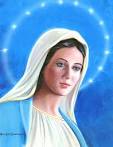
Mary


The powerful presence of Mary as Mother in the Catholic Christian tradition may have overshadowed this third aspect of Brigid.

Irish theologian Mary Condren makes reference to Brigid as Mother: Brigit’s symbolism is firmly maternal, nourishing, protecting, spinning and weaving the bonds of human community, but it is maternal in the broadest sense of that word in that Brigit’s traditions fostered … maternal thinking… (refusing) to do in the public world what would not be acceptable in the home. Brigit constantly bridged the worlds of nature and culture: her traditions aim to bridge the world of public and private and to keep the life force moving rather than allowing it to stagnate….Her traditions speak of an approach to sacrality intimately connected with relationships rather than splitting.
In keeping with her maternal aspects, the predominant fluid for Brigit is milk, the milk of human kindness. The milk of the Sacred Cow was one of the earliest sacred foods throughout the world, equivalent to our present day Holy Communion. In historical times it was said that the Abbesses of Kildare (Brigit’s successors) could drink only from the milk of the White Cow. The same milk was also believed to provide an antidote to the poison of weapons.

Milk represented the ideal form of all food for its purity and nourishment. Mother’s milk was especially valuable and was believed to have curative powers…Brigit was even said to have been baptized in milk. Baptisms in milk were practised by the Irish until the practice was banned by the Synod of Cashel in 1171.
….
Whereas Brigit’s traditions had insisted on creating, maintaining, and healing relationships through the power of her artefacts, imagery, stories and rituals, the rising power of the father gods depended on their establishing or maintaining their positions by threatening to, or actually sacrificing their children. Not surprisingly, therefore, when Brigit’s traditions were overthrown, maternal milk was replaced by bloodshed, not in the course of the life cycle – childbirth or menstruation – but in the voluntary giving or taking of life, in various forms of sacrifice.
(Mary Condren in “Brigit, Matron of Poetry, Healing, Smithwork and Mercy”, Journal of the European Society of Women in Theological Research 18, 2010)

Brigid as Mother challenges us to restore to our rituals, our communities, our nations and our planet a sense of the sacred that is relational rather than divisive and to replace the flow of sacrificial blood in conflict with the milk of mutual respect and nurturing.


May we celebrate Bealtaine with joy, as we welcome the masculine energy of activity, the bright sun that will nourish and call forth the seeds of new life we planted in the dark and quiet days of the feminine energy time.

Perhaps we will be drawn on May 1st to rise before dawn, climb a hill, light a fire to welcome the sunrise, then wash our faces in the morning dew. Thus we symbolically embrace masculine (fire) energies and feminine (water) energies, inviting both to dwell in harmony within us and throughout our planet.

Brigid and Spring Equinox

In mid-morning of March 21st, we walk from our hotel to the garden where we sat with Brigid on our first visit. She is here already, seated beside the pool of water, expecting us. Her smile warms the air of this spring day, this day of equinox. Following her lead, we too breathe in the fragrance of earth, of violets, daffodils, foxglove, and trees whose young leaves are ready to burst outwards.

With a gesture of welcome, Brigid invites us to sit near her where the early grass softens the earth beside the pool.
“Today we need to speak of the equinox,” Brigid begins. “Do you know its meaning?”

A few of us exchange glances. Every child knows what equinox means, and yet Brigid waits, expecting a response.“It means that day and night are of equal length after the short days and long dark nights of winter,” one of us responds, politely.

Brigid smiles. I have the uncomfortable feeling that she knows exactly what we are thinking. “That’s a good answer, as far it goes,” she says now. “But did you not understand our last conversation? You and I and all that lives upon our beautiful planet are part of her. Our lives, our bodies, our souls, our spirits are one with her rhythms, her seasons. Since this is so, what meaning does equinox hold for us?”

“Is it about balance?” someone ventures.

At this, Brigid smiles. Mischievously, I think. “Balance, yes. But balance of what?”

“Light and darkness,” I say, growing increasingly uncomfortable as I wonder what Brigid is up to, if she is playing with us, trying to trip us up in our knowledge of the earth.Spurred by this thought, I rush on, “it is the balance of light and darkness that shows us that spring is coming. Longer days mean that the earth will soon be bursting with new life. And also,” I add this with some pride as I have only just learned it myself, “it is the increase in daylight that draws the birds back from the south.”

But Brigid appears unimpressed. “I don’t think you really understand about the equinox. You are describing what you see around you. My question is about what is happening within you.”

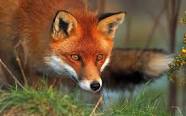
Suddenly a fox emerges from the bushes beyond the garden. It walks with soft steps, unswervingly, towards Brigid. Though her back is to the fox, though she could not possibly see the delicate animal, Brigid stretches her hand towards the fox, calling out, “Come, my friend. Meet some people who have a great deal to learn.”download

We who were frozen in fear at the appearance of the fox, watch now in amazement as the small animal comes to sit, composed, peaceful, at Brigid’s feet.

“Your Celtic ancestors,” Brigid continues, as she strokes the fox’s fur with her hand, “like indigenous peoples everywhere, experienced time as circular. They danced to its rhythm: night gave birth to dawn and day blossomed before it waned into evening, back into night.

“Our ancestors watched the cycles of the moon, the turning of the tides. The women noticed how the rhythms of their own bodies, their regular times of bleeding, followed the moon’s rhythms. No wonder they felt at home in the universe, embraced by the earth.

“Because they saw their lives as part of the great cycle of life, the Celtic people created a calendar that marked the seasons of the year, dividing the year into two major parts related to the sun’s light: giamos and samos. They celebrated eight festivals that were about 45 days apart.

Because they understood that it is darkness that gives birth to light, their year opened with the Festival of Samhain, November 1st, where the dark days begin. These are the days of inwardness, receptivity, the time that came to be known as feminine. Here the pace slows, linear time recedes, the intuitive is honoured over the rational. With the Festival of Bealtaine, on May 1st, the bright masculine sun days begin, the samos time of outer activity when the seeds nourished through the dark days blossom into new life. The linear, analytic, rational way dominates once again.

“ In the Celtic Calendar, the Spring Equinox occurs halfway between the Winter and Summer Solstices. It is the festival just before Bealtaine, when the feminine season ends, and the masculine begins.

“Now can you see a deeper meaning for the equinox? It is an invitation to find a new balance within our lives, within our cultures and throughout the planet, of these masculine and feminine energies that so often are in opposition. It is a time to choose how we shall hold the values of the dark time of the goddess even as the bright active masculine takes over in our lives.

“How will you choose to honour the feminine intuitive gifts of the moon time in the days when the sun calls forth your logical, rational gifts? Will you make a space in these busier days for quiet reflection, for remembering your winter dreams, for poetry, music, drawing, dance or whatever nourishes your inward life? Will you seek a finer balance of work and recreation, of times with family and friends as well as times of solitude? Will you consider how the dance of opposites in your own life might flow in rhythm, even as it does in the Celtic Calendar?

“These are important questions, dear friends. I hope you will consider them in the time until we meet here again.

“If we could enter into the ancient ones’ understanding of time, the rhythms of our lives would take on sacred meaning. Our times of inner darkness would hold the promise of a dawn of new joy. Our losses would be seen as invitations to embrace other gifts, our death as birth into a new as yet unimagined life.”

And with those words, Brigid is gone, her fox companion with her!
We are left here by the pool, thinking, wondering.