
Category Archives: St. Catharine’s Monastery

Sophia in Egypt Twenty-Five

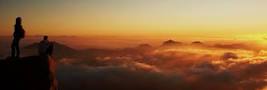
I sleep deeply for a few hours, not hearing the sounds of those who waken at 1:30 to set out to watch the sunrise on Mount Sinai. Sometime around three I am awake, awash in old fears and darkness. I call out for help, hardly knowing to whom I cry. I sleep again, waken in time to watch the sunrise from the window of my cabin. As I gaze at the glowing light in the eastern sky above the mountains, some peace, some joy trickles back into my soul.
mount-sinai-sunrise

sunrise from Mount Sinai

I recall a moment from yesterday’s visit to the Monastery of St. Catharine. Tiredness had emptied me of joy, and I found myself looking at the radiance of others, sensing I lacked some essential quality of openness, of wonder. Walking away from the monastery towards our bus, I fell in step with one of the men in our group, Arthur. “I see a glow about you… I just wanted to tell you that.” In that moment of inner darkness, his words were like a cup of cool white wine to me. In this dawn moment, I wonder now what prompted him to say that. I feel graced, knowing that some loving presence saw my need, reached out to me through Arthur.

My companions slowly drift back from their odyssey, arriving at breakfast with stories of the stunning views of the sunrise, and many adventures on camels, on foot. Suzanne is glowing with the experience, rode a camel part way up the mountain. At least my coat got to ride a camel! She has brought me a stone from Mount Sinai which I treasure.

It is two hours before everyone has finally returned, and a further wait as the last arrivals hurry to shower, to pack up, to prepare for our departure. Michael, the young doctor in our group, is suddenly standing near me, just outside the dining lodge. His face is a mask of regret, disappointment, something even darker.

“I wanted to go,” he says. “I really wanted to climb Mount Sinai. But I didn’t get a wake-up call, and missed the whole thing.”

I feel his deep distress, reach for something that might ease it. “Maybe you just needed some extra sleep,” I offer.

“No,” he says, angrily. “The Hebrew God really has it in for me. I know it.”
I am appalled at this. “Michael, we are held in love. I can see how tired you are, that you need rest. Why wouldn’t God see it too, and give you what you needed most?”

I can see that my words are not enough to overturn a lifetime of such thinking.

When at last the bus pulls away, Jean tells us we have an option : those who’d like to return to the Monastery to see the icons will be dropped off first, while the others will go on to a market where the Bedouins sell their handicrafts. I picture glorious woven shawls, rare carvings, the chance to meet these strange and elusive people. Then I think about the sacred icons that Jean has spoken about.

I feel unable to make a choice. I am sitting with Rosemary, and tell her my dilemma.

With her usual practical wisdom, Rosemary asks, “Do you plan to do any more shopping?”

Of course not. I have my Isis bracelet, gifts for my family and a few friends. “No,” I say, suddenly relieved and clear.

In the morning light, as we stand in the courtyard of the Monastery before the flowering bush with its flame-coloured flowers, my heart softens. I am open to the possibility that this is a descendant or relative of the Burning Bush that Moses encountered. The Holy One has chosen stranger places from which to speak…

Jean stands with our small group, invites us into a time of quiet meditation, suggests that we pray for healing for ourselves and for our world. For myself, I pray for the healing that has been the recurring theme of this journey, a healing of the wound which opens whenever I am drawn to love someone deeply. For the earth, I pray for the rising of feminine energy everywhere to heal and renew life. This morning the Monastery has a sacred feel to it.

Inside the Monastery we are allowed to enter the chapel to see the icons. I remember the heart-stopping beauty of a small collection of Greek icons I’d seen at Ottawa’s Museum of Civilization. There’d been one of the Madonna and Child that had captivated me there. I begin searching the walls aware that the icons here are dark, have a grimy appearance, as though the dust of centuries has been allowed to settle on them. But the piercing awareness of the eyes that look back at me from each painting soon makes me forget dust. And everything else. I feel drawn to an icon of Jesus, but as I look more closely what is emanating from the eyes is not love but fierceness, a force.


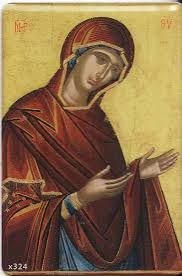
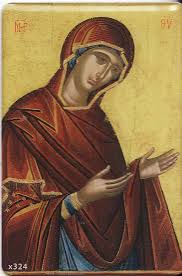
Two of Mary are compelling. One is the icon that I’ve known since childhood under the title, “Mother of Perpetual Help”. In another, Mary is holding out her arms as though embracing a child, but there is no child. I spend a long time standing before this image, wanting to be the one for whom her arms are reaching.
images

Icon of Mary, with arms open

Today, November 21st, is a feast of Mary, recalling her Presentation in the Temple when she was a child.
Sophia in Egypt Twenty-Four

Suddenly the mirage that was Sharm el Sheikh has disappeared and our bus makes its dusty way towards the Sinai Desert, passing the rough rock- built Bedouin homes, clustered together in small villages as though for protection against the harsh reality of sand, stone, sun and mountain. I become aware of a shift in mood, of tension on our guide’s face, of whispered conversations, of long unexplained delays as we move deeper into the Sinai. Only later will we come to know that border skirmishes with Israel, involving the Bedouins, have very nearly scuttled our journey.

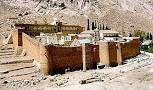
We arrive safely and without incident at the base of the long hill that climbs upwards towards the Greek Orthodox Monastery of Saint Catharine of Alexandria. Here the bus rests as we climb, gazing up at what looks like a fortified medieval town, protected by walls of sand-coloured stone that soar upwards to a height of perhaps eighty feet. St. Catharine’s is one of the oldest Christian Monasteries on the planet.

monastery-2

Saint Catharine’s Monastery


Tradition says it was on this height of land that God called out to Moses from a burning bush. Inside the walls, we go first to the place where, just above our heads, a rose bush, a hardy, long-lived strain native to the Sinai, spills out in blossoming welcome. The Monastery has a continual supply of fresh water from the Well of Moses which taps an underground spring. It is traditionally held to be the well where Moses met his future wife, Zipporah.

Helena, mother of the Emperor Constantine, was so impressed by the sacredness of this place that in the year 330 she had a small chapel built on the site, dedicated to the Blessed Virgin Mary. In 530, Emperor Justinian had a much larger basilica constructed, the Church of the Transfiguration. From that time, the monastery took on the character of a walled city. The Prophet Mohammed also visited the monastery, giving the place his personal pledge of protection.

Our delayed journey has brought us here outside visiting hours. Of the monastic community in residence, we see only a sandaled foot, a wind-whipped robe, as the men pass by. Like children outside a candy store, we peer through the darkened windows of the locked chapel door, trying to catch a glimpse of the magnificent icons on the walls. Jean is determined that we shall not miss this wonder, arranges a visit on the following morning. I am feeling heavy, tired, not open to this experience. Knowing there’ll be a second chance tomorrow feels like a reprieve.

Full darkness has risen like a cloak over earth and sky by the time we reach our accommodations. We emerge from the bus onto flat rock-strewn sand that spreads itself in homage at the feet of towering mountains of ancient, weather-sculpted stone. One of those hovering shadows is the place where Moses received the commandments of Yahweh. Tomorrow at dawn we’ll be there….

Tonight however, we make our way along paths that intersect a series of small stone dwellings, looking for the numbers we’ve been given that identify our lodgings for the night. Once settled, with time for a quick shower, a change of clothing, we gather in one of the larger buildings, a conference centre. Jean tells the story of Moses who led the Israelites out of Egypt, escaping the pursuing armies of Pharaoh.

Which Pharaoh?

For the first time, the question is an important one for me. What I have learned of Egypt gives a different weight to the Biblical story. Jean responds that most scholars believe it was Ramses the Second, the thirteenth-century BCE pharaoh who ruled Egypt for more than sixty-five years, whose statues and temples dominate the Egyptian landscape.

The theological questions are interesting. The Egyptians had honoured many gods, had, as we had learned earlier, gods or neters for almost every human activity, every need. They lived in an atmosphere where the spirit of the gods filled their lives. In the fourteenth century BCE, the Egyptian Pharaoh, Amenhotep IV, declared that God is One, the sun god, Aten. He changed his name to Akhenaten, and moved the capital of Egypt from Thebes to the newly-built city of Akhetaten (Tell -el- Amarna) to honour the Sun god. But his beliefs were widely opposed, and after his death his monuments were destroyed, his name removed from statues and reliefs.

Moses and the Israelites worshipped One God whom they knew as Yahweh.
Patriarchal Religion began here on Mount Sinai, a name that means “Moon”, suggesting the mountain may once have been a site of goddess worship.

From the conference building, we make our way across the rocky ground up a low hill to the building where supper is waiting. The large undecorated room echoes with voices of other groups who are here, including some Canadians on their way to Israel. The place has the look and feel of a hunting lodge. We take plates and fill them with from a table of basic foods, eggs, beans, bread. We find places on wooden benches at long tables. Conversation turns to plans to climb Mount Sinai. As the sunrise from the 7,500 foot summit is spectacular, and the climb will take two and a half hours on foot, less for those who are ready to pay for a camel for the journey, wake-up calls are arranged for one-thirty a.m.

Sunrise on Mount Sinai. A camel ride. Surely this is one of the highlights of the journey. Yet, when Jean asks whether I want to go, I feel uncertain, respond crossly, “I haven’t decided”. I am aching with fatigue, but there is something deeper, something harder to acknowledge. Egypt has shifted my spirituality away from patriarchs, from commandments carved on stone, from arduous climbs so beloved by the ascetics of my faith. Memories, sensations return of the more feminine spiritual experiences I have had on this journey: the magnificent coral, the rainbow coloured fish I saw under the Red Sea, the moment in a tomb, in the Valley of the Kings, when I felt a sweep of tenderness beside a wall painting of an ibex….I cannot summon desire to make this pilgrimage.

But those who plan to go are eager. The night will cool down considerably and there is a flurry of borrowing jackets or sweaters. Suzanne needs something warm to wear, and I offer her the long cotton coat I’ve brought. It feels like a blessing. Part of me at least will go with her. My last tinges of regret dissolve.
Jean herself will not go. From within my own fatigue I can see how tired she is. But she will stay awake, keeping vigil for those who are making the climb.
“Take care of one another,” Jean says.

mount-sinai2-sunrise

Sunrise from Mount Sinai