
We’ve come to the Stillpoint House of Prayer to honour the early November Feast of Samhain: the Celtic New Year. Eight women friends who’ve been gathering since the Summer Solstice of 2023 to celebrate the Earth Festivals, our gatherings follow a pattern, weaving poetry, music, dance, and ancient story. We share experiences of joy, growing edges, challenges leading to a ritual which allows us to ground the focus of each festival in our bodies, our hearts, our souls.
On the second day of our gathering, November 6th, we waken to a pall of darkness as news of US Election results creeps into our awareness. We continue with our plans for the day, reflecting on inner light, on the wisdom of our crone years, on our preparations for the ritual when we shall place in the Cauldron of the Cailleach whatever in our lives is raw and unpalatable, requiring transformation through water and fire.

As we await the coming of darkness, our mood is shifting. Perhaps the day’s late autumn warmth, the way the river shines silver in the waning light, or maybe the glowing crescent of the rising moon…. Reminders of the beauty on the planet restore calmness. One of the women offers to read something called “Storm on the Lake” from the writings of Teilhard de Chardin:
At every moment the vast and horrible Thing breaks in upon us through the crevices and invades our precarious dwelling-place, that Thing we try so hard to forget but which is always there, separated from us only by thin dividing walls: fire, pestilence, earthquake, storm, the unleashing of dark moral forces, all these sweep away ruthlessly, in an instant, what we had laboured with mind and heart to build up and make beautiful..…
Lord God… lest I succumb to the temptation to curse the universe, and the Maker of the universe, teach me to adore it by seeing you hidden within it….If only we will it to be so, the immense and sombre Thing, the spectre, the tempest—is you.
“It is I, fear not.”(Mark 6:50; Luke 24:36). All things in life that fill us with dread, all that filled your own heart with dismay in the garden of agony: all, in the last resort, are… appearances, the matter, of one and the same sacrament.

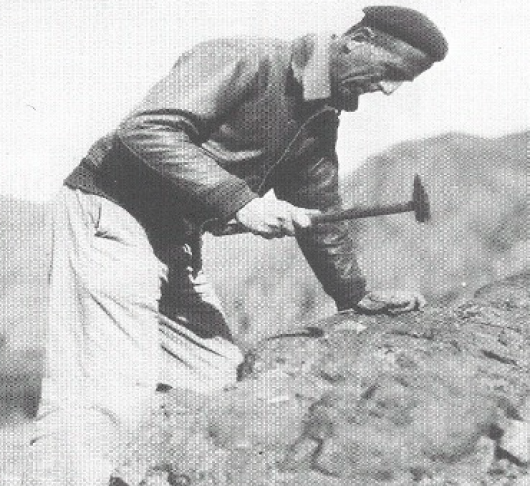
Returning home from our Samhain Retreat, I search among Teilhard’s teachings for further light. In my library, I find the book I seek: Teilhard to Omega Ilia Delio, ed. (Orbis Books, Maryknoll, NY, 2014) In an essay by John Haught, “Teilhard de Chardin: Theology for an Unfinished Universe”, words leap out at me: “For Teilhard, autumn rather than spring was the happiest time of year.” Intrigued, I read on: “It is almost as though the shedding of leaves opened his soul to the limitless space of the up-ahead and the not-yet, liberating him from the siren charms of terrestrial spring and summer.”
A scientist, a mystic, rather than a theologian, Teilhard deplored the way that theology continued to reflect on God as though the scientific fact of a still –emerging universe was either unknown or irrelevant. Almost seventy years after Teilhard’s death, theologians are still engaged in the work of re-imagining a God who calls us forward into an as-yet-unknown reality. And yet, even a limited grasp, a glimpse, of what Teilhard saw of the “up- ahead and the not-yet” is enough to inspire hope.
Neither scientist nor theologian, I am a storyteller. I know how a change in the story has power to alter and illuminate our lives. Changing the story that once shaped our lives changes everything. If we live in a story of a completed universe where once upon a perfect time our first parents, ecstatically happy in a garden of unimaginable beauty, destroyed everything by sin, what have we to hope for? The best is already irretrievably lost. Under sentence of their guilt we can only struggle through our lives, seeking forgiveness, trusting in redemption, saved only at a terrible cost to the One who came to suffer and die for us. The suffering around us still speaks to us of punishment for that first sin, burdening us with the effort of continuing to pay for it with our lives. Despair and guilt are constant companions. Hope in that story rests in release from the suffering through death.
Yet, if we live the story as Teilhard saw it, seeing ourselves in an unfinished universe that is still coming into being, everything changes. In a cosmos that is still a work in progress, we are called to be co-creators, moving with the universe into a future filled with hope. Our human hearts long for joy. The possibility that there could be peace, reconciliation, compassion, mercy and justice to an increasing degree on our planet is a profound incentive for us to work with all our energy for the growth of these values. The call to co-create in an unfinished universe broadens and deepens our responsibility:
The Love that rules the stars will now have to be seen as embracing two hundred billion galaxies, a cosmic epic of fourteen billion years’ duration, and perhaps even a multiverse. Our thoughts about Christ and redemption will have to extend over the full breadth of cosmic time and space. (Haught, 13)

Haught believes that “if hope is to have wings and life to have zest,” we need a new theological vision that “opens up a new future for the world.” For Teilhard that future was convergence into God. His hope was founded in the future for he grasped the evolutionary truth that the past has been an increasing complexity of life endowed with “spirit”.
Teilhard saw God as creating the world by drawing it from up ahead, so that the really real is to be sought in the not yet. And this means that:
The question of suffering, while still intractable, opens up a new horizon of hope when viewed in terms of an unfinished and hence still unperfected universe. (19)
Haught believes that the concept of an unfinished universe can strengthen hope and love:
…the fullest release of human love is realistically possible only if the created world still has possibilities that have never before been realized….Only if the beloved still has a future can there be an unreserved commitment to the practice of charity, justice and compassion. (19)
We live today on the edge of planet-wide climate disaster. In the midst of recent ravages by hurricanes, floods, tornadoes and droughts, UN Secretary General Antonio Guterres said that Earth is crying out to us, “but we are not listening.”
Working together communally, nationally, and internationally we can face this moment with courage. The path has been set before us by scientists, by leaders in the ecological movement, by writers and thinkers who have known what is coming. If we are appalled by the failures of international organizations and governments, we can still do our part, creating sanity within our own circles.
The sacred season that follows Samhain, the feminine womb-time of darkness, is the time of the Cailleach, the Ancient Crone, the dark mother who calls on us to change our ways, to turn away from destructive behaviours that harm our planet and all that lives within and upon her. It is the season of the great cauldron of the Cailleach where the unpalatable attitudes and activities that are endangering life are to be transformed. Teilhard teaches us to see with clarity that even in this crisis we are being drawn forward by the Love that is up ahead in a future that awaits us. Partnered and empowered for this work, we place in the Cauldron of the Cailleach our despair, embracing the hope we need to do what we must.






 sophiawakens