
Category Archives: Uncategorized
Advent Three: Becoming Wild Inside
As we prepare to celebrate the Birth of Jesus, the One whose coming brings Light at the darkest time of the year, Mary is a companion, a guide, a friend who walks with us in the darkness.
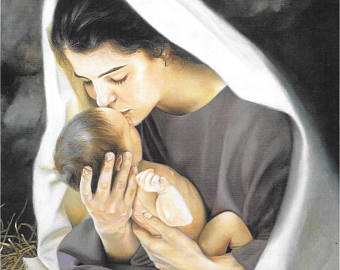
Mary has left us no written word. The little we know of her from the Gospels is sketchy at best, her appearances brief, her words cryptic. Yet her influence on Christian spirituality is staggering in its power.
Who is this woman, and how has she risen from a quiet life in the outposts of the Roman Empire to become, as the Church proclaims her, “Queen of Heaven and Earth”?
If you grew up Catholic in the years before the Second Vatican Council, chances are Mary was at the very heart of your faith. You prayed the “Hail Mary” many times daily; you sang hymns to Mary as you walked in May processions carrying flowers to decorate her statue; in every trouble and doubt, in every dark moment of your own life, you turned to her as to a mother whose love for you was unconditional. You probably knew by heart the “Memorare”, a prayer to Mary that says, in part, “Remember…Mary, that never was it known that anyone who fled to your protection, implored your help or sought your intercession was left unaided…”
At the call of Pope John 23rd, 2600 Roman Catholic Bishops gathered in Rome for the Second Vatican Council in the mid-1960’s. Believing they were restoring a balance, they invited Mary to step from her throne, and guided her gently to a place among the faithful, the followers of her son, Jesus. The “excesses” of Marian devotion were curbed… and then what happened?
Over the past sixty years since the closing of the Vatican Council, we have seen a burgeoning of interest in the “Sacred Feminine”; a recovery of ancient stories of the Goddess; archaeological finds that create renewed interest in the time when the Sacred One was honoured as a woman; an explosion of writing among theologians, historians, cultural storytellers, seeking to understand the power and presence of “Mary” in the Christian story. I will cite a few here: The Virgin by Geoffrey Ashe; Missing Mary by Charlene Spretnak; Truly Our Sister by Elizabeth Johnson and Untie the Strong Woman by Clarissa Pinkola Estes, a collection of stories honouring Mary as “Our Lady Of Guadalupe,” beloved in Latin America where in the 16th century Mary, in the guise of a Latino woman, appeared to Juan Diego, Today, December 12, the feast day of Our Lady of Guadalupe is celebrated in Mexico.
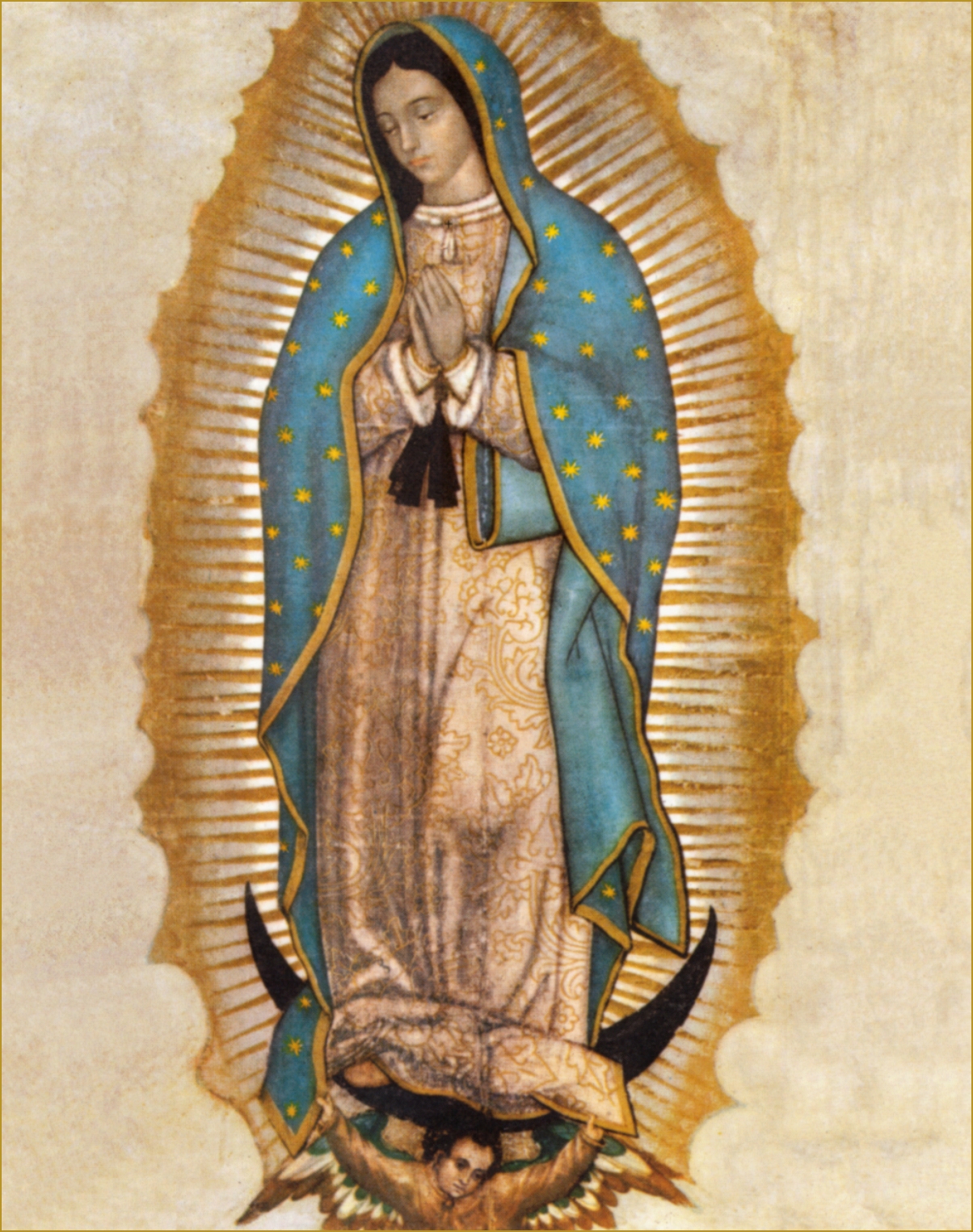
Our Lady of Guadalupe
Though I am no theologian, I have a consuming interest in the many aspects of this mystery. What I glimpse is this: the human heart longs for a divine mothering presence. Ancient cultures honoured a feminine divine who over millennia was called by many names: Isis in Egypt; Inanna in Sumeria; Ishtar in Babylon; Athena, Hera and Demeter in Greece, Anu or Danu among the ancient Celts; Durga, Kali and Lakshmi in India; for the Kabbalists, Shekinah; for the gnostics, Sophia or Divine Wisdom. Christianity had no “Mother God” to put in the place of the Goddesses whose worship it was determined to eradicate. Geoffrey Ashe’s theory is that Mary’s gradual ascension in Christianity was not an initiative of Church Leadership, but rather a response to the hunger of the early Christians for a sacred feminine presence.
How it came about is less interesting to me than the reality that Mary became for us an opening to a loving feminine sacred presence. Or, put another way, a loving sacred feminine presence responded to the cries of her people when they called her “Mary”, just as that presence had responded over the millennia to other names cried out in love or sorrow or desperate need.
Over these darkening days as we descend to the longest night of the year at the Winter Solstice, Mary will be our companion. We reflect on her pregnancy, her waiting, her uncertainty, the doubts of those who love her, the trust that sustains her “while she opens deeper into the ripple in her womb…” as John O’Donohue has written.
This is profound mystery. For Mary. For each one of us who carries the Holy within us, seeking a place of birth. We walk the dark road, with Mary, in trust.
We walk companioned by one who knows our struggles to maintain our trust in the face of inner doubts and outer calamity. We walk with one who loves us and encourages us until we are ready to welcome “the day which will be born from the womb of this present darkness.”
Where does our story touch Mary’s? Where are the meeting points?
In his poem, “Annunciation”, John O’donohue offers some hints:
Cast from afar before the stones were born
And rain had rinsed the darkness for colour,
The words have waited for the hunger in her
To become the silence where they could form.
The day’s last light frames her by the window,
A young woman with distance in her gaze,
She could never imagine the surprise
That is hovering over her life now.
The sentence awakens like a raven,
Fluttering and dark, opening her heart
To nest the voice that first whispered the earth
From dream into wind, stone, sky and ocean.
She offers to mother the shadow’s child;
Her untouched life becoming wild inside.
Shall we make the offer that is asked of us? Will our hunger “become the silence” where the words of invitation take form? When our hearts open, will they also become a nest for a new birthing of the Holy?
These are questions to ask in our daily contemplative time… From Jean Houston, we have learned that now there is no time for us to modestly refuse any call that smacks of greatness. The urgent needs of our time require a “yes” to the conception, followed by the birthing, of newness.
Here are Jean’s words, reflecting upon the call of Mary, our call
.Just think of the promise, the potential, the divinity in you, which you have probably disowned over and over again because it wasn’t logical, because it didn’t jibe, because it was terribly inconvenient (it always is), because it didn’t fit conventional reality, because… because… because….
What could be more embarrassing than finding yourself pregnant with the Holy Spirit? It’s a very eccentric, inconvenient thing to have happen.
(Jean Houston in Godseed)
Eccentric. Inconvenient. Perhaps. But nonetheless it is our call. Mary’s story gives us the courage to say “yes” without knowing where that “yes” may lead. It is enough to know that certainly our own life will become, like Mary’s, “wild inside”.
Wisdom for Longest Night, Solstice
The external darkness of winter is mirrored by internal darkness this year. The fragility of our planet, the depletion of uncounted life-forms, the pollution of lakes, rivers, oceans, soil, even the air we breathe can no longer be ignored. The warnings of scientists about a coming time of disaster have shifted to confirmation that the dark future is already here. We see the effects of the destruction of our home planet with our own eyes and hearts.
In a time of great darkness, we may look for light; we may seek it in denial of the reality, in distractions, in seeking whatever comfort we may find to help us “make it through the night”… and yet there is another way: the way of the Cailleach, the way of Wisdom: we may choose to enter the darkness, to explore it for its hidden gifts, for what it has to teach us. We may learn to know the darkness.
Jan Richardson offers a Blessing for this:
Bless those
Who know the darkness
and do not fear it,
Who carry the light
And are not consumed,
Who prepare the way
and will not abandon it,
Who bless with grace
That does not leave us.
Ancient people came to “know the darkness” with such accuracy that they could predict the time of the longer nights, the earlier dawns of winter solstice when the return of light became visible. We, in our time, have come to understand the darkness has come from an excessive love of light, from a worship of bright intellect over the nurturing of nature, the extremes of using the planet’s resources without the needed balance of wisdom….
The 20th century Jungian writer Helen Luke explains it clearly in her book The Way of Woman:
“…the instinct of the feminine is precisely to use nothing, but simply to give and to receive. This is the nature of the earth – to receive the seed and to nourish the roots– to foster growth in the dark so that it may reach up to the light.
“How are women to recover their reverence for and their joy in this great archetype of which the symbols have always been the earth, the moon, the dark, and the ocean, mother of us all? For thousands of years the necessity of freeing consciousness from the grip of the destructive inertia and from the devouring quality, which are the negative side of the life-giving mother, rightly gave to the emerging spirit of activity and exploration an enormous predominance; but the extremes of this worship of the bright light of the sun have produced in our time an estrangement even in women themselves from the patient nurturing and enduring qualities of the earth, from the reflected beauty of the silver light of the moon in the darkness, from the unknown in the deep sea of the unconscious and from the springs of the water of life. The way back and down to those springs and to the roots of the tree is likewise the way on and up to the spirit of air and fire in the vaults of heaven.” (pp. 15-16)
It is time for humanity to shift from “the extremes of this worship of the bright light of the sun”. Women, as well as men who are not afraid to explore their own feminine side, are called now urgently to do this work, essential for our time, to befriend once more the qualities of earth, moon, sea and springs, to make our way “back and down to those springs and to the roots of the tree.”
Here is a Blessing of Hope from Jan Richardson for Longest Night before the dawn of Winter Solstice December 21st::
All throughout these months
as the shadows
have lengthened,
this blessing has been
gathering itself,
making ready,
preparing for
this night.
It has practiced
walking in the dark,
traveling with
its eyes closed,
feeling its way
by memory
by touch
by the pull of the moon
even as it wanes.
So believe me
when I tell you
this blessing will
reach you
even if you
have not light enough
to read it;
it will find you
even though you cannot
see it coming.
You will know
the moment of its
arriving
by your release
of the breath
you have held
so long;
a loosening
of the clenching
in your hands,
of the clutch
around your heart;
a thinning
of the darkness
that had drawn itself
around you.
This blessing
does not mean
to take the night away
but it knows
its hidden roads,
knows the resting spots
along the path,
knows what it means
to travel
in the company
of a friend.
So when
this blessing comes,
take its hand.
Get up.
Set out on the road
you cannot see.
This is the night
when you can trust
that any direction
you go,
you will be walking
toward the dawn.
Humanity’s Sacred Mission
I am sharing with you, dear reader of Sophiawakens, news of a follow up to the event I wrote about in my recent blog, “Awakening to Sophia.”
 Embrace the Sacred Mission Dance with the Planet Saturday, March 16th, 2024 9am PT, 12pm ET, 5pm CET with Ervin Laszlo From Ervin: We are dancing on the planet, but we are not dancing well. We are dancing on the planet, but not with the planet. We treat the planet as a passive backdrop to our dance, a supplier of the air, water, land, and other resources we claim as our possession. We are not treating it as a partner in our evolution. We thought we could dance above and beyond the domains of life on Earth. This was a mistake, and we are now paying for it. It is time to realize that we can only dance safely and enduringly in partnership with our planet. We must urgently correct our steps and return to the dance our forebears often danced, but we have nearly forgotten. Dancing with the planet is a dance to which we can return. We have the skills and the knowledge, the technologies and the information. Now we must come up with the will and the commitment. The way for us to achieve coherence is to adapt and cooperate. It is to live in peace and in readiness to join together in coherent ecological and social systems. Coherence creates an environment capable of sustaining all people on the planet in peace and prosperity. We are cosmic beings endowed with articulate consciousness. We can apprehend our mission, and we can respond to it. We can and now must awaken to the urgent need to adopt the universe’s drive toward integral wholeness as our felt and acknowledged sacred mission. Add your heart to this global pulse event, register here: https://bit.ly/GCPulseMarch2024 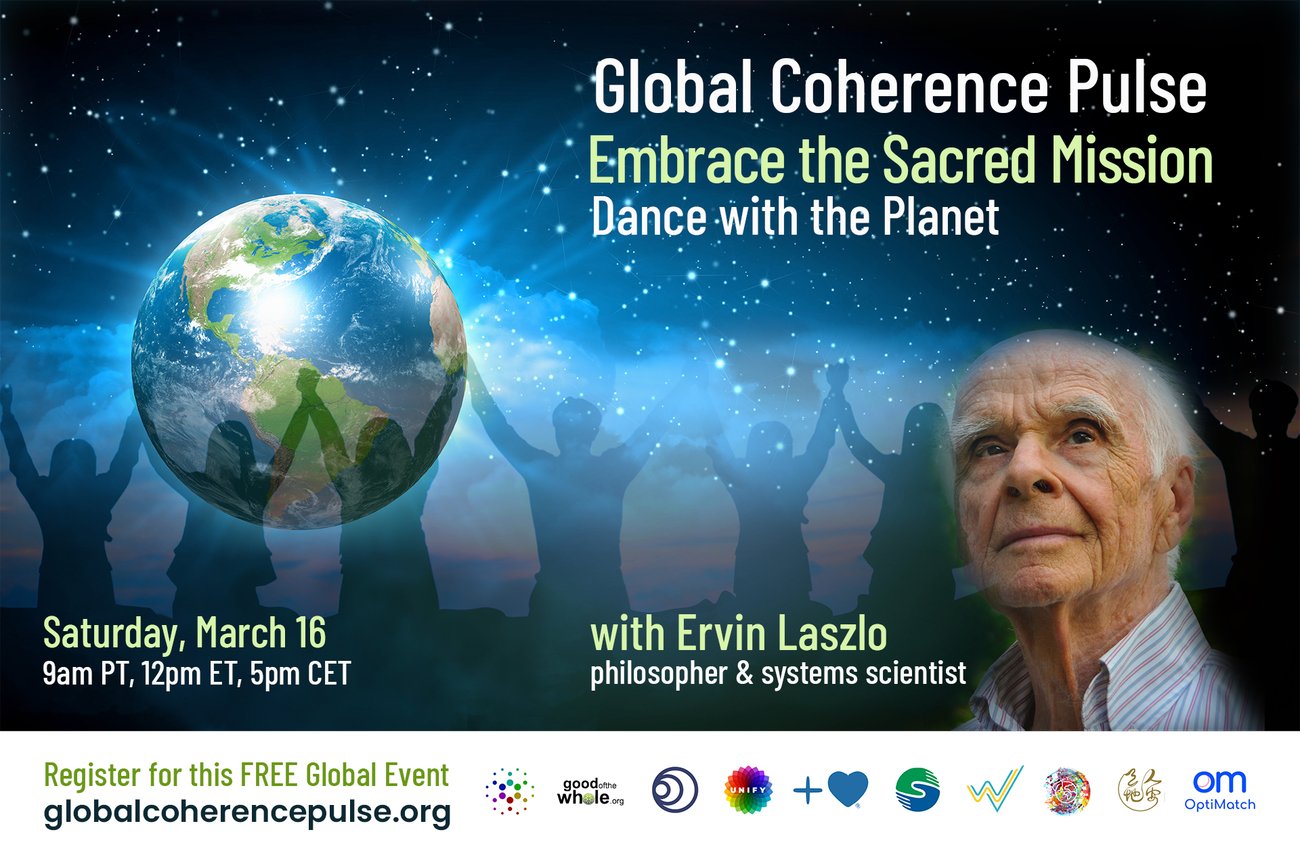 Awakening to Humanity’s Sacred Mission Session 3 and 4 are now Awakening to Humanity’s Sacred Mission Session 3 and 4 are nowavailable on YouTube. If you weren’t able to join us live for the Symposium, tune into Day Two sessions: Synergizing for Change and Peace Making, and stay tuned for more sessions to be released on YouTube. The entire Symposium broadcast can be viewed at your convenience on UNITY EARTH TV – https://unity.earth/symposium-2024-global-broadcast/Day Two, Session 3: Synergizing for Change Day Two, Session 4: Peace Making Support world-changing work:please give generouslyto Purpose Earth by donating here – https://www.purposeearth.org/givedonate All of the funds will go to small grass-roots organizations,mostly in the developing world. Ways to Stay Connected:Join the Weekly Call every Wednesday at 6pm EDT / 3pm PDT, Zoom ID 606 000 1111, http://zoom.us/j/6060001111Join the Mighty Network at https://oneworld.earth?Join our WhatsApp Thread https://chat.whatsapp.com/Fq0zxKqYOGz2mQ96lmT78F Join our Telegram channel https://t.me/unityearth1111 UNITY EARTH Community Facebook Group https://www.facebook.com/groups/unityearth/ UNITY EARTH TV https://unity.earth/tv/  unity.earth unity.earth |
Brigid: Midwife for a Planetary Rebirth
by Dolores Whelan
Reflecting on the turmoil present in the world today it is clear to all, but those steeped in denial, that all is not well. It seems that something ails us humans; something that causes us to live in ways that disrespect our mother, the living earth, and all our relatives. We ask what is it in us humans that creates such a restless world where there is little sense of belonging, nurture or home and which causes so many of the species with which we share this planet to suffer?
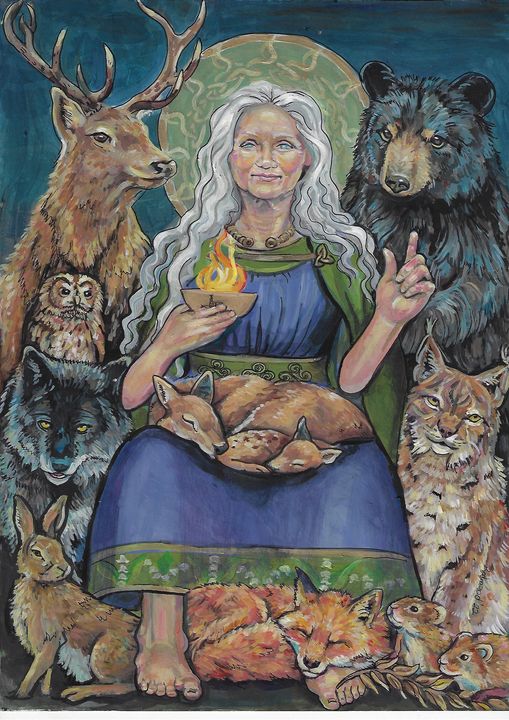
Artwork by Andrea Redmond, an artist living in Donegal, originally from Prince Edward Island, Canada
The exclusion of the Feminine energy in our naming and understanding of the Divine is reflected in a corresponding absence and valuing of feminine energy in all aspects of life in western society. The devaluing and exclusion of the feminine energy over the past centuries has created a distorted story about life which has resulted in a world whose shape and vibration create disharmony.
So how do we find our way back to a more harmonious way of life? If we know what is missing and what ails us, it may be possible for us to make the journey back towards wholeness and health.
In times of great danger and challenges, cultures often seek the wisdom for the journey ahead in the stories and myths that sustained them in an earlier time. However as Poet Nuala Ni Dhomhnail suggests this requires an understanding that “actual myths and stories themselves soar way above any uses to which they may have been put to already and can and must be retranslated by each generation in terms of their own need and thus liberated into a new consciousness.” (1)
At the present time there is a wonderful re-emergence of aspects of ancient spiritual traditions by people all over the world. The reconnection and embodiment of these ancient spiritual traditions, myths and stories has the potential to release the spiritual power needed for us to become agents of transformation within our society.
At this time many people are becoming aware of the wisdom of the feminine. As this happens, the absence of genuine feminine energy present in most institutions, both religious and secular, throughout western culture, becomes obvious. To include the presence of the divine feminine energy in creating a world whose shape is more wholesome requires a fundamental reclaiming of the essential role of the feminine in all aspects of life. In order to create change within the physical world and in our society it is necessary to change the dreams and stories held within the imagination of a society.
My own journey over the past 25years has been primarily within the Celtic spiritual tradition. This tradition has emerged over many millennia and continues to evolve. It includes the wisdom of the megalithic, the pre-Christian Celtic and the Christian Celtic traditions as they met and engaged with each other through the ages. I believe the rekindling of the flames of this tradition, which have lain dormant for many centuries, “like coals under the smooring awaiting a new kindling” holds a key to the recovery of the wisdom needed to create a more sane society.
“God is good and he has a great mother!” a statement sometimes heard in Ireland, reflects an important truth at the heart of the Celtic spiritual tradition, one that honours the presence of the divine feminine and understands that even God emerges out of the feminine energy of being-ness. The Divine Feminine is present at the heart of this spiritual tradition and plays a central role in both Celtic spirituality and Celtic culture. There are many goddesses within Celtic mythology; however Brigid, as both goddess and saint, occupies a central place as representative of the Divine Feminine within Celtic tradition.
Reconnecting with and re-membering the spirit and archetypal energy of Brigid, in both her Goddess and saint manifestations, is an essential task of this renaissance. Brigid, although normally associated with the maiden and mother aspects of feminine energy, is also expressed in the cailleach form, as indicated in the prayer “Molamid Brid an mhaighean; Molamid Brid an mhathair; Molamid Brid an cailleach” (Praise to Brigid, the maiden, the mother, and the crone).
These three different, but related manifestations, the maiden, the mother, and the cailleach, or crone, together create a divine feminine trinity. Each aspect of this trinity occupies a different role within the life, death, and rebirth continuum. The Feminine energy is both the harbinger and the birther of new life and is the destroyer of life that has been spent. It is experienced at the thresholds of life and death and rebirth.
In the past 20 years there has been a new awakening of the importance of Brigid and her place within our lives and our world. Her Feastday at Imbolc in now celebrated in many places in Ireland and all over the world. There is an understanding perhaps it is time for us individually and collectively to recover the qualities that Brigid embodied in her lifetime, marking her as a woman of true spiritual power.
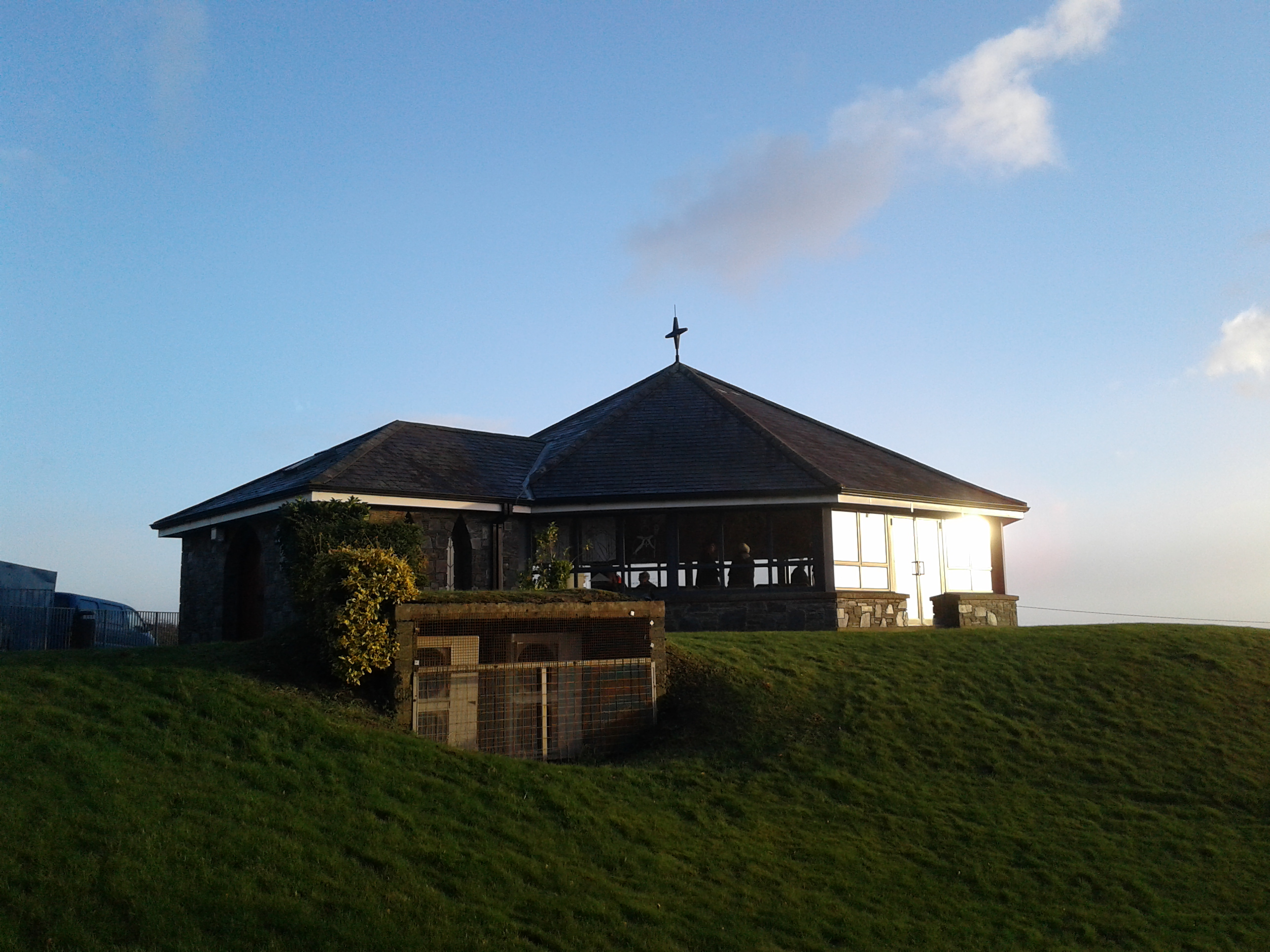
Below: The Shrine of Brigid in Faughart , Ireland , believed to be the birthplace of Brigid of Kildare( Photo, February 1, 2018)
Solace for Our Bleak Midwinter
In JRR Tolkien’s Lord of the Rings, Gandalf has just revealed to Frodo that he must accept responsibility for a ring of power left to him by Bilbo. Gandalf continues, “This is the Master-ring, the One Ring to rule them all. This is the One Ring that (the Dark Lord) lost many ages ago, to the great weakening of his power. He greatly desires it– but he must not get it.”
Frodo sat silent and motionless. Fear seemed to stretch out a vast hand, like a dark cloud rising in the East and looming up to engulf him. “I wish it need not have happened in my time,” said Frodo.
“So do I,” said Gandalf, “and so do all who live to see such times. But that is not for them to decide. All we have to decide is what to do with the time that is given us. And already, Frodo, our time is beginning to look black.”
Remove the wrappings from Tolkien’s tale. Its heart speaks to us. Fear “like a dark cloud rising in the East” engulfs our planet with a series of climate crises, wars, disasters. We hear ourselves echoing Frodo’s words: “I wish it need not have happened in my time.”
Gandalf’s wisdom also echoes: All we have to decide is what to do with the time that is given us.
To decide that will require wisdom as well as courage. Yet we also need a sense of hope, as well as sources of solace…. This I wish to offer especially in one area of our current darkness: the depredation of our planet, Gaia. And for this I turn to poets who, as Teilhard de Chardin has written, also serve us as mystics and philosophers. To find hope in Gaia even in the midst of our suffering, it’s good to remember the words of Kahlil Gibran in The Prophet: When you are sorrowful, look again in your heart, and you shall see that in truth you are weeping for that which has been your delight.
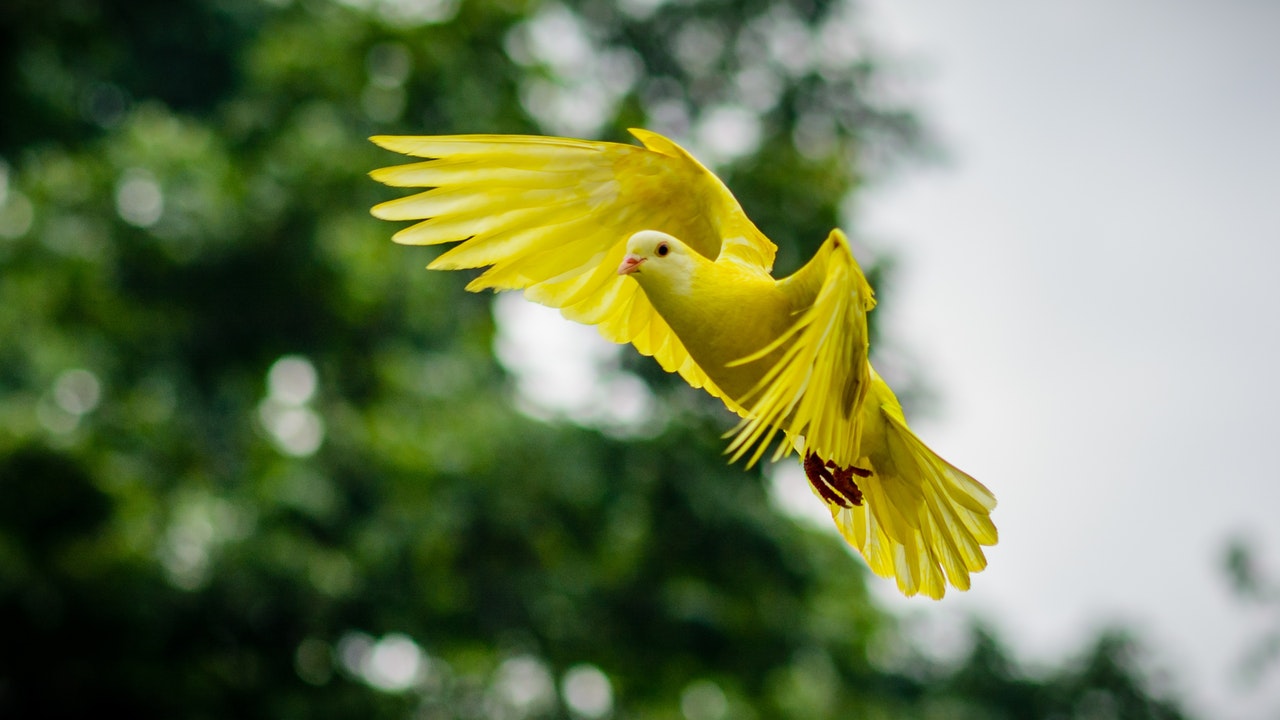
The poet Alfred K LaMotte reminds us that even now Gaia has delight to offer us, to sustain us:
YOU ASKED
When you asked,
How can I face
such a dark world?
the answer was all around you.
The wands of pine
in rain-laden breeze answered,
bell-throated, blackbirds
ringing over the wetland
answered, stars
floating on a still pond
answered, dancing
snow of milkweed,
pearl-eyed mushrooms
seeing through midnight
in the forest answered:
This world is not the seat of sorrow.
This world is sunlight
playing in a risen mist
over the fountain of beauty.
The seat of sorrow is your heart
aching, thirsting
for its own illumination.
But the healing is easy.
Turn your gaze around
and see into your source.
You are that fountain, that
refraction of prism’d beauty.
Listen to the raindrop fall,
how it finds its way home,
as fallen things do,
to the hidden spring
under pungent green moss
where it was born.
Even the raindrop answers,
Yes.

Jude Currivan in “The Story of Gaia” describes a mystical moment of beauty and wonder during a solar eclipse:
On August 1, 2008, together with some fellow travelers, I climbed one of the high peaks of mount Huashan, located about 120 kilometers from the city of Xian in China, to witness a total Solar eclipse. Across from me was another of the five summits of this sacred mountain.
With their rocks delving deep into Gaia and their peaks reaching high to the heavens, mountains have held spiritual significance for millennia, inviting pilgrims to undertake journeys of inner and outer discovery and revelation. Indeed, the Chinese phrase for pilgrimage, h’ao-shan chin-hsiang, means “to offer respect to a mountain.” And from ancient times this particular massif, carved from a single huge block of granite, and the precipitous and dangerous paths to its crests have held especial meaning, offering hard-won opportunities for insight and guidance.

Its five-peaked shape spreads open like the lotus after which it’s named – symbolizing a flower that rises from its roots in mud, through water, to open its blossoms to Sol. Representing purity of heart and mind, the lotus and thus the mountain embodies the sacred seat of Buddha, as attested to by the many shrines and temples adorning its flanks and heights.
After a spectacular cable car ride to near the top of the peak and a steep climb to its crest, we arrived in the late afternoon of a beautiful, warm late-summer day. In the pale blue sky above the mountain, Luna in her fullness was slowly but inexorably extending her shadow over the disk of Sol.
One small cloud was visible in an otherwise clear sky. But as the eclipse continued to proceed to its few minutes of totality, when Luna completely covered Sol, the arc of their combined path, to my consternation, dipped behind the cloud.
After journeying so far to witness one of the most glorious of cosmic phenomena, it seemed that I was destined for it to be out of sight and only to sense its occurrence. So, I closed my eyes, aiming to attune with the coming few minutes of totality, when Gaia, Sol, and Luna perfectly aligned.
With my conscious mind having surrendered to whatever I might experience, I had no further expectations. A few moments later, though, I heard clairaudiently a message to “open your eyes.”
When I did, I literally began to shake with emotion and tears began to flow down my face. My gaze took in an amazing scene. Across the valley beneath me and upward to the pointed mountain peak beyond, the disk of Sol was now exactly covered by that of Luna. Fully clear of the small cloud and with no sunlight to reflect off Luna’s face, the total eclipse created a perfect circle of utter blackness against the backdrop of bright sky.
Of itself, this incredible sight is one of the most extraordinary phenomena of our Soular System. Yet, in a further miracle, the eclipse appeared almost impossibly poised: perfectly balanced, exactly and only for its few minutes of totality, on the very tip of the mountain.
This trinity of Sol, Luna, and Gaia experienced uniquely, only at this precise moment and at this exact vantage point, and shared only with my fellow travelers and a few young and local Chinese people was, as yet, the most wonder-full sight of my life.
It was as though the galaxy had sent an emissary to remind me of the vast black hole at its center and even, perhaps, as a sense of connecting to its sentience through the totality of the eclipse.
I watched this miracle in silence, along with the world around us that also seemed spellbound, as, in their cosmic dance, Sol and Luna, majestically sashaying together, slipped behind the peak. Moments later, now hidden from our view, as they silently parted to go their separate ways until their next communion, the sky behind the mountain crest before us exploded into light.
Solar eclipses as seen from Gaia certainly appear like nothing else in our Soular System and may be exceedingly rare or even unique throughout our galaxy and even entire Universe. The striking image of what black holes might look like when seen up close, may be nearest to this celestial phenomenon that occurs with awe-full regularity a few times every year. It’s a vision that on a profound level inspires in me a sense of the “black whole” of no-thingness and yet al-thingness.
Let us set our hearts to find what we are called to do with this, our time. And let us sustain our courage, our joy with the beauty that still exists on Gaia.
Part Two: Our Journey Towards Radiance
Teilhard de Chardin (Jesuit 20th c.) This is what I have learnt from my contact with the earth… the diaphany of the divine at the heart of a glowing universe, the divine radiating from the depths of matter aflame.

Vincent Van Gogh’s painting “Starry Night” with an image of the Universe from the James Webb telescope superimposed
Last week I Invited you to consider the dreams you hold for your life as we look together at the unfolding of the Universe through the ten powers described by Cosmologist Brian Swimme.
We saw that the path of the mystics of many faith traditions reveal a surprising harmony with the scientific discoveries made in our time about the evolution of the Universe itself. Like the mystics, the Universe moves through a process that leads towards radiance.
This is our process as well, our story, and our most urgent call of this, our time on the planet.
Through the dark weeks of Samhain, we’ll make a journey into radiance guided by Brian Swimme’s DVD series: “Powers of the Universe.” Like his mentor, Thomas Berry, Brian was inspired by the vision of Teilhard de Chardin. For these weekly reflections, I will be drawing on Jean Houston’s teachings as well as the writings of poets and mystics such as John O’Donohue, Etty Hillesum, Caryll Houselander, Hildegard of Bingen, Julian of Norwich and Angela of Foligno.
We’ll begin by looking more closely at Seamlessness, Centration, Allurement and Emergence.
Seamlessness:The universe is bound together in communion, each thing with all the rest. The gravitational bond unites all the galaxies; the electromagnetic interaction binds all the molecules; the genetic information connects all the generations of the ancestral tree of life. (Brian Swimme)
Jean Houston expands onSwimme’s description: All the powers of the universe are seamlessly one, trying to bring forth radiance. These powers can be understood mystically as within ourselves waiting to assist us to bring forth a world that works for everyone.
To illustrate seamlessness, Jean turns to an ancient story from India: A great ruler named Indra asked aritificers to create for him a magnificent web as large as the Universe itself. At every crossing in this web there is a jewel. As each jewel shines its light is reflected in every other jewel. Thus Indra’s Net symbolizes the interconnectedness of all that exists.
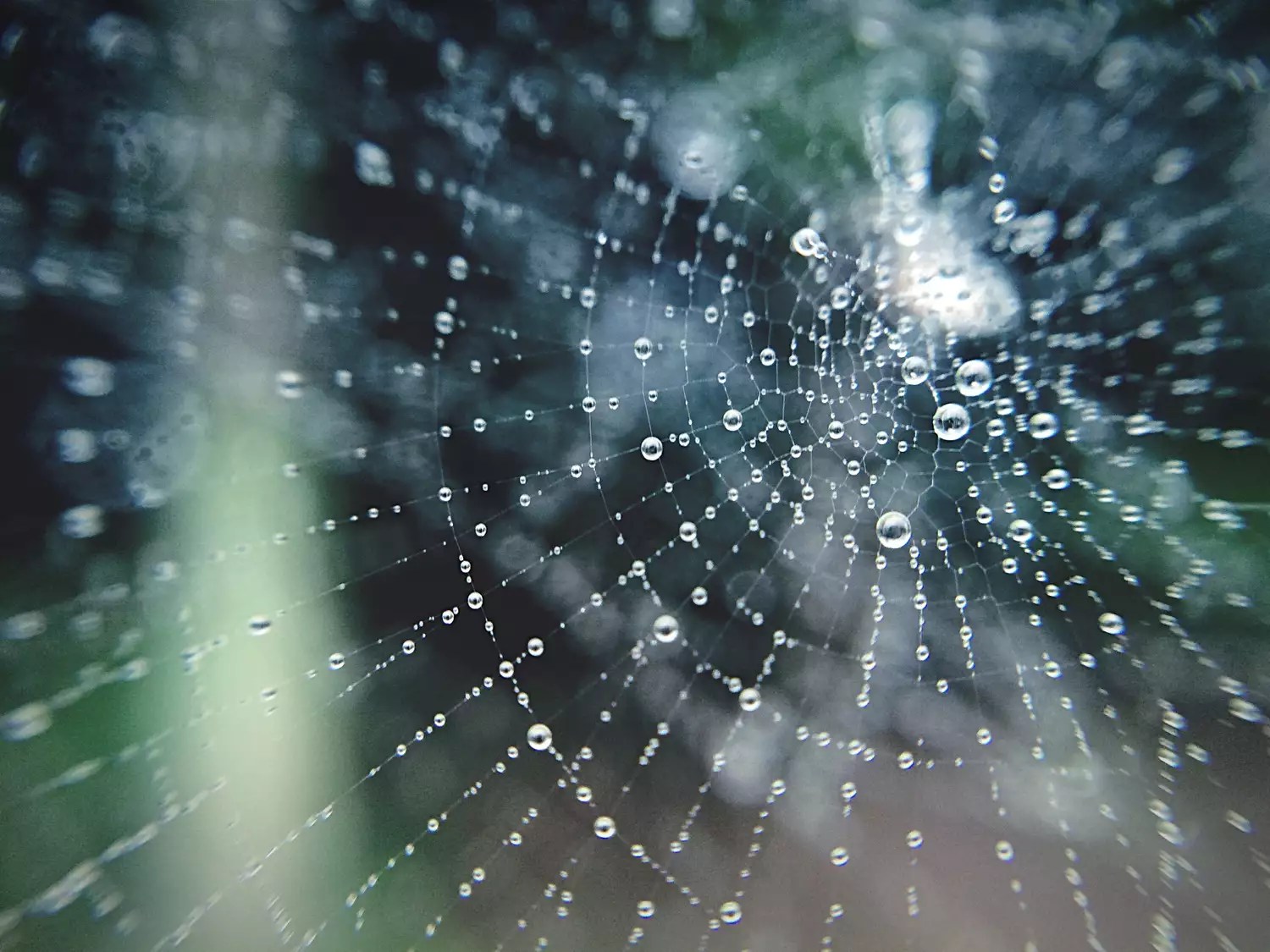
Alan Watts offers an image from nature to illustrate the concept of Indra’s Net:“Imagine a multidimensional spider’s web in the early morning covered with dew drops. And every dew drop contains the reflection of all the other dew drops. And, in each reflected dew drop, the reflections of all the other dew drops…. And so ad infinitum. That is the Buddhist conception of the universe in an image.”
Centration: We are the gathered-in-ness of 13.8 billion years. Brian Swimme teaches that we are the Universe conscious of itself, self-aware of WHO we really are and of all that we are.
Margaret Brennan teaches: Mystics are people who come in touch with the sacred source of who they really are and are able to realize and experience that in their lives. When we have come in touch with the deep centre of ourselves/our lives we realize that we are more than what we seem to be, that there’s something deeper in ourselves than meets the eye.
John O’Donohue writes: For millions of years, before you arrived here, the dream of your individuality was carefully prepared. You were sent to a shape of destiny in which you would be able to express the special gift you bring to the world. Sometimes this gift may involve suffering and pain that can neither be accounted for nor explained. There is a unique destiny for each person. Each one of us has something to do here that can be done by no one else. If someone else could fulfill your destiny, then they would be in your place, and you would not be here.
Allurement: As the mystics did, we draw unto ourselves, are lured towards, the love that holds the Universe together; we allure all we require to grow in that love, within the calling, the shape of destiny that is uniquely ours; we ourselves can be principles of allurement.
Jean Houston advises us to have leaky margins, to be able to fall in love with everything. If fears and worries are blocking allurement, bring in an inner guide to care for them, to set you free… be aware of the negative quality of allurement: notice what you draw to yourself.
It is in the depths of your life that you will discover the invisible necessity that has brought you here. When you begin to decipher this, your gift and giftedness come alive. (O’Donohue)
Emergence: the Universe flares forth out of darkness Our lives begin to blossom with gifts that grow through our co-creative love relationship with the Holy; we begin to see what is possible as we open to joy.
Jean Houston teaches: We can learn how to work with the Universe in what is trying to emerge within us. Set up a schedule. Show up at the page, or in the listening or prayer place regularly to signal our intent to be open. We can create internal structures that are ready to receive what wants to emerge in us. Then we drop in an idea that puts us in touch with essence, creates in us a cosmic womb so the universal power can work in us, so that, like Hildegard we become a flowering for the possible, attracting the people and resources that we need.
Your heart quickens and the urgency of living rekindles your creativity. (O’Donohue)
To be continued on November 27, 2023: Part Three: Our Journey towards Radiance
Sophia at Samhain: The Womb of This Present Darkness
The call to awaken to the presence of Sophia comes at a time when much of our planet struggles with darkness. Live-streaming news gives us an immediate knowing of disasters, disease, wars, weather-related devastation that can be overwhelming.
Yet the greater the darkness, the greater is our awareness of the need for light, the deeper our appreciation for it, the more compelling our own call to be co-creators of light.
As these shorter days in autumn prepare us for the yearly plunge into winter’s darkness, we are entering into the sacred time of Sophia. Our ancient ancestors, who knew almost nothing of events beyond their immediate homes, knew about the rhythms of the earth, the apparent movements of sun, moon and stars, the cycle of the seasons, with an accuracy of observation that fills us with awe. The early peoples of Ireland were so deeply attuned to the shifting balance of light and darkness that they could build a monument to catch the first rays of sunrise on the winter Solstice. The Newgrange mound in Ireland, predating the Egyptian Pyramids, receives the Solstice light through a tiny aperture above the threshold.
Like the Egyptians and other ancient peoples, the Celts wove their spirituality from the threads of light and darkness that shaped their lives. Their spiritual festivals moved through a seasonal cycle in harmony with the earth’s yearly dance, associating the bright sunlit days with masculine energy, the darker time with contemplative feminine energy. For the Celts, the days we are entering this week, days we name Halloween, All Saints’ and All Souls’, were one festival known as Samhain (Saw’ wane). These three days marked the year’s end with a celebration that served as a time-out before the new year began. 1The bright masculine season with its intense activity of planting, growing, harvesting was over. The quieter days of winter were ahead, 1 “the time of darkness, the realm of the goddess where the feminine energy principle is experienced and the season of non-doing is initiated.” (Dolores Whelan: Ever Ancient, Ever New pp. 98-9) www.doloreswhelan.ie
We in the twenty-first century may still draw on this ancient wisdom to live in harmony with the earth as the Northern Hemisphere of our planet tilts away from the sun. We can welcome this time of darkness as a season renewal when earth and humans rest. Our energy can be gathered inwards to support what is happening deep within the earth and deep within our souls. The energy gathered in this season will be used when the winter has passed and spring has brought new life to the land and the people.
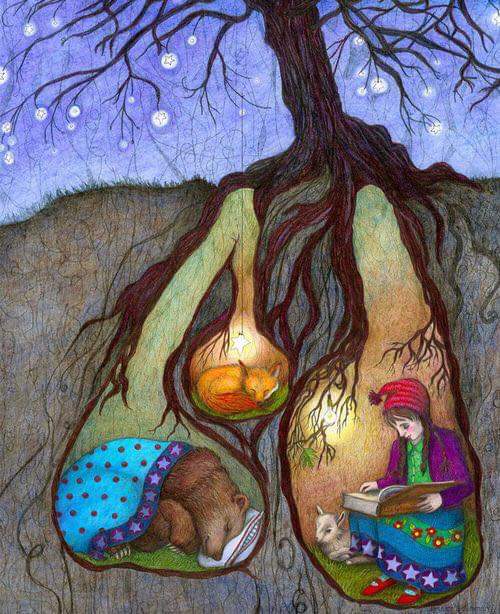
We too can accept the invitation of Samhain to release whatever is not completed at this time, letting go of the light and the activity of sun-time, surrendering ourselves to the restful moon-time, the darkness of holy waiting. Living within the wisdom of the earth’s seasons, we move towards the rebirth of the sun at the winter solstice, embracing a journey of deep surrender. This is Sophia time. Within her sacred cauldron, our lives and our desires for our planet find a place of gestation, a safe darkness where, as with the caterpillar in a chrysalis, the great work of transformation of our souls and of all of life can happen.
Sylvia Shaindel Senensky writes:
We are being called upon by the sorrowing and powerful Dark Feminine to know our own darkness and the profound richness of all dark places, even when they are laden with pain. Through her we know the mystery of existence and the sacredness of the cycles of life. We learn how important the destruction of the old ways is to the rebirth of the new. When she steps into our lives and awakens us, we can be shattered to our core, and we know, as we see the tears streaming down her face, that she too is holding us in her compassionate and loving embrace.
…. She is calling upon us, each in our way to do our inner work, to become her allies, to become the best human beings we know how to be; to allow our creativity, our compassion and our love to flow to ourselves and to all life forms on this planet…. Love attracts love. If we flood our planet with loving and transformative energy, our actions will begin to mirror our feelings. We will come home to ourselves. (Healing and Empowering the Feminine Chiron Publications, Wilmette Illinois 2003)
Let us enjoy this sacred season, this womb-time, as we curl up near the fireside of our hearts. From Sophia’s cauldron, we shall emerge in springtime in an interdependent co-arising with the earth, knowing ourselves renewed in soul, body and spirit.
Teilhard’s Spiritual Gift to Us
Throughout my life, by means of my life,
the world has little by little caught fire in my sight until,
aflame all around me, it has become almost luminous from within.
Such has been my experience in contact with the Earth.
The diaphany of the Divine at the heart of the universe on fire.
Teilhard de Chardin in The Divine Milieu
When a visionary scientist, a mystic, a priest, sees luminous fire at the heart of the universe, drawing us into a unity of love, how is his life’s purpose altered? If that man, though forbidden to teach, writes what he has come to understand, to cherish, ensuring that his writings survive after his death, how might his spiritual vision sustain our hope and transform our darkness at this moment in the history of the earth, nearly ninety years after his death? For that is the gift that Teilhard de Chardin left us when he died on Easter Sunday, 1955.
“One of Teilhard’s greatest contributions to modern religious thought is his conception of reality as composed of both spirit and matter.” Mary Evelyn Tucker, in her Foreword to Teilhard de Chardin, A Book of Hours, (edited by Kathleen Deignan, cnd, and Libby Osgood, cnd, Orbis Press, Maryknoll, New York, 2022)
Writing of Teilhard’s insights on the implications of this view of reality, Tucker offers us foundation stones for a 21st century spirituality. Teilhard saw that this ”interior and numinous dimension of reality” present from the inception of the universe, “radically alters our perspective of matter itself which for (Teilhard) was not dead and inert but dynamic and evolving.” It calls us to shift our religious quest from ”otherworldly goals such as personal salvation after death,” redirecting our vision to ”what is close at hand and yet coextensive with the birth of the universe itself.”

This “numinous reality that infuses matter brings us face-to-face with the immanence of the divine in all things.” This is cosmic spirituality. Its implications are worth considering…
For Teilhard, without this presence in matter of an interior aspect, “consciousness could not emerge in the human” for the human emerges from all that preceded us since the birth of the universe. As Tucker writes: “To understand that all reality from the tiniest atom to the entire Earth community is composed of a within and a without gives us a very different perspective on our universe and our spiritual journey.”
It was Teilhard’s belief that understanding this spiritual immanence in the depth of matter as part of “a dynamic evolutionary perspective” would lead humans to “appreciate the fundamental unity of life.” As the discoveries of science evoke a sense of unity, our collective imagination is awakening to a sense of the cosmos, and of the Earth as alive, even as they have been so for millennia in the imaginations of indigenous peoples.

Teilhard himself writes: “The cosmic sense must have been born as soon as man found himself facing the forest, the sea and the stars. And since then, we find evidence of it in all our experience of the great and unbounded: in art, in poetry, in religion. Through it we react to the world a whole as with our eyes to the light.” (Human Energy, translation J.M. Cohen, New York, Harcourt Bruce Jovanovich, 1971, 82.)
As Tucker points out, “In terms of cosmic perspective…Teilhard offers a vision of unity that resituates the human in the whole evolutionary journey. It provides a means of reciprocity and reverence with the universe and Earth….Our capacity for communication with nature is greatly enlarged and revitalized when we recognize its essential connectedness with ourselves.”
What effect does this have on contemporary spirituality? Tucker responds: “If spirit and matter are the dynamics of evolution, we have a radically new perspective for situating the whole idea of purpose.” Human emergence, far from a random event, is “intrinsically linked to the evolution of spirit and matter in the universe as a whole.”
Moreover, “we are at a moment in history when we are taking responsibility for guiding this evolutionary process in a sympathetic awareness of its profound connection to ourselves.”
Tucker sees that Teilhard invites us “to embody this explicit consciousness of being an atom or a citizen of the universe.”
Now we are called to recognize the divine as “present and acting in the world.” We move “to seeing human lives and destinies intertwined in evolution.” We begin “to discover an ordering principle (LOGOS) at the heart of all matter.”
The effect of this new insight, writes Tucker, is to reorient our spiritual goals “from a quest toward otherworldly perfection and goodness to a quest toward alignment with the dynamic evolutionary processes close at hand. Our spiritual purpose is expanded to embrace and to understand both four and a half billion years of Earth history and the contemporary environmental challenges to the planet and the evolution of its life forms.”
Teilhard and the Circle of Spirit
The internal face of the world comes to light and reflects upon itself in the very depths of our human consciousness. Pierre Teilhard de Chardin, (The Human Phenomenon, 29)
We have already begun to explore Teilhard’s “Circle of Spirit”, discovering the hope and passion it offers in these perilous times for our planet. How did Teilhard move from examining rock layers to exploring the inner dynamics of the universe and of the human spirit? How did he reach his conviction that matter is moving towards spirit, that everything is “driven, from its beginning, by an urge toward a little more freedom, a little more power, more truth?” (Writings in Time of War)
Kathleen Duffy tells us that Teilhard “began by plumbing the depths of his own being, plunging into the current that was his life so that he could chart the development of his person from the very beginning. He wanted to see whether, and if so, how, the principle of Creative Union was operating in his own cosmic story.” (Teilhard’s Mysticism, 83)
Teilhard tells us of that inner journey:
And so, for the first time in my life…I took the lamp and, leaving the zone of everyday occupations and relationships where everything seems clear, I went down into my inmost self, to the deep abyss whence I feel dimly that my power of action emanates. But as I moved further and further away from the conventional certainties by which social life is superficially illuminated, I became aware that I was losing contact with myself. At each step of the descent a new person was disclosed within me of whose name I was no longer sure, and who no longer obeyed me. And when I had to stop my exploration because the path faded from beneath my steps, I found a bottomless abyss at my feet, and out of it came — arising I know not from where – the current that I dare to call my life. (Divine Milieu 76-77)
On this deep inner journey, Teilhard felt “the distress characteristic to a particle adrift in the universe” (DM, 78). Kathleen Duffy describes his experience:
The immensity and grandeur of the universe overwhelmed him. As he descended back through the eons of time, the landscape became less and less familiar; patterns came and went at random and then disappeared. Finally, near the beginning of time, all cosmic structure dissolved into a sea of elementary particles. Troubled, at first, by the apparent lack of unity, Teilhard reversed his direction, exploring instead the cosmic becoming. As he moved forward through time, he watched elementary particles fuse into fragile streams. Amazed by how these streams continued to coalesce, he focused on those that would eventually form his own current, noting the way they converged. Extending “from the initial starting point of the cosmic processes…to the meeting of my parents” (Writings in Time of War, 228), rivulets were growing in strength and beauty. As time progressed, they came alive – they began cascading in torrents, swirling in eddies, pulsating with life and with spiritual power. Teilhard could feel the energy of life gushing from his core. (Teilhard’s Mysticism, 84)
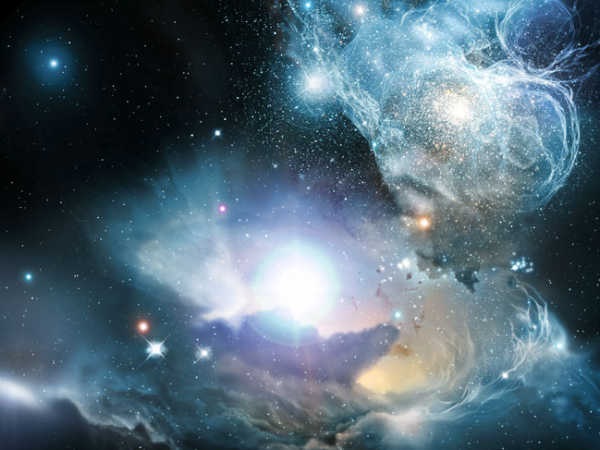
From this mythic/mystical inner journey through his own being Teilhard began to trace the evolution of spirit within matter. It became clear to him that “a certain mass of elementary consciousness becomes imprisoned in terrestrial matter at the beginning” (Human Phenomenon, 37).
Contemplating the first cells bubbling up from the ocean floor, Teilhard was aware of more than the evolution of matter; he realized that he was also witnessing the evolution of spirit…. The more complex matter becomes, the more capable it is of embodying a more developed consciousness or spirit (TM 87).
We hear an excitement in Teilhard’s words as he sees the implications of this:
And here is the lightning flash that illuminates the biosphere to its depth …. Everything is in motion, everything is raising itself, organizing itself in a single direction, which is that of the greatest consciousness (The Vision of the Past, 72).
Seeing the evolutionary process moving in this way, Teilhard is assured that:
“The universe as a whole, cannot ever be brought to a halt or turn back in the movement which draws it towards a greater degree of freedom and consciousness” (Christianity and Evolution, 109).
If we also feel that “lightning flash”, that stirring of excitement and promise, how will our everyday lives change? For starters, might we free ourselves from that tangle of despair and helplessness that ensnares us when we look only at the challenges, immense and awe inspiring as they are, and free up our energies to look also at the 13.8 billion years of evolution that have brought us to this threshold. We may trust that we are made for these times, that we have evolved to face this crisis, that we have all that we require to do what is demanded of us.
For why else was Teilhard sent to us as a guide in this moment in human history?
 sophiawakens