
Category Archives: Uncategorized

Coming to Know Wisdom Sophia

So I prayed, and understanding
was given me:
I called upon God, and Wisdom came to me.
I preferred Her to scepters and thrones;
Vast wealth was nothing in
Comparison to Her.
Before Her, gold is like sand;
Silver like clay.
I loved Her above health and beauty,
And chose Her eternal radiance
Over the most scintillating light.
All good things came to me with Her,
And I took joy in them because of Her,
But I did not then know She was
Their Mother.
(Wisdom of Solomon 7:7-12)

Who is this wondrous being who so captivated the heart of Solomon? He writes of a living, an abiding presence, one capable of giving him “all good things”; yet the joy he found in everything is because of Her. His relationship with this feminine being of “eternal radiance” is one of love. Moreover this love unfolds, evolves as do our best human friendships. For he tells us that there was a time when he knew less of Her, and a time when he understood more: he came to know this Sacred Presence as “Mother” of all the good that She brought to him.

This is astounding. If a clay jar holding these words had been unearthed only in this century, we would be amazed. Yet, the very familiarity of these Biblical passages may have blinded us to their full power. Perhaps we saw them as “metaphor” for a way of knowing, a quality termed “wisdom” not unlike other qualities such as “courage” or “kindness” or “honesty”…

Who can fall in love with a metaphor? Solomon fell in love with a Someone.

One of the more surprising insights in Rabbi Rami Shapiro’s book on the Divine Feminine is that “The Song of Songs” attributed to King Solomon, is considered part of the Wisdom writings in the Hebrew Bible. Shapiro writes that the love affair described in exquisitely sensual images is between the “sage” (woman or man) and Wisdom/Sophia/Chochma.

You have captured my heart,
My sister, my bride,
You have captured my heart
With a single glance,
With one coil of Your necklace.
How sweet is Your love,
More intoxicating than new wine!
Your perfume more fragrant than the finest spice!
(Song of Songs 4:9-10)

Shapiro writes:
You want to be embraced by Wisdom; you desire Her love as much as She desires to love you. A part of you may doubt and question; a part may seek to hide from your desire in cynicism, but at your core you want Her.
A single encounter with Wisdom is enough to lift you out of your desperately reasoned ego, and to leave you breathless with love and desire. Wisdom is not a cool intellectual exercise, but a hot embrace. Wisdom is not dispassionate, but the Way of passion.

As Rabbi Rami Shapiro explores the question of why Wisdom/Sophia/Chochma is so little known, he writes:

First because Wisdom is a woman and women haven’t fared well in the Western religious tradition of the past three thousand years. While you can point out significant exceptions, the norm in Judaism, Christianity, and Islam is to downplay the role of women. One way to do that is to ignore the role of the Mother, Chochma, in creation and the life of us creatures. It is no small thing to note that Wisdom is feminine. The original language of the texts, both Hebrew and Greek, make this very clear: Hebrew Chochma and Greek Sophia are both feminine nouns. The authors of the Wisdom books took this gender specificity seriously and envisioned Wisdom as Mother, God’s consort and bride, the Divine Feminine through which the masculine God fashioned all creation. Further, they saw in the union of masculine and feminine a powerful analogy for the greater unity of all in the ineffable Godhead that transcends our imagination.

Shapiro makes an important clarification around language when he adds:
I do not believe that God is literally male or that Chochma is literally female. We are not dealing with biological facts but with theological archetypes residing within each of us. What is needed is a marriage of the two within the individual. The unity of these forces creates a new person, the divine anthropos. The fully integrated human is called the sage in these Wisdom books. The sage, regardless of gender, is married to Chochma; he or she is the partner of the Divine Feminine.

Shapiro calls on each of us to become a sage when he writes:
You and I have the capacity to be sages. As you read the teachings of Mother Wisdom, know that She is speaking to you, inviting you to Her home, to Her Hearth, to Her teachings that you may become a sage.

He encourages each of us to find the image of Chochma that most appeals to us: As the Divine Feminine, Wisdom can appear to you as Mother, Lover, Bride, Sister or any number of feminine archetypal forms… Find the image that best suits you, and allow it to open you to the way that leads to the birth of the divine anthropos within you.

Aside from the feminine identity of Wisdom in Biblical writings, Shapiro believes there is another significant reason why the teachings of Chochma are ignored:

She is intrinsically antiestablishment and nonhierarchical. Wisdom is taught, so the student needs a teacher, but once She is learned there is a great leveling: Teacher and student share the same understanding.

Behold, days are coming…
when I will seal a new covenant
with the House of Israel and with the House of Judah…
I will place My Teaching within them
and I will write it on their heart…
They will no longer teach one another,
saying Know the Lord!
For everyone will know Me, from the smallest to the greatest.
(Jeremiah 31:30-33)

How might this change our way of relating to the Sacred Presence, to one another, to ourselves?

Reference: Rabbi Rami Shapiro “The Divine Feminine in Biblical Wisdom Literature”, Skylight Illuminations, 2005
Finding, and Found by Wisdom Sophia

Where do you seek wisdom? Do you have overflowing shelves where recently acquired books hide earlier treasures like the nine layers of settlement in ancient Troy? Do you seek teachers trained in ancient wisdom? Select from among the many speakers now available on-line? Or have you been fortunate enough to find a truly wise teacher who leads you inward to your own source of deep wisdom? If so, you have already found Wisdom: She has already found you.

Wisdom is bright, and does not grow dim.
By those who love her she is readily seen,
and found by those who look for her.
Quick to anticipate those who desire her, she makes herself known to them.

Watch for her early and you will have no trouble;
you will find her sitting at your gates.
Even to think about her is understanding fully grown;
be on the alert for her and anxiety will quickly leave you.

She herself walks about looking for those who are worthy of her
and graciously shows herself to them as they go,
in every thought of theirs coming to meet them.

(Wisdom of Solomon 6:12-17 Jerusalem Bible)

Once we come to know and trust our inner “Sophia”, we have a treasure within us, and the eyes to recognize Her everywhere. The wisdom of the ages, of the sages, of the poets and the mystics. takes on a vibrant clarity, a singing resonance, for we have an inner lake that catches the light, reflecting to us the heart of reality.

Rabbi Rami Shapiro’s book, “The Divine Feminine in Biblical Wisdom Literature” (Skylight Illuminations, 2005) which I have been referencing for the past weeks, has opened my eyes as well as my heart to the myriad facets of Wisdom’s presence in the natural world from its sunlit morning warmth to night’s radiant moon-path stretching across the river, to its wild winds, crashing thunder, its rain suddenly rushing from the skies, a Niagara of unseen source. Within my own life, I have become aware of a presence of Wisdom, showing me the moonlit way through challenges in relationships, difficulties in my work, small or larger questions of “What now?” or “How next?” … for, as The wisdom of Solomon assures us:

Even to think about her is understanding fully grown;
be on the alert for her and anxiety will quickly leave you.

I have experienced (as you must have done at times) how a day can suddenly open out in beauty, revealing patterns unseen until that moment, making sense of the journey of our life in ways we had not understood. Two days ago, reflecting on the work I am called to do in Spirituality, I was led by Wisdom-Sophia to Jean Houston’s talk on the fluidity of time from her Quantum Powers course.

Following Jean’s guidance, I stood before a curtain of time, allowing a moment in my life I had not understood to reappear. Six years ago, I was invited into a new beginning. I have since thought I had missed the moment, had not taken the road shown to me, and somehow lost the gift being offered. Now in a sacred moment, with the assistance of a true Wisdom teacher, I found that the invitation had taken me to just where I needed to be: to this place where I have everything I require for this work among you. I experienced a moment of joy, a recovery of trust, finding the way right here under my feet, a yellow brick road, hiding under a layer of dust, pine needles, dried autumn leaves.

I share this with you, not that you need to know about my life, but that you may know more about your own, learn with Sophia to recognize your path, find the joy of walking in it, companioned by Wisdom.

We live now, as Jean Houston reminds us, in the time of the great confluence, when the wisdom of the ages, from many different sacred traditions, is available to us, along with the newest discoveries of the physicists, who have been called the mystics of our time. What we need is inner guidance to open our hearts to recognize wisdom when it presents itself to us.

Often for me, especially when my spirit is deflated, when the moon of my soul is obscured by clouds, light breaks through with poetry. During such a moment this past week, I came upon these words of Hafiz:
You don’t have to act crazy anymore—
We all know you were good at that.

Now retire, my dear,
From all that hard work you do

Of bringing pain to your sweet eyes and heart.

Look in a clear mountain mirror—
See the Beautiful Ancient Warrior
And the Divine elements
You always carry inside

That infused this Universe with sacred Life
So long ago

And join you Eternally
With all Existence—with God!

(trans. Daniel Ladinsky in “I Heard God Laughing”)

May you too find that clear mountain mirror within, kneel there beside Wisdom-Sophia and be amazed at what you see, O Beautiful Ancient Warrior, bearer of Divine elements.

Seeking Wisdom-Sophia

We come away from the magic of the Storyteller’s Well on the Hill of Tara. It is time for us to seek Sophia’s Wisdom in other places, in other times, through other voices.

Our guide for the next few weeks will be Rabbi Rami Shapiro speaking to us through the pages of his book, “The Divine Feminine in Biblical Wisdom Literature”  (Skylight Illuminations. Woodstock Vermont, 2005)

In his Preface, Rabbi Shapiro tells of being pursued by the Sacred Feminine:

I began to see her everywhere. She started talking to me….She intruded on my meditation and prayer time, and just would not leave me alone….She had me. I would go for walks late at night and talk with her.

His friend Andrew Harvey advised that he had best surrender, adding: “She calls to everyone, and to ignore her is to ignore the greatest gift you may ever be offered: the passionate embrace of the Mother. She is going to hound you until she has you, and then She is going to strip you of all your ideas and notions until there is nothing left to you but the ecstasy of her embrace.”

Yet still Shapiro struggled, for it seemed to him that the presence was the Virgin Mary, someone he could not commit to as a Jew.

Andrew said to me, “It isn’t Mary, but the Mother. She comes to the Christian as the Blessed Virgin; She comes to you as Chochma, Mother Wisdom.” And with that my whole life changed.

Shapiro writes: Chochma, the Hebrew word for “wisdom”, is the manifestation of the Divine Mother as She appears in the Hebrew Bible. She is the first manifestation of God, the vehicle of His unfolding, the Way of nature, the way God is God in the world you and I experience every day. Seeing her as Chochma removed the last of my defenses. I stopped running away, and gave myself to Her as best I could.

As he began to share Her teachings as found in the Jewish Wisdom Literature of the Hebrew and Greek Bibles, Shapiro found his listeners “began to relax”, not because he had made Her ”kosher” but rather because “what they heard in the text was what they somehow already knew in their hearts”.

As you read the teachings of Mother Wisdom, know that She is speaking to you, inviting you to Her home, to Her hearth, to her teachings that you may become a sage….Wisdom is taught, so the student needs a teacher, but once She is learned there is a great levelling: Teacher and student share the same understanding. (from the Introduction)

As Shapiro began to move through the Hebrew Scriptures, citing passages, reflecting upon them, I also felt I was hearing what I “somehow already knew in (my) heart.” See if this is also how it is for you.

In the Book of Proverbs, Wisdom/ Sophia/ Chochma speaks:

The Lord created Me at the beginning of His work, the first of His ancient acts.
I was established ages ago, at the beginning of the beginning, before the earth…
When He established the heavens, I was already there.
When he drew a circle on the face of the deep,
When He made firm the skies above,
When he established the fountains feeding the seas below…
I was beside Him, the master builder.
I was His daily delight, rejoicing before Him always.
Rejoicing in His inhabited world, and delighting in the human race.
(Proverbs 8: 22-31)

Shapiro writes that “Chochma ….is the ordering principle of creation”:

She embraces one end of the earth to the other, and She orders all things well.
(Wisdom of Solomon 8:11)

To know her, Shapiro adds, is to know the Way of all things and thus to be able to act in harmony with them. To know the Way of all things and to act in accord with it is what it means to be wise. To know Wisdom is to become wise. To become wise is to find happiness and peace:

Her ways are ways of pleasantness and all Her paths are peace. She is a Tree of Life to those who lay hold of Her; those who hold Her close are happy. (Proverbs 3: 17-18)

Moreover, writes Shapiro: Wisdom is not to be taken on faith. She is testable. If you follow Her you will find joy, peace and happiness not at the end of the journey but as the very stuff of which the journey is made. This is crucial. The reward for following Wisdom is immediate. The Way to is the Way of.

Shapiro teaches that the key to awakening that is Wisdom is having a clear perception of reality.

Wisdom does not lead you to this clarity; She is this clarity….The Way to Wisdom is Wisdom Herself. You do not work your way toward Her; you take hold of Her from the beginning. As your relationship deepens, your clarity of seeing improves, but from the beginning you have Her and She has you.

I am my Beloved and my Beloved is mine. (Song of Songs 2:16)

Chochma is not a reluctant guide or a hidden guru, Shapiro writes, She is not hard to find nor does she require any austere test to prove you are worthy of Her.

She stands on the hilltops, on the sidewalks, at the crossroads, at the gateways (Proverbs 8:1-11)

and calls to you to follow Her. Wisdom’s only desire is to teach you to become wise. Her only frustration is your refusal to listen to Her.

….To know Wisdom is to be her lover, and by loving Her, you become God’s beloved as well.

In our becoming partners, co-creating with Wisdom, Shapiro writes:
Wisdom will not tell why things are the way they are, but will show you what they are and how to live in harmony with them….Working with Wisdom, you learn how…to make small, subtle changes that effect larger ones. You learn how to cut with the grain, tack with the wind, swim with the current, and allow the nature of things to support your efforts. She will not tell you why things are the way they are, but She will make plain to you what things are and how you may deal them to your mutual benefit.

Unveiling the Mystery of Etain

The Storyteller sits near us in silence, allowing us to absorb the tale of “The Wooing of Etain” with its surprising ending. The silence stretches for such a long while that I am wondering if she means for us to quietly leave the well on Tara Hill. Perhaps she has no more to say to us..

Suddenly she asks:
Shall I speak with you about the deeper meaning of this story?
You know it is about love, about longing, and about the many transformations we pass through in a lifetime. Etain’s first transformation, from a woman into a purple fly, came through the treachery of Fuamnach, just as our transformations sometimes come through treachery, betrayal or cruelty on the part of another.

Her second transformation came through exhaustion, causing her to tumble from the roof of the house of Etar into the wine cup of his wife, entering the woman’s womb. After a gestation of nine months, Etain is reborn as a human baby, daughter of Etar, without memory of her former life. Some of our transformations also may come through exhaustion: women who suddenly cannot keep up the frenetic pace of their lives, who develop an illness or a depression that demands a kind of “rebirth” into a different way of being.

Yet the final transformation, the most important, is wrought by love. Midir’s love for Etain and hers for him work the miracle that reunites them, as they fly over Tara as two white swans. They are transformed by love into love.

Now the Storyteller turns to me and asks, What are the words on your spiral pendant?
I am surprised that she has forgotten, for she asked me this same question on an earlier visit.

As though reading my thoughts, the Storyteller says, I have not forgotten the poem. I ask because it is important that you read the words aloud. They hold the key to the love story I have just told.

Still puzzled, but willing now to allow her to teach us in her own winding way, I say by heart the words of the Sufi poet Hafiz that are carved on my necklace:
There is something holy deep inside of you that is so ardent and awake, That needs to lie down naked next to God.

The Storyteller pauses while the words reverberate around the well’s inner cavern, echoing and re-echoing in our hearts.
Hafiz has given you all the teaching you require. You had these words carved on your necklace because they speak of love, the passionate love of the Holy One for you. Hafiz is teaching you of that immense longing for union that is at the deep heart of this story, the longing that kept Midir seeking Etain for a thousand years, giving finally his riches and his labours after losing in the chess game so that he might contrive a way to win her at last from Eochaid.

The One whom Hafiz calls the Friend, the Beloved, or sometimes God, is the Holy One who yearns so deeply for you, who is so drawn by your longing that he/she comes to where you dance alone, ready to lift you into the arms of Love. The One who loves you is as full of passion, patience, and longing as Midir is for Etain.
But there is yet more…

Hafiz teaches you one more secret. There is deep within you something so sacred, so holy, that it needs to lie down naked next to God…

With a half-smile that is both playful and inscrutable, the Storyteller adds, I could have told you all of that myself when you asked but Hafiz is the better poet.

Now do you understand the story? This is a story of human hunger and longing for love, for deep union. This is a story of the yearning that draws flesh to flesh, that is the allurement that is at the heart of all of life, at the heart of the sacred seeking that first sent humans in quest of the Holy. They sought her among the stars when all the while she lay hidden in the depths of the earth or the deep sea, in the atoms, the cells, the very stuff of their own bodies.

Who really is Etain in the story? In Ireland we name her Aine, or Danu, a name that comes from Anu, the Great Mother of the ancestor gods of the Irish. Aine is ancient and known by many names. She is the womb of life, the vitality in your veins, the sun in your cells. Her breasts are the two hills called the Paps of Anu in Ireland. Her hair flows like the waves, ripples gold like corn. Her eyes hold the starlight, her belly the tors, earth barrows that birth you. Like the cat, the owl, the sow, she eats her young if they are sick or dying. Aine is the cycle of life, the wheel of the seasons.

And having stunned us with these disclosures, she is suddenly gone! We sit like carvings for what seems a very long while, then shake off the amazement, dive into the pool and swim to the other side. Lifted by a current of water, we make our way back up through the well to Tara’s hillside.

The Wooing of Etain Part Seven

King Eochaid has just laid upon Midir the great tasks that have become famous throughout all of Ireland, promising, as Midir requested, that no one would be out of doors all night so that Midir and his people might work unseen. But as soon as Midir departs, Eochaid sends his steward to follow him and spy upon the night’s activity.

The steward went with all stealth from Tara, and as he watched, it seemed to him that all the men from all the Elf-mounds in the world were raising tumult there, and Midir, standing on a hill, urged on his Fairy Hosts. Then to his surprise, the King’s man saw that the strong dark blue Fairy oxen were yoked by their shoulders so that the pull might be there, and not on their foreheads, as it had always been in Ireland. And as they worked, the hosts of the Elf-mounds sang:

“Heave here, pull there, excellent oxen,
In the hours after sundown, And none shall know whose
Is the gain or the loss
From the Causeway of Tavrach.”

And the causeway would have been the best in the world, had not the work of the Fairy Hosts been spied upon, but Midir was angry because of this and he left some defects in the work.

Meanwhile the steward returned to Tara, and told the King of the magic he had witnessed during the night, and he told him of the new way he had seen of yoking the oxen so that the pull might be upon their shoulders. When he heard this, Eochaid decreed that henceforth all the oxen in Ireland should be thus yoked, and for this decree he was called Eochaid Air-em, “The Ploughman.”

“There is not on the ridge of the world a magic power to surpass the magic I have seen this night,” the steward said, and as he spoke, Midir appeared before them, his loins girt and an angry look on his face. Eochaid was afraid, but he made Midir welcome.

“It is cruel and unreasonable of you to lay such hardship and affliction on me and on my people, and then to spy on me,” Midir said. “My mind is inflamed against you.”

“I will not give wrath for your rage,” the King said.

“Then,” said the Fairy King, “let us play chess.”

“What stake shall we set upon the game?” Eochaid asked.

“That the loser pays what the winner shall desire,” said Midir of Bri Leith, and they sat down to play.

Midir won with ease, and Eochaid’s stake was forfeit.   “You have taken my stake,” he said.

“Had I wished I could have taken it before now.”

“What do you want of me?”

“My arms about Etain, and a kiss from her lips.”

Eochaid was silent. Then he said: “Come one month from today and it shall be given to you.”

Midir left Tara for the Fair Mound of Bri Leith, and Eochaid, losing no time, called the flower of the warriors to his land, and the best war lords in all Ireland, and he mustered them around Tara, without and within, ring upon ring of the heroes of Ireland to guard the Hill of Tara, and the King and Queen were in the centre of the House; and the Courts were locked and guarded by the Men of Strength, and the Men of Hearing, against the Man of Magic who was to come.

Etain was serving wine to the King and the Lords in the midst of the Hall, and as she bent over towards the goblet in the King’s hand, Midir, in the centre of the Royal House, came towards her.

He was fair at all times, but on this night he was fairest, and the hosts of Tara were astonished at his beauty, and at the radiance of him. In the silence, the King made him welcome.

Midhir1

“What is pledged to me, let it be given to me,” Midir said.

“I have given the matter little thought,” said the King.

“What is promised is due,” Midir said.

Etain was silent, and her cheeks were red as the scarlet rowanberry, and then, by turn, white as snow.

“Do not blush, Etain,” Midir said to her. “I have been a year seeking you with gifts and treasures, the richest and most beautiful in Ireland. It is not by the dark magic that I have won you.”

“I will not go with you, Midir, unless the King releases me to you,” Etain replied.

“I will never release you,” Eochaid said. “But as for this stake, I willingly allow this warrior to put his arms about you, and to kiss you, here in the middle of the Royal House, while the hosts of Tara look on.”

“It shall be done,” said Midir, and he took his weapons in his left hand, and with his right arm he held Etain round the waist, and as he kissed her, and kissed her again, he bore her away in his embrace, through the skylight of the House.

The men of Ireland rose in shame about their King, and he led them out in hot pursuit. But Eochaid, High King of Ireland, and his hosts, saw only two snow-white swans in full flight over Tara.

The Wooing of Etain: Part Six

The Storyteller continues her magical tale of Etain. Midir has found Etain once more, having waited a thousand years for her. He has told her of their love of long ago, but has not been able to persuade her to return with him. Etain has said she will not leave Eochaid unless he releases her. How will MIdir manage to win her from the King?

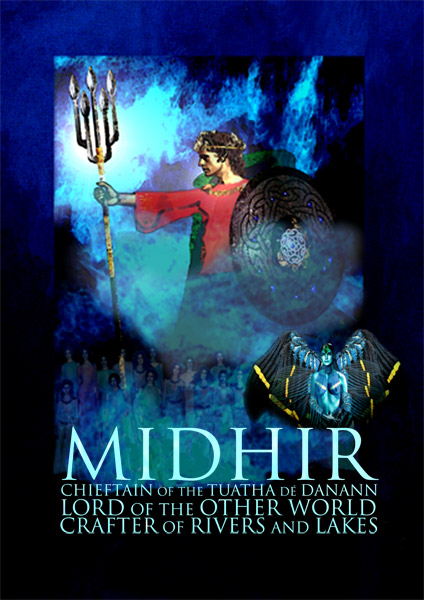
On a day in midsummer Eochaid the King arose and went to the high terrace of Tara to look out over the plain of Breg, shimmering in the haze of summer. He could hear the gentle humming of the bees in the flowers around him, and the cries of the nimble deer from the wooded slopes, and the lowing of the heifers, white-backed, short-haired and merry in the soft fields. The cuckoo called with familiar voice, and the early blackbird sang the dawn, and as he looked about him at the fair land, suddenly he saw on the terrace before him a young warrior. He wore a purple cloak, and a golden brooch that reached from one shoulder to the other. He held a five-pointed spear in one hand, and in the other a white-bossed shield. It was richly encrusted with jewels and precious stones that gleamed in the morning sunlight, so that the King could not see the warrior clearly for the radiance of him.

This warrior was not in Tara last night when the gates were locked, he thought, and the Courts have not yet been opened for the day. The visitor walked towards him.

“Welcome to you, Warrior. I do not know you,” the King said.

“It is for that we have come,” said the warrior.

“We do not know you,” the King said again.

“Yet, in truth, I know you well,” the stranger replied.

“Then, in truth, tell me your name.”

“I am Midir of Bri Leith.”

“And what has brought you here?”

“I have come to play chess with you.”

“Of a truth, I am good at chess,” said Eochaid, who was the best chess player in all of Ireland, “but the chessboard is in the House of the Queen, and she is yet asleep.”

“It is of no matter,” said Midir, “I have one here that is not inferior.” And in a trice, there on the table in front of them, was a silver chessboard with golden men delicately carved by the finest artificers. Each corner of it was lit by a precious stone of golden hue, and the bag for the chessmen was of plaited links of bronze. The King looked down at it.

“It is not inferior,” he said.

“Then what shall be the stake?” Midir asked, and Eochaid said: It is of no matter.”

“If you win my stake,” the warrior said, “at the hour of terce tomorrow you shall have from me fifty dark grey steeds with dappled, blood-red heads, and pointed ears, broad-chested, with distended nostrils and slender limbs. Mighty, keen, huge, swift, steady, yet easily yoked with their fifty enamelled reins.”

Eochaid agreed to the stake and the play began. The King won with ease, and the strange warrior left the terrace of Tara, taking his chessboard with him.

But when the King arose on the morrow, his opponent was already waiting for him, and he wondered again how the warrior had entered the House before the Courts had been opened. Then he saw fifty darkly beautiful steeds on the Plain of Breg, each with its wrought enamelled bridle, and all other thoughts left his mind. He turned to his visitor.

“This is honourable, indeed,” he said.

“What is promised is due,” said Midir of Bri Leith, and he repeated his words. “What is promised is due”.

They sat down again, to play. This time Eochaid asked what the stake should be.

“If you win my stake, you shall have from me fifty young boars, curly-mottled, grey-bellied, blue-backed, with horse’s hoofs to them…and further you shall have fifty gold-hilted swords, and again fifty red-eared cows,” Midir said, “and fifty swords with ivory hilts.”

“It is well,” agreed the King, and again, he won, and the fruits of his winning were there at his House when he wakened. He was filled with wonder, and was counting his rich gains when his foster-father came upon him.

“From whence, Eochaid, is this great wealth?” he asked, surprised, and the King told him of the strange warrior to whom locked doors were no barrier, but who could not defeat him at the chess game.

“Have a care, Eochaid,” his foster-father said, “for this is a man of great magic power that has come to you. See that next time you lay heavy burden on him.” And the King’s foster-father bade him farewell, and left Tara for his own kingdom.

The King went out to the terrace, and on the instant Midir was there, and the chessboard ready. Remembering the advice he had been given, Eochaid made the stake, and he put on Midir the famous tasks that are remembered in Ireland to this day.

“If I take your stake,” he said, “you must clear the rocks and stones from the hillocks of Great Meath, and the rushes from the land of Tethba. You must cut down the forest of Breg, and lay a causeway over the Great Bog of Tavrach, and all this you must accomplish in a single night.”

“You lay too much upon me,” Midir said.

“I do not indeed,” the King replied.

“Then grant me this request,” asked Midir. “That none shall be out of
doors till the sun shall rise tomorrow.”

“It shall be done,” Eochaid agreed, and they began to play.

The King won again, and when Midir left, Eochaid called for his steward and commanded him to go to the Bog of Tavrach, forthwith, and to watch the efforts and the work of that night.

The Wooing of Etain Part Five

The Storyteller has taken us to the moment when Etain, in her new life as daughter of Etar, has become the bride of the High King of Ireland, Eochaid. Today, as she continues the tale, there is a mischievous glint in her eyes, showing she is aware of the questions stirring within us.

What has happened to Midir? Will no one tell Etain of her former life, her former love?

Now the Storyteller continues:

The Great Feast of Tara was held with all splendour, and the people of Ireland rejoiced. The King had two brothers, and Anguba, the younger of them, saw Etain at the Feast and he gazed on her continually, and such gazing is a sign of love. His heart reproached him, and he tried not to love his brother’s wife, but to no avail, and that his honour should not be stained, he ate no food, fell into a decline, and was near to death.

It was the time of the Royal Circuit, and Eochaid, despite his grief and deep distress, was forced to leave Tara. He left his brother in the care of Etain, and bade her attend him, and if he should die, to see that his grave be dug, his lamentations made and his cattle slain.

Every day Etain came to the house where Anguba lay sick, and spoke with him, to comfort him, and his sickness was eased, for as long as she stayed with him, he would be gazing at her. Etain pondered on the matter, and one day she asked him the cause of his sickness.
“It is for love of you,” Anguba said, and Etain answered:
“Pity, indeed, that you have been so long without telling it. Had we but known, you would have been healed a while ago.”

“Even this day I could be whole again,” Anguba said, “if you are willing.”
“ I am willing indeed,” Etain replied, and every day she came to his House and she bathed his head, and carved his meat, and after thrice nine days Anguba was healed of his sickness and he said to Etain:
“And when shall I have from you what is still lacking to cure me?”
“Tomorrow,” Etain said, “but not in the King’s House shall he be shamed. Tomorrow, on the hill above the Court, I will wait for you.”

Etain kept the tryst, but at the hour of meeting a magic sleep overcame Anguba, and he did not waken till the third hour of the next day. When Etain returned to the house, she found the King’s brother sorrowful and distraught.
“That I should have tryst with you, and then fall asleep,” he said.

Twice they made tryst, and each time Anguba slept, and on the third night a man was waiting on the hill above the Court.
“Who are you?” Etain said. “It was not you I came to meet. My tryst with Anguba is not for sin or hurt, but that one who is worthy to be King should be healed of his sickness.”

And the stranger revealed himself to her, and told her his name.
“I am Midir of Bri Leith, and I have loved you for a thousand years. You were daughter to Aylill, Fairy King of Mag Inish, and I was your lover and your husband. I paid a great bride-price for you.”
He was tall and fair, and his purple mantle fell in five soft folds around him, and in it was the golden brooch of Bri Leith, that reached to his shoulder on either side. His bright yellow hair was held back from his brow by a fillet of gold, and the radiance of desire was in his eyes.

“Tell me,” said Etain, “what parted us?”
“The sorcery of Fuamnach divided us, one from the other,” said Midir, and approached her. “It was I who put love for you in Anguba’s heart, so that he was sick with longing and near to dying. It was I who took from him all carnal desire and covered him with sleep that your honour might not suffer.”

Etain was silent, and turned away from him.

“Etain,” he said, “will you come with me to the wondrous land where harmony is?

Hair is like the crown of the primrose there, and the body smooth and white as snow.
There is neither mine nor thine,
White are teeth there, and dark the brows.
A delight to the eye is the number of our hosts.”

But Etain would not look at him.

“A wondrous land is the land I tell of,” Midir said.
“Warm sweet streams flow though the land,
the choice of mead and wine,
stately folk, without blemish,
conception is without sin, without lust,
We see everyone on every side,
And no one seeth us.”
But still she stood apart.

“Will you come with me if the King, your husband, bids you?”

“Willingly,” Etain answered, and they looked into each other’s eyes.

When she returned to the house she found Anguba and he was whole
again, and healed of the cause of his sickness.
“We are well met,” he said, “for now I am healed, and your honour has not suffered.”
“It is well,” said Etain, and they rejoiced together.

When Eochaid returned from his journeying, he gave thanks to Etain for her care of Anguba, his brother, and for all she had done to tend him. There was feasting in the great hall of Tara, and Etain poured the wine for Eochaid, her husband, and for Anguba, his brother, for it is written, “the pouring of wine was a special gift of hers.

The Wooing of Etain Part Four

We come now to one of the great themes of our lives, though we seldom recognize it when it happens to us. This is the mystery that lies at the heart of the universe. It is found in the most ancient stories over and over again, in the Egyptian story of Isis and Osiris, in the Sumerian story of Inanna, in the Greek story of Persephone and Demeter, and in the story of Jesus of Nazareth. It is the mystery of life /death/life, the mystery of rebirth, the mystery of transformation. And here it is in an ancient Celtic tale.

Let’s take time to reflect on this mystery. We have become so accustomed to living within a culture where time is linear. First this, then this, then this: conception, birth, growth, maturity, diminishment, death. Though they experienced all these stages, our ancient Celtic ancestors, like indigenous peoples everywhere, experienced time as circular. They danced to its rhythms: night gave birth to dawn and day blossomed before it waned into evening, back into night. The Egyptians honoured the sky goddess Nut, mother of the sun, Horus. She gives birth to him each dawn and swallows him at dusk, gives birth to him again at dawn. In Newgrange in Ireland, the very place in our story that is the home of the Mac Og, there is a stone mound where the light of the sun, only at the winter solstice dawn, enters through a small slit and shines in the centre of an inner chamber.

Our ancestors watched the cycles of the moon, the turning of the tides. The women noticed how the rhythms of their own bodies, their regular times of bleeding, followed the moon’s rhythms. No wonder they felt at home in the universe, embraced by the earth.

If we could enter into the ancient ones’ understanding of time, the rhythms of our lives would take on sacred meaning. Our times of inner darkness would hold the promise of a dawn of new joy. Our losses would be seen as invitations to embrace other gifts, our death as birth into a new as yet unimagined life.

We seldom think about the rebirthing that happens many times in our lives. Do you remember the Gospel story of Nicodemus who came to Jesus by night, in secrecy, not wanting others to know he was drawn by this man’s presence and teaching? Jesus speaks to him in the language of death and rebirth. “Unless you are willing to be born again…”
Nicodemus scoffs: “What? Can a man enter again into his mother’s womb?” But Jesus takes him to the deeper meaning. “Born again of water and the Spirit”…. Jesus is talking about radical change, costing not less than everything, offering no less than everything we desire and need for fullness of life.

Were there times in your life when you felt as though you were once more in the womb? When there was no way to see where you were, to understand what was happening? No ability to do anything but wait and wait and wait, nourished by an unknown source, until the walls of this place of ingression squeeze, forcing you back out into the sunlight. Joseph Campbell calls this part of our journey being in the belly of the whale. We can do nothing but wait, be nourished, grow, until we no longer fit in this place, and like Jonah, are cast forth into active life. We find ourselves changed, changed utterly, perhaps only realizing how much when our friends and family no longer know how to be with us or we with them.

This is what is happening now in Etain’s tale.Back into the womb, into the belly of the wife of Etar. A change so radical that when she is reborn as Etain, daughter of Etar, she will recall nothing of her former life, nothing of what came before.

Now, the Storyteller awaits us.

Eochaid, King of Ireland, in the year after his succession, commanded that the great Feast of Tara be held in order to assess the tribute and the taxes. But the people assembled and talked together, and they refused to pay tribute to a King who had no Queen, and they would not hold Festival at that time. So it was that Eochaid, without delay, sent envoys to the North and to the South, to the East and to the West, to seek the fairest maiden in Ireland to be his bride.

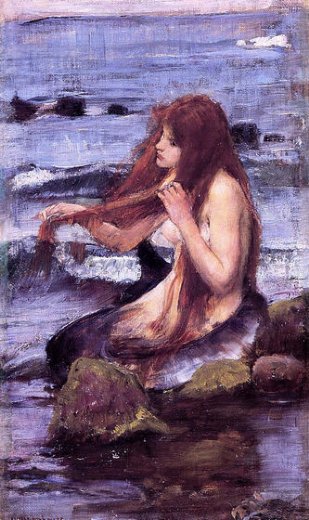
As the months passed and, one by one, the messengers returned to Tara, each had audience with the King. He listened to them and conferred with his men of wisdom, and his poets, but his heart did not leap within him until, late on an evening, he was alone on the terrace of Tara and a young envoy asked leave to speak with him. The King bade him draw near, and eagerly, the messenger spoke. “Fifty beautiful maidens there were, O King, bathing in the estuary near to the house of Etar, in Ulster, and one more beautiful than all the others, at the edge of a spring, with a bright silver comb ornamented with gold, washing her hair in a silver bowl with four golden birds on it, and little flashing jewels of purple carbuncle on the rims of the bowl… There were two golden yellow tresses on her head; each one was braided of four plaits, with a bead at the end of each plait. The colour of her hair seemed … like the flower of the water-flag in summer, or red gold that has been polished.

john-william-waterhouse-sketch-for-a-mermaid

“She was loosening her hair to wash it… her wrists were as white as the snow of one night and they were soft and straight; and her clear and lovely cheeks were red as the foxglove of the moor. Her eyebrows were as black as a beetle’s wing… Her eyes were blue as the bugloss; her lips red as vermillion; her shoulders were high and smooth and soft and white as the foam on the wave… The bright blush of the moon was on her noble face… She was the fairest and loveliest and most perfect of the women of the world that the eyes of men have ever seen…” “She is Etain,” the messenger said, “daughter of Etar, and there is pride on her brow and radiance in her eyes, and it is said, ‘All are fair till compared with Etain.’ I thought her to be out of a Fairy Mound.”

Eochaid, the King, wooed Etain, and married her, and she matched him in lineage, in youth and fame, and she brought joy and happiness to the King’s House.

The Wooing of Etain: Part Three

Well, that was rather sudden and unexpected! The lovely Etain becomes a pool of water! A worm! A gorgeous purple fly!
What do you think of this? Let’s take time to ponder…

Water is the first of the elements to embrace our bodies while we are in our mother’s womb. So water is a feminine substance. And isn’t water a symbol of the deep unconscious within our psyche? the womb of new dreams, stirrings, possibilities, riches.

Especially in Ireland, water is honoured: its ancient holy wells are places of healing; its rivers were thought to be birthing places of the goddesses. The Mac Og’s mother Boan is of the River Boyne.

The water of life rebirths Etain. From it she emerges as a worm, and the worm transforms into a gorgeous purple fly.

The physicist Elisabeth Sautoris has devoted intense study to the life cycle of the butterfly, tracing the astounding transformative process that happens within the cocoon. Imaginal cells that will become a butterfly cluster to protect themselves against the older caterpillar cells which see them as invaders and try to destroy them. The clustering of the new cells gives them the strength to overcome the older form. And then when the time is right, at the Kairos moment, a new being emerges.

Have there been times in your life when newness seemed to be gathering within you? Did you then experience the old ways rising up within you, crying out, “too much trouble!” or “Why not just go on as you are?” or even “How do you dare to believe you are meant to be more? Be satisfied with your little life….”

Then, in your deep soul, did you feel the strengthening of the new desires? Did you feel them drawing together until they were strong enough to silence the voices of defeat? Did you feel yourself emerge into newness? surprising and
perhaps annoying your friends and family?

Think about these times… ask where you are now in the ongoing process of transformation. It doesn’t happen all at once, or only once. There is always newness gathering within us; there are always old inner habits, beliefs, holding
the newness back, trying to destroy it.

Now, the Storyteller continues her tale:

But soon Fuamnach discovered the happiness of Midir and Etain, and forthwith she came to where they were. Midir tried to protect his love, but the witch-power of Fuamnach prevailed, and straightway she began to chant a powerful incantation, and they could not see each other. She raised and stirred up a great evil wind of assault, strong and irresistible, so that in spite of their love, and of all the arts of Midir, Etain was taken up and swept away from the fair familiar mound of Bri Leith.

Fuamnach put upon her further that she should not light on any hill or tree or bush in the whole of Ireland for seven years, but only on the sea rocks, and upon the waves themselves.

P1000092

For seven years,  Etain could light only on the sea rocks and on the waves themselves

Whenever Etain, faint and exhausted, tried to settle on a shrub or a land rock, the evil blast blew her upwards and away. She had no respite, no rest until, seven years to the day, she alighted on the golden fringe of Angus mac Og’s tunic as he stood on the Mound of the Brugh.

“Welcome,” he said. “Welcome, Etain, weary and careworn, who has suffered great dangers through the evil of Fuamnach.” And the Mac Og gathered the tired purple fly into the warm fleece of his cloak, against his heart. He brought her into his House. Angus made a sun bower for Etain, with bright windows for passing in and out. He filled it with flowers of every hue, and wondrous healing herbs. The purple fly throve on the fragrance and the bloom of those goodly, precious plants. Angus slept in the sun bower with Etain, and comforted her, until gladness and colour came to her again. Wherever he went, he took the sun bower with him.

At the end of the seven years Fuamnach had begun her search for the purple fly. When she found the sun bower, and discovered the honour and the love that the Mac Og bestowed upon Etain, her hatred deepened. With cunning, she went to Midir. “Let Angus come and visit you for a while,” she said,” for the love between you is deep.”

Midir, in his loneliness, welcomed the thought, and sent messengers to bid the Mac Og come to Bri Leith.
Angus left the Brugh and the sun bower with a heavy heart. As soon as he had come to the Fair Mound of Bri Leith, and he and his foster father were closeted together, Fuamnach, by devious and secret ways, came to his House. Entering into the sun bower, she raised the same dread fury of wind and swept Etain with violence through the window and away from the Brugh, to be driven and buffeted, hither and yon, for seven more years, over the length and breadth of Ireland.

When Angus returned to the Brugh and found the crystal sun bower empty, he followed Fuamnach’s tracks. He came up with her at the House of the wizard Bresal, and he shore off her head.

Etain, seven years to the day of the second great wind of Fuamnach, tired and spent, small and pale, lit upon the roof of Etar’s House. Etar was an Ulster warrior. There were feasting and celebration within. As the wife of Etar was about to drink, Etain, exhausted, dropped from the roof and fell into the golden beaker. The woman swallowed the purple fly with the wine that was in the goblet. Etain was conceived in the womb of Etar’s wife, and afterwards became her daughter.

When she was born, she became Etain, daughter of Etar. It was one thousand and twelve years from the time of her first begetting by the Fairy King, Aylill, until her conception in the womb of the wife of Etar.
(to be continued….)

We Return to the Well of the Storyteller

These days the heat and humidity weigh on us. Let’s return to the cool deep well of the Storyteller. Surely there are tales she has not yet told us.

tara-overhead-86682_207x136

You remember the way. We climb Tara Hill, follow the spiral path towards the south east. We arrive at the well, its low surrounding stones forming a protective wall. Here we remove our shores, bend down, grasp firmly a large stone for balance, then swing with the grace of an Olympic gymnast above and across the stones, letting our body sink upright into the welcoming cool of the water. Now, we let go. We sink down, down, down, pulled by our weight, until the right wall of the well disappears, pulling us into a womb–like opening that pushes us out into an underground pool. We swim across, climb up onto the rocky ledge. We are wholly dry, as refreshed as though just wakened from a sweet afternoon nap.
The Storyteller is here, seated near us, her dark eyes luminous in the shadow of of her purple hooded cloak. She smiles, welcomes us with delight in her voice:
You’ve come for another story!

The Storyteller gazes at us, scrutinizing each face, nodding as though she has reached a decision. It must be a story of longing and desire. It all begins with longing…

She looks directly at me as she says, Isn’t that what I have taught you? But this tale you have not heard before. You were not ready. Perhaps you are ready now. We shall see.

This is a love story from ancient Ireland, “The Wooing of Etain”.

In the early days when the children of the Goddess Danu, the Fairy gods, were defeated by the Sons of Mil, they agreed to make their vast and beautiful dwelling places inside the mountains and under the rivers and lakes of Ireland. The High King of the Fairy gods was the Dagda. He played upon his wooden harp to make the seasons to follow one another. He commanded the winds and the rains and the crops. His people called him “the good god”.

According to ancient custom, the Dagda sent his son Angus mac Og to be fostered by Midir, the proud Fairy King of Bri Leith. Angus’ companions were thrice-fifty of the noblest youths in Ireland and thrice-fifty of the loveliest maidens, and for all their great number, they all lived in one House. Their beds had columns and posts adorned with wrought gold that gleamed in the light of a precious stone of great size, brilliant in the roof at the centre of the House. Angus was leader of them all, for the beauty of his form and face and for his gentleness.

His days were spent in the Playing field, in feasting and taletelling, in harping and minstrelsy, and the reciting of poetry, and every youth was a chess player in the House of Midir of Bri Leith. Angus stayed with his foster-father for nine years, then he returned to his own Sid, Brugh on the Boyne.

One year to the very day of Angus’ departure, Midir, lonely for his foster son, decided to visit him. He put on his white silk, gold-embroidered tunic and his shoes of purple leather with silver-embroidered tips. He fastened his purple cloak of good fleece with the golden gem-encrusted brooch of Bri Leith, that reached from shoulder to shoulder, in splendour, across his breast, and on the Eve of the autumn Feast of Samhain, he came to the Sid of Angus mac Og, at Brugh on the Boyne.

The Mac Og was standing on the Mound of the Brugh, watching two companies of his youths at play before him. The first company rode horses of purple-brown colour, and their bridles were of white bronze, decorated with gold, and the horses of the second company were blue as the summer sky at early morn, and they had bridles of silver.

The battle sport was joyful, and the air was filled with the clash of arms, the clean ring of metal against metal and the lusty, clear-voiced challenging cries. Angus embraced his foster-father with delight, and they watched the play together, until, inadvertently, Midir was hurt in the eye by one of the youths. Though he was cured by the Dagda’s Physician, he was angered, and demanded satisfaction.

Angus readily agreed. “If it is in my power,” he said, “it is yours. What is your desire?”

“The hand of Etain who is the gentlest and loveliest in all Ireland.”

“And where is she to be found?” Angus asked.

“In Mag Inish, in the North East. She is daughter of the Fairy King Aylill.”

“Then it shall be so,” the Mac Og said, and at the end of the feasting he set out over the soft, cloud-bright fields of our many-hued Land, and came to Mag Inish, in the North East.
Aylill the King demanded a high bride-price. “I will not give my daughter to you except that you clear for me twelve plains in a single night,” he said, “and furthermore, that you draw up out of this land twelve great rivers to water those plains.”
Angus knowing he could not himself accomplish these feats, went to his father, the Dagda, who, of his great power, caused twelve plains to be cleared in the Land of Aylill, and he caused twelve rivers to course towards the sea, and all in a single night. On the morrow, Angus mac Og came to Etain’s father to claim her for Midir.

“You shall not have her till you purchase her,” Aylill said.

“What do you require now?” Angus asked.

“I require the maiden’s weight in gold and silver,” Aylill answered and the Mac Og said: “It shall be done.”
And forthwith he placed the maiden in the centre of her father’s House, measured the weight of her in gold and silver, and leaving the wealth piled up there on the floor, he returned to Brugh on the Boyne with Etain, and the ancient manuscript says, “Midir made that company welcome.”

Etain looked into Midir’s eyes, and that night she became his bride.

Here the Storyteller pauses for that is her way, allowing us time to ask, “What surprised me so far in this tale?”

“What gift have I received from this first part?”

(to be continued….)