Category Archives: Uncategorized

Brigid : Wise Guide for Modern Soul Seekers

Brigid’s Day is celebrated on February 1st, ancient Celtic Festival of Imbolc . Brigid is known as the one who”breathes life into the mouth of dead winter”. Brigid has left us no written word. Her earliest biography was written a hundred years after her death by Cogitos, one of the monks of Kildare, the double monastery where Brigid was Abbess of both men and women in fifth century Ireland.
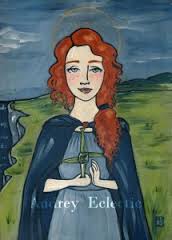
Brigid of Irelanad

Ireland is a land of story. The stories woven through and around Brigid’s life are interlaced with the stories of the Ancient Goddess Brigid so that the two have come to be one sacred archetypal presence. This is best illustrated in words overheard a few years ago at a ceremony at Brigid’s Well in Kildare: “Sure and wasn’t she a goddess before ever she was a saint.”

                                                                                                                                                                                                                                                                                    In the winter of 2018, I was in Ireland for Imbolc, the Feast Day of Brigid.  Staying in the home of Dolores Whelan, I found in her garden small snowdrops blooming For a Canadian, such flowers in late January appeared miraculous.
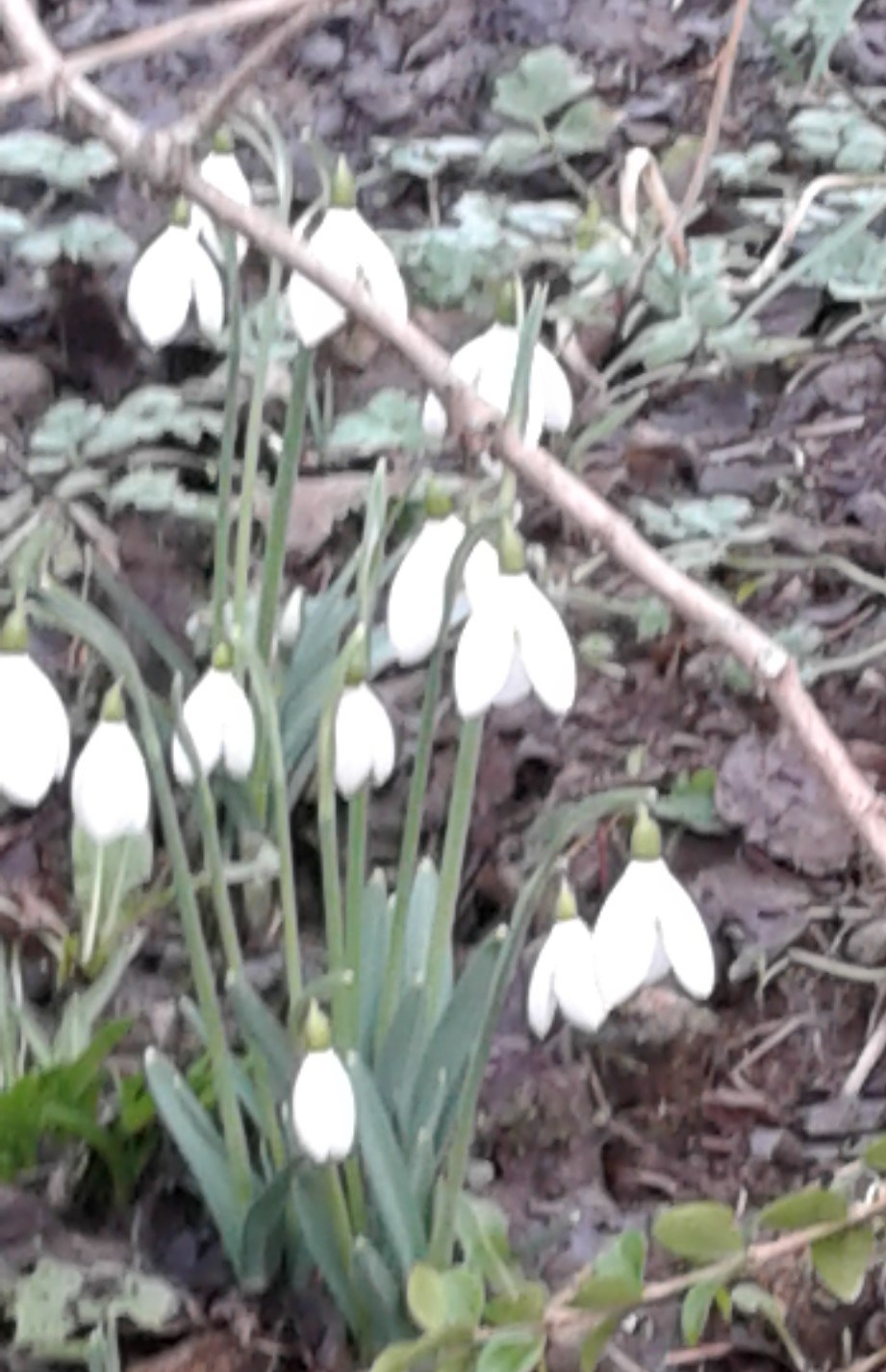
snowdrops for Brigid’s Day

Dolores, who is my primary teacher in the ways of Brigid, showed me the hill of Faughart, clearly visible from the upper story window of her home. Faughart is known in legend as the birthplace of Brigid. I had the joy of being present at the Oratory in Faughart on February 1st, Brigid’s Day, for a Ritual of Music and Readings.

In her article, “Brigid of Faughart – Wise Guide for Modern Soul Seekers”, Dolores Whelan writes of coming to know Brigid:

Faughart, near Dundalk ,Co Louth, Ireland is an ancient place filled with a history that is both gentle and fierce. It is a place associated with battles, boundaries and travel. The Sli Midhluachra, one of the five ancient roads of Ireland, runs through the hill of Faughart on its way from the Hill of Tara to Armagh and then to the north coast of Ireland, making it a strategically important place.

However, Faughart is also a place of deep peace, tranquility, beauty and healing, being associated from ancient times with Brigid, Pre-Christian Goddess and Christian Saint. Brigid holds the energy of the Divine Feminine within the Celtic Spiritual tradition. Faughart is the place associated with Brigid, the compassionate woman who heals, advises and nurtures all who come to her in times of need.

People are drawn to her shrine at Faughart because of the deep peace they experience there. Brigid’s peaceful presence can be experienced in this landscape where the ancient beech trees radiate old knowledge and hold a compassionate space for us all.
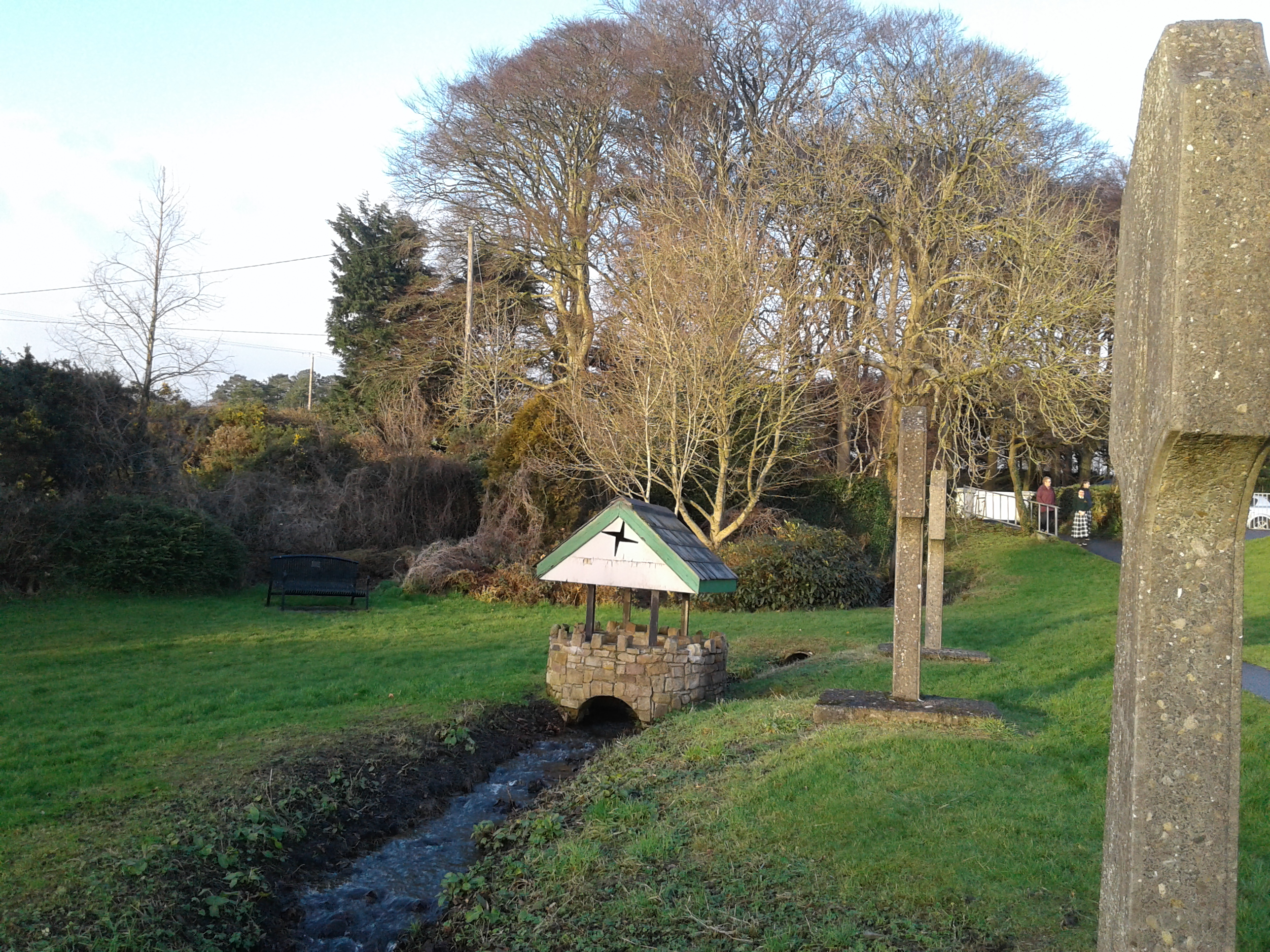
land, trees, water near Brigid’s Shrine, Faughart, Ireland

On La feile Bhride (Feb 1st) people come in their multitudes! On this special day the shrine at Faughart is thronged with pilgrims who come to invoke Brigid’s blessing on their emerging lives. Brigid is associated with springtime and new life emerging. She is the one who “breathes life into the mouth of dead winter.”
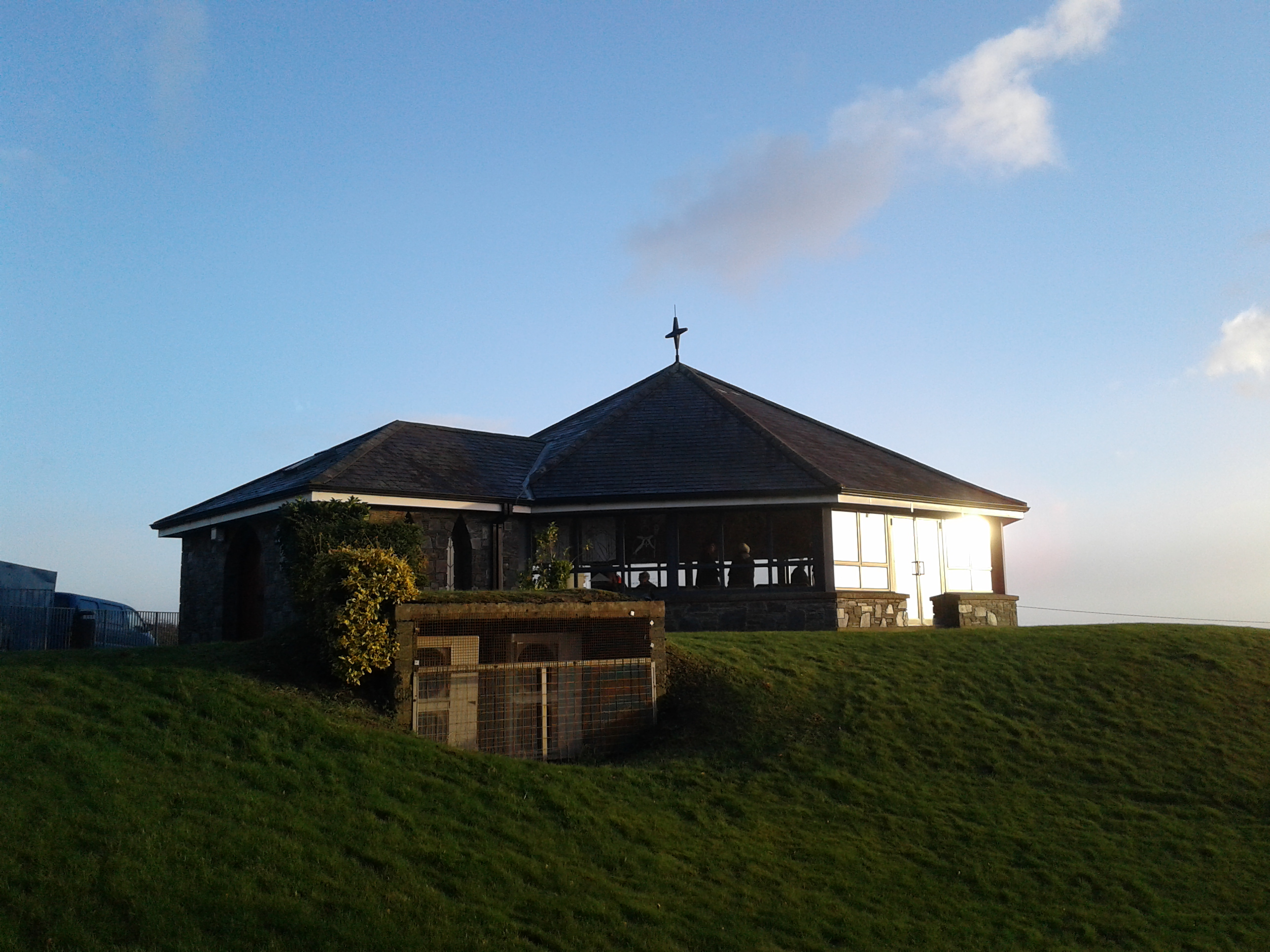
Shrine at Faughart on Brigid’s Feast

I first went to Faughart in 1992 and was amazed by the beautiful energy present there. At that time, I had begun to study the Celtic spiritual tradition, something from which I and so many other people had been disconnected over many centuries. My quest at that time and since then has been to recover some of the riches and wisdom of that ancient tradition. And to ask the question:  “How could this wisdom be integrated into the lives of us modern humans in ways which would create a more balanced and peaceful life for all of the beings on planet Earth”?

While at Faughart in 1992 something deep and ancient stirred in my heart and I have been on a journey with Brigid ever since. In 1993 I went to The Brigid Festival in Kildare, organised by Mary Minehan, Phil O’Shea, and Rita Minehan (Solas Bhride). At this festival these women, in a daring Brigid-like action, re-kindled the flame of Brigid in Kildare. The flame of Brigid had been quenched at the time of the suppressions of the monasteries around the 12th century.

As this took place an ancient part of my soul understood the significance of this prophetic act. My journey into the Celtic spiritual tradition changed and evolved over time, becoming a deeply significant part of my life’s purpose.

It is said that from the moment Brigid learned to know God that her mind remained ever focused on God/Divine. This allowed her to remain connected to God and the heavens while living on the earthly plane. Her great power of manifestation was a result of this ability to be aligned heaven to earth. The strong connection between her inner and outer worlds allowed her to focus her energy onto a particular intention so clearly as to ensure its manifestation in the physical world.

Brigid had the capacity to bring forth new life, to nourish, to create plenty in the crops or an abundance of the milk from cows, and to manifest or create ex nihilo. This gift reflected the true abundance and prosperity that was present in the society she created, a society living in right relationship with the land. Her life and work thrived due to her deep trust in life and because there was a total absence of fear within her.

Slowly, I began to understand that Brigid, the Pre-Christian Goddess and Celtic Christian saint who lived in the 5thCentury in Faughart and Kildare, who embodied wonderful qualities of compassion, courage, independence and spiritual strength was not only a historical figure! I realised that those energies and qualities exemplified by her in her lifetime are still alive in the world and available to me and to all humanity. What a gift it was to realise this! And so the task became how could I access those qualities in myself, embrace them and use them to challenge the dominant thinking of our culture and become like Brigid, a catalyst for change in society.

Brigid challenges each of us to have that same courage; to live our lives with the passion and commitment that comes from trusting our own inner truth and living the integrity of our unique soul journey. She invites us, like her, to breathe life into the mouth of dead winter everywhere we find it in ourselves and in our society. She represents for me the spiritual warrior energy reflected in this ancient triad “The eye to see what is, the heart to feel what is, and the courage that dares to follow.”

Deep thanks to Dolores Whelan for this compelling, insightful reflection on Brigid’s gifts for our time.
To read more from Dolores, go to her website: http://doloreswhelan.ie

Apostle to the Apostles

images (3)

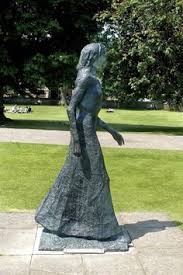
This Magnificent statue created by artist Elizabeth Frink on the grounds of the Salisbury Cathedral in England shows the strong, purposeful Magdalene striding forth on her apostolic journey as “Apostle to the Apostles”.

“High on an escarpment crowning the medieval walled city of Vezalay France, stands the magnificent basilica of St. Mary Magdalene”. That is how Episcopal priest and writer Cynthia Bourgeault opens her book, The Meaning of Mary Magdalene (Shambala, Boston and London, 2010). Bourgeault spent Holy Week of 2005 with the young monastic order in residence at the Cathedral of Vezalay. Here she would have a stunning awareness of Mary Magdalene’s presence in the events of the death and resurrection of Jesus.

Bourgeault tells us:

This mixed community of men and women monks is well known for the imagination and beauty of its liturgy, and toward the end of the Good Friday Liturgy I witnessed an unusual ceremony that changed forever how I understood my Christianity….

The late afternoon shadows were already dimming the cathedral when we finished with communion, followed by the traditional stripping of the altar. And then came the ceremony I am speaking of. Two of the sisters brought forward a small corpus – the crucified Christ figure that traditionally hangs on Roman Catholic crosses. It was carved in wood, about two feet long. Tenderly they wrapped it in the altar cloth, laid it on the altar, and placed beside it an icon of the Shroud of Turin (the portrait of Jesus allegedly imprinted on his original burial shroud and revealed through radiocarbon dating). They set a small candle and incense burner at the foot of the altar. And then, as sunset fell, one of the monks began to read in French the burial narrative from the Gospel of Matthew.

Enchanted by the mystical beauty of all this – the smell of the incense, the final shafts of daylight playing against the great stone walls of the cathedral – I allowed the sonorous French to float by my ears while I drifted in and out, catching what I could. I heard the description of Joseph of Arimathea asking for the body of Christ, wrapping it (just as the sisters had just done) in a linen cloth, laying it in a tomb. And then out of the haze of words came “et Mary Magdalene et l’autre Marie restaient debout en face du tombeau…”
That’s when I did my double take. Mary Magdalene was there? That was in the scripture? Why hadn’t I ever noticed it before?

Thinking that maybe my French had failed me, I went back to my room that evening, took out my Bible, and looked it up. But yes, right there in Matthew 27:61 it reads: “And Mary Magdalene and the other Mary remained standing there in front of the tomb.”

Suddenly the whole picture changed for me. I’d thought I knew the tradition well. …. How could this key point have escaped my attention? No wonder Mary Magdalene came so unerringly to the tomb on Easter morning; she’d stood by in silent, unflinching vigil the whole time Jesus was being laid to rest there. Maybe she never left…. Since that moment I have literally not heard the Passion story in the same way. It inspired me to go back to the gospel and actually read the story in a new way. (pp.5-6)

Bourgeault reflects further that much of what we know of Mary Magdalene has been absorbed “through the dual filters of tradition and the liturgy, which inevitably direct our attention toward certain aspects of the story at the expense of others.” (p. 6)

Turning to the Gospels directly, Bourgeault focuses mainly on John’s account of the resurrection. Here is the story:

Mary (Magdalene) arrives alone at the tomb in the early hours of the morning to discover that the stone blocking the tomb has been rolled away. She hurries off to find Peter and “the disciple whom Jesus loved” who race each other to the site, discover the tomb empty and the grave cloths rolled up, and return home in bewonderment. After the two of them have gone their way, Mary stays behind, weeping beside the tomb. Then, in a unique and immortally reverberating encounter:

She turned around and saw Jesus standing there, but she did not recognize him. Jesus said, “Woman, why are you weeping? Who are you looking for?”

mary_magdalene by Sieger Koder

She thought it was the gardener and answered him, “… if you have taken him away, tell me where you have put him and I will go and remove him.” Jesus said to her, “Mary.” She turned and said to him, “Rabboni” – which means Master. Jesus said to her, “Do not cling to me; you see I have not yet ascended to my Father. But go to my brothers and say to them: I am ascending to my Father and your Father, to my God and your God.”
So Mary went and announced to the disciples, “I have seen the Lord, and this is what he said to me. (John 20:14-18)

Bourgeault continues, pre-empting the June announcement from the Vatican:

It is on the basis of this announcement that Mary earned the traditional title of “Apostle to the Apostles.” The first to witness to the resurrection, she is also the one who “commissions” the others to go and announce the good news of the resurrection. (p. 8)

One small synchronicity I would like to point out: the verse in the Gospel of John cited above: Jesus said to her, “Mary.” is numbered John 20:16. The year of Mary Magdalene’s full recognition….

Apostle to the Apostles

On June 3rd in 2016, an announcement came from Pope Francis that you may not have heard. In its way it is more startling than most of what passes for daily news. Francis proclaimed that from now on Mary Magdalene is to be honoured as the “apostle to the apostles” and “first witness to the Resurrection of Jesus”. Her feast day, July 22nd, has been elevated to an Apostolic Feast of high honour commensurate with her male counterparts, to whom Jesus sent Mary saying, “Go and find the brothers and tell them: I am ascending to my Father, and your Father, to my God and Your God.” (John 20: 17)

images (3)

This Magnificent statue created by artist Elizabeth Frink on the grounds of the Salisbury Cathedral in England shows the strong, purposeful Magdalene striding forth on her apostolic journey as “Apostle to the Apostles”.

“High on an escarpment crowning the medieval walled city of Vezalay France, stands the magnificent basilica of St. Mary Magdalene”. That is how Episcopal priest and writer Cynthia Bourgeault opens her book, The Meaning of Mary Magdalene (Shambala, Boston and London, 2010). Bourgeault spent Holy Week of 2005 with the young monastic order in residence at the Cathedral of Vezalay. Here she would have a stunning awareness of Mary Magdalene’s presence in the events of the death and resurrection of Jesus.

Bourgeault tells us:

This mixed community of men and women monks is well known for the imagination and beauty of its liturgy, and toward the end of the Good Friday Liturgy I witnessed an unusual ceremony that changed forever how I understood my Christianity….

The late afternoon shadows were already dimming the cathedral when we finished with communion, followed by the traditional stripping of the altar. And then came the ceremony I am speaking of. Two of the sisters brought forward a small corpus – the crucified Christ figure that traditionally hangs on Roman Catholic crosses. It was carved in wood, about two feet long. Tenderly they wrapped it in the altar cloth, laid it on the altar, and placed beside it an icon of the Shroud of Turin (the portrait of Jesus allegedly imprinted on his original burial shroud and revealed through radiocarbon dating). They set a small candle and incense burner at the foot of the altar. And then, as sunset fell, one of the monks began to read in French the burial narrative from the Gospel of Matthew.

Enchanted by the mystical beauty of all this – the smell of the incense, the final shafts of daylight playing against the great stone walls of the cathedral – I allowed the sonorous French to float by my ears while I drifted in and out, catching what I could. I heard the description of Joseph of Arimathea asking for the body of Christ, wrapping it (just as the sisters had just done) in a linen cloth, laying it in a tomb. And then out of the haze of words came “et Mary Magdalene et l’autre Marie restaient debout en face du tombeau…”
That’s when I did my double take. Mary Magdalene was there? That was in the scripture? Why hadn’t I ever noticed it before?

Thinking that maybe my French had failed me, I went back to my room that evening, took out my Bible, and looked it up. But yes, right there in Matthew 27:61 it reads: “And Mary Magdalene and the other Mary remained standing there in front of the tomb.”

Suddenly the whole picture changed for me. I’d thought I knew the tradition well. …. How could this key point have escaped my attention? No wonder Mary Magdalene came so unerringly to the tomb on Easter morning; she’d stood by in silent, unflinching vigil the whole time Jesus was being laid to rest there. Maybe she never left…. Since that moment I have literally not heard the Passion story in the same way. It inspired me to go back to the gospel and actually read the story in a new way. (pp.5-6)

Bourgeault reflects further that much of what we know of Mary Magdalene has been absorbed “through the dual filters of tradition and the liturgy, which inevitably direct our attention toward certain aspects of the story at the expense of others.” (p. 6)

Turning to the Gospels directly, Bourgeault focuses mainly on John’s account of the resurrection. Here is the story:

Mary (Magdalene) arrives alone at the tomb in the early hours of the morning to discover that the stone blocking the tomb has been rolled away. She hurries off to find Peter and “the disciple whom Jesus loved” who race each other to the site, discover the tomb empty and the grave cloths rolled up, and return home in bewonderment. After the two of them have gone their way, Mary stays behind, weeping beside the tomb. Then, in a unique and immortally reverberating encounter:

She turned around and saw Jesus standing there, but she did not recognize him. Jesus said, “Woman, why are you weeping? Who are you looking for?”

mary_magdalene by Sieger Koder

She thought it was the gardener and answered him, “… if you have taken him away, tell me where you have put him and I will go and remove him.” Jesus said to her, “Mary.” She turned and said to him, “Rabboni” – which means Master. Jesus said to her, “Do not cling to me; you see I have not yet ascended to my Father. But go to my brothers and say to them: I am ascending to my Father and your Father, to my God and your God.”
So Mary went and announced to the disciples, “I have seen the Lord, and this is what he said to me. (John 20:14-18)

Bourgeault continues, pre-empting the June announcement from the Vatican:

It is on the basis of this announcement that Mary earned the traditional title of “Apostle to the Apostles.” The first to witness to the resurrection, she is also the one who “commissions” the others to go and announce the good news of the resurrection. (p. 8)

One small synchronicity I would like to point out: the verse in the Gospel of John cited above: Jesus said to her, “Mary.” is numbered John 20:16. The year of Mary Magdalene’s full recognition….

Becoming Wild Inside

On the Greek Island of Paros we come upon a magnificent Church, built by the Roman Emperor Constantine to fufill a promise made by his mother Helena.  The Church of Panagia Ekatontapyliani (Our Lady of a Hundred Doors) is the oldest remaining Byzantine church in Greece

In 326, St. Helena, the mother of Emperor Constantine the Great, sailed for the Holy Land to find the True Cross. Stopping on Paros, she had a vision of success and vowed to build a church there. She founded it but died before it was built. Her son built the church in 328 as a wooden-roof basilica.

Two centuries later, Justinian the Great, who ruled the Byzantine Empire from 527 to 565, had the church splendidly rebuilt with a dome. The emperor appointed Isidorus, one of the two architects of Constantinople’s famed Hagia Sophia, to design it.

Inside we come upon two large, luminous icons of Mary. Affixed to the lower frame of the icons we see images made of gold and silver in shapes depicting eyes, legs, arms….. Our guide, Calliope, tells us that these are offerings given in thanksgiving for a healing. Kapi reminds us that we saw something similar in the Museum: plaster representations of an arm or a leg that was healed, offered in thanksgiving to the healer god Asclepius.

Greece 2015 138

Icon of Mary in the Church of Our Lady of a Hundred Doors, Paros, Greece


The dogmas change; the traditions go on, Kapi comments, revealing yet another way in which Greek spirituality is part of a continuum from ancient days. Where once the Greeks sought healing from Asclepius, they now turn to Mary in their need.

On this beautiful island in the Aegean, the mystery of Mary of Nazareth confronts us. A woman wrapped in silence, the one who waits in the shadow for the great birthing, who “ponders in her heart” the wonders that follow upon the coming of her child.

As we prepare to celebrate the Birth of Jesus, the One whose coming brings Light at the darkest time of the year, Mary is a companion, a guide, a friend who walks with us in the darkness.

Mary has left us no written word. The little we know of her from the Gospels is sketchy at best, her appearances brief, her words cryptic. Yet her influence on Christian spirituality is staggering in its power.

Who is this woman, and how has she risen from a quiet life in the outposts of the Roman Empire to become, as the Church proclaims her, “Queen of Heaven and Earth”?

When we first meet Mary in the Gospels, she is being offered an invitation.

Here is how the Irish poet John O’Donohue imagines the scene:


Cast from afar before the stones were born

And rain had rinsed the darkness for colour,

The words have waited for the hunger in her

To become the silence where they could form.


The day’s last light frames her by the window,

A young woman with distance in her gaze,

She could never imagine the surprise

That is hovering over her life now.


The sentence awakens like a raven,

Fluttering and dark, opening her heart

To nest the voice that first whispered the earth

From dream into wind, stone, sky and ocean.


She offers to mother the shadow’s child;

Her untouched life becoming wild inside.


Where does our story touch Mary’s? Where are the meeting points? What are the words waiting for the hunger in us “to become the silence where they could form”? This might be a question to ask in our daily contemplative time… when our hearts open, will they also become a nest for a new birthing of the Holy?

From Jean Houston, we have learned that now there is no time for us to modestly refuse any call that smacks of greatness. The urgent needs of our time require a “yes” to the conception, followed by the birthing, of newness.

Here are Jean’s words, reflecting upon the call of Mary, the call of each of us:

Just think of the promise, the potential, the divinity in you, which you have probably disowned over and over again because it wasn’t logical, because it didn’t jibe, because it was terribly inconvenient (it always is), because it didn’t fit conventional reality, because… because… because….

 What could be more embarrassing than finding yourself pregnant with the Holy Spirit? It’s a very eccentric, inconvenient thing to have happen.

(Jean Houston in Godseed p. 38)

Eccentric. Inconvenient. Perhaps. But nonetheless it is our call. Mary’s story gives us the courage to say “yes” without knowing where that “yes” may lead. It is enough to know that certainly our own life will become, like Mary’s, “wild inside”.


To the limits of our longing

It is Holy Week, April, 2015. The promise of Resurrection is everywhere: in birdsong, in the first green shoots appearing in the wet earth, in the budding trees, in the softer air.

A dream comes to me in the night. I am standing in a darkened room where the different aspects of my creative work: my writing, my ministry with women, the plays I offer, the stories I tell, appear within lighted frames on the walls.

My mentor, Jean Houston is there. We walk together, looking at each image. Jean tells me she must leave, for it is time for me to travel alone. I must go further into the darkness of this room where there are no lights.

I sense in the dream that the Sacred Feminine Presence is waiting for me in the darkness. This is where the dream ends.

Not long afterwards (though at the time I made no connection with the dream), Jean sent an email telling of her intuition that I should come on the Journey to Greece she was leading in September. I was hesitant, unsure. Then I recalled the dream. I sensed that the journey to Greece was part of this call to meet the Sacred Feminine.

The weeks in Greece were so rich in insights, experiences, rituals, and healing of archaic wounds that I did not think of the dream again.

On our last morning on the island of Paros in the Aegean, in the time before the ferry departed, I was walking in the town, disappointed to find that the shops were not yet open… on one narrow street I saw a small building with an open doorway.

I walked inside, found a tiny darkened chapel with lighted red lamps near Icons. On the right wall an Icon of Mary drew me.

I stood spellbound. I felt invited to rededicate my life to the Sacred Feminine as I had done four years earlier. Words from one of Rilke’s poems rose in my heart, as though spoken by the Sacred Feminine:

You, sent out beyond your recall,

Go to the limits of your longing.

Embody Me.

Flare up like flame

And make big shadows I can move in.

Let everything happen to you: beauty and terror

Just keep going. No feeling is final.

Don’t let yourself lose Me.

Nearby is the country they call life.

You will know it by its seriousness.

Give Me your hand.

(Rainer Maria Rilke)

Still, I could not go. I kept gazing at the Icon. Then I saw the Child in Mary’s arms.

Icon in chapel on Paros Island, Greece

Suddenly the “Sealskin, Soulskin” story in C.P. Estes’ Women Who Run with the Wolves came to me.

I recalled the teaching that when a woman has found her soul, it is her spirit (her son) that she sends to do her work in the world.

I recalled the words that the Sealwoman spoke to her son as she placed him on the shore in the moonlight, “Only touch what I have touched and I shall breathe into your lungs a wind for the singing of your songs.”

I felt that the Sacred Feminine was promising me the same, as well as inviting me to send my spirit – my work- into the world.

In that small dark chapel on Paros, the circle that had opened with the mysterious dream of the darkened room where I saw images of my work and was sent in search of the Sacred Feminine, was completed.

I offer this personal experience as an invitation to each of you to revisit  moments in your life when you were touched by a Sacred Presence, one for whom you may have had no name. Until now. May Rilke’s poem speak to your heart.

May each of us “let everything happen to (us): beauty and terror”.

May we make “big shadows” where the Sacred One may walk. 

May we too embody her, as we “go to the limits of (our) longing.”

Teilhard/ the CaULDRON of the Cailleach

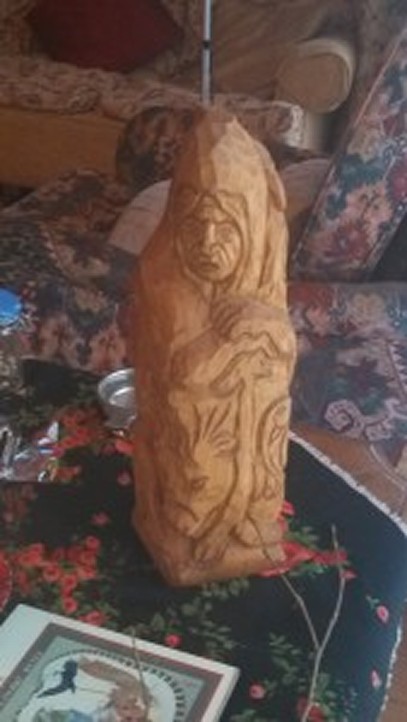
Image of the Cailleach

We are moving further into the sacred season that follows the Celtic Feast of Samhain, the feminine womb time of darkness.

This is the time of the Cailleach, the Ancient Crone, the dark mother who calls on us to change our ways, to turn away from destructive behaviours that harm our planet and all that lives within and upon her.

It is the season of the great Cauldron of the Cailleach where the things that are unpalatable, the attitudes and activities that are endangering life, are to be transformed.

Where we ourselves are to be transformed.

“How might Teilhard’s teachings serve as a guiding light for this dark season?” I wonder.

As if in answer, these words leap out at me: “For Teilhard, autumn rather than spring was the happiest time of year.”  Intrigued, I read on:  “It is almost as though the shedding of leaves opened his soul to the limitless space of the up-ahead and the not-yet…”

(John Haught, “Teilhard de Chardin: Theology for an Unfinished Universe” Teilhard to Omega Ilia Delio, ed. Orbis Books, Maryknoll, NY, 2014)

A scientist, a mystic, rather than a theologian, Teilhard deplored the way that theology continued to reflect on God as though the scientific fact of a still –emerging universe was either unknown or irrelevant.

Sixty years after Teilhard’s death, theologians are still engaged in the work of re-imagining a God who calls us forward into an as-yet-unknown reality.  

And yet, even a limited grasp, a glimpse, of what Teilhard saw of the “up- ahead and the not-yet” is enough to inspire hope.

Neither scientist nor theologian, I am a storyteller. I know how a change in the story has power to alter and illuminate our lives. Changing the story that once shaped our lives changes everything.

If we live in a story of a completed universe where once upon a perfect time our first parents, ecstatically happy in a garden of unimagined beauty, destroyed everything by sin, what have we to hope for?

The best is already irretrievably lost. Under sentence of their guilt we can only struggle through our lives, seeking forgiveness, trusting in redemption, saved only at a terrible cost to the One who came to suffer and die for us.

The suffering around us still speaks to us of punishment for that first sin, and the burden of continuing to pay for it with our lives…. Despair and guilt are constant companions.

Hope in that story rests in release from the suffering of life into death.

But if we live the story as Teilhard saw it, seeing ourselves in an unfinished universe that is still coming into being, everything changes.

In a cosmos that is still a work in progress, we are called to be co-creators, moving with the universe into a future filled with hope.

Our human hearts long for joy, and we love to hear stories where suffering and struggle lead to happiness, to fulfillment, to love.

The possibility that there could be peace, reconciliation, compassion, mercy and justice to an increasing degree on our planet is a profound incentive for us to work with all our energy for the growth of these values.

The call to co-create in an unfinished universe broadens and deepens our responsibility: Our sense of the creator, the work of the Holy Spirit, and the redemptive significance of Christ can grow by immense orders of magnitude. The Love that rules the stars will now have to be seen as embracing two hundred billion galaxies, a cosmic epic of fourteen billion years’ duration, and perhaps even a multiverse. Our thoughts about Christ and redemption will have to extend over the full breadth of cosmic time and space. (Haught, 13)

Haught believes that “if hope is to have wings and life to have zest,” we need a new theological vision that “opens up a new future for the world.”  

For Teilhard that future was convergence into God. His hope was founded in the future for he grasped the evolutionary truth that the past has been an increasing complexity of life endowed with “spirit”. 

At the extreme term of the convergent movement of the universe from past multiplicity toward unity up ahead, Teilhard locates “God-Omega”. Only by being synthesized into the unifying creativity and love of God does the world become fully intelligible. (18)

Teilhard saw God as creating the world by drawing it from up ahead, so that the really real is to be sought in the not yet.

And this means that: The question of suffering, while still intractable, opens up a new horizon of hope when viewed in terms of an unfinished and hence still unperfected universe. (p.19)

Haught believes that the concept of an unfinished universe can strengthen hope and love: … the fullest release of human love is realistically possible only if the created world still has possibilities that have never before been realized….Only if the beloved still has a future can there be an unreserved commitment to the practice of charity, justice and compassion. (19)

Teilhard’s embrace of an emerging universe is one of the reasons why his writings often lift the hearts of his scientifically educated readers and make room for a kind of hope…that they had never experienced before when reading and meditating on other theological and spiritual works.  (20) 

Today, November 5, 2019, a declaration, signed by 11,000 scientists, was released to the media.

It stated that we are experiencing a planetary climate emergency.

Rather than plunging us into despair, into guilt-ridden inaction, this intensifies our call to do what we can.

Working together communally, nationally, and internationally we can face this moment with courage.

The path has been set before us by scientists, by leaders in the ecological movement, by writers and thinkers who have known what is coming.

Even those signing the declaration believe it is still possible to act to meet this challenge.

Teilhard teaches us to see with clarity that even in this crisis we are being drawn forward by the Christic Presence, by the Love that is up ahead in a future that awaits us.

Knowing we are partnered and empowered for this time, this work, will give us the hope we need to do what we must.

TEILHARD’S CIRCLE OF SPIRIT

The internal face of the world comes to light and reflects upon itself in the very depths of our human consciousness. Pierre Teilhard de Chardin

We continue our spiral journey, guided by Kathleen Duffy, (Teilhard’s Mysticism, Orbis Books, Maryknoll, New York, 2014) through Teilhard’s Circles of Presence, Consistence and Energy towards his discoveries in the Circle of Spirit.  As I begin today’s Reflection, lured by Teilhard’s vision for our planet, his hope for the spiritualization of consciousness, I hear another voice that breaks through: the voice of teenager Greta Thunberg who crossed the Atlantic Ocean on a boat without the aid of fossil fuels to address World Leaders at the UN yesterday.

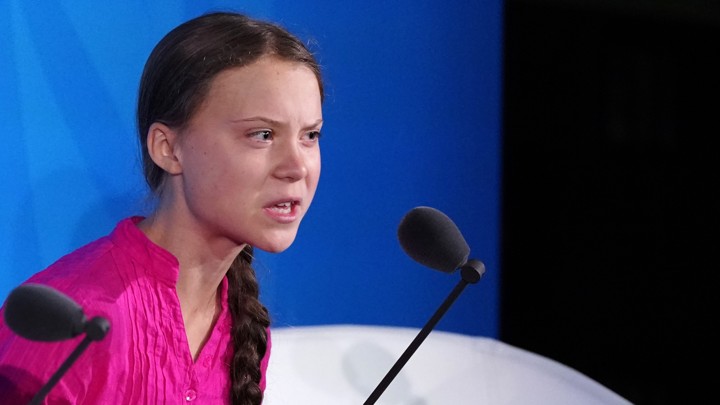
16-year-old Swedish Climate activist Greta Thunberg speaks at the 2019 United Nations Climate Action Summit at U.N. headquarters in New York City, New York, U.S., September 23, 2019. REUTERS/Carlo Allegri – HP1EF9N1AIFX9

Her words to us: “HOW DARE YOU?” weave themselves through Teilhard’s words as counterpoint, a drumbeat, a call to action, a reminder of how little we have advanced on the path that Teilhard showed us. There was anguish on her face, passion in her words, a tone of despair as she cried out, “This is all wrong. I should not be here. I should be back in school on the other side of the ocean.” 

“People are suffering. People are dying. Entire ecosystems are collapsing. We are in the beginning of a mass extinction. And all you can talk about is money and fairytales of eternal economic growth. How dare you!” Greta Thunberg

Asking why governments have failed to act on thirty years of scientific evidence that show the earth hurtling towards disaster, Greta expressed her inability to believe those who claim they understand the crisis. If you have truly understood, she told the assembly, and yet have not acted, “then you are evil”, and that she refuses to believe.

With Greta’s words still echoing, I begin, not with Teilhard’s own journey through the darkness of feeling himself like “a particle adrift in the universe”, before he became aware of the consiousness within matter, but instead with the ending of Kathleen Duffy’s Chapter on “The Circle of Spirit” . Here I find hope strong enough to support this NOW moment in our planetary story, a moment for which Teilhard intended to prepare us.

Inspired by Kathleen Duffy’s research into Teilhard’s thought, I would like to suggest what he might have said to young Greta had they walked together in Central Park.  

“Greta,” (I hear Teilhard say) “you showed great courage in your words today to the UN. You challenged the pretence of understanding as well as the despair that leads to paralysis by demanding that if the leaders understand the crisis, they must act. You told them they must not look to young people for hope because this is now their own task, their Great Work.  You have shown them the face of courage, matched with deeds, by crossing the ocean on a long journey unaided by fossil fuels.

“I believe firmly that nothing is more dangerous for the world than resignation and false realism. Though you are deeply distressed, you have chosen courageous action over despair. Know this, Greta; the Universe is drifting towards spirit in a forward movement that cannot ever be stopped. It is moving towards greater freedom and consciousness.

“The Internet, a technology I glimpsed in my lifetime, has allowed people around the planet to hear your words, even to watch your expression, your eyes, as you spoke yesterday. And yet not only your words, but your deep passion, your challenge, have entered the hearts of those who listened, and have entered the noosphere, a weaving of soul I imagined that gently wraps itself around the planet, its golden threads of spirit, its crimson threads of matter, intricately entwined. You, my dear brave Greta, are a weaver in the noosphere.

“The noosphere is conscious of itself, capable of collaboration, of spiritual relationship, and of sympathy, and thus of counteracting the dissolution brought on by individualization …though it is a fragile envelope, because of its capacity for relationship, it can overcome the tendency to fragmentation. I see it as the sphere of the conscious unity of souls…. I would call it “the Soul of the Earth”. You yourself are living the same vision, a young woman who understands that it is the capacity for relationship, for union, that brings about growth,  that must be our greatest source of hope.

“Moving from the individual to the collective is the most crucial challenge facing human energy. For the work can be done only if humanity participates in the forward movement and each person can be saved only by becoming one with the universe.

“My dear Greta, may you keep a zest for life, a passion for the whole and above all a flame of expectation for the awakening of full human potential. Only faith in the future will give us the motivation and the energy to overcome the obstacles to unity. We shall direct our energy to the creativity required to live the dream of the future.

“Keep developing a deep sense of yourself, Greta, the true self that allowed you to speak truth to power before the United Nations, unshaken by applause or criticism or any need for adulation. In your growth, be free to move beyond all boundaries, all structures and strictures that no longer serve the Great Work. Be like the cosmos as you continually develop new forms. I so look forward to what you shall become Greta, and to what you will achieve with your passion as you weave with the noosphere.

“And trust me in this, Greta, for I have passed through great darkness to come into the light that does not grow dim. Earth’s story is not ended. The Universe is not yet finished. Earth is moving towards wholeness, her people towards oneness.”

In gratitude to Kathleen Duffy for her own great work in bringing the essence of Teilhard’s spirit to us, I close with her words:

As co-creators in the ongoing evolution of life and spirit, the future of the cosmos depends on the choices that we make, the effort that we exert, the work that we do….The Great Work consists in providing impetus for the transformation into greater consciousness, promoting the cultural transition through which we as a species are slowly moving, fostering the next major phase transition in human history. It calls us to assess our impact, to take responsibility for our actions, and to forward the cosmic project in the direction of spirit. (TM 97, 106)

Teilhard: Circle of energy

Kathleen Duffy’s exploration of Teilhard’s Circle of Energy (Teilhard’s Mysticism, Orbis Books Maryknoll, NY 2014) shows the uniqueness of his mystic path.

Rather than fleeing the earth, Teilhard seeks the sacred in the deep heart of life on Earth in all its wonder and terror, and in the fiery depths of the cosmos, as it cycles through destruction and rebirth.

Touched by the intricate and beautiful structure of the cosmos and yearning to be possessed by the Sacred Presence that fills it…Teilhard continued his mystical journey, ever searching for the supreme tangible reality. As he stepped into the third circle, he found the cosmos ablaze with activity. The Divine Presence that had been alluring him had suddenly acquired a new aspect—Energy. (TM 55)

Teilhard was stirred by the evolutionary story, a story whose creativity and energy were shown to him in the layers of rock, in the depths of the earth, as he worked as a geologist and paleontologist. Enthralled by the emergence of living organic matter from inorganic, Teilhard writes:

See how (Earth’s) shades are changing. From age to age its colors intensify.Something is going to burst out on the juvenile Earth. Life! See it is life!” (The Human Phenomenon, 38, translation Sara Appleton-Weber, Portland OR: Sussex Academic Press, 1999)  

Teilhard imaged evolution as a tapestry whose threads revealed “the amazing energy at work at the heart of the cosmos” (TM 59).

He describes this tapestry as: endless and untearable, so closely woven in one piece that there is not one single knot in it that does not depend upon the whole fabric (Science and Christ, 79, trans. Rene Hague New York, Harper and Row, 1968).

Teilhard saw that since the beginning of time complex structures have been emerging from the union of simpler ones: “a thrust towards union seems to be coded into the very fabric of the cosmos” (TM 60).

As his awareness of the complexity and interconnectedness of the Universe deepened, Teilhard could see that these qualities lead to understanding our global life:

…No elemental thread in the universe is wholly independent…of its neighboring threads  (The Future of Man, 87, trans. Norman Denny, New York: Harper and Row, 1964).  For just as the simplest vibration of a single cosmic tapestry thread affects the whole fabric, so local interactions can be felt on a global scale (TM, 70).

Teilhard came to know the importance of considering the whole in order to grasp the order that lies under the appearance of disorder.

He intuitively understood that “deep down there is in the substance of the cosmos a primordial disposition …for self-arrangement and self-involution” (Heart of Matter, 33).

Yet Teilhard knew in his life what today’s scientists continue to explore: the “transition region between the two extremes of ordered stability and chaotic instability called the edge of chaos” (TM 73). In the trenches of World War 1, the horror in which he was immersed still allowed for “feelings of freedom, unanimity, and exhilaration” (TM 75).

Because he understood that “the self-organization of the world progresses only by dint of countless attempts to grope its way” (Christianity and Evolution, 187, trans Rene Hague, New York: Harcourt Brace Jovanovich, 1969), Teilhard saw the mystic must also “test every barrier, try every path, plumb every abyss” (The Divine Milieu, 70,  New York, Harper and Row, 1960).

Moving through the Circle of Energy, Teilhard became aware of the universe as “alive, vibrant, filled with Divine Energy and solidly enduring….undergoing a cosmogenesis…slowly moving it toward greater complexity and deeper union” (TM, 75).

This deep knowing led Teilhard to see his own sufferings as part of the larger story: Putting his personal suffering into a cosmic perspective, he turned his attention to the pain and suffering that pervades the evolutionary story, a story that is rife with misfortune, struggle, disease, and death: natural disasters beset Earth on every side; predators prey on more vulnerable species; changing environmental conditions cause many species to become extinct; within the human community, war and oppression continue to rage. It is not only humans who suffer. Every part of the cosmos bears the scars of the chaos and tragedy that accompany the evolutionary process (TM, 76-7).  

Within the cosmic story, Teilhard’s mystic path would become one of uniting with “the Divine Fire at work at the heart of matter” (TM 78)

Earth’s story had shown Teilhard that the Divine is continuing to shape the universe and therefore human action may “channel … the whole of the World’s drive towards the Beautiful and the Good” (Heart of Matter, 204).

Seeing the “sacred duty” of working with Divine Energy, Teilhard vowed: “I shall work together with your action…. to your deep inspiration… I shall respond by taking great care never to stifle nor distort nor waste my power to love and to do” (The Divine Milieu, 79).

In a letter written to a friend during his work as a geologist, Teilhard describes a moment of mystic knowing:

 … this contact with the real does me good. And then, amid the complexity and immobility of the rocks, there rise suddenly toward me “gusts of being,”sudden and brief fits of awareness of the laborious unification of things, and it is no longer myself thinking, but the Earth acting. It is infinitely better (Letters to Two Friends 1926-1952, 73, translated by Helen Weaver, edited by Ruth Nanda Anshen, New York: New American Library, 1967).     

Teilhard’s mystic path led him to the heart of the earth:  

He was convinced that he must steep himself in the sea of matter, bathe in its fiery water,plunge into Earth where it is deepest and most violent, struggle in its currents, and drink of its waters. Earth was the source of his life:through the world Divine Energy enveloped him, penetrated him, and created him. Because Earth had cradled him long ago in his preconscious existence, he knew that the Earth would now raise him up to God. (TM 80-1)

Teilhard de Chardin and the Incarnation

In recent weeks, through the eyes of 21st Century theologians, we have been gazing into the mind, heart, and mystical, poetic soul of Pierre Teilhard de Chardin.  Brilliant scientist, creative thinker, man of faith, Teilhard brings into harmony recent discoveries about an evolving universe and his faith in the Christic presence at the heart of it all.

For Teilhard the concept of original sin, committed by our first parents in a lost garden of paradise, was incompatible with the reality of an evolving universe where everything is moving into fullness of being, including God.

So how does Teilhard view the Incarnation, the Word made Flesh that we celebrate each Christmas? If we are not irretrievably sinful and lost, not in need of someone “to save us all from Satan’s power when we were gone astray…” what are the “tidings of comfort and joy”?

Ilia Delio, our guide through the seas of theology on Teilhard’s ship, writes:

Teilhard began with evolution as the understanding of being and hence of God. What he tried to show is that evolution is not only the universe coming to be but it is God who is coming to be. By this he means that divine love poured into space-time rises in consciousness and eventually erupts in the life of Jesus of Nazareth…

Christ invests himself organically with all of creation

From the Big Bang 13.8 billion years ago to the present, God has been creating through the word of loveand incarnating creation in a unity of love. The integral relationship between incarnation and creation is the unfolding of Christ, the Word incarnate, who invests himself organically with all of creation,immersing himself in things, in the heart of matter and thus unifying the world. (“From Teilhard to Omega” Orbis Books, Maryknoll, NY 2014 pp. 46-7)

But how would Teilhard himself speak about the mystery of Incarnation? Let’s bend space-time imaginally to place ourselves in a small Jesuit Chapel somewhere in France, just after the Second World War. Father Pierre Teilhard de Chardin walks to the pulpit to give the Christmas homily. At first, his words sound like an overture to the symphony we have come to hear:

I shall allow … (a) picture to emerge — at first in apparent opposition to the dreams of the Earth,but in reality to complete and correct them — that of the inexpressible Cosmos of matter and of the new life,the Body of Christ, real and mystical, unity and multiplicity, monad and pleiad.And, like a man who surrenders himself to a succession of different melodies,I shall let the song of my life drift now here, now there — sink down to the depths,rise to the heights above us, turn back to the ether from which all things came,reach out to the more-than-man, and culminate in the incarnate God-man. (1)

Incarnation is a making new…of all the universe’s forces and powers

He pauses, looks directly at us, continues:  The Incarnation is a making new, a restoration,of all the universe’s forces and powers; Christ is the Instrument, the Centre, the End, of the whole of animateand material creation; through Him, everything is created, sanctified and vivified.This is the constant and general teaching of St. John and St. Paul (that most “cosmic” of sacred writers),and it has passed into the most solemn formulas of the Liturgy: and yet we repeat it,and generations to come will go on repeating it,without ever being able to grasp or appreciate its profound and mysterious significance,bound up as it is with understanding of the universe.

the Pearl of the Cosmos…the Blessed Virgin Mary, Queen and Mother of all things, the true Demeter… 

With the origin of all things, there began an advent of recollection and work in the course of whichthe forces of determinism, obediently and lovingly, lent themselves and directed themselves in the preparation of a Fruit that exceeded all hope and yet was awaited. The world’s energies and substancesproduced the glittering gem of matter, the Pearl of the Cosmos, and the link with the incarnate personal Absolute—the Blessed Virgin Mary, Queen and Mother of all things, the true Demeter…and when the day of the Virgin came to pass, then the final purpose of the universe, deep-rooted and gratuitous, was suddenly made clear: since the days when the first breath of individualization passed over the expanse of the Supreme Centre here below so that in it could be seen the ripple of the smile of the original monads, all things were moving towards the Child born of Woman.

the Mystical Christ has not reached the peak of his growth 

And since Christ was born and ceased to grow, and died, everything has continued in motion because he has not yet attained the fullness of his form. He has not gathered about him the last folds of the garment of flesh and love woven for him by his faithful. The Mystical Christ has not reached the peak of his growth…and it is in the continuation of this engendering that there lies the ultimate driving force behind all created activity…Christ is the term of even the natural evolution of living beings. (2)  

We leave the little chapel, our hearts ablaze.  Now we also have a task: co-creating,and through our own embodied lives bringing divine love more fully into every aspect of life on our planet.

This could take some time. At the very least, it could take the rest of our lives!

(1) Pierre Teilhard de Chardin, Writings in Time of War  pp. 15-16

(2) Pierre Teilhard de Chardin in The Future of Man translated from “L’Avenir de l’Homme (1959) by Norman Denny;William Collins Pub. London, Harper & Row Pub. New York, 1964

teilhard’s call to immerse ourselves in the universe

We live in a universe where everything that exists shines, in Teilhard’s view, “like a crystal lamp illumined from within”, as we saw in our April 24th Reflection on “Teilhard’s Spiritual Vision” (From Teilhard to Omega edited by Ilia Delio, Orbis Books, Maryknoll NY 2014 Chapter Ten).

“like a crystal lamp illumined from within”

This reality calls us to respond with wonder, awe, gratitude. But Teilhard believed that much more is required from us. The same essay goes on to describe the way Teilhard saw our involvement in the evolutionary process:

(Teilhard) envisioned the evolutionary process as one moving toward evolution of consciousness and ultimately toward evolution of spirit, from the birth of mind to the birth of the whole Christ. He urged (us)…to risk, get involved, aim toward union with others, for the entire creation is longing for its fulfillment in God. (Delio and Dinges p. 174) 

Beyond recognizing evolution, we are called to work towards it in ourselves. This is a spirituality that calls for immersion in the world:

… plunging our hands into the soil of the earth and touching the roots of life….a “mysticism of action,” involvement in the world compenetrated by God. (Teilhard) held that union with God is not withdrawal or separation from the activity of the world but a dedicated, integrated, and sublimated absorption into it. (p.174)

live from the center of the heart where love grows

Teilhard understood the Gospel call to “leave all and follow me” meant seeing the Christic presence in the heart of matter, then working to bring that presence into greater fullness.

The world is still being created and it is Christ who is reaching his fulfillment through it….We are to harness the energies of love for the forward movement of evolution toward the fullness of Christ. This means to live from the center of the heart where love grows and to reach out to the world with faith, hope and trust in God’s incarnate presence. (p. 175)

In this new incarnational vision of the relationship between God and the universe, a relationship that spans the whole evolutionary journey leading towards the future, Teilhard offers three fresh perspectives. These are described by Delio and Dinges:

First, (Teilhard’s) love of matter and spirit is a dual commitment to God and to the world;

second, his inclusion of suffering and evil in the forward movement of evolution offers a realistic approach to evil as part of unfolding life;

…third, the participation of humans is essential to the process of Christogenesis, that is, the evolution of Christ in the world and the world in Christ.

“If we are to remain faithful to the gospel,” he says “we have to adjust its spiritual code to the new shape of the universe….It has become the great work in process of completion which we have to save by saving ourselves”. (p. 175)

Teilhard looked at the earth/ the universe with the eyes of a mystic, with the heart of a lover.

In love with Holy Presence at the deep heart of all that exists, he could echo Rumi’s wonder-filled exclamation: “Is the one I love everywhere?” Through Teilhard’s eyes, we can learn to see what mystic-poet Catherine de Vinck calls “the fire within the fire of all things”. Once we see that fire, we know the call that Teilhard knew to put our hearts at the service of the evolution towards love that is the call of the universe, as well as our personal call within the universal call, for the two are inseparable.

our deepest call is to love

Teilhard shows us that our deepest call is to love, that evolution is advanced by union on every imaginable level of being. And, as another poet, Robert Frost observed: “Earth’s the right place for love: I don’t know where it’s likely to go better.”

Teilhard wrote: I merge myself through my heart with the very heart of God….God is, in a sense, at the point of my pen, my pick, my paint-brush, my needle—and my heart and my thought. It is by carrying to its completion the stroke, the line, the stitch I am working on that I shall lay hold on that ultimate end towards which my will at its deepest levels tends. (p. 176)

Our place within (the universe)… is to be its eyes of wonder, its heart of love, its allurement toward union

Nothing that lives on our planet is outside of us. We can no longer accept lines of division between religions, between cultures, between nations, between species. This universe is evolving as one. Our place within it, like Teilhard’s, is to be its eyes of wonder, its heart of love, its allurement toward union. Everything that we do contributes towards that great comingled work of the evolution of the universe, the evolution of ourselves.

How would our lives be different is we devoted time each day to a deeper seeing, a heartfelt listening to the songs of the universe, its joy-filled melodies, its grief-laden cries, seeking the “shining of God through creation, the diaphany of God radiating through a world that becomes transparent.” (p.176) 

“shining of God through creation, the diaphany of God radiating through a world that becomes transparent.”

Teilhard invites us to:… establish ourselves in the divine milieu. There we shall find ourselves where the soul is most deep and where matter is most dense. There we shall discover, where all its beauties flow together, the ultra-vital, the ultra-sensitive, the ultra-active point of the universe. And, at the same time, we shall feel the plenitude of our powers of action and adoration effortlessly ordered within our deepest selves. (“Divine Milieu” quoted by Delio and Dinges on p.179)

awakening to the sacred feminine presence in our lives