Category Archives: Uncategorized

5 Easy Book Marketing Tips For Authors

M.J. Moores's avatar

I came across this great little nugget recently and wanted to share it with you all.

JUST PUBLISHING ADVICE goes over these 5 important techniques:

  1. TypingMeticulous Listing
  2. Blog More
  3. Share Better
  4. Comment Everywhere
  5. Stop Selling

Whether you think you know this stuff already or not, it’s worth a read. You’d be surprised at how simple and straightforward this advice is and how practical it is to put into play.

View original post

Welcoming Brigid as co-birthers

The knocking on the wooden door is so loud it startles us, even though we are waiting for the sound. A woman’s voice, strong, certain, calls out from the other side: “I am Brigid. Do you have a welcome for me?”
We have our answer ready, “Yes, we do.” The door opens. The woman playing Brigid’s role enters.

On this final morning of our weekend with Dolores Whelan at the Galilee Retreat Centre, we are enacting an ancient Celtic Ritual of Imbolc, as we welcome Brigid in her Maiden form. Brigid, who “breathes life into the mouth of dead winter”, comes among us, announcing spring.

Our recent weeks of reflecting on Brigid, paying her a visit in her home country of Ireland, show us the depth, the importance of this brief exchange. Do we “have a welcome” for Brigid in our lives? What does it mean to answer her question with a resounding, “yes”?

Brigid is a woman of great power, an archetype, an embodiment of the energies of the sacred feminine, another facet of Sophia. Our welcome of her will open up our lives in ways we cannot foresee, cannot even imagine. But the hints are already given in the stories we have been recalling.

In “Brigid: The Mary of the Gael”, we recalled the legend that angels carried Brigid over the seas from Ireland to Bethlehem so that she might be present for the birth of Jesus, assisting Mary as midwife. Brigid, who was born in the fifth century after the event….

Immediately we find ourselves in sacred time, in what today’s physicists, following Einstein, would call the simultaneity of time. Mystery. We suspend disbelief, allow our linear, logical brains to take a break, invite the story to offer us its teachings. Ask how this applies to our own lives. Listen.

Each one of us is asked, like Mary, to give birth to the Holy One. In Godseed, Jean Houston writes about the heart of our call, inviting us into a meditation, a visualization, of how this might be:

Lying down now and closing your eyes, imagine that you are dreaming. In your dreams, you see light, and into this light comes a Being of Light, a Bearer of Good News, a Resident from the Depths. This angel says to you, “Oh Child of God, fear not to take unto yourself the spiritual partnership, for that which is conceived in you is of the spiritual Reality. And this Reality, if nurtured, shall be born of you and shall help you to…bring the Godseed into the world.”

And now see what the angel sees—the fulfillment and the unfolding of this Child of Promise within you….see and feel and know the possibilities, indeed the future, of this Child in you, this Godseed that you are growing in the womb of your entire being, should you allow it to be nurtured and to grow and to be born into the world. (Jean Houston in Godseed Quest Books 1992 p.39)

This call to birth the Christ within us is as ancient as first century Paul, who wrote of being in labour until Christ is born in us. It is as modern as twenty-first century eco-feminist theologian Yvonne Gebara who entreats us to give birth to the Christic Presence in the Universe.

Contemporary writer Diarmuid O’Murchu cites the words of the thirteenth century Dominican mystic Meister Eckhart: What does God do all day long? God lies on a maternity bed, giving birth all day long.

Reflecting on Meister Eckhart’s image, O’Murchu continues:

This is a metaphor we have known as a spiritual species for thousands of years, long before formal religions ever came into being….The Great Goddess of our Paleolithic ancestors was perceived as a woman of prodigious fecundity, birthing forth the stars and galaxies, the mountains and oceans and every life form populating planet earth today. God, the great life-giver in the pregnant power of creative Spirit, is probably the oldest and most enduring understanding of the Holy One known to our species.

O’Murchu concludes that: we are called to become co-birthers with our birthing God of the ongoing evolutionary re-creation of God’s world in justice, love, compassion and liberation. (Diarmuid O’Murchu Jesus in the Power of Poetry 2009 pp. 45-46)

When we say yes to our call to give birth, we are embracing a lifelong partnership with the Holy One of “prodigious birthing”, a responsibility that has the power to take over our lives, to demand of us everything, to offer us a life that is at once profoundly meaningful, and intimately engaged with the ongoing renewal of the universe. There will be suffering, there will be hard work, but there will also be times of ecstatic joy, tasting our oneness with the Love at the heart of life.

Dolores reminds us that: it is only in us, you and me, that the energy of Brigid will rise again, take form and become a force for transformation in our world.(Dolores Whelan in Ever Ancient, Ever New Dublin 2010 p. 81)

Brighid by Jo Jayson

painting of Brigid by Jo Jayson


Brigid, midwife of this birthing, stands at the door. We hear her voice, “Do you have a welcome for me?”

What is our response?

Epiphany: A Celebration of Wisdom

Wisdom is bright, and does not grow dim.
By those who love her she is readily seen, and found by those who look for her.
Quick to anticipate those who desire her, she makes herself known to them.
Watch for her early and you will have no trouble;
you will find her sitting at your gates.
Even to think about her is understanding fully grown;
be on the alert for her and anxiety will quickly leave you.
She herself walks about looking for those who are worthy of her
and graciously shows herself to them as they go,
in every thought of theirs coming to meet them.

Wisdom 6: 12-16 ( Jerusalem Bible)

The Twelfth Night of Christmas invites a celebration of Wisdom. In her book In Wisdom’s Path  Jan L. Richardson writes: The Feast of Epiphany began as a festival of the Eastern Church which celebrated the appearing of Jesus, focusing on the events of his birth and baptism. In the Western Christian tradition, Epiphany has … focused on the coming of the wise men to welcome Jesus. At its core this holy day offers an invitation to wrestle with the mystery of the incarnation, to recognize the multitude of ways that the sacred takes flesh and to welcome the divine into our midst.

Elsewhere Jan has written of the women who must also have come to welcome the radiant new life:

188331_497269806985968_754445133_n

Wise women also came.
The fire burned
in their wombs
long before they saw
the flaming star
in the sky.
They walked in shadows,
trusting the path
would open
under the light of the moon.

Wise women also came,
seeking no directions,
no permission
from any king.
They came
by their own authority,
their own desire,
their own longing.
They came in quiet,
spreading no rumors,
sparking no fears
to lead

to innocents’ slaughter,
to their sister Rachel’s
inconsolable lamentations.

Wise women also came,
and they brought
useful gifts:
water for labor’s washing,
¬fire for warm illumination,
a blanket for swaddling.
Wise women also came,
at least three of them,
holding Mary in the labor,
crying out with her
in the birth pangs,
breathing ancient blessings
into her ear.

Wise women also came,
and they went,
as wise women always do,
home a different way.

Jan L. Richardson
(www.janrichardson.com)

As we enter a new year, we welcome Wisdom into our lives, knowing that “for those who love her, she is readily seen, and found by those who look for her”. Companioned each day by Wisdom, we shall, like the wise women in Jan’s poem, experience a fire burning in our wombs. Like them we will not seek permission of any king or ruler to do what Wisdom requires of us. We will set out on our own authority, our own desire, our own longing, trusting that for us,, as for them, the path will open under the light of the moon.

The Greek Journey: Seven

Part Two: The Heroic Journey (Mount Pelion)

Under an Ancient Tree on Mount Pelion we revisit our lives as a journey, find where we are now in the story, share that with our companions, and turn the journey into a play.

The Road of Trials, the Belly of the Whale
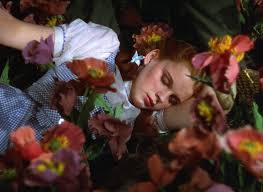
Dorothy is offered Guidance, but not a map. “Follow the Yellow Brick Road.” What in the Hero’s journey is a road of trials, often for the heroine includes a time of what Campbell calls being in the “belly of the whale”. In the Wizard of Oz, this is symbolized by the poppy fields where Dorothy and her three companions suddenly fall deeply asleep under the spell of the Wicked Witch.

images (5)

The Belly of the Whale takes us by surprise, for just when we know what we must do, just when we manage to fool the guardian and pass the gate, we find ourselves blindsided… by a depression, an ingression, a call to the depths of being. Though we are clear about our mission, we are not yet prepared. The Belly of the Whale gives us preparatory time, time for deep inner work. We enter our own depths, the source place for all endeavours. Find your form for this inner work: drawing or dance or journaling or music or drumming or nature or working with an archetype. When you discover who your archetype is, you have guidance. You are put on the path.

You may not know what your archetypal guidance is, but your archetypal guidance knows who you are.”(Jean Houston)

Live in the Temple of Inner Abundance where you are the womb of your new becoming. Choose your daily practice and be faithful.

images (3)

Assisted by her friends, Dorothy wakens and all four approach the Emerald City, once again facing a guardian at the gate who will not allow them to see the Wizard. Dorothy’s tears as she speaks of her longing to see her Aunt Em break down his resistance.

Yet the Wizard, when they at last meet him, refuses to grant their request until they fulfill an impossible task: Bring me the broomstick of the Witch of the West!
The challenge here is to discover the task that you never believed you could do, but the Wizard of the inner sanctum of yourself always knew you could, and if you did, would change the nature of your belief about yourself….Your inner Wizard…the Friend, stands before you and asks you to recall the “impossible things” you have done…. Now the Friend-Wizard asks you to consider what “impossible things” you have yet to do in the near future. The Friend- Wizard also asks you to imagine as vividly as you can actually doing it, with all the difficulties and acts of courage that it may require. Remember that you have allies, a Protector and the Friend to help and accompany you. (Jean Houston in The Power of Myth and Living Mythically p.202)

Emergence with Amplified Power
You discover now that your expectations become magnets, drawing to you what you need for your task, your life work. You have entered the path of wisdom, and with her come all good things. You experience the grace of ABBONDANZA. You are moving into the fullness of life. Your entelechy holds the seed of what you truly are and draws you into the magic and mystery of being “a local outcropping of the Godself in time”. (JH)

The life force of Toto (“Run, Toto, Run), the support and cleverness of her three friends, and finally the life force of water accomplish the impossible. Dorothy and her companion return to the Wizard in triumph.

Return with Elixir

You begin to embody the deep happiness that is your birthright. You heed the call to live the WHY at the centre of your life.

images

And so Dorothy returns home, changed by her adventures, companioned within by those whom she met and loved in Oz :

“Home” is that land to which one returns in a deepened condition after the trials and adventures of initiation. It is now a realm that was perceived in Oz, but can be felt in the here and now as the deepened and extended land. You have brought back with you now mindfulness, heartfulness and courage….You have gone home to Kansas, but not before you have grown up in Oz….You have returned a mythic being, and, like Dorothy, you now have the chance to green the wasteland of your own particular “Kansas” with your newfound knowings. (Jean Houston in The Power of Myth and Living Mythically pp. 210-1)

We sit beneath the great plane tree and ask ourselves:

Which part of the journey am I now experiencing?

What do I need to do at this stage?

What do I now understand?

What happens next?

The Greek Journey: Mount Pelion

Our bus climbs a narrow road that spirals upwards, criss-crossing the forested flanks of Mount Pelion. The fog that envelops us, seemingly emanating from the trees, adds mystery to the magic. On either side, gigantic trees hover, verdant pines, flourishing plane trees, oak, beech and chestnut, conifer and deciduous, inviting the imagination to conjure stories of enchanted woods. We think of Robin Hood’s Sherwood Forest, of Tolkien’s Lothlorien…

P1000637

In places where the trees part, we look outwards across the vista. Best not to look downwards, for the road may vanish, the bus appear to hover in mid-air above chasms. Such a journey requires a trustworthy driver and we breathe our thanks for Panagiotis.

Mount Pelion lies halfway between Athens and Thessalonica, taking us into the storied life of Asclepius, believed to have been born in Thessalonica (520 km north of Athens) before the Trojan War (1250 BCE). As a child, Asclepius was sent to be taught by the Centaur physician Chiron, who trained him in the arts of healing. This mountain whose heights we are ascending may have been the place where Asclepius climbed to meet his teacher.

Continuous with the knowledge of the most ancient ones, filled with their reverence and knowledge of the natural order, Asclepius became the greatest healer in Greece, his vast knowledge matched only by the depth of his compassion. He could apparently heal almost any ill of mind or body, sometimes using herbs and medicines or surgical procedures, but more often than not healing through spiritual and psychological means, attuning his patients to their capacity for health and wholeness. (Jean Houston, “The Search for the Beloved” p.9)

In this same book, Jean Houston tells us of the suggestion made by writer Mary Renault that the centaurs, the “ancient ones” whose knowledge was passed on to Asclepius, may not have been half man, half horse as legend portrays them. They may have been the remnants of Neanderthals who did not entirely disappear from the planet 25,000 years ago, but instead “removed themselves to remote and hilly country where they were often seen riding shaggy ponies, their hairy bodies indistinguishable from their mounts” They passed on to selected students, who included priests, princes and physicians in training their “botanical knowledge and natural philosophy of a hundred thousand years or more”. (p. 8)

Mount Pelion was known as a “healing mountain” because of the medicinal and healing plants that flourish on its slopes, and the crystal clear water of its streams. Homeopathic, herbal, flower essences and even poisonous remedies were distilled from the herbs of Mount Pelion: meadow saffron, hemlock, henbane, nightshade, mandrake, St. John’s wort, mullein and yarrow. Still today these plants and herbs are gathered and sold in village markets throughout the region.

As we continue our ascent of Mount Pelion, we are invited into a time of silence. We each carry within our own magical forest, our own mysterious fog, our own longings for healing and wholing. What are these inner enchantments? Which serve our life, our work of healing and wholing for our own time? Which ones do we want to let go because they hinder our work, our journey? What is the healing we seek on this sacred mountain?

We come to the village of Tsagarada where the turquoise Aegean Sea fills our eastward gaze, while the wooded slopes of Mount Pelion dominate the westward view. Once we have settled into our rooms, caught our breath, and donned good walking shoes, Panagiotis takes us to one of the village’s four courtyards, each one named for its church.

P1000660 In the courtyard of St. Paraskevi there stands a plane tree that is 1100 years old, with a circumference of 46 feet. The tiny chapel is open, inviting us to enter, to gaze at a lovely Icon of Mary with large lustrous eyes, her hand resting on her heart. Her presence draws forth the questions that arose in us during the silence of our bus journey. But we feel her guidance not to grapple with these, but rather to focus on the magic of now, to be with our companions, rather than being absorbed with our own story.

P1000649

Our guide for a walk along the pathways of Pelion is Nikolas, who greets us with an armful of walking sticks. For the next two hours we make our careful way along the ancient footpaths, stopping to gaze out at the wooded heights touched by the setting sun, or down at a perfect pink cyclamen growing, it seems, straight out of a rock.

P1000655

We pick up small herbs, chew on fresh mint, ask the names of small blue and red berries on bushes beside the path, notice chestnuts…
Suddenly the path opens above a striking view of the distant Aegean far below us.

P1000640

With the persistence of a soundtrack, our personal questions hum within us. We smile to see a road sign that may point the way for us. It is, of course, in Greek…P1000658


The Greek Journey Part Three

The AmphiareionAmphiare

Our Journey to Greece was inspired by a great healer named Asclepius who lived in Ancient Greece over 3000 years ago. His wholistic approach to healing included drama and dreams, laughter and song, dance, spirituality. “Asclepius,” writes Jean Houston, “demonstrated how full well-being can be created by energizing and balancing the body, heart, intuition, dreams, faith and spirit of a person.”

Today we set out from Athens, travelling 22 miles northeast to visit a sanctuary and oracular healing center. Founded in the 5th century BCE and flourishing until the 4th century CE , the site was dedicated to the god-hero Amphiaraus. Healing at the Amphiareion came through dreams and their interpretation. The Greek travel writer Pausanias described the process in the 2nd century CE:
the first thing is to purify oneself, when someone comes to consult Amphiaraus, and the purification ritual is to sacrifice to the god, and people sacrifice to him and to all those whose names are on (the altar), and — when these things are finished—they sacrifice a ram and spreading out its skin under themselves, lie down waiting for the revelation of a dream.

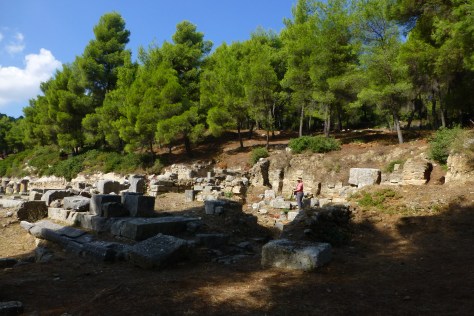
We approach the Amphiareion as pilgrims, as well as time travellers, for we have come to an ancient ruin seeking a spiritual power that lingers. Here, nestled in a plain among mountains, there were once baths, a theatre, the god’s temple, staff residences, shops, inns, the agora and a water clock. Today there are only stone remnants of pedestals and sleeping benches. Yet the peace of this place envelops us with its natural beauty, its quiet strength.

First we purify ourselves, washing our hands in a bowl that holds water infused with herbs. We have been asked to bring a non-physical sacrifice, something in our lives we are ready to release….I have been wondering what this might be.

Inviting us to find places to sit among the tumbled stones, Jean tells us: “Sacrifice is about making holy. What aspect of your life do you wish to make holy?”

We ponder this in silence. What rises for me is an old fear, one that emerges now and then with renewed ferocity. It is about home, about belonging: where do I belong? with whom? I feel drawn to sacrifice this fear, handing it over to the Sacred Presence to whom my life is dedicated, trusting Love to care for me… I sit looking into a grove of trees, then across to the distant mountains, breathing in peace and trust.

After a time, Jean calls us back together. Now her invitation to us is to close our eyes, to imagine ourselves back to the 5th century BCE. Within our minds the Amphiareion reappears as a glimmer of white marble buildings, with throngs of hope-filled seekers, moving gracefully in their draped linen garments, speaking, gesturing, laughing, even singing… the scene moves in our imaginations like a documentary film.

“Now, open your eyes,” Jean invites. “What do you see?”

There are people who have a gift for seeing with open eyes something long vanished. It does not happen here, today. Yet, for a while longer, we move back and forth in time in our imagination.

My eyes are still closed, so this is no vision. But I do sense a presence. A tall man in the flowing white robes of Ancient Greece is standing, facing me. He looks directly at me with wisdom and kindness in his expression: “Why have you come? What healing do you seek?” I hear him speak in the silence of my heart.

Startled, I show him my questions, though I form no words.

He grasps at once what is in my heart, then he speaks to me: “You have your home within you.”

I believe I have encountered an oracular healer, one who heals with words from the Sacred Presence.

Later, we walk the grounds, eat fresh figs straight from the trees, climb the steep stone steps that lead to the ruins of the ancient theatre. There some of our companions speak to us, sing to us. Aingeal proclaims the call of our time crying out, “Now is the time to banish fear from our lives”, the call to each to live that fullness of life that will be our gift to the evolution so needed, so longed for. Dick sings an “Alleluia” moving Leonard Cohen’s words into a celebration of newness of life.

What have we experienced? Something more than an archaeological site, more than a history lesson. It is a wrinkle in time; it is a taste of healing power that nourishes each of us in our own way, in our own need.

We board our bus, re-enter the crowded, vibrant, noisy, streets of 21st century Athens. We pass a car dealership. It offers to us its own version of “oracular healing”, loudly proclaiming in a huge red-lettered sign: FIND NEW ROADS.

The Greece Journey Part Two : Delphi: Temple of Apollo and Pythia

We begin our climb upwards from the Tholos of Athena towards the Temple of Apollo. The way is winding, a graduated path, smooth, making only gentle demands on our knees. We have breath enough as we climb to engage in conversation with our companions, to share our thoughts, our experiences while we were gathered around the Tholos.

Above, and across the road lies the Kastalian Spring:
Here, where the great cliffs form a chasm, both pilgrims and the priesthood gathered to purify themselves in preparation for entering the great temple.(“The Traveler’s Key to Ancient Greece“)

delgoi_kastalia_pigi_tx

These Kastalian waters were said to confer inspiration and were connected with the Muses. In late Roman times the Muses were named and assigned this way:

Calliope (fair face) Epic song
Clio (proclaimer) History
Euterpe (gentle rejoicing or delight) Lyric song
Thalia (festive) Comedy
Melpomene (honey-sweet song) Tragedy
Terpsichore (rejoicing or delighting in the dance) Dance
Erato (passionate) Erotic poetry
Polyhymnia (rich in hymns) Sacred songs
Urania (the starry heavens) Astronomy

We continue upwards along the Sacred Way, its flights of stone steps challenging. The Sanctuary of Apollo once contained temples, rich treasures brought here as gifts from many cities and individuals, hundreds of statues. Today we pass ruins, weathered stone, holding only the memory of wealth.

The Temple of Apollo was composed of an outer and inner chamber. On the outer walls were inscribed sayings of the Seven Sages, intended to inspire those who came seeking answers, to prepare themselves for their meeting with the Pythia. For the prophetess awaited them in the inner sanctum.

Delphi Temple of Apollo

Here the Pythia sat beside a stone known as the omphalos, the center of the world. She held an umbilicus tied to the omphalos. She was seated on a tripod placed over a chasm in the earth from which vapors arose. She waved a branch of laurel and entered into an altered state – enthousiasmos – in which she uttered prophecies. The priests who attended her recorded and “translated” her words into Homeric verse. This formal procedure for the functioning of the oracle acquired its final form in the 6th century BCE. remaining unchanged until the reign of the Roman emperor Hadrian, 2nd century AD.Delphi place where oracle was

area where the Pythia sat

If we feel some regret, some sadness, that we are nearly two millennia late for the experience, we have not yet understood the Quantum Powers of the Universe, nor learned what Jean Houston has been teaching us on this journey about the way these powers are available to us, bringing us the gift of time, past/present/future, in each sacred moment.

For here in this sacred place of the Pythia, Jean invites us to find places to sit on the fallen stones. We breathe deeply, close our eyes, come to stillness. We call upon the presence of the prophetess, trusting that her spirit is still available to us.

Jean invites us to present our questions to the Pythia. What guidance does she offer for our time? How may we move towards a planet of peace? Responses arise from within our hearts. Voices speak within our circle:

Peace will come as we open our third eye, the eye of wisdom, to recognize and honour the beauty, the light of the sacred presence, in one another.
This seeing will lead us along the path to peace.
The Pythias invites us to take time each day for deep listening to her voice, the voice of Wisdom… she will speak in and through us, offering guidance.
You who are reading this in the sacred space of your own home may also find yourselves seated imaginally among the fallen stones of the Temple of Apollo, near the earth’s omphalos. Here, you may breathe deeply, focus your heart, and call upon the wisdom that once spoke through the Pythia. What questions do you bring to her? What responses do you hear? Take time now to ask, to listen.

One more ancient structure catches our eye. It is an empty grotto-like space. It is very like the grottos created throughout the Christian world to honour Mary, often holding a statue of her. Once again, with a shiver of recognition, we see the continuation of the presence of the Sacred Feminine honoured through ages lost in memory, vanished before memory. Yet still present.

Delphi Grotto

Sophia Wisdom and Athena

Over recent weeks, we have been exploring the presence of Sophia in our lives, especially as she reveals herself in the Wisdom Literature of the Hebrew Scriptures. I believe there is a presence of sacred feminine energy that holds us in an embrace of love, cares profoundly and personally for each one of us and is willing to respond to any or all names with which we call to her. This is deep mystery, as well as a reflection of our human need to name what we experience.

I have just returned from a Journey to Greece, led by my teacher and mentor, Jean Houston. Now I am pondering expressions of this sacred feminine energy encountered in an ancient goddess culture, layered over with a patriarchal  culture that replaced most of the goddess power with masculine deities who were in turn layered over with the Christian Orthodox faith.

Here are notes from that journey:

Racing along the 401 highway towards the “Park ‘n Fly” at the Toronto Airport, heart in mouth, I think only of arriving in time to catch my flight to Athens. An hour later, moving through the press of travellers seeking the flight desk, I am startled by a heavily-accented voice that rises above the din: “This way to Athena. This way to Athena.”

Athena. Already the realm of the mythic is opening. The goddess herself will guide our journey. I recall words from Jean’s book, “The Hero and the Goddess” :

The realm of myth exists beyond time and space and daily reality. It is a symbolic world that dwells within us at levels deeper than our normal consciousness. And yet, it can be openly and vividly engaged in ways that expand the possibilities of every aspect of our lives. But to reach these depths and heights, we must pledge our commitment, our theatricality, our excitement. We must not bore the gods – or ourselves….(from the Preface)

We are travelling one hundred miles northwest from Athens towards Delphi. Our faithful driver Panagiotis (whose name means “holy one”) guides our elephantine bus along cliff edges with the confidence of a boy skirting puddles. The massive ancient mountain of Parnassus, more than a million years old, looms to our right, its rounded limestone bulk worn smooth by eons of weather. Looking downwards left across the valley that leads to the Gulf of Corinth, we see the great olive grove of more than a million trees. The olive tree was Athena’s gift to the people who named their city in her honour.

We are about to walk the Sacred Way, becoming one with the pilgrims who, for thousands of years, climbed to the Temple of Apollo in Delphi.

As was the case in most approaches to temples in Greece, the Sacred Way delivered the pilgrim to the gate of…sacred experience as though through a labyrinth, in this case a labyrinth which began down in the depths of the valley and wound upward through the Gate of Athena at Marmaria, through the underworld of the Kastalian Spring, and then into the sculpted and golden world of manifest divinity. (“The Traveler’s Key to Ancient Greece”)

Like those earlier pilgrims who approached from Athens, we arrive first at the Tholos of Athena, a reminder that before Apollo took over this site, it was the holy place of the Earth Mother, Gaia.

The position of the sanctuary symbolizes Athena’s role as the protector of the place…but also serves to restore certain aspects of the old Goddess’ power to the sacred landscape, to mitigate the change wrought by the violence of the Olympian assault. Athena’s power is symbolized by the snake, thus repairing at least part of Gaia’s power snatched by Apollo. (from “Sanctuaries of the Goddess”)

The late September sunlight sends a fiery blessing on us as we walk into the area of the Tholos, sacred to Athena. We see three great pillars supporting the massive stone ruin of the archway, the circle of fallen stones that are all that remain of her temple. At Jean’s invitation we find places to sit on the ancient rocks, seeking some hint of shade.

Greece 2015 021

the Tholos of Athena at Delphi

We settle into the realm of Athena, whom Homer praised as “the glorious goddess, bright-eyed, inventive, unbending of heart…” Athena is Jean’s guiding archetype. The “ever near” Athena adopted Jean to develop the goddess’ own qualities as the One who shapes civilizations, companioning those who take on the task of co-creating with the Sacred.

When we energetically and dramatically encounter this mythic realm and the beings who dwell there, we begin to understand that our individual lives – our personal stories – echo the events and truths of their lives and stories. We reflect these mythic beings and they reflect us. Experiencing this mutual recognition gives us access to more vigor and energy, a greater sense of joy and release, and an even deeper commitment to the unfolding planetary story. We begin living with the doors and windows of ordinary life wide open to the depth world.
(Jean Houston from the Preface to “The Hero and the Goddess” Quest Books, Wheaton, IL 1992, 2009)

Now we begin to engage this mythic realm and the beings who dwell there as Jean leads us in a meditation. We invite the godded beings of the Greek pantheon to offer their powers to us through each of the Chakras of our bodies.

Following the meditation we begin our climb towards the sanctuary of Apollo on Delphi, where we may encounter the spirit of the Oracle herself, the Pythia. We are leaving Athena’s Tholos when a sudden question sends me hurrying to catch up to our Greek guide, Calliope. “Kapi, you have told us that the Greek people of today honour above all the Sophia, Holy Wisdom. Do they see a connection between her and the goddess Athena?” I ask.

“Of course,” Kapi responds. “They see a continuation.”

At once many weeks of reflection on the Sophia (through Rabbi Rami Shapiro’s book ‘The Divine Feminine in Biblical Wisdom Literature”) become a river flowing from an ancient source, an unstoppable flow of wisdom and love, a promise fresh and ever-flowering, the Sophia, the “ever near” presence for which we long.

Weaving Our Days with Wisdom-Sophia

Being faithful to a spiritual practice of deep listening brings about a change in our daily living. We notice a presence of Loving Wisdom that embraces us in the ordinary moments of each day, assisting in decisions and choices, lifting our spirits when clouds obscure our inner light, opening us to see the beauty in the life, the beings, around us. She befriends us in every activity, every aspect of our lives.

As Rabbi Rami Shapiro unpacks the Wisdom Literature of the Bible, we learn that the sages who honour Sophia/Chochma have known this guidance, this companionship for millennia.

Although She is one,
She does all things.
Without leaving Herself
She renews all things.
Generation after generation She slips into holy souls
Making them friends of God, and prophets,
for God loves none more than they who dwell with
Wisdom.
(Wisdom of Solomon 7: 27-28)

Commenting on this passage, Shapiro writes:

This is what Wisdom can make of you: a friend and prophet of God. A friend of God is one who dwells in Wisdom. A prophet of God is one who shows others how to do the same. To dwell in Wisdom is to see the ground from which all things come. To see the ground is to open yourself to what is rather than what you desire. Opened to what is, you engage the Way of things in this very moment. Things arise from the conditions that precede them, but options are always present. The prophet works with the current embedded in the conditions to nurture justice rather than injustice, compassion rather than cruelty. (pp.32-3 “The Divine Feminine in Biblical Wisdom Literature” Rabbi Rami Shapiro Skylight Illuminations. Woodstock Vermont 2005)

Far before the words about Wisdom Sophia were recorded in the Bible, long before recorded history of any kind, Wisdom was present in the human heart, though never possessed fully:
The first human did not know Wisdom fully,
Nor will the last ever fathom Her.
For Her mind is more spacious than the sea,
Her counsel more deep than the great abyss.
(Wisdom of Jesus Ben Sirach: 28:29)

Wisdom cannot be contained, Shapiro writes, and that which cannot be contained cannot be known completely….Wisdom is the ground out of which you come, and cannot be separated from your self …. You can no more know Her than your nose can smell itself or your ear can hear itself. Wisdom is not a thing you can know but a Way you can follow…. The way to follow Wisdom is to surrender narrow mind to spacious mind— the mind that knows to the knowing itself. (pp. 26-7)
Yet Wisdom’s overflowing presence extends far beyond the humans who honour her:

She is more beautiful than the sun,
And the constellations pale beside Her.

Compared to light, She yet excels it.
For light yields to dark,
while She yields to nothing.
She stretches mightily throughout the cosmos,
and guides the whole universe for its benefit.
(Wisdom of Solomon: 7:29-8:1)

Reflecting on this passage, Shapiro comments: What is to your benefit? To be wise, to immerse yourself in the Way of Wisdom. Wisdom’s desire is for you; She wants what is best for you, and that is for you to embrace Her. (pp.34-5)

Wisdom is not only all-pervasive, but also timeless:

Before time,
At the beginning of beginnings,
God created Me.
And I shall remain forever.
(Wisdom of Jesus Ben Sirach 24: 9)

Referring to the English language translation of Genesis: In the beginning God created…(Gen 1:1) Shapiro writes:

This is a misreading of the Hebrew. A more precise translation would be, By means of beginning, God created… Creation is the stuff of beginnings. There is no beginning unless there is something that begins.
Wisdom is said to have been created before beginnings. This shows the limits of language, for in fact this cannot be. If She is created, then there is a beginning. What, then, is this Wisdom Who was created before the things of creation? She is the pattern of creation, the Way of God’s unfolding from eternity into time. (pp. 22-23)

Wisdom is the earth’s foundation,
and understanding the sky’s pillar
She is the divine order patterning all creation,
from the ancient oceans to this morning’s dew. (Proverbs 3: 19-20)

Reflecting on the way Wisdom patterns all creation, Shapiro writes:

Wisdom is not separate from creation; She is the order of creation. She is the grain of wood, the currents of wind and sea. Everything rests on a metaphysical order, a principle that patterns all reality. While the world you encounter is impermanent, the principle of Wisdom is limitless. To know Wisdom is to know the current in the midst of the chaos….There is a guiding principle that orders even that which appear as random. That guiding principle is Chochma….

Using the metaphor of a game of dice, Shapiro suggests:

The extent to which you fixate on any one throw is the extent to which you are lost in chaos. As you step back and see the pattern, you are free to engage the game with equanimity. (pp. 14-5)

Discipline as a Way of Love

Of (Wisdom) the most sure beginning is the desire for discipline,
care for discipline means loving Her…

(Wisdom 6:17 Jerusalem Bible)

These words about discipline from the Wisdom Literature of the Bible have been with me in recent days. As I thought about them, I noticed how I have come full circle with the concept of discipline. When I was young, I accepted it as a denial of pleasure, like giving up candy for Lent, harsh but ultimately good for me. Later, I rejected that self-denying approach to life, embracing joy and a sense of being loved without having to “earn” it through sacrificing what I enjoyed. In recent years, I have discovered discipline in a new way, a commitment to “showing up” in a relationship with the Beloved each day…

Reflecting on this, I recalled a story that shows discipline as a requirement of love. Here is an excerpt from  “The Little Prince” :

The fox…gazed at the little prince for a long time. “Please tame me!” he said.
“I’d love to,” replied the little prince, “but I don’t have much time. I’ve got friends to find and lots of things to understand.”
“You only understand the things you tame,” said the fox. “People no longer have the time to understand anything….If you want a friend, tame me!”
“What do I have to do?” said the little prince.
“You must be very patient,” replied the fox. “Sit down in the grass a little way away from me, like this. I’ll watch you out of the corner of my eye and you won’t say a word. Language is a source of misunderstanding. And each day, you can sit a little closer.”
The next day, the little prince returned.
“It would have been better if you’d come back at the same time,” said the fox. “If you come at four o’clock in the afternoon, then from three o’clock I’ll start feeling happy. The later it gets, the happier I’ll feel….but if you come at any old time, I’ll never know when to feel glad in my heart…we need rituals.”
What’s a ritual?” said the little prince.
“Something else that is too readily forgotten,” said the fox. “It is what makes one
day different from another, or one hour different from the other hours.”
(from “The Little Prince” by Antoine de Saint-Exupery, 1943; English translation, 2010 by Ros and Chloe Schwartz)

This wisdom from the fox echoes the teaching of spiritual writers that we must be willing to show up, at the same time each day, or at least at some time each morning and evening, for perhaps a quarter hour. During this time, we need to be willing to wait, to listen, to quiet the inner chaos of anxiety or questioning, of self-reproach or self-justification, just to allow ourselves to be in the silent presence of Love.

In her magnificent book, The Search for the Beloved (Tarcher/Putnam New York, 1987) Jean Houston writes:

While the realm of the Beloved may still remain “other”, the distance can be bridged by bringing the extraordinary into the ordinary….
Although being porous to the Beloved increases the capacity to live in two realms, the growth and maintenance of this capacity seems to depend upon the faithful practice of a discipline. Discipline has had a very bad press. We must recognize that the high practice of a discipline gives enormous freedom, and with this freedom comes a greatly increased capacity to love. Often we do not love others, much less the Divine Beloved, because we are caught up with every whim, irritant, and distraction….Discipline, conscious and mindful orchestration of the pieces of our lives, gives us a capacity to live in the depths as well as on the surface. Ideally, a discipline has a physical, mental, and spiritual component and is practiced each day. If, however, your discipline becomes compulsive…then it is time to consciously change it and do something funny or ironic. (pp. 132-3)

Shapiro cites words from Proverbs where Wisdom/Chochma/Sophia again speaks of discipline:

Listen to Me:
Follow Me and be happy.
Practice My discipline and grow wise….
(Proverbs 8: 32-33 NRSV Bible)

Commenting on this, he writes:
To listen you must first be silent. When you are silent, the narrow mind, the small self of thought and language, melts into the spacious self of clarity and compassion. To be mindful is to be present. When you are present, the distracted self recedes and the greater self emerges. With this comes Wisdom, joy and happiness.

Sometimes, and I find this usually happens just at the end of the brief listening time, Love surprises us with a fresh thought, a somersault of insight, that lifts us to new place. And when Love is wholly silent and I long for words, I open my book of poems by Hafiz, to find at times a gift that eases my heart. Like this verse, found on day when my soul was dark and troubled:

I wish I could show you,
When you are lonely or in darkness,
The Astonishing Light
Of your own Being!
(“I Heard God Laughing” trans. Daniel Ladinsky)

Truly, as Wisdom/Sophia/Chochma assures us in Proverbs:

I bring joy to those who listen;
I bring happiness to those who are mindful of Me…
Find Me and find life,
Find Me and find grace…
(Proverbs 8 NRSV Bible)