Sophia in Ireland : Five

Come now along the dirt path winding upwards towards Tara’s height. Push open the wooden gate, built to keep the sheep inside. Like the ancient circular ditch, gouged four metres deep into solid rock, surrounded by great wooden palisades, the protective fencing of Tara is meant to hold the good spirits within as much as to prevent the bad spirits from entering.


tara-overhead-86682_207x136

aerial view of Tara Hill, County Meath, Ireland


Inside the gate, we choose a direction that is south and east, turning to the left.
Just beyond that hedge, on the eastern slope, is one of Tara’s wells, so old that when it was documented in the Tenth Century AD, it was already ancient in oral tradition. Over the millennia, it has borne many names. At one time, it was called the Healer, later the Dark Eye. One of its names, Well of the White Cow, associated it with the Fertility Goddess. More recently, it has been known as Cormac’s Well and Saint Patrick’s Well.

This is the well we enter now.

There is a ritual to follow. First, we remove our shoes. This is a sign of respect for the sacred presence we are approaching. It is also a practical consideration. Shoes are heavy and can make our return to the surface more difficult. We’ll also need the agility of our toes for the downward climb and the ascent afterwards. The mouth of the well is encircled by stones, each laid in its place with such care that they seem always to have been together, like a community of friends, melded into a solid surround.


Now, get a good grasp on the stones at the top of the well. Feel for finger-holds until your hands are securely rooted, then let your body drop into the well so that, still hanging by your hands, you are immersed waist deep in the clear dark water. Next, scrabble with your toes along the stones nearest your feet until their grip feels secure.
Don’t be afraid. I’m right here beside you, both of us clinging frog-like to the inner wall of the well.

Now breathe deeply. Fill your lungs.

The plunge will be sudden and deep.

Let go. Fingers. Toes. Anxiety. Fear. Even, and especially, expectation. Drop down.

Darkness enfolds us. Silence, deeper that any we have ever known. Water holds us as it did before our birth. We are safe.

The descent is slower now, our body’s weight balanced by the weight of the water. No longer plunging, we are now drifting downwards. Down. Down. Still further down.
Our hands brush against the stone walls of the well. Suddenly, the stones on one side vanish and we flow with the water into an open channel, a birth canal. With a rush, we are carried forward, dropped into a pool. Just beyond the pool, we see a dusty red rock cavern, lit by the faintest sliver of light from somewhere high on the walls.

Swim across the pool. Pull yourself up and out onto the rocky ledge. Notice that we are both immediately dry; neither skin, nor clothing, nor hair show signs of our watery descent. We feel refreshed, as though we’ve just wakened from a sweet afternoon nap.
And we are not alone. The Storyteller will have questions to ask you. She will want to know what you are seeking. Be clear. She does not like vagueness, as I have learned to my cost. Nor will she spare you any of her time if you lack passion. Only a deep desire will win you her attention and her assistance.

If you are blessed (as I was) she will offer you her companionship, her love, her support and her guidance for all the days of your life. If that is your deep desire. But do not bother to ask her name, who she is. She will not tell you.

She is already here, resting against a large, smooth rock. She is wrapped in a cloak of Irish wool in dark purple tones. The cloak’s hood partially hides her face, giving a sense of a shadowy, not-quite-real presence. She appears to be tall, slender, neither young nor old. Strength, compassion, wisdom emanate from her, glow from her eyes.

She gestures towards a place in the darkness, signing that we are to sit, but from this moment on, hers will be the only voice we hear.

Storyteller: You are welcome. I’ve been expecting you. I see that you have not
come alone. These must be the friends you have spoken about, the ones you wished me to meet. You want me to tell a story of the Irish people, the ancient Celts? Who they were, how they understood the earth, their lives, and the otherworld. Ahhhhh…

She pauses, gazing at each of us, as though to read our hearts.

Then it must be a love story, a story of desire and longing, for haven’t I taught you that it all begins with desire and longing? It must be a story with music and poetry, with laughter and beauty, with loss and suffering and … transformation.

This is the ancient Irish tale of “The Wooing of Etain”. Are you ready for the gift it brings ?john-william-waterhouse-sketch-for-a-mermaid

Sophia in Ireland: Four

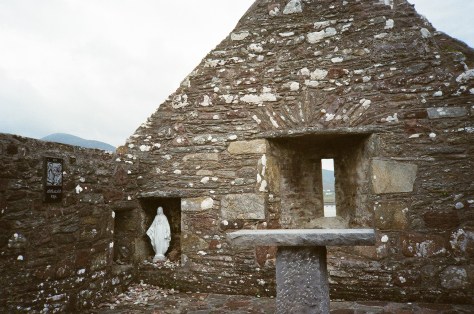
I am once more in Ireland, in Mayo, where my father’s people come from. Grey-black weathered stones still shape walls and openings for windows, but the small church on Achill Island, just off the west coast of Ireland, has long since lost its roof. The June morning is cool, ruffled by soft winds, as we twelve women gather under the slate-grey sky around the stone altar.

roofless church with Mary statue on Achill IslandWe have come here seeking an ancient holy well, dedicated to the early Christian Saint Dymphna, (Dimp / Nah) credited with healings. Dymphna was fleeing from her father, a pagan Irish king, her pathway marked by sacred wells, remnants of a tradition that predates Celtic Christianity. People sought healing at such wells, believed to be the openings of the body of our Mother Earth.
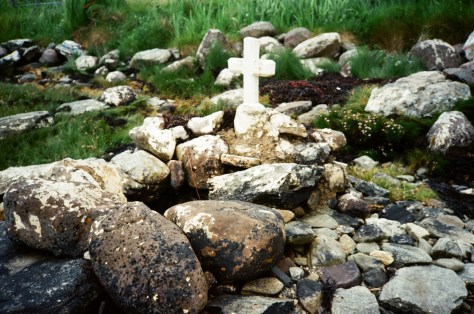
Around that altar, we are standing where women have been, in recent centuries, forbidden to stand. With that awareness, a power moves within us, along with a joy that has no words. One of the women in our group reads a poem by Denise Levertov:
Don’t say, don’t say there is no water
to solace the dryness at our hearts.
I have seen
The fountain springing out of the rock wall
and you drinking there. And I too
before your eyes
found footholds and climbed
to drink the cool water.
The woman of that place, shading her eyes,
frowned as she watched—but not because
she grudged the water,
only because she was waiting
to see we drank our fill and were
refreshed.
Don’t say, don’t say there is no water.
That fountain is there among its scalloped
green and gray stones,
it is still there and always there
with its quiet song and strange power
to spring in us,
up and out through the rock.

With these words still echoing, we walk outdoors, make our way through the old graveyard where in past centuries people from all across the island brought their dead for burial. We find the well of Dymphna on a piece of low ground just metres from the edge of the sea, its small opening protected by a circle of stones. We stand here, ourselves a circle, praying silently for those in need of healing.

well3 on Achill Island

Holy Well of Dymphna

One of the women, kneeling to take a photo, discovers a heart-shaped rock, one side deeply carved and creased with lines of breakage, now healed; another picks up a stone with the clear shape of a mother and child. For both these women, the stones hold a reflection of their lives. I walk a little way past the well and see a small silver stream of running water. Without knowing why I feel drawn to do so, I kneel, scoop up water, place it on my forehead, on my heart.

Later that day, I realize with a shiver of wonder that it is the anniversary of my baptism.

This moment marks a sacred beginning. My life becomes interwoven with a presence of love for whom I have no name. My searching will take me back to the ancient days of Ireland, before the Celts arrived there, forward to the spirituality glimpsed by Teilhard de Chardin, to the newly unfolding mysteries of the universe in whose life and powers we share intimately… for these next parts of the story I shall take you back to the Hill of Tara. There is someone there whom you must meet.

Tonight, I follow the thread of the story that began twice seven years ago. Once more I climb Tara’s hill. I feel the same needle pricks of mist against my face, see again the grey shroud of fog that conceals everything except what lies before me: this stone, this sheep, this tussock, this tree. Each arises, disappears, as on that night, the night when I called out to the Old Ones, and no one answered. Now I know the One I seek. I have found the hidden well where she awaits me, and this knowing has transformed my desert into an oasis. This time, I shall call out and be heard. I shall be answered.

Come with me. It is time for us to begin. The one whom we seek allures us with a flow of energy, but to meet her we must first come to stillness. A strong desire for the encounter is our best assurance of being met by the One we seek. She responds to our longing. I cannot tell you her name. I am not certain she has a name. I know her as the Storyteller.

It is through their stories that we will find how the Celts related to the Sacred Presence of Love at the Heart of the Universe. For this storytelling we need someone whose wisdom is as ancient as the lakes and rivers, the rocks and hills of Ireland.

Sophia in Ireland: Three

My experience watching Siamsa Tire (The National Folk Theatre of Ireland) perform “The Children of Lir” shows me that it is within the stories of the ancient Celts that their deepest truths are woven, a silver thread we can learn to see, to follow, to trust.

The Ceile de, or Spouses of God, a monastic order formed in the early centuries of Christianity in Ireland, and rebirthed in our time, tell this story: A remarkable change happened among the Druids, the priests of the ancient Celtic religion, somewhere around the time of the birth of Christ. A group arose who became known as the Strangers. They spoke out against the ostentations, the warlike behaviour that had characterized the Celts for centuries. They dressed simply in linen, wandered through Ireland, seeking hospitality wherever they were, teaching a new consciousness.

They told stories of a Holy One who would be born of a Virgin, One who would initiate a new time of peace and love. Though the fifth century saint, Patrick, has long been honoured as the first to bring Christianity to Ireland, it now seems that the new faith may have arrived as early as the first century. And when these first Christian travellers spoke of a Holy One, born of a Virgin, preaching love, the Celts recognised the tale told by the Strangers. This is why the coming of Christianity to Ireland was without bloodshed, with “nary a martyr” as the old tales say. All it took was a dawn and a song and the ringing of a bell.

Pre-Christian mythology among the Celts told of an invisible god who becomes visible in the feminine, able to be touched with the senses. In one myth a god who wanted to know itself divided into invisible and visible: spirit and matter/ Mater (universe, earth, body). So the Christian story of an invisible Father and a visible mother (Mary) birthing the Christ made sense to the Celts. For them, Christ, born of a heavenly Father and an earthly Mother, represents perfect balance.

Julian of Norwich, in her Celtic Heart, understood that as truly as God is our Father, so truly is God our Mother.

Celtic Christianity was woven into the hearts and souls of a people drawn to mystery rather than to rigidity of belief, rooted in the earth, in story, in music, in laughter. The Celts were naturally drawn to the mysticism of the Gospel of John. They embraced and understood a suffering Messiah, for they needed someone who knew pain as well as ecstasy, who could weep as well as sing, dance and rejoice. The Celts loved Jesus so much that re-imagined him as one of their own. That strange depiction on my wall that I thought was a woman crucified was copied from an 8th century image of Jesus with Celtic features, clothed in a long Celtic robe decorated with spirals…. CrucifixLfrom an 8th c. bronze plaque, St. John’s Rinnagan, County Roscommon, Ireland
 

What happened to this indigenous expression of Christianity? How could such a vibrant, rooted, faith wither? Be subsumed into the more rigid forms of Roman Catholic Christianity? The answer is not one of organic development but rather of a deliberate, sustained and determined crushing of roots, uprooting of plants, replanting with other expressions of Christianity by a Church whose increasingly centralized authority in Rome could not abide differences of expression, and valued conformity of belief and practice over a lived and living indigenous faith.

It took centuries for the Celtic expression of Christianity to be supplanted by the Roman expression, but from the moment in the late fourth century when Pelagius, a Celtic monk, debated with the great Augustine of Hippo that goodness, not sin, is at the heart of life, the death knell was already sounding for Celtic Christianity. Augustine won the debate and became a saint of the Roman Church. Pelagius lost and became a heretic. The doctrine of Original Sin took its place in the Christian story.

When the Normans arrived in Ireland in the 12th century, they replaced Irish monastic life with the large European orders of Augustinians and Benedictines, completing the transmutations in line with the Roman Model of Christianity.

What I’ve learned of Celtic Christianity shows me a weaving, still open for the Kairos moment, still loose enough to receive the shuttle cock carrying the weft thread of our new knowing that we are intimately part of, in fact we are holograms of, an interconnected universe. The weaving of Celtic Christianity has honoured the gifts of women, so denigrated, and the spiritual needs of women, so ignored, by the Roman Church. It has honoured the earth with her sacred cycles of night and day, her active summer days of the bright masculine sun-energy, her contemplative winter days of the dark feminine moon-energy, her birthings and dyings and risings.

One night, during these twice seven years of searching, I had a dream. A huge stone Church soars into the sky, obscuring the light. It is heavy, forbidding, much too burdened with all the laws inscribed upon its stones. It suddenly shakes, then topples backwards. As it falls, its perfect reflection in the lake that lies at its base rises. It is lighter, freer, still magical in openness and colour, with spaces where one might breathe freely, even underwater. It rises slowly even as the stone Church falls backwards. It takes its place in the clean and emptied air.

download (2)

(to be continued)

Sophia in Ireland: Two

In the morning I travel across Killarney’s Lough Leane, named Lake of Learning for the Irish monks who drew people from the far reaches of Europe to study on the Isle of Innisfallen. As our launch crosses the living lake, the waters toss and swell and smooth under the wind, swirling in grey mist, absorbing the splashing rain with the same receptive spirit that drinks in the sunlight minutes later. All the while the oak trees, roots deep in the green hills, hold the lake like a cup offered to the thirsty heart.

We come ashore on Innisfallen, and for the next three hours, I walk in the sixth century, circling the small island, stopping to gaze through gaps in the trees when the lake becomes suddenly visible, or when a shaft of sunlight turns the woods into sacred space. I find a smooth place beneath an oak tree. As clouds, like old magicians, obscure, then release, the sun, I open Croker to read what Thomas Moore wrote about this island:

How fair thou art,

let others tell,

while but to feel how fair

is mine.

On the shoreline, I pick up a blackened stone that looks to have two small monks carved on its side. I make my way back to the ruins of the earliest monastery, and stand looking under the lintel into the open doorway and wonder how it felt to enter and become a student here. In the remains of the early chapel, I see a Celtic cross of red sandstone, found in the Lake, its age unknown.

Later I will discover words Seamus Heaney wrote about visiting this ancient chapel:

Inside, in the dark of the stone, it feels as if you are sustaining a great pressure, bowing down like the generations of monks who must have bowed down in meditation and reparation on the floor…But coming out of the cold heart of the stone into the sunlight and dazzle of grass and sea, I felt a lift in my heart, a surge towards happiness that must have been experienced by those monks as they crossed that same threshold centuries ago. (Seamus Heaney Preoccupations London, 1980; in Lost in Wonder p.99, Esther de Waal, Canterbury Press, Norwich, 2003)

I am at peace on this island, and find, as Moore says, that it matters not whether the sun surprises or the rain showers dampen. It’s hard to leave when the motor launch returns.

Three nights later, in the west of Ireland, in Tralee, I find my way to the newly-built fieldstone playhouse, home to the Siamsa Tire, Ireland’s National Folk Theatre. Tonight they are to perform “The Children of Lir”.

The magic begins before the curtain rises. I feel a tingling anticipation, the promise of something more, the promise of what I sought on Tara Hill.
The story is sung entirely in Irish by a young man whose voice floats on swans’ wings over the theatre while the actors dance and mime the tale with exquisite grace and beauty. I understand no word of the language of my foremothers and forefathers. I have to rely on programme notes for the storyline.

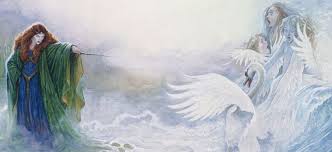
The tale of the Children of Lir is like the fairy tales that we heard when we were young. A beloved mother dies. A beloved father remarries. A wicked stepmother pretends love for the children but secretly plots their destruction. In this old Irish tale, Aifa (eefa) takes them to Lake Derravaragh (Derryvar’agh) where, using the magic staff of her husband, Lir, King of the Sea, she transforms them into swans.

images (1)

The spell will last for three times three hundred years. The swans will have to live in three different places until the dawn of the New Age sets them free. The woman must have had a small light in her dark heart, for she allows the swans to keep their human voices. She returns to the castle, telling Lir that his four beloved children, Fionnuala (fee-un-oo’la), Aedh (aid), Fiachra (fee’ach-ra) and Conn are dead. (music ends)

As the children try to adapt to their swan bodies, they comfort themselves by singing. Word begins to spread throughout the kingdom that the music of the swans can soothe away grief. The King goes to the lake, seeking comfort, and his swan children tell him what has transpired.

download

Lir uses his magic staff to transform his Queen into a demon of the air. He himself moves to an encampment near the lake to be near his children. They have many happy years together until the spell unfolds the moment when the swans must go to another place.

They arrive at the Sea of Moyle which is cold and lonely. A fierce storm arises to scatter and nearly destroy them. Fionnuala arrives safely at the Rock of the Seals, but she fears her brothers are dead. She mourns for them. She sings her song of grief. Yet one by one, they return. The four are again together. A long time passes and the third of their destinations calls to them. They fly over their home, but see no sign of their father. On the deserted western shore, the swans settle into their third resting place, resigned to their fate, singing to console their hearts. Their music draws birds from all over Ireland.

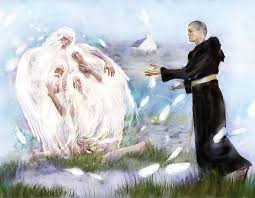
Time passes. The Kairos moment arrives, the opening in the weaving of time to allow something new to happen. A holy hermit hears their song and responds with music of his own.

images


The children sing with him in harmony as a pale golden light rises on the stage, appearing behind the two standing stones, carved with spirals and with the Ogham letters of the Irish alphabet. The bell of the New Age sounds even as a third stone drops to form an arch with the other two. The swan skins fall away, revealing four very old people. The hermit baptizes them, releasing them into freedom. Together they walk into the golden light. Transformation.

Though it ends in death, the Children of Lir is a birthing story. I know that I am watching a mythic tale of the beginnings of Christianity in Ireland. My soul recognizes its deep truth though it tells me nothing that might pass for history. The coming of Christianity was a promise fulfilled, a dawning whose power released from old binding spells.

That night in Tralee I fall in love once more with the promise. My quest has altered, subtly, importantly. Within me, as Yeats says, “a terrible beauty (is) born”. I know now that what I seek is not, as I had thought, to find a pure religion that existed here before Christianity, but rather to recover the beauty and passion and love that was at the heart of the early Christian faith in Ireland. I need to reclaim my own heritage.

Sophia in Ireland: One

Tara_3_Hill[1]

Twice seven years ago, I stood on the Hill of Tara in County Meath, Ireland.

I cried out for a presence in the mist, called out to the Old Ones. I was wearied beyond words, beyond telling, with the calcified religion that had swept through Ireland, drying up its Holy Wells, its Sacred Springs, its flowing Streams of laughter, song, magic, stories. That night on Tara Hill, I called out to the magic ones, the pagan ones, the holy ones, the ones the Druids worshipped.

But no one answered.

I tasted the mist, let the fog penetrate my lungs, let the mystery enfold me.
And still no one came.
“There is nothing left here.” I knew it in my very soul.
My companion appeared out of the shrouding fog, his face suddenly clear before me. He gestured towards the thickening gloom. “We’d better drive back before the road becomes dangerous.”

A few days later, I travel to the Wicklow Hills, to Glendalough, site of Kevin’s sixth century hermitage. Legend says that Kevin held his arms outstretched in prayer for so long that a blackbird nested in his hand. He stayed in that position until her eggs were laid and hatched. Fifteen hundred years later, Ireland’s poet laureate Seamus Heaney praises Kevin:

he prays
A prayer his body makes entirely
For he has forgotten self, forgotten bird
And on the riverbank forgotten the river’s name

By the lake at Glendalough, Kevin’s hermitage grew into a monastery that lasted a thousand years. Here I meet a teacher of Celtic Christianity. After twenty years working in Africa as a missionary priest, Michael Rodgers has returned to Ireland to teach his own people their forgotten ways. He guides us by a stream under dark oaks, and invites us to consider our journeys in life, what we seek. He walks with us by the base of the cliffs and invites us to call out our questions, and hear them echoed back to us. The answers are within, he says.

I think about my house beside the Ottawa River, where a piece of ancient Ireland hangs on the wall. A gift from my sister, it depicts in grey pottery what appears to be a woman on a cross. I want to like this shiveringly new/old image, but try though I may, I cannot feel close to it.

CrucifixL


I hope that in Ireland I will find the elusive ancient holiness that welcomes and embraces the feminine; I want to find a spirituality that speaks to my life as I experience it. I want to read my way back into the story.

We gather inside the shell of the monastery where the singing stones hold memories of those who left all to seek all, and add our prayers to those prayed here for a millennium. Michael tells us that the monasteries were the beating hearts of villages where people gathered to live their lives close by their “soul friends”. Each monastery was its own centre, shepherded by its own abbot, with its own rule. Of the eight remaining Books of Rule from the old monasteries, six are written in poetry.

The Celtic cross is surrounded by the ancient feminine symbol of the circle, sign of the interconnectedness of all of life, the rhythm of the seasons, the life/death/life cycle. Michael tells us that Celtic Christianity was cross-centred, focussed on the person of Jesus. His suffering gave hope to a people who felt the nearness of God so intimately that their breaths commingled with those of Jesus, his light pierced the darkness of their days and his compassion reached into the most earthy needs of their lives as they prayed.
An early Celtic prayer asks:

May Christ and Mary
Go with us the length of the road;
May our journey not be in vain
But may every inch of it be for our good.

The next day, I walk the three miles from my lodgings to return to Tara, finding in sunlight what the mist had obscured, the high stone that once sang in recognition of the one who would be High King of Ireland. The guide tells of Patrick’s visit here to the High King Laoghaire in 433 AD. seeking permission to bring the teachings of Christianity to Ireland.

“I do not understand this religion,” the king responded.

Patrick then stooped down and picked a three-leafed plant, and began to teach the king about the Trinity.

”Look down at your feet,” our guide says. We are standing on shamrocks.

On the lip of the Hill of Tara, there is an old building whose stones are full of stories and poetry. Inside, I find a small book called “Legends of Killarney” by Crofton Croker, written in 1828. I will be travelling to Killarney. Now, I have a guide.

But on the following day, as I settle into my seat on the BusEirann, I sink into a fug of uncertainty about my faith. No pre-Christian magic reached out to me on the Hill of Tara and what I am hearing about early Christian Ireland is captivating my heart against my will and my better (feminist) judgement. I look at my hands, where a hot rash had been raging the day before, until I bathed them in Patrick’s Holy Well. They are clear, as are my eyes, which had been red and itching with allergies, until I splashed the cool spring water over them. In the background I am aware of old American tunes on the BusEirann radio. A woman’s voice sings, “I’m your lady . . .” I notice this only because of a strange conjunction as we pass under a stone viaduct. Someone has chalked in large letters, “I love you, lady.” I sit wondering, feeling comforted.

I open the small worn Croker and read of the beauty that awaits me. By the time we reach Killarney, some six hours and two buses beyond Dublin, I know enough of the old legends to look forward to my exploration of the same lakes and islands that he saw nearly two centuries earlier. I will see them with his eyes as well as my own, peopled with the characters he met and full of the stories he recorded: of the old monk who travelled from Innisfallen to Mucross for the annual purchase of wine, and fell asleep for a hundred years, waking to find that spring had become winter. He seized a boat to return to Innisfallen where he found his monastery owned by strangers, and monastic life dissolved by Dublin parliament in harmony with Henry V111’s wishes. I read of enchanted wolves and lost treasure and strange battles and heart-rending loves.

I begin to trust that every inch of the journey will be for good. So I am not surprised to find that the hotel booked for me on Killarney’s main street has the beauty and comfort of long-polished wood, and my seat in the dining room is beside the illustration from the Book of Kells of the author of the Gospel of John, the Gospel most loved by the Celts.

(to be continued)

Sophia in Egypt: Thirty-Six

Following the Ritual of Blessing and Anointing by each goddess, Ellyn speaks in her role as Hathor: “We will now give bodily expression to the joy within us as we dance to the music of Tchaikovsky’s Sleeping Beauty. Our dance will be an awakening to new life.”

As the last chords of the magnificent music fade, the dancers, like graceful glass figures adorning music boxes, slowly swirl down to stillness, each standing alone, scattered across the room.

A new voice speaks. She does not identify herself as a goddess.There is no need. The women in the room know this voice, a voice that has guided them through many deep journeys.

Jean Houston speaks: “I invite you now to join with your essence self, your own higher patterning, that dynamic purposive self to whom you are connected. Raise your hands, palms outwards, to connect with that essential self, who loves you, who honours you, who charges you, who cherishes you, and in whose presence you are utterly known, deeply loved, empowered, affirmed, enhanced. Let the connection be so close that you and the entelechy become one.

“Now, breathing from the heart space with this enhanced self, think of two people in this room. From your heart space make a bonding with them. Now ask those two people to make a connection with two people who are not in this room, and at the same time, you make a connection with two people who are not in this room, perhaps people back home, and you ask them, through the heart space, to make a connection to two others and they to two others and they to two others and they to two others and in a few moments, it is true, literally everyone in this world is now connected through your heart space.

“Now think of two creatures, two animals that you know and love, and because it’s heart space, it transcends language but the intention to them is to connect with two others and they to two others and they to two others until finally all sentient creatures are connected.

“Now connect with two plants or trees from the heart space, and know that they are connected to two others, and they to two others and they to two others and in a moment all of earth and all its creatures are connected.

“Now speak to our beautiful planet and ask her to connect with two other planets and they to two others, all from the heart space, and they to two others and they to two others until all the planets in this part of the galaxy are connected.

“Now speak to our sun, our sun who has a deep relationship with all the other suns, and invite it to connect with two other suns, and they to two others and they to two others. Now the 100 to 200 billion suns are connected.

“Speak to our galaxy, from your heart space, and ask our galaxy to connect with two other galaxies, and they to two others and they to two others and soon what is now known to be about 190 billion galaxies in our universe are connecting.

“Now ask our universe to connect to two other universes, in your heart space, and they to two others and they to two others and very soon all known and unknown universes including their multiple dimensions are connecting.

“And now you find that you are connected to what some call God or the cosmos, and you are connected to the mind and heart of all being and the mind and heart of all being is connected back to you in your heart space, and the mind and heart of all being is sending this loving resonance to you and through you to all the creatures and beings and planets and dimensions in all the universe, and they are flowing back to you with love and affirmation and deep knowing. And you can feel your own head and heart and beingness in this great expansion, so that you are now from this moment forth hyper-connected in the great hologrammatic universe. You are ubiquitous through the stars. All of reality shines back in and through you and from your heart space to all of reality and from all of reality back to you. And you are bonded in this deep empathy, in this exchange of essence with all others.

“In the future when you need to connect at a deeper level, do so in this manner, connect with the universe through your heart space and then with a particular human person, one with whom your soul requires to connect. This connection is now amplified through your entelechy to their entelechy, through that which transcends any negativity or any difficulty or alienation. From this day forward, whenever you need to, you may connect in this way, through your entelechy to their entelechy, to a particular life, to all of life.”

And now another loved voice speaks, one that evokes memories of many rituals in Egypt. Peg says, “I offer you, as a blessing and as a summons, the words of the poet Rainer Maria Rilke. I give them to you as though they are coming to you from the great Goddess, the Holy One to whom our lives are now given. This is her blessing as you go forth from here, with your life-made-new.”

You, sent out beyond your recall,
Go to the limits of your longing.
Embody Me.
Flare up like flame
And make big shadows I can move in.
Let everything happen to you: beauty and terror.
Just keep going. No feeling is final.

Don’t let yourself lose Me.
Nearby is the country they call life.
You will know it by its seriousness.
Give Me your hand.

This concludes the series of excerpts I have shared with you from my book,
Called to Egypt on the Back of the Wind. To order your own copy, simply contact:
http://borealispress.com

Thank you for sharing the Mysteries of Egypt with me. Next week, on this blog, we begin a new series of reflections: “Sophia in Ireland”. We will be exploring the Sacred Feminine as she was known and honoured in Ancient Ireland, as she is known and honoured today.

Sophia in Egypt Thirty-Five

Epilogue of Called to Egypt on the Back of the Wind

It is night. It is always night when a story is told. But this night is part of the story, envelops and transforms it, embraces the ending.

The room holds the darkness gently, the darkness holds the women. The room watches as they take their places. To the east, near the altar where the gold statue of the Buddha sits smiling, unconcerned, the woman stands who is to portray Isis, goddess of new beginnings. To the south against the high windows that receive the morning sun, stands the one who will speak for Sekhmet, the goddess with the fire of the south in her belly. To the west, just at the entrance doors, stands the one who will portray Nephthys, the goddess of the in-between times, of the subtle energies that weave in and out of dream time, connecting our sleeping and waking. To the north, beneath the tall windows, stands the woman who is to play Ma’at, the goddess who envisions our lives from beginning to end, who will at death weigh our hearts on a scale against the weight of the ostrich feather which adorns her hair, Ma’at who portrays honesty, integrity and balance. And in the centre, at the heart of the circle, stands Hathor, the goddess of love and joy. An inner circle of women surrounds Hathor, facing outward, towards the four directions. In darkness, in utter silence, they stand, waiting.

The room does not see goddesses. It sees only women. In seventy-five years, it has seen so many others come and go. First, all the men, then women and men together, now only women in a circle. The room sighs, feeling bored, unaware of the story, unimpressed with its quiet ending.

A light flares in the centre of the room, and in moment a tall candle is illumined. A voice speaks. “Tonight, I am Hathor, goddess of love and joy. I welcome you here to celebrate the gifts of our time in Egypt. Tonight we remember with joy all that we have received. We open our hearts to the gifts, to the promise, and to what may be asked of us in return. I invite you now to look towards the east, to the place of beginnings.”

goddess-hathor

The Goddess Hathor

A second flare of light and a second tall candle is illumined. A voice speaks. “Tonight, I am Isis, goddess of beginnings. I am the divine power in the womb of my mother Nut. The day of my birth is called the Child Who Is in Her Nest. I am she who finds fruit in the field. I am the mother of Horus. I am she who rises with Sothis, the star that heralds the flood. I am Queen of river, wind and sea. As goddess of beginnings, I call upon you now to dedicate to me your womb, in readiness to receive the seed of new life that the world hungers for.

image of goddess Isis

The Goddess Isis

Will you open yourself to be filled with the life that is needed for your time in history? If you are willing, come forward now, and I shall anoint your hands with the sacred oil of cedar for spiritual strengthening.”

When the anointing is completed, another light flares, another tall candle is illumined, this one beneath the windows on the south side of the room. A voice speaks. “Tonight I am Sekhmet, ruler of the element of fire. I stand in the south where the sun’s fire is strongest. My name means mighty, powerful one. My heart burns with the courage of conviction. I represent the strength of will power. My ennobled passions are best used for healing and preserving others. As goddess of fire, I call upon you now to dedicate to me your belly and back, source of spiritual fire and power.

XIR218945
The Goddess Sekhmet

Will you open yourself to be filled with the courage and strength required to heal and preserve life on this planet at this potent time in history? If you are willing, come forward and I shall anoint you with the lotus, drawn from the water lilies of Egypt, offered for protection in the heart.”

Now a fourth light flares, and a fourth tall candle is illumined, this one on the west side of the room. “I am Nephthys, and I stand in the west, the place of the sunset, the place of what is passing away into other realms, for I am mistress of the in-between, the subtle energies. My creativity arises from the unconscious, for I represent dreams, ideals, psychic receptivity and the unknowable. I stand at the end of the finite world, the bridge to infinity. I am the one who illumines the dream time, who draws together the invisible threads that unite the seen and the unseen worlds. I am goddess of sympathy and self-sacrifice, opening my life to embrace the sufferings of others, and to ease their pain with the light of what I see. My ears hear the messages of the divine, and my throat speaks the words I hear in gentle songs of hope.

Nepthys wsith edits

The Goddess Nepthys


Are you willing to open your ears to hear the sounds from deep within you, and to speak what you hear to give hope to the people of the planet? If you are willing, come forward and I shall anoint you with the oil of the bay leaf for purification and psychic awareness.”

On the north side of the room, a fifth light flares, and another woman speaks. “I am Ma’at, goddess of justice, honesty, integrity. I stand in the north, the place of transformation, for I represent the divine principles of cosmic order and law. I offer the gifts of harmony and balance, a life on this planet that will be transformed when it is lived in truth. On my head, I wear the ostrich feather of truth that is placed in the balance of the scales of justice when the heart is weighed in the Underworld.

maat_cropped

The Goddess Ma’at

Are you willing to open your heart to me that it might become the heart of Ma’at, by living in truth and keeping your life in balance? If you are willing, come forward and I shall anoint you with the oil of the rose for the gift of an enlightened heart.”

Now Hathor speaks once more. “We have opened ourselves tonight to be bearers of new life in our wombs, fire in our backs and bellies, wisdom in our ears and throats, the light of justice in our hearts. As goddess of joy and love, I invite you now to open your eyes to be the eyes of Hathor, eyes that shine in the darkness and see love and joy in all things. Come forward to receive the blessing of the sacred oil of freesia, for love, peace and gentleness.”
(to be continued)

Sophia in Egypt: Thirty-Four

The four of us respond enthusiastically to Ellyn’s suggestion for a ritual.

“Let’s ask Jean and Peggy now, before we break for lunch,” Rosemary suggests, as she gestures to our teachers, inviting them to join us.

When Ellyn tells them her idea, Jean groans theatrically. “I don’t have a single song, dance, poem or prayer left in me, but maybe Peggy does.”

I look at Peg, see her fatigue, mingled with her wish to help us. “No need,” I say quickly. “We’ll plan it ourselves. The two of you only need to show up, at, let’s say, 7:30?”

“Over lunch, we’ll talk to the rest of the group,” Ellyn says. “We’ll invite them to work with us on this.”

“I have something you may wish to use in your preparations,” Peg tells us. “Normandi Ellis has a book of Rituals based on the Egyptian Mysteries. It’s called Feasts of Light.”

Towards the end of lunch, Ellyn makes an announcement about the ritual, inviting everybody who wants to take part in the planning to gather in the Meditation Room at four o’clock, bringing their Egyptian robes, the galabiyyas given us by Mohamed, as well as any perfumed oils, jewellery and small statues from Egypt that could be used in the ritual. Then the five of us agree to meet around three o’clock to look through the Normandi Ellis book, and do some pre-planning.

There is something I must do first. I find a pair of thin cotton socks to wear inside my sandals, put on my long cotton coat, and venture out into the wintry universe. The sun by now has melted the snow on the roadway so that, with care, I can make my way to the parking lot. My car is still buried under a foot of fresh soft snow, which I sweep off the trunk with the sleeves of my coat. I open the trunk and reach inside, fumbling around until I locate the heavy fleece-lined boots I’ve brought from home. With a graceless, one-footed dance I manage to step out of my sandals, into the boots.

I feel around again in the depths of the trunk, pull out a cloak of thick cotton fleece. Grateful for its weight, though the fabric is ice-cold to the touch, I pull it on.

The Garrison Institute sits on a height of land that rolls downwards in a gentle sweep from the driveway at its front entrance to the cliff atop the Hudson River. On Mystery School weekends, in spring, summer and early autumn, my companions and I often walked here on the grass, among the flowers, beside trees so ancient that they still hold memories of Benedict Arnold’s famous flight. On a stroll one spring morning, I had discovered an empty stone grotto, tucked in under the stones that support the driveway, hidden by a richly verdant vine of three-lobed leaves. The Capuchin Monastery was named in honour of Mary Immaculate. The monks must have built this grotto. Her statue must once have graced it.

Today, I make my careful way down the snowy stairs to find the grotto. Its vines are barren of leaves, brittle, yet blossoming! Snow has settled on the tiny twigs in soft puff balls, creating an illusion of branches budding with May flowers. A hymn from my childhood, one I’ve not sung in decades, comes back to me: Oh Mary, we crown thee with blossoms today . . . Queen of the Angels, Queen of the May . . .

Mary

I stand here for a long while, thinking, wondering. The love I’d known both for and from the spiritual presence whom I called Mary found me and touched me in Egypt under names that were strange to me. But I do not now doubt that the love I experienced there had the same source. Nor do I now doubt that my life has been transformed by that love. This mystery seems to me now so deep, so vast, that I can’t begin to comprehend its ramifications for my life, for my faith, for the planet, for the universe. But a mystery does not ask for understanding. It asks only for trust. And trust is the gift I carry home from Egypt.

It is after three o’clock when I return to the Meditation Room where my friends are gathered, already excitedly making plans. Ellyn waves the Normandi Ellis book at me. “I’ve been reading this ever since Peg gave it to me just after lunch. It’s all here, what we were sharing together about how we were each connected to different aspects of the goddess, the sacred feminine. So here’s what we’ve been thinking. . .”

I listen, growing as excited as my friends. This is truly amazing, a last great gift from Egypt. “So, each of us will portray a face of the goddess, and invite everyone to carry aspects or gifts of the goddess out into the world?”

They nod enthusiastically. “Kathleen has agreed to portray Nephthys, Rosemary will be Ma’at, Suzanne will be Isis, I’ll be Hathor. . .” Ellyn pauses. “And you can represent—”
“. . . Sekhmet!” I am ridiculously pleased.

But there is something missing. “What about music?” I ask. “Shouldn’t there be dancing?”
I wait, and when no one else seems to have a suggestion, I say, “What about Tchaikovsky’s Sleeping Beauty? Remember that night at Sharms, watching a film of the ballet under the stars?”

And already others of our companions are arriving, ready to join in the planning.

(to be continued)

Sophia in Egypt: Thirty-Three

Remembering the Gifts of Egypt

When I pull open the large door to Garrison’s Meditation room, I see brilliant sunlight making its multi-coloured way through the stained glass windows, caressing the dark wood choir stalls on either side of the long room that was once a Monastic Chapel, echoing with psalmody. The sun spreads light over the toffee-coloured floor. Already our group has formed a circle at the front of the room, under the beatific smile of a golden Buddha, who sits at ease on the altar. I join the circle.

“Egypt was an experience of utter felicity,” Jean begins. “We entered sacred sites: tombs, temples, pyramids, reactivating spiritual energies that may have lain dormant for millennia. We know what we did there together: the rituals, the songs, the dances, the prayers, the promises we made to embrace a joyous fullness of life, a life of deep partnership with the masculine and feminine energies within and outside of us. We entered a sacred partnership with the Beloved for the healing and wholing of the planet.

“How do we strengthen this new story? How do we keep it alive in outrageous conditions? For the first time in human history, we have to think like a planet.

“That is the work for the rest of our lives. But for now, think about what happened for you personally in Egypt. What newness opened within you? What was birthed within you through your encounter with the spiritual energies of Egypt? What sacred places touched you most? I’m going to play Bruch’s first Violin Concerto. I need you to dance the answers to these questions.”

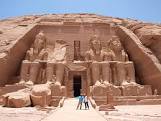
The sound system erupts with Bruch’s wondrous music and we dance, a dancing that takes us back to Egypt, deep inside our hearts and souls. I am again under the night sky at Abu Simbel, watching a shooting star; I am sitting on a rock wall on the Island of Philae as the earth rolls under the sun at the edge of the waters of the Nile; I am inside the tomb of the Pharaoh Queen Tausret, feeling immense tenderness embrace me as I gaze at the wall painting of an ibex. I see once more the glint of light in the eyes of Isis, in the wall painting; I am standing again before the statue of Sekhmet at Karnak, only now she is smiling, pleased I have finally let go of my fears, sent sorrow packing. My dancing is wilder, freer, more joyous, as though all the gifts of Egypt are reweaving themselves into my heart and soul.

As the music ends, Jean invites us to form groups to share what has returned to us during the dance. Suzanne, Rosemary, Kathleen, Ellyn and I gather chairs to form a circle.

Ellyn begins: “It was Hatshepsut who convened the Feasts of Light at Hathor’s temple at Dendera. That place held special meaning for me when we visited it. My name, Ellyn, means light.”

“Dendera,” I say now, remembering. “That’s where you were blowing the motes of light in the air towards Suzanne and me. You were filled with joy that night. ”

“I recognized a deep, energetic connection to Hathor. While we were visiting the Temple of Isis on the island of Philae before dawn, I focused my photography on the round face of Hathor on each pillar’s capital.” I watch Ellyn as she shares this, noticing that her face bears an uncanny resemblance to the carvings of the face of Hathor.

goddess-hathor

Hathor

“At the Temple of Horus in Edfu, there were many images of her in the birthing room,” Ellyn continues.

“The power spot for me at Edfu was the birthing room,” Suzanne adds. “A guard took me aside to show me an image of Isis breast-feeding Horus.”

“Kathleen,” I ask, “which face of the goddess do you identify with most?”

“Isis, I suppose. But also Sekhmet whom I encountered years ago on another trip with Jean. We were in France in the Louvre Museum. When I touched the statue of Sekhmet, I felt energy travelling from her hand and the ankh she held, up my own hand and arm. Why do you ask?”

“I think of you as Nephthys, the goddess of the in-between, of the dream time and of the other worlds, in touch with them, drawing them into our time,” I say. “And I know now that Ellyn relates most to Hathor, and Suzanne, I am guessing, to Isis. What about you, Rosemary?”

“For me, it’s also Isis,” Rosemary says.

“I see you especially as Isis in her role as Ma’at,” I say. “There were times on the trip when you spoke a truth I needed to hear.”

“Which face of the sacred feminine do you relate with?” Suzanne asks me.

“It surprises me to say this now, but it was the fierce Sekhmet who taught me what I most needed to learn,” I tell my friends. “There were times on the journey when I felt caught up in old grief, feelings I thought I’d long ago outgrown. Those were the times when I seemed to hear the voice of Sekhmet saying, Send sorrow packing! When we were in the tiny shrine in Karnak, I stood before the statue of Sekhmet, looked up at her fierce, tender, lion’s face, and prayed for strength to be my godded self. I asked for a fire within me that would become love given freely. And I knew at once that the gift demanded a price . . .” I stop here, wondering if I can share more.

XIR218945
Statue of the lion-headed goddess Sekhmet, from the Temple of Mut, Karnak, New Kingdom, c.1391-1353 BC (diorite)

“What was the price?” Kathleen asks, as calmly as if she were asking the price of a cup of coffee.

“I knew I had to give up my—” I pause, seeking the words—“my allurement to tragedy.”

I can see puzzled expressions on the faces of my friends. I smile to soften the words, “I’ve always believed more readily in darkness than in light, expected the worst in relationships, doubted love without constant reassurances . . .”

“So what does it mean to give that up?” Ellyn asks.

The answer that leaps to my mind is so clear that I am surprised as I answer. “Trust. Trust in love and joy. Trust that I am loved, that I can be a giver of love and joy to others.”

“That sounds like Hathor,” Ellyn says. “And it’s giving me an idea. What if we celebrated a ritual of gratitude tonight, for all that we’ve received from Egypt?”

This and the previous “Sophia in Egypt” posts are excerpts from Called to Egypt on the Back  of the Wind by Anne Kathleen McLaughlin, Borealis Press, Ottawa, Canada, 2013. To order online go to http://borealispress.com

Sophia in Egypt: Thirty-Two

Unpacking Egypt’s Gifts

With a thump, a rush of speed, a sudden stillness as engines cut, we are in New York. JFK Airport is a different kind of shock, like a dowsing in cold water. Part of me still feels the embrace of Egypt’s warm air, an atmosphere already moving into memory, into mythic time. Here amidst the jostling for position at the luggage carrels, then the locking of trolley wheels, the search for the customs exits, everything feels out of place, out of time, wrong. I am beside Ellyn when a woman in the uniform of security staff rudely orders her to hurry along. I see the look of shock on Ellyn’s face, realize she will not let this pass.

“We are human beings,” Ellyn says with quiet strength. She holds the woman’s gaze, but there is only bored insolence in those official eyes. I whisper calming words to Ellyn, hurrying her past the woman, seeing in memory the security guard in the Cairo Museum who gave me a thumbs up, a joyous smile. In this instant I know the impossibility of bringing our Egyptian experience back into a culture that hasn’t time for courtesy.

Somehow despite exhaustion, despite having flown backwards several hours in time, despite the culture shock of our arrival, our group manages to make its slow, ragged, luggage-burdened way to the transportation area. In the last light of afternoon, we find the bus that will return us to Garrison already waiting. The driver takes our luggage, stows it in the underbelly bins.

There is a quick headcount, each of us asked to look around, to be sure there is no one missing, and we are on our way. I close my eyes, lean against the headrest, try to sleep, grateful that we shall have time at Garrison to recollect the wonders of Egypt.

Though the journey can’t have been much more than an hour, the early darkness of late November is already enveloping the grounds and buildings of our beloved “Hogwarts” by the time we arrive. There is just enough light to see that the trees, radiant in autumn colours when we left, are now almost bare. But there is no evidence yet of snow, and the faint glint of light remaining on the surface of the Hudson River far below us shows that it has not yet frozen.

Inside, we check the list for our room assignments. Seasoned travellers that we now are, we stow our heavier luggage near the coat racks in the hallway, carry up to our rooms only a small bag with what we need for two nights. I have just made up my bed
with the crisp cotton sheets provided, hung my long cotton coat in the closet, and am making my way towards the washroom when I hear the gong announcing supper.

The long polished wood buffet table offers up a thick creamy mushroom soup, a salad of mixed greens, a steaming hot veggie lasagna. There is, as ever, a basket of homemade bread and wheat rolls, a plate of butter squares, a pitcher of iced peppermint tea. Beside the bread and rolls I see a dessert plate of chocolate brownies.

I call upon just enough energy to serve my plate, take a napkin and cutlery, and seek a place at one of the long wooden dining tables. I slide in along the polished bench
beside Kathleen, across from Ellyn and Rosemary. In a few minutes, Suzanne joins us. Suzanne can at least summon a smile, and say “the sounds of silence.” It’s true, I realize. Our whole group is here now in the dining room, and there is barely enough sound to vibrate the air. I see in my companions’ faces that we are all in a state of non-feeling, tiredness, the shock of arrival.

Slowly, as we are warmed and nourished by the food, life returns. Kathleen asks the question that has been on my mind as well. “What do you suppose we’ll be discussing when we gather with Jean and Peg?”

“I think we’ll need to have some sort of decompression exercise, like the astronauts,” Ellyn says. “A chance to speak about what we’ve learned and experienced.”

“Right now, I don’t think I could form a sentence, let alone say anything profound,” Rosemary says.

Suzanne and I are both agreeing when a voice says, “You won’t need to.” We look up to see Peg beside our table. “Jean is telling the groups at the other tables that it would be best to go to bed and have a good night’s sleep. We’ll gather at nine-thirty, immediately after breakfast.”

That night I fall into a deep sleep, after a brief ragged prayer that I might awaken with a feeling of gratitude. In a dream, I am with my travelling companions, all of us asleep in a sort of dormitory of narrow cots, with our belongings stowed under our beds. Jean wakens us, singing, “We are all made of stardust . . .” When the others have gotten up and gone to take showers, Jean hands me a huge ancient-looking iron key, like something out of a fairy tale.
“Have you written about this?” she asks me.
“You mean, made up a story?” I ask, uncertain.
“NO,” Jean responds with a fierceness that would not shame a fairy tale potentate. “I don’t want TALES. Write about your life as it weaves around this.”

When I do truly awaken, just after sunrise, it is to a world transformed. The light coming into my room from the direction of the Hudson River holds a memory . . . “Snow!” I must have said it out loud, climbing out of bed, moving to the window. Not stardust, but snow dust, a magic carpet, laid with exquisite care over tree and rock, river and roadway. The one magic that Egypt cannot create has fallen as we slept.

“Welcome home,” it whispers. And gratitude swells within me.

The level of sound at breakfast assures me that my companions have slept well. Not pomegranate seeds, but steaming porridge awaits us. I find Kathleen, wanting to share my dream.
“Why a key?” I ask her, “and write about WHAT???” But even as I ask, I think I know the answer.

Kathleen is thinking deeply. This is her milieu, her homeplace, the in-between place of dreams and words in the night, the subtle energies that weave in, around and between our lives. “Keys unlock things. Did Egypt unlock something in your life for you?”

“Yes,” I say, unwilling, unready to say more.

Kathleen smiles, her eyes telling me that she is hearing the more. “Then that’s what you need to write about.”

awakening to the sacred feminine presence in our lives