Powers of the Universe: Transmutation


In his DVD series, “The Powers of the Universe”, Brian Swimme recalls Teilhard’s saying that we are the universe reflecting on itself. Swimme invites us to see ourselves as the Power of Transmutation reflecting on itself in conscious self–awareness. He asks, “How can this lead to a more vibrant earth community?”

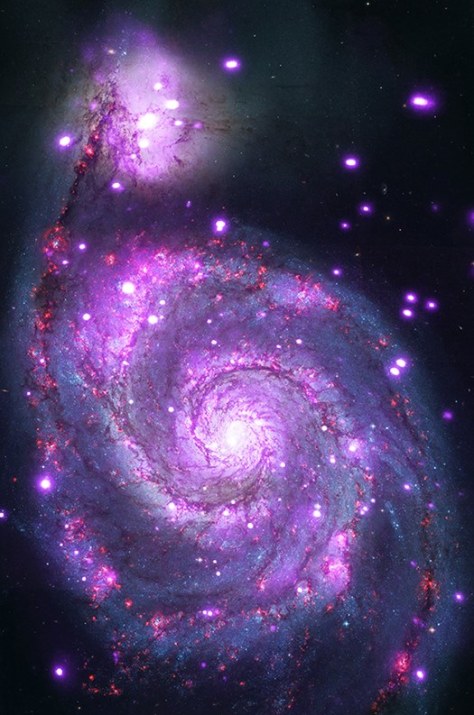
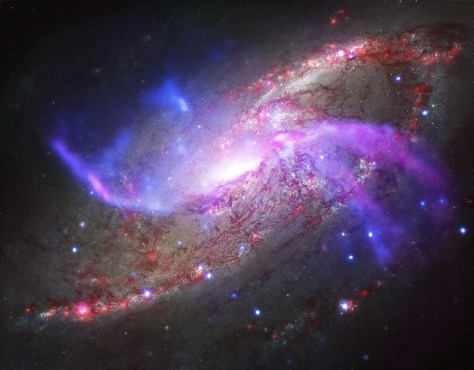
Natural selection, Transmutation, is the way form changes through time… in the universe, the birth of radiant energy in atoms changes everything; clouds change into galaxies; primal stars transmute into stellar systems with planets; the earth herself changes from molten rock into a living planet.

The universe forces itself out of one era into another. If you are a particle you have nowhere to go but into an atom…

So, what do we do when we discover ourselves in the midst of the end of one era, moving into another? How do we participate in this Transmutation?

Swimme says we need to look at the way life moves from one form to another. The earth uses a form of restraint, of judgement. At the moment when the earth begins to cool from its molten state to form a crust, there is a constraint into the form of continents. When two continents collide, there is further restraint on formerly free activity, enabling restriction and opposition that create mountain ranges. To insist that things remain the same is to insist on the end of the planet’s growth.

Another form of resistance happens when the desires of different beings are in opposition. At the heart of transmutation is the question of how to deal with obstacles and opposites. The grasshopper is constrained by the bird who eats it; the bird has to follow the grasshopper. But to remove the constraints is to upset the beauty of form. A slower grasshopper leads to a less fleet bird; a slower bird means that the grasshopper decreases its speed. The destiny of the bird is tied to the grasshopper.

Creativity is spread out over the whole community. The system has constraints, demands, judgements. The natural selection dynamic is based on judgement that leads to excellence of form and beauty. The beak of the bird developed so it might retrieve bugs from a tree. The relationship between the bird and the tree is a form of intimacy. Every bioregion has this spectacular beauty, with the integrity of the whole maintained by this power of judgement, restraint, struggle.

Until humans arise, taking the whole system into collapse through our ability to get around the constraints, the judgements, using all the powers to our own advantage. No longer does natural selection take care of the whole.

Our challenge is to become the Power of Transmutation in conscious self-awareness. We are called upon to bring restraint to human activity so that the natural selection dynamics can proceed. The powers of the universe need the human to proceed through this change. Though our laws, customs and disciplines impose restraint on human activity, they have until now taken for granted that the human is the focus. Now we need to ask for laws that enable the whole community of life to flourish. We need to say clearly, “Some things are going to lead to ruin”. We need a law to protect species for themselves.

Swimme suggests that the human person in whom the Power of Transmutation surfaces strongly has a mind that is highly critical, judgemental. The tone of this person will be highly pessimistic with a sensitivity to the dynamic of the whole, with a drive for survival as well as deep respect for law, tradition, custom. The mind of a person in whom the Power of Transmutation is strong is not dogmatic, but has the ability to change in order to make it through the challenges before us. The one in whom the Power of Transmutation is strong is highly–disciplined, leading a structured life, the opposite of the chaotic personality in whom Emergence is the stronger power. However, should the Power of Transmutation become frozen in a person, there is danger that the negative aspects of pessimism, cynicism and guilt might take over.

The feeling mode of the person experiencing the Power of Transmutation is that one does not fit in. There is a sense of being cut off, set aside, rejected, even wounded. Yet those who feel most cut off are the ones who feel most deeply that the universe has made a judgement that this era is over. This is an invitation from the universe to look at what life does, to see in the opposition, the wound, one’s destiny. Swimme says: You are feeling the universe is rejecting part of you. Embrace the rejection, embrace that which is attempting to eliminate those aspects of yourself that are maladaptive, the elements that are part of the era that is over: a society based on consumerism, based on destroying opposition.

The planet is withering because humans have accepted a context that is much too small. We can no longer decide only what is best for a corporation or a culture but we must move to a larger context, to the planetary level. Our decisions will affect thousands of future generations. We are the universe as a whole reflecting on itself in this particular place.

Who are the models to inspire us? We co-evolve with all other beings. The great moments of beauty in the universe become our guides, and our criteria by which to judge. We look to the future, to beings who will learn to live in harmony to enable the whole to flourish. Thus we learn to live in the context of the whole universe: past, present and future, with the energies of the planet.

Sometimes we catch a glimpse of that future: when a windstorm knocked out electricity in our community’s holiday place one summer, a few of us decided to stay on. Small changes, transmutations… an evening swim rather than a morning shower…. food cooked on a barbecue… water for washing dishes heated on the barbecue…. perishables such as milk and yogurt packed in an ice chest…. wading into the lake in tall boots to scoop up buckets of water to keep the toilets working…

On the second night, sitting in darkness illumined by golden candles, we watched the rose madder sunset splash across the sky, and soon after Venus became clearly visible. For a little while she was a silvery presence but as the earth rolled away to the east, Venus slowly sank below the horizon…

This beauty we would have missed had there been electric light. I remembered a snatch of poetry: “After my house burned down, I had a better view of the moon.”

IMG-20160624-00097


Powers of the Universe: Synergy

As we continue our exploration of the Powers of the Universe, as described by Brian Swimme in his DVD series of that name, we come to the power of synergy. This power is magnificently illustrated in the behaviour of the Emperor Penguins of Antarctica for whom a learned behaviour has meant survival. They form a tight cluster with the outer circle exposed to the frigid cruelty of the weather while the inner circle is held in warmth. Then in a shifting soundless dance, they change places.


images (1)

The power of synergy has brought forward some of the most wondrous and crucial developments in the 13.8 billion year history of the universe. Plants that need nitrogen to survive, but are unable to draw it in, form a synergistic relationship with nodules whose bacteria can draw in nitrogen. Flowers, plants and trees that need to be pollinated thrive through their synergistic relationship with bees.


Swimme describes some great moments in synergy throughout the life of our planet:

(a) single cells learn to trade aspects of genetic information, enabling the spread of ideas across the earth;

(b) photosynthesis occurs when, in a synergistic relationship between life and the sun, cells learn to interact with sunlight to draw in energy;

(c) life learns to get hydrogen from water, releasing oxygen, but as oxygen is destructive to life, those forms of life that learn to draw in oxygen, creating through synergy new structures, survive, while the forms of life that do not learn how to do this, sink down into the swamp ;

(d) organisms learn how to mate: the discovery of sexuality 1.5 billion years ago enables an explosion of possibilities and new life forms as sexualized animals cover the planet.

Synergistic relationships enable survival and endurance. In order for life to endure two great challenges need to be met: find energy and create offspring. Life rewards creativity in these two crucial areas with survival. Synergy flowers as life finds creative response to this dual challenge. The quest, according to Swimme, is not to eliminate the challenge but to respond to it.


Seeking a synergistic response to life’s challenges has led to increasing complexity in the human. The challenge of finding energy relates to finding food. Swimme cites an aboriginal tribe who depended upon rabbit for survival. Regularly a group of fifty hunters came together to catch an abundance of rabbits for a steady food supply. Their social cohesion resulted from this need to work together to catch their food. In Inuit societies, the whole community comes together to capture a whale, something impossible for a lone hunter to achieve.


When humans learn to interact with seeds and plants, the nomadic way of life of the hunter/ gatherer societies is altered. A settled way of life emerges with the development of agriculture, pushing to the margins those who remain with the old ways, continuing to hunt and gather. The settled way of life intensifies through classical civilization and into industrial society where productivity increases, again with a crowding out of the earlier forms.


In our time, we see contemporary industrial society around the planet crowding out earlier forms of life, with the evaporation of indigenous groups everywhere. The factories and sweat shops of India and China lure workers into cities, where in order to earn small wages, they sometimes have to live separated from their families in barrack-like conditions. Understanding the process that has led to this moment in the earth’s history frees us to question whether this intensity of production is what we really want. Does the revelation of the appalling, life-threatening conditions in factories such as those in Bangladesh lead us to question our societal thirst for more and cheaper goods? Is this really an enhancement of life on our planet?


Do we see the phenomenal rise in community gardens and farmers’ markets as a sign of hope that we are shifting away from a production/transportation model that brings food to our table from across the planet? A recent CBC story told of an organic garden being created atop a high-rise building in downtown Montreal, a prototype for a whole new way of imagining how to grow the food we need.


The challenge for our time, as Swimme sees it, is for synergy to operate through conscious self-awareness. The movement now needs to be from an industrial to a planetary civilization, requiring the birth of the planetary human. Once we accept our true identity as earth community, sharing genes with oak trees and oysters, this becomes much easier. If we see our humanness from the perspective of biology rather than from religion or politics or culture, we can begin to imagine a planetary society. If we open ourselves to what other species can teach us, our learnings are greatly enhanced. What might fish be able to teach us about keeping the oceans healthy? Finally, war, once a form of social cohesion, has to be replaced. We take on instead the challenge of a synergistic relationship with others in order to deal with a wilting planet and a failing eco-system.


The death throes of Western civilization can be experienced as birth pangs as a new era of humanity is about to emerge. To move towards an abundance of life for all children, for all planetary life, demands greater synergy, deeper power, new technology and moral wisdom to guide us forward, Swimme believes. As with other new developments, the older nationalistic forms of life will not disappear but will hang around as they gradually make their way to the bottom of the swamp.

A message about the power of synergy comes in this email from Ricken Patel of Avaaz.org, a planet-wide movement, inviting individuals to study and respond to issues that affect all of life, such as Monsanto’s pesticide:

Dear Avaazers,
This has my head spinning. In months, Europe could actually ban the killer herbicide that Monsanto’s entire business model is based on!
Glyphosate kills *everything* except Monsanto’s genetically engineered crops, transforming our planet into ecological wastelands where nothing can live but one GM crop. It’s apocalyptic.
Even worse, its use is skyrocketing, has been found in 90% of our bodies, and a new study says it likely causes cancer!

Last week, we won a massive battle to block renewal of glyphosate’s license in Europe. Everyone told us this was impossible, but we changed the game! Leading EU politician Pavel Poc said: “Avaaz is indisputably the driving force on glyphosate”.


(As) with climate change and the Paris agreement, Avaaz has mobilised people on this issue at an unprecedented scale – we’ve taken the fight against Monsanto to a whole new level, and now it’s up to all of us, over the next 18 months, to win it.
First big oil, now Monsanto. We are taking on the dragons of our world. But if we stick together, and choose to believe and act, we can do anything.
With hope and determination, Ricken, Alice, Bert, Pascal and the whole Avaaz team


pesticides_spraying_2


This movement towards newness and rebirth is beginning. When we align our personal energies with it by creating mutually enhancing relationships, we align our human energies with this cosmological power called synergy.


Powers of the Universe: Cataclysm

Cataclysm, as Brian Swimme teaches in his DVD series: “Powers of the Universe”, is as essential to reality as emergence. The destructions, degradations and disasters of the universe are part of the story of its life, a movement from a complex to a simple state that allows for the emergence of newness.

Imagine a star twenty times the size of our sun. The force of gravity would reduce it to a cinder were it not for the opposing energy sent forth from its heart, created by the fusing of hydrogen nuclei into helium nuclei. This activity allows it to maintain, in Swimme’s words, “a seething equilibrium” for some ten million years.

But when the hydrogen has all been transformed into helium, that fusion process ends. Gravity causes the star to collapse into a smaller space until its core heats up to the temperature required to fuse helium into carbon. The cycle repeats as carbon fuses into oxygen, then oxygen into silicon and on and on until only iron remains. Iron releases no energy when it fuses; nothing is left to push out from the star’s centre to oppose the force of gravity. The star can only implode upon itself and in seconds a multi-million year process is over; a massive star becomes a mere speck.

But the energy of the implosion has crushed the constituent electrons and protons together to form neutrons, releasing more elementary particles called neutrinos. This reverses the imploding movement to blast the star apart in a firework display more brilliant than a galaxy of shining stars. As it expands a nucleosynthesis takes place, creating the nuclei of all the elements of the universe. In this supernova explosion are birthed the elements that will form our planet and our bodies. (for a fuller explication of this process, see Chapter 3: “The Emanating Brilliance of Stars” in  Journey of the Universe,  co-authored by Brian Swimme and Mary Evelyn Tucker, Yale University Press, New Haven and London, 2011)

The life story of a star is an astounding example of cataclysm giving birth to new life. But the power of cataclysm is seen in many aspects of life in the universe. Two hundred and fifty million years ago (when our earth was already ancient of days at age four billion and a bit…) a cataclysm occurred that eliminated 96% of marine species and 70% of land species. Swimme says that huge die-offs occur roughly every one hundred million years, and we are right in the middle of one now. Whatever our capacities for conscious denial, Swimme believes, our hearts and our bodies feel this awareness in a rising sense of frustration, of regret, of failure.

I would add to that a profound sense of grief. I recall watching a power-point that singer/songwriter Carolyn McDade prepared to illustrate the species in my own bio-region under threat of extinction. As I watched the unique, startling beauty of each form of life, the soulful eyes of owls, reptiles, birds, otters, small mammals, gazing back at me from the screen, I was shaken by a grief so sudden and wrenching that I wept. All the while, Carolyn’s voice sang as a prayer of pleading, “let them continue on….” Later that summer I saw in the river near my home an otter with a mate and young, and felt a deep joy…

Concurrent with this extinction of species is the desertification of land, the shrinking rain forests, the dying rivers and lakes. As though engaged in a death dance between nature and man-made structures, we see the waning into near-extinction of many of the religious, political, economic, education, health and societal systems in which we had once placed our trust.

Is there a graced way to live into a period of cataclysm? Swimme suggests that we might identify with the power that is destroying us by consciously surrendering aspects of ourselves, our society, our way of being in the world, that no longer serve us, thus enabling the universe to pulverize those aspects…We can try to see the destruction of consumer culture as part of the earth’s work of cataclysm, seeking to free us, to free our lives.

When cataclysm strikes an area of the planet through flood or fire, earthquake, tornado or tsunami, haven’t we heard voices raised that dared to bless the disaster that revealed what is worth valuing in life?

The twentieth century mystic Etty Hillesum, shortly before her death in Auswitch, wrote words that might be a light for us in this time: I shall try to help you, God, to stop my strength ebbing away, though I cannot vouch for it in advance. But one thing is becoming increasingly clear to me: that you cannot help us, that we must help you to help ourselves. And that is all we can manage these days, also all that really matters: that we safeguard that little piece of you, God, in ourselves. And in others as well. Alas, there doesn’t seem to be much you yourself can do about our circumstances, about our lives. Neither do I hold you responsible. You cannot help us but we must help you and defend your dwelling place inside us to the end.

This is our moment, Brian Swimme believes, our star exploding, ready to create emeralds and giraffes, ready to release us into a new earth community.IMG_0007

For the next level of growth, of deepening, something has to wake us up, shake us up. It may take a tornado to blow us all the way to Oz where the greatest gifts await us. Jean Houston says that the call of this time of Cataclysm is to “radical reinvention” in order to speciate, to become a deepening spirit of the earth for her new emergence. Never before in history have so many devoted themselves to develop fully, to regard problems as opportunities in work clothes. Encouraging us that we have just the right gifts on just the right planet to bring this new earth community to life, Jean adds, “You are blessed to be alive at this time.”

Powers of the Universe: Homeostasis

One of the major shifts in consciousness required for our time is that we belong to the evolutionary co-creative process, and it is in discovering our mutual interdependence within the cosmos, and particularly with planet Earth, that we will begin to reclaim our spiritual identity.
Diarmuid O’ Murchu Reclaiming Spirituality New York Crossroads 1998 p. 41

Homeostasis is the power by which the universe maintains what it values. It is a delicate dance of holding onto what is most important through all the swirls and shifts of change.

In his DVD series “Powers of the Universe”, Brian Swimme offers some stunning examples of the earth’s power of homeostasis: the dynamics that maintain the form and function of a mammal’s body; the human bloodstreams where the ph balance is the same as in the bloodstreams of most animals and fish; the temperature of the human body. The earth herself remains in a state where life can flourish, even as the sun gets hotter; the earth has maintained its temperature over the four billion years, just as a mammal’s body does. The earth cycles through times of cooling when the ice caps swell to reflect more of the sun’s heat away; then it grows warmer so that the ice caps shrink. This cycle repeats every 100,000 years.

The Milky Way Galaxy cycles through its explosions of supernovas. In one million year cycle where there are 8000 supernovas (a smaller number) the cloud becomes denser than usual, so the capacity to create stars is greater. In the next million year cycle, 12000 supernovas explode. Homeostasis.

Then we humans enter the realm of life with our quality of conscious self-awareness.

When we understand what is valued, essential for life on this planet, our perspective shifts away from focus on the part to the whole. The enormous ego-centricity of our lives in a nation like Canada or the United States shifts to embrace the need to maintain human life in other parts of the planet, then to look at what animal life/ tree life/ river life/ocean life /earth life require for continuance.

Though we understand ourselves to be the gathered-in-ness of 13.8 billion years of life in the universe (the power of centration), though we honour the search for love and fullness of life that draws us forward (the power of allurement) and though we rejoice in the restless creativity that is our personal invitation from the universe to be involved in emergence, the power of homeostasis calls us to a care and vigilance, a keen awareness of the fragility of our existence, and a sensitivity to vulnerable areas.

Asking the question why homeostasis is falling apart in major life systems, (the desertification of huge amounts of land, the poisoning of rivers and lakes, the loss of the rain forests, the very lungs of our planet…) Brian Swimme says it is because we humans are trying to use the power of homeostasis to maintain a subgroup of the whole rather than the whole body. We think our fundamental responsibility is to a sub-unit rather than to the whole body. The great search now for fossil fuel in tar sands or through fracking, poisoning the water to release gas, is a desperate effort to maintain a standard of life enjoyed by a favoured few.

Swimme calls it an intellectual illusion that humanity is separate from the earth community. There is no human community without the whole. The earth community is a form of guidance for us, crying out to us that it is not inert material, not just stuff! It takes a major shift for us humans to see that we come out of the earth community, we derive from it. The matrix itself is primary.

chambered-nautilus-swimming-se40

“Not just stuff”the chambered nautilus knows when to move to a larger room 


Such an understanding would alter the way we organize life on the planet, calling us to create laws and establish policing to protect bio-regions as well as humans, to protect the right to existence of all life on the planet. If we know that each being has a right to be we understand the need to restrict human activity so that the whole can flourish.

On a communal and on a personal level, the power of homeostasis will help us to maintain the achievements of our lives, to raise up energy and increase commitment to our work, to our relationships. We can tell the story of what we’re about, tell the story of our love relationships and maintain a zest for life! Millions of years, Swimme says, are involved in a single moment of zest.

Whenever and wherever we tell the story of our emergence out of the life of the planet, honouring all the forms of life that share our right to be here, we are the power of homeostasis, enabling life to blossom.

But homeostasis, as with the other powers of the universe, has its down side. Maintaining and sustaining what we value in life, what keeps us sane, is important, but, as Jean Houston warns, holding onto anything for too long leads to stagnation, and “the universe gets bored with you”. The opening scenes of the film, “the Wizard of Oz” show homeostasis as the absence of vitality. Nothing is happening in a place blown dry, grey-brown, empty. No one has time for the young Dorothy who is in a state of immense longing. The only being who still has any zest for life is the little dog Toto.


When homeostasis goes on for too long, when life no longer holds zest, the next power of the universe must come into play: Cataclysm ….

To my readers: I welcome your comments and questions: what further Sophia themes would you like to read about here?  Contact me: amclaughlin@sympatico.ca 

Powers of the Universe: Emergence

Emergence: the universe flares forth out of darkness, creating, over billions of years, through trial and error and trying again, astounding newness: carbon for life in the middle of a star…. the birth of planets, our earth holding what is required for life to emerge…. the creation of water from hydrogen and oxygen….the emergence of a cell with a nucleus.
Each of these seemingly impossible happenings did happen, offering us humans the hope that the impossible tasks confronting us in our time can be creatively addressed, showing us, as Brian Swimme expressed it, a domain of the possible beyond imagination. Our human endeavour has been powered by non-renewable energy resources. Our task now is to reinvent the major forms of human presence on the planet in agriculture, architecture, education, economics…. We need to align ourselves with the powers of the universe, consciously assisting, amplifying, accelerating the process of creative endeavour.


In her teaching on the powers of the universe, Jean Houston speaks about how we can work with the universe in what it is trying to emerge within us. We set up a schedule. We show up at the page, or in the listening or prayer place, regularly to signal our intent to be open. We create internal structures that are ready to receive what wants to emerge in us. We drop in an idea that puts us in touch with essence, creates in us a cosmic womb so the universal power can work in us. Thus, like Hildegard of Bingen, we become a flowering for the possible, attracting the people and resources that we need.

P1000655

Among the aspects of human life that require creative imagination for a new birth, I would like to focus on religion/spirituality/our way of relating with the Sacred. Eco-theologian Thomas Berry wrote that:
…the existing religious traditions are too distant from our new sense of the universe to be adequate to the task that is before us. We need a new type of religious orientation….a new revelatory experience that can be understood as soon as we recognise that the evolutionary process is from the beginning a spiritual as well as a physical process. (Dream of the Earth Sierra Club, San Francisco, 1988)

What new revelatory experience, what new type of religious orientation is emerging today?
As I am neither a theologian nor a sociologist, I invite you to experience with me a n experience of the newness in religion, in spirituality, that is emerging among women with roots in Christianity, with branches that now extend to embrace a relationship of partnership with a sacred feminine presence whom some would call the Goddess.


Take a chair at the table in a room in a small Catholic college in western Canada. As part of a focus group of thirteen women, drawn from some one hundred interviewees, you’ve been asked to reflect upon the way you blend your Christian faith with a relationship to the feminine holy. For several hours of concentrated conversation on this topic, facilitated by the research co-ordinator, you listen to your new companions.


What do you see? Hear? Experience? On this sunny late spring morning, one of the women leads an opening prayer in the four directions, calling on the presence of the Sacred Feminine to guide us in wisdom, in newness, nurtured by the gifts symbolized by earth, air, water and fire.


As each woman speaks, you notice the different pathways that have brought her here, that have awakened her awareness of a Holy Presence that is feminine. For some it is the writings of the feminist theologians, uncovering the deep but largely neglected tradition of Sophia /Wisdom, the feminine principle of God. For others it is through earth–based spiritualities such as indigenous beliefs and practices, or involvement in ritual, or Wiccan studies. For the several Catholics present, Mary has been the pathway. As one woman recalls, “I was taught as a child that God was too busy to hear my prayers so I should pray to Mary instead.” Listen as other women tell of travels to places where the Sacred was known and honoured as woman in ancient times, especially sites in France and elsewhere in Europe sacred to the Black Madonna.


But mostly you are struck by the way that for each one, imaging the Holy as feminine has given a voice, a new power, a sense of her own value that were lacking to her in the time when God was imaged as male. Imaging God as woman gives an honouring to women’s bodies, especially needed in a culture where the standard for feminine beauty (young, slim, nubile) is set by men. You hear women share without bitterness, but with a sense of having come to a place of grace, childhood and adult experiences of feeling devalued in Church – related settings because of being female. You smile with recognition as one woman recalls that when her teacher said, “God is in everyone,” she had asked, “Is God in me?” and was assured that was so. “Then is God a woman?” she asked. Her teacher, a nun, responded, “There are some mysteries we are not meant to understand.”


Listen now to the responses when the facilitator asks, “How do you express your relationship with the Feminine Divine? Would you call it worship?” No one feels that word fits. “She is a mother’…   “At first she was mother, but now is more of a friend”… “A partner, inviting me to co-create with her”…“Devotion is the word I choose, because it holds a sense of love,” and to this many agree with nods and smiles.


What stirs in you as you listen? Do you begin to sense that there is more to this emerging relationship to the sacred feminine than our need for her, our longing for her? Is this emergence initiated perhaps by the Holy One herself who comes to us in our time of great need?


Look around the table at your companions: these are power houses. The submissive woman, so beloved of patriarchal religions, has no place in a life devoted to the Goddess. There is a rage for justice, for the transformation of life on the planet. One woman here has taken on the task of building and maintaining natural hives for bees; one is a film-maker who wants to tell stories of women that will change the way we see ourselves in the images of most films and television; one is a Baptist minister who writes of the way Jesus is himself an embodiment of the Sophia-Wisdom principle; one is a theologian who identifies the Spirit as the life force found everywhere in each land and culture and tradition, linking all of life; one fiercely joins the struggle to defeat those who would modify and monopolize the seeds of the earth, or put poison in ground water to release its gas…


As you look at these devotees of the sacred feminine at this table, you see that they are living the new revelatory experience that Berry wrote about. They are themselves the beautiful reflection of the Sophia, the Sacred Feminine, the Goddess of many names, emerging in the lives of the women and men of today who are opening themselves to her. They are, we are, the ones ready with her creative power at work in us to take on the great tasks that our times require.

Gloria Steinem has written: God may be in the details, but the goddess is in the questions. Once we begin to ask them, there is no turning back.

Sophia and the Universe: Allurement

The process through which the universe unfolds into radiance is our process as well, our story, and our most urgent call in this time. As Jean Houston reminds us: All the powers of the universe are seamlessly one, trying to bring forth radiance. These powers can be understood mystically as within ourselves waiting to assist us to bring forth a world that works for everyone.

Brian Swimme, in his DVD series Powers of the Universe, describes ten interwoven powers: Centration, Allurement, Emergence, Homeostasis, Cataclysm, Synergy, Transmutation, Transformation, Interrelatedness and Radiance. Centration is the coming together in one life of the entire 13.8 billion year process of evolutionary development.

Allurement is what holds everything together. At the heart of the universe, Allurement holds the earth in thrall to the sun, the moon to the earth, the tides to the moon, our very blood to the surges of the sea. The planets are lured by the sun to orbit ceaselessly around it, while our galaxy spins, in harmony with other galaxies, in one great dance of desire and longing.

The universe is bound together in communion, each thing with all the rest. The gravitational bond unites all the galaxies; the electromagnetic interaction binds all the molecules; the genetic information connects all the generations of the ancestral tree of life. (Brian Swimme)

4.5 billion years ago, the earth and the sun discovered one another, coming forth in a powerful field of allurement and attraction. Swimme notes that the action of chlorophyll, the green pigment found in most plants, responsible for absorbing light to provide the energy needed for photosynthesis, only works on our planet. It is an inter-creation with our sun, the earth being shaped by that which it loves. Atoms respond to allurement, becoming stars, becoming part of a gravitational field, becoming themselves a source of allurement even though, Swimme adds, “they have no idea why they are responding.”

After they were birthed, the Magellanic Clouds, nearest neighbour to our Milky Way Galaxy, stopped making stars for eight billion years. Four billion years ago, this luminous mass was drawn into an encounter with the Milky Way that ignited its star-making capacities…it’s been making stars ever since!

On our planet, sexuality began some 300 million years ago and allurement has been developing ever since in life forms. Life wants to deepen the journey that begins with allurement, Swimme says. We can think of ourselves as the place where the universe houses its power of allurement, wanting it to burst into conscious self-awareness. The power of allurement is at work within us. Swimme suggests that if we are attracted, we have already been acted upon; and we are molded by what we love. As with the earth and the sun, through the work of adoration we allow the Beloved to begin to shape who we are.

We need to be aware of the tenderness of the human, remembering that what we’re attracted to is also wounded; it is true of bio-regions as well as of communities and individuals that membranes guard our sensitivities. The intensity of attraction, the power of allurement, can, over time, dissolve these protective membranes, allowing for mutual enhancement and mutual healing.

Our capacity for self-reflection enhances our desire to merge, to be a presence of joy and pleasure, to evoke a depth of feeling and well-being in the other. This desire is so deep that we learn to feel what the beloved is feeling; we desire to be a cause of joy.

And for us humans these powers of love go beyond the partnership of human lovers, expanding into a partnership with the Divine, allowing us to become a presence of love wherever we are: with persons, with other life forms, with the planet herself, through our awareness of the interconnectedness of all of life.

In the process of loving, the Mystics become our friends, our teachers, our guides. They lived in the power of allurement through their love relationship with the Sacred Presence at the heart of the Universe. Writing in the thirteenth century, Mechtild of Magdeburg exults in a passionate love with and for the Holy One:

I cannot dance, O Lord, unless Thou lead me. If Thou wilt that I leap joyfully, then must Thou Thyself first dance and sing! Then will I leap for love, from love to knowledge, from knowledge to fruition, from fruition to beyond all human sense. There will I remain and circle evermore.

Hafiz, the Sufi mystic poet of fourteenth century Persia, teaches us:
Know the true nature of your Beloved. In His loving eyes, your every thought, Word and movement is always, Always beautiful.

As the mystics did, we draw unto ourselves, and are lured towards, the love that holds the universe together. We allure all we require to grow in that love, within the calling, the shape of destiny that is uniquely ours. And we ourselves can be principles of allurement. Again, Hafiz says it well:
There is only one reason we have followed God into this world: To encourage laughter, freedom, dance and love.

Swimme believes that by allowing allurement to unfurl in our consciousness, we can develop:
*passionate absorption in the world of others with a capacity to enter deeply into its reality
* a wide spectrum of feelings and moods because of the ability to absorb the needs and feelings of persons and places
*an amazing capacity to become completely overwhelmed in situations that seem trivial, such as sitting by a pond
* a sensitivity to beauty in all its forms.

The challenge for someone deeply drawn by allurement is to maintain a sense of identity. (Am I a cloud or a raven?) Allurement is balanced by the opposite pull of centration.

Yet if we allow ourselves to be drawn by beauty, releasing ourselves into the field of our allurements, we’ll create a mutually-enhancing lure to beauty. And in doing so, we will discover something that Swimme wrote many years ago in his book The Universe is a Green Dragon: Your allurements draw you into the activity of evoking the life about you.

1513851_10155814472155285_2883105051202678217_n


Swimme tells how he was lured by the wonder of the stars to study physics. One day a student of his changed his major from music to physics. This is how the universe works, Swimme believes. We are captivated by the beauty of the universe. We pursue this beauty. Others are captivated through us.

Jean Houston advises us to have leaky margins, to be able to fall in love with everything. We live then with delight in the other, experiencing the energy and generativity that come with loving.

Sophia and the Powers of the Universe

Today we begin our exploration of the powers of this universe where Sophia resides as spiritual animator of life.

The cosmological Powers of the Universe
are coursing through us moment by moment.
To become aware of these powers is to touch the Source of Life.
Brian Thomas Swimme, Evolutionary Cosmologist

1513214_10155814472145285_5248696702093065973_n

In the introduction to his DVD set “The Powers of The Universe”, Brian Swimme offers this summary of the ten powers, held together in Seamlessness:

Centration: the coming together in one life of the entire evolutionary development

Allurement: what holds it all together; in societies, the values and ideals that help them cohere

Emergence: the Universe is a story, not a place or a thing, always bringing forth newness

Homeostasis: the Universe holds onto its achievements: the oyster shell – it works!

Cataclysm: the Universe sometimes destroys its achievements purposely in addition to accidental destruction

Synergy: complexification as things come together; diversity creates more complex systems

Transmutation: newness begins, builds

Transformation: always, always newness is being created

Inter-relatedness: when diversity and commonality come together, as now on the planet: people are discovering diverse gifts, beginning to have common concerns

Radiance: a new evolutionary reality, as Teilhard de Chardin foresaw, something beyond what has been until now.

Out of seamlessness, a person is here (centration) seeing the universe involved in her unfolding. Through allurement, she begins to pursue dreams which emerge in relationships. Through homeostasis she finds her role in society, where she fits in …but then cataclysm where things fall apart… marriage, health, job… One way or another, the person’s cataclysm will relate to the present cataclysm of the planet. The collapse of what one thought was real eliminates illusion, a glimmer of the need for synergy, a larger vision for the community and for others. Transmutation comes from awareness that I need to change parts of my life (consumerism? militarism? competition?) This can lead to a deep unlearning, a metanoia, metamorphosis, connecting one to the origins of things, developing a creative vision for moving forward, a vision that itself needs to be tested internally against the other powers of the universe…moving one towards transformation where inter-relatedness happens at a more elegant level as one sees the light in the other, and finally radiance.

Recalling that we are beings in whom the Universe resides, we begin our exploration of Swimme’s teaching with the first power that he identifies in the Universe: Centration.

CENTRATION, Swimme teaches, is the coming together in one life of the entire evolutionary development. What if? he asks, what if the role of the human after 13.8 billion years, is to allow the Powers of the Universe to be enhanced and advanced though us? What if we understood that the Universe is centered on us, with the aim of bringing forth another form of life, one that will draw life itself forward? Our challenge, Swimme says, is to learn how to participate in this process by removing obstacles so that the power of centration can proceed. The main obstacle, he says, is that modern individual consciousness prevents our appreciation that the WHOLE is real, and has its own intentions.


How would our lives look if we opened ourselves to allow the power of centration to grow in us? The shift in consciousness, should we as a species open ourselves to this fully, would rival the shift that occurred when, in the sixteenth century Copernicus declared that the earth revolved around the sun, not the sun around the earth….


In 1905, Einstein realized that life is not boxed in with a clock ticking beside it but rather that space and time in the Universe depend upon the observer, that the Universe rises up with respect to a particular orientation. Half a century later, Carl Jung would understand that each of us experiences the universe in our own way.


The story of the evolution of life holds the teachings we require to allow the power of centration to be enhanced through us. Life created the membrane to allow creation to withstand the onslaught of the sea. Swimme advises that in this time when our planet is threatened with destruction we too need to develop a permeable barrier whose intelligence will determine what goes through and to find a way to keep out what is leading to degradation, refusing to give entry.

We need also to identify and amplify what we do want to pass through the membrane: those elements which will enhance our journey into ourselves.


The second thing required for the development of life is a catalyst that, like the molecule, accelerates the process. For this, Swimme suggests we find a way to contact the primordial energy of nature, to drop into contact with the Universe, knowing that the Universe is longing to center itself in a new way. Spend time in a storm, by the waves of a shore, beside a bird-feeder, Swimme suggests. Find a way to channel this energy of 13.8 billion years.

Reflecting on Centration:

What would change in my life if I were more fully open to the power of Centration, understanding that my life is part of a WHOLE? How would my life be different if I saw it as a journey for which the UNIVERSE holds intention, holds a hope for something far beyond what I can see or imagine?

How do I /we develop an intelligent sieve, a membrane with wisdom to keep out of my consciousness what would harm me while recognizing and allowing the passage of elements that will enhance and assist the journey to the sacred centre of my life?

What ways have I found and which do I seek that will bring me into closer contact with the power of nature? Knowing that the Universe is longing to be more fully centred in me, how do I encourage this closeness?

Mystics, the Universe and Sophia

As we awaken to the presence of Sophia in our lives, we are coming to know her as creative partner of the Love at the heart of our universe. In the Book of Proverbs, Wisdom/ Sophia speaks:

The Lord created Me at the beginning of His work, the first of His ancient acts.
I was established ages ago, at the beginning of the beginning, before the earth…
When He established the heavens, I was already there.
When he drew a circle on the face of the deep,
When He made firm the skies above,
When he established the fountains feeding the seas below…
I was beside Him, the master builder.
I was His daily delight, rejoicing before Him always.
Rejoicing in His inhabited world, and delighting in the human race.
(Proverbs 8: 22-31)

For the next several weeks, we take on the magnificent task of exploring the new story of the evolutionary universe, seeking within it a new way of knowing the Love at its deep heart. Mystics, like Julian of Norwich, Teilhard de Chardin, and Hildegard of Bingen were so in tune with the sacred centre of themselves that they intuited things about life in the universe that are only now being affirmed scientifically.

Julian of Norwich, fourteenth century English mystic, writes that God showed her:
in my mind’s eye…something small, no bigger than a hazelnut, lying in the palm of my hand, and I perceived that it was as round as any ball. I looked at it and thought “what can this be?” And I was given this general answer: It is everything which is made. I was amazed that it could last, for I thought that it was so little that it could suddenly fall into nothing. And I was answered in my understanding: It lasts and always will, because God loves it; and thus everything has being through the love of God. (Showings, Colledge and Walsh p. 130)

Look now at the photo that has become a major icon in our lifetime:

earth from Apollo 17

(earth from Apollo 17)

Seven hundred years after Julian saw the earth as something small…as round as any ball in the palm of her hand, the U.S. Astronaut James Irwin wrote:

The Earth reminded us of a Christmas tree ornament hanging in the blackness of space. As we got farther and farther away it diminished in size. Finally it shrank to the size of a marble, the most beautiful marble you can imagine. That beautiful, warm, living object looked so fragile, so delicate, that if you touched it with a finger it would crumble and fall apart. (p. 158 The Hand of God)

If you have ever had, in a moment of deep prayer, in an out-of-body or near-death experience, a knowing beyond that available through your senses, you, like Julian, have had a mystical experience. Mystics fascinate philosophers, psychologists and scientists especially now when perceptions by mystics and physicists about the universe are coming into startling coherence.

Who or what is mystic? Theologian Margaret Brennan offers a response that opens the door where we all might enter with grace:

Mystics are people who come in touch with the sacred source of who they really are and are able to realize and experience that in their lives. When we have come in touch with the deep centre of ourselves/our lives we realize that we are more than what we seem to be, that there’s something deeper in ourselves than meets the eye.

Evelyn Underhill, early 20th c. English scholar and mystic, gives this descriptor:

Mysticism…is the direct intuition or experience of God; and a mystic is a person who has, to a greater or less degree, such a direct experience – one whose religion and life are centred, not merely on an accepted belief or practice, but on that which (s)he regards as first-hand personal knowledge.

In Awakening Universe, Emerging Personhood, 2002, Mary Conrow Coelho speaks of the relevance of mystics for us today:

The contemplative tradition certainly provokes many questions about the nature of matter, the identity of the person, the meaning of the word God.
It once seemed impossible to understand and accept the contemplative’s claims, given Western assumptions about matter and God. But now this has changed. Within the new story of the evolutionary universe and the new cosmology and new physics by which it is informed, the contemplative tradition finds a central place.

When the 20th c. Physicist David Bohm said that we are “frozen light” did he know that in the 12th century, Hildegard had proclaimed that “every creature has a radiance”?

The mystics intuited the interconnection of all of life long, long before physicists in our time made the same discovery. Hildegard of Bingen wrote: Everything that is in heaven, on the earth and under the earth is penetrated with connectedness…with relatedness.

W.T. Stace, a contemporary scholar of mysticism writes: The whole multiplicity of things which comprise the universe are identical with one another and therefore constitute only one thing, a pure unity. The Unity, the One…is the central experience and the central concept of all mysticism, of whichever type.

He quotes the medieval Dominican Mystic Meister Eckhart:

All that a (person) has here externally in multiplicity is intrinsically One. Here all blades of grass, wood and stone, all things are One. This is the deepest depth.

20th century mystic Thomas Merton experienced this oneness with life: One only ceases to be absurd when, realizing that everything is absurd when seen in isolation from everything else, meaning and value are sought only in wholeness. The solitary must return to the heart of life and oneness, losing himself, not in the illusion but simply in the root reality, plunging through the center of his own nothingness and coming out in the all, which is the void, and which is, if you like, the Love of God. (Journals, June 20, 1966)

As we journey together into the insights now available to us about our universe, we shall also be deepening our understanding of ourselves, for we are beings who live in the universe and the universe lives in us.

Ritual for Bealtaine May 1st

For the Celtic Festival of Bealtaine on May 1st, I created with some friends a ritual which we imagined taking place on the sacred island of Iona in the North Atlantic. I offer it to you for your own adaptation in this first week of May. Anne Kathleen
In the pre-dawn darkness we make our way into the circle of grass embraced by the low stone walls of the ruined nunnery on Iona. We have never before been here before the sun, never seen our companions like this: darker shadows against a grey sky. It is utterly still, without even the movement of light wind that heralds the sun.


F1010015

the garden of the ruined nunnery on Iona

Each of us has brought dry sticks, bits of gathered grass and heather and this we pile on the wood that awaits the Bealtaine fire.

On the edge of a cliff across the island is a pool that has been known for its spiritual power. Two of our companions, Shirley and Suzanne who have a deep affinity for water, who work for its healing throughout the planet, went there yesterday to collect water for our ritual. The large clay pitcher they carried back sits beside the readied fire.


F1000009

where they went


When all of us have gathered, we stand in a circle facing towards the east. We chant: “Look to the East where promise is born; look to the East where the sun brings the morn.” Slowly, slowly, as we repeat the chant, the grey of the sky warms into shades of pale seashell pink, deepening into soft rose then into deep rose madder. Slowly, slowly, the golden orb of the sun appears to be pushing itself up above the horizon. In such a way, we who know it is in fact the earth on which we stand that is rolling towards the sun, we still experience the moment as did our ancient ancestors. We still speak of a rising sun.


At the moment when the sun becomes visible, Mary Ellen lights the fire, and as the sun’s light ripples on the water in the clay container, we come forward, one by one, to splash the water over our faces. Then with the water still wet upon us, we stand in the rays of the rising sun. The sun blesses us, blesses the water upon us. As we feel the warmth that come from sun and fire, and the wetness from the water, we ask for a harmony within us of the masculine/sun/fire energies and the feminine/water energies.


By the time all thirty women have completed the ritual, the garden is glowing with the full golden light of morning. Now that it is warm enough to sit down, we gather in a circle. There is a lightness in our hearts that bubbles up in spontaneous laughter. Someone begins to sing, “Morning has broken…” and we join in.

Kathleen has brought the Celtic Calendar that Dolores Whelan created, as well as Dolores’ book, Ever Ancient, Ever New, and offers Reflection questions based on the rituals we have just done:

What negativity left over from winter do I now release into the Bealtaine fires so that my heart is ready for the newness of life and work at this season?

What new fertility in my life, in my projects, do I welcome in the form of the young mother of early summer?

How shall I honour the harmony of fire and water, the masculine and feminine energies working within the land, within myself, within the work that I am called to birth?

Kathleen invites us to take these questions into our hearts as we end our time here with the Bealtaine prayer from the Celtic Calendar:

May I/we embrace the support of the blossoming life force and growing light as I/we step boldly into the world to express my/our creativity.

5 Easy Book Marketing Tips For Authors

M.J. Moores's avatar

I came across this great little nugget recently and wanted to share it with you all.

JUST PUBLISHING ADVICE goes over these 5 important techniques:

  1. TypingMeticulous Listing
  2. Blog More
  3. Share Better
  4. Comment Everywhere
  5. Stop Selling

Whether you think you know this stuff already or not, it’s worth a read. You’d be surprised at how simple and straightforward this advice is and how practical it is to put into play.

View original post

awakening to the sacred feminine presence in our lives