Brigid and the Celtic Festival of Bealtaine

As one of the threefold goddesses, Brigid is honoured as Maiden, Mother and Crone. We began our reflections on Brigid with the Feast of Imbolc, February 1st, when Brigid in her Maiden form emerges to breathe life into the mouth of dead winter. We have reflected on Brigid in her Crone presence, the Cailleach who brings about transformation for our lives, for our planet, when we submit ourselves to the slow processes of her cauldron. With the Celtic Feast of Bealtaine, May 1st, we conclude this time with Brigid.

Bealtaine ushers in the full richness of summer, the active sun-drenched days of masculine energy. At Bealtaine, we welcome Brigid in the third aspect, in her embodiment of the Mother.

Bealtaine is a mingling of three themes:

(1) purification by fire
In ancient times, the cattle who had been kept indoors all winter were walked through the fires in preparation for their move to the summer pastures; in our time we need to be purified from any negativity that remains from winter that might interfere with the blossoming of our lives and our work;

(2) the flower maiden
The young mother represents the fertility of the land goddess. She was honoured with flowers strewn on altars, on doorsteps, on rooftops invoking fertility in all aspects of one’s life; altars were built and heaped with flowers; children walked and sang in joyous processing carrying flowers;

(3) sacred marriage of masculine and feminine energies
The Maypole rituals celebrate the young god of summer who woos the flower maiden away from the winter king and marries her; the masculine energy serves the seeds sown and nurtured by the feminine energies through the winter.

Rituals of Bealtaine celebrate the harmonious working together of masculine and feminine energies. As Dolores Whelan writes:
In the Celtic tradition, the masculine and feminine energies are represented by fire and water and are considered to be most effective when they act together in harmony with each other. On May morning, it was customary for people to go to the top of a hill before sunrise, light fires in honour of the sun, and bathe in the rays of the sun as it rose on the first day of summer. They washed their faces in the morning dew, which was considered a magical substance as it consisted of fire and water, capable of ensuring youth and vitality. Others went to holy wells and drank the water or poured water over themselves as the rays of the rising sun hit the water. All of these customs and rituals reflect this power of water and fire working together and the potency of masculine and feminine energy working in harmony within the land, a person, or a project.
(Dolores Whelan Ever Ancient, Ever New 2010 p. 114)
Until the mid-years of the twentieth century, Catholic school children walked in joyous processions honouring Mary as “Queen of the May”, unaware that this ceremony had origins that went back to the ancient Mayday rituals honouring the Goddess. Dressed in their best clothes, walking in the sunlight of late spring, they lifted their voices in melodious hymns to Mary: Bring flowers of the fairest, bring flowers of the rarest, from garden and woodland and hillside and dale; our full hearts are swelling, our glad voices telling, the praise of the loveliest rose of the vale. Oh Mary, we crown thee with blossoms today, Queen of the Angels, Queen of the May… 
Mary


The powerful presence of Mary as Mother in the Catholic Christian tradition may have overshadowed this third aspect of Brigid.

Irish theologian Mary Condren makes reference to Brigid as Mother: Brigit’s symbolism is firmly maternal, nourishing, protecting, spinning and weaving the bonds of human community, but it is maternal in the broadest sense of that word in that Brigit’s traditions fostered … maternal thinking… (refusing) to do in the public world what would not be acceptable in the home. Brigit constantly bridged the worlds of nature and culture: her traditions aim to bridge the world of public and private and to keep the life force moving rather than allowing it to stagnate….Her traditions speak of an approach to sacrality intimately connected with relationships rather than splitting.
In keeping with her maternal aspects, the predominant fluid for Brigit is milk, the milk of human kindness. The milk of the Sacred Cow was one of the earliest sacred foods throughout the world, equivalent to our present day Holy Communion. In historical times it was said that the Abbesses of Kildare (Brigit’s successors) could drink only from the milk of the White Cow. The same milk was also believed to provide an antidote to the poison of weapons.

Milk represented the ideal form of all food for its purity and nourishment. Mother’s milk was especially valuable and was believed to have curative powers…Brigit was even said to have been baptized in milk. Baptisms in milk were practised by the Irish until the practice was banned by the Synod of Cashel in 1171.
….
Whereas Brigit’s traditions had insisted on creating, maintaining, and healing relationships through the power of her artefacts, imagery, stories and rituals, the rising power of the father gods depended on their establishing or maintaining their positions by threatening to, or actually sacrificing their children. Not surprisingly, therefore, when Brigit’s traditions were overthrown, maternal milk was replaced by bloodshed, not in the course of the life cycle – childbirth or menstruation – but in the voluntary giving or taking of life, in various forms of sacrifice.
(Mary Condren in “Brigit, Matron of Poetry, Healing, Smithwork and Mercy”, Journal of the European Society of Women in Theological Research 18, 2010)

Brigid as Mother challenges us to restore to our rituals, our communities, our nations and our planet a sense of the sacred that is relational rather than divisive and to replace the flow of sacrificial blood in conflict with the milk of mutual respect and nurturing.


May we celebrate Bealtaine with joy, as we welcome the masculine energy of activity, the bright sun that will nourish and call forth the seeds of new life we planted in the dark and quiet days of the feminine energy time.

Perhaps we will be drawn on May 1st to rise before dawn, climb a hill, light a fire to welcome the sunrise, then wash our faces in the morning dew. Thus we symbolically embrace masculine (fire) energies and feminine (water) energies, inviting both to dwell in harmony within us and throughout our planet.

Welcoming Brigid as co-birthers

The knocking on the wooden door is so loud it startles us, even though we are waiting for the sound. A woman’s voice, strong, certain, calls out from the other side: “I am Brigid. Do you have a welcome for me?”
We have our answer ready, “Yes, we do.” The door opens. The woman playing Brigid’s role enters.

On this final morning of our weekend with Dolores Whelan at the Galilee Retreat Centre, we are enacting an ancient Celtic Ritual of Imbolc, as we welcome Brigid in her Maiden form. Brigid, who “breathes life into the mouth of dead winter”, comes among us, announcing spring.

Our recent weeks of reflecting on Brigid, paying her a visit in her home country of Ireland, show us the depth, the importance of this brief exchange. Do we “have a welcome” for Brigid in our lives? What does it mean to answer her question with a resounding, “yes”?

Brigid is a woman of great power, an archetype, an embodiment of the energies of the sacred feminine, another facet of Sophia. Our welcome of her will open up our lives in ways we cannot foresee, cannot even imagine. But the hints are already given in the stories we have been recalling.

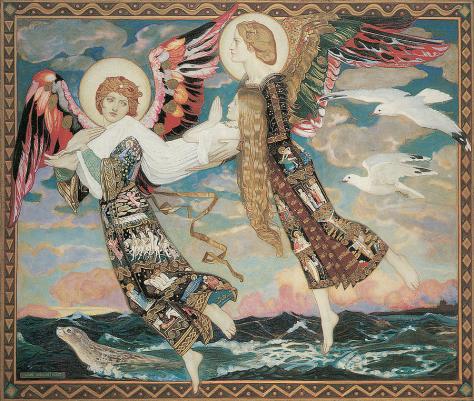
In “Brigid: The Mary of the Gael”, we recalled the legend that angels carried Brigid over the seas from Ireland to Bethlehem so that she might be present for the birth of Jesus, assisting Mary as midwife. Brigid, who was born in the fifth century after the event….

Immediately we find ourselves in sacred time, in what today’s physicists, following Einstein, would call the simultaneity of time. Mystery. We suspend disbelief, allow our linear, logical brains to take a break, invite the story to offer us its teachings. Ask how this applies to our own lives. Listen.

Each one of us is asked, like Mary, to give birth to the Holy One. In Godseed, Jean Houston writes about the heart of our call, inviting us into a meditation, a visualization, of how this might be:

Lying down now and closing your eyes, imagine that you are dreaming. In your dreams, you see light, and into this light comes a Being of Light, a Bearer of Good News, a Resident from the Depths. This angel says to you, “Oh Child of God, fear not to take unto yourself the spiritual partnership, for that which is conceived in you is of the spiritual Reality. And this Reality, if nurtured, shall be born of you and shall help you to…bring the Godseed into the world.”

And now see what the angel sees—the fulfillment and the unfolding of this Child of Promise within you….see and feel and know the possibilities, indeed the future, of this Child in you, this Godseed that you are growing in the womb of your entire being, should you allow it to be nurtured and to grow and to be born into the world. (Jean Houston in Godseed Quest Books 1992 p.39)

This call to birth the Christ within us is as ancient as first century Paul, who wrote of being in labour until Christ is born in us. It is as modern as twenty-first century eco-feminist theologian Yvonne Gebara who entreats us to give birth to the Christic Presence in the Universe.

Contemporary writer Diarmuid O’Murchu cites the words of the thirteenth century Dominican mystic Meister Eckhart: What does God do all day long? God lies on a maternity bed, giving birth all day long.

Reflecting on Meister Eckhart’s image, O’Murchu continues:

This is a metaphor we have known as a spiritual species for thousands of years, long before formal religions ever came into being….The Great Goddess of our Paleolithic ancestors was perceived as a woman of prodigious fecundity, birthing forth the stars and galaxies, the mountains and oceans and every life form populating planet earth today. God, the great life-giver in the pregnant power of creative Spirit, is probably the oldest and most enduring understanding of the Holy One known to our species.

O’Murchu concludes that: we are called to become co-birthers with our birthing God of the ongoing evolutionary re-creation of God’s world in justice, love, compassion and liberation. (Diarmuid O’Murchu Jesus in the Power of Poetry 2009 pp. 45-46)

When we say yes to our call to give birth, we are embracing a lifelong partnership with the Holy One of “prodigious birthing”, a responsibility that has the power to take over our lives, to demand of us everything, to offer us a life that is at once profoundly meaningful, and intimately engaged with the ongoing renewal of the universe. There will be suffering, there will be hard work, but there will also be times of ecstatic joy, tasting our oneness with the Love at the heart of life.

Dolores reminds us that: it is only in us, you and me, that the energy of Brigid will rise again, take form and become a force for transformation in our world.(Dolores Whelan in Ever Ancient, Ever New Dublin 2010 p. 81)

Brighid by Jo Jayson

painting of Brigid by Jo Jayson


Brigid, midwife of this birthing, stands at the door. We hear her voice, “Do you have a welcome for me?”

What is our response?

Brigid: “Forge Us Anew”

There is something more I need to ask Brigid, something about a forge, a smithy. Didn’t Anne O’Reilly tell us that Brigid is also the Matron of Smithcraft?

These lines from James Joyce have always haunted me:

I go for the millionth time into the reality of experience
To forge in the smithy of my soul
The uncreated conscience of my race.

There is a link I am trying to make, trying to forge, I suddenly realize. I risk now asking Brigid: “How does the poetry connect with smithcraft? Anne O’Reilly’s poem asks you to forge us anew. I sort of get that, but James Joyce seems to be talking of so much more. He says he must forge in the smithy of his soul the uncreated conscience of his race. What does that mean?”

Brigid holds my gaze for a long searing moment. “Indeed,” she says at last, “what does that mean? When you understand, you will each be ready to leave this garden, to return to your homes, to do the same for your time, for your task, for your earth.”

And with that, she is gone. We get up from the almost-dry grass, shake the last drops of rain from our umbrellas, and head back to the hotel.

We did not see Brigid again during our time in Ireland. We returned home, her last challenge still ringing in our hearts.

Yet we continued to seek a deeper understanding. We stayed in touch with one another, offering our thoughts on what it might mean to forge ourselves anew. Here are some of our responses:

Noreen suggests: it is a call to each to do our own inner work.

Patricia touches on the same theme: we need to trust and be in touch with how we feel, what we see… and then to bring it into relationship with our mind. We must trust ourselves and be true to who we are and what we believe, protective of the unique gift that we bring to our world.

Shirley, commenting on the magnitude of the challenges presented to us by the global crisis in the planet’s environment, says: if we allow ourselves to connect deeply with our feelings, we tap into the energy that can give us courage, strength and determination to practise compassion to create a better world.

These three women have understood the heart of Brigid’s challenge: the call to transformation that is the essence of our work in the hearth or smithy of our soul.

Irish Theologian Mary Condren writes compellingly of the gifts of Brigid for our time. Her article, “Brigit, Matron of Poetry, Healing, Smithwork and Mercy: Female Divinity in a European Wisdom Tradition” was published in 2010 in the Journal of the European Society of Women in Theological Research.

Mary Condren’s work sheds light on this fourfold matronage of Brigid, and was my source for information in the last posting on the role of the poets in ancient Celtic Society.

11312672_956995234363662_9002817779987489934_o

Mary Condren guides us into a further understanding of smithwork of the soul:
As a smith, Brigid transformed people’s minds rather than metals. She forged new ways of being and transformed old patterns of behaviour into new courses of action. Her psychic mojo speaks of another kind of in-depth knowledge: the perspective of the Crone, the one who has seen it all and is not afraid to speak.

Brigit may be patroness of smithcraft, but her anvil was that of the soul; her alchemy, that of the spirit….Brigit’s matronage of smithwork also takes the form of the “inner fire” necessary to ensure the ethical life of the community….the fire that does not burn, the life-force within….Brigit’s followers, like the ancient Vestal Virgins, were charged with holding the seed of the fire on behalf of the community. The fire would not burn provided they remained focussed, and undistracted by flattery.

With the poet Anne O’Reilly we ask Brigid to forge us anew, to assist us in our work of transformation in the smithy of our souls.

Shirley offers a further reflection that speaks to this challenge, offering us hope:

If our hearts can be turned forward we can help co-create a new human species, a new consciousness. We cannot be fear based. If we stay fear based we can become more unconscious. There are powerful voices building, encouraging momentum. Hopefully in our dialogue we can change minds and hearts by increasing the awareness of the sacredness of all creation and the interconnection of all things.

May we ponder this and send light and love to assist in the emergence of a new human community to embrace the whole of the Earth Community.

This is part of the dying and resurrection. We work it through and that’s the power of the resurrection. This is a new universe being born and it’s messy.

Thomas Berry wrote: “We are not lacking in the dynamic forces needed to create the future. We live immersed in a sea of energy beyond all comprehension. But this energy, in an ultimate sense, is ours not by domination but by invocation.”

Brigid: Matron of Poetry and Smithcraft

Following our conversation with Brigid about the meaning of Equinox, we gather for dinner back at our hotel. The mood is somewhat subdued, the conversation sporadic, touching on the sudden chill of the evening, the earthy tang of the Guinness, our plans for the evening. Within walking distance, there is a poetry reading at eight o’clock, featuring the works of Irish writers of the 20th century. I do not say it to my companions, but I think poetry might be a welcome release from Brigid’s intense teaching and catechizing. I am still smarting from her comment to the fox that we have a great deal to learn…

Just before eight, we make our way to the pub for the readings. We crowd in, some of us clustering around small tables of dark well-polished wood, others perching on the high bar stools. Though I feel a little guilty about it, I am looking forward to an evening without thinking about Brigid. Minutes later, I hear Irish poet Anne Frances O’Reilly, the evening’s host, say that the poetry will be dedicated to Brigid, patron or rather matron, of poetry, healing and smithcraft…

Anne begins with her own poem to Brigid, as recorded on her CD “Breath Song”.

Brigid

These words will never carve
your image out of bog oak
but that is what they want to do
to dig down into the moist wetness
to touch the layers of centuries
that have made you
woman, goddess, saint
to see your shape emerge intact
from the dark earth.

My instruments are crude for such a work
the bog resistant to intruders
as an ancient tribal memory
in its dark and secret places.

But I must search out these roots
this memory as vital as breath.
I must drag this ancient oak
from the centre of the bog.

I will wait as I must
for the time of dryness where I can see
the shape of what you were and what you are.

The fine coat of resin will preserve your beautiful shape intact
and I will call on you great woman
to grace me with a golden branch and tinkling bells.

And I will polish you then with images of
sun and moon, cows, sheep, serpents, vultures,
bags, bells, baths and sacred fires
so that you become a fiery arrow
and breathe life into the mouth of dead winter
as it is these days in the lives of women
whose spirits have ceased to quicken.

O beautiful vessel still intact
where we have unearthed you,
remind us of your many manifestations
and let us smile again in memory
of when doddering Mel pronounced you bishop
or your cloak spread over the green fields of Kildare.
You who turned back the streams of war
whose name invoked stilled monsters in the seas
whose cross remains a resplendent, golden sparkling flame
come again from the dark bog and forge us anew.


The following morning, we arrive at the place we now think of as “Brigid’s Garden” under umbrellas that offer little shelter from a wetness that blows towards us from the side. Balancing umbrellas with one hand, spreading jackets or raincoats with the other, we sit on the wet grass.

Brigid is laughing, the raindrops caught in her long hair like sparkling jewels. The sunlight radiates in the drops creating prisms of light, and soon the rain has vanished as though lapped up by their thirst.

“Did you enjoy the poetry last evening?” Brigid asks.

There is a buzz of response, nods of agreement, a few of us quoting remembered lines and images from WB Yeats, from Patrick Kavanagh, from Seamus Heaney.

“Anne O’Reilly said you are the matron of poetry, Brigid,” Elizabeth says. Herself a poet, she then ventures to ask, “How did that come about?”

“How did I come to be matron of poetry?” Brigid echoes, then adds, with great seriousness, “you have seen and read, of course, my collected poems? No? Well, there’s a good reason for that.” She laughs suddenly. Lightly. It eases the tension. Each of us had been fearing we’d missed something important. “I’ve never written even one verse,” she admits.

“Let me tell something of the role of poets in ancient Ireland. They were honoured along with kings and priests as part of a triad of leaders. Poets played a role in the inauguration and the legitimizing of kings. Should a king not live up to what was required of him, the poets could overthrow him.

“The last time you were here, we spoke of the Celtic year that begins with Samhain, as the dark time of the year approaches. You may recall my saying that for ancient people life was understood to begin in darkness. For this reason, the training of poets for a culture that was mostly oral demanded that they spend many hours in complete darkness memorizing the ancient tales and the wisdom lore of Ireland. Because they had faced this darkness and at the same time, their own inner darkness, the poets were prepared to call the community to integrity, to challenge unjust rulers, and false decisions, to defend the weak.

“Now you already know that my name goes back millennia to a time when it meant High or Exalted One. In early Irish law there is mention of a Brigh Ambui who was a woman, an author of wisdom and prudence among the men of Erin. From her were named the incantations called Briathra Brighi by which the poet’s mind was made prophetic.

“The poets of Ancient Ireland had three significant duties: intuitive knowing, whereby they accessed wisdom from the collective unconscious and from within their own bodies; composing without thinking, or on the spot, out of this deep source of wisdom, their store of knowledge and the poetic gift that brings the knowing forth; and the illumination of song.”

We are silent, taking this in, expanding our understanding of the art of poetry, the task of poetry.


Sophia in the Easter Mystery

Through the cold, quiet night time of the grave underground,
The earth concentrated on him with complete longing
Until his sleep could recall the dark from beyond
To enfold memory lost in the requiem of mind.
The moon stirs a wave of brightening in the stone.
He rises clothed in the young colours of dawn.
John O’Donohue “Resurrection”

The Easter Mystery of life-death-life is at the heart of the universe, at the heart of life on our planet, in the deep heart of our own lives. From its birth out of the womb of a dying star, through its daily cycle of day/dusk/ night/dawn, its yearly cycle of summer/autumn/ winter/spring, the earth teaches us to live within the paschal mystery.

 Ancient peoples understood this mystery. Through their careful observations they constructed buildings such as the mound in Newgrange Ireland where a tiny lintel receives the first rays of dawn only on the winter solstice.

The ancients wove their understanding of life/death/life into their mythologies: the Egyptian story of Osiris, whose severed body was put together piece by piece by his wife Isis, then reawakened; the Sumerians tell of the great queen Inanna who descended to the underworld to visit her sister Erishkigal. There she was stripped of all her royal robes and insignia, and murdered by her sister who then hung her lifeless body on hook. Three days later, Inanna was restored to life, all her honour returned to her.

The people of Jesus’ time would have known these and other great myths of the ancient Near East. What was so stunningly different in the Jesus story was that the mystery of life-death-life was incarnated in a historical person. The Resurrection of Jesus is at the heart of the Christian faith. As Paul wrote, “If Christ be not risen then our faith is in vain”.

In our lifetime, the explosion of new science shows us the life/death/mystery at the heart of the universe. Like exploding stars, our lives are continuously being rebirthed into a deeper more joyous existence. By allowing the death within ourselves of old habits, old mindsets and narrow ideas of who or what we may be, we open ourselves to the possibility of new life being birthed within us. As Jesus told his friends, “You will do what I do. You will do even greater things”.

“Resurrection is about being pulsed into new patterns  appropriate to our new time and place,” Jean Houston writes in Godseed. For this to happen, we need to open in our deep core to “the Heart of existence and the Love that knows no limits. It is to allow for the Glory of Love to have its way with us, to encounter and surrender to That which is forever seeking us, and from this to conceive the Godseed.”

“The need for resurrection has increased in our time,” Jean continues. “We are living at the very edge of history, at a time when the whole planet is heading toward a global passion play, a planetary crucifixion.” Yet “the longing with which we yearn for God is the same longing with which God yearns for us…. the strength of that mutual longing can give us the evolutionary passion to roll away the stone, the stumbling blocks that keep us sealed away and dead to the renewal of life”. (Godseed pp.129-130)

The yearly miracle of Spring awakens within us the confidence and joy that this same rebirth is ours to accept and to live. We know our call to green our lives, our times, our planet:

The force that through the green fuse drives the flower
Drives my green age (Dylan Thomas)

Talmost spring 003

Where in my life do I most experience the need for a rebirth?
What old habits and beliefs would I have to let die in order for this new life to be born?
How does knowing that the longing with which (I) yearn for God is the same longing with which God yearns for (me) make my life more joyful?
What would a resurrected life look like, feel like, for me? for those with whom my life is woven? for our planet?

May Sophia, the feminine presence of Sacred Wisdom, gently guide us through the death of what no longer serves us into the joy of the rebirth for which our hearts yearn.

Brigid and Spring Equinox

In mid-morning of March 21st, we walk from our hotel to the garden where we sat with Brigid on our first visit. She is here already, seated beside the pool of water, expecting us. Her smile warms the air of this spring day, this day of equinox. Following her lead, we too breathe in the fragrance of earth, of violets, daffodils, foxglove, and trees whose young leaves are ready to burst outwards.

With a gesture of welcome, Brigid invites us to sit near her where the early grass softens the earth beside the pool.
“Today we need to speak of the equinox,” Brigid begins. “Do you know its meaning?”

A few of us exchange glances. Every child knows what equinox means, and yet Brigid waits, expecting a response.“It means that day and night are of equal length after the short days and long dark nights of winter,” one of us responds, politely.

Brigid smiles. I have the uncomfortable feeling that she knows exactly what we are thinking. “That’s a good answer, as far it goes,” she says now. “But did you not understand our last conversation? You and I and all that lives upon our beautiful planet are part of her. Our lives, our bodies, our souls, our spirits are one with her rhythms, her seasons. Since this is so, what meaning does equinox hold for us?”

“Is it about balance?” someone ventures.

At this, Brigid smiles. Mischievously, I think. “Balance, yes. But balance of what?”

“Light and darkness,” I say, growing increasingly uncomfortable as I wonder what Brigid is up to, if she is playing with us, trying to trip us up in our knowledge of the earth.Spurred by this thought, I rush on, “it is the balance of light and darkness that shows us that spring is coming. Longer days mean that the earth will soon be bursting with new life. And also,” I add this with some pride as I have only just learned it myself, “it is the increase in daylight that draws the birds back from the south.”

But Brigid appears unimpressed. “I don’t think you really understand about the equinox. You are describing what you see around you. My question is about what is happening within you.”

Suddenly a fox emerges from the bushes beyond the garden. It walks with soft steps, unswervingly, towards Brigid. Though her back is to the fox, though she could not possibly see the delicate animal, Brigid stretches her hand towards the fox, calling out, “Come, my friend. Meet some people who have a great deal to learn.”download

We who were frozen in fear at the appearance of the fox, watch now in amazement as the small animal comes to sit, composed, peaceful, at Brigid’s feet.

“Your Celtic ancestors,” Brigid continues, as she strokes the fox’s fur with her hand, “like indigenous peoples everywhere, experienced time as circular. They danced to its rhythm: night gave birth to dawn and day blossomed before it waned into evening, back into night.

“Our ancestors watched the cycles of the moon, the turning of the tides. The women noticed how the rhythms of their own bodies, their regular times of bleeding, followed the moon’s rhythms. No wonder they felt at home in the universe, embraced by the earth.

“Because they saw their lives as part of the great cycle of life, the Celtic people created a calendar that marked the seasons of the year, dividing the year into two major parts related to the sun’s light: giamos and samos. They celebrated eight festivals that were about 45 days apart.

Because they understood that it is darkness that gives birth to light, their year opened with the Festival of Samhain, November 1st, where the dark days begin. These are the days of inwardness, receptivity, the time that came to be known as feminine. Here the pace slows, linear time recedes, the intuitive is honoured over the rational. With the Festival of Bealtaine, on May 1st, the bright masculine sun days begin, the samos time of outer activity when the seeds nourished through the dark days blossom into new life. The linear, analytic, rational way dominates once again.

“ In the Celtic Calendar, the Spring Equinox occurs halfway between the Winter and Summer Solstices. It is the festival just before Bealtaine, when the feminine season ends, and the masculine begins.

“Now can you see a deeper meaning for the equinox? It is an invitation to find a new balance within our lives, within our cultures and throughout the planet, of these masculine and feminine energies that so often are in opposition. It is a time to choose how we shall hold the values of the dark time of the goddess even as the bright active masculine takes over in our lives.

“How will you choose to honour the feminine intuitive gifts of the moon time in the days when the sun calls forth your logical, rational gifts? Will you make a space in these busier days for quiet reflection, for remembering your winter dreams, for poetry, music, drawing, dance or whatever nourishes your inward life? Will you seek a finer balance of work and recreation, of times with family and friends as well as times of solitude? Will you consider how the dance of opposites in your own life might flow in rhythm, even as it does in the Celtic Calendar?

“These are important questions, dear friends. I hope you will consider them in the time until we meet here again.

“If we could enter into the ancient ones’ understanding of time, the rhythms of our lives would take on sacred meaning. Our times of inner darkness would hold the promise of a dawn of new joy. Our losses would be seen as invitations to embrace other gifts, our death as birth into a new as yet unimagined life.”

And with those words, Brigid is gone, her fox companion with her!
We are left here by the pool, thinking, wondering.

A Conversation With Brigid

After these weeks of reflecting upon Brigid, we decide to pay her a visit. We book spaces on an Aer Lingus Flight to Shannon Airport. Outside the airport, we find a bus, its destination clearly written above the front window: Church of St. Brigid.

The bus stops before a stone church that appears and feels to be centuries old. Inside, as our eyes adjust to darkness, we pull shawls/sweaters/light coats more closely around us to protect against the chill, the seeping dampness from winter’s rain. The smell is a not unpleasant mix of wax, flowers, dusty hymnals, wispy remnants of incense.

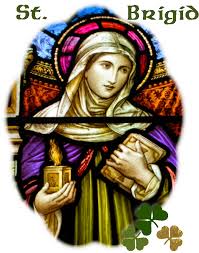
Light comes from the red sanctuary lamp and, in a side aisle, a single candle bows in a soft breeze from a high, partially open, window. Drawn by the candle, we look upwards, gazing at an image in stained glass of Saint Brigid, eyes looking away, one hand grasping a book of prayer, the other a flaming candle.
Clearly she is not expecting us.

image of Brigid


But then, slowly, she lowers her gaze, looks steadily at us and…. WINKS!

Beneath her, the partially open window shows a sunlit landscape of such verdancy that we are drawn towards it, even as we see her gesturing that we follow her. We are outside now, breathing in the fragrance of wet, newly-turned earth, pungent with spring life. Brigid draws us onward towards a pool of water that holds a drowned, cloud-drifted sky, invites us to sit on the springy young grass that surrounds the pool.

When we are settled, she speaks: “There’s something I need to tell you….”

We look to her, surprised by this turn of events, eager to listen, to learn.

“First of all, you took the wrong bus. When I drew you here to Ireland, I thought you’d know where to look for me, but when you climbed into that bus, I had to get here ahead of you. Believe me, it was no easy task to stand so still, trying my best to look holy, otherworldly, until you arrived. But now you’re here, I have much to say to you.

“You’ve heard stories about me, of my life in the Christian Monastery of Kildare where I served as abbess to both men and women. I embodied in that role the qualities of compassion and generosity, of kindness, of fierceness in my focus, as I kept the sacred fire alight, the healing water of the holy well flowing. These stories you understand for they are part of your heritage.

“But there is so much more for you to know, wisdom that goes back to the countless millennia before Christianity, before the Hebrew Scriptures, before men decided that God was a powerhouse running the universe, yet wholly separate from what “he” had created.

“I will speak of Ireland, but you must understand that this wisdom was found in many different parts of the planet, in the myths and stories of numberless, now mostly forgotten, aboriginal peoples, in the days when the Holy was understood to be a woman whose body was the earth that births and holds us, nourishes and comforts us, receiving us back into her body when we die. Fragments of this wisdom have endured, to come to us in stories, in myths, in rituals.

“In those ancient days, wave after wave of people came to Ireland, each bringing their own understanding of that sacred being, our mother. Over the millennia, she was called by many different names: Anu, which relates to Danu, the goddess for whom the great river Danube is named; or Aine, the wheel of the seasons, the circle of life; and later Brigit, a name that derives from an Indo-European word brig, meaning the High, the Exalted One.

“In ancient Ireland, Brigid was honoured as embodying all three aspects of the goddess: maiden, mother and crone. The poets, who themselves held positions of honour almost equal to that of the king, worshipped the goddess Brigid, taking her as patron. She was said to have two sisters, each named Brigid, one the patron of healers, the other patron of smith-craft.

“In this, you can see that Brigid was a goddess of many aspects, perhaps herself the many-faceted One, the sacred holy mother of far more ancient times.

“I can see by your expressions that some of you are wondering why I feel it so important to tell you all of this, you who live in a time so different, so removed from the ancient days of Ireland. Yet I have seen in your hearts some of the darkness and suffering you carry, your grief for the ravaging of the planet, the earth, that you know as your mother. I have felt your pain over the desertification of the rain forest, the lungs of your planet, the pollution of its waters, its rivers, lakes, oceans, its very life blood, the poisoning of the air…

“I want you to know, to rediscover, the wisdom of the ancient ones who saw Brigid/Aine /Anu as the life within the earth herself. The hills, her breasts, were called the Paps of Anu; the nipples of high mountains sprouting water were like breasts giving milk; wells that spring from rocks on the sides of mountains and hills or gushing forth from under the earth, or deep inside caves, were her offering of healing.

“Open your eyes, dear ones, so that you may see the earth as co–creating with you in love. See yourself as a partner in this great work, and know yourself held in love by the earth whom you honour as mother.

“As you watch spring returning to your land, remember these things, remember me, and know you are not alone.

“I hear your bus returning. You need not tell the driver what we’ve been speaking about. But do come back again, for I have so much more to tell you!”

We board the bus, bemused, intrigued, making for our hotel. We know this is only the first of many conversations with Brigid.

Brigid : Learning to Hold Our Ground

The light in her eyes is fiercely bright, a Brigid fire that holds my gaze even as her words pierce the air between us. “I’ve been thinking about the schedule,” Dolores says. “We’ll work through Saturday afternoon until just before supper. It is a Brigid challenge to hold our ground.”

For Celtic Spirituality teacher Dolores Whelan, Brigid is more than a research project. For her, Brigid is soul-shaper, trail-blazer, way-shower, one who patterns for us how to be and do in the midst of life’s challenges.

dolores-img

Dolores Whelan (www.doloreswhelan.ie)

I had met Dolores two days earlier. In the three-hour drive from Montreal’s Trudeau Airport to the Galilee Centre in Arnprior, west of Ottawa, we spoke about Brigid. Dolores told me of the recent Festival near her home in Dundalk in County Louth Ireland that celebrated Brigid as Goddess and Saint marking Imbolc, the Coming of Spring in the Celtic Calendar. Then we talked about the weekend of teaching and ritual that Dolores would facilitate.

I told her of the scheduling challenge that had arisen. The resident priest, who would not be part of the weekend experience, had invited us to attend the Mass he was celebrating in the Centre’s Chapel at four o’clock on Saturday. I was uncomfortable with the invitation, wondering if Dolores envisioned a different flow for the days, a flow that would perhaps lead to and culminate in our own ritual celebration on Sunday morning. I knew that the women coming to the weekend were seeking something else. But perhaps some of them would welcome a chance to attend a Mass? We considered the question together. When Dolores suggested that a peaceful resolution might be simply to have some free time around four pm on Saturday to allow for those who wished to attend the Mass, I agreed….
So why am I now seeing a Celtic Tiger burning bright before me? And what has this decision to do with Brigid? Over the days, as Dolores brings life to the legends of Brigid, I find the answer. For Dolores, being in relationship with Brigid is not about devotion. Rather it is about finding the qualities that guided her life, then imbibing them, living as Brigid lived. Brigid was “fiercely authentic, fiercely protective of her gift,” her call, the focus of her life. She stood her ground, would not be turned aside from her destiny.

I recall the legend that tells that when her father, a pagan chieftain, sought a husband for her among the leading men of Ireland, Brigid contrived to make herself appear ugly so that no man would want her. When she achieved her desire, taking vows as a nun, the ugliness dissolved.

Women are too ready to be accommodating, Dolores says, too ready to set aside our own focus, our own destiny in order to please others. (As I would have done, altering the schedule so as not to offend…) We need to create a container to hold the divine energy that waits to enter us. We may have a moment of grace but we cannot contain it because our cauldron leaks, our energy dissipates, flowing away.

The women who tended the sacred fire in Brigid’s Monastery in Kildare have been likened to the Vestal Virgins whose task was to tend the sacred fire in Ancient Rome. To be virginal, Dolores explains, is to be defined in relation to oneself. Celibacy is chosen so that sexual energy may be used to keep the fire alive.

“What is the flame within us that will never burn us but will never die out?” Dolores asks. It is the passion within us. But that flame can go out if we allow ourselves to become overtired, if we don’t allow ourselves sufficient rest. We have to take care of ourselves and of the gift we have been given. By being too busy, we let the flame go out.

Brigid, though busy, knew the secret of aligning herself with heaven and earth. Brigid’s constant focus on, awareness of, God kept her in alignment in the midst of her many tasks.

Many of the legends about Brigid relate to her power to manifest food, lands, cows, whatever was required to meet the needs of the poor. Dolores sees that this gift rests on an absolute trust in the universe and in abundance. Brigid did not act from ego, which is fear-based, doubting that what is required will be supplied; rather she trusted that she would get what she needed.

“Brigid never felt unworthy,” Dolores believes. She was “always in confidence” that she would have what she needed. She gave away with abandonment, because she knew she would have enough. Her generosity came out of a belief in the abundance of the universe. It is gratitude that opens the heart and attracts to us what we need.

Brigid

Over the days of Dolores’ teaching, I feel a fire building inside me: a fierce determination to keep my life focused on the call that is my own purpose and destiny; I see that I need to deepen my trust in the abundance of the universe; I understand that giving freely, and being grateful for all that I receive, releases me from the fear of not-enough. I want my fire to burn bright. I need to create a strong container for the divine energy that wants to fill me, my own “cup to catch the sacred rain”. Brigid becomes real for me.

The ritual that we celebrate on Sunday morning holds power, manifests beauty. And it is ours, a feminine expression flowing out of the time we spent with Dolores who brought us Brigid, and with one another.

It is no small task to integrate the divine energy of the sacred feminine within oneself, Dolores assures us. We each do only one piece of the work but each piece together creates a quantum shift.

Who is Brigid for us Today?

Who is Brigid for us today? As women seeking to live a spirituality of and for our time, we take inspiration from her. Yet we are separated from her life by a millennium and a half. We don’t live in a monastery, or in a way of life intimately tied to the land and its cycling seasons.

In her book Praying with Celtic Holy Women Bridget Mary Meehan writes that “the force of (Brigid’s) Celtic soul is a rich lodestone of the Celtic feminine which continues to challenge each new generation.” (p.29) Consider the word Meehan chooses: a lodestone, a magnet, a thing that attracts…. What is it in Brigid’s story that so attracts us after so many centuries?

third image of Brigid


What I see in Brigid is that she matters to the time in which she lives, to the people whom she serves, as we each hope to do in some way. But she also matters to (maters as in mothers) the Church where her leadership was strong, recognised and luminous.

A woman living in the 21st century in the Catholic Church does not matter in that way. She may write, teach, offer retreats, and yet be largely ignored by the Institutional Church.

Until now, I have not minded. It allows a certain freedom. But something in Brigid’s story makes me wonder if perhaps it does matter very much indeed that the Church to which I have belonged since infancy does not appear to need or even notice women. How does the Celtic Feminine as expressed in Brigid’s life challenge me/us in this matter?

In last week’s Reflection on Brigid, we saw how old Bishop Mel, guided by the Holy Spirit, accidently consecrated Brigid as a bishop. We know that her monastery in Kildare was a double monastery, housing consecrated women and men, as was the way in the Celtic expression of Christianity. Brigid would have governed as Abbess/Bishop to both women and men. The development of Irish Monasticism appears to have been richly differentiated, a garden of wild profusion and endless variety. So there is no way of knowing how or when or why Brigid’s monastery of women began to welcome men. But here is a story I found that tells how it may have happened:

One day a group of men, for whom Brigid’s faithful spirit and generous heart were as a lodestone, came knocking at the door of the Kildare Monastery, requesting that they be allowed to join the community. Brigid consulted with her Sisters. They were aghast! What? Men! Noisy, unruly, bothersome. No way! Brigid’s first assistant sealed the matter with the words that have frequently put an end to something new: “It’s never been done before.”

Still not at ease with the decision, Brigid went outside and sat near the holy well. Something urged her to look deeply into its dark waters, recalling as she did so that imagination dwells in the dark places. Brigid picked up a tiny stone and dropped it into the well. Down, down it fell, until a small splash in the deep told her it had reached the water. But there was still nothing to be seen in the well’s depths. She picked up another stone and dropped it into the well. Just at that moment the noonday sun at its highest place in the sky illumined the water where the stone had struck. Brigid saw tiny circles rippling out from where the stone had pierced the water.

In the depths of her own imagination, Brigid saw a circle widening. She thought about this: “Because it’s never been done before does not mean it can never be done.” And it was so. Kildare become a monastery for both men and women, drawn by the depth of Brigid’s holiness.

Seeking a meaning for the word lodestone I notice another word: lodestar. This refers to the star by which a ship navigates, usually the pole star. Symbolically it refers to a guiding principle. This illumines something for me, shining into the wells of legend and story that flow around Brigid’s life. Under the tales there is a guiding principle that will illumine our lives if we look deeper.

What was the lodestar of Brigid’s life, the star by which she navigated the uncertainties and challenges that faced her each day? In an imaginal dialogue with her, I asked that question. Here is Brigid’s response:

 From the first moment I met the Holy, my thoughts have never strayed. Can you say the same? Or are you like Brendan, anxious about the weather and the tides and the location of the fish? focussed on your important tasks but forgetting the one thing necessary?  

I had to admit to her how easily I lose focus, forget the One who began this work in me, let the Holy One slip from my gaze, from my path, from my heart. The fire of a passionate love for the Holy that has been lit within me, a fire I must tend faithfully. A fire tender must first of all take care that the flame of her love burns bright.

The one thing necessary is the flame that must be tended and nourished from deep within. Then the fire may be turned to other uses: warming those who come near, creating art, poetry, song, melody and ritual, offering food to the hungry, and justice to those denied it.

Brigid spoke again: If you turn your heart towards the fire, the other tasks will seem less arduous. The fire will ignite your creativity. The love will give you the strength and joy you require. FOCUS! That’s the Brigid–gift I offer you. 

Brigid, you are our lodestone, drawing us to a life aflame. You are our lodestar, offering us guidance in something so utterly new, so untried, that it sparkles in the sun’s light even in the midst of surrounding darkness. The ripples make circles that widen, that embrace ever-new possibilities. Thank you.


Brigid: The Mary of the Gael

Edinburgh was coated in light snow on that February day in 1992, the air a raw biting cold, as I set out to explore the city. The National Gallery of Scotland lured me within, down a narrow staircase to an explosion of beauty, wildly out of proportion to the size of its modest rooms, its small wall space. I hold vague memories of standing in awe before landscapes, clusters of children in a garden, beautiful women and solemn men whose painted faces gazed back at me.

st-bride-john-duncan

One image remains etched in rich detail in my mind. I stopped, breathless, before John Duncan’s 1913 painting called, “St. Bride”. Two angels in gloriously patterned robes, miniature tapestries holding scenes from Celtic mythology, were carrying a white-robed maiden, her hands joined in prayer. One angel supported her back with his hands, as her golden hair fell in great waves towards the sea. The other angel held her ankles while her knees rested on his shoulders. The angels’ wings were a symphony of colour from scarlet to rose to pale pink, shaded with greens, golds, midnight blues. The angels’ toes just brushed the surface of the sea where a seal swam ahead of them.
I had no idea what I was seeing.

That evening, in the home of the friend with whom I was staying, I learned the story of Brigid. Legend tells that she was carried by angels across the seas from Ireland to Bethlehem in Judea, to be present at the birth of Jesus, and that she became his foster mother. Other tales add that Brigid served Mary as mid-wife, and that when Herod was seeking the Child to destroy him, Brigid distracted the soldiers by running through the streets, allowing Mary and Joseph to escape with Jesus.

As I am sure you recognize, we are in the realm of story. But as I hope you realize, it is the story that matters, that lures us, inspires us, teaches us what we need to understand about life. The life of Brigid is in some ways more mysterious than the life of Mary. With Mary, we have the fragments of the Gospels. For Brigid, what we have are mostly legends.
Brigid was born in Ireland in 457 AD and founded a double monastery in Kildare sometime before her death in 524 AD. A wealth of stories about her were carried in oral tradition until Cogitosus, a monk of Kildare, wrote his “Life of Brigid” around 650 AD. At the time of his writing, Cogitosus noted that in the Kildare monastery, the nuns still guarded her sacred fire.

According to Cogitosus, Brigid was the daughter of Dubhthach, a pagan noble of Leinster, while her mother Brocseach was a Christian. Baptized at an early age, Brigid was fostered by a Druid.

The stories of Brigid reveal her spirit of compassion for the poor: one day when she was a child, after she had milked the cows, she gave away the milk to some poor persons who were passing. She feared her mother’s reproof, but when she arrived home, her milk pail was found to be even fuller that that of the other maidens.

The adult Brigid approached a rich landowner, asking for land where she might grow food for the poor. The landowner agreed to give her as much land as she could cover with her cloak. Brigid lay down her cloak and it expanded until it covered many, many acres.
Another story tells of Brigid’s father preparing for her marriage to a nobleman while Brigid herself wanted to become a nun. Through the intervention of the Christian King of Leinster, Brigid’s desire was granted. With seven other young women Brigid was consecrated to Christ.

In a wonderful tale, during the Ceremony for Consecration of a Virgin to Christ, the very old Bishop Mel of Ardagh mistakenly read for Brigid the words for Consecration of a Bishop. When his mistake was pointed out to him by co-presider Bishop MacCaille of Longford, Mel insisted that the Consecration would stand, as it must have been the work of the Holy Spirit. Brigid would be the only woman to hold the episcopal office in Ireland.

In the book, Miniature Lives of the Saints, I came upon this explanation for Brigid’s title, “The Mary of the Gael”:
At a synod held near Kildare, during the lifetime of the saint, says an old legend, one of the fathers declared that he had seen a vision, and that the Blessed Virgin would on the morrow appear among them. Next day Brigid arrived with her companions, and the father immediately exclaimed, “There is the holy Mary whom I saw in my dream.” Brigid accordingly came to be called “The Mary of the Gael,” that is, of the Irish; for so pure was she in spirit, so holy in every action, so modest, so gentle, so filled with mercy and compassion, that she was looked on as the living image in soul and body of Mary the Mother of God. (London, Burns and Oates, 1959)

Legend says that Brigid’s mother gave birth to her on the doorstep of their home, one foot within, one foot outside the door. This would seem to be a prophecy for a life that would become a threshold, bridging pagan and Christian, woman and man, rich and poor….Goddess and Saint.

For the story of Brigid, founder of the Christian Monastery of Kildare, is interwoven with the ancient Irish goddess who shares her name. As goddess, Brigid is known as maiden, mother and crone. And the Feast of Saint Brigid, February 1st, coincides with the ancient Celtic Festival of Imbolc, the beginning of spring.

It is Brigid who “breathes life into the mouth of dead winter”. It is Brigid who, as we have already read in Dolores Whelan’s article, “Brigid: Cailleach and Midwife for a New World” holds the cailleach energy, the energy of the cauldron where our lives, individually and communally, need to be transformed through the power of her fire, her water.

I close with words spoken by a contemporary Irish woman who was seeking to grasp the goddess/saint mystery of Brigid: ”Ah, wasn’t she a goddess before ever she was a saint?” (in The Red-Haired Girl from the Bog by Patricia Monaghan)

awakening to the sacred feminine presence in our lives