We Return to the Well of the Storyteller

These days the heat and humidity weigh on us. Let’s return to the cool deep well of the Storyteller. Surely there are tales she has not yet told us.

tara-overhead-86682_207x136

You remember the way. We climb Tara Hill, follow the spiral path towards the south east. We arrive at the well, its low surrounding stones forming a protective wall. Here we remove our shores, bend down, grasp firmly a large stone for balance, then swing with the grace of an Olympic gymnast above and across the stones, letting our body sink upright into the welcoming cool of the water. Now, we let go. We sink down, down, down, pulled by our weight, until the right wall of the well disappears, pulling us into a womb–like opening that pushes us out into an underground pool. We swim across, climb up onto the rocky ledge. We are wholly dry, as refreshed as though just wakened from a sweet afternoon nap.
The Storyteller is here, seated near us, her dark eyes luminous in the shadow of of her purple hooded cloak. She smiles, welcomes us with delight in her voice:
You’ve come for another story!

The Storyteller gazes at us, scrutinizing each face, nodding as though she has reached a decision. It must be a story of longing and desire. It all begins with longing…

She looks directly at me as she says, Isn’t that what I have taught you? But this tale you have not heard before. You were not ready. Perhaps you are ready now. We shall see.

This is a love story from ancient Ireland, “The Wooing of Etain”.

In the early days when the children of the Goddess Danu, the Fairy gods, were defeated by the Sons of Mil, they agreed to make their vast and beautiful dwelling places inside the mountains and under the rivers and lakes of Ireland. The High King of the Fairy gods was the Dagda. He played upon his wooden harp to make the seasons to follow one another. He commanded the winds and the rains and the crops. His people called him “the good god”.

According to ancient custom, the Dagda sent his son Angus mac Og to be fostered by Midir, the proud Fairy King of Bri Leith. Angus’ companions were thrice-fifty of the noblest youths in Ireland and thrice-fifty of the loveliest maidens, and for all their great number, they all lived in one House. Their beds had columns and posts adorned with wrought gold that gleamed in the light of a precious stone of great size, brilliant in the roof at the centre of the House. Angus was leader of them all, for the beauty of his form and face and for his gentleness.

His days were spent in the Playing field, in feasting and taletelling, in harping and minstrelsy, and the reciting of poetry, and every youth was a chess player in the House of Midir of Bri Leith. Angus stayed with his foster-father for nine years, then he returned to his own Sid, Brugh on the Boyne.

One year to the very day of Angus’ departure, Midir, lonely for his foster son, decided to visit him. He put on his white silk, gold-embroidered tunic and his shoes of purple leather with silver-embroidered tips. He fastened his purple cloak of good fleece with the golden gem-encrusted brooch of Bri Leith, that reached from shoulder to shoulder, in splendour, across his breast, and on the Eve of the autumn Feast of Samhain, he came to the Sid of Angus mac Og, at Brugh on the Boyne.

The Mac Og was standing on the Mound of the Brugh, watching two companies of his youths at play before him. The first company rode horses of purple-brown colour, and their bridles were of white bronze, decorated with gold, and the horses of the second company were blue as the summer sky at early morn, and they had bridles of silver.

The battle sport was joyful, and the air was filled with the clash of arms, the clean ring of metal against metal and the lusty, clear-voiced challenging cries. Angus embraced his foster-father with delight, and they watched the play together, until, inadvertently, Midir was hurt in the eye by one of the youths. Though he was cured by the Dagda’s Physician, he was angered, and demanded satisfaction.

Angus readily agreed. “If it is in my power,” he said, “it is yours. What is your desire?”

“The hand of Etain who is the gentlest and loveliest in all Ireland.”

“And where is she to be found?” Angus asked.

“In Mag Inish, in the North East. She is daughter of the Fairy King Aylill.”

“Then it shall be so,” the Mac Og said, and at the end of the feasting he set out over the soft, cloud-bright fields of our many-hued Land, and came to Mag Inish, in the North East.
Aylill the King demanded a high bride-price. “I will not give my daughter to you except that you clear for me twelve plains in a single night,” he said, “and furthermore, that you draw up out of this land twelve great rivers to water those plains.”
Angus knowing he could not himself accomplish these feats, went to his father, the Dagda, who, of his great power, caused twelve plains to be cleared in the Land of Aylill, and he caused twelve rivers to course towards the sea, and all in a single night. On the morrow, Angus mac Og came to Etain’s father to claim her for Midir.

“You shall not have her till you purchase her,” Aylill said.

“What do you require now?” Angus asked.

“I require the maiden’s weight in gold and silver,” Aylill answered and the Mac Og said: “It shall be done.”
And forthwith he placed the maiden in the centre of her father’s House, measured the weight of her in gold and silver, and leaving the wealth piled up there on the floor, he returned to Brugh on the Boyne with Etain, and the ancient manuscript says, “Midir made that company welcome.”

Etain looked into Midir’s eyes, and that night she became his bride.

Here the Storyteller pauses for that is her way, allowing us time to ask, “What surprised me so far in this tale?”

“What gift have I received from this first part?”

(to be continued….)

Sophia: Love That Transforms Our Lives: Part Two

As I continue to reflect on how my life has changed since my dedication to Sophia, the sacred feminine presence, I realize my loving relationships have expanded in unexpected ways. Now the list of “those I love” includes a tree to whose presence I turn when I seek healing for myself and others; a small chipmunk who enjoys eating her lunch beside me on the back deck; a family of Phoebes who nest each spring above the porch light; the Iris plant that blooms in delicate splendour each June; the heron who moves down the river with slow grace, her wings weighted only with sunlight and soft winds; wild roses unattended, spilling gifts of perfumed beauty; the people I encounter, at the Post Office, the Waste Depot, the Library here in my small town.

Jean Houston teaches that when we love we become more intelligent, more creative, as we open to the patterns in the universe, as we glimpse the wonder of life and the wonder in ourselves. Speaking during her July 2014 Seminar, “Love in the Quantum Field”, Jean urged us to open the love receptor in all possible directions, the evolutionary and loving lure that has to rise in our time if we are to keep going. Patterns of connection activated by love are being brought out of the DNA, “bootstrapped into the culture”, Jean says. This transformation, this evolution, is taking place in our lifetime.

For Carol P. Christ, writing in “The Rebirth of the Goddess” (1997) hope is possible if we use the “human powers of reflection and moral action” that we once thought “set us apart from nature” to “create a new place for human beings within the web of life.” (p. 155)

Though thinking and acting (wrongly) have created many of the problems we and the Gaia body now face, human hope can only be located in the human capacity to think and to act differently about our place in the web of life….We act morally when we live in conscious and responsible awareness of the intrinsic value of each being with whom we share life on earth. When we do so, we embody the love that is the ground of all being. (p. 156)

Carol Christ believes that love forms the basis of morality:

…we have each experienced the power of intelligent love that grounds all beings in the web of life. This can become the basis for morality and moral transformation. None of us is perfect, nor can we be expected to be. What is asked of us as we work to heal the web of life is that we return the love and nurture given to us and that we try to contribute just a little bit more to the lives of all people and all beings than those who came before us. If we value our feelings of deep connection, if we love life on its own account and through others, and if we find the courage to act together on what we know, then maybe, just maybe, we can build a better future for ourselves, our children, and all the other children of earth. (pp. 158-9)

In her final chapter, Christ shares with us nine touchstones or ethical guidelines which she has discovered within her experience of the web of life. We might ask as we reflect upon them, how some or all of these might serve us in our lives, which ones we would set aside, which others we would add.

*Nurture life
*Walk in love and beauty
*Trust the knowledge that comes through the body
*Speak the truth about conflict, pain and suffering
*Take only what you need
*Think about consequences of your actions for seven generations
*Approach the taking of life with great restraint
*Practice great generosity
*Repair the web

Christ ends her book with this hope, this promise:

If we focus on the beauty around us, if we love life on its own account and through others, if we trust the knowledge that comes to us through our bodies, we will find the strength to continue the work of personal, cultural, and social transformation. If we speak the best of ourselves and others while at the same time speaking the truth about the harm that has been done, perhaps we all will recognize that it is in our own best interest to care about the survival of the web of life. Then we can begin again to create communities and societies that live in greater harmony and justice with other people, all our relations, and the earth body. (p. 177)

What shines brightest for me in Jean Houston’s teachings about “Love in the Quantum Field”, is her call to loving partnership with the Divine Beloved. This, says Jean, is the Great Lure that will draw us forward, opening us in love to all the realms of being. It involves an intensive practice, a daily practice of spiritual exercise, learning how to commit, to make the conscious choice of loving. “You will discover,” Jean says, “that the universe is alive and loving. As you move towards it, it moves towards you.”

P1000415

Sophia: Love that Transform our Lives: Part One

Once we take our first turning towards a Sacred Feminine Presence, welcoming her into our lives, change begins. In “Rebirth of the Goddess” (1997), Carol P. Christ writes of how the presence she names the Goddess altered her life. Her book reflects her new view of religion, politics, ecology, life, death, relationships, morality, the meaning of existence….

Reading Christ’s book has led me to reflect on how my own life has been altered over these five years since coming to know Sophia. I realize that the change began when I first recognized that there is a feminine path to the Holy that differs in important ways from the masculine path. The masculine path was shown to me as I grew up in a Church where the teachers, priests, writers, theologians were mostly men (or women who had embraced the masculine way of holiness).

As I have written earlier, it was the feminist theologians, writing in the last third of the twentieth century, who used their  intellects, their theological training, and their own experience to show that the “objective” masculine teachings, thought to apply to all humankind, actually reflected the masculine way to God. The feminist theologians found the heart of the difference between the masculine and feminine ways to be the perceived dualities described by Greek philosophy: spirit/matter, sky/earth, thought/ feeling, supernatural/natural, mind/body, spirituality/sexuality, man/woman. More than a separation, there is a perceived hierarchy where spirit, sky, thought, the supernatural, mind, spirituality, man are viewed as separate from, superior to, matter, earth, feeling, nature, body, sexuality and woman. This is a worldview where God is separate from creation, from humanity. To find this God, we must soar above the human.

Embracing this worldview, I had embraced an ideal of spiritual life that led me to distrust emotion, to value thought over feeling. to approach a drawing to love with extreme caution. I had learned to distrust my desires, my body, my sexuality, all of which, I’d been warned, would lead me astray, away from God. I learned to embrace an ideal of perfection, though I never succeeded in living it out.

Through the writings of the feminist theologians, I learned that to recover a sense of the sacredness of the feminine would be to recover as well a sense of the sacredness of the earth, of the body, of my feelings, of my sexuality. At this time in the story of our planet Earth, such a recovery is vital. The sacred presence of love lives within all of life, within the earth herself, within the creatures that walk, swim, fly, crawl upon and within her. Only this knowing can give us the courage and the strength we need for the work we are called to do with the earth as she heals from the ravages of our despoiling her.

In the sixth chapter of her book, “The Web of Life”, Christ writes compellingly of this call:
To know ourselves as of this earth is to know our deep connection to all people and beings. All beings are interdependent in the web of life….We feel deeply within ourselves that we are part of all that is, but we must learn to speak of what we know. We know, too, that we participate fully in the earth’s cycles of birth, death, and regeneration….
The fundamental insight of connection to all beings in the web of life is experienced by children, poets, mystics, and indeed, I suspect, by all of us, though we may lack the language to express what we feel….(p. 113)

P1000024

Acknowledging the difficulty of speaking of this deep connection “in the face of criticism rooted in dualistic thinking”, Christ quotes Jewish theologian Martin Buber who wrote of his “I-Thou” relation to a tree:

I contemplate a tree.
I can accept it as a picture: as rigid pillar in a flood of light, or splashes of green traversed by the gentleness of the blue silver ground.
I can feel it as movement: the flowing veins around the sturdy, striving core, the sucking of the roots, the breathing of the leaves, the infinite commerce with earth and air – and the growing itself in its darkness…
But it can also happen, if will and grace are joined, that as I contemplate the tree I am drawn into a relation, and the tree ceases to be an It. The power of exclusiveness has seized me. (Martin Buber, I and Thou trans. Walter Kaufmann, New York, Charles Scribner’s Sons, 1970 pp. 58-59)

Christ finds in the writings of Susan Griffin a recognition of “This Earth” as intelligent and aware:

I taste, I know, and I know why she goes on, under great weight, with this great thirst, in drought, in starvation, with intelligence in very act does she survive disaster. (Susan Griffin in “Woman and Nature: The Roaring Inside Her” New York, Harper and Row, 1978 p. 219)

A beautiful reweaving of dualities into wholeness flows from our embrace of Sophia/Sacred Feminine/Goddess. Here is Carol Christ’s celebration of the insight into oneness intuited by children, mystics and poets:

If Goddess is an intelligent power that is fully embodied in the world, then the notion that divinity, nature and humanity are three totally distinct categories collapses. If Goddess as fully embodied intelligent love is the ground of all being, then it makes sense to speak of intelligence and love as rising out of the very nature of being and of all beings as intelligent and infused with love. Human intelligence and our capacity to love do not separate us from nature. Instead, everything we are arises from the nature of being, from our grounding in the earth. (p. 123)

Daily Life with Sophia

Therefore I determined to take her to live with me,
Knowing that she would give me good counsel
And encouragement in cares and grief.
(Wisdom 8:9 NRSV Bible)

Midsummer: a time for dreams, for magic, for the unexpected. We celebrate Solstice as the sun’s light comes earliest, stays longest in the Northern Hemisphere while coming latest, leaving soonest in the Southern Hemisphere.

A memory returns of a Summer Solstice morning five years ago. I had wakened from a strange dream that I could not unravel. CBC Radio was playing Tchaikovsky’s “Romeo and Juliet” so I began to dance, hoping the mystery might become clear through sacred movement. Words began to rise from deep within me: “Unbind her and let her go free”. If the words referred to myself, that only puzzled me further. How was I bound? How did I need to be set free?

I phoned a woman whose wisdom I trusted, Jean Houston, my mentor, teacher and friend.
“You didn’t come in here alone,” Jean said. “Unbind that sacred presence within you. Let her go free.”

Thus began my relationship with a sacred feminine presence whom I am coming to know through the ordinary, sometimes extraordinary, experiences of daily life. For, as the Book of Wisdom says, I determined to take her to live with me…

Over the years of attending Jean Houston’s Mystery School sessions, I had learned a process for engaging with a sacred, archetypal presence for whom I had no name. I began a new journal. On the first page, I wrote the date, and on the next line my own name, followed by a colon.

Here is what I wrote first:

Anne Kathleen: Dear Friend, who are you? What are you?

On the next line, I wrote the word Friend with a colon and let my pen script her response.

Friend: I am the One who holds you in love.

Anne Kathleen: There are moments from my life when I sensed a presence that loved me deeply. Was that you?

Friend: Sometimes I was in the voice or body of someone – I spoke to you, touched you through a beloved other. But were there not moments when you sensed a presence of love when NO ONE was there?

Anne Kathleen: You are that love? That presence?

(Here I made reference to specific moments and experiences in my life, and the Friend added others…)

Anne Kathleen: Are you the Mother? Isis? Sacred Feminine? I do not know how to address you.

Friend: For now, just allow me to be with you. Names, titles, descriptions, come later.

That is how it began. I was grateful for Jean’s teaching that at first we will think it is our own imagination. But in time, there will be responses so surprising and unexpected that we know they come from something deeper than ourselves. For a long while, the nudges or suggestions I received from the Friend seemed so ordinary that I was disappointed. Seeking great adventures, I would instead be reminded about a necessary email or phone call, or a task I’d forgotten.

Slowly, slowly, over these five years, the daily writings have become a compass for my life. When faced with a tangle of tasks, I am guided as to where and how to begin. When I feel overwhelmed, I might be invited to take some time to walk to settle my thoughts and feelings. When there are important choices or decisions to be made, I am sometimes astonished to hear a writing voice very different from my own who offers another approach, one I would not have found on my own, one that proves to be life-giving and peaceful. Yet, I have not found this Friend to be all-knowing, for sometimes a situation changes in a way she did not seem to anticipate.

Her love has brought a profound peace to my life, one that eases anxiety, assures me in uncertainty, brings light into the darkest times. I am no longer alone.

I share this with you as a way of suggesting that if you indeed seek the awakening of Sophia in your own life, you may wish to try this journaling approach. See where it might lead you. Notice how synchronicities arise in your life, bringing you the right book/friend/opportunity to nurture your dedication to this sacred presence.

These days, the books of Thealogian Carol P. Christ  are light to me, as she weaves personal experience through her scholarship. She writes of her experience of being with her mother as she was dying:

As my mother drew her last breaths, I felt the room flooded with what I can only describe as a great power of love. A revelation had been given to me. Until that moment, I had always felt that I had not been loved enough. I began to understand that a great matrix of love had always surrounded and sustained my life. Since then, I have come to experience love as the gift of the abundant earth. It truly is the power of all being, the power I know as a Goddess. (“Rebirth of the Goddess”  Addison Wesley Publishers, Menlo Park, California 1997 p.4)

And from that same book, I read on the Solstice:

When we love concretely, intelligently, in our bodies and in concern for the whole web of life, we are listening to the persuasion offered to us by the Goddess whose intelligent embodied love is the ground of all being (pp. 108-9)

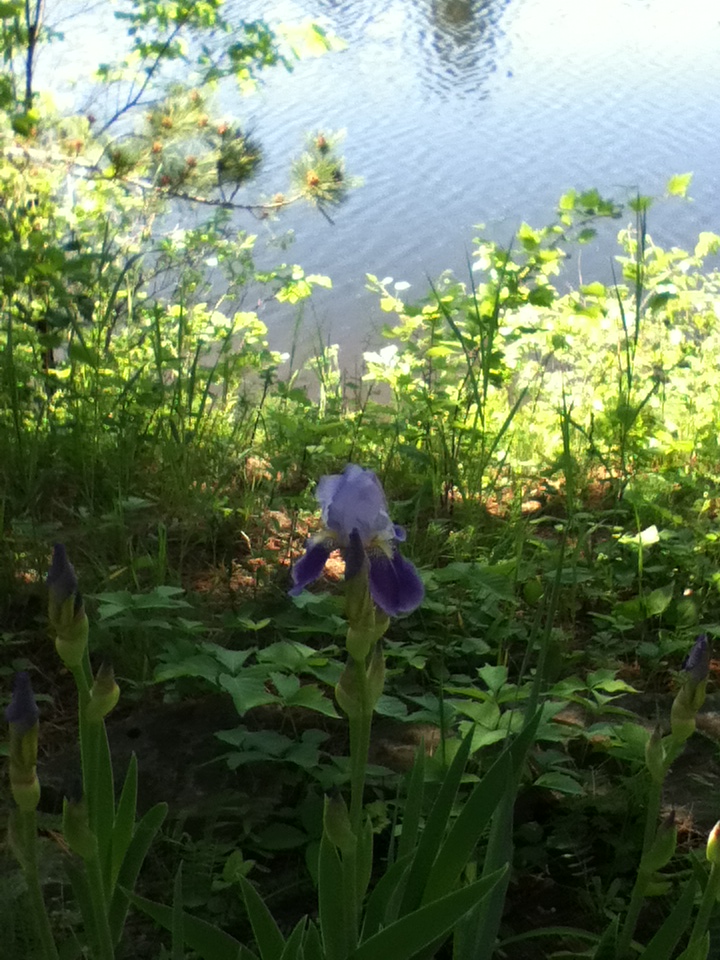
first Iris opens

Encountering Sophia in Sacred Places

The earth around my home is bursting with green life, flowering, spreading, growing taller in prodigal exuberance. A forest of Queen Anne’s lace has emerged, blocking the path where I used to walk. Impossible to recall winter days, the ground frozen metres below the snow. If spring happened only once in a lifetime we would never recover from wonder.

On these June days, I sit outdoors reading Carol P. Christ’s “Rebirth of the Goddess” (Addison Wesley Pub., 1997), watching the Bonnechere River take its sweet time towards the Ottawa. I read of ancient cultures where the source of the life that permeates earth was honoured as Goddess, that this deep knowing was eroded as warfare and practices of domination superseded the earlier harmony of cultures that lived close to the earth. Myths were shaped to tell of the slaying of the goddess by masculine power. It is a long, long story of which we have only recovered fragments. Yet glimpses of that earlier time of the Goddess can still be found in sacred sites on the planet.

Carol Christ, who lived in Greece for many years, exploring ancient sites, temples, caverns, found that at the site of an ancient temple, “there is almost always a church.” A memory comes to me of standing at the site of the Eleusinian mysteries of Demeter and Persephone about twenty kilometers from Athens. Our guide pointed up to a small white church atop a piece of land that had not been excavated. “That is a Church dedicated to Mary,” she said. “We find that a Church built to honour Mary almost always indicates that there is an ancient temple to the goddess below.”

Christ writes that “modern Greeks who speak their deepest needs to the Mother of God after making a pilgrimage to a beautiful place are not much different from their ancient ancestors who brought offerings to Goddess Mother. I began to light candles and open my heart in places filled by other pilgrims. As I did so, I realized that the Goddess had never died. She could not die because she was in the land, she was the land. (p. 42)

Three years ago in Ireland, I encountered something of that same presence.

roofless church with Mary statue on Achill Island

Its grey-black weathered stones still shaped walls and openings for windows, but the small church on Achill Island, just off the west coast of Ireland, had long since lost its roof. The June morning was cool, ruffled by soft winds, as we twelve women stood under the slate-grey sky around the plain stone altar. We had come here seeking an ancient holy well, dedicated to the early Christian Saint Dymphna, credited with healings, especially of those afflicted with mental illness. Dymphna was fleeing from her father, a pagan Irish king. Her pathways were marked by sacred wells, remnants of a tradition that predates Celtic Christianity. People sought healing at such wells, believed to be the openings of the body of our Mother Earth.

As we stood around that altar, we were aware that we were standing where women have been, in recent centuries, forbidden to stand. With that awareness, an inner strength moved within us, along with a joy that had no words.

One of women in our group read a poem by Denise Levertov:

Don’t say, don’t say there is no water
to solace the dryness at our hearts.
I have seen
The fountain springing out of the rock wall
and you drinking there. And I too
before your eyes
found footholds and climbed
to drink the cool water.
The woman of that place, shading her eyes,
frowned as she watched—but not because
she grudged the water,
only because she was waiting
to see we drank our fill and were
refreshed.
Don’t say, don’t say there is no water.
That fountain is there among its scalloped
green and gray stones,
it is still there and always there
with its quiet song and strange power
to spring in us,
up and out through the rock.

With these words still echoing, we walked outdoors, found our way through the old graveyard where in past centuries people from all across the island brought their dead for burial.

We found the well of Dymphna on a piece of low ground just metres from the edge of the sea, its small opening protected by a circle of stones. We stood there, ourselves a circle, praying silently for those in need of healing.
well3 on Achill Island

One of the women, kneeling to take a photo, discovered a heart-shaped rock, one side deeply carved and creased with lines of breakage, now healed; another picked up a stone with the clear shape of a mother and child. For both these women, the stones held a reflection of their lives.

I walked a little way past the well and saw a small stream of running water. Without knowing why I felt drawn to do so, I knelt and scooped up water, placing it on my forehead, on my heart. Later that day, I realized with a shiver of wonder that it was the 70th anniversary of my baptism.

That moment marks a sacred beginning as my life continues to be interwoven with a presence of love for whom I have no name.

Encounter with Wisdom Sophia

Yesterday I spent time engaged in a ritual designed by Starhawk. It was an invitation to go outdoors, to encounter a growing plant, study it, listen to its wisdom, learn from it. This is what aboriginal shamans did, how they learned about the medicinal qualities of plants as well as other aspects of earth wisdom.wisdom plant 001

This plant in my garden is awakened by the sun’s morning appearance in the east, inviting her to live a new day. Reflecting on this, I recalled words of Ezechiel: “Live and grow like the grass in the fields”. Was this the plant’s wisdom for me? I turned towards the south whose warmth engenders life within this plant, asking what I need to engender new life from within. I remembered the west wind loved by poets, the winds that ruffle the leaves of this plant, soothing, caressing. I remembered friends whose gentle winds of love sustain me through times of inner turmoil. I faced north, the place of transformation. What is north for this plant?

Winter, I thought, imagining her glossy green leaves brittle, brown, broken. Winter when she must let go of all she cherishes, feeling it blown away by cold winds until nothing remains but her buried roots. Under the snow-covered garden, she endures the long wait through darkness until her new life emerges with spring. But would she know about spring? I found my thoughts turning to my own life, to the way I resist recurring cycles of loss and transformation, as though I too were ignorant of the way spring must follow winter.

I looked at my plant, admiring her steady presence, her calm acceptance of the rhythms of life…. She has become my wisdom-teacher.That ritual opened my heart when I later read Rilke’s poem, “The Apple Orchard” :

The trees….
bear the weight of a hundred days of labor
in their heavy, ripening fruit.
They serve with endless patience to teach

how even that which exceeds all measure
must be taken up and given away,
as we, through long years,
quietly grow toward the one thing we can be.

(in “A Year with Rilke“ Joanna Macy, Anita Barrows, ed.)

My heart knew urgency. What is that “one thing (I) can be?” And how soon might my winter come? I decided to share with you, my blog readers, the work which has been taking shape in my life, the “one thing” that I can be and can do. I invite you to be part of something new that I have been called to create, as my small work within the great work of transforming spirituality in and for our time.

June is opening around us, releasing young birds into the air, drawing the tall purple Iris into bloom, bursting trees into leafy greenness. At each moment the universe is birthing newness. We in whom the universe dwells are continuously being reborn. Yet we carry in our hearts, our minds, our very souls, old, outworn, decaying images and thoughts of the sacred, unaware of the beauty within us, blind to our own light, deaf to the music of our longings, utterly incapable of knowing how deeply we are loved.

June2015 033
Reflecting on Ephesians 4:6, Elizabeth Johnson writes:
The One who blows the wild wind of life, who fires the blaze of being, who gives birth to the world, or who midwifes it into existence does not stand over against it or rule it hierarchically from afar but dwells in intimate, quickening relationship with humanity and the life of the earth…. Enfolding and unfolding the universe, the Spirit is holy mystery over all and through all and in all. (in “Woman, Earth and Creator Spirit“ Paulist Press 1993 p. 57)

We are being wooed by a Love passionate and faithful beyond our imaginings, a Love that yearns for our freedom, our transformation from caterpillar to butterfly, into a newness that is joyous, rich, empowered to reach out in love to transform the world.

What I want to say is
that the past is the past
and the present is what your life is,
and you are capable of choosing what that will be…
So come to the pond,
or the river of your imagination,
or the harbour of your longing,
and put your lips to the world
and live your life.
(Mary Oliver)

There are three aspects of this invitation for you to consider, allowing your own desires to guide you in your choice to become involved in one, or two or all three facets of the work.

First, gather a group of friends who share your desire to imagine/ to explore/ to create together a new expression of spirituality.

Second, contact me to arrange a time and place when I might come to offer the play, “The Wooing of the Soul”, woven around the ancient Irish tale of Midir and Etain.

Third, should you and your friends wish to continue to engage in this adventure on your own, I shall provide resources and suggestions that will assist you, serving as a compass.

If you have been experiencing a stirring, a call to incarnate a new way of knowing the Holy, a desire to share this with others, you may wish to pray these words from Clarissa Pinkola Estes:
Please remind me that people are waiting for my work,
That I make them suffer even more by withholding it.
Please help me to create in all mercy toward others
For I’ve been given everything I need to be one who awakens myself and others through
how I live, how I work, not so much even in the doing than in the BEING….

I am willing to work with you to make this possible, affordable, enchanting. It will form the heart of my work over the years ahead. You may contact me if you have questions or for further clarity. amclaughlin@sympatico.ca

Let us together put our lips to the world and live our life!

Anne Kathleen McLaughlin

Sophia with Another Name

We emerge from the Well of the Storyteller on Ireland’s Tara Hill. Her tale of Seal Woman has shown us a sacred space within ourselves, a homeplace where all that we are is held in love. Her tale of a woman of bone has revealed something of our longing for love. The poetry of Hafiz has spoken to us of a love at the heart of the universe that yearns for us in return.

From Tara Hill, we travel to London Ontario to attend a three day Festival at Brescia College, honouring Brigid. Rather than a mysterious presence who will not tell her name, we encounter and celebrate a woman who actually lived on our planet some fifteen centuries ago.

Brigid, the fifth century abbess of Kildare, was born in Ireland just as Christianity was taking root in soil once sacred to the goddess of many names. Her father was a pagan chieftain, her mother a Christian. Legend tells us that Brigid’s mother gave birth on the doorstep of her home, a foreshadowing of Brigid’s call to be a threshold person, a causeway joining pagan and Christian Ireland. As abbess of a monastery for both women and men, Brigid held the spiritual power, the moral authority of a Bishop. Though she left us no written records, stories of her life hold an energy, an influence, that has now reached far beyond Ireland.

On Thursday evening before the Festival, Starhawk, an earth-honouring social activist from the U.S., spoke to some five hundred people about the crisis facing our earth. For her sacred text, she chose Naomi Klein’s book This Changes Everything. For hope, inspiration and direction, she called on Brigid, pausing in the midst of mind-numbing facts and photos of burning oil wells, flooding seas, nuclear disasters, polluted waters, land ravaged by drought, to sing the chant: “Holy Well and Sacred Flame”, to ask, What Would Brigid Do?

Starhawk suggested Brigid’s responses: honour water so that to defile it would be morally unacceptable; transform polluted waters (there are ways to do this!); rehydrate the earth; promote an alternate world-view based on interdependence where good food and fresh water are available to everyone; leave the oil and gas in the ground; work towards a low carbon future, finding ways to sequester carbon in the soil; engage in activism that will create enough power to bring the powerful corporate polluters to our table; stand up to say NO to oil pipelines; organize locally using whatever gifts and skills we have: educating/ researching/ negotiating/ mobilizing/acting. Find our power, find our gift. Stand with the indigenous people and with them take our responsibility as guardians of the earth. Community is an antidote to Climate Change.

Calling “austerity” programs a form of theft, a neo-feudalism, Starhawk said Brigid’s life teaches that generosity creates abundance. We need a new imagination to face down the fear that arises from “scarcity thinking”.

P1000564(1)

Starhawk (centre)

In the days that follow, we hear of Brigid’s generosity: as a child she would give away the milk she took from her family’s cow, only to find that the pail had refilled itself when she returned home. As a woman concerned for the hungry, Brigid asked a rich landowner to give her a field that she might grow food for the poor. He agreed to give her all the land that her cloak would cover. When Brigid spread her cloak on the ground, it stretched across several acres. Brigid shows us that our generosity yields abundance.

Brigid’s sacred flame, which her community kept burning for more than a millennium, shows us the fire that does not burn, the inner fire that keeps us focused on what truly matters.

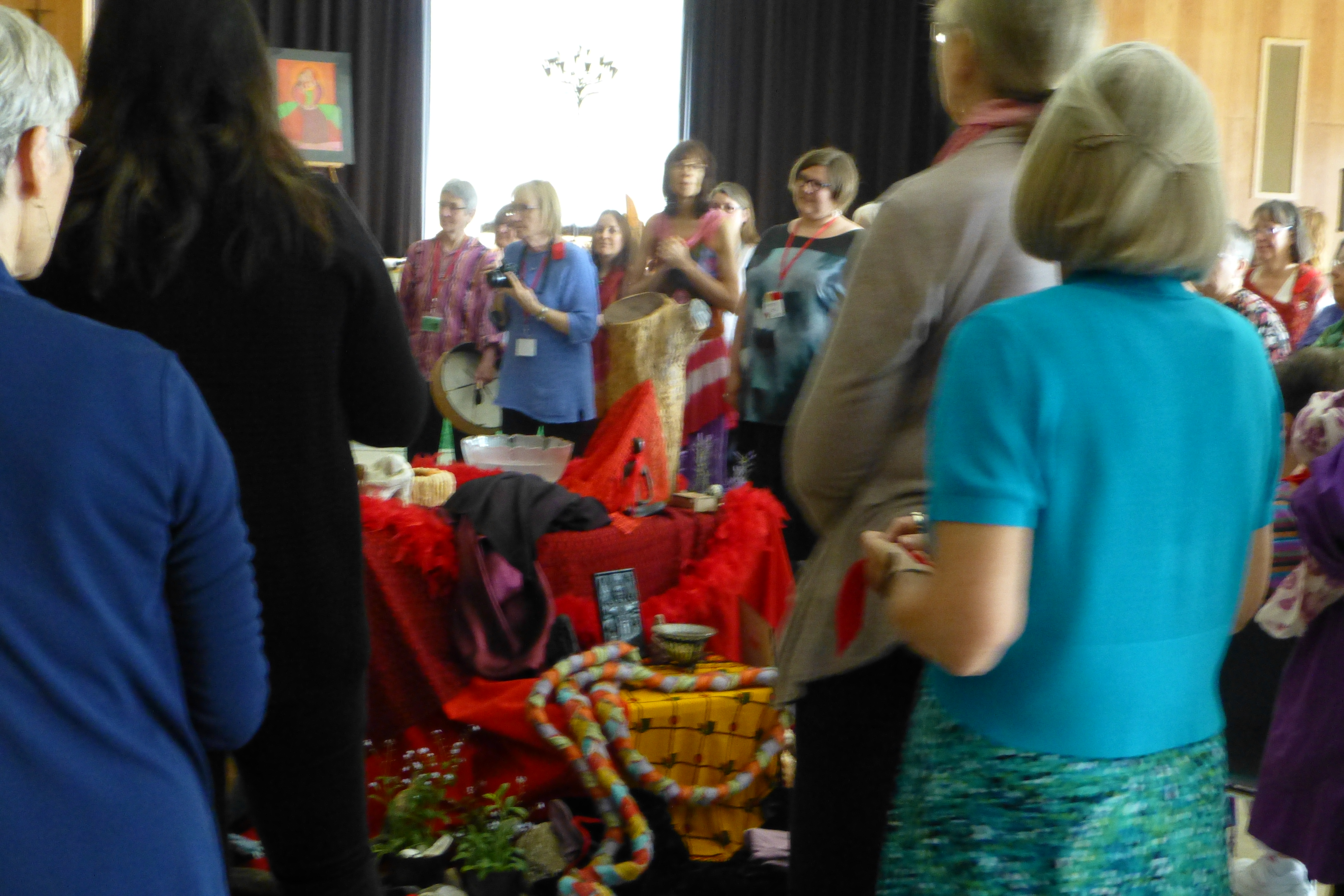
We experience rituals: a sacred dance of earth, water, air and fire; walking the labyrinth under the young moon; singing together; following the drum in a spiralling meditation; passing through the gateway of the braided crios or belt of Brigid that in ancient times was a symbol of woman’s authority. With more than a hundred women as companions, we find spirit sustenance, a homeplace where our soul might rest. This is Brigid’s threshold power at work, drawing together women who had left other faith traditions that did not nourish them.

P1000559

Ritual table showing braided crios

“Brigid is the acceptable face of woman’s divinity”, Mary Condren told Festival participants on Friday morning. Mary, who is the National Director of Woman Spirit Ireland, and Research Fellow at Trinity College Dublin, is exploring the Cailleach (Crone) aspect of the threefold presence of the sacred feminine, discovering how central the Cailleach tradition was in ancient times. It seems that at the Festival of Samhain, the maiden, mother and crone return to the Cailleach. By uncovering old pilgrimage paths and excavating ancient ritual sites in Ireland, researchers are finding many earlier aspects of the sacred feminine that were then ”folded into” the Brigid tradition which in turn was interwoven with the fifth century abbess, Saint Brigid. Mary Condren expressed a longing for Adrienne Rich’s “dream of a common language” that would bring the Cailleach/Brigid tradition into harmony with the Christian tradition.

Brigid’s cloak is a symbol of protection and of the creative womb of the earth. At her sacred well, we align ourselves with the call to speak truth to power; we align ourselves with what we are called to do with our lives. Brigid’s fire is an inner flame that does not burn out. Mary Condren suggests that we cultivate that inner fire of purification and protection rather than the spectacular destructive fire of sacrifice.

We leave the Brigid Festival, knowing we have encountered in the women we met, and in the spirit of Brigid herself, another aspect of Sophia, the sacred feminine presence.

Naming the Presence of Love

Prompted by the Storyteller’s questions, I have been searching my heart-memory. There are lines from the poetry of Hafiz that have come to me as though spoken by a Holy Loving Presence for whom I have no name. Hafiz calls that presence simply “the Friend”.

I speak his lines:

Ask the Friend for love,
Ask again.
For I have learned that every heart will get
What it prays for most.

Suddenly I recall the one poem by Hafiz that I do know fully, one I laboured to learn by heart.

There is one more, I tell you both, one I love so much that I think I can remember all the lines:

I saw you dancing last night,
On the roof of your house all alone.
I felt your heart longing for the Friend.
I saw you whirling beneath the soft bright rose
that hung from an invisible stem in the sky.
So I began to change into my best clothes
in hopes of joining you,
Even though I live a thousand miles away.
And if you had spun like an immaculate sphere
just two more times,
And bowed again so sweetly to the east,
You would have found God and me
standing so near and lifting you into our arms.
I saw you dancing last night near the roof of this world.
Hafiz feels your soul and mine calling for our Beloved.

I wait for a few heartbeats before I say: That’s really as much as I remember from Hafiz. Maybe I didn’t even get all the words exactly right.

I look directly at the Storyteller, impatience rising in me as I say: Now, will you please tell us about this story?

The Storyteller smiles, speaks calmly, apparently unaware of my annoyance with her:

Hafiz has given you all the teaching you require. I notice that you selected the poems that speak of love. The story of the Skeleton Woman, like Hafiz’ poetry, is about the passionate love of the Holy One for you. Hafiz is teaching you of that immense longing for union that is at the deep heart of this story, the longing that called out to the fisherman from the depths of the sea, though he did not know who called to him.

The One whom Hafiz calls the Friend, the Beloved, or sometimes God, is the Holy One who yearns so deeply for you, who loves your stumbling dance steps, who is so drawn by your longing that he/she comes to where you dance alone, ready to lift you into the arms of Love.

And then this Sufi poet teaches you one more secret. There is deep within you something so sacred, so holy, that it needs to lie down naked next to God.

I could have told you all of that myself when you asked, the Storyteller adds, but Hafiz is the better poet.

Now do you understand the story? It is about the human hunger, the longing for love, for deep union. This is a story of the yearning that draws flesh to flesh, the allurement that is at the heart of all of life, at the heart of the sacred seeking that first sent humans in quest of the Holy. They sought her among the stars when all the while she lay hidden in the depths of the marsh, in the bed of the sea, in the atoms, the cells, the very stuff of their own bodies.

There is utter silence in the well after she says this. You and I gaze at her, amazed.

You are the one who asks the question, the question I warned you, on our first visit here, not to ask, believing she would not answer.

Now I, too, need to know.

Who are you? you ask. The question spins in the well like a whirling dervish.

For answer, the Storyteller says, Bring your cup and I will pour out God.

That, too, is Hafiz! I say to her. But who are YOU really?

I am every particle of dust and wheat – you and I
Are ground from the Holy One’s Body. I am rioting at your door;
I am spinning in midair like golden falling leaves
Trying to win your glance.
I am sweetly rolling against your walls and your shores
All night, even though you are asleep. I am singing from
The mouth of animals and birds honoring our
Beloved’s promise and need: to let
you know the Truth.

I watch you open your eyes wide in surprise as she says all this.

But I am not impressed. I know she has not revealed anything.
That, too, is a poem from Hafiz, I say.
I begin at once to make my way back up out of the well, not even looking to see if you are ready to come. I do not say goodbye to the Storyteller.

References:
Clarissa Pinkola Estes gave us the “The Skeleton Woman” story and teachings in her book, “Women Who Run With the Wolves”, Ballantine Books New York 1992

Daniel Ladinsky brought Hafiz alive for our time by translating his poetry. “My Sweet, Crushed Angel” is from the CD “Hafiz: The Scent of Light”, trans. Daniel Ladinsky, published by Sounds True, Boulder CO, USA, 2002; you can also find this poem in Daniel Ladinsky “Love Poems from God” Penguin Compass, New York, 2002; “I Saw You Dancing” and all other excerpts of Hafiz’ poetry quoted here are from “The Subject Tonight Is Love” translated by Daniel Ladinsky, Penguin Compass New York, 1996, 2003

Hafiz Teaches of Love

After I finish speaking, the Storyteller sits in silence for so long that I begin to feel uncomfortable. Has the long tale of my discovery of the feminist theologians been inappropriate? Perhaps it is taking us in a different direction from what she intended.

To my surprise, the Storyteller asks, What more have you learned from the feminist theologians?

The words pour from me as though they’d been waiting for her question. I learned that I’d been living a spiritual life second-hand, that I’d been taught by men, some of them holy, most well-meaning, how to be a good man. I’d been warned about the dangers of pride, lust, anger, none of which were my most serious struggles. I had learned to distrust love, to be cautious with emotion, to value thought over feeling. I’d learned to distrust my desires, my body, my sexuality, all of which, I’d been warned, would lead me astray, away from God. I learned to embrace an ideal of perfection, though I never succeeded in living it out.

One day a young priest came to the Galilee Centre to give a talk on feminine spirituality. From him, I learned that in the classic dualities of Greek thought: spirit/matter, sky/earth, thought/ feeling, supernatural/natural, mind/body, spirituality/sexuality, man/woman, there is a perceived hierarchy. Spirit, sky, thought, the supernatural, mind, spirituality, man are viewed as separate from, superior to, matter, earth, feeling, nature, body, sexuality and woman. This is a worldview where God is separate from creation, from humanity. To find this God, we must soar above the earth..

I learned that to recover a sense of the sacredness of the feminine would be to recover as well a sense of the sacredness of the earth, of the body, of our feelings, of our sexuality. Listening to the wisdom of that young man, I discovered that not all feminist theologians are women.

That day, I began a journey of reclaiming what had been lost, what I had lost. I began with the recovery of desire. What did I really want? Truly, deeply, want. I began with knowing that was the question that would lead me to the Holy One, as truly as the fisherman’s hunger led him to Her. That’s why I asked you tell us a story of desire and longing on the first day we came here.
There is so much more I could say. I stop talking. I look at her. Please. Tell us what you know about the mysteries in this story of the Skeleton Woman. As I ask, I am fingering the silver spiral pendant I’ve been wearing for the past year. I notice her gaze, directed at my necklace.

What are the words on your spiral pendant? the Storyteller asks.

I feel a stab of annoyance. It is not like her to elude my questions, to try to distract me like this.

You know well what they are, I say impatiently. We have often spoken of these words. They are part of a poem by Hafiz, the Sufi poet from fourteenth-century Persia.

What is the poem? Will you read it aloud for us?

As she asks this, the Storyteller places just the slightest emphasis on the word “us”. I look at you, realize she wants you to hear the poem read aloud.

Sorry, I say, to both of you. I had almost forgotten you were here.

I squint at the silver etchings. I didn’t bring my reading glasses, and I can’t make out the tiny words.

No matter. I know them by heart.

There is something holy deep inside
of you that is so ardent and awake.
That needs to lie down naked
Next to God.

In the dry air of the cavern, the words echo strangely. It’s as though another voice has spoken them. After the silence deepens, I ask her again: What have you to teach us today about the story of the Skeleton Woman?

The Storyteller, maddeningly, asks only, What other poems by Hafiz do you know by heart?

I answer, still nettled by her questions. I don’t know any full poems, only a few lines from different ones that speak to me deeply, comfort me when I feel alone, calm me when I sense I’ve fallen short of some ideal…

Tell us these lines, she says. Then, acknowledging my reluctance, she adds, I wouldn’t ask if it were not important.

I muster grace enough to scan my memory. I recall a day when I was driving home from a community meeting where I had failed badly. I no longer remember what I’d said or done, only the familiar surge of guilt, shame, disappointment in myself. A new CD of Hafiz’ poetry was playing in the car’s sound system. For the first time, I heard one of the final tracks. These are the lines I remember, the ones I speak aloud now:

You have
not danced so badly, my dear,
trying to hold hands with the Beautiful One.
You have waltzed with great style, my sweet, crushed angel…
Our Partner is notoriously difficult to follow, and even His
best musicians are not always easy to hear.

As I say the words, I remember the sweet wash of joy that flooded my heart, even as I still marvel how, by chance, that poem should have come on that day for the first time.

Now we are all wrapped in silence, in a magic cloak of love, woven by Hafiz.

Who Is Skeleton Woman ?

Since hearing the story of Skeleton Woman we have been sitting in silence: you, me and the Storyteller. Now she breaks the silence, turns to me and asks, Do you remember how you first understood this story? How you invited others to understand it?

I feel a rush of embarrassment, remembering a time when I thought that any story must and ought and should be understood in the light of the Jesus story, the Paschal Mystery of his life, death and resurrection. I have learned since that the Jesus story is powerful for us because it is part of a more ancient story-well: Isis and Osiris, Inanna, Demeter and Persephone, stories that were at the heart of the ancient world’s mystery schools, especially in Egypt and in Greece. These ancient stories are in their own way a retelling of the oldest story we know: the story of the life/death/life of our planet earth, birthed from the life/death/life and exploding star.

Do you remember? she asks me again, mischief shining in her dark eyes, a smile softening the contours of her face. I see that she wants me to recall the moment when this story opened out for me, offering unimagined possibilities.

‘Yes, I remember,” I tell her now. “It was many years ago when I was just beginning my work in spiritual teaching. I had discovered that the ancient stories held wisdom and symbols that shed light on our relationship with the Holy. When I reflected on this story, absorbing the deep teachings of Clarissa Pinkola Estes, I saw myself in Skeleton Woman, in her bones, in her thirst, in her desire for love. So I cast in the role of the fisherman the best love of my life, the compassionate, untangling, tender Jesus.

“I cannot remember how many times I’d worked with the story in this way, always inviting people to see how Jesus comes into our lives to untangle us, to give us new life through his heart of flesh.

“One evening I was with a group of women and men in a parish in Southern Ontario. Though they had been a challenging group to begin with, on this, our third evening, I noticed a difference in the energy. As they were sharing their reflections on the story of Skeleton Woman in small groups, using the guiding questions I’d given them, I noticed hands gesticulating, heads shaking, nodding, the volume of voices rising, rising, especially in one group.

“I was elated. This is good, I thought. Now they are really connecting with the story.

“I invited their comments, their responses, asking my usual question, Who is God in this story?

Well, the speaker from one group began, I guess God is the fisherman. He went on to say why, prompted by my leading questions.

No, said a woman’s voice. As she stood, I saw with alarm the fire of debate in her eyes. God cannot be the fisherman in this story. God would never run from us in fear.

“It was her group that had been engaging in fierce discussion. I saw their heads nodding now in agreement as she spoke.

“Then something wonderful happened inside me. I understood!

You are right, I told her. For you have tested the story’s teaching against the truth of your own experience. And your experience tells you that the Holy One would never run from us. So, where is God in this story?

“As I waited for her response, I felt as though I’d just leapt from a plane, my parachute not yet open. I had no idea what the answer might be….

The Holy One is Skeleton Woman, the woman said. She went on to show brilliantly how the Holy One enters our life, invites our engagement with her, drinks our tears, takes her very flesh from our beating hearts, and finally becomes one with us, body to body, flesh to flesh, heart to heart, spirit to spirit.

“That woman, I learned later, was a feminist theologian. It was my first close encounter with a member of the species.

“Since that night, I have studied the writings of feminist theologians. On a few rare occasions, I have heard them teach, or give public lectures. I have grown in awe and appreciation of these women who, beginning in the last third of the twentieth century, applied their brilliant, trained intellects, their powerful intelligence, their embodied knowing, to the pursuit of God.

“As the woman who spoke that night did, the feminist theologians use their own experience as the fish gut to seek out the Holy, waiting, watching, in the deep waters of their own lives, as well as in the waters of Scripture and Tradition. They do not merely travel the sea of theology in a kayak. They plumb its depths. With fierce intelligence, with skills honed through years of work, they separate out the crustaceans that have clung to the ivory teeth of truth; they sort through the imbalances, the errors that have accumulated over centuries of masculine-only embellishments, masculine-only experience, masculine-only perceptions.

“I found that the feminine aspect of the Holy had been hurled from the cliffs of patriarchy, had been left abandoned at the bottom of the sea. Now, in the fullness of time, She is being fished out by our need of Her, our hunger for Her, for all that She represents.

“I learned that Sophia, the personification of Wisdom in the Hebrew Scriptures, is the feminine principle of God. More startlingly, I learned that Jesus may himself be the masculine embodiment of that feminine principle.”

I stop speaking, aware I have been waxing on.

The Storyteller smiles. Let’s take some time to think of this, she says.

awakening to the sacred feminine presence in our lives