Tag Archives: Brigid

Brigid: Midwife for Planetary Rebirth-2

As we consider the qualities embodied by Brigid as reflected in the stories of her life as abbess of Kildare Ireland, it is obvious that these qualities are similar to those present in her incarnation as pre-Christian goddess.
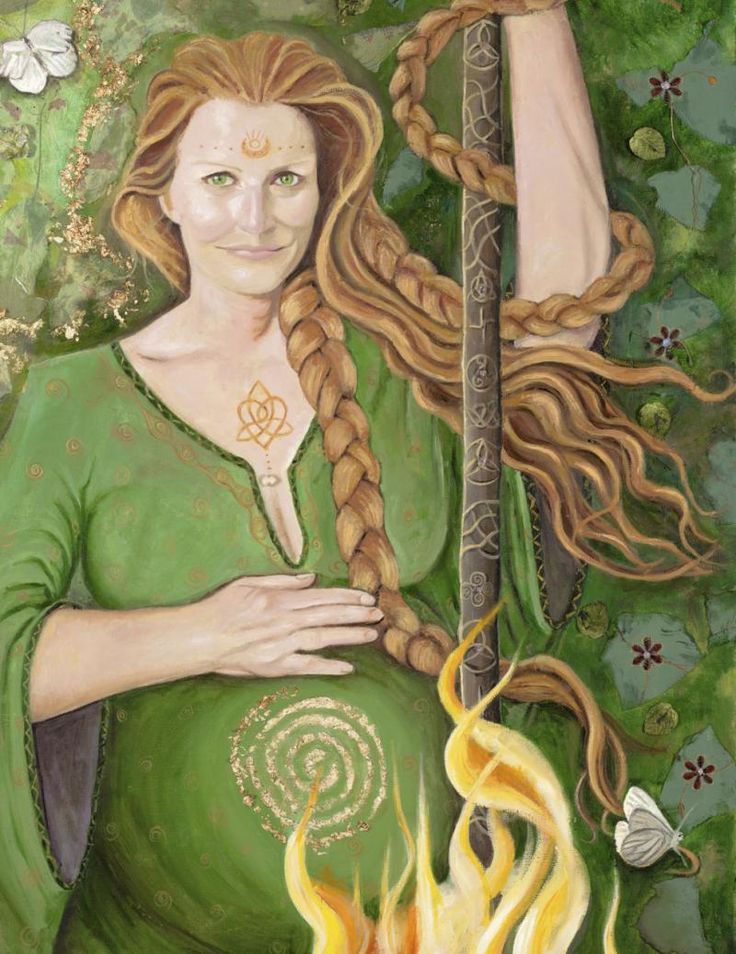
Brigid by Jo Jayson

Brigid is considered a threshold person, one who can straddle both sides and remain detached. This quality, which is central in her life, is highlighted in the stories of her birth, which attest that she was born on the threshold of the house, neither within nor without; that her father was a noble man, her mother a slave; and that he was a pagan, her mother a Christian. From her origins, she has this ability to stand in the void and remain centred within it, while holding the creative tension between two opposite perspectives. Many stories from her life portray her as a person capable of resolving conflicts in a healthy manner. Being centred and aligned within herself, she is detached and can grasp the energies of both sides clearly thereby facilitating a resolution. She has the ability to stand still and remain focused, in spite of the uncertainty present in the outer world.

As a child and a young woman Brigid constantly challenged the accepted norms of her society, especially those expressed by her father when they opposed to her own values. This reflects Brigid as a person who lives her life from a place of deep inner knowing and inner authority.

She also refused to marry any of the suitors that her father arranged for her, because she had chosen a different life path and destiny. She would not compromise her soul journey!

Brigid’s generosity is legendary and is related in numerous stories of her giving away food and clothes to people who came to her monastery or whom she met along the way. This generosity was, it seems, based on her absolute faith in the abundance of the universe to provide all that was needed in each moment. Each time she gave away the butter or meat needed for the next meal it miraculously reappeared in time for that meal!

Brigid’s capacity to bring forth new life, to nourish, to create plenty in the crops or an abundance of the milk from cows, and to manifest or create ex nihilo is a reflection of the true abundance and with the prosperity of the society, living in relationship with the land , created by her. Her life and work thrived because of her deep trust and an absence of fear.

It is said that from the moment Brigid learned to know God her mind remained ever focused on God. She remained connected to God and the heavens while living on the earthly plane. Her power of manifestation was a result of this ability to be aligned heaven to earth. The strong connection between her inner and outer worlds allowed her to focus her energy onto a particular intention and ensure its manifestation.

The story how Brigid got the land for her monastery in Kildare is a wonderful example of her ability to manifest what is needed. She states clearly what she needs and asks the local lord for land. First he refused but she is not deterred by this. She pursues her request in a different way by asking “Give me what land my mantle will cover.” He says yes! When she placed the mantle on the ground it grew until it covered enough land for the monastery .This reflects a woman who can hold her intention clearly, even when on the surface it seems that her request will not be met!!

These inspiring stories of Brigid relate to her active life in the world, where she embodies and live true spiritual power!
But what and where is the source of this power?

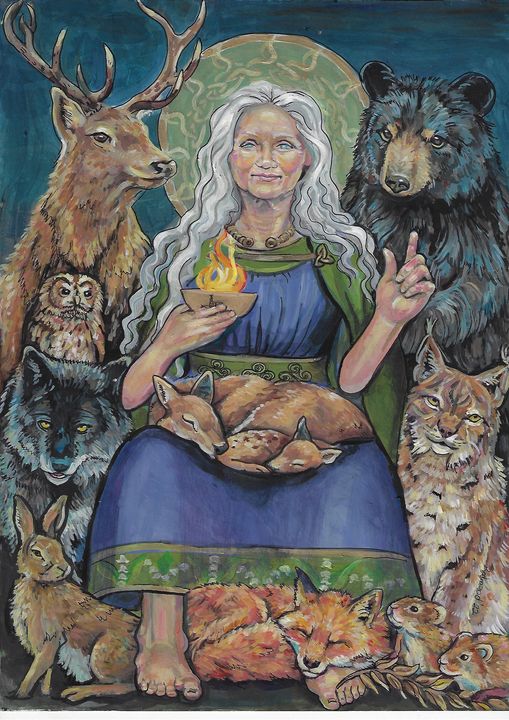
To fully understand the power and the qualities that Brigid embodied, as reflected in the many stories about her life, we need to begin with an exploration of the role of Brigid as Cailleach, the aspect of the Divine Feminine that rules during the season of Samhain (winter) at the beginning of the Celtic year. This I believe is the wellspring from which Brigid’s power manifests in the world emerges.

What then is the energy associated with the hag, crone, or cailleach aspect of the divine feminine? The cailleach is the embodiment of the tough mother-love that challenges its children to stop acting in destructive ways. It is the energy that refuses to indulge in inappropriate personal or societal dreams. It is the energy that will bring death to those dreams and fantasies that are not aligned with our highest good. Yet, this cailleach energy also will support the emergence and manifestation in the world of the highest and deepest within us. It will hold us safely as we embrace the darkness within ourselves and our society. It is an energy that insists that we stand still, open our hearts, and feel our own pain and the pain of the earth. This is the energy that teaches us how to stay with the process when things are difficult. This energy will not allow us to run away!

Her way of being is a slow, inwardly focused way, with minimum outward activity: a way that values times of active waiting that pays attention and allows life to unfold.

An essential part of the journey that all the great heroes and heroines in world mythologies undertake includes facing and embracing the energy of surrender, darkness, and death. The hero or heroine learns the next step required in their outer world journey only by submitting to and being initiated into the dark world of the cailleach.

Through this initiation the mature masculine power can emerge and lead each one to find their true path. When this happens the action that follows will be in the service of the true feminine and bring forth wisdom and compassion creating new life, vitality, and sustainability. However because western society is currently dominated by the young masculine energy, present in both men and women, characterised by its “can do” attitude, there is an urgent need for each of us to make this heroic journey with the cailleach, so that we will become agents for the transformation of our society.
Brigid: Midwife for a Planetary Rebirth

by Dolores Whelan

Reflecting on the turmoil present in the world today it is clear to all, but those steeped in denial, that all is not well. It seems that something ails us humans; something that causes us to live in ways that disrespect our mother, the living earth, and all our relatives. We ask what is it in us humans that creates such a restless world where there is little sense of belonging, nurture or home and which causes so many of the species with which we share this planet to suffer?

The exclusion of the Feminine energy in our naming and understanding of the Divine is reflected in a corresponding absence and valuing of feminine energy in all aspects of life in western society. The devaluing and exclusion of the feminine energy over the past centuries has created a distorted story about life which has resulted in a world whose shape and vibration create disharmony.

So how do we find our way back to a more harmonious way of life? If we know what is missing and what ails us, it may be possible for us to make the journey back towards wholeness and health.

In times of great danger and challenges, cultures often seek the wisdom for the journey ahead in the stories and myths that sustained them in an earlier time. However as Poet Nuala Ni Dhomhnail suggests this requires an understanding that “actual myths and stories themselves soar way above any uses to which they may have been put to already and can and must be retranslated by each generation in terms of their own need and thus liberated into a new consciousness.” (1)

At the present time there is a wonderful re-emergence of aspects of ancient spiritual traditions by people all over the world. The reconnection and embodiment of these ancient spiritual traditions, myths and stories has the potential to release the spiritual power needed for us to become agents of transformation within our society.

At this time many people are becoming aware of the wisdom of the feminine. As this happens, the absence of genuine feminine energy present in most institutions, both religious and secular, throughout western culture, becomes obvious. To include the presence of the divine feminine energy in creating a world whose shape is more wholesome requires a fundamental reclaiming of the essential role of the feminine in all aspects of life. In order to create change within the physical world and in our society it is necessary to change the dreams and stories held within the imagination of a society.

My own journey over the past 25years has been primarily within the Celtic spiritual tradition. This tradition has emerged over many millennia and continues to evolve. It includes the wisdom of the megalithic, the pre-Christian Celtic and the Christian Celtic traditions as they met and engaged with each other through the ages. I believe the rekindling of the flames of this tradition, which have lain dormant for many centuries, “like coals under the smooring awaiting a new kindling” holds a key to the recovery of the wisdom needed to create a more sane society.

“God is good and he has a great mother!” a statement sometimes heard in Ireland, reflects an important truth at the heart of the Celtic spiritual tradition, one that honours the presence of the divine feminine and understands that even God emerges out of the feminine energy of being-ness. The Divine Feminine is present at the heart of this spiritual tradition and plays a central role in both Celtic spirituality and Celtic culture. There are many goddesses within Celtic mythology; however Brigid, as both goddess and saint, occupies a central place as representative of the Divine Feminine within Celtic tradition.

Reconnecting with and re-membering the spirit and archetypal energy of Brigid, in both her Goddess and saint manifestations, is an essential task of this renaissance. Brigid, although normally associated with the maiden and mother aspects of feminine energy, is also expressed in the cailleach form, as indicated in the prayer “Molamid Brid an mhaighean; Molamid Brid an mhathair; Molamid Brid an cailleach” (Praise to Brigid, the maiden, the mother, and the crone).

These three different, but related manifestations, the maiden, the mother, and the cailleach, or crone, together create a divine feminine trinity. Each aspect of this trinity occupies a different role within the life, death, and rebirth continuum. The Feminine energy is both the harbinger and the birther of new life and is the destroyer of life that has been spent. It is experienced at the thresholds of life and death and rebirth.

In the past 20 years there has been a new awakening of the importance of Brigid and her place within our lives and our world. Her Feastday at Imbolc in now celebrated in many places in Ireland and all over the world. There is an understanding perhaps it is time for us individually and collectively to recover the qualities that Brigid embodied in her lifetime, marking her as a woman of true spiritual power.

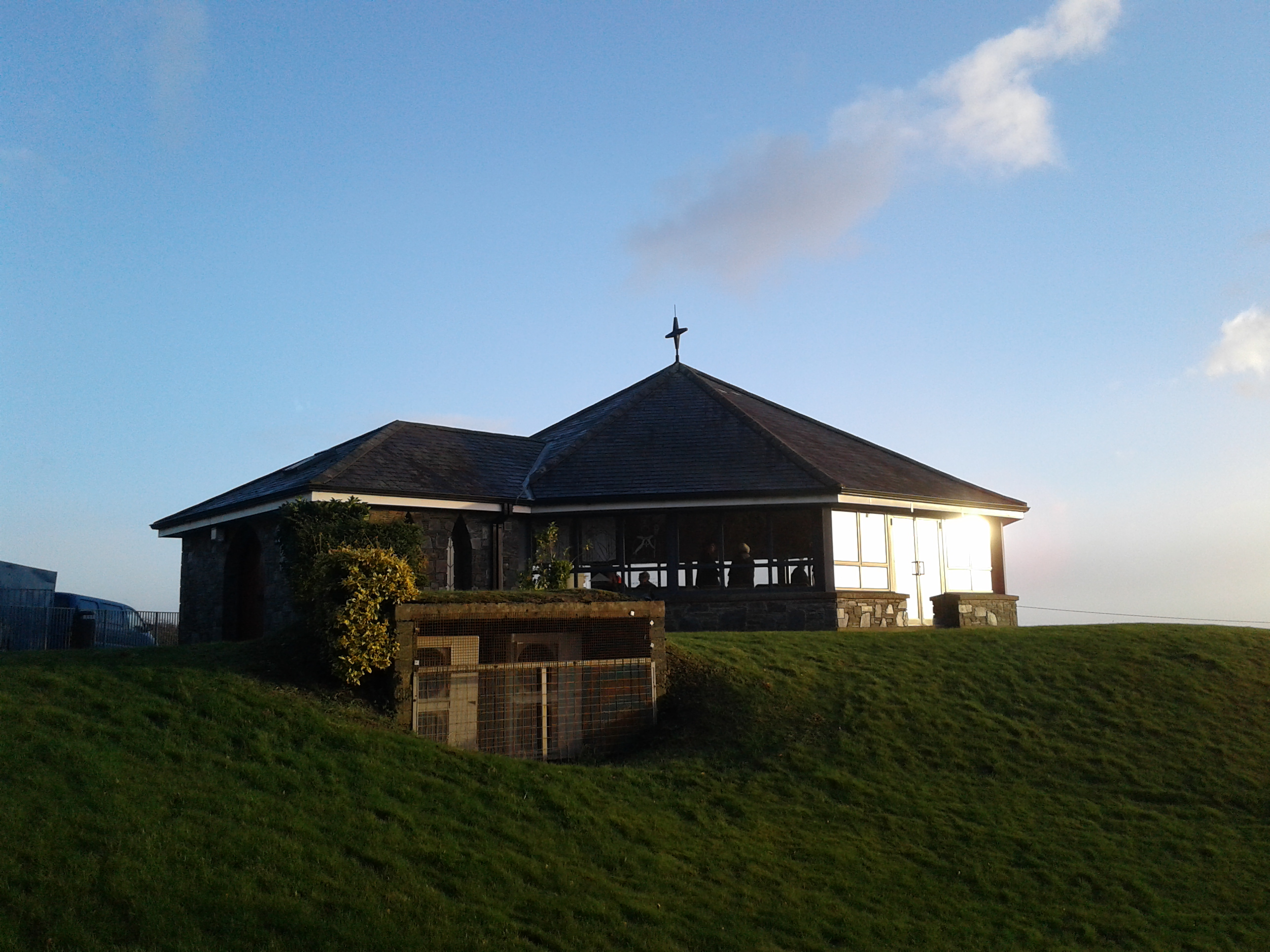
Below: The Shrine of Brigid in Faughart , Ireland , believed to be the birthplace of Brigid of Kildare( Photo, February 1, 2018)

Brigid and Spring Equinox

In mid-morning of March 21st, we walk from our hotel to the garden where we sat with Brigid on our first visit. She is here already, seated beside the pool of water, expecting us. Her smile warms the air of this spring day, this day of equinox. Following her lead, we too breathe in the fragrance of earth, of violets, daffodils, foxglove, and trees whose young leaves are ready to burst outwards.

With a gesture of welcome, Brigid invites us to sit near her where the early grass softens the earth beside the pool.
“Today we need to speak of the equinox,” Brigid begins. “Do you know its meaning?”

A few of us exchange glances. Every child knows what equinox means, and yet Brigid waits, expecting a response.“It means that day and night are of equal length after the short days and long dark nights of winter,” one of us responds, politely.

Brigid smiles. I have the uncomfortable feeling that she knows exactly what we are thinking. “That’s a good answer, as far it goes,” she says now. “But did you not understand our last conversation? You and I and all that lives upon our beautiful planet are part of her. Our lives, our bodies, our souls, our spirits are one with her rhythms, her seasons. Since this is so, what meaning does equinox hold for us?”

“Is it about balance?” someone ventures.

At this, Brigid smiles. Mischievously, I think. “Balance, yes. But balance of what?”

“Light and darkness,” I say, growing increasingly uncomfortable as I wonder what Brigid is up to, if she is playing with us, trying to trip us up in our knowledge of the earth.Spurred by this thought, I rush on, “it is the balance of light and darkness that shows us that spring is coming. Longer days mean that the earth will soon be bursting with new life. And also,” I add this with some pride as I have only just learned it myself, “it is the increase in daylight that draws the birds back from the south.”

But Brigid appears unimpressed. “I don’t think you really understand about the equinox. You are describing what you see around you. My question is about what is happening within you.”

Suddenly a fox emerges from the bushes beyond the garden. It walks with soft steps, unswervingly, towards Brigid. Though her back is to the fox, though she could not possibly see the delicate animal, Brigid stretches her hand towards the fox, calling out, “Come, my friend. Meet some people who have a great deal to learn.”download

We who were frozen in fear at the appearance of the fox, watch now in amazement as the small animal comes to sit, composed, peaceful, at Brigid’s feet.

“Your Celtic ancestors,” Brigid continues, as she strokes the fox’s fur with her hand, “like indigenous peoples everywhere, experienced time as circular. They danced to its rhythm: night gave birth to dawn and day blossomed before it waned into evening, back into night.

“Our ancestors watched the cycles of the moon, the turning of the tides. The women noticed how the rhythms of their own bodies, their regular times of bleeding, followed the moon’s rhythms. No wonder they felt at home in the universe, embraced by the earth.

“Because they saw their lives as part of the great cycle of life, the Celtic people created a calendar that marked the seasons of the year, dividing the year into two major parts related to the sun’s light: giamos and samos. They celebrated eight festivals that were about 45 days apart.

Because they understood that it is darkness that gives birth to light, their year opened with the Festival of Samhain, November 1st, where the dark days begin. These are the days of inwardness, receptivity, the time that came to be known as feminine. Here the pace slows, linear time recedes, the intuitive is honoured over the rational. With the Festival of Bealtaine, on May 1st, the bright masculine sun days begin, the samos time of outer activity when the seeds nourished through the dark days blossom into new life. The linear, analytic, rational way dominates once again.

“ In the Celtic Calendar, the Spring Equinox occurs halfway between the Winter and Summer Solstices. It is the festival just before Bealtaine, when the feminine season ends, and the masculine begins.

“Now can you see a deeper meaning for the equinox? It is an invitation to find a new balance within our lives, within our cultures and throughout the planet, of these masculine and feminine energies that so often are in opposition. It is a time to choose how we shall hold the values of the dark time of the goddess even as the bright active masculine takes over in our lives.

“How will you choose to honour the feminine intuitive gifts of the moon time in the days when the sun calls forth your logical, rational gifts? Will you make a space in these busier days for quiet reflection, for remembering your winter dreams, for poetry, music, drawing, dance or whatever nourishes your inward life? Will you seek a finer balance of work and recreation, of times with family and friends as well as times of solitude? Will you consider how the dance of opposites in your own life might flow in rhythm, even as it does in the Celtic Calendar?

“These are important questions, dear friends. I hope you will consider them in the time until we meet here again.

“If we could enter into the ancient ones’ understanding of time, the rhythms of our lives would take on sacred meaning. Our times of inner darkness would hold the promise of a dawn of new joy. Our losses would be seen as invitations to embrace other gifts, our death as birth into a new as yet unimagined life.”

And with those words, Brigid is gone, her fox companion with her!
We are left here by the pool, thinking, wondering.