Tag Archives: faith

Mary, Mother of Jesus, Who Are You?

Advent Four December 2025
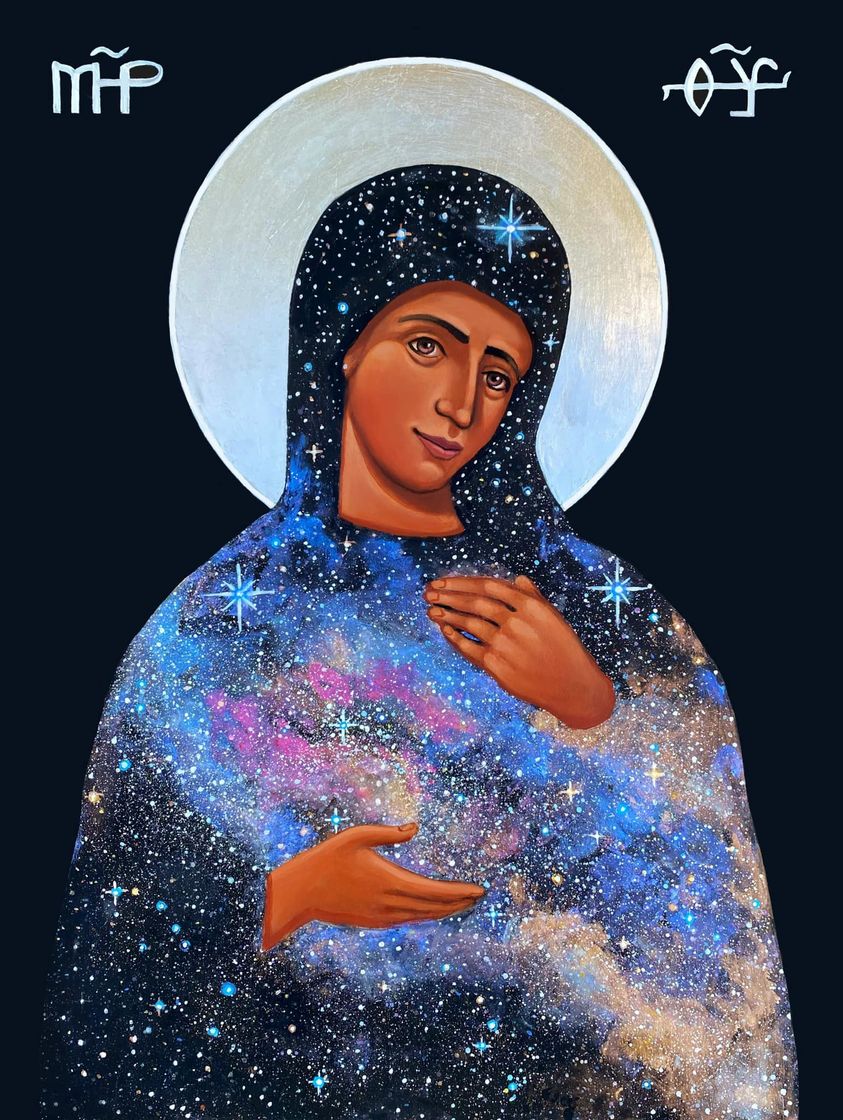
If you grew up Catholic in the years before the Second Vatican Council, chances are Mary was at the very heart of your faith. You prayed the “Hail Mary” many times daily; you sang hymns to Mary as you walked in May processions carrying flowers to decorate her statue; in every trouble and doubt, in every dark moment of your own life, you turned to her as to a mother whose love for you was unconditional. You probably knew by heart the “Memorare”, a prayer to Mary that says, in part, “Remember…Mary, that never was it known that anyone who fled to your protection, implored your help or sought your intercession was left unaided…”

At the call of Pope John 23rd, 2600 Roman Catholic Bishops gathered in Rome for the Second Vatican Council in the mid-1960’s. Believing they were restoring a balance, they invited Mary to step from her throne, and guided her gently to a place among the faithful, the followers of her son, Jesus. The “excesses” of Marian devotion were curbed… and then what happened?

Over the past sixty years since the closing of the Vatican Council, we have seen a burgeoning of interest in the “Sacred Feminine”; a recovery of ancient stories of the Goddess; archaeological finds that create renewed interest in the time when the Sacred One was honoured as a woman; an explosion of writing among theologians, historians, cultural storytellers, seeking to understand the power and presence of “Mary” in the Christian story. I will cite a few here: The Virgin by Geoffrey Ashe; Missing Mary by Charlene Spretnak; Untie the Strong Woman by Clarissa Pinkola Estes and Truly Our Sister by Elizabeth Johnson.

Though I am no theologian, I have a consuming interest in the many aspects of this mystery. What I glimpse is this: the human heart longs for a divine mothering presence. Ancient cultures honoured a feminine divine who over millennia was called by many names: Isis in Egypt; Inanna in Sumeria; Ishtar in Babylon; Athena, Hera and Demeter in Greece, Anu or Danu among the ancient Celts; Durga, Kali and Lakshmi in India; for the Kabbalists, Shekinah; for the gnostics, Sophia or Divine Wisdom. Christianity had no “Mother God” to put in the place of the Goddesses whose worship it was determined to eradicate. Geoffrey Ashe’s theory is that Mary’s gradual ascension in Christianity was not an initiative of Church Leadership, but rather a response to the hunger of the early Christians for a sacred feminine presence.

Mary became for us an opening to a loving feminine sacred presence. Or, put another way, a loving sacred feminine presence responded to the cries of her people when they called her “Mary”, just as that presence had responded over the millennia to other names cried out in love or sorrow or desperate need.

Over these darkening days as we descend to the longest night of the year at the Winter Solstice, Mary will be our companion. We reflect on her pregnancy, her waiting, her uncertainty, the doubts of those who love her, the trust that sustains her “while she opens deeper into the ripple in her womb…”

This is profound mystery. For Mary. For each one of us who carries the Holy within us, seeking a place of birth. We walk the dark road, with Mary, in trust.

We walk companioned by one who knows our struggles to maintain our trust in the face of inner doubts and outer calamity. We walk with one who loves us and encourages us until we are ready to welcome “the day which will be born from the womb of this present darkness.”

What mystery is “Coming Ashore” inside you?

Richard and Julian

Faith is the comfort of not needing to know” ( Richard Rohr)

Somewhat unsteadily, using a cane for support, Richard Rohr walked across the stage at the University of Notre Dame, settled into the armchair across from the interviewer. He gazed into the darkness where the packed auditorium of listeners awaited his words in silence. It was Rohr’s first public talk since Covid created a cocoon around our lives.

(Note; The talk referred to here ,“Christianity and the Re-emergence of the Non-dual Mind” is available for viewing on YOUTUBE)

Gentle, smiling, often self-deprecating, this elderly, grandfather-like figure cut to the heart of our 21st century reality. Holding it in the light of the Gospel, particularly the Beatitudes, Rohr showed us that in our eagerness for clarity, our fear of uncertainty, we’re caught in dualities.

“If you don’t understand non-dual thinking, everything slips into liberal of conservative”. Instead of clinging to our own way of thinking as the only right way, Rohr advises “let the whole horizon of reality all come towards you.”

We still haven’t grasped the message of Jesus, haven’t accepted that wisdom lies in that hazy place where we are at peace with not knowing, “Faith is the comfort of not needing to know.” The mystics of the early centuries of Christianity accepted, embraced this unknowing in contemplative presence.

Rohr’s own presence, that smile, that shake of the head at absurdity, was puzzled, a little sad….

He drew a paper from his pocket, unfolded it, began to read a poem to us, translated from Symeon, a tenth century theologian.

We awaken in Christ’s body

As Christ awakens our bodies,

and my poor hand is Christ, He enters

my foot, and is infinitely me.

I move my hand, and wonderfully

my hand becomes Christ, becomes all of Him

(for God is indivisibly

whole, seamless in His Godhead).

I move my foot, and at once

He appears like a flash of lightning.

Do my words seem blasphemous?–Then

open your heart to Him

and let your heart receive the one

who is opening to you so deeply.

For if we genuinely love Him,

we wake up inside Christ’s body

where all our body, all over

every most hidden part of it,

is realized in joy as Him,

and He makes, utterly, real,

and everything that is hurt, everything

that seemed to us dark, harsh, shameful,

maimed, ugly, irreparably

damaged, is in Him transformed

and recognized as whole, as lovely,

and radiant in His light

we awaken as the Beloved

in every last part of our body.

(I found the full poem in The Enlightened Heart, an anthology of poetry edited by Stephen Mitchell, Harper Perennial, 1993)

As the interview was drawing to a close, Rohr was asked, “How would you want to be remembered?”

“I’m about life.” Rohr replied. “It’s not about me. God allowed me to do everything wrong so God could do everything right…through me…in spite of me….it’s all mercy, within mercy, within mercy.”

What words would Rohr send in a text message to the world? “In the end it will be good.”

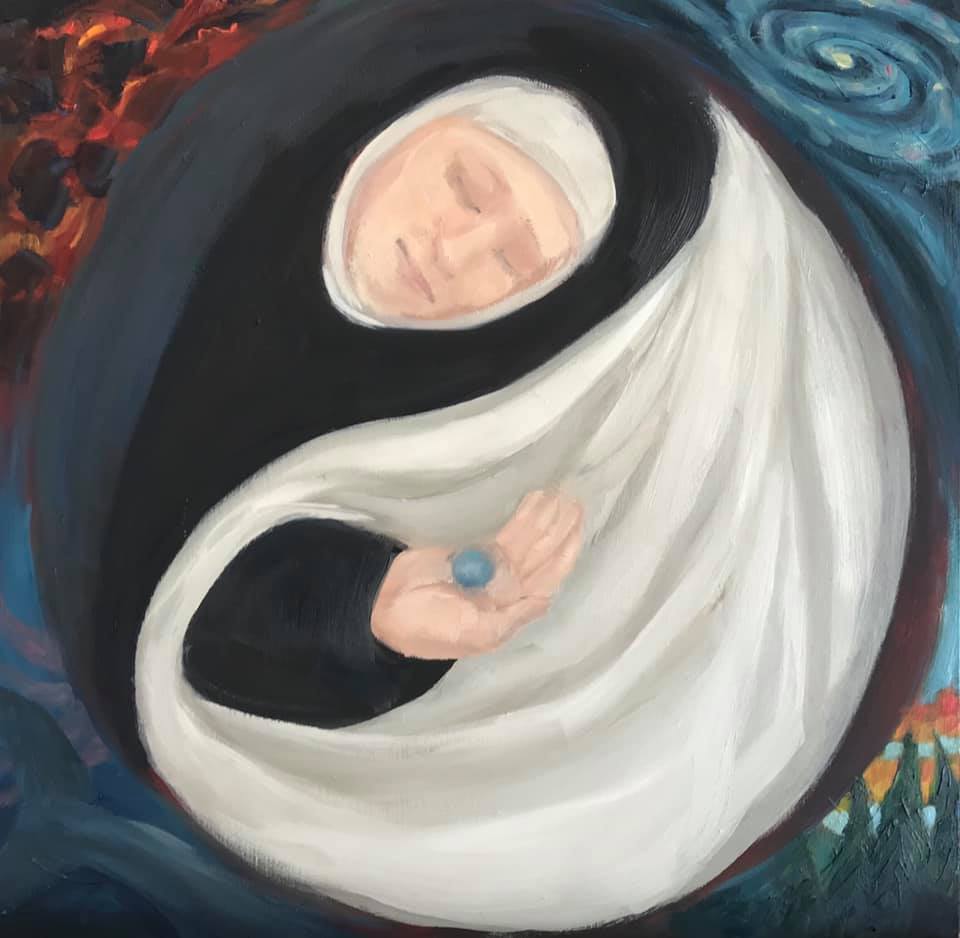
Painting of Julian of Norwich by Jane Joyner

I write this on the Feast Day of Julian of Norwich, the fourteenth century mystic who lived through three outbreaks of Black Plague, which reduced the population of England by one-half, the violence of the Peasant’s Revolt and the Western Schism which brought chaos to all of Christendom. Yet her writings are a distant echo of Rohr’s words about mercy, about all being well in the end. In her book, Revelations of Divine Love, Julian records her conversations with the risen Jesus which took place in a night of visions following her near-death experience at the age of thirty.

Acknowledging to Julian that, indeed, sin is everywhere, Christ assures her that “All shall be well, and all will be well, and you shall see for yourself that all manner of thing shall be well.” In the two decades of reflection that followed these visions, Julian came to trust that the meaning of this message was that everyone would be saved.

Julian too was texting to the world: “In the end it will be good.”

Today, on Julian’s Feast Day in the Anglican Calendar, I wondered what Julian herself would most want us to remember from her many teachings. Asking for her guidance, I combed through her Revelations of Divine Love seeking passages that seem most important to our lives, to our calling in these times when hope seems out of reach…

(All of the selections are from the Long Text of Julian’s Revelations in Showings, Colledge & Walsh translation, Paulist Press, New York, Toronto, 1978.)

The first passage is stunning in its intimacy and tenderness:

I saw that (Jesus) is to us everything which is good and comforting for our help. He is our clothing who wraps and enfolds us for love, embraces us and shelters us, surrounds us for his love, which is so tender that he may never desert us. And so in this sight I saw that he is everything which is good, as I understand. (Fifth Chapter)

The second continues the theme of intimate nearness, inviting us to respond in like manner:

For as the body is clad in the cloth, and the flesh in the skin, and the bones in the flesh, and the heart in the trunk, so are we, soul and body, clad and enclosed in the goodness of God. Yes, and more closely, for all these vanish and waste away; the goodness of God is always complete, and closer to us beyond any comparison. (Sixth Chapter)

And the third choice: He did not say: “You will not be troubled, you will not be belaboured, you will not be disquieted”; but he said: “You will not be overcome.” God wants us to pay attention to these words, and always to be strong in faithful trust, in well-being and in woe, for he loves us and delights in us, and so he wishes us to love him and delight in him, and trust greatly in him, and all will be well. (Sixty-Eighth Chapter)

(Reflections on Julian of Norwich to be continued…..)