

I long for You so much
I follow barefoot Your frozen tracks
That are high in the mountains
That I know are years old.
I long for You so much
I have even begun to travel
Where I have never been before.
(Hafiz The Subject Tonight Is Love trans. Daniel Ladinsky)
Twelve years ago, I began posting on “Sophiawakens.” I felt drawn to make the Sacred Feminine Presence better known, even as She was Herself rising in the hearts of women and men who are longing for Her. My journey has led me through moments of deep joy, though awareness of being held in love, through clear guidance when the path seemed to vanish. There have been times of emptiness, doubt, and darkness when all I could do was cling blindly to memories of light and love, to my deep longing to find Sophia within me.
This morning, I was surprised by an unexpected call: to return to the beginning of my journey, to find memories to offer to you, who may be on a similar journey, seeking Sophia, aware of our need for Her guidance, Her love, Her wisdom as we wander in a time and place like the garden of Briar Rose, overgrown with thorn trees so that no way lies open.
When we set out in search of Sophia, the missing feminine aspect of the Holy, we prepare for a long journey, following tracks that are millennia old. We learn to be adept at time travel, exploring deep dusty caverns of pre-history, unravelling, reweaving, threads of ancient stories.
Sophia is nowhere precisely, yet everywhere subtly. Mythologies of many cultures abound with tales of her presence, her power, her sufferings, her admonishments. Old fairy tales hold glimpses of her that are both tender and terrifying. We will need to look into sacred wells, old ritual sites, ruined temples and sanctuaries. We will carefully examine fragments of poetry, shards of pottery, pieces of drums, tiny perfect feminine figures carved of stone, buried in the depths of the earth.
We are living today in the time of the great recovery. What has been hidden is being revealed to us. Scholars of ancient civilizations are writing of their findings: the traces of a sacred feminine presence within the stories, myths and ritual practices of people long vanished.
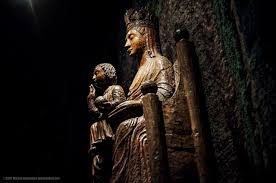
The Black Madonna. Chartres Catherdral, France
In A Brief History of The Celts, Peter Berresford Ellis writes of the Great Mother Goddess of the Ancient Celts, revealing the connection between the Celtic Goddess and the great rivers of Ireland, a sacred connection also found in India’s mythology:
“… the Celts believed their origins lay with the mother goddess Danu, ‘divine waters from heaven’. She fell from heaven and her waters created the Danuvius (Danube), having watered the sacred oak tree Bile. From there sprang the pantheon of the gods who are known as the Tuatha de Danaan (Children of Danu) in Irish and the Children of Don in Welsh myths.” (p. 162)
“The story associated with the Danuvius, which is arguably the first great Celtic sacred river, has similarities with myths about the Boyne, from the goddess Boann, and the Shannon, from the goddess Sionan in Ireland. More important, it bears a close resemblance to the Hindu goddess Ganga, deity of the Ganges. Both Celts and Hindus worshipped in the sacred rivers and made votive offerings there. In the Vedic myth of Danu, who exists as a deity in Hindu Mythology as well, the goddess appears in the famous Deluge story called “The Churning of the Ocean.” (p.7)
Celtic writer Jen Delyth writes of the goddess Anu, also known as Danu and Aine: “An ancient figure, venerated under many names, she is known as the womb of life. She is the spark and vitality of life. She is the seed of the sun in our veins. The Great Earth Mother is more ancient than the god of the Celtic Druids. She is the Mother whose breasts are the Paps of Anu in Ireland. Her hair is the wild waves, the golden corn. Her eyes are the shining stars, her belly the round tors or earth barrows from which we are born. Like the cat, the sow, the owl, she eats her young if they are sick or dying. She is the cycle of life, the turning of the seasons.”
In rivers, waves, and corn, in stars and earth barrows, in the very seasons of our land, this sacred presence is embodied, immersed, implanted in the universe, around, above, within us.
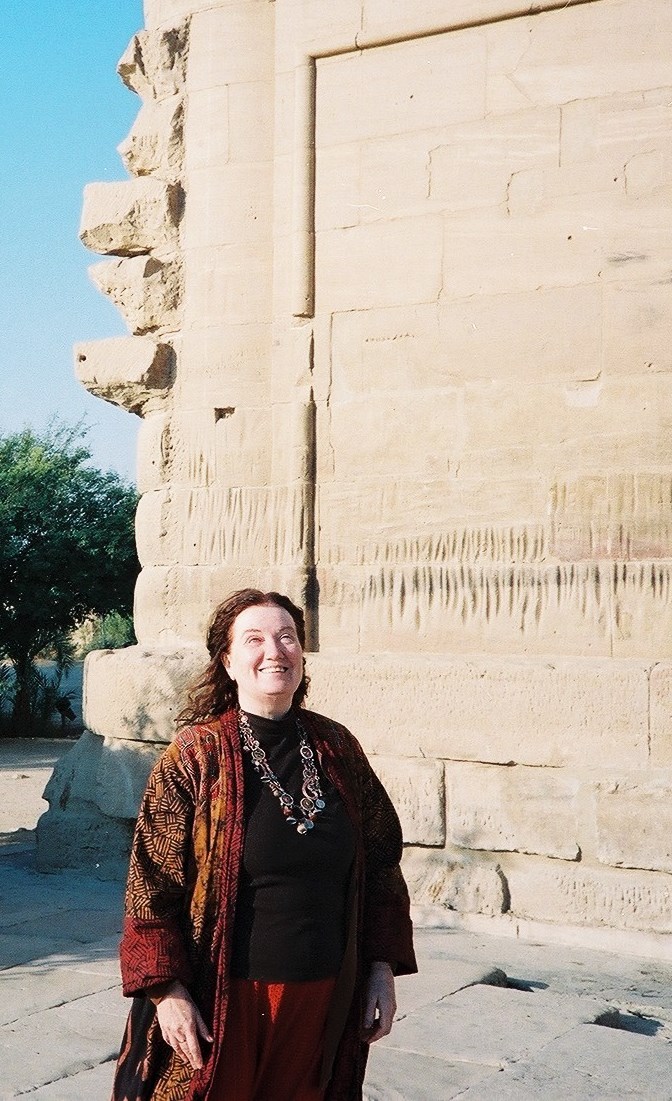
I cherish a memory from my own search for Sophia. It is predawn, November 13, 2008, during the journey I made to Egypt with a group led by Jean Houston. We are gathered in the tiny sanctuary sacred to the goddess Isis on the Island of Philae in the Nile River. Jean is reading something about Isis, a series of sacred names. The writing is from “The Golden Ass’’ written by Apuleius, a first or second century Roman, not a Christian. In the story, an unskilled magician named Lucius has accidentally turned himself into a donkey. In despair, he cries out to the Goddess Isis for help.
The Sacred One identifies herself to Lucius with these words:
“I, the natural mother of all life, the mistress of the elements, the first child of time, the supreme divinity…. I, whose single godhead is venerated all over the earth under manifold forms, varying rites, and changing names…. Behold, I am come to you in your calamity. I am come with solace and aid. Away then with tears. Cease to moan. Send sorrow packing. Soon through my providence shall the sun of your salvation rise. Hearken therefore with care unto what I bid. Eternal religion has dedicated to me the day which will be born from the womb of this present darkness.
After that reading in the Isis sanctuary, we were asked to call out all the names by which we have known the Sacred Feminine. I remember hearing voice after voice calling out wonderful names. Many of those names were familiar to me, titles I’d learned as a child, and they referred to Mary. Mystical Rose. Tower of Ivory. Gate of Heaven. I hear now in memory my own voice call out: “Star of the Sea.” I hear Jean’s voice, strong, certain: “Mary in all her forms.”
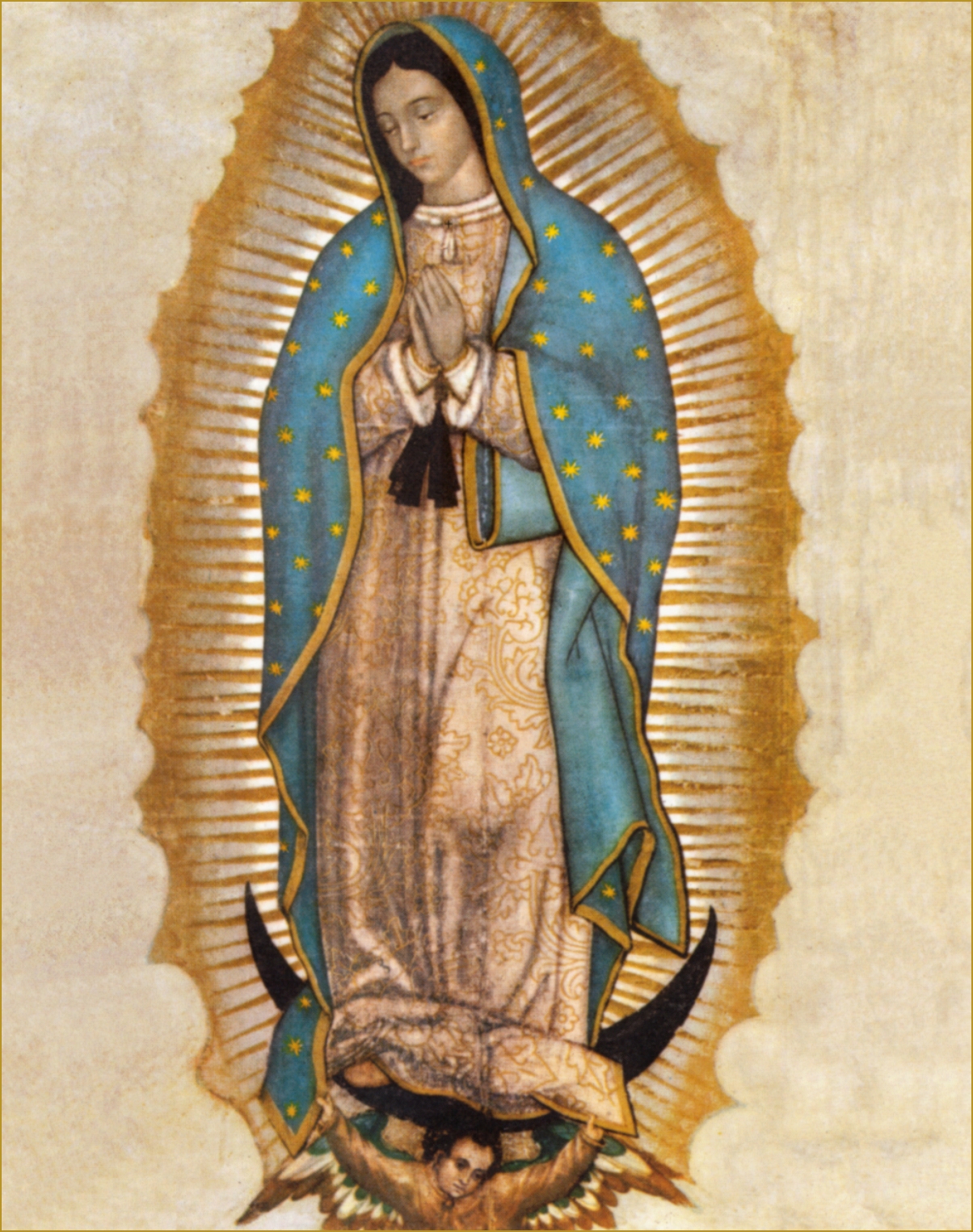
Our Lady of Guadalupe
As our group emerges from the Sanctuary, our Egyptian guide is waiting, looking distressed, apologetic: “I am sorry. I made a mistake. I never should have allowed your whole group to go inside at the same time. The sanctuary is too small to hold so many.”
Yet we had all found room for joy.
In Women of the Celts, Jean Markale offers an overview of the decline of the Sacred Feminine presence as the Jewish/Christian religions became dominant, but he also hints at how her presence survives: “Within the patriarchal framework (goddesses) were often obscured, tarnished and deformed, and submerged into the depth of the unconscious. But they do still exist, if only in dormant state, and sometimes rise triumphantly to rock the supposedly immovable foundations of masculine society. The triumph of Yahweh and Christ was believed sanctified forever, but from behind them reappears the disturbing and desirable figure of the Virgin Mary with her unexpected names: Our Lady of the Water, Our Lady of the Nettles, Our Lady of the Briars, Our Lady of the Mounds, Our Lady of the Pines. But in spite of the veneration accorded her over the centuries and the public declaration of successive dogmas related to Mary, the authorities of the Christian Church have always made her a secondary character, overshadowed and retiring, a model of what women ought to be. Now the pure and virginal servant of man, the wonderful mother who suffers all heroically, she is no longer the Great Goddess before whom the common herd of men would tremble, but Our Lady of the Night.”
Such an appropriate name for the presence we seek, the One who has so many different names… yet is being rebirthed now in our time, from the “womb of this present darkness”.
The pathways we follow in our search for her may seem arduous, but the starting place is deep within our souls. As Hafiz hints in his poem, the search begins with our longing for her.
(Photo) Anne Kathleen on Philae Island November 13, 2008
 sophiawakens
Dear Anne Kathleen, So glad you are doing this again and I have now read through it three times, and how wonderful and inspiring! Your creative energy of Light and Hope and Universal Love itself is still inspiring the world, me included! Love and Blessings and deep gratitude, Brenda
LikeLike