All posts by amclaughlin2014

Member of Community of Grey Sisters of Pembroke; Masters Degree in Religious Communication, Loyola University, Chicago; Author: Called to Egypt on the Back of the Wind (2013) Planted in the Sky (2006) both published by Borealis Press, Ottawa Canada www.borealispress.com Retreat facilitator: The Wooing of the Soul (2013) The Sophia Salons, beginning in February 2016, offer journeys to one's own inner wisdom for small groups of women. For information: amclaughlin@sympatico.ca

The Greece Journey Part Two : Delphi: Temple of Apollo and Pythia

We begin our climb upwards from the Tholos of Athena towards the Temple of Apollo. The way is winding, a graduated path, smooth, making only gentle demands on our knees. We have breath enough as we climb to engage in conversation with our companions, to share our thoughts, our experiences while we were gathered around the Tholos.

Above, and across the road lies the Kastalian Spring:
Here, where the great cliffs form a chasm, both pilgrims and the priesthood gathered to purify themselves in preparation for entering the great temple.(“The Traveler’s Key to Ancient Greece“)

delgoi_kastalia_pigi_tx

These Kastalian waters were said to confer inspiration and were connected with the Muses. In late Roman times the Muses were named and assigned this way:

Calliope (fair face) Epic song
Clio (proclaimer) History
Euterpe (gentle rejoicing or delight) Lyric song
Thalia (festive) Comedy
Melpomene (honey-sweet song) Tragedy
Terpsichore (rejoicing or delighting in the dance) Dance
Erato (passionate) Erotic poetry
Polyhymnia (rich in hymns) Sacred songs
Urania (the starry heavens) Astronomy

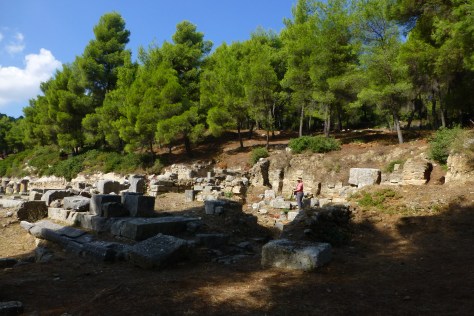
We continue upwards along the Sacred Way, its flights of stone steps challenging. The Sanctuary of Apollo once contained temples, rich treasures brought here as gifts from many cities and individuals, hundreds of statues. Today we pass ruins, weathered stone, holding only the memory of wealth.

The Temple of Apollo was composed of an outer and inner chamber. On the outer walls were inscribed sayings of the Seven Sages, intended to inspire those who came seeking answers, to prepare themselves for their meeting with the Pythia. For the prophetess awaited them in the inner sanctum.

Delphi Temple of Apollo

Here the Pythia sat beside a stone known as the omphalos, the center of the world. She held an umbilicus tied to the omphalos. She was seated on a tripod placed over a chasm in the earth from which vapors arose. She waved a branch of laurel and entered into an altered state – enthousiasmos – in which she uttered prophecies. The priests who attended her recorded and “translated” her words into Homeric verse. This formal procedure for the functioning of the oracle acquired its final form in the 6th century BCE. remaining unchanged until the reign of the Roman emperor Hadrian, 2nd century AD.Delphi place where oracle was

area where the Pythia sat

If we feel some regret, some sadness, that we are nearly two millennia late for the experience, we have not yet understood the Quantum Powers of the Universe, nor learned what Jean Houston has been teaching us on this journey about the way these powers are available to us, bringing us the gift of time, past/present/future, in each sacred moment.

For here in this sacred place of the Pythia, Jean invites us to find places to sit on the fallen stones. We breathe deeply, close our eyes, come to stillness. We call upon the presence of the prophetess, trusting that her spirit is still available to us.

Jean invites us to present our questions to the Pythia. What guidance does she offer for our time? How may we move towards a planet of peace? Responses arise from within our hearts. Voices speak within our circle:

Peace will come as we open our third eye, the eye of wisdom, to recognize and honour the beauty, the light of the sacred presence, in one another.
This seeing will lead us along the path to peace.
The Pythias invites us to take time each day for deep listening to her voice, the voice of Wisdom… she will speak in and through us, offering guidance.
You who are reading this in the sacred space of your own home may also find yourselves seated imaginally among the fallen stones of the Temple of Apollo, near the earth’s omphalos. Here, you may breathe deeply, focus your heart, and call upon the wisdom that once spoke through the Pythia. What questions do you bring to her? What responses do you hear? Take time now to ask, to listen.

One more ancient structure catches our eye. It is an empty grotto-like space. It is very like the grottos created throughout the Christian world to honour Mary, often holding a statue of her. Once again, with a shiver of recognition, we see the continuation of the presence of the Sacred Feminine honoured through ages lost in memory, vanished before memory. Yet still present.

Delphi Grotto

Sophia Wisdom and Athena

Over recent weeks, we have been exploring the presence of Sophia in our lives, especially as she reveals herself in the Wisdom Literature of the Hebrew Scriptures. I believe there is a presence of sacred feminine energy that holds us in an embrace of love, cares profoundly and personally for each one of us and is willing to respond to any or all names with which we call to her. This is deep mystery, as well as a reflection of our human need to name what we experience.

I have just returned from a Journey to Greece, led by my teacher and mentor, Jean Houston. Now I am pondering expressions of this sacred feminine energy encountered in an ancient goddess culture, layered over with a patriarchal  culture that replaced most of the goddess power with masculine deities who were in turn layered over with the Christian Orthodox faith.

Here are notes from that journey:

Racing along the 401 highway towards the “Park ‘n Fly” at the Toronto Airport, heart in mouth, I think only of arriving in time to catch my flight to Athens. An hour later, moving through the press of travellers seeking the flight desk, I am startled by a heavily-accented voice that rises above the din: “This way to Athena. This way to Athena.”

Athena. Already the realm of the mythic is opening. The goddess herself will guide our journey. I recall words from Jean’s book, “The Hero and the Goddess” :

The realm of myth exists beyond time and space and daily reality. It is a symbolic world that dwells within us at levels deeper than our normal consciousness. And yet, it can be openly and vividly engaged in ways that expand the possibilities of every aspect of our lives. But to reach these depths and heights, we must pledge our commitment, our theatricality, our excitement. We must not bore the gods – or ourselves….(from the Preface)

We are travelling one hundred miles northwest from Athens towards Delphi. Our faithful driver Panagiotis (whose name means “holy one”) guides our elephantine bus along cliff edges with the confidence of a boy skirting puddles. The massive ancient mountain of Parnassus, more than a million years old, looms to our right, its rounded limestone bulk worn smooth by eons of weather. Looking downwards left across the valley that leads to the Gulf of Corinth, we see the great olive grove of more than a million trees. The olive tree was Athena’s gift to the people who named their city in her honour.

We are about to walk the Sacred Way, becoming one with the pilgrims who, for thousands of years, climbed to the Temple of Apollo in Delphi.

As was the case in most approaches to temples in Greece, the Sacred Way delivered the pilgrim to the gate of…sacred experience as though through a labyrinth, in this case a labyrinth which began down in the depths of the valley and wound upward through the Gate of Athena at Marmaria, through the underworld of the Kastalian Spring, and then into the sculpted and golden world of manifest divinity. (“The Traveler’s Key to Ancient Greece”)

Like those earlier pilgrims who approached from Athens, we arrive first at the Tholos of Athena, a reminder that before Apollo took over this site, it was the holy place of the Earth Mother, Gaia.

The position of the sanctuary symbolizes Athena’s role as the protector of the place…but also serves to restore certain aspects of the old Goddess’ power to the sacred landscape, to mitigate the change wrought by the violence of the Olympian assault. Athena’s power is symbolized by the snake, thus repairing at least part of Gaia’s power snatched by Apollo. (from “Sanctuaries of the Goddess”)

The late September sunlight sends a fiery blessing on us as we walk into the area of the Tholos, sacred to Athena. We see three great pillars supporting the massive stone ruin of the archway, the circle of fallen stones that are all that remain of her temple. At Jean’s invitation we find places to sit on the ancient rocks, seeking some hint of shade.

Greece 2015 021

the Tholos of Athena at Delphi

We settle into the realm of Athena, whom Homer praised as “the glorious goddess, bright-eyed, inventive, unbending of heart…” Athena is Jean’s guiding archetype. The “ever near” Athena adopted Jean to develop the goddess’ own qualities as the One who shapes civilizations, companioning those who take on the task of co-creating with the Sacred.

When we energetically and dramatically encounter this mythic realm and the beings who dwell there, we begin to understand that our individual lives – our personal stories – echo the events and truths of their lives and stories. We reflect these mythic beings and they reflect us. Experiencing this mutual recognition gives us access to more vigor and energy, a greater sense of joy and release, and an even deeper commitment to the unfolding planetary story. We begin living with the doors and windows of ordinary life wide open to the depth world.
(Jean Houston from the Preface to “The Hero and the Goddess” Quest Books, Wheaton, IL 1992, 2009)

Now we begin to engage this mythic realm and the beings who dwell there as Jean leads us in a meditation. We invite the godded beings of the Greek pantheon to offer their powers to us through each of the Chakras of our bodies.

Following the meditation we begin our climb towards the sanctuary of Apollo on Delphi, where we may encounter the spirit of the Oracle herself, the Pythia. We are leaving Athena’s Tholos when a sudden question sends me hurrying to catch up to our Greek guide, Calliope. “Kapi, you have told us that the Greek people of today honour above all the Sophia, Holy Wisdom. Do they see a connection between her and the goddess Athena?” I ask.

“Of course,” Kapi responds. “They see a continuation.”

At once many weeks of reflection on the Sophia (through Rabbi Rami Shapiro’s book ‘The Divine Feminine in Biblical Wisdom Literature”) become a river flowing from an ancient source, an unstoppable flow of wisdom and love, a promise fresh and ever-flowering, the Sophia, the “ever near” presence for which we long.

Wisdom Imaged in Nature

The ancient writers see in Wisdom’s flowing, all-pervasive presence an outpouring like rain or floodwaters:

Who knows the root of Her?
Who fathoms Her subtleties?
There is only one so wise and so wondrous – God!
He created Her and saw her true nature
God gave Her life and poured Her out
Upon all creation.
She is with you according to your ability to know Her;
For God has given Her to all who love Him.
(Wisdom of Jesus Ben Sirach 1: 6-10)

Of these wonderful images, Shapiro writes:

Wisdom is the way God lays out the foundation of creation….She is both the field and the rain that nurtures the field.
And just as rain falls on all, so too Wisdom. You do not deserve Her; you do not earn Her. You simply receive Her. And yet…
She is with you according to your ability to know Her. It is as if you were begging for pennies in the street without realizing that your pockets were stuffed with hundred dollar bills. Your love of God and your ability to know Wisdom are connected. Knowing Wisdom is the way you love God, and loving God is the way you know Wisdom.
(pp.18-19 in “The Divine Feminine in Biblical Wisdom Literature” Rabbi Rami Shapiro, Skylight Illuminations, Woodstock, Vermont 2005)

In the following passage, Wisdom speaks to us of Herself as Cosmic Being:

I am the breath of the Most High,
blanketing the earth like mist,
filling the sky like towering clouds.
I encompass distant galaxies,
and walk the innermost abyss.
Over crest and trough,
over sea and land,
over every people and nation
I hold sway.
(Wisdom of Jesus Ben Sirach 24:3-6)

Shapiro notes the many water metaphors that hint at Sophia’s nature:
She is poured out, She falls like mist, She rises like clouds. Like water, Wisdom is yielding, and yet, like water She is capable of wearing down the hardest stone. She holds sway not by attacking but by embracing.

In these qualities, Shapiro finds resonance with the “highest good” described in Chapter 8 of the Tao Te Ching:
The highest good imitates water,
Giving life to all without struggle or striving.
She flows in places you dismiss and in this She is like the Tao.
Shapiro adds:

There is no struggle in Wisdom’s way. She does not exert Herself, but simply is Herself. When you act in accordance with Wisdom, you act without coercion. You act in sync with the moment, engaging what is to nurture what can be. (pp. 20-21)

In our time, when we are beginning to grasp the truth that we are all interconnected, it is Wisdom-Sophia who draws us together:

She arises in God
and is with Him forever…
Established before beginnings,
She transcends time.
She is God’s word, a fountain of understanding;
Her ways are timeless, linking each to all,
and all to One.
(Wisdom of Jesus Ben Sirach 1: 1-5)

Shapiro finds here another parallel with the Tao:

The valley spirit never dies;
She is woman, primal mother.
Her gateway is the root of heaven and earth.
She is like a sheer veil, translucent, almost transparent.
Use her; She will never fail.
(Tao Te Ching: Chapter 6)

Wisdom arises in God, and is the gateway to God writes Shapiro. Referencing the Tao, Chapter 11, he adds:

She is the foundation of all things and the Way of all things. Wisdom is both timeless and timely, open to you now and capable of lifting you to eternity. She is the center that holds the periphery, just as the spokes of a wheel share a single hub. (pp. 16-7)

Wisdom is honoured as “Mother” in the Hebrew Scriptures:
I am the Mother of true love,
wonder,
knowledge, and
holy hope.
Beyond time, I am yet given to time,
a gift to all My children:
to all that He has named.

(Wisdom of Jesus Ben Sirach 24:18)

Shapiro writes: Wisdom is the Mother of quality as well as quantity. Wisdom is the Mother of the metaphysical as well as the physical. Wisdom is not only the Mother of the rose, but the Mother of the delight that arises when you smell one.

Wisdom is a gift to all God has named. The named are the seemingly separate things of the natural world. Until a thing is named, it is undefined and not fully alive. In Hebrew the root of the words “speak,” “word,” and “thing” is the same: dvr. Until the word is spoken, until the thing is addressed, it does not truly exist. Wisdom is the ability to reverse the process, to speak the name in such a way as to return to the silence of God that preceded it. (pp 24-25).

Sophia reflects light and goodness as a mirror of the divine:
She is God’s spotless mirror,
Reflecting eternal light,
and the image of divine goodness.
(Wisdom of Solomon 7: 24-26)

Shapiro comments:

The Mirror of God reflects all things and is none of them. She reflects whatever is: good and bad, hope and horror. Wisdom is not one thing or another, but the Way to deal with all things in their time. (pp. 30-31)

Weaving Our Days with Wisdom-Sophia

Being faithful to a spiritual practice of deep listening brings about a change in our daily living. We notice a presence of Loving Wisdom that embraces us in the ordinary moments of each day, assisting in decisions and choices, lifting our spirits when clouds obscure our inner light, opening us to see the beauty in the life, the beings, around us. She befriends us in every activity, every aspect of our lives.

As Rabbi Rami Shapiro unpacks the Wisdom Literature of the Bible, we learn that the sages who honour Sophia/Chochma have known this guidance, this companionship for millennia.

Although She is one,
She does all things.
Without leaving Herself
She renews all things.
Generation after generation She slips into holy souls
Making them friends of God, and prophets,
for God loves none more than they who dwell with
Wisdom.
(Wisdom of Solomon 7: 27-28)

Commenting on this passage, Shapiro writes:

This is what Wisdom can make of you: a friend and prophet of God. A friend of God is one who dwells in Wisdom. A prophet of God is one who shows others how to do the same. To dwell in Wisdom is to see the ground from which all things come. To see the ground is to open yourself to what is rather than what you desire. Opened to what is, you engage the Way of things in this very moment. Things arise from the conditions that precede them, but options are always present. The prophet works with the current embedded in the conditions to nurture justice rather than injustice, compassion rather than cruelty. (pp.32-3 “The Divine Feminine in Biblical Wisdom Literature” Rabbi Rami Shapiro Skylight Illuminations. Woodstock Vermont 2005)

Far before the words about Wisdom Sophia were recorded in the Bible, long before recorded history of any kind, Wisdom was present in the human heart, though never possessed fully:
The first human did not know Wisdom fully,
Nor will the last ever fathom Her.
For Her mind is more spacious than the sea,
Her counsel more deep than the great abyss.
(Wisdom of Jesus Ben Sirach: 28:29)

Wisdom cannot be contained, Shapiro writes, and that which cannot be contained cannot be known completely….Wisdom is the ground out of which you come, and cannot be separated from your self …. You can no more know Her than your nose can smell itself or your ear can hear itself. Wisdom is not a thing you can know but a Way you can follow…. The way to follow Wisdom is to surrender narrow mind to spacious mind— the mind that knows to the knowing itself. (pp. 26-7)
Yet Wisdom’s overflowing presence extends far beyond the humans who honour her:

She is more beautiful than the sun,
And the constellations pale beside Her.

Compared to light, She yet excels it.
For light yields to dark,
while She yields to nothing.
She stretches mightily throughout the cosmos,
and guides the whole universe for its benefit.
(Wisdom of Solomon: 7:29-8:1)

Reflecting on this passage, Shapiro comments: What is to your benefit? To be wise, to immerse yourself in the Way of Wisdom. Wisdom’s desire is for you; She wants what is best for you, and that is for you to embrace Her. (pp.34-5)

Wisdom is not only all-pervasive, but also timeless:

Before time,
At the beginning of beginnings,
God created Me.
And I shall remain forever.
(Wisdom of Jesus Ben Sirach 24: 9)

Referring to the English language translation of Genesis: In the beginning God created…(Gen 1:1) Shapiro writes:

This is a misreading of the Hebrew. A more precise translation would be, By means of beginning, God created… Creation is the stuff of beginnings. There is no beginning unless there is something that begins.
Wisdom is said to have been created before beginnings. This shows the limits of language, for in fact this cannot be. If She is created, then there is a beginning. What, then, is this Wisdom Who was created before the things of creation? She is the pattern of creation, the Way of God’s unfolding from eternity into time. (pp. 22-23)

Wisdom is the earth’s foundation,
and understanding the sky’s pillar
She is the divine order patterning all creation,
from the ancient oceans to this morning’s dew. (Proverbs 3: 19-20)

Reflecting on the way Wisdom patterns all creation, Shapiro writes:

Wisdom is not separate from creation; She is the order of creation. She is the grain of wood, the currents of wind and sea. Everything rests on a metaphysical order, a principle that patterns all reality. While the world you encounter is impermanent, the principle of Wisdom is limitless. To know Wisdom is to know the current in the midst of the chaos….There is a guiding principle that orders even that which appear as random. That guiding principle is Chochma….

Using the metaphor of a game of dice, Shapiro suggests:

The extent to which you fixate on any one throw is the extent to which you are lost in chaos. As you step back and see the pattern, you are free to engage the game with equanimity. (pp. 14-5)

Discipline as a Way of Love

Of (Wisdom) the most sure beginning is the desire for discipline,
care for discipline means loving Her…

(Wisdom 6:17 Jerusalem Bible)

These words about discipline from the Wisdom Literature of the Bible have been with me in recent days. As I thought about them, I noticed how I have come full circle with the concept of discipline. When I was young, I accepted it as a denial of pleasure, like giving up candy for Lent, harsh but ultimately good for me. Later, I rejected that self-denying approach to life, embracing joy and a sense of being loved without having to “earn” it through sacrificing what I enjoyed. In recent years, I have discovered discipline in a new way, a commitment to “showing up” in a relationship with the Beloved each day…

Reflecting on this, I recalled a story that shows discipline as a requirement of love. Here is an excerpt from  “The Little Prince” :

The fox…gazed at the little prince for a long time. “Please tame me!” he said.
“I’d love to,” replied the little prince, “but I don’t have much time. I’ve got friends to find and lots of things to understand.”
“You only understand the things you tame,” said the fox. “People no longer have the time to understand anything….If you want a friend, tame me!”
“What do I have to do?” said the little prince.
“You must be very patient,” replied the fox. “Sit down in the grass a little way away from me, like this. I’ll watch you out of the corner of my eye and you won’t say a word. Language is a source of misunderstanding. And each day, you can sit a little closer.”
The next day, the little prince returned.
“It would have been better if you’d come back at the same time,” said the fox. “If you come at four o’clock in the afternoon, then from three o’clock I’ll start feeling happy. The later it gets, the happier I’ll feel….but if you come at any old time, I’ll never know when to feel glad in my heart…we need rituals.”
What’s a ritual?” said the little prince.
“Something else that is too readily forgotten,” said the fox. “It is what makes one
day different from another, or one hour different from the other hours.”
(from “The Little Prince” by Antoine de Saint-Exupery, 1943; English translation, 2010 by Ros and Chloe Schwartz)

This wisdom from the fox echoes the teaching of spiritual writers that we must be willing to show up, at the same time each day, or at least at some time each morning and evening, for perhaps a quarter hour. During this time, we need to be willing to wait, to listen, to quiet the inner chaos of anxiety or questioning, of self-reproach or self-justification, just to allow ourselves to be in the silent presence of Love.

In her magnificent book, The Search for the Beloved (Tarcher/Putnam New York, 1987) Jean Houston writes:

While the realm of the Beloved may still remain “other”, the distance can be bridged by bringing the extraordinary into the ordinary….
Although being porous to the Beloved increases the capacity to live in two realms, the growth and maintenance of this capacity seems to depend upon the faithful practice of a discipline. Discipline has had a very bad press. We must recognize that the high practice of a discipline gives enormous freedom, and with this freedom comes a greatly increased capacity to love. Often we do not love others, much less the Divine Beloved, because we are caught up with every whim, irritant, and distraction….Discipline, conscious and mindful orchestration of the pieces of our lives, gives us a capacity to live in the depths as well as on the surface. Ideally, a discipline has a physical, mental, and spiritual component and is practiced each day. If, however, your discipline becomes compulsive…then it is time to consciously change it and do something funny or ironic. (pp. 132-3)

Shapiro cites words from Proverbs where Wisdom/Chochma/Sophia again speaks of discipline:

Listen to Me:
Follow Me and be happy.
Practice My discipline and grow wise….
(Proverbs 8: 32-33 NRSV Bible)

Commenting on this, he writes:
To listen you must first be silent. When you are silent, the narrow mind, the small self of thought and language, melts into the spacious self of clarity and compassion. To be mindful is to be present. When you are present, the distracted self recedes and the greater self emerges. With this comes Wisdom, joy and happiness.

Sometimes, and I find this usually happens just at the end of the brief listening time, Love surprises us with a fresh thought, a somersault of insight, that lifts us to new place. And when Love is wholly silent and I long for words, I open my book of poems by Hafiz, to find at times a gift that eases my heart. Like this verse, found on day when my soul was dark and troubled:

I wish I could show you,
When you are lonely or in darkness,
The Astonishing Light
Of your own Being!
(“I Heard God Laughing” trans. Daniel Ladinsky)

Truly, as Wisdom/Sophia/Chochma assures us in Proverbs:

I bring joy to those who listen;
I bring happiness to those who are mindful of Me…
Find Me and find life,
Find Me and find grace…
(Proverbs 8 NRSV Bible)

Coming to Know Wisdom Sophia

So I prayed, and understanding
was given me:
I called upon God, and Wisdom came to me.
I preferred Her to scepters and thrones;
Vast wealth was nothing in
Comparison to Her.
Before Her, gold is like sand;
Silver like clay.
I loved Her above health and beauty,
And chose Her eternal radiance
Over the most scintillating light.
All good things came to me with Her,
And I took joy in them because of Her,
But I did not then know She was
Their Mother.
(Wisdom of Solomon 7:7-12)

Who is this wondrous being who so captivated the heart of Solomon? He writes of a living, an abiding presence, one capable of giving him “all good things”; yet the joy he found in everything is because of Her. His relationship with this feminine being of “eternal radiance” is one of love. Moreover this love unfolds, evolves as do our best human friendships. For he tells us that there was a time when he knew less of Her, and a time when he understood more: he came to know this Sacred Presence as “Mother” of all the good that She brought to him.

This is astounding. If a clay jar holding these words had been unearthed only in this century, we would be amazed. Yet, the very familiarity of these Biblical passages may have blinded us to their full power. Perhaps we saw them as “metaphor” for a way of knowing, a quality termed “wisdom” not unlike other qualities such as “courage” or “kindness” or “honesty”…

Who can fall in love with a metaphor? Solomon fell in love with a Someone.

One of the more surprising insights in Rabbi Rami Shapiro’s book on the Divine Feminine is that “The Song of Songs” attributed to King Solomon, is considered part of the Wisdom writings in the Hebrew Bible. Shapiro writes that the love affair described in exquisitely sensual images is between the “sage” (woman or man) and Wisdom/Sophia/Chochma.

You have captured my heart,
My sister, my bride,
You have captured my heart
With a single glance,
With one coil of Your necklace.
How sweet is Your love,
More intoxicating than new wine!
Your perfume more fragrant than the finest spice!
(Song of Songs 4:9-10)

Shapiro writes:
You want to be embraced by Wisdom; you desire Her love as much as She desires to love you. A part of you may doubt and question; a part may seek to hide from your desire in cynicism, but at your core you want Her.
A single encounter with Wisdom is enough to lift you out of your desperately reasoned ego, and to leave you breathless with love and desire. Wisdom is not a cool intellectual exercise, but a hot embrace. Wisdom is not dispassionate, but the Way of passion.

As Rabbi Rami Shapiro explores the question of why Wisdom/Sophia/Chochma is so little known, he writes:

First because Wisdom is a woman and women haven’t fared well in the Western religious tradition of the past three thousand years. While you can point out significant exceptions, the norm in Judaism, Christianity, and Islam is to downplay the role of women. One way to do that is to ignore the role of the Mother, Chochma, in creation and the life of us creatures. It is no small thing to note that Wisdom is feminine. The original language of the texts, both Hebrew and Greek, make this very clear: Hebrew Chochma and Greek Sophia are both feminine nouns. The authors of the Wisdom books took this gender specificity seriously and envisioned Wisdom as Mother, God’s consort and bride, the Divine Feminine through which the masculine God fashioned all creation. Further, they saw in the union of masculine and feminine a powerful analogy for the greater unity of all in the ineffable Godhead that transcends our imagination.

Shapiro makes an important clarification around language when he adds:
I do not believe that God is literally male or that Chochma is literally female. We are not dealing with biological facts but with theological archetypes residing within each of us. What is needed is a marriage of the two within the individual. The unity of these forces creates a new person, the divine anthropos. The fully integrated human is called the sage in these Wisdom books. The sage, regardless of gender, is married to Chochma; he or she is the partner of the Divine Feminine.

Shapiro calls on each of us to become a sage when he writes:
You and I have the capacity to be sages. As you read the teachings of Mother Wisdom, know that She is speaking to you, inviting you to Her home, to Her Hearth, to Her teachings that you may become a sage.

He encourages each of us to find the image of Chochma that most appeals to us: As the Divine Feminine, Wisdom can appear to you as Mother, Lover, Bride, Sister or any number of feminine archetypal forms… Find the image that best suits you, and allow it to open you to the way that leads to the birth of the divine anthropos within you.

Aside from the feminine identity of Wisdom in Biblical writings, Shapiro believes there is another significant reason why the teachings of Chochma are ignored:

She is intrinsically antiestablishment and nonhierarchical. Wisdom is taught, so the student needs a teacher, but once She is learned there is a great leveling: Teacher and student share the same understanding.

Behold, days are coming…
when I will seal a new covenant
with the House of Israel and with the House of Judah…
I will place My Teaching within them
and I will write it on their heart…
They will no longer teach one another,
saying Know the Lord!
For everyone will know Me, from the smallest to the greatest.
(Jeremiah 31:30-33)

How might this change our way of relating to the Sacred Presence, to one another, to ourselves?

Reference: Rabbi Rami Shapiro “The Divine Feminine in Biblical Wisdom Literature”, Skylight Illuminations, 2005

Finding, and Found by Wisdom Sophia

Where do you seek wisdom? Do you have overflowing shelves where recently acquired books hide earlier treasures like the nine layers of settlement in ancient Troy? Do you seek teachers trained in ancient wisdom? Select from among the many speakers now available on-line? Or have you been fortunate enough to find a truly wise teacher who leads you inward to your own source of deep wisdom? If so, you have already found Wisdom: She has already found you.

Wisdom is bright, and does not grow dim.
By those who love her she is readily seen,
and found by those who look for her.
Quick to anticipate those who desire her, she makes herself known to them.

Watch for her early and you will have no trouble;
you will find her sitting at your gates.
Even to think about her is understanding fully grown;
be on the alert for her and anxiety will quickly leave you.

She herself walks about looking for those who are worthy of her
and graciously shows herself to them as they go,
in every thought of theirs coming to meet them.

(Wisdom of Solomon 6:12-17 Jerusalem Bible)

Once we come to know and trust our inner “Sophia”, we have a treasure within us, and the eyes to recognize Her everywhere. The wisdom of the ages, of the sages, of the poets and the mystics. takes on a vibrant clarity, a singing resonance, for we have an inner lake that catches the light, reflecting to us the heart of reality.

Rabbi Rami Shapiro’s book, “The Divine Feminine in Biblical Wisdom Literature” (Skylight Illuminations, 2005) which I have been referencing for the past weeks, has opened my eyes as well as my heart to the myriad facets of Wisdom’s presence in the natural world from its sunlit morning warmth to night’s radiant moon-path stretching across the river, to its wild winds, crashing thunder, its rain suddenly rushing from the skies, a Niagara of unseen source. Within my own life, I have become aware of a presence of Wisdom, showing me the moonlit way through challenges in relationships, difficulties in my work, small or larger questions of “What now?” or “How next?” … for, as The wisdom of Solomon assures us:

Even to think about her is understanding fully grown;
be on the alert for her and anxiety will quickly leave you.

I have experienced (as you must have done at times) how a day can suddenly open out in beauty, revealing patterns unseen until that moment, making sense of the journey of our life in ways we had not understood. Two days ago, reflecting on the work I am called to do in Spirituality, I was led by Wisdom-Sophia to Jean Houston’s talk on the fluidity of time from her Quantum Powers course.

Following Jean’s guidance, I stood before a curtain of time, allowing a moment in my life I had not understood to reappear. Six years ago, I was invited into a new beginning. I have since thought I had missed the moment, had not taken the road shown to me, and somehow lost the gift being offered. Now in a sacred moment, with the assistance of a true Wisdom teacher, I found that the invitation had taken me to just where I needed to be: to this place where I have everything I require for this work among you. I experienced a moment of joy, a recovery of trust, finding the way right here under my feet, a yellow brick road, hiding under a layer of dust, pine needles, dried autumn leaves.

I share this with you, not that you need to know about my life, but that you may know more about your own, learn with Sophia to recognize your path, find the joy of walking in it, companioned by Wisdom.

We live now, as Jean Houston reminds us, in the time of the great confluence, when the wisdom of the ages, from many different sacred traditions, is available to us, along with the newest discoveries of the physicists, who have been called the mystics of our time. What we need is inner guidance to open our hearts to recognize wisdom when it presents itself to us.

Often for me, especially when my spirit is deflated, when the moon of my soul is obscured by clouds, light breaks through with poetry. During such a moment this past week, I came upon these words of Hafiz:
You don’t have to act crazy anymore—
We all know you were good at that.

Now retire, my dear,
From all that hard work you do

Of bringing pain to your sweet eyes and heart.

Look in a clear mountain mirror—
See the Beautiful Ancient Warrior
And the Divine elements
You always carry inside

That infused this Universe with sacred Life
So long ago

And join you Eternally
With all Existence—with God!

(trans. Daniel Ladinsky in “I Heard God Laughing”)

May you too find that clear mountain mirror within, kneel there beside Wisdom-Sophia and be amazed at what you see, O Beautiful Ancient Warrior, bearer of Divine elements.

Sophia: Beloved Travelling Companion

What was your favourite story when you were a child? Have you reflected on how that story may have influenced your adult life, shaping your longings, your choices, in ways of which you were unaware?

For the past weeks, I have been reflecting upon Rabbi Rami Shapiro’s book, “The Divine Feminine in Biblical Wisdom Literature” (Skylight Illuminations, 2005). Again and again I found something as old as longing, as fresh and new as a summer breeze.

Like this, from the Wisdom of Solomon (6: 15-16)
Resting your thoughts on Her—
this is perfect understanding.
Staying mindful of Her-
this is perfect calm.
She embraces those who are ready for Her,
revealing Herself in the midst of their travels,
meeting them in every thought.

Now, seeking words to convey the wonder, the joy awakened in me, I think of guidance, then companionship, or having a wise friend to turn to in times of doubt or struggle…A memory comes of summers spent in my grandmother’s home, entering the magic within a heavy, hard-cover book of Hans Christian Andersen’s stories. The tale I turned to over and over again was “The Travelling Companion”.

Like many of Andersen’s stories, it begins with a young person who is sad: John’s father has just died and he is all alone. Before setting out into the wide world, he makes a last visit to the graveyard to say goodbye, promising he will be good and kind, as he, his father had always been.

On his travels, John takes refuge from a storm in a church, where a coffin rests before the altar. To his horror, John sees two men approach the coffin, and open it. From their gruff words, he learns that the dead man owed them money so they plan in revenge to dump his body in a field. John offers the men his entire inheritance from his father if they will leave the dead man in peace. Laughing derisively at his foolishness, they agree.

Now penniless, John resumes his journey. One day, he is joined by a stranger who asks if they might travel together to seek their fortunes. This stranger becomes a companion to John, and much later, after many adventures, guides John to successfully solve magical riddles and thereby win the hand of a beautiful princess.

On the day following the wedding, the stranger, travelling knapsack on his back, walking stick in hand, comes to say goodbye. John is devastated, having hoped his friend would stay with him to share the happiness he had won for him. But the stranger says, “No, my time on earth is over. I have paid my debt. Do you remember the dead man whom the evil men wanted to harm? You gave everything you owned so that he could rest in his coffin. I am the dead man.”
With these words he disappeared.

Somewhere within I have held the longing for such a “travelling companion”, for a friend who would walk with me, guide me, advise me when I was perplexed, comfort me when I was sorrowful, show me how to make my way along the pathways of life as they opened before me.

Through Shapiro’s unfolding of the Wisdom passages in the Hebrew Scriptures, I recognized in Sophia/ Chochma the beloved friend I had sought, the One who embraces those who are ready for Her, revealing Herself in the midst of their travels, meeting them in every thought.

Even more, I recognized that I had already found Her. Through my lifetime, She has come to me in different guises, bearing different names, from Mary to Isis to Sophia to the “Friend” who offers daily guidance in the smaller and greater aspects of my life, walking with me, a light in darkness.

It is she whom I now recognise as the presence who sometimes speaks in the poetry of Hafiz, especially in this one, sent to me by a friend shortly after the death of my sister Patti:
Keeping Watch
In the morning
When I began to wake,
It happened again…..

That feeling
That you Beloved,
Had stood over me all night
Keeping watch.

That feeling
that as soon as I began to stir
You put your lips on my forehead
And lit a Holy Lamp
Inside my heart.
Renderings of Hafiz by Daniel Ladinsky:” I Heard God Laughing”

Who among us does not yearn for such a presence of love? And yet the beauty of Wisdom-Sophia is that we have only to desire her in order to find her:
Do you desire Me?
Come to Me!
Do you crave Me?
Eat My fruit!
Even the Memory of Me is sweeter than honey,
And to possess Me is sheer ecstasy.
(The Book of Sirach 24:19-20)

Reflecting on these words, Shapiro writes:
When it comes to Wisdom let your desire guide you. Take Her and eat of Her and do so without reserve or hesitation. She wants you to want Her, and desires to give Herself to all who hunger for Her.

And if we fear losing her, or even if we know we have in the past both found and lost, Shapiro encourages us that the Memory of Her love will stay with you and push you to seek Her again…. Her gifts of simplicity and grace cannot be matched. And when you receive them, the narrow self is overcome with joy and the spacious self unfolds in bliss.

For each one of us, May it be so! (And so it is!)

Seeking Wisdom-Sophia

We come away from the magic of the Storyteller’s Well on the Hill of Tara. It is time for us to seek Sophia’s Wisdom in other places, in other times, through other voices.

Our guide for the next few weeks will be Rabbi Rami Shapiro speaking to us through the pages of his book, “The Divine Feminine in Biblical Wisdom Literature”  (Skylight Illuminations. Woodstock Vermont, 2005)

In his Preface, Rabbi Shapiro tells of being pursued by the Sacred Feminine:

I began to see her everywhere. She started talking to me….She intruded on my meditation and prayer time, and just would not leave me alone….She had me. I would go for walks late at night and talk with her.

His friend Andrew Harvey advised that he had best surrender, adding: “She calls to everyone, and to ignore her is to ignore the greatest gift you may ever be offered: the passionate embrace of the Mother. She is going to hound you until she has you, and then She is going to strip you of all your ideas and notions until there is nothing left to you but the ecstasy of her embrace.”

Yet still Shapiro struggled, for it seemed to him that the presence was the Virgin Mary, someone he could not commit to as a Jew.

Andrew said to me, “It isn’t Mary, but the Mother. She comes to the Christian as the Blessed Virgin; She comes to you as Chochma, Mother Wisdom.” And with that my whole life changed.

Shapiro writes: Chochma, the Hebrew word for “wisdom”, is the manifestation of the Divine Mother as She appears in the Hebrew Bible. She is the first manifestation of God, the vehicle of His unfolding, the Way of nature, the way God is God in the world you and I experience every day. Seeing her as Chochma removed the last of my defenses. I stopped running away, and gave myself to Her as best I could.

As he began to share Her teachings as found in the Jewish Wisdom Literature of the Hebrew and Greek Bibles, Shapiro found his listeners “began to relax”, not because he had made Her ”kosher” but rather because “what they heard in the text was what they somehow already knew in their hearts”.

As you read the teachings of Mother Wisdom, know that She is speaking to you, inviting you to Her home, to Her hearth, to her teachings that you may become a sage….Wisdom is taught, so the student needs a teacher, but once She is learned there is a great levelling: Teacher and student share the same understanding. (from the Introduction)

As Shapiro began to move through the Hebrew Scriptures, citing passages, reflecting upon them, I also felt I was hearing what I “somehow already knew in (my) heart.” See if this is also how it is for you.

In the Book of Proverbs, Wisdom/ Sophia/ Chochma speaks:

The Lord created Me at the beginning of His work, the first of His ancient acts.
I was established ages ago, at the beginning of the beginning, before the earth…
When He established the heavens, I was already there.
When he drew a circle on the face of the deep,
When He made firm the skies above,
When he established the fountains feeding the seas below…
I was beside Him, the master builder.
I was His daily delight, rejoicing before Him always.
Rejoicing in His inhabited world, and delighting in the human race.
(Proverbs 8: 22-31)

Shapiro writes that “Chochma ….is the ordering principle of creation”:

She embraces one end of the earth to the other, and She orders all things well.
(Wisdom of Solomon 8:11)

To know her, Shapiro adds, is to know the Way of all things and thus to be able to act in harmony with them. To know the Way of all things and to act in accord with it is what it means to be wise. To know Wisdom is to become wise. To become wise is to find happiness and peace:

Her ways are ways of pleasantness and all Her paths are peace. She is a Tree of Life to those who lay hold of Her; those who hold Her close are happy. (Proverbs 3: 17-18)

Moreover, writes Shapiro: Wisdom is not to be taken on faith. She is testable. If you follow Her you will find joy, peace and happiness not at the end of the journey but as the very stuff of which the journey is made. This is crucial. The reward for following Wisdom is immediate. The Way to is the Way of.

Shapiro teaches that the key to awakening that is Wisdom is having a clear perception of reality.

Wisdom does not lead you to this clarity; She is this clarity….The Way to Wisdom is Wisdom Herself. You do not work your way toward Her; you take hold of Her from the beginning. As your relationship deepens, your clarity of seeing improves, but from the beginning you have Her and She has you.

I am my Beloved and my Beloved is mine. (Song of Songs 2:16)

Chochma is not a reluctant guide or a hidden guru, Shapiro writes, She is not hard to find nor does she require any austere test to prove you are worthy of Her.

She stands on the hilltops, on the sidewalks, at the crossroads, at the gateways (Proverbs 8:1-11)

and calls to you to follow Her. Wisdom’s only desire is to teach you to become wise. Her only frustration is your refusal to listen to Her.

….To know Wisdom is to be her lover, and by loving Her, you become God’s beloved as well.

In our becoming partners, co-creating with Wisdom, Shapiro writes:
Wisdom will not tell why things are the way they are, but will show you what they are and how to live in harmony with them….Working with Wisdom, you learn how…to make small, subtle changes that effect larger ones. You learn how to cut with the grain, tack with the wind, swim with the current, and allow the nature of things to support your efforts. She will not tell you why things are the way they are, but She will make plain to you what things are and how you may deal them to your mutual benefit.

Unveiling the Mystery of Etain

The Storyteller sits near us in silence, allowing us to absorb the tale of “The Wooing of Etain” with its surprising ending. The silence stretches for such a long while that I am wondering if she means for us to quietly leave the well on Tara Hill. Perhaps she has no more to say to us..

Suddenly she asks:
Shall I speak with you about the deeper meaning of this story?
You know it is about love, about longing, and about the many transformations we pass through in a lifetime. Etain’s first transformation, from a woman into a purple fly, came through the treachery of Fuamnach, just as our transformations sometimes come through treachery, betrayal or cruelty on the part of another.

Her second transformation came through exhaustion, causing her to tumble from the roof of the house of Etar into the wine cup of his wife, entering the woman’s womb. After a gestation of nine months, Etain is reborn as a human baby, daughter of Etar, without memory of her former life. Some of our transformations also may come through exhaustion: women who suddenly cannot keep up the frenetic pace of their lives, who develop an illness or a depression that demands a kind of “rebirth” into a different way of being.

Yet the final transformation, the most important, is wrought by love. Midir’s love for Etain and hers for him work the miracle that reunites them, as they fly over Tara as two white swans. They are transformed by love into love.

Now the Storyteller turns to me and asks, What are the words on your spiral pendant?
I am surprised that she has forgotten, for she asked me this same question on an earlier visit.

As though reading my thoughts, the Storyteller says, I have not forgotten the poem. I ask because it is important that you read the words aloud. They hold the key to the love story I have just told.

Still puzzled, but willing now to allow her to teach us in her own winding way, I say by heart the words of the Sufi poet Hafiz that are carved on my necklace:
There is something holy deep inside of you that is so ardent and awake, That needs to lie down naked next to God.

The Storyteller pauses while the words reverberate around the well’s inner cavern, echoing and re-echoing in our hearts.
Hafiz has given you all the teaching you require. You had these words carved on your necklace because they speak of love, the passionate love of the Holy One for you. Hafiz is teaching you of that immense longing for union that is at the deep heart of this story, the longing that kept Midir seeking Etain for a thousand years, giving finally his riches and his labours after losing in the chess game so that he might contrive a way to win her at last from Eochaid.

The One whom Hafiz calls the Friend, the Beloved, or sometimes God, is the Holy One who yearns so deeply for you, who is so drawn by your longing that he/she comes to where you dance alone, ready to lift you into the arms of Love. The One who loves you is as full of passion, patience, and longing as Midir is for Etain.
But there is yet more…

Hafiz teaches you one more secret. There is deep within you something so sacred, so holy, that it needs to lie down naked next to God…

With a half-smile that is both playful and inscrutable, the Storyteller adds, I could have told you all of that myself when you asked but Hafiz is the better poet.

Now do you understand the story? This is a story of human hunger and longing for love, for deep union. This is a story of the yearning that draws flesh to flesh, that is the allurement that is at the heart of all of life, at the heart of the sacred seeking that first sent humans in quest of the Holy. They sought her among the stars when all the while she lay hidden in the depths of the earth or the deep sea, in the atoms, the cells, the very stuff of their own bodies.

Who really is Etain in the story? In Ireland we name her Aine, or Danu, a name that comes from Anu, the Great Mother of the ancestor gods of the Irish. Aine is ancient and known by many names. She is the womb of life, the vitality in your veins, the sun in your cells. Her breasts are the two hills called the Paps of Anu in Ireland. Her hair flows like the waves, ripples gold like corn. Her eyes hold the starlight, her belly the tors, earth barrows that birth you. Like the cat, the owl, the sow, she eats her young if they are sick or dying. Aine is the cycle of life, the wheel of the seasons.

And having stunned us with these disclosures, she is suddenly gone! We sit like carvings for what seems a very long while, then shake off the amazement, dive into the pool and swim to the other side. Lifted by a current of water, we make our way back up through the well to Tara’s hillside.