Category Archives: Andrew Harvey

The Fire and the Rose Are One

(TS Eliot Four Quartets)

The two friends are walking slowly along the road from Jerusalem, dragging their feet, not really sure why they’re going this way, not caring whether they ever arrive. The hopes they’d shared have collapsed. The dream has died. The one who gave them hope, who shaped the dream, is dead. Best to let the fellowship of three years die with him, along with the dream, with its deceptive promise.

Too weary to lift their eyes from the dusty track, they don’t notice that a stranger has been for some time keeping pace with them. Until he speaks. Asks them why they walk along, looking so sad…

The question startles them into stillness. They look at him in wonder. “Where have you been these past days? How could you not know? What are you, deaf, dumb and blind, or perhaps an idiot?”

The stranger is none of these things. He resumes his walk. Without knowing they are doing so, they begin to accompany him, listening to his words with disbelief, then with wonder, finally with astonishment stirring embers of hope.

This stranger reminds them of the writings of the prophets, of the stories they have known all their lives, without understanding what they meant. “Don’t you see that the suffering of the Christ was the very path to the new life he promised?”

When they finally turn from the road towards Emmaus. the stranger makes as though to go further. They beg him to stay with them for a meal. In the breaking of the bread, their eyes are opened and they know him, even as he vanishes from their sight…

They look at one another, each seeing a light of reborn joy in the face of his friend.

“Were not our hearts burning within us as he spoke to us, showing us what the scriptures meant?”

And even though it’s late, they set out at once to return to their friends in Jerusalem.

This story is two thousand years old, yet as relevant as today’s news: the latest landfall of Hurricane Beryl, the latest political intrigues, election results, economic downturns, the latest failed peace talks, the deaths from wars, from sinking ships filled with refugees, from weather-related scorching heat and flooding rains, from suicides, from drug overdoses…The dawning awareness that our planet is dying.

Today, should someone dare to express surprise at our sadness, we reply in words very like those of the walkers on the road to Emmaus: “Where have you been these past days? How could you not know? What are you, deaf, dumb, blind, or perhaps an idiot?”

A few days ago, I listened as someone dared to risk hearing that very response, dared to suggest something even more radical: that JOY is what’s needed in this present reality…someone I see as prophet and mystic in our time: Andrew Harvey.
In the past ten years on this blog, Sophiawakens, I’ve offered teachings of the prophets of our time: Teilhard de Chardin, visionary scientist in love with the Universe; Mary Oliver, magnificent poet in love with the earth and the life it nurtures; Thomas Berry and Brian Swimme following Teilhard’s lead to reveal the wonders of the Universe within and around us. The mystics of our time are often the physicists and cosmologists. As well, for the first time in human history, we have access to the sacred writings of all ages, all spiritualities, along with the writings and poetry of their mystics. Words of guidance are as close to us as the small screens on our phones.

Yet, like the two walking to Emmaus, we deserve the stranger’s words of chastisement:

“You foolish ones! So slow to believe the full message of the prophets!”

On July 3, in the first of seven weekly presentations on the Shift Network entitled “The Ultimate Rebellion Against Darkness and Despair”, Andrew Harvey spoke of joy:

We have this opportunity right now to share from the deepest part of ourselves at a crucial moment in our evolution about the real force of evolution that is joy….

All of the constructions we’ve ever had about life, about God, about society, about stability, about the lasting nature of life and of… the Earth, all of these structures are now being destroyed….

The intensity of what we’re living is opening us up to ever deeper divine resources within ourselves. As the illusions burn down, we discover that not only do they not destroy our identity, they reveal aspects of our identity far braver, far more beautiful, far wilder, far more loving, far more passionate, far more compassionate, far, far more joyful than we ever imagined we had. That’s the nature of this stupendous stretching of the entire psyche and spirit of the human race, this great birthing process that is happening.

Do you hear in Andrew’s words a distant echo of the writings of the great 14th century mystic Julian of Norwich? Julian’s hope-filled words, scarcely known before the twentieth century, were woven by TS Eliot into his Four Quartets:

Quick now, here, now, always—

A condition of complete simplicity

(Costing not less than everything)

And all shall be well and

All manner of thing shall be well

When the tongues of flame are in-folded

Into the crowned knot of fire

And the fire and the rose are one.

As we pass through the fire, let us hold the image of the rose in our hearts, trusting Julian’s words, trusting in the promise that, ultimately, in mystery beyond our power to imagine, All manner of thing shall be well.
Seeking Wisdom-Sophia

As we continue our search for Wisdom-Sophia, our guide for the next few weeks will be Rabbi Rami Shapiro speaking to us through the pages of his book, The Divine Feminine in Biblical Wisdom Literature (Skylight Illuminations, 2005).

rami-shapiro

Rabbi Rami Shapiro

In his Preface, Rabbi Shapiro tells of being pursued by the Sacred Feminine:

I began to see her everywhere. She started talking to me….She intruded on my meditation and prayer time, and just would not leave me alone….She had me. I would go for walks late at night and talk with her.

His friend Andrew Harvey advised that he had best surrender: “She calls to everyone, and to ignore her is to ignore the greatest gift you may ever be offered: the passionate embrace of the Mother. She is going to hound you until she has you, and then She is going to strip you of all your ideas and notions until there is nothing left to you but the ecstasy of her embrace.”

Yet still Shapiro struggled, for it seemed to him that the presence was the Virgin Mary, someone he could not commit to as a Jew.

Andrew said to me, “It isn’t Mary, but the Mother. She comes to the Christian as the Blessed Virgin; She comes to you as Chochma, Mother Wisdom.” And with that my whole life changed.

Shapiro writes: Chochma, the Hebrew word for “wisdom”, is the manifestation of the Divine Mother as She appears in the Hebrew Bible. She is the first manifestation of God, the vehicle of His unfolding, the Way of nature, the way God is God in the world you and I experience every day. Seeing her as Chochma removed the last of my defenses. I stopped running away, and gave myself to Her as best I could.

As he began to share Her teachings as found in the Jewish Wisdom Literature of the Hebrew and Greek Bibles, Shapiro found his listeners “began to relax”, not because he had made Her ”kosher” but rather because “what they heard in the text was what they somehow already knew in their hearts”.

As you read the teachings of Mother Wisdom, know that She is speaking to you, inviting you to Her home, to Her hearth, to her teachings that you may become a sage….Wisdom is taught, so the student needs a teacher, but once She is learned there is a great leveling: Teacher and student share the same understanding. (from the Introduction)

As Shapiro began to move through the Hebrew Scriptures, citing passages, reflecting upon them, I as a reader felt I was hearing what I “somehow already knew in (my) heart.”  See if this is also how it is for you.

In the Book of Proverbs, Wisdom/ Sophia/ Chochma speaks:

The Lord created Me at the beginning of His work, the first of His ancient acts.

I was established ages ago, at the beginning of the beginning, before the earth…

When He established the heavens, I was already there.

When he drew a circle on the face of the deep,

When He made firm the skies above,

When he established the fountains feeding the seas below…

I was beside Him, the master builder.

I was His daily delight, rejoicing before Him always.

Rejoicing in His inhabited world, and delighting in the human race.

(Proverbs 8: 22-31)

Shapiro writes that “Chochma ….is the ordering principle of creation”:

She embraces one end of the earth to the other, and She orders all things well.  (Wisdom of Solomon 8:11)

 To know her, according to Shapiro,  is to know the Way of all things and thus to be able to act in harmony with them. To know the Way of all things and to act in accord with it is what it means to be wise. To know Wisdom is to become wise. To become wise is to find happiness and peace:

Her ways are ways of pleasantness and all Her paths are peace.

She is a Tree of Life to those who lay hold of Her; those who hold Her close are happy.

(Proverbs 3: 17-18) 

Wisdom is not to be taken on faith. She is testable. If you follow Her you will find joy, peace and happiness not at the end of the journey but as the very stuff of which the journey is made. This is crucial. The reward for following Wisdom is immediate. The Way to is the Way of.  

 115887046_3691459724215551_8751174915181774355_o

“When She Rises” Artwork by She Who Is Mixed Media 2017

Shapiro teaches that the key to awakening that is Wisdom is having a clear perception of reality. Wisdom does not lead you to this clarity; She is this clarity….The Way to Wisdom is Wisdom Herself. You do not work your way toward Her; you take hold of Her from the beginning. As your relationship deepens, your clarity of seeing improves, but from the beginning you have Her and She has you.

I am my Beloved and my Beloved is mine. (Song of Songs 2:16)

Chochma is not a reluctant guide or a hidden guru, Shapiro writes. She is not hard to find nor does she require any austere test to prove you are worthy of Her.

She stands on the hilltops, on the sidewalks, at the crossroads, at the gateways (Proverbs 8:1-11) and calls to you to follow Her. Wisdom’s only desire is to teach you to become wise.  Her only frustration is your refusal to listen to Her.

….To  know Wisdom is to be her lover, and by loving Her, you become God’s beloved as well.

In our becoming partners, co-creating with Wisdom, Shapiro writes:

Wisdom will not tell why things are the way they are, but will show you what they are and how to live in harmony with them….Working with Wisdom, you learn how…to make small, subtle changes that effect larger ones. You learn how to cut with the grain, tack with the wind, swim with the current, and allow the nature of things to support your efforts. She will not tell you why things are the way they are, but She will make plain to you what things are and how you deal them to your mutual benefit.

The Divine Feminine in the Song of Songs Part Seven

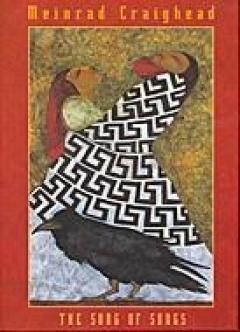
Meinrad Craighead Song of Songs

As we continue to explore the mysteries of love, hidden within the Song of Songs, we pull back from the close-up offered by Rabbi Rami Shapiro for an overview.

Here is part of Cynthia Bourgeault’s Foreword to Shapiro’s book:

“The Song of Songs has no plot, so to speak; its lovers simply play “hide and seek” through eight successive, almost surrealistic freeze-frames. Yet, something happens, and the spiritually-attuned heart picks up on it. Somewhere between Chapter 2 and Chapter 3 the male lover goes missing, and the woman, with wrenching determination, confirms her fidelity to her beloved and to the path of love: I will leave my bed and wander the city, searching street and square for you for whom my breath pants. (Song of Songs 3:2)

“Reunion, consummation, erotic bliss hurtle by, again in the Song’s allusive, freeze-frame way, and then, at the beginning of Chapter 6 another separation allusively looms, along with hints of rejection by society and family members. Another reunion and, finally, out of the blue, comes that empassioned affirmation that is no doubt among the top ten of the most stirring and luminous proclamations ever uttered in all of literature:

Set me as a seal upon your heart,

as an insignia upon your arm;

for love is strong as death,

passion as fierce as the grave;

its smallest spark is a flash of fire

igniting an inferno. (Song 8:6)

“All of a sudden thing have jumped from the launchpad of erotica to land in the domain of mystical union, with this soul-stirring proclamation of the ultimate dominion of love, the ultimate certainty of an alchemical fusion of souls that exceeds all space and time, all human loss and bereavement. (Cynthia Bourgeault, Foreword to Embracing the Divine Feminine, Rabbi Rami Shapiro, Skylight Illuminations, 2014)

Towards the end of his Introduction to the Song of Songs, Shapiro offers an interpretation of the Genesis story of the creation of the first earthling:

“In Genesis1:27, the Hebrew Bible says God created adam ‘male and female.’ The logical way to read this is to say God created man and woman at the same time. The problem with this reading is that just prior to telling us that God created ‘them’, the Hebrew Bible says God created ‘him’.”

Alluding to the centuries of rabbinical interpretation that arose from this, Shapiro offers his suggestion:

“My own reading of Genesis posits the original earthling as bisexual – physically, psychologically, and spiritually. Adam is the sacred androgyne, to use religious scholar Andrew Harvey’s term, who actualizes the inter-being of feminine and masculine and who longs to be born in your body.”

Shapiro cites Harvey’s writings:

This oneness heals all divisions and fuses all “separate” powers and brings into the union of Sacred Marriage all the “male” and “female” powers of the self, unites and fuses intellect and divine love, imagination and ecstasy, the spirit and the body, the laws of the heart and the structures of the mind, the light and every breath, gesture, thought and emotion lived in its truth.

What is born from this fusion, this “Sacred Marriage” of all separate powers of heart, mind, body, and soul is the Sacred Androgyne, the one who in his or her being realizes the total interpenetration with the Christ of all normally “opposed” or “contradictory” qualities.

This Sacred Androgyne – birthed in what early Gnostic writings such as the Gospel of Philip and the Acts of Thomas call again and again the “bridal  Chamber,” the place of fusion between “male and female” – is a divinized human divine being free of all normal categories of “male” and “female” because it exists in a unity that contains, absorbs, “uses,” and  ecstatically transcends both…the Sacred Androgyne… is the new Eve-Adam reuniting in his-her own being the Adam and  Eve that we separated at the “Fall.”  In such a being, “heaven” lives on earth: through such a being the divine radiates divine grace and power directly.

 (Andrew Harvey, Son of Man:The Mystical Path to Christ, New York, Jeremy P. Tarcher/Putnam, 1998, 121)

Shapiro adds: “What the Song of Songs celebrates and awakens us to, is the unification that is an ever-present but oft over-looked reality.” 

As Shapiro notes, mystics have described their encounter with the Divine in terms of sexual union.

In my own study of the Medieval Christian Women Mystics I discovered that in their longing to share their experience, they found the Romantic Writings of the Medieval Troubadours to be the most helpful form of written expression upon which to model their work.

Here is a fragment from the writings of Mechtilde of Magdeburg (1208-1282):

The Youth: I hear a voice which speaks somewhat of love.

Many days have I wooed her

But never heard her voice.

Now I am moved.  I must go to meet her.

She it is who bears grief and love together.

The Youth comes to greet the Soul in the woods

where nightingales sing and invites her to dance.

The Soul: I cannot dance, O Lord, unless Thou lead me.

If Thou wilt that I leap joyfully,

then must Thou Thyself first dance and sing!

Then will I leap for love, from love to knowledge,

From knowledge to fruition, from fruition to beyond all human sense.

There will I remain and circle evermore.

The Youth: Thy dance of praise is well done.

Now shalt thou have thy will of the Virgin’s Son.

“Then is she overcome and beside herself with weakness and can do no more. And He is overpowered with love for her, as He ever was, He neither gives nor takes. Then she says, `Lord, Thou art my beloved! My desire! My flowing stream!  My sun! and I am thy reflection!’ “


Shapiro points to other sacred love songs found in many religious traditions.

He asks: “What are we to do with these songs? Are they simply poetic artifacts to be appreciated or can they be lived in our own bodies?”

His response is that the Song of Songs “has to be embodied, just as the Beloved has to be embraced.”

Like Mechtilde, we are invited to

leap for love, from love to knowledge,

from knowledge to fruition, from fruition to beyond all human sense.


for your soul-thoughts:

How does this echo your desire for union with the Sacred Beloved?

Read the Song of Songs and look for traces of your own story in the finding, the losing, and being found once more by the Beloved, both human and divine.