Category Archives: Jean Houston

Sophia in Egypt Twenty-Eight

Ritual in the King’s Chamber

In this ancient place of initiation we are about to enact a sacred ritual. We are invited to enter into a time of silence, preparing our hearts to ask for what we most desire. I see two of my friends approach the sarcophagus. Clothed in long loose Egyptian galabeyas, they take their places at either end as Jean tells us that Deidre will play the role of Isis, Valarie that of her sister Nepthys, the two goddesses who regathered the scattered pieces of the body of Osiris. I remember now that we saw statues of Isis and Nepthys beside the container of the coffin of Tutankhamen in the Cairo Museum. Jean invites anyone else who is gifted in ritual to come forward. Ellyn rises to stand with others who gather around the sarcophagus.

Great Pyramid, Khufu burial chamber

inside the King’s Chamber with the Sarcophagus at the centre back

I feel empty, ungifted, unable to offer anything to others. I sit, carved in stone, as a rush of feelings, a NiIe flooding, sweeps over and through me. I am again five years old, watching as my friends are chosen for the Christmas Pageant, feeling bereft, invisible, unchosen by a beloved teacher.

This flood continues within me, unabated. I feel helpless to stem it, to bring any adult reason to the experience. Faintly, from far away, in a far-off time, a far-off country, I hear words from my beloved Bishop friend. “You have your own beauty, your own gifts.” I hear again the tenderness in his voice, the incomprehension. But an even older memory has taken hold, is gripping my heart. A child who feels she is not loved, because others are preferred.

I sit here, gripped by a grief I can neither understand nor overcome. I have forgotten Sekhmet’s warnings, as well as all that this journey has already given me: the joy, the gifts, the desire to be a presence of love for others. This is our final ritual and I am further from wholeness than I was when I arrived. Egypt has pared me down to this, cutting away all my illusions about being a loving person, a spirit-filled being, a light for others.

I look up to see Deidre standing at the end of the sarcophagus, eyes closed, radiant. I look to where the line of those approaching has dwindled to a final few. If don’t go now, I won’t be able to experience the ritual. I stand, walk over, join the line. I have no idea what to ask for.

I take refuge in an old ploy, one from the days of my first fervour, when I fancied myself quite adept at “holy indifference”. To the One listening, waiting, I say, “Give me what you desire me to have.”

But I have grown beyond such denial of my longings. I feel drawn to a deep inner honesty. I need to name what I want most at this moment, and as embarrassing, as trivial, as childish as my desire appears to me, I ask it anyway, in the silence of my heart. “I want to be seen. I want someone to wrap a shawl around my shoulders.”

And somehow, through my naming that wish, another arises within me. I recall the moment when I sat by the window of the Moon Goddess, looking out over the Nile, feeling the pure bliss of being held in love by the Holy, the true Beloved of my life, feeling a gratitude that drew tears of joy.

In the very nick of time, for now it is my turn to be helped into the sarcophagus, I ask silently for both these gifts. I have a vague understanding, an intuition, that if I were to be given the human gift I long for, I would know that the less tangible spiritual love would also be given.

I let myself be lifted, lowered, steered, manoeuvred into the sarcophagus. I am unable to assist Dwayne and Joan in this; my muscles are atrophied, frozen before such a task. I know I must be a lifeless weight to them.

Finally, I am lying in the deep base of the coffin, looking up as Jean holds bronze bells about a foot above my body, passing them along the areas of the chakras. I am like one who has already died, who can no more be touched by any human experience.

The brief ritual ends. I pull myself up into a sitting position. Once again Dwayne and Joan, with visible effort, assist me as I stand, as I climb out of the coffin.

Looking for somewhere where I might be hidden from view, I choose a place at the base of the sarcophagus where I sit leaning my back against its unreceptive granite. I lift up my hands, palms outwards, call on my own Ka energy, my spirit, to bring to life whatever needs to be born. I remember the swirling rose of love outpoured that I had visualized in the “Recrowning of Isis” ritual, just before our visit to Sekhmet.

While I lay in the coffin, the bronze bells that Jean rang above me may have activated that gift. I hope this might be true. But I feel nothing. Nothing at all.

Sophia in Egypt Twenty-Seven

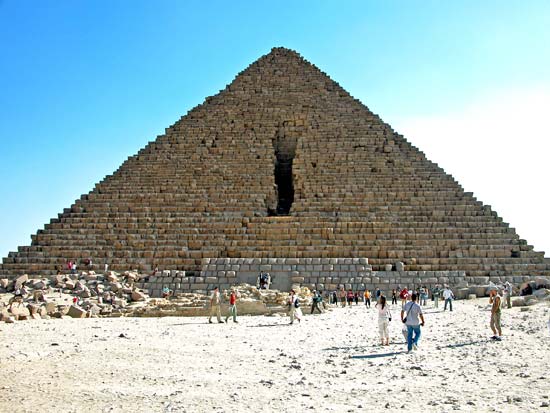
The Great Pyramid

189745-004-16FD89FC

Though it is clearly visible across the wide expanse of sand, the Great Pyramid is too far from the Sphinx for a casual walk. We reboard the bus to travel to the place of our final Sacred Ritual in Egypt. Mohammed has arranged for our group to have this magnificent place to ourselves for the next two hours.

Up close to the Great Pyramid, all perspective is lost. I might be gazing upwards from the base of a mountain, its peak unseen. Except that this mountain has not grown up out of the earth but was placed upon it, block by block 4500 years ago. It is the largest building ever constructed, covering thirteen acres.

This pyramid functioned as an enormous sundial. Its shadow to the north, and its reflected sunlight to the south, accurately marked the annual dates of the solstices and the equinoxes. Once these weathered stones were young, fitted together with such precision that no breath could move between them, a seamless creation. Today, they are teeth worn down by time in the mouth of someone ancient of days. They are rounded, gaping. And they are not smiling.

Jean Houston leads us up a path that has been carved into the sides of this pyramid, with stone blocks for steps, crossing at an angle, leading into an entranceway. Later, I would see the analogy of entering a birth canal, climbing back up inside a womb. Now, I am aware only of being in a scarifyingly narrow stone passageway, drawing us upwards. The air is dusty, the light dim, the path morphing into an alarmingly steep tilt. Here we must bend our backs, lean forward to walk like ancestral apes to avoid the low ceiling. Our feet would surely slip, creating a dangerous domino effect on the people behind us, were it not for the placement of horizontal bars of wood, a ladder embedded in stone. At one point, we are invited to look down, down, down to our right, into a great carved hollow that is called the Queen’s Chamber. The climb is featureless, offering no indication of progress, no promise of soon reaching the end, no helpful wall maps that say You are here.

I feel tired, breathless, and wonder how my companions are managing. Soon I have energy only to concentrate on getting myself up, up, up into the highest chamber in the pyramid: the King’s Chamber.

Hope comes in song, as music drifts down towards us, at first only a faint chanting, increasing in volume and clarity as we climb towards our companions who are already within the chamber. Quite suddenly the passageway ends and I follow those ahead of me into a rectangular high-ceilinged room, as wide across and about half as long as the chapel at the Garrison Centre where we gather for Mystery School. Jean is leading the singing that I heard, leading the group in the sacred Egyptian chant of Sa, Sekhem, Sahu.

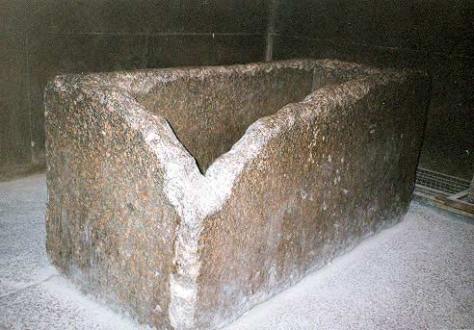
I join in, knowing now that singing activates the sacred space, remembering our resonant song in the tomb in the Valley of the Kings.Members of our group continue to come through the doorway, each finding a place to sit, backs resting against the stone walls, picking up the chant. As we sing, I gaze around the room. I am relieved to see the subtle glow of artificial lights, to hear the faint breath of an air exchange system. Without these amenities, it must have been a terrifying place for the ancient initiates. For this room was once a place of sacred ritual for Mystery School students. At one end of the room, to the right of the entrance way, a huge stone sarcophagus stands, open, waiting.

Jean and Peg explain the ritual. Each of us is invited to form a request, an inner desire, and then to approach the great sarcophagus. Two of our companions, Dwayne and Joan, will assist each of us to climb into the sarcophagus, creating a balance of masculine and feminine energies. We will lie there for a few moments, a ritual of passing through death, before rising, emerging into life. Unlike the ancient initiates, we will not spend a night in the coffin.

coffer

the Sarcophagus in the King’s Chamber made of red Aswan granite

(from Called to Egypt on the Back of the Wind by Anne Kathleen McLaughlin, Borealis Press, Ottawa, Canada, 2013) This book may be ordered online at http://borealispress.com

Sophia in Egypt Twenty-Six

We leave St. Catharine’s Monastery, begin our walk back down the hillside, pass a row of camels who sit waiting, perhaps for travellers who will hire them for explorations across the desert or up into the mountains. The camels have brightly woven rugs over their backs, modestly unaware of the fashion statement they make. Ahead of me on the steep downward climb, I hear Jean engage with Arthur in what sounds like a theological discussion. I catch up, join in.

“How did we get Yahweh so wrong?” I ask, telling Jean and Arthur about my conversation with Michael. Jean believes that the characterization of Yahweh is drawn in part from the fierce desert god, a god of wind and storm, who would have been known among the Israelites.

“And yet,” I say, “there is such great tenderness in Hosea and in Ezekiel. My favourite part of the Hebrew Scriptures is Ezekiel 16.”

“Recite it for us,” Jean asks.

I begin. I know this by heart, but nonetheless, the lines come out rather muddled.

I saw you in a field on the day you were born. You were lying in blood with no one to wash you, to rub you with salt. You were as unloved as that on the day you were born. I said to you, ‘Live and grow like the grass of the fields.’ Later I passed by again and saw that your time had come, the time for love. I wrapped my cloak around you. I made you my own…

The words, as always, stir me to delight. I spin around on the dusty road, my arms a windmill, saying, “What passionate love! There is nothing in the Gospels to touch it!”

“I like the funny parts,” Jean says. “My Dad was a comedy writer. Do you know that in the Beatitudes, the truer translation is not blessed are the poor in spirit but blessed are the debonair!”

Deidre has joined us, “But Jesus was so young,” she says. “He didn’t live long enough to get serious.”

“I’m glad we have lived long enough to live into joy!” I say.

We board the bus, now waiting for us after the return from the Bedouin market. I look back at a glorious view of the monastery, a garden nestled in the arms of the mountains.

We begin a seven hour journey across the Sinai to Cairo, still unaware of the border skirmishes, puzzled by our guide Samai’s unwillingness to make any stops. By late afternoon, we are hungry, thirsty. Samai relents, cautioning us to get something quickly in what looks like an Egyptian hamburger stand without the hamburgers, the food expensive and sparse. We continue on over mostly featureless land, driving through a tunnel that takes us under the Suez Canal.

When at last we reach Cairo, city lights pierce the darkness of full night. We enjoy a supper of char-broiled chicken at a comfortable, softly- lit restaurant. I am sitting near Suzanne, Rosemary and Marjorie, the woman who had led Chi-gong movements for us on the deck of the Moon Goddess. Our return to Cairo brings with it a sense of endings. “How do we talk about this when we return home?” The question hovers in the air above us, silencing us. How indeed…

It is Marjorie who responds, speaking with quiet assurance. “We come like Odysseus, like a beggar, listening to their stories of what went on in our absence, before we unfold our own stories.” There is a further silence as each of us recognizes the wisdom of Marjorie’s words, then imagines how that would be when we are home…

We return to the Mena House, whose marble halls welcomed us on our first night in Egypt. This time, the window of my room overlooks a busy Cairo street, a Mobil Oil station hovering protectively over its gas-thirsty cars and trucks. Egypt is already shedding itself of us, turning off some of its magic.

But not all of it. We’ll be up before dawn for a sunrise prayer between the paws of the Sphinx.

I waken at four, drawn into prayer, needing to prepare for this day, our visit to the Sphinx, our ritual in the Great Pyramid, our final day in Egypt. Time is running out for whatever miracles are still to happen. I catch myself getting caught in clock time, forgetting what I’ve learned of durative time. I remember that in the Gospel stories, people are sometimes only aware of a healing after they set out for home.

We are in the tour bus by 5:10, but Egyptian Security is still tight. After a long delay, we are given the necessary escort for the short journey.

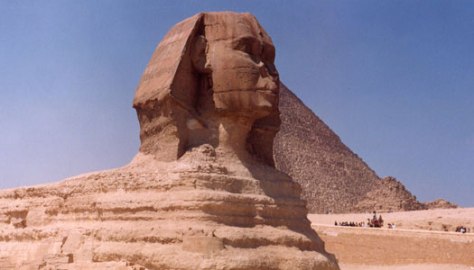
The moon is a cup half full of golden wine in a sky that sings of night when we reach the Giza Plateau. We walk towards the Sphinx, full of awe, watch it grow larger as we draw near. Its great paws were deeply buried in sand for millennia. Cleopatra would not have seen them. This majestic storied presence is distant, even when we are at last standing beneath its chest, leaning against stones ancient beyond anyone’s reckoning. The face carved on the Sphinx, thirteen feet wide, is now thought to be that of a woman with Negroid features. Samai tells us that the face is more recent than the base, for it had to be realigned with the stars. The Giza Pyramids are oriented towards Orion. Over perhaps nine thousand years, the sky map has changed.

great_sphinx_of_egypt

The Great Sphinx Egypt

I stand now in the generous space between stretched-out paws. I have to tilt my head back to see the face that looks out across the sands to a far horizon, unaware of me. There is no message that I can understand in the far-off gaze. Here there is no sense of presence, neither the gentle one of Isis, nor the joyous one of Hathor. Not even the fierce presence of Sekhmet.

But when I turn to look in the direction the Sphinx is facing, the sky is opening in mango and lemon. Ra the Sun appears.

At the moment of the sun god’s appearance, Jean invites us into a time of silence. I try to be present to this experience of no thing. Surreptitiously, I take two photos, but it feels like a desecration.

After our sunrise prayer, as I walk away, I hear Jean say, “How people can stand before a mystery and a wonder and just take photos amazes me!” I feel chastened, thinking of Eliot’s words. Have I also “had the experience but missed the meaning”? I decide that I was at least open to the wonder, to the mystery.

Later, I will discover that my photos are double-exposed, worthless.

Sophia in Egypt Twenty-Five

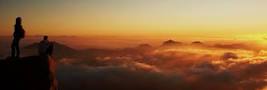
I sleep deeply for a few hours, not hearing the sounds of those who waken at 1:30 to set out to watch the sunrise on Mount Sinai. Sometime around three I am awake, awash in old fears and darkness. I call out for help, hardly knowing to whom I cry. I sleep again, waken in time to watch the sunrise from the window of my cabin. As I gaze at the glowing light in the eastern sky above the mountains, some peace, some joy trickles back into my soul.

mount-sinai-sunrise

sunrise from Mount Sinai

I recall a moment from yesterday’s visit to the Monastery of St. Catharine. Tiredness had emptied me of joy, and I found myself looking at the radiance of others, sensing I lacked some essential quality of openness, of wonder. Walking away from the monastery towards our bus, I fell in step with one of the men in our group, Arthur. “I see a glow about you… I just wanted to tell you that.” In that moment of inner darkness, his words were like a cup of cool white wine to me. In this dawn moment, I wonder now what prompted him to say that. I feel graced, knowing that some loving presence saw my need, reached out to me through Arthur.

My companions slowly drift back from their odyssey, arriving at breakfast with stories of the stunning views of the sunrise, and many adventures on camels, on foot. Suzanne is glowing with the experience, rode a camel part way up the mountain. At least my coat got to ride a camel! She has brought me a stone from Mount Sinai which I treasure.

It is two hours before everyone has finally returned, and a further wait as the last arrivals hurry to shower, to pack up, to prepare for our departure. Michael, the young doctor in our group, is suddenly standing near me, just outside the dining lodge. His face is a mask of regret, disappointment, something even darker.

“I wanted to go,” he says. “I really wanted to climb Mount Sinai. But I didn’t get a wake-up call, and missed the whole thing.”

I feel his deep distress, reach for something that might ease it. “Maybe you just needed some extra sleep,” I offer.

“No,” he says, angrily. “The Hebrew God really has it in for me. I know it.”
I am appalled at this. “Michael, we are held in love. I can see how tired you are, that you need rest. Why wouldn’t God see it too, and give you what you needed most?”

I can see that my words are not enough to overturn a lifetime of such thinking.

When at last the bus pulls away, Jean tells us we have an option : those who’d like to return to the Monastery to see the icons will be dropped off first, while the others will go on to a market where the Bedouins sell their handicrafts. I picture glorious woven shawls, rare carvings, the chance to meet these strange and elusive people. Then I think about the sacred icons that Jean has spoken about.

I feel unable to make a choice. I am sitting with Rosemary, and tell her my dilemma.

With her usual practical wisdom, Rosemary asks, “Do you plan to do any more shopping?”

Of course not. I have my Isis bracelet, gifts for my family and a few friends. “No,” I say, suddenly relieved and clear.

In the morning light, as we stand in the courtyard of the Monastery before the flowering bush with its flame-coloured flowers, my heart softens. I am open to the possibility that this is a descendant or relative of the Burning Bush that Moses encountered. The Holy One has chosen stranger places from which to speak…

Jean stands with our small group, invites us into a time of quiet meditation, suggests that we pray for healing for ourselves and for our world. For myself, I pray for the healing that has been the recurring theme of this journey, a healing of the wound which opens whenever I am drawn to love someone deeply. For the earth, I pray for the rising of feminine energy everywhere to heal and renew life. This morning the Monastery has a sacred feel to it.

Inside the Monastery we are allowed to enter the chapel to see the icons. I remember the heart-stopping beauty of a small collection of Greek icons I’d seen at Ottawa’s Museum of Civilization. There’d been one of the Madonna and Child that had captivated me there. I begin searching the walls aware that the icons here are dark, have a grimy appearance, as though the dust of centuries has been allowed to settle on them. But the piercing awareness of the eyes that look back at me from each painting soon makes me forget dust. And everything else. I feel drawn to an icon of Jesus, but as I look more closely what is emanating from the eyes is not love but fierceness, a force.


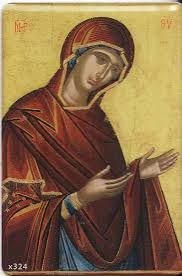
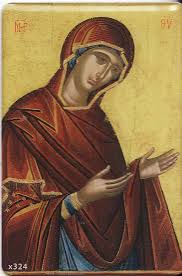
Two of Mary are compelling. One is the icon that I’ve known since childhood under the title, “Mother of Perpetual Help”. In another, Mary is holding out her arms as though embracing a child, but there is no child. I spend a long time standing before this image, wanting to be the one for whom her arms are reaching.

images

Icon of Mary, with arms open

Today, November 21st, is a feast of Mary, recalling her Presentation in the Temple when she was a child.

Sophia in Egypt Twenty-Four

Suddenly the mirage that was Sharm el Sheikh has disappeared and our bus makes its dusty way towards the Sinai Desert, passing the rough rock- built Bedouin homes, clustered together in small villages as though for protection against the harsh reality of sand, stone, sun and mountain. I become aware of a shift in mood, of tension on our guide’s face, of whispered conversations, of long unexplained delays as we move deeper into the Sinai. Only later will we come to know that border skirmishes with Israel, involving the Bedouins, have very nearly scuttled our journey.

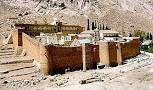
We arrive safely and without incident at the base of the long hill that climbs upwards towards the Greek Orthodox Monastery of Saint Catharine of Alexandria. Here the bus rests as we climb, gazing up at what looks like a fortified medieval town, protected by walls of sand-coloured stone that soar upwards to a height of perhaps eighty feet. St. Catharine’s is one of the oldest Christian Monasteries on the planet.

monastery-2

Saint Catharine’s Monastery


Tradition says it was on this height of land that God called out to Moses from a burning bush. Inside the walls, we go first to the place where, just above our heads, a rose bush, a hardy, long-lived strain native to the Sinai, spills out in blossoming welcome. The Monastery has a continual supply of fresh water from the Well of Moses which taps an underground spring. It is traditionally held to be the well where Moses met his future wife, Zipporah.

Helena, mother of the Emperor Constantine, was so impressed by the sacredness of this place that in the year 330 she had a small chapel built on the site, dedicated to the Blessed Virgin Mary. In 530, Emperor Justinian had a much larger basilica constructed, the Church of the Transfiguration. From that time, the monastery took on the character of a walled city. The Prophet Mohammed also visited the monastery, giving the place his personal pledge of protection.

Our delayed journey has brought us here outside visiting hours. Of the monastic community in residence, we see only a sandaled foot, a wind-whipped robe, as the men pass by. Like children outside a candy store, we peer through the darkened windows of the locked chapel door, trying to catch a glimpse of the magnificent icons on the walls. Jean is determined that we shall not miss this wonder, arranges a visit on the following morning. I am feeling heavy, tired, not open to this experience. Knowing there’ll be a second chance tomorrow feels like a reprieve.

Full darkness has risen like a cloak over earth and sky by the time we reach our accommodations. We emerge from the bus onto flat rock-strewn sand that spreads itself in homage at the feet of towering mountains of ancient, weather-sculpted stone. One of those hovering shadows is the place where Moses received the commandments of Yahweh. Tomorrow at dawn we’ll be there….

Tonight however, we make our way along paths that intersect a series of small stone dwellings, looking for the numbers we’ve been given that identify our lodgings for the night. Once settled, with time for a quick shower, a change of clothing, we gather in one of the larger buildings, a conference centre. Jean tells the story of Moses who led the Israelites out of Egypt, escaping the pursuing armies of Pharaoh.

Which Pharaoh?

For the first time, the question is an important one for me. What I have learned of Egypt gives a different weight to the Biblical story. Jean responds that most scholars believe it was Ramses the Second, the thirteenth-century BCE pharaoh who ruled Egypt for more than sixty-five years, whose statues and temples dominate the Egyptian landscape.

The theological questions are interesting. The Egyptians had honoured many gods, had, as we had learned earlier, gods or neters for almost every human activity, every need. They lived in an atmosphere where the spirit of the gods filled their lives. In the fourteenth century BCE, the Egyptian Pharaoh, Amenhotep IV, declared that God is One, the sun god, Aten. He changed his name to Akhenaten, and moved the capital of Egypt from Thebes to the newly-built city of Akhetaten (Tell -el- Amarna) to honour the Sun god. But his beliefs were widely opposed, and after his death his monuments were destroyed, his name removed from statues and reliefs.

Moses and the Israelites worshipped One God whom they knew as Yahweh.
Patriarchal Religion began here on Mount Sinai, a name that means “Moon”, suggesting the mountain may once have been a site of goddess worship.

From the conference building, we make our way across the rocky ground up a low hill to the building where supper is waiting. The large undecorated room echoes with voices of other groups who are here, including some Canadians on their way to Israel. The place has the look and feel of a hunting lodge. We take plates and fill them with from a table of basic foods, eggs, beans, bread. We find places on wooden benches at long tables. Conversation turns to plans to climb Mount Sinai. As the sunrise from the 7,500 foot summit is spectacular, and the climb will take two and a half hours on foot, less for those who are ready to pay for a camel for the journey, wake-up calls are arranged for one-thirty a.m.

Sunrise on Mount Sinai. A camel ride. Surely this is one of the highlights of the journey. Yet, when Jean asks whether I want to go, I feel uncertain, respond crossly, “I haven’t decided”. I am aching with fatigue, but there is something deeper, something harder to acknowledge. Egypt has shifted my spirituality away from patriarchs, from commandments carved on stone, from arduous climbs so beloved by the ascetics of my faith. Memories, sensations return of the more feminine spiritual experiences I have had on this journey: the magnificent coral, the rainbow coloured fish I saw under the Red Sea, the moment in a tomb, in the Valley of the Kings, when I felt a sweep of tenderness beside a wall painting of an ibex….I cannot summon desire to make this pilgrimage.

But those who plan to go are eager. The night will cool down considerably and there is a flurry of borrowing jackets or sweaters. Suzanne needs something warm to wear, and I offer her the long cotton coat I’ve brought. It feels like a blessing. Part of me at least will go with her. My last tinges of regret dissolve.
Jean herself will not go. From within my own fatigue I can see how tired she is. But she will stay awake, keeping vigil for those who are making the climb.
“Take care of one another,” Jean says.

mount-sinai2-sunrise

Sunrise from Mount Sinai

Sophia in Egypt: twenty-three

We return from Sekhmet’s Shrine in Karnak for a last evening on the Moon Goddess. Before dinner, several of us go to the upper deck to enjoy the cooler air, the stunning Monet colours of the evening sky. The events, the palette of emotion I have experienced since this morning, swirl within me. I have a longing so intense it must be visible to pour it all out in words. I wonder if I might speak with Jean, if she would understand if I said it all to her. But I see her deep in conversation with another woman in our group.

I choose a deck chair with a view of the western sky, lean back, invite the evening’s beauty to be my companion. From a mosque on the eastern shore behind me, I hear the call of the muezzin, followed by the deep resonant chanting of evening prayer. I lie still, my eyes filled with the colours of the sunset as the earth rolls eastwards, away from Ra.

With the suddenness of magic, Egyptian magic, I am no longer alone. Imaginary or imaginal, the presence I have summoned by my longing is with me, sitting at the end of the deck chair, waiting, ready to listen. At such moments, there is no point in trying to understand what is happening. Forster’s wisdom applies: “Do we find happiness so often that we can afford to throw it off the box when it happens to sit there?”

Simply, fully, gladly, I unfold the whole story in an inner dialogue. I sit with my eyes closed, still seeing the rose swirl of the evening sky, still hearing the melodious chanting from the mosque. During these sacred moments I speak all that is in my heart, feeling heard, being understood, being known. Warmly, gently, the time passes in a half-awake state. As easily at it began, it ends with an invitation to return at any time to this presence.


In full darkness, we depart the Moon Goddess, board a bus for the airport. Hours of waiting follow: frustration, flight delays. It is nearly two o’clock in the morning by the time we find our rooms in a hotel that might have flown straight out from a tale of the Arabian Nights. We have arrived at Sharm el Sheikh on the Red Sea.

red-sea-map

Sharm El Sheikh, called “The Peace City” in honour of the many peace conferences that have taken place there, is located on the tip of the Sinai Peninsula. It is a cosmopolitan Red Sea resort city, with red mountains, thirty-five miles of white sandy beaches, blue sea and coral gardens. Diving is the primary activity, for divers at all levels of skill, including none whatever.

It is only with the light of morning that we see the wonders of the place. It’s like waking up in paradise. Flowers flow from every stone archway, spilling in pale blues, in warm pinks above our heads, and at our feet everywhere we walk. As we make our way to breakfast, clusters of palm trees wave in the morning air, and beyond it all the glistening sun-kissed sea awaits.

We have a whole day here, a day out of time, without schedule or gatherings. A day to recover energy after journeys both mythical and actual. After breakfast, I am drawn to the sea’s edge, where I find Valarie. Under the shade of the palm trees, we talk, not about Egypt, not about goddesses and temples and pyramids, but about our lives, our families. Valarie’s mother is becoming frail; my own mother has recently died. We find storylines that intersect. It is comforting.

I return to my room, change into swimwear, meet Denise just returning from an underwater adventure, willing to loan me her mask and flippers.

I have never dived. Descending from the small pier, I have difficulty breathing underwater through the mask. But at my first glimpse of the magic that awaits me I am determined to stay. The coral is magnificent, treacherous. We’ve been warned not to get close to the razor sharp edges of this underwater flower garden. I gaze at clusters of white, red, pink coral, watch fish swim past in impossible shades of blue and green and red. I can hardly grasp that so much beauty exists only metres below the surface.

images

Afterwards, I shower to wash away the stickiness of salt, change into fresh clothing, and hurry to the amphitheatre where I settle onto the stone bench near others of our group. As waiters move among us offering red wine, Tchaikovsky’s music fills the night air. We watch a DVD of a 1989 performance by the Bolshoi Ballet of “The Sleeping Beauty” on a gigantic screen. A fairy tale. A love story that ends happily. The perfect antidote to an overdose of Egyptian mythology, and the not-so- subtle warnings of a goddess about my allurement to tragic romance. I take it all in, in a state of bliss.

Valarie, Denise and others of our group find an outdoor cafe and enjoy char-broiled calamari.

I fall asleep that night, restored by beauty and joy.

(excerpt from Called to Egypt on the Back of the Wind Anne Kathleen McLaughlin,
Borealis Press, Ottawa, Canada, 2013 http://borealispress.com)

Sophia in Egypt: Twenty-One

Following our reflections on Seth and Horus, we move into the final ritual, the recrowning of Isis, the ritual I experienced alone in my community’s prayer room two months earlier. Now I enter into it, companioned by the group with whom I have shared a mythic journey.

Yet, in the final moments, standing before the presence of the Sacred Feminine, I feel alone, wrapped in mystery. At the moment of the gifting in September I had asked for something to be taken away, the great emptiness that had made me a beggar of love.

Today, I open myself to receive something from this presence. There is a moment of utter stillness. Then I see an inner image, a ball of swirling fire, a glass globe of rose and white light, and it is within me, in my own deep centre. I am being filled with love.

There is no time to reflect on this wonder, to take it in with gratitude.

The morning session is over. Lunch awaits us in the dining room, and afterwards we are to visit the great Temple of Karnak.

An hour later, we are gathered in the lobby, ready to leave the ship to board the bus. I am suddenly overtaken by a grief so intense that, to my shame, tears are pouring down my cheeks. I quickly turn away, but not quite soon enough to escape Jean’s glance. I pretend interest in one of the paintings on the wall.

As if that encounter with love in the ritual only an hour before had never happened, I am empty.

This grief is human, a keen awareness of an ending, prefatory to further endings, knowing this magic cannot return, knowing I shall never again be here in the presence of the teacher from whom I have received the reweaving of my life. The remembered words of Tolkien’s Gimli, leaving Galadriel of the Golden Woods, rise within me: I would not have come had I known the danger of light and joy. Now I have taken my worst wound in this parting.

The intense heat of the mid-day sun devours us like some fiery Sobek as we enter the massive courtyard before the Temple of Karnak. An oddly-shaped stone just ahead of my sandaled foot catches my eye. I pick it up, turn it over in my palm, see a lumpy heart shape with an open wound across the top.

We move quickly inside the towering walls, eager to find some protective shade. Our guide Samai gathers us beneath a huge leafy tree to speak about this temple. He tells us it is constructed so that the sun appears to travel through the day along the line of its one hundred and thirty-four columns, moving from Karnak to Luxor and across the Nile to Deir-el-Bahari. As I listen to Samai, the inner grief weighs down my heart. I become aware of Jean’s presence, a little distance behind where I am standing.

Awhile later, wandering alone in the temple precincts, I notice the grief has dissolved, that it left me there, under the leafy tree. With a lightened heart, once again open to receive beauty, I pause beside a small lake encircled by a low stone wall. It is the place where priests were purified in ancient times in preparation for ritual. The water is so clear that a tall palm tree gazes down at itself, perfectly reflected. A huge stone scarab, seven times my size, sits atop a circular plinth three metres above me. It was here at the Karnak Temple that the scarab was declared a symbol of eternal life.

download-of-scarab

Scarab at Karnak: symbol of Eternal Life

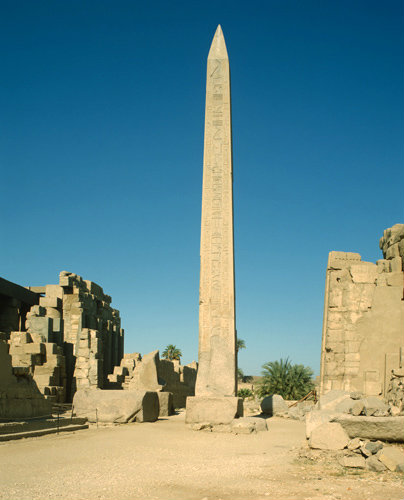
Soaring above the temple walls like a great tower of Rapunzel, stands the only remaining obelisk of Hatshepsut, the woman pharaoh whose successors tried to obliterate all memory of her.

eg51-9-17


Behind Karnak’s main temple complex and through five gateways stands a small Sekhmet shrine that still holds the original statue of the beautiful, fierce, serene, lion-headed goddess. Those who seek her at her Karnak shrine invariably have powerful experiences orchestrated by a statue created as a vessel for the divine presence of Sekhmet. Skilled craftsmanship and sacred rites opened the statue to the goddess’ spiritual attributes. Three thousand years later, the power of Sekhmet captured in basalt endures.

Nikki Scully, musician, energy healer and leader of shamanic pilgrimages to Egypt, speaks of Sekhmet’s call to our time: When we embrace this power, something happens to us at a cellular level. It’s as though the energy enters into our field and then into our very cells. A person who is receiving this feels as though every molecule and cell is suddenly coming out of an ancient atrophy and malaise, and awakening, becoming alert.
I believe this awakening is a part of the conscious evolutionary process we’re engaged in, bringing forth the aspects of the power of the Divine Feminine that are required in order to achieve the balance we’re seeking at this time.

(Next: Encounter with Sekhmet)

(excerpt from Called to Egypt on the Back of the Wind Anne Kathleen McLaughlin, Borealis Press, Ottawa, Canada, 2013  http://borealispress.com)

Sophia in Egypt: Twenty


Note to the reader: If you wonder how Sophia, the Wisdom presence of the Holy in the Hebrew Scriptures, relates to the ancient Egyptian story of Isis and Osiris, or how she is part of this 21st century  journey to Egypt, this segment may begin to offer enlightenment. Isis, Hathor, Ma’at and Sehkmet are aspects of the Sophia, the Sacred Feminine presence who is making herself known in our time.


After last night’s visit to the Luxor Temple, I fell asleep with columns of hieroglyphs on yellow sandstone moving across my eyelids. Then a clear image of Hathor appeared, goddess of love and joy. I awaken to this new day thinking of the light of Ra, the gift of love that shines equally on all.

goddess-hathor

Hathor: Goddess of Love and Joy

After breakfast, some of us gather on the upper deck of the Moon Goddess where Marjorie and Paul, a married couple in our group, lead us in Chi-Gong movements. Afterwards, I sit cooling my feet in the pool, looking over at the Valley of the Kings on the West Bank.

In the peace of the moment, remembered words of Jesus rise up within me:

John was a lamp, alight and shining,and for a time you were content to rest in his light.

There is a hint of something here. This light, in which I am just learning to rest, is only for a time. But I don’t follow the thought where it might lead. I cling instead to this present moment, wanting it to last, not looking beyond this day, our final one on the Moon Goddess.

At ten o’clock in the Captain’s Lounge, we re-enter the story, find ourselves in the midst of the eighty-year battle waged by Horus against Seth, the principle of entrapment and limitation. Jean Houston invites us to see how we need to activate the inner muscular Horus within us to stand up to recalcitrance, both within and outside of us, and do battle. People who are entrapped by, limited to the status quo, are living out of their reptilian brains. If we remain working with them, we can only become assistant dinosaurs. To advance the world, the individuated wilful Horus must emerge.

Within ourselves the opposites, the Seth principle of limitation and the Horus principle of abundance, are often at war. We enact a ritual battle between the Seth and the Horus within us, partnering with another to give voice to each aspect of the self. Denise, the woman from Ireland, offers to play Seth to my Horus. I tell her of wanting to travel the earth, working with women to help them find their deep spirit.

“Do you think you can be like Jean Houston?” she mocks. Our role play, as fierce on my side as on hers, leads us into a deep sharing about the need we have both felt for inner guidance, the longing of a woman who feels herself unmothered.

In their epic battle, Seth and Horus shape-shift, become hippos and bears and lions, enduring terrible wounds. Such battles arise, in our time, Jean believes, in cultures that lack guiding principles. Yeats describes it in “The Second Coming”:

Things fall apart; the centre cannot hold;

Mere anarchy is loosed upon the world,

The blood-dimmed tide is loosed, and everywhere

the ceremony of innocence is drowned;

The best lack all conviction, while the worst

Are full of passionate intensity….

And what rough beast, its hour come round at last,

Slouches towards Bethlehem to be born?

That rough beast is Seth, Jean suggests.

As in the Iliad, the gods take sides in this great battle. Ma’at, the principle of truth, withdraws, goes underground and lives with Osiris. She chooses to leave the battle to go into the higher order of the unconscious. We, too, when we cannot make sense of things, retreat into the unconscious, taking Ma’at with us.

After the battle, when Isis realizes that she cannot kill Seth, Horus seizes her crown, tearing it from head. Later, he repents and recrowns his mother, giving her the cow-headed crown of the goddess Hathor.

Seth tries to seduce Horus. Jean comments that even after we think we’ve won the battle, we keep meeting our same old issues, again and again, but at increasingly complex levels. We are seduced by our own Seth, given these struggles to strengthen us. Each time we find ourselves in these same old patterns, we might think of them as trenches in the brain, something we need to over-ride. Dealing with these as fractals of the eternal return, old ditches we must cross, helps us to get on with the new story.

The ancient story concludes with Isis tricking the ferryman into taking her to the council of the gods on Elephantine Island. Disguising herself as a beautiful woman, Isis persuades Seth to acknowledge his crime and make restitution. The gods order him to create a barge that will carry the high spirit of Osiris into the depth world.

Rather than what traps us in time, our Seth principle of appropriate limitation becomes the vehicle to carry us into eternity.

The story became a transformational ritual in Egypt, a ritual of the soul. In it, the four principles of movement, fertility (Isis), inspiration (Osiris), limitation (Seth), and growth (Horus) are engaged in the big turn-around and fall becomes resurrection. What is destroyed is transmuted into a deepened quality, rising like the djed pillar in us as compassion, as empathy.

The transformational journey of the soul is the basis of the Mystery Rituals. In a Hellenized version, the Mysteries of Isis and Osiris were celebrated throughout the Graeco-Roman world. Many themes of the Isis/Osiris/Seth/ Horus story reappear in Christianity: the woman, impregnated by a father in the spiritual world; the threat that the newborn child will be destroyed; the tree as vehicle of death. Isis is the virgin/mother /crone who was worshipped in Greece and Rome for centuries. Some ancient black madonnas are actually Isis with Horus in her lap. Many qualities of Isis are subsumed into Mary.

Jesus was like Osiris, living out the Egyptian mystery of the dying/rising God, taking on the full ancient archetypal myth of the Mystery Religions while existing in space and time. No wonder, Jean concludes, he became Jesus Christ Superstar!

After the story, we take time to reflect more deeply on its meaning for our lives.

What vulnerable quality within us can be transformed from a negative Sethian glitch to a deeper potential, as the barge of Seth became transformative for Osiris?

I sit in silence with this question, wondering how my longing for a particular love can be transformed into a love that overflows from within me to others. It is for me the fractal of the eternal return, the question that continues to arise in my life, always from a deeper place, ever more complex.

( excerpt from Called to Egypt on the Back fo the Wind Anne Kathleen McLaughlin Borealis Press, Ottawa, 2013 http://borealispress.com )


Sophia in Egypt: Nineteen

The Temple of Luxor

After dinner that evening, when full darkness has risen to cloak Luxor  where the Moon Goddess is docked once more, we gather in the ship’s lobby. The dockside doors are open, and we pass through them into the lobby of a second, then a third ship, this one securely nudged beside the dock. From there we climb a set of steep stone stairs to the street. In a line, awaiting us, are horse-drawn carriages, their wooden wheels and body painted black and red, their seats made of leather, still carry the faded elegance of a nineteenth century “surrey with the fringe on top”. Their drivers turn towards us in welcome.

We are on our way to the Temple of Luxor but we take a circuitous route through the back streets of the ancient city which Homer in The Iliad called “Thebes of the hundred gates.” We pass parents walking with small children whose faces illumine the night. There are clusters of men, talking, laughing, gathered outside shops and houses. Only rarely do I see women and these stay very near to the front doorway of a house.

The driver introduces himself to us as Mufasa, asks our names. “Are you married?” he asks me. His face lights up when I say I am not, and I realize he is making a proposal. He is alone, he says, married only to his horse Rambo, and would like to change this.
The divine comedy eludes me until later. On a day when I have been struggling with the mysterious depths of spiritual love, an ordinary man is asking me to marry him, and for no better reason than his hope that I would be a better companion than his horse!
The Temple of Luxor really existed for the festival of Opet. This was an eleven-day event during which mass quantities of bread, cakes and beer were distributed. After processions of sacred images, followed by members of the royal family, the king and priests retired to private chambers in the temple where the king and his divine essence were merged, transforming him into a divine being. As part of the festival, the god (in human form) celebrated the sacred marriage with the human queen. The whole event was a ceremony of reconciliation – the king’s humanity with his divinity- for the purpose of renewing vitality for both human and divine beings. Although Amenhotep 111 built the temple, six colossal statues of Ramses 11 flanked the entrance. Of these, only two seated figures survive.

47-luxor-temple-at-night_thumb

Tonight, the Luxor Temple glows golden in the darkness, lit from below so that the light spills upwards. The effect is magical. Its great monumental gateway is carved with bas reliefs that show scenes from the military campaigns led by Ramses 11 against the Hittites. In front of this wall, next to the two remaining seated carvings of Ramses 11, stands an obelisk, twenty-five metres high. Its twin was carried off to France in 1833 where it now stands in the Place de la Concorde in Paris.

Jean leads us into the sanctuary-heart of the temple, a place of initiation, where we chant: I AM, WE ARE, THIS IS ME. These three simple sayings hold deep levels of meaning, of interconnectedness. Our ordinary “this is me” lives are enfolded in the “We are” of myth and symbol and archetype that we are learning about in Egypt. “We are” expresses our existence in durative time, the place where we encounter sacred time and space. Beyond and yet within these two realms is the “I Am”, the Holy, Being itself, Love itself.
At Jean’s invitation, we turn to one another saying, “I see the I AM in you. I see the WE ARE in you, and in you I see THIS IS ME.”

After our ritual of recognition, we are free to wander through the open courtyards, to look at the bas reliefs, the walls inscribed with hieroglyphs. An avenue that begins at the front of the temple is lined with small sphinxes that once led all the way to the Temple of Karnak. It has been partially restored, and we walk its length, marvelling.

Along another walkway, rows of rounded columns tower over us like redwood trees in a forest of stone. I am suddenly jolted back from these ancient carvings, from the WE ARE of myth to the THIS IS ME, aware I am standing between two turbaned, long-robed guards. They are gesturing to me, pointing at my camera, then towards a row of lighted pillars. For a startled moment, I feel really afraid, then my experience of other guards in other tombs clicks in, and I understand. I am being invited to pose for a photo with one guard as the other wields the camera. For Baksheesh. Of course.

Later, I will see a photo of a very handsome tall bearded guard and a happily smiling woman standing beside one of Luxor’s storied columns. This is me… we are… held safe in the love of I am.

(from the novel, Called to Egypt on the Back fo the Wind by Anne Kathleen McLaughlin,

Borealis Press, Ottawa, Canada, 2013  http://borealispress.com )

Sophia in Egypt: Eighteen

Sailing to Luxor

In silence, we are given the grace of loving deeply, wholly and well.     (Jean Houston)

During the night following our visit to the Valley of the Kings, my sleep is shadowed by old fears. I am visited by the ghosts of my lifelong struggles with loving, with letting go, my fear that love will measure me, find me wanting, or in the Egyptian way, weigh me, find my heart too heavy, abandon me.

In one of the dark hours, I feel invited into prayer. An image of Russian nested dolls comes to me. I open the first, who looks like Jean, and find inside a second, an image of the Sacred Feminine, the Holy One. In the clarity that comes between sleep and full wakefulness, I hear an invitation, “Simply enjoy being close to this person. Enjoy the gift of this time.”

Hours later, I waken fully to clarity and joy, the power of these old demons vanquished by morning’s light.

We are to spend this day on the ship, a morning of teaching in the Captain’s Lounge, an afternoon free to rest, to enjoy the scenery as the Moon Goddess takes us back up the Nile, then down again to Luxor.

Today, Jean speaks to us of magic in its many forms. “The Sorcerer’s Apprentice,” the tale that unfolds in Disney’s Fantasia with Mickey Mouse multiplying brooms to carry buckets of water, is based on the true story of a Greek who studied magic with an Egyptian master.

Magic, Jean tells us, happens for many who travel to Egypt, returning home to find healing and wholeness have come to friends, to difficult situations, while they were away. Things happen in Egypt because it is believed that everything here is invested with life – even stones! As we come to understand the holographic universe, we know everything is a containment of the whole.

While Jean speaks of magic, there is some glitch occurring in the sound system in the lounge. Suddenly coloured lights above her chair begin to blink off and on.
“The ancients learned how to expect the unexpected,” Jean says.
I realize that we are learning the same thing here.

A quiet joy is blinking off and on within me as I sit here, fully aware of being on a ship on the Nile, listening to a teacher whose words have illumined my life for several years now.
Kairos time, Jean is saying now, is a Greek expression that refers to the moment when, in weaving, two sets of weft thread are open so the warp thread, carried by the shuttle cock, can pass through. Kairos time is sacred and urgent. It allows clock time to be suspended and you have the option to change the story.

Now we are back in the story of Isis and Osiris. Their child, Horus, has been born, hidden by Isis in the papyrus swamps. Ruthless Seth at last succeeds in finding the child and releases a scorpion to sting him to death. In her agonized grief, Isis stops time to allow Horus to be healed.

Kairos time offers radical choice. If we don’t take the opportunity, we are like Parsifal who failed to ask the question in the Grail Castle and must wander for years in misery before the second chance is offered.

Like Parsifal, like Jesus, Horus is the widow’s son. His father Osiris is in the Underworld and from there begins to teach his son though dreams. Osiris trains Horus in wisdom and prepares him to defeat Seth in battle.

The Egyptians understood dreams better than any ancient peoples. What we dream comes in more directly than what is obscured by daily life, so that in our dream we can be “tricked out of” our ordinary mindsets.

Inevitably, the time comes when we are called beyond our linear lives. We need training in the depths. We, like Horus, are available to be trained by the partner in the archetypal realm when we are ready to take on our task in the great world.

Today when the sacred stewardship of the planet is so urgent, when an enormous rise of Seth energy is seen in the destruction of the planet, in the economic collapse that destroys the dreams of so many people, we need the training that comes from the ones who, like Isis, sidle in through our doors. From them, we learn how to use the gifts we have been given, for we are born into this time for our task.

For the Ancient Egyptians, training was far more than intellectual development. They were aware that there were other parts of the self, which they called other “bodies”. They described five bodies, with other persona, other ways of being. Egyptian priests learned how to access these other persona, developing a level of consciousness that allowed them to distinguish each of the five while remaining aware of wholeness.

To accomplish our great work, we too need to contact and be gifted with qualities of the five bodies: the Aufu – the physical body; the Ka –the double or what we hold in our mind as our body image; the Haidit – the shadow body entered in dream and trance states; the Khu – the magical body, which in ancient times was thought of as magical-spiritual; and the Sahu – the most subtle, etheric spiritual body.

In a process, beginning with the physical body or Aufu, Jean leads us into awareness of the five bodies within. When we come to the visualization of our magical-spiritual self or Khu body, I am surprised to see an inner image of an old and beloved teacher. For several years the figure of Yoda from Star Wars would appear in my prayer and offer guidance.


yoda_swsb

YODA

Now he is here, but will not engage in the conversations I want to have about my struggles with loving. He is wholly silent. I sense, I know, he is calling me into a newness, sending a shaft of light that releases my love to flow easily through my life and my work. Love set free.The experience is brief. Powerful.