
Category Archives: Sacred Feminine

Wisdom Sophia: Companion of our Days

Greece 2015 138So I prayed, and understanding
was given me:
I called upon God, and Wisdom came to me.
I preferred Her to scepters and thrones;
Vast wealth was nothing in
Comparison to Her.
Before Her, gold is like sand;
Silver like clay.
I loved Her above health and beauty,
And chose Her eternal radiance
Over the most scintillating light.
All good things came to me with Her,
And I took joy in them because of Her,
But I did not then know She was
Their Mother.
(Wisdom of Solomon 7:7-12)

Who is this wondrous being who so captivated the heart of Solomon? He writes of a living, an abiding presence, one capable of giving him “all good things”; yet the joy he found in everything is because of Her. His relationship with this feminine being of “eternal radiance” is one of love. Moreover this love unfolds, evolves as do our best human friendships. For he tells us that there was a time when he knew less of Her, and a time when he understood more: he came to know this Sacred Presence as “Mother” of all the good that She brought to him.

This is astounding. If a clay jar holding these words had been unearthed only in this century, we would be amazed. Yet, the very familiarity of these Biblical passages may have blinded us to their full power. Perhaps we saw them as “metaphor” for a way of knowing, a quality termed “wisdom” not unlike other qualities such as “courage” or “kindness” or “honesty”…

Who can fall in love with a metaphor? Solomon fell in love with a Someone.

One of the more surprising insights in Rabbi Rami Shapiro’s book on the Divine Feminine is that “The Song of Songs” attributed to King Solomon, is considered part of the Wisdom writings in the Hebrew Bible. Shapiro writes that the love affair described in exquisitely sensual images is between the “sage” (woman or man) and Wisdom/Sophia/Chochma.

You have captured my heart,
My sister, my bride,
You have captured my heart
With a single glance,
With one coil of Your necklace.
How sweet is Your love,
More intoxicating than new wine!
Your perfume more fragrant than the finest spice!
(Song of Songs 4:9-10)

Shapiro writes:
You want to be embraced by Wisdom; you desire Her love as much as She desires to love you. A part of you may doubt and question; a part may seek to hide from your desire in cynicism, but at your core you want Her.
A single encounter with Wisdom is enough to lift you out of your desperately reasoned ego, and to leave you breathless with love and desire. Wisdom is not a cool intellectual exercise, but a hot embrace. Wisdom is not dispassionate, but the Way of passion.

As Rabbi Rami Shapiro explores the question of why Wisdom/Sophia/Chochma is so little known, he writes:
First because Wisdom is a woman and women haven’t fared well in the Western religious tradition of the past three thousand years. While you can point out significant exceptions, the norm in Judaism, Christianity, and Islam is to downplay the role of women. One way to do that is to ignore the role of the Mother, Chochma, in creation and the life of us creatures. It is no small thing to note that Wisdom is feminine. The original language of the texts, both Hebrew and Greek, make this very clear: Hebrew Chochma and Greek Sophia are both feminine nouns. The authors of the Wisdom books took this gender specificity seriously and envisioned Wisdom as Mother, God’s consort and bride, the Divine Feminine through which the masculine God fashioned all creation. Further, they saw in the union of masculine and feminine a powerful analogy for the greater unity of all in the ineffable Godhead that transcends our imagination.

Shapiro makes an important clarification around language when he adds:
I do not believe that God is literally male or that Chochma is literally female. We are not dealing with biological facts but with theological archetypes residing within each of us. What is needed is a marriage of the two within the individual. The unity of these forces creates a new person, the divine anthropos. The fully integrated human is called the sage in these Wisdom books. The sage, regardless of gender, is married to Chochma; he or she is the partner of the Divine Feminine.

Shapiro calls on each of us to become a sage when he writes:
You and I have the capacity to be sages. As you read the teachings of Mother Wisdom, know that She is speaking to you, inviting you to Her home, to Her Hearth, to Her teachings that you may become a sage.

He encourages each of us to find the image of Chochma that most appeals to us: As the Divine Feminine, Wisdom can appear to you as Mother, Lover, Bride, Sister or any number of feminine archetypal forms… Find the image that best suits you, and allow it to open you to the way that leads to the birth of the divine anthropos within you.

Aside from the feminine identity of Wisdom in Biblical writings, Shapiro believes there is another significant reason why the teachings of Chochma are ignored:
She is intrinsically antiestablishment and nonhierarchical. Wisdom is taught, so the student needs a teacher, but once She is learned there is a great leveling: Teacher and student share the same understanding.

Behold, days are coming…
when I will seal a new covenant
with the House of Israel and with the House of Judah…
I will place My Teaching within them
and I will write it on their heart…
They will no longer teach one another,
saying Know the Lord!
For everyone will know Me, from the smallest to the greatest.
(Jeremiah 31:30-33)

How might this change our way of relating to the Sacred Presence, to one another, to ourselves?

Reference: Rabbi Rami Shapiro The Divine Feminine in Biblical Wisdom Literature, Skylight Illuminations, 2005
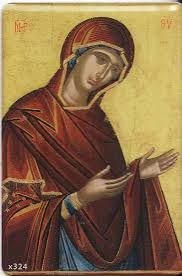
Walking with Wisdom Sophia

Where do you seek wisdom? Do you have overflowing shelves where recently acquired books hide earlier treasures like the nine layers of settlement in ancient Troy? Do you seek teachers trained in ancient wisdom? Select from among the many speakers now available on-line? Or have you been fortunate enough to find a truly wise teacher who leads you inward to your own source of deep wisdom? If so, you have already found Wisdom: She has already found you.

Wisdom is bright, and does not grow dim.
By those who love her she is readily seen,
and found by those who look for her.
Quick to anticipate those who desire her, she makes herself known to them.

Watch for her early and you will have no trouble;
you will find her sitting at your gates.
Even to think about her is understanding fully grown;
be on the alert for her and anxiety will quickly leave you.

She herself walks about looking for those who are worthy of her
and graciously shows herself to them as they go,
in every thought of theirs coming to meet them.

(Wisdom of Solomon 6:12-17 Jerusalem Bible)

Once we come to know and trust our inner “Sophia”, we have a treasure within us, and the eyes to recognize Her everywhere. The wisdom of the ages, of the sages, of the poets and the mystics. takes on a vibrant clarity, a singing resonance, for we have an inner lake that catches the light, reflecting to us the heart of reality.

Rabbi Rami Shapiro’s book, The Divine Feminine in Biblical Wisdom Literature (Skylight Illuminations, 2005) which I have been referencing for the past weeks, has opened my eyes as well as my heart to the myriad facets of Wisdom’s presence in the natural world from its sunlit morning warmth to night’s radiant moonpath stretching across the river, to its wild winds, crashing thunder, its rain suddenly rushing from the skies, a Niagara of unseen source.

Within my own life, I have become aware of a presence of Wisdom, showing me the moonlit way through challenges in relationships, difficulties in my work, small or larger questions of “What now?” or “How next?” … for, as The Wisdom of Solomon assures us:

Even to think about her is understanding fully grown;
be on the alert for her and anxiety will quickly leave you.

I have experienced (as you must have done at times) how a day can suddenly open out in beauty, revealing patterns unseen until that moment, making sense of the journey of our life in ways we had not understood. Two days ago, reflecting on the work I am called to do in Spirituality, I was led by Wisdom-Sophia to Jean Houston’s talk on the fluidity of time from her Quantum Powers course. Following Jean’s guidance, I stood before a curtain of time, allowing a moment in my life I had not understood to reappear.

Eight years ago, I was invited into a new beginning. I have since thought I had missed the moment, had not taken the road shown to me, and somehow lost the gift being offered. Now in a sacred moment, with the assistance of a true Wisdom teacher, I found that the invitation had taken me to just where I needed to be: to this place where I have everything I require for this work among you. I experienced a moment of joy, a recovery of trust, finding the way right here under my feet, a yellow brick road, hiding under a layer of dust, pine needles, dried autumn leaves.

I share this with you, not that you need to know about my life, but that you may know more about your own, learn with Sophia to recognize your path, find the joy of walking in it, companioned by Wisdom.

We live now, as Jean Houston reminds us, in the time of the great confluence, when the wisdom of the ages, from many different sacred traditions, is available to us, along with the newest discoveries of the physicists, who have been called the mystics of our time. What we need is inner guidance to open our hearts to recognize wisdom when it presents itself to us.

Often for me, especially when my spirit is deflated, when the moon of my soul is obscured by clouds, light breaks through with poetry. During such a moment this past week, I came upon these works of Hafiz:


You don’t have to act crazy anymore—
We all know you were good at that.

Now retire, my dear,
From all that hard work you do

Of bringing pain to your sweet eyes and heart.

Look in a clear mountain mirror—
See the Beautiful Ancient Warrior
And the Divine elements
You always carry inside

That infused this Universe with sacred Life
So long ago

And join you Eternally
With all Existence—with God!

(trans. Daniel Ladinsky in I Heard God Laughing)

May you too find that clear mountain mirror within, kneel there beside Wisdom-Sophia and be amazed at what you see, O Beautiful Ancient Warrior, bearer of Divine elements.


Sophia: Beloved Travelling Companion

What was your favourite story when you were a child? Have you reflected on how that story may have influenced your adult life, shaping your longings, your choices, in ways of which you were unaware?

Walking the sand shore by the lake at our Community’s holiday house “Stella Maris”, I have been reflecting upon Rabbi Rami Shapiro’s book, The Divine Feminine in Biblical Wisdom Literature (Skylight Illuminations, 2005). Again and again I found something as old as longing, as fresh and new as a summer breeze. Like this, from the Wisdom of Solomon (6: 15-16)

Resting your thoughts on Her—
this is perfect understanding.
Staying mindful of Her-
this is perfect calm.
She embraces those who are ready for Her,
revealing Herself in the midst of their travels,
meeting them in every thought.

Now, seeking words to convey the wonder, the joy awakened in me, I think of guidance, then companionship, or having a wise friend to turn to in times of doubt or struggle…
A memory comes of summers spent in my grandmother’s home, entering the magic within a heavy, hard-cover book of Hans Christian Andersen’s stories. The tale I turned to over and over again was “The Travelling Companion”.

Like many of Andersen’s stories, it begins with a young person who is sad: John’s father has just died and he is all alone. Before setting out into the wide world, he makes a last visit to the graveyard to say goodbye, promising he will be good and kind, as he, his father had always been.

On his travels, John takes refuge from a storm in a church, where a coffin rests before the altar. To his horror, John sees two men approach the coffin, and open it. From their gruff words, he learns that the dead man owed them money so they plan in revenge to dump his body in a field. John offers the men his entire inheritance from his father if they will leave the dead man in peace. Laughing derisively at his foolishness, they agree.

Now penniless, John resumes his journey. One day, he is joined by a stranger who asks if they might travel together to seek their fortunes. This stranger becomes a companion to John, and much later, after many adventures, guides John to successfully solve magical riddles and thereby win the hand of a beautiful princess.

On the day following the wedding, the stranger, travelling knapsack on his back, walking stick in hand, comes to say goodbye. John is devastated, having hoped his friend would stay with him to share the happiness he had won for him. But the stranger says, “No, my time on earth is over. I have paid my debt. Do you remember the dead man whom the evil men wanted to harm? You gave everything you owned so that he could rest in his coffin. I am the dead man.”

With these words he disappeared.

Somewhere within I have held the longing for such a “travelling companion”, for a friend who would walk with me, guide me, advise me when I was perplexed, comfort me when I was sorrowful, show me how to make my way along the pathways of life as they opened before me.

Through Shapiro’s unfolding of the Wisdom passages in the Hebrew Scriptures, I recognized in Sophia/ Chochma the beloved friend I had sought, the One who

embraces those who are ready for Her,
revealing Herself in the midst of their travels,
meeting them in every thought.

Even more, I recognized that I had already found Her. Through my lifetime, She has come to me in different guises, bearing different names, from Mary to Isis to Sophia to the “Friend” who offers daily guidance in the smaller and greater aspects of my life, walking with me, a light in darkness.

It is she whom I now recognise as the presence who sometimes speaks in the poetry of Hafiz, especially in this one, sent to me by a friend shortly after the death of my sister Patti:

Keeping Watch

In the morning
When I began to wake,
It happened again…..

That feeling
That you Beloved,
Had stood over me all night
Keeping watch.

That feeling
that as soon as I began to stir
You put your lips on my forehead
And lit a Holy Lamp
Inside my heart.
Renderings of Hafiz by Daniel Ladinsky: I Heard God Laughing

Who among us does not yearn for such a presence of love? And yet the beauty of Wisdom-Sophia is that we have only to desire her in order to find her:

Do you desire Me?
Come to Me!
Do you crave Me?
Eat My fruit!
Even the Memory of Me is sweeter than honey,
And to possess Me is sheer ecstasy.
(The Book of Sirach 24:19-20)

Reflecting on these words, Shapiro writes:
When it comes to Wisdom let your desire guide you. Take Her and eat of Her and do so without reserve or hesitation. She wants you to want Her, and desires to give Herself to all who hunger for Her.

And if we fear losing her, or even if we know we have in the past both found and lost, Shapiro encourages us that the Memory of Her love will stay with us and push us to seek Her again…. Her gifts of simplicity and grace cannot be matched. And when we receive them, the narrow self is overcome with joy and the spacious self unfolds in bliss.

For each one of us, May it be so! (And so it is!)

Coming to Know Sophia

We come away from the magic of the Storyteller’s Well on the Hill of Tara. It is time for us to seek Sophia’s Wisdom in other places, in other times, through other voices.

Our guide for the next few weeks will be Rabbi Rami Shapiro speaking to us through the pages of his book, The Divine Feminine in Biblical Wisdom Literature (Skylight Illuminations, 2005).

In his Preface, Rabbi Shapiro tells of being pursued by the Sacred Feminine:
I began to see her everywhere. She started talking to me….She intruded on my meditation and prayer time, and just would not leave me alone….She had me. I would go for walks late at night and talk with her.

His friend Andrew Harvey advised that he had best surrender, adding: “She calls to everyone, and to ignore her is to ignore the greatest gift you may ever be offered: the passionate embrace of the Mother. She is going to hound you until she has you, and then She is going to strip you of all your ideas and notions until there is nothing left to you but the ecstasy of her embrace.”

Yet still Shapiro struggled, for it seemed to him that the presence was the Virgin Mary, someone he could not commit to as a Jew. Andrew said to me, “It isn’t Mary, but the Mother. She comes to the Christian as the Blessed Virgin; She comes to you as Chochma, Mother Wisdom.” And with that my whole life changed.

Shapiro writes: Chochma, the Hebrew word for “wisdom”, is the manifestation of the Divine Mother as She appears in the Hebrew Bible. She is the first manifestation of God, the vehicle of His unfolding, the Way of nature, the way God is God in the world you and I experience every day. Seeing her as Chochma removed the last of my defenses. I stopped running away, and gave myself to Her as best I could.

As he began to share Her teachings as found in the Jewish Wisdom Literature of the Hebrew and Greek Bibles, Shapiro found his listeners “began to relax”, not because he had made Her ”kosher” but rather because “what they heard in the text was what they somehow already knew in their hearts”.

As you read the teachings of Mother Wisdom, know that She is speaking to you, inviting you to Her home, to Her hearth, to her teachings that you may become a sage….Wisdom is taught, so the student needs a teacher, but once She is learned there is a great levelling: Teacher and student share the same understanding. (from the Introduction)

As Shapiro began to move through the Hebrew Scriptures, citing passages, reflecting upon them, I also felt I was hearing what I “somehow already knew in (my) heart.”

See if this is also how it is for you.

 In the Book of Proverbs, Wisdom/ Sophia/ Chochma speaks:

The Lord created Me at the beginning of His work, the first of His ancient acts.
I was established ages ago, at the beginning of the beginning, before the earth…
When He established the heavens, I was already there.
When he drew a circle on the face of the deep,
When He made firm the skies above,
When he established the fountains feeding the seas below…
I was beside Him, the master builder.
I was His daily delight, rejoicing before Him always.
Rejoicing in His inhabited world, and delighting in the human race.
(Proverbs 8: 22-31)

Shapiro writes that “Chochma ….is the ordering principle of creation”:

She embraces one end of the earth to the other, and She orders all things well.
(Wisdom of Solomon 8:11)

To know her, Shapiro adds, is to know the Way of all things and thus to be able to act in harmony with them. To know the Way of all things and to act in accord with it is what it means to be wise. To know Wisdom is to become wise. To become wise is to find happiness and peace:

Her ways are ways of pleasantness and all Her paths are peace. She is a Tree of Life to those who lay hold of Her; those who hold Her close are happy. (Proverbs 3: 17-18)

Moreover, writes Shapiro: Wisdom is not to be taken on faith. She is testable. If you follow Her you will find joy, peace and happiness not at the end of the journey but as the very stuff of which the journey is made. This is crucial. The reward for following Wisdom is immediate. The Way to is the Way of.

Shapiro teaches that the key to awakening that is Wisdom is having a clear perception of reality. Wisdom does not lead you to this clarity; She is this clarity….The Way to Wisdom is Wisdom Herself. You do not work your way toward Her; you take hold of Her from the beginning. As your relationship deepens, your clarity of seeing improves, but form the beginning you have Her and She has you.

I am my Beloved and my Beloved is mine. (Song of Songs 2:16)

Chochma is not a reluctant guide or a hidden guru, Shapiro writes, She is not hard to find nor does she require any austere test to prove you are worthy of Her.

She stands on the hilltops, on the sidewalks, at the crossroads, at the gateways (Proverbs 8:1-11) and calls to you to follow Her. Wisdom’s only desire is to teach you to become wise. Her only frustration is your refusal to listen to Her.
….To know Wisdom is to be her lover, and by loving Her, you become God’s beloved as well.

In our becoming partners, co-creating with Wisdom, Shapiro writes:
Wisdom will not tell why things are the way they are, but will show you what they are and how to live in harmony with them….Working with Wisdom, you learn how…to make small, subtle changes that effect larger ones. You learn how to cut with the grain, tack with the wind, swim with the current, and allow the nature of things to support your efforts. She will not tell you why things are the way they are, but She will make plain to you what things are and how you deal them to your mutual benefit.

Sophia in Ireland: Twelve

crone
The Storyteller looks at us expectantly after ending her tale of Midir and Etain. Shall I leave you now to speak with one another about this story, about transformation in Etain’s life and in your own?

Something in our expressions seems to give her our response.

You don’t feel ready to speak of it? Why ever not, my dears? Have I been all this time with you and you still do not understand? It’s a story of desire. You know well that Celtic mystic, Julian of Norwich, how the Holy One told her, “I am the ground of your desire, the cause of your longing…” and sure haven’t you been reading all about the physicists, how they found that the caterpillar in her cocoon becomes a soup of cells, how the imaginal cells conquer the older caterpillar cells to transform into a butterfly as Etain becomes a purple fly of wondrous size? And then in the womb of Etar‘s wife… Or is it the final transformation you don’t understand… because you have not yet experienced it… the transformation by love into Love?
Do you want me to speak with you about this? to teach you the deeper hidden meaning in the story?

Storyteller looks serious, pauses, considering.

Very well… there is a poem by Hafiz that begins to tell of it.

There is something holy deep inside
Of you that is so ardent and awake
That needs to lie down naked
Next to God.

Hafiz has given you all the teaching you require. His poem speaks of love, the passionate love of the Holy One for you. Hafiz is teaching you of that immense longing for union that is at the deep heart of this story, the longing that kept Midir seeking Etain for a thousand years, giving finally his riches and his labours after losing in the chess game so that he might contrive a way to win her at last from Eochaid. The One whom Hafiz calls the Friend, the Beloved, or sometimes God, is the Holy One who yearns so deeply for you, who is so drawn by your longing that he/she comes to where you dance alone, ready to lift you into the arms of Love. The One who loves you is as full of passion, patience and longing as Midir is for Etain. But there is yet more… Hafiz teaches you one more secret. There is deep within you something so sacred, so holy, that it needs to lie down naked next to God…

The Storyteller adds, with a light playful tone: I could have told you all of that myself when you asked but Hafiz is the better poet.

Now do you understand the story? This is a story of human hunger and longing for love, for deep union. This is a story of the yearning that draws flesh to flesh, that is the allurement that is at the heart of all of life, at the heart of the sacred seeking that first sent humans in quest of the Holy. They sought her among the stars when all the while she lay hidden in the depths of the earth or in the deep sea, in the atoms, the cells, the very stuff of their own bodies.

There is utter silence in the well after she says this.

A listener’s voice breaks through the silence with a question: “Who are you?”

The Storyteller laughs merrily at the question, then says:

Bring your cup and I will pour out God.

In response to our expressions, she adds: Of course that too is Hafiz! Haven’t I told you just now? He’s a better poet than I am.

But another among us asks: “But who are you really?”

The Storyteller begins to sound impatient: Do you still not understand? Why not ask instead who Etain is in the story? In Ireland we name her Aine, or Danu, a name that comes from Anu, the Great Mother of the ancestor gods of the Irish. Aine is ancient and known by many names. She is the womb of life, the vitality in your veins, the sun in your cells. Her breasts are the two hills called the Paps of Anu in Ireland. Her hair flows like the waves, ripples gold like corn. Her eyes hold the starlight, her belly the tors, earth barrows that birth you. Like the cat, the owl, the sow, she eats her young if they are sick or dying. Aine is the cycle of life, the wheel of the seasons. 

We look around at one another, to confirm that we are all feeling the same frustration. A third person speaks: “We don’t want to hear about Aine or Danu or Etain or anyone else just now. Please just tell us who YOU are. “

The Storyteller responds: You want to know who I am?

I am every particle of dust and wheat – you and I
Are ground from the Holy One’s Body. I am rioting at your door;
I am spinning in midair like golden falling leaves
Trying to win your glance.
I am sweetly rolling against your walls and your shores
All night, even though you are asleep. I am singing from
The mouth of animals and birds honoring our
Beloved’s promise and need: to let
you know the Truth.

Storyteller: (examining our faces, reading our expressions) Yes, of course, that, too, is a poem from Hafiz.

One of our group speaks to us with conviction: “We will learn nothing more from the Storyteller today. We may as well leave the well, return to the surface now.”

We begin to stand, to move to the edge of the pool, preparing to swim across to the opening into the well. Some of us have begun swimming upwards to the surface when the Storyteller calls out to us:

Wait!! Are you leaving? Like this? You haven’t said goodbye…..

The Storyteller begins to follow, reaches out, drops her arm, lets us go.


Sophia in Ireland : Seven

Deep within the well on the Hill of Tara, the Storyteller continues her tale:

Etain and Midir stayed together in the Brugh with Angus for a year and a day, sporting and playing chess for precious stones, drinking the choice wines and listening to the music of Angus’ three half-brothers, the sons of Boann, his mother, who were called “the Fair and Melodious Three”. Their names were Goltraiges, Gentraiges and Suantraiges, and the harps on which they played were of gold, and silver, and white bronze, with figures of serpents and birds and hounds wrought upon them. When Goltraiges played the Music of Weeping, twelve warriors of the household died of sadness, but when Gentraiges played the Music of Smiling, the Brugh was full of gladness and laughter, and when Suantraiges played the Music of Sleeping, there were gentleness and peace in the House, and in all Ireland the women whose time was upon them gave easy birth, and no animal was fierce in all the land. And so the days and the nights of the year passed, and sweet was the intimacy of Midir and Etain, and fond their espousal.

When the time came for them to return to Bri Leith, Angus, embracing them, said to Midir: “Take care, Midir, of Etain, for your wife awaits you at Bri Leith, and Fuamnach is a dreadful and a cunning woman.”

The warning of Angus was timely, for when the lovers returned, Fuamnach came out to meet them. With cleverness, she put them at their ease. She talked to Midir of his House and household, of his lands and herds, and of his people, but later, when Etain was in her chamber alone, combing her hair and waiting for Midir, Fuamnach came to her and struck her, as she sat, with a rod of scarlet quicken-tree. Etain, on the instant, became a shining pool of water in the centre of the room.

In triumph, Fuamnach went to Midir and told him what she had done, and moreover, swore that she would harm Etain for as long as she lived, and in whatever form she might be. Then she left Bri Leith and returned to the House of her foster-father, the wizard Bresal. Midir, without solace, and lonely, left his House to wander over the far lands.

Meanwhile the crystal pool that was Etain dried, rolled itself together and became a small worm, and because Etain was lovely and full of joy, the worm turned into a beautiful purple fly, of wondrous size.


images (1)

(S)weeter than pipes and horns was the sound of her voice, and the hum of her wings. Her eyes would shine like precious stones in the darkness, and the fragrance and bloom of her would turn away hunger and thirst from anyone around whom she would go, and the spray that fell from her wings would cure all sickness.

She longed for Midir, and when she had tried her wings and gathered strength, she flew to the far reaches of Bri Leith, and when she came to him, Midir knew that the lovely purple fly was Etain. Everywhere he went, she attended him, and while she was there he took no other woman, and the sight of her nourished him, and the sweet sound of her humming would send him to sleep, and Midir would neither eat nor drink, nor dance, nor play the chess game, nor hear any other music, if he could not hear the music of her voice, and the sound of her wings, and he could not see her and smell the fragrance of her.

But soon Fuamnach discovered the happiness of Midir and Etain, and forthwith she came to where they were. Midir tried to protect his love, but the witch-power of Fuamnach prevailed, and straightway she began to chant a powerful incantation, and they could not see each other, and she raised and stirred up a great evil wind of assault,  strong and irresistible so that in spite of their love, and of all the arts of Midir, Etain was taken up and swept away from the fair familiar mound of Bri Leith.

Fuamnach put upon her further that she should not light on any hill or tree or bush in the whole of Ireland for seven years, but only on the sea rocks, and upon the waves themselves. Whenever Etain, faint and exhausted tried to settle on a shrub or a land rock, the evil blast blew her upwards and away, and she had no respite and no rest until, seven years to the day, she alighted on the golden fringe of Angus Mac Og’s tunic as he stood on the Mound of the Brugh. 

 “Welcome,” he said. “Welcome, Etain, weary and careworn, who has suffered great dangers through the evil of Fuamnach.” And the Mac Og gathered the tired purple fly into the warm fleece of his cloak, and to his heart, and he brought her into his House. And Angus made a sun bower for Etain, with bright windows for passing in and out, and he filled it with flowers of every hue, and wondrous healing herbs, and the purple fly throve on the fragrance and the bloom of those goodly, precious plants. Angus slept in the sun bower with Etain, and comforted her, until gladness and colour came to her again, and wherever he went, he took the sun bower with him.

Sophia in Ireland : Six

The Storyteller in Tara’s ancient well begins her tale of “The Wooing of Etain” while we sit rapt in silence within the red rock cavern beneath the well on Tara’s Hill.

In the early days when the children of the Goddess Danu, the Fairy gods, were defeated by the Sons of Mil, they agreed to make their vast and beautiful dwelling places inside the mountains and under the rivers and lakes of Ireland. The High King of the Fairy gods was the Dagda. He played upon his wooden harp to make the seasons to follow one another. He commanded the winds and the rains and the crops. His people called him “the good god”.

According to ancient custom, the Dagda sent his son Angus Mac Og to be fostered by Midir, the proud Fairy King of Bri Leith.

Midhir1


Angus’ companions were thrice-fifty of the noblest youths in Ireland and thrice-fifty of the loveliest maidens, and for all their great number, they all lived in one House. Their beds had columns and posts adorned with wrought gold that gleamed in the light of a precious stone of great size, brilliant in the roof at the centre of the House. Angus was leader of them all, for the beauty of his form and face and for his gentleness. His days were spent in the Playing field, in feasting and tale-telling, in harping and minstrelsy, and the reciting of poetry, and every youth was a chess player in the House of Midir of Bri Leith.

Angus stayed with his foster father for nine years, then he returned to his own sid, Brugh on the Boyne.

One year to the very day of Angus’ departure, Midir, lonely for his foster son, decided to visit him. He put on his white silk, gold-embroidered tunic and his shoes of purple leather with silver-embroidered tips. He fastened his purple cloak of good fleece with the golden gem-encrusted brooch of Bri Leith, that reached from shoulder to shoulder, in splendour, across his breast, and on the Eve of the autumn Feast of Samhain, he came to the Sid of Angus Mac Og, at Brugh on the Boyne.

The Mac Og was standing on the Mound of the Brugh, watching two companies of his youths at play before him. The first company rode horses of purple-brown colour, and their bridles were of white bronze, decorated with gold, and the horses of the second company were blue as the summer sky at early morn, and they had bridles of silver. The battle sport was joyful, and the air was filled with the clash of arms, the clean ring of metal against metal and the lusty, clear-voiced challenging cries. Angus embraced his foster-father with delight, and they watched the play together, until, inadvertently, Midir was hurt in the eye by one of the youths. Though he was cured by the Dagda’s Physician, he was angered, and demanded satisfaction. Angus readily agreed.

If it is in my power,” he said, “it is yours. What is your desire?”

“The hand of Etain who is the gentlest and loveliest in all Ireland.”

“And where is she to be found?” Angus asked.

“In Mag Inish, in the North East. She is daughter of the Fairy King Aylill .”

“Then it shall be so,” the Mac Og said, and at the end of the feasting he set out over the soft, cloud-bright fields of our many-hued Land, and came to Mag Inish, in the North East.

Aylill the King demanded a high bride-price. “I will not give my daughter to you except that you clear for me twelve plains in a single night,” he said, “and furthermore, that you draw up out of this land twelve great rivers to water those plains.”

Angus, knowing he could not himself accomplish these feats, went to his father, the Dagda, who, of his great power, caused twelve plains to be cleared in the Land of Aylill, and he caused twelve rivers to course towards the sea, and all in a single night. On the morrow, Angus Mac Og came to Etain’s father to claim her for Midir.

“You shall not have her till you purchase her,” Aylill said.

“What do you require now?” Angus asked.

“I require the maiden’s weight in gold and silver,” Aylill answered and the Mac Og said: “It shall be done.” And forthwith he placed the maiden in the centre of her father’s House, measured the weight of her in gold and silver, and leaving the wealth piled up there on the floor, he returned to Brugh on the Boyne with Etain, and the ancient manuscript says, “Midir made that company welcome.”

Etain looked into Midir’s eyes, and that night she became his bride.

We have time to reflect on this story while we wait to hear how it continues. The Storyteller promised a tale of desire and longing. Did you notice that when Midir was asked what he desired in compensation for an injury, he knew at once the deepest longing of his heart was to wed Etain….

What of us? If you were offered your heart’s deepest desire would you know at once what to request? Think about this and write in your journal about the desires of your heart. Our desires and longings lead us to the true path for our life.


Sophia in Ireland: One

Tara_3_Hill[1]

Twice seven years ago, I stood on the Hill of Tara in County Meath, Ireland.

I cried out for a presence in the mist, called out to the Old Ones. I was wearied beyond words, beyond telling, with the calcified religion that had swept through Ireland, drying up its Holy Wells, its Sacred Springs, its flowing Streams of laughter, song, magic, stories. That night on Tara Hill, I called out to the magic ones, the pagan ones, the holy ones, the ones the Druids worshipped.

But no one answered.

I tasted the mist, let the fog penetrate my lungs, let the mystery enfold me.
And still no one came.
“There is nothing left here.” I knew it in my very soul.
My companion appeared out of the shrouding fog, his face suddenly clear before me. He gestured towards the thickening gloom. “We’d better drive back before the road becomes dangerous.”

A few days later, I travel to the Wicklow Hills, to Glendalough, site of Kevin’s sixth century hermitage. Legend says that Kevin held his arms outstretched in prayer for so long that a blackbird nested in his hand. He stayed in that position until her eggs were laid and hatched. Fifteen hundred years later, Ireland’s poet laureate Seamus Heaney praises Kevin:

he prays
A prayer his body makes entirely
For he has forgotten self, forgotten bird
And on the riverbank forgotten the river’s name

By the lake at Glendalough, Kevin’s hermitage grew into a monastery that lasted a thousand years. Here I meet a teacher of Celtic Christianity. After twenty years working in Africa as a missionary priest, Michael Rodgers has returned to Ireland to teach his own people their forgotten ways. He guides us by a stream under dark oaks, and invites us to consider our journeys in life, what we seek. He walks with us by the base of the cliffs and invites us to call out our questions, and hear them echoed back to us. The answers are within, he says.

I think about my house beside the Ottawa River, where a piece of ancient Ireland hangs on the wall. A gift from my sister, it depicts in grey pottery what appears to be a woman on a cross. I want to like this shiveringly new/old image, but try though I may, I cannot feel close to it.

CrucifixL


I hope that in Ireland I will find the elusive ancient holiness that welcomes and embraces the feminine; I want to find a spirituality that speaks to my life as I experience it. I want to read my way back into the story.

We gather inside the shell of the monastery where the singing stones hold memories of those who left all to seek all, and add our prayers to those prayed here for a millennium. Michael tells us that the monasteries were the beating hearts of villages where people gathered to live their lives close by their “soul friends”. Each monastery was its own centre, shepherded by its own abbot, with its own rule. Of the eight remaining Books of Rule from the old monasteries, six are written in poetry.

The Celtic cross is surrounded by the ancient feminine symbol of the circle, sign of the interconnectedness of all of life, the rhythm of the seasons, the life/death/life cycle. Michael tells us that Celtic Christianity was cross-centred, focussed on the person of Jesus. His suffering gave hope to a people who felt the nearness of God so intimately that their breaths commingled with those of Jesus, his light pierced the darkness of their days and his compassion reached into the most earthy needs of their lives as they prayed.
An early Celtic prayer asks:

May Christ and Mary
Go with us the length of the road;
May our journey not be in vain
But may every inch of it be for our good.

The next day, I walk the three miles from my lodgings to return to Tara, finding in sunlight what the mist had obscured, the high stone that once sang in recognition of the one who would be High King of Ireland. The guide tells of Patrick’s visit here to the High King Laoghaire in 433 AD. seeking permission to bring the teachings of Christianity to Ireland.

“I do not understand this religion,” the king responded.

Patrick then stooped down and picked a three-leafed plant, and began to teach the king about the Trinity.

”Look down at your feet,” our guide says. We are standing on shamrocks.

On the lip of the Hill of Tara, there is an old building whose stones are full of stories and poetry. Inside, I find a small book called “Legends of Killarney” by Crofton Croker, written in 1828. I will be travelling to Killarney. Now, I have a guide.

But on the following day, as I settle into my seat on the BusEirann, I sink into a fug of uncertainty about my faith. No pre-Christian magic reached out to me on the Hill of Tara and what I am hearing about early Christian Ireland is captivating my heart against my will and my better (feminist) judgement. I look at my hands, where a hot rash had been raging the day before, until I bathed them in Patrick’s Holy Well. They are clear, as are my eyes, which had been red and itching with allergies, until I splashed the cool spring water over them. In the background I am aware of old American tunes on the BusEirann radio. A woman’s voice sings, “I’m your lady . . .” I notice this only because of a strange conjunction as we pass under a stone viaduct. Someone has chalked in large letters, “I love you, lady.” I sit wondering, feeling comforted.

I open the small worn Croker and read of the beauty that awaits me. By the time we reach Killarney, some six hours and two buses beyond Dublin, I know enough of the old legends to look forward to my exploration of the same lakes and islands that he saw nearly two centuries earlier. I will see them with his eyes as well as my own, peopled with the characters he met and full of the stories he recorded: of the old monk who travelled from Innisfallen to Mucross for the annual purchase of wine, and fell asleep for a hundred years, waking to find that spring had become winter. He seized a boat to return to Innisfallen where he found his monastery owned by strangers, and monastic life dissolved by Dublin parliament in harmony with Henry V111’s wishes. I read of enchanted wolves and lost treasure and strange battles and heart-rending loves.

I begin to trust that every inch of the journey will be for good. So I am not surprised to find that the hotel booked for me on Killarney’s main street has the beauty and comfort of long-polished wood, and my seat in the dining room is beside the illustration from the Book of Kells of the author of the Gospel of John, the Gospel most loved by the Celts.

(to be continued)

Sophia in Egypt: Thirty-Six

Following the Ritual of Blessing and Anointing by each goddess, Ellyn speaks in her role as Hathor: “We will now give bodily expression to the joy within us as we dance to the music of Tchaikovsky’s Sleeping Beauty. Our dance will be an awakening to new life.”

As the last chords of the magnificent music fade, the dancers, like graceful glass figures adorning music boxes, slowly swirl down to stillness, each standing alone, scattered across the room.

A new voice speaks. She does not identify herself as a goddess.There is no need. The women in the room know this voice, a voice that has guided them through many deep journeys.

Jean Houston speaks: “I invite you now to join with your essence self, your own higher patterning, that dynamic purposive self to whom you are connected. Raise your hands, palms outwards, to connect with that essential self, who loves you, who honours you, who charges you, who cherishes you, and in whose presence you are utterly known, deeply loved, empowered, affirmed, enhanced. Let the connection be so close that you and the entelechy become one.

“Now, breathing from the heart space with this enhanced self, think of two people in this room. From your heart space make a bonding with them. Now ask those two people to make a connection with two people who are not in this room, and at the same time, you make a connection with two people who are not in this room, perhaps people back home, and you ask them, through the heart space, to make a connection to two others and they to two others and they to two others and they to two others and in a few moments, it is true, literally everyone in this world is now connected through your heart space.

“Now think of two creatures, two animals that you know and love, and because it’s heart space, it transcends language but the intention to them is to connect with two others and they to two others and they to two others until finally all sentient creatures are connected.

“Now connect with two plants or trees from the heart space, and know that they are connected to two others, and they to two others and they to two others and in a moment all of earth and all its creatures are connected.

“Now speak to our beautiful planet and ask her to connect with two other planets and they to two others, all from the heart space, and they to two others and they to two others until all the planets in this part of the galaxy are connected.

“Now speak to our sun, our sun who has a deep relationship with all the other suns, and invite it to connect with two other suns, and they to two others and they to two others. Now the 100 to 200 billion suns are connected.

“Speak to our galaxy, from your heart space, and ask our galaxy to connect with two other galaxies, and they to two others and they to two others and soon what is now known to be about 190 billion galaxies in our universe are connecting.

“Now ask our universe to connect to two other universes, in your heart space, and they to two others and they to two others and very soon all known and unknown universes including their multiple dimensions are connecting.

“And now you find that you are connected to what some call God or the cosmos, and you are connected to the mind and heart of all being and the mind and heart of all being is connected back to you in your heart space, and the mind and heart of all being is sending this loving resonance to you and through you to all the creatures and beings and planets and dimensions in all the universe, and they are flowing back to you with love and affirmation and deep knowing. And you can feel your own head and heart and beingness in this great expansion, so that you are now from this moment forth hyper-connected in the great hologrammatic universe. You are ubiquitous through the stars. All of reality shines back in and through you and from your heart space to all of reality and from all of reality back to you. And you are bonded in this deep empathy, in this exchange of essence with all others.

“In the future when you need to connect at a deeper level, do so in this manner, connect with the universe through your heart space and then with a particular human person, one with whom your soul requires to connect. This connection is now amplified through your entelechy to their entelechy, through that which transcends any negativity or any difficulty or alienation. From this day forward, whenever you need to, you may connect in this way, through your entelechy to their entelechy, to a particular life, to all of life.”

And now another loved voice speaks, one that evokes memories of many rituals in Egypt. Peg says, “I offer you, as a blessing and as a summons, the words of the poet Rainer Maria Rilke. I give them to you as though they are coming to you from the great Goddess, the Holy One to whom our lives are now given. This is her blessing as you go forth from here, with your life-made-new.”

You, sent out beyond your recall,
Go to the limits of your longing.
Embody Me.
Flare up like flame
And make big shadows I can move in.
Let everything happen to you: beauty and terror.
Just keep going. No feeling is final.

Don’t let yourself lose Me.
Nearby is the country they call life.
You will know it by its seriousness.
Give Me your hand.

This concludes the series of excerpts I have shared with you from my book,
Called to Egypt on the Back of the Wind. To order your own copy, simply contact:
http://borealispress.com

Thank you for sharing the Mysteries of Egypt with me. Next week, on this blog, we begin a new series of reflections: “Sophia in Ireland”. We will be exploring the Sacred Feminine as she was known and honoured in Ancient Ireland, as she is known and honoured today.

Sophia in Egypt Thirty-Five

Epilogue of Called to Egypt on the Back of the Wind

It is night. It is always night when a story is told. But this night is part of the story, envelops and transforms it, embraces the ending.

The room holds the darkness gently, the darkness holds the women. The room watches as they take their places. To the east, near the altar where the gold statue of the Buddha sits smiling, unconcerned, the woman stands who is to portray Isis, goddess of new beginnings. To the south against the high windows that receive the morning sun, stands the one who will speak for Sekhmet, the goddess with the fire of the south in her belly. To the west, just at the entrance doors, stands the one who will portray Nephthys, the goddess of the in-between times, of the subtle energies that weave in and out of dream time, connecting our sleeping and waking. To the north, beneath the tall windows, stands the woman who is to play Ma’at, the goddess who envisions our lives from beginning to end, who will at death weigh our hearts on a scale against the weight of the ostrich feather which adorns her hair, Ma’at who portrays honesty, integrity and balance. And in the centre, at the heart of the circle, stands Hathor, the goddess of love and joy. An inner circle of women surrounds Hathor, facing outward, towards the four directions. In darkness, in utter silence, they stand, waiting.

The room does not see goddesses. It sees only women. In seventy-five years, it has seen so many others come and go. First, all the men, then women and men together, now only women in a circle. The room sighs, feeling bored, unaware of the story, unimpressed with its quiet ending.

A light flares in the centre of the room, and in moment a tall candle is illumined. A voice speaks. “Tonight, I am Hathor, goddess of love and joy. I welcome you here to celebrate the gifts of our time in Egypt. Tonight we remember with joy all that we have received. We open our hearts to the gifts, to the promise, and to what may be asked of us in return. I invite you now to look towards the east, to the place of beginnings.”

goddess-hathor

The Goddess Hathor

A second flare of light and a second tall candle is illumined. A voice speaks. “Tonight, I am Isis, goddess of beginnings. I am the divine power in the womb of my mother Nut. The day of my birth is called the Child Who Is in Her Nest. I am she who finds fruit in the field. I am the mother of Horus. I am she who rises with Sothis, the star that heralds the flood. I am Queen of river, wind and sea. As goddess of beginnings, I call upon you now to dedicate to me your womb, in readiness to receive the seed of new life that the world hungers for.

image of goddess Isis

The Goddess Isis

Will you open yourself to be filled with the life that is needed for your time in history? If you are willing, come forward now, and I shall anoint your hands with the sacred oil of cedar for spiritual strengthening.”

When the anointing is completed, another light flares, another tall candle is illumined, this one beneath the windows on the south side of the room. A voice speaks. “Tonight I am Sekhmet, ruler of the element of fire. I stand in the south where the sun’s fire is strongest. My name means mighty, powerful one. My heart burns with the courage of conviction. I represent the strength of will power. My ennobled passions are best used for healing and preserving others. As goddess of fire, I call upon you now to dedicate to me your belly and back, source of spiritual fire and power.

XIR218945
The Goddess Sekhmet

Will you open yourself to be filled with the courage and strength required to heal and preserve life on this planet at this potent time in history? If you are willing, come forward and I shall anoint you with the lotus, drawn from the water lilies of Egypt, offered for protection in the heart.”

Now a fourth light flares, and a fourth tall candle is illumined, this one on the west side of the room. “I am Nephthys, and I stand in the west, the place of the sunset, the place of what is passing away into other realms, for I am mistress of the in-between, the subtle energies. My creativity arises from the unconscious, for I represent dreams, ideals, psychic receptivity and the unknowable. I stand at the end of the finite world, the bridge to infinity. I am the one who illumines the dream time, who draws together the invisible threads that unite the seen and the unseen worlds. I am goddess of sympathy and self-sacrifice, opening my life to embrace the sufferings of others, and to ease their pain with the light of what I see. My ears hear the messages of the divine, and my throat speaks the words I hear in gentle songs of hope.

Nepthys wsith edits

The Goddess Nepthys


Are you willing to open your ears to hear the sounds from deep within you, and to speak what you hear to give hope to the people of the planet? If you are willing, come forward and I shall anoint you with the oil of the bay leaf for purification and psychic awareness.”

On the north side of the room, a fifth light flares, and another woman speaks. “I am Ma’at, goddess of justice, honesty, integrity. I stand in the north, the place of transformation, for I represent the divine principles of cosmic order and law. I offer the gifts of harmony and balance, a life on this planet that will be transformed when it is lived in truth. On my head, I wear the ostrich feather of truth that is placed in the balance of the scales of justice when the heart is weighed in the Underworld.

maat_cropped

The Goddess Ma’at

Are you willing to open your heart to me that it might become the heart of Ma’at, by living in truth and keeping your life in balance? If you are willing, come forward and I shall anoint you with the oil of the rose for the gift of an enlightened heart.”

Now Hathor speaks once more. “We have opened ourselves tonight to be bearers of new life in our wombs, fire in our backs and bellies, wisdom in our ears and throats, the light of justice in our hearts. As goddess of joy and love, I invite you now to open your eyes to be the eyes of Hathor, eyes that shine in the darkness and see love and joy in all things. Come forward to receive the blessing of the sacred oil of freesia, for love, peace and gentleness.”
(to be continued)