Category Archives: Uncategorized

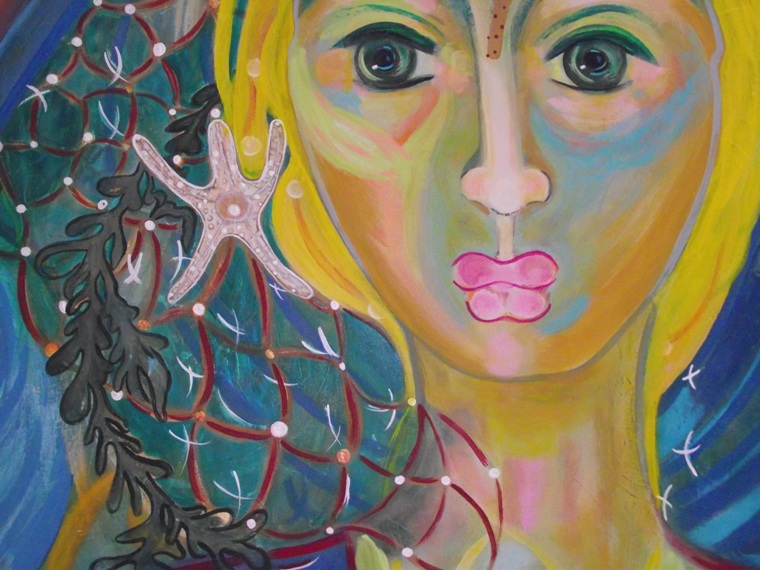
Marauders and the Mistresses of Water

Goddess of Healing by Flo Schell

Jean Houston forwarded this article by anthropologist Carla Stang about the archetypal dynamics of the War in Europe:

As an anthropologist I take a long long view of this war and what I see is something stunning. This conflict is an echo of a thing terrible and crucial that occurred in exactly this place in ancient times, and which has been reverberating ever since. It’s little known that 7000 years ago western Ukraine was the cradle of Europe’s first civilisation, and in three waves it was invaded by people of the steppes of Russia and southeast Ukraine. The subjugation of this civilisation and the destruction of their peaceful, egalitarian way of life set the course for Western culture as we know it, that is to say, the culture of the West that we inherited is a culture of marauders.

It is no surprise then that we are outraged to our bones. We are witnessing the playing out of a primordial nightmare, the seed of the blasted tree that would grow into a history of misogyny, war and the horrors of colonialism. Which means what is being fought for is nothing less than the redemption of European culture, an ancient European culture which cherished the earth, children, women along with men, art and peace, a culture which was not only vanquished but purposely hidden and forgotten, which still grows its tendrils through present day Ukraine. In a sense what is being fought for is what the West once was, what barely survived of it and what could be once more.

Let us first remember.

Before the ziggurats and pyramids there existed from 5500 – 2750 BC the megasite cities of the Cucuteni-Trypillia or the Tripolye or Trypilsti people, with a population that at its height exceeded one million, in an area that extended through Bulgaria, Moldova, Romania and Ukraine. The largest of these settlements was in Ukraine near Kyiv and reached the size of medieval London.

Why is this not widely known? Why do the textbooks and Google say that the first complex civilisation was in Mesopotamia? First because the initial archaeological finds in 1885 occurred after those of the civilisations of Sumer and Ancient Egypt. Then because the research which the Soviets funded at first was then silenced by them because the finds did not fit with their ideology, research was stopped, archaeologists were convicted of being spies and many fled to other countries.

In the last few decades since communist rule, there has been a tide of scholarship and interest. What has been found continues to be astonishing and confounding. These huge settlements do not fit with theories about the Neolithic and about urbanisation. The sprawling settlements incorporated the rural into the urban, rather than being one or the other. And the intricate and sophisticated way they did this defies long held ideas of Europe as having nothing but a smattering of small, warring tribes.

“Under the earth were strewn thousands and thousands of images of woman” – Vikentiy Khvoika

Large well-made temples and houses, 90 foot quarries, trade routes, supply chains, inventories. Agriculturalists, potters, blacksmiths, gold and coppersmiths and weavers. The largest burial of worked gold ever found anywhere. And everywhere images of throned women, and images of men with exquisite expression, carvings of stone so beautifully made one can see the tenderness of the hands that hold the baby. Every object used in every aspect of life is lovingly ornamented.

Earthenware, ceramics, pottery, tools, vessels, dishes, pottery moulds, internal walls of houses painted in varying earth-colours, white, red, ochre and black, and sometimes carved with incisions or encrusted with symbols of nature sun, moon, stars, rain, snakes, birds, bulls, trees, branches, seeds, flowers, water and with magical symbols circle, teeth, rhombus, crosses, endless meanders, snake-pattern.

I could go on and on about this culture where nature entwined and pulsed through every aspect human life. But for brevity’s sake let us continue and add that this was a culture which depicted councils as concentric circles of throned women. And rituals of initiation, fertility and farming by women and men who venerated before all others the goddess in forms of crone, lover, mother and young maiden, bird and serpent but also the animal-masked god-man, ecstatic dancer, the one-eyed ancient one and the divine child. No images of war. There were no slaves. And the priestess and priest who wore the gold at public events went home to an ordinary house.

From around 3000 BC in successive waves down came the Proto-Indo-Europeans, riders on horseback. And conquest included the things we have learned to be familiar with, murder, rape, deliberate obliteration of local culture. In this way the semi-nomadic pastoralists of the steppes, carrying with them their sky gods and patrilineal and patriarchal social systems, destroyed the great Neolithic civilizations of the 4-5th millennia. I wonder at how many cultures the survivors seeded elsewhere (I know of a few), in how many of us ancestral memories stir, and how far these survivors were flung.

But archaeologists agree too that the land of the Trypiltsi has been tilled without cease since these ancient times, and just as under this earth the lives of the Trypiltsi were preserved, so were they in the people of Ukraine, the celebration of singing children and men, of nature and powerful women, flower on clothing and stove, the meandering line of water on the wall, beliefs and attitudes that just would not die.

May the people of the Mistresses of Water wash the Marauders away, and may the West find the spiralling way back to the dream before the nightmare, of the beauty of what it might have become and could become again.

Seeking Love at the Heart of the Universe

In these lingering winter days of February amidst an ongoing pandemic, darkened by protests in Canada and political unrest around the planet, we need more than Valentines. This “winter of our discontent” calls out for an exploration of Love at the Heart of the Universe.

We begin with Mary Malone’s poem inspired by the writings of a Medieval Beguine: Hadewijch of Brabant.

Woman God of my Heart,

It is You I know,

You who beckon me into the nameless nights.

By day I scrabble for love

As the little birds of winter scrabble for grain.

But in the night of unfaith,

the long, nameless night,

it is You,

Woman God of love,

it is You,

 Woman love of God

that dares me

to open my soul to Your womanly caress,

to expand, blossom, breathe

in the darkness.

Woman God of my Life,

You summon me to newness.

Don’t let newness escape.

She the Lover comes,

She the Lover goes.

Don’t seek stability in this love

but know that only in this love

Will you meet the Woman-being of God

And stroke the Woman-face of God.

Reason has taught me to seek God

where God is not,

 in the given names and images and symbols,

in creeds and dogmas and commands.

But Love, the dark being of new love,

teaches me to touch the love being of God Herself.

Woman God of Truth,

Lead me into the newness of unfaith.

Breathe with me through this lightsome darkness.

Lead me through the nameless nights.

Open my spirit to

new love

new clarity

new fidelity

new truth,

 and again,

new darkness.

What joy to be human

and know ever and ever again

the nameless God,

She of the nameless nights.

(Mary T. Malone in Praying with the Women Mystics, Dublin, 2006)

Teilhard de Chardin, brilliant 20th century scientist and mystic, in his book Writings in Time of War (translated by Rene Hague, London: Collins, and New York: Harper & Row, 1968), writes of a feminine presence drawn from the Wisdom literature of the Bible, particularly the Book of Proverbs, (8: 22-31).

In her essay “Sophia: Catalyst for Creative Union and Divine Love” Kathleen Duffy reweaves Teilhard’s writings on the sacred feminine, working through its shining threads new insights from science, wisdom literature and the work of many “who have contemplated the divine creativity at work at the heart of matter.”  Duffy names the feminine presence in Teilhard’s poem “Sophia” from the Greek word for Wisdom, and says that Teilhard experienced this presence “with nature, with other persons, and with the Divine.”

He began gradually to recognize her everywhere — in the rocks that he chiseled, in the seascapes and landscapes that he contemplated, and in the faces of the dying soldiers to whom he ministered during the war….Teilhard came to know Sophia as the cosmic Love that is holding all things together.   

Teilhard’s poem opens at the beginning of time, at the moment when Sophia is embedded into the primordial energy that is already expanding into the space-time of the early universe. Only half formed and still elusive, she emerges as from the mist, destined to grow in beauty and grace (WTW, 192).

As soon as the first traces of her presence become apparent, she assumes her mandate to nurture creation, to challenge it, to unify it, to beautify it, and ultimately to lead the universe back to God. With this mission as her guide, she attends to her work of transforming the world, a world alive with potential.

Teilhard agreed with Christopher Bamford that “Sophia… can be known only in embodied human actions.”

 “Who then is Sophia?” Duffy asks. Here is her magnificent response:

 She is the presence of God poured out in self-giving love, closer to us than we are to ourselves, ever arousing the soul to passion for the Divine. From the very depths of matter, she reveals herself to us as the … very nature of God residing within the core of the cosmic landscape.

 Attempting always to capture our attention, Sophia peers out at us from behind the stars, overwhelms us with the radiance of a glorious sunset, and caresses us with a gentle breeze….Shining through the eyes of the ones we love, she sets our world ablaze.

Sophia is the mercy of God in us….She sits at the crossroads of our lives, ever imploring us to work for peace, to engage in fruitful dialogue, and to find new ways of connecting with the other. She longs to open our eyes to the presence of pain and suffering in the world, to transform our hearts and to move us to action.

Duffy concludes her luminous essay with these words:

Sophia was the source of Teilhard’s life…. Her constant care for creation during so many billions of years gave him confidence she would continue to be faithful… Teilhard vowed to steep himself in the sea of matter, to bathe in its fiery water, to plunge into Earth where it is deepest and most violent, to struggle in its currents, and to drink of its waters. Filled with impassioned love for Sophia, he dedicated himself body and soul to the ongoing work needed to transform the cosmos to a new level of consciousness and to transformative love.  

(from  “Sophia: Catalyst for Creative Union and Divine Love” by Kathleen Duffy, SSJ in From Teilhard to Omega edited by Ilia Delio Orbis Books, Maryknoll, New York 2014) 

Sophia at the Dawn of a New Year

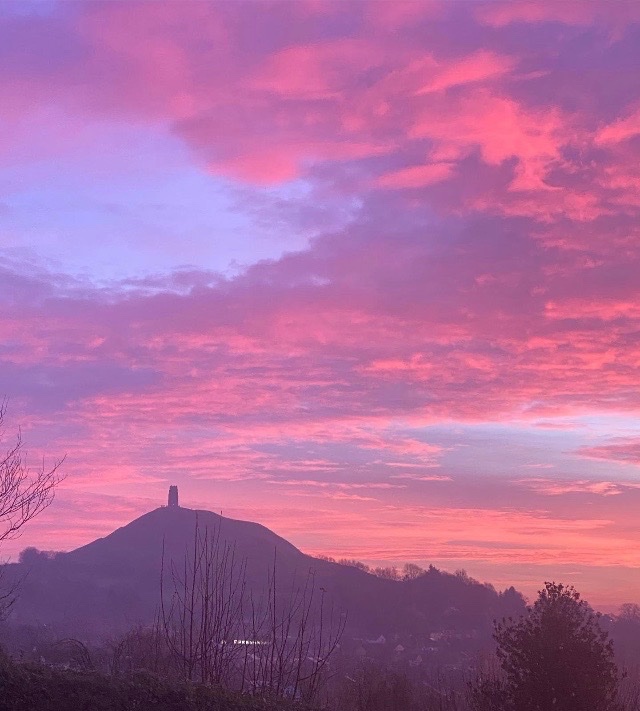
Dawn above Glastonbury Tor. photo by Jasmine Grace Zahara

A most likely place to hide a promise. But here it lies. Within the writings of a little-known first century Roman, Lucius Apuleius, whose character, a hapless magician, turns himself into an ass. He cries to the Goddess for help. Suddenly, shining like the sun, she is there. She rescues him, refers to her many names, then makes this promise: I am come with solace and aid. Away then with tears. Cease to moan. Send sorrow packing. Soon…shall the sun of your salvation rise…. Eternal religion has dedicated to me the day which will be born from the womb of this present darkness. 

That darkness would envelop the sacred feminine presence, forgetting her many names, abandoning her temples, sending her into two millennia of hiddenness…

Well, almost, but not quite.

The light of the feminine holy, like the dawn that follows the darkest night, would find a way to break through. The Shekinah of the Jewish Kabbalah, the Sophia of the Book of Wisdom and the Gnostic Gospels, Mary with her wonderful names drawn from the beauty of the planet: Mystical Rose, Star of the Sea, Our Lady of the Pines, of the Lakes, of the Mountains, Madonna of the Rocks… would find her way into hearts ready to receive her light.

We have been born into the time of the great recovery of ancient wisdom from story, myth, legend, from sacred writings, poetry, and ritual, from the peoples of earth-honouring religions: American and Australian Aboriginals; the Ancient Egyptians; the Celts.

Within these rediscovered traditions, we find the presence of a Sacred Mother, a womb of life who calls us to honour the earth and all her living systems, to honour ourselves, to honour our bodies which are part of the earth. She calls us to accept the wisdom of the circle of life: its rhythms of dawn to day to dark to day; of spring to summer to autumn to winter to spring; of birth to life to death to rebirth.  She calls us by our true name as she invites into the adventure of life in a time when each of us is needed to live fully.

She calls us into joy, through allurement to the hope, to the stunning beauty of a promise born in light. She reminds us that the universe herself is drawn, not through duty, despair, grim determination, but through allurement: the earth is allured to the sun, caught up into a dance of spinning wonder; the moon is allured to earth, circling her in ecstasy; the tides of the seas are allured to the moon, as are the cycles of women’s bodies. Each planet in our galaxy, like each of the galaxies of the universe, of the multiverse, twirls in a passionate dance of awe and delight.

Sophia calls us to awaken on this day which is being born from the womb of this present darkness. Her time is now.

From a Ritual for Epiphany, created by Kathleen Glennon in her book Heartbeat of the Seasons, (Columba Press, Dublin, 2005) I offer this chant/and prayer:

Chant: The wisdom you desire will be given unto you. (Eccl. 6:30)

Dance of Wisdom

Wisdom of the Universe, come to me/us/all

raise hands over your head and bring down to your head

Wisdom of the Earth, come to me/us/all

bring hand upwards from the earth and bring to heart

Wisdom of the Ancestors, come to me/us/all

bow reverently

For the following verse, extend arms upwards,

palms facing upwards and sway to the music

Wisdom of the maiden, come to me/us/all. 

Wisdom of the mother, come to me/us/all. 

Wisdom of the crone, come to me/us/all.

Final Blessing

May Sophia, the Wisdom of the Ages, the Wisdom of the Universe,

continue to journey with us.

May she meet us at our gates in the morning.

May she lie down with us at night.

May all who seek her find her.

May she bring the spirit of discernment into the lives of all.

May her company bring joy and happiness to all.  Amen. 

Sophia at Solstice

The external darkness of winter is mirrored by internal darkness this year. The ongoing crisis of a planet-wide pandemic that shifts its shape to re-appear in new forms adds suffering to our fragile planet. In a bittersweet awakening, a collection of birdsongs from fifty-three endangered species in Australia has shot to top of that country’s music charts. The depletion of uncounted life-forms, the pollution of lakes, rivers, oceans, soil, and even the air we breathe can no longer be ignored. The warnings of scientists about a coming time of disaster have shifted to confirmation that the dark future is already here. We see the effects of the destruction of our home planet with our own eyes and hearts.

In a time of great darkness, we may look for light; we may seek it in denial of the reality, in distractions, in whatever comfort we may find to help us “make it through the night”… and yet there is another way: the way of the Cailleach, the way of Wisdom: we may choose to enter the darkness, to explore it for its hidden gifts, for what it has to teach us. We may learn to know the darkness.

Jan Richardson offers a Blessing for this:

Bless those

Who know the darkness

and do not fear it,

Who carry the light

And are not consumed,

Who prepare the way

 and will not abandon it,

Who bless with grace

That does not leave us.

Ancient people came to “know the darkness” with such accuracy that they could predict the time of the longer nights, the earlier dawns of winter solstice when the return of light became visible.

Winter 2020 Solstice Sunrise, Newgrange, Ireland

In our time, we have come to understand the darkness has come from an excessive love of light, from a worship of bright intellect over the nurturing of nature, the extremes of using the planet’s resources without the needed balance of wisdom….

The 20th century Jungian writer Helen Luke explains it clearly in her book The Way of Woman:

…the instinct of the feminine is precisely to use nothing, but simply to give and to receive. This is the nature of the earth – to receive the seed and to nourish the roots– to foster growth in the dark so that it may reach up to the light.

How are women to recover their reverence for and their joy in this great archetype of which the symbols have always been the earth, the moon, the dark, and the ocean, mother of us all? For thousands of years the necessity of freeing consciousness from the grip of the destructive inertia and from the devouring quality, which are the negative side of the life-giving mother, rightly gave to the emerging spirit of activity and exploration an enormous predominance; but the extremes of this worship of the bright light of the sun have produced in our time an estrangement even in women themselves from the patient nurturing and enduring qualities of the earth, from the reflected beauty of the silver light of the moon in the darkness, from the unknown in the deep sea of the unconscious and from the springs of the water of life. The way back and down to those springs and to the roots of the tree is likewise the way on and up to the spirit of air and fire in the vaults of heaven.” (pp. 15-16)

It is time for humanity to shift from “the extremes of this worship of the bright light of the sun”. Women and men who are not afraid to explore their own feminine side, are called now urgently to do this work, essential for our time, to befriend once more the qualities of earth, moon, sea and springs, to make our way “back and down to those springs and to the roots of the tree.”

Here is a Blessing of Hope from Jan Richardson for Winter Solstice :

Blessing for Longest Night

All throughout these months
as the shadows
have lengthened,
this blessing has been
gathering itself,
making ready,
preparing for
this night.

It has practiced
walking in the dark,
traveling with
its eyes closed,
feeling its way
by memory
by touch
by the pull of the moon
even as it wanes.

So believe me
when I tell you
this blessing will
reach you
even if you
have not light enough
to read it;
it will find you
even though you cannot
see it coming.

You will know
the moment of its
arriving
by your release
of the breath
you have held
so long;
a loosening
of the clenching
in your hands,
of the clutch
around your heart;
a thinning
of the darkness
that had drawn itself
around you.

This blessing
does not mean
to take the night away
but it knows
its hidden roads,
knows the resting spots
along the path,
knows what it means
to travel
in the company
of a friend.

So when
this blessing comes,
take its hand.
Get up.
Set out on the road
you cannot see.

This is the night
when you can trust
that any direction
you go,
you will be walking
toward the dawn.

© Jan L. Richardson. janrichardson.com

__._,_.___

Celebrating the Birth of Love

In The Quest of Rose (Jean Houston, Anneloes Smitsman, 2021) Rose’s grandmother, the wise woman Verdandi tells Rose: “your view of life as a story often determines how life will treat you.” (Chapter Three p.30) Yet how much are our own stories shaped by the dominant myths of our culture? Shouldn’t we first change those larger stories? Verdandi advises Rose that “to change the dominant myths, we need to guide people into the realms of their own psyches first, so they’re able to access their power to change their own essential story.” (p. 31)

Pondering the way our stories are influenced, intertwined, with the stories we learned as young children, I began to imagine how the new stories being told to children would shape their lives in a new way. One young mother I know is teaching her little daughter about the Universe and its divine power, about how it watches over us, how Christmas is a special time of year for the Universe.

The Jesuit Palaeontologist Pierre Teilhard de Chardin taught us that everything that exists has a spiritual core. He wrote in The Divine Milieu: “This is what I have learnt from my contact with the earth—the diaphany of the divine at the heart of a glowing universe, the divine radiating from the depth of matter a-flame.” Our experience of Love in this twenty-first century is rooted in the birth of our Universe nearly fourteen billion years ago. And this is our heritage, the gift we are being called now to share more widely:  

Here is a Story of the Universe based on Brian Swimme’s book: The Universe is a Green Dragon.

It began with fire. It was a silent fire, which was just as well, for there was no one, no thing to hear it. This fire filled the Universe. This fire was the Universe, for within it every particle that would eventually form life in the Universe already existed. It was being forged by heat and pressure.

From this fire there exploded a burning light that began to expand outwards. This light would burn for half a million years. Even now, in our time, almost fourteen billion years later, the light from the edge of that first fireball can still be seen with powerful telescopes. The light is still expanding, carrying with it all that was birthed from the fire: black holes and stars, like our sun, galaxies and planets, including our beloved Mother Earth, and all the life she carries above, on and within her: willow trees and walruses, dolphins and diamonds, as well as the latecomers, the humans like you and me. That light from the fireball has been there from the beginning; yet,  it’s taken billions of years for life to develop the capacity to see it, to interact with its radiation.

Now, in our lifetime, we know that everything that exists shares the same beginning in that silent explosion of light, and everything we see around us, on earth, in the sky, in the sea, in the depths of the earth contains elements forged in that ancient furnace. We are birthed from the stars. What is more, our future will be a continuation of the story we have only begun to know.

Do you see how this alters earlier understandings of the place of the human on the planet and within the universe?  There is nothing we might boast of that was not here millions, even billions of years before humans existed. We are the inheritors of the development of life, with capacities that were shaped and perfected before the first human stood upright to gaze across a vista with her eyes, to listen to the song of a bird with his ears, to tenderly hold her offspring to her breast, to paint with red ochre on a cave wall shapes of the animals his eyes saw…

It’s not difficult for us to relate to earlier forms of human life that echo our own life. But what of other forms of existence? Do these also have a “self” to organize what is needed for life? If all that we are was already there in the original fireball, the capacity to be guided internally towards life must have been there too.

Look at a tree: it’s made of the materials of the same supernova as we are, materials that came through space and settled on our planet even as the materials of our bodies did, commingling. Now it exists in the form of a tree, with its own hopes for all it needs: moisture from melting snow and rain, light and warmth from the sun, wind to carry its seeds into the future. It knows what it needs, and if it gets these things, it lives and thrives. If it cannot get what it needs, it dies. Looking at a tree, our task as humans is to become aware of its mystery, its presence, its intelligence, to send it blessings of thriving.

So too with the Earth, which humans once saw as only a clump of raw materials, good for growing food for our tables and trees to build houses, for pasturing livestock, but more valuable if we could dig deep to extract oil, coal and gas, gold, silver, uranium and nickel, even if we had to blow the tops off mountains or poison the ground waters to get at these buried treasures. 

Only now in our lifetime have we come to know that the Earth is a self, that she has the capacity to self-organize, to control and maintain a level of oxygen that was enough to allow for the development of animal life without being so much that there was a  risk of destroying the planet by fire.

We have come to know that our dreams are not ours alone. Our dreams of the Earth’s health and thriving are the Earth’s dreams coming awake in us.  We are entering the time of the great re-genesis. Our life activities, all that we dream and do from now on must be guided by the intercommunion of all species. Our destiny and our calling is to allow the Earth to re-organize herself in a new way, a way not possible in the four billion years of her existence.

We are being invited into a co-creative partnership with Earth, our Mother.

This Christmas, as we celebrate the birth of the loving Christ two thousand years ago, may we also honour the Birth of Love in the Universe, fourteen billion years ago.

The BabaYaga: Part Two

Vasalisa at the home of the Baba Yaga

The Baba Yaga has agreed to give Vasalisa the burning coal she requests. Now she states her terms. Vasalisa must serve her for three days, washing her clothes preparing her meals, performing whatever other chores are assigned. If Vasalisa does all to the Baba Yaga’s complete satisfaction, she will receive what she asks for. If not, she will DIE!

And so Vasalisa enters the strange house, and sets to work at once. On that and on the next evening, before she sets out on her haunts, the Baba Yaga assigns one further task so utterly impossible that Vasalisa is in despair. But as soon as the witch has gone, her doll says, “Rest now. I’ll help you with that task.” And in the morning when Vasalisa awakens, the impossible task is already done: sorting poppy seeds from dirt or sorting mildewed corn from good corn. On each day, Vasalisa devotes the hours before the Baba Yaga’s return to preparing her supper, cleaning her house, washing her clothes.

When the Baba Yaga returns, Vasalisa watches in wonder as a surprising thing happens. The crone summons hands from the air, hands that crush the poppy seeds into juice, hands that shuck the corn into neat piles, hands that then disappear.

The Baba Yaga appears both pleased and displeased by Vasalisa’s accomplishments. She softens enough to say, “Is there anything more you wish to ask me?” before adding crossly, “but take care what you ask, for too much knowledge makes one old before one’s time.”

Vasalisa asks about the three horsemen who passed her in the woods.

“Ah,” says the Baba Yaga, “you met my night, my dawn, my sunrise.

“What else do you ask?”

Vasalisa thinks of the mysterious hands that appear in the air to squeeze poppy seeds, to shuck corn. But the doll in her pocket whispers, “No”.

“There is nothing more,” Vasalisa answers, “for as you say yourself old mother, too much knowledge make one old before one’s time.”

At this the Baba Yaga almost smiles. “You are wise for your years. From whence comes this wisdom?”

“From the blessing my kind mother gave me before she died.” Vasalisa answers.

Hearing these words, the Baba Yaga flies into a rage. She roars, “Speak not to me of blessings or kind mothers. Get out! Get out! Get out!”

At the sound of her voice, her door flies open. The Baba Yaga shoves Vasalisa out into the night. Before the child can recover herself, the Baba Yaga is behind her. In her gnarled hands she holds a skull with a burning coal inside it. Seizing a bone from her fence, the Baba Yaga pushes the skull onto the bone and thrusts it into Vasalisa’s hands, shouting, “Here! Take your flame and go!”

The girl opens her mouth to say thank you, but her doll whispers, “No. Do as she says. Just go!”

And so she goes, returning home through the dark wood, guided by the doll in her pocket. The grinning skull frightens her so that she wants to throw it away. The doll in her pocket, sensing this, whispers, “No. Trust it. It will help you.”

As Vasalisa at last emerges from the woods, her father’s house stands in utter darkness. Her stepmother and sisters come running out to meet her.

 “We could not light the fire while you were gone,” the stepmother says.

 Vasalisa notices that the skull is looking intently at her stepmother and stepsisters, with a gaze full of knowing. Unaware of danger, the stepmother seizes the burning skull from her hands and runs indoors to light the fire.

When she wakens in the morning, Vasalisa comes downstairs to begin her day’s chores. At first, she can find no sign of her cruel stepmother and sisters. On the floor beside the stove she finds three burnt cinders.

A kind village woman takes Vasalisa into her home to await her father’s return from a distant land. While she stays with this woman, Vasalisa spins flax into thread. Her doll creates a loom so that she might weave the fine threads into linen.

Seeing the quality of the linen that Vasalisa is making, the old woman tells her that only the Tsar is worthy to wear clothes made from it. And so the old woman arranges for Vasalisa to make a dozen shirts for him.

So impressed is the Tsar with the quality of the shirts that he asks to see the seamstress.

At his first sight of Vasalisa, the Tsar falls in love with her and asks her to marry him.

The wedding is celebrated, and when Vasalisa’s father returns, he’s invited to live with his daughter and the Tsar. The old woman comes to live with them, too.  And Vasalisa keeps her doll in her pocket until the end of her days..

What is the meaning of the doll that is her dying mother’s gift to Vasalisa?

Sophia and Samhain

This week I’m posting a guest blog from my friend Kate Fitzpatrick who lives in County Kerry, Ireland. To learn more about Kate’s “Mythic Voice” blog and her music go to : http://www.patreon.com/mythicvoice

“In crossing the threshold to Samhain on 31st October we have the ancient energies of the land coming to meet us and take us into the Cave again. This is a cave of transformation, rebirth, gestation. It is the death of the year and the beginnings of a new one taking form within. It is the Cave of the Feminine – the womb, and a time to surrender. 

“This year, I believe, we are being asked to become lighter, clearer and more in resonance with a higher light of the Divine Feminine. All patterns of Patriarchal control and domination of this earth are being demolished.

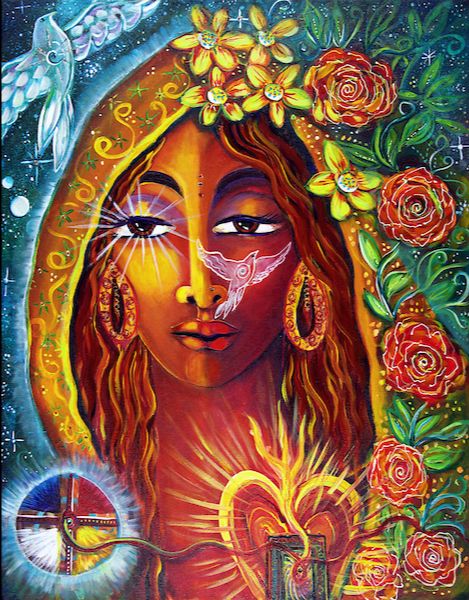
Artwork: Marie Osos

“And what I believe – is that the Gaia, our Earth Mother – is spitting out abusive patterns one by one. With Earthquakes, volcanoes, breakdowns in many systems, this is helped by the power of the other planets and the beings of light from many places in our Universe that are collectively committed to this evolutionary change. Gaia – within us and around us – is raising her vibration of Light. 

“Centuries of abuse are being purged from the Earth. In the mythic sense, I see it not as an issue of ‘Climate Change’ nor a need for ‘Climate Control’ but rather that Mother Earth is taking her power to become free of this horrendous abuse to her and all her children. She is settling this score once and for all. Humanity will no longer be able to use her riches to dominate and control the beauty of the earth, nor the creatures and kingdoms that live within it. As all patterns of abuse are being purged, we keep in step with her as we release our own issues and regrets. We can, therefore, go with her to a higher, healed place.

“What I imagine also happening – is that the Divine Feminine Light of Source is coming in more and more to meet the Earth Mother and she is rising up to meet this new light. When they meet – perhaps in 2022 as many would say- it will be a union of Earth and Heaven. By our steep climbing and resilience to let much go from our lives – we too we can be a part of this.

“We are a part of that flow and right now – every day – every step we take – we are helping to release the energies needed for that Union. A Healed Feminine will exist in one whole body of light. New Earth Risen. A healed Masculine energy rising from the ashes of old systems – is a phoenix reborn and ready to meet this liberated Divine Mother.

“I have journeyed for more than thirty years in the search of Feminine Healed light and her integration with a healed and whole Masculine that is held in divine union. On and on and on, harrowing and endless it seemed as we progressed through the years. Never, ever giving up that journey to the Light.

“In the past few months I have the ever-increasing sense that we have now arrived at what we were looking for. I cannot put this into words. I cannot even understand it myself. But in every cell of my body and in the flow of each precious day, I know this: In the clear-seeing of  patterns being shown to me, and as I tackle every challenge thrown in my path by the forces that would resist the upgrade of Earth to a place of light and truth and healing, I know, in the whole of my heart, that this world is changing forever and that what we have steadfastly held as our life’s vision for New Earth, is about to manifest. Blessed Be.”

Wisdom Sophia as Mother


So I prayed, and understanding

was given me:

I called upon God, and Wisdom came to me.

I preferred Her to scepters and thrones;

Vast wealth was nothing in

Comparison to Her.

Before Her, gold is like sand;

Silver like clay.

I loved Her above health and beauty,

And chose Her eternal radiance

Over the most scintillating light.

All good things came to me with Her,

And I took joy in them because of Her,

But I did not then know She was

Their Mother.

(Wisdom of Solomon 7:7-12)

Who is this wondrous being who so captivated the heart of Solomon? He writes of a living, an abiding presence, one capable of giving him “all good things”; yet the  joy he found in everything is because of Her. His relationship with this feminine being of “eternal radiance” is one of love. Moreover this love unfolds, evolves as do our best human friendships. For he tells us that there was a time when he knew less of Her, and a time when he understood more: he came to know this Sacred Presence as “Mother” of all the good that She brought to him.

This is astounding. If a clay jar holding these words had been unearthed only in this century, we would be amazed. Yet, the very familiarity of these Biblical passages may have blinded us to their full power. Perhaps we saw them as “metaphor” for a way of knowing, a quality termed “wisdom” not unlike other qualities such as “courage” or “kindness” or “honesty”…

Who can fall in love with a metaphor? Solomon fell in love with a Someone.

One of the more surprising insights in Rabbi Rami Shapiro’s book on the Divine Feminine is that “The Song of Songs”, attributed to King Solomon, is considered part of the Wisdom writings in the Hebrew Bible. Shapiro writes that the love affair described in exquisitely sensual images is between the “sage” (woman or man) and Wisdom/Sophia/Chochma.

You have captured my heart,

My sister, my bride,

You have captured my heart

With a single glance,

With one coil of Your necklace.

How sweet is Your love,

More intoxicating than new wine!

Your perfume more fragrant than the finest spice!

(Song of Songs 4:9-10)

In the midst of this global pandemic, in the urgent need to provide her people with safety, with guidelines, with assistance in this time of unprecedented danger and challenge, Jacinda Ardern, Prime Minister of New Zealand, was inspired to write a poem which she addressed to “Mother Earth”. Here are a few excerpts:

Rest now, e Papatūānuku (Mother Earth)
Breathe easy and settle
Right here where you are
We’ll not move upon you
For awhile

We’ll stop, we’ll cease
We’ll slow down and stay home
Draw each other close and be kind
Kinder than we’ve ever been.

Time to return
Time to remember
Time to listen and forgive
Time to withhold judgment
Time to cry
Time to think
About others
Remove our shoes
Press hands to soil
Sift grains between fingers
Gentle palms

Time to plant
Time to wait
Time to notice
To whom we belong
For now it’s just you
And the wind
And the forests and the oceans
and the sky full of rain

Prime Minister Ardern‘s poem expresses the leap in understanding that countless others across the globe are coming to: our home planet, our earth, is a living sentient being, of whose essence we are made, from whose body we are nurtured, without whom we would all perish.This is not a new understanding: ancient peoples, and those indigenous cultures who still live in this awareness, intuitively understood “to whom we belong.” They would have spoken in the same way to mother earth. They understood that finally it is “just you and the wind and the forests and the oceans and the sky full of rain”…

And they knew even more: They knew that within this sacred home dwells the divine energy/light/spark/love—whatever name they had for it—the Holy Heart of the Universe.

This is the wisdom we need to find once more in and for our time. If the Corona Virus opens us to that quest, it will be a gift of light within the darkness it has brought.

Sophia and Discipline

In her magnificent book, The Search for the Beloved (Tarcher/Putnam New York, 1987) Jean Houston writes:

While the realm of the Beloved may still remain “other”, the distance can be bridged by bringing the extraordinary into the ordinary….

Although being porous to the Beloved increases the capacity to live in two realms, the growth and maintenance of this capacity seems to depend upon the faithful practice of a discipline. Discipline has had a very bad press. We must recognize that the high practice of a discipline gives enormous freedom, and with this freedom comes a greatly increased capacity to love. Often we do not love others, much less the Divine Beloved, because we are caught up with every whim, irritant, and distraction….

Brigid of Kildare taught about the need to focus on the Beloved

Discipline, conscious and mindful orchestration of the pieces of our lives, gives us a capacity to live in the depths as well as on the surface. Ideally, a discipline has a physical, mental, and spiritual component and is practiced each day. If, however, your discipline becomes compulsive…then it is time to consciously change it and do something funny or ironic. (pp. 132-3)

Rabbi Rami Shapiro cites words from Proverbs where Wisdom/ Chochma/Sophia speaks of discipline:

Listen to Me:

Follow Me and be happy.

Practice My discipline and grow wise….

(Proverbs 8: 32-33 NRSV Bible)

Commenting on this in his book The Divine Feminine in Biblical Wisdom Literature, he writes: “To listen, you must first be silent. When you are silent, the narrow mind, the small self of thought and language, melts into the spacious self of clarity and compassion. To be mindful is to be present. When you are present, the distracted self recedes and the greater self emerges. With this comes Wisdom, joy and happiness.”

Sometimes, and I find this usually happens just at the end of the brief listening time that is prayer, Love surprises us with a fresh thought, a somersault of insight, that lifts us to new place.

And when Love is wholly silent and I long for words, I open my book of poems by Hafiz, to find at times a gift that eases my heart. This opened to me on a day when my soul was dark and troubled:

I wish I could show you,

When you are lonely or in darkness,

The Astonishing Light

Of your own Being!

(Hafiz, I Heard God Laughing trans. Daniel Ladinsky)

 Truly, as Wisdom/Sophia/Chochma assures us in Proverbs:

Shapiro writes: You want to be embraced by Wisdom; you desire Her love as much as She desires to love you. A part of you may doubt and question; a part may seek to hide from your desire in cynicism, but at your core you want Her.

I bring joy to those who listen;

I bring happiness to those who are mindful of Me…

Find Me and find life,

Find Me and find grace… 

(Proverbs 8 NRSV Bible)

A single encounter with Wisdom is enough to lift you out of your desperately reasoned ego, and to leave you breathless with love and desire. Wisdom is not a cool intellectual exercise, but a hot embrace. Wisdom is not dispassionate, but the Way of passion. 

 As Rabbi Rami Shapiro explores the question of why Wisdom/ Sophia/Chochma is so little known, he writes:

Wisdom is a woman and women haven’t fared well in the Western religious tradition of the past three thousand years. While you can point out significant exceptions, the norm in Judaism, Christianity, and Islam is to downplay the role of women. One way to do that is to ignore the role of the Mother, Chochma, in creation and the life of us creatures.

It is no small thing to note that Wisdom is feminine. The original language of the texts, both Hebrew and Greek, make this very clear: Hebrew Chochma and Greek Sophia are both feminine nouns. The authors of the Wisdom books took this gender specificity seriously and envisioned Wisdom as Mother, God’s consort and bride, the Divine Feminine through which the masculine God fashioned all creation. Further, they saw in the union of masculine and feminine a powerful analogy for the greater unity of all in the ineffable Godhead that transcends our imagination.

Shapiro makes an important clarification around language when he adds:

I do not believe that God is literally male or that Chochma is literally female. We are not dealing with biological facts but with theological archetypes residing within each of us. What is needed is a marriage of the two within the individual.

The unity of these forces creates a new person, the divine anthropos. The fully integrated human is called the sage in these Wisdom books. The sage, regardless of gender, is married to Chochma; he or she is the partner of the Divine Feminine.

Shapiro calls on each of us to become a sage when he writes:

You and I have the capacity to be sages. As you read the teachings of Mother Wisdom, know that She is speaking to you, inviting you to Her home, to Her Hearth, to Her teachings that you may become a sage.

He encourages each of us to find the image of Chochma that most appeals to us:

As the Divine Feminine, Wisdom can appear to you as Mother, Lover, Bride, Sister or any number of feminine archetypal forms… Find the image that best suits you, and allow it to open you to the way that leads to the birth of the divine anthropos within you.

Aside from the feminine identity of Wisdom in Biblical writings, Shapiro believes there is another significant reason why the teachings of Chochma are ignored:

She is intrinsically antiestablishment and nonhierarchical. Wisdom is taught, so the student needs a teacher, but once She is learned there is a great leveling: Teacher and student share the same understanding.

Behold, days are coming…

when I will seal a new covenant

with the House of Israel and with the House of Judah…

I will place My Teaching within them

and I will write it on their heart…

They will no longer teach one another,

saying Know the Lord!

For everyone will know Me,

from the smallest to the greatest. (Jeremiah 31:30-33)

How might this change our way of relating to the Sacred Presence, to one another, to ourselves? 

(Reference: Rabbi Rami Shapiro, The Divine Feminine in Biblical Wisdom Literature, Skylight Illuminations, 2005)

Embracing the Sophia Presence

Sophiawakens September 24, 2021

As the Autumn Equinox arrives, darkness and light, night and day, winter and summer move into a delicate balance. Following her example, I allow the earth to guide my own balance of feminine and masculine both within and outside of myself. This prompts me to return once more to Rabbi Rami Shapiro, opening my heart to receive his translation of the “Song of Songs”, the Jewish text originally written in Greek somewhere in the second or first centuries BCE. Shapiro, in his book, Embracing the Divine Feminine, traces the history of rabbinical scholarship and offers his own insights into this poem of erotic love which he sees as “a celebration of the union of the seeker of wisdom with Lady Wisdom herself.”

In his Introduction, Shapiro writes: Given the centrality of Chochmah, Lady Wisdom, to this reading of the Song of Songs, we would be wise to take a moment to understand just who she is. According to the Book of Job, Wisdom is the means by which God created the universe. God looked and took note of her. (Job 28:27) In other words, God looked to Wisdom to discover both the form and function of the universe. Wisdom therefore is the very nature in nature.

Curious, I opened my Jerusalem Bible to the Book of Job and found these lines:

But tell me, where does wisdom come from? ….

God alone has traced (her) path

and found out where (she) lives….

When (God) willed to give weight to the wind

 and measured out the waters with a gauge,

When (God) made the laws and rules for the rain

and mapped a route for the thunderclaps to follow,

then (God) had Wisdom in sight, and cast (her) worth, 

assessed (her), fathomed (her). (Job 28:20, 23, 25-27)

Who is Lady Wisdom?

For answer, Shapiro offers his own translation of Proverbs 8: 22-32. (Remember Thomas Merton’s dream of a young girl named Proverbs who was for him the Sophia Presence?)

I am the deep grain of creation,

the subtle current of life.

God fashioned me before all things:

I am the blueprint of creation,

I was there from the beginning,

from before there was a beginning.

I am independent of time and space, earth and sky.

I was there before depth was considered,

before springs bubbled with water,

before the shaping of mountains and hills,

before God fashioned the earth and its bounty,

before the first dust settled on the lands.

When God prepared the heavens, I was there.

When the circle of the earth was etched into the face of the deep

I was there.

I stood beside God as firstborn and friend.

My nature is joy and I gave God constant delight.

Now that the world is inhabited, I rejoice in it.

I will be your true delight if you will heed my teachings.

Follow me and be happy.

Practice my discipline and grow wise.

Shapiro Comments:(T)he Hebrew is clear: the speaker is Chochma, Lady Wisdom, and hence all the pronouns and verbs referring to Wisdom in this passage are feminine. The grammar of this and every passage that speaks of, to, about, or for Wisdom always uses the feminine form.  

Shapiro invites us to consider the qualities of Wisdom usually associated with God. She is the “firstborn” of God and from her come the thousand things of creation. Her way is of truth and justice while her essence is pure delight. Wisdom delights in humanity and one who finds her finds life.

Shapiro compares this with Jesus who said, I am the way, the truth and the life. No one comes to the Father except through me. (John 14:6) Paul connects Jesus with Wisdom in Corinthians 1:24 when he writes: Christ is the power of God and the Wisdom of God.

Then Shapiro goes further: What becomes the male Christ in the Christian Scriptures was originally the female Chochmah in the Hebrew Bible.

He continues: Wisdom is the way God manifests in and as creation. Uniting with Wisdom, as the Song of Songs invites us to do, is a way of uniting with the life and the Source from which life arises.

Statue of the Black Madonna with her child in Chartres Cathedral

Why do we personify Wisdom? Shapiro believes it is because “on a deep and subconscious level we know her to be the other with whom we long to unite. She is not an abstraction but our Beloved. She is not to be thought about but physically embraced in a manner that reveals YWVH to us.”

Shapiro offers us his translation of Proverbs: Chapter 9, 1-6:

Wisdom’s house rests on many pillars.

It is magnificent and easy to find.

Inside, she has cooked a fine meal and

sweetened her wine with water.

Her table is set.

She sends her maidens to the tallest towers to summon you.

To the simple they call: Come enter here.

To those who lack understanding they say:

Come eat my food, drink my wine,

Abandon your empty life and walk in the way of understanding.

Shall we accept her invitation?

.