The BabaYaga: Part Two

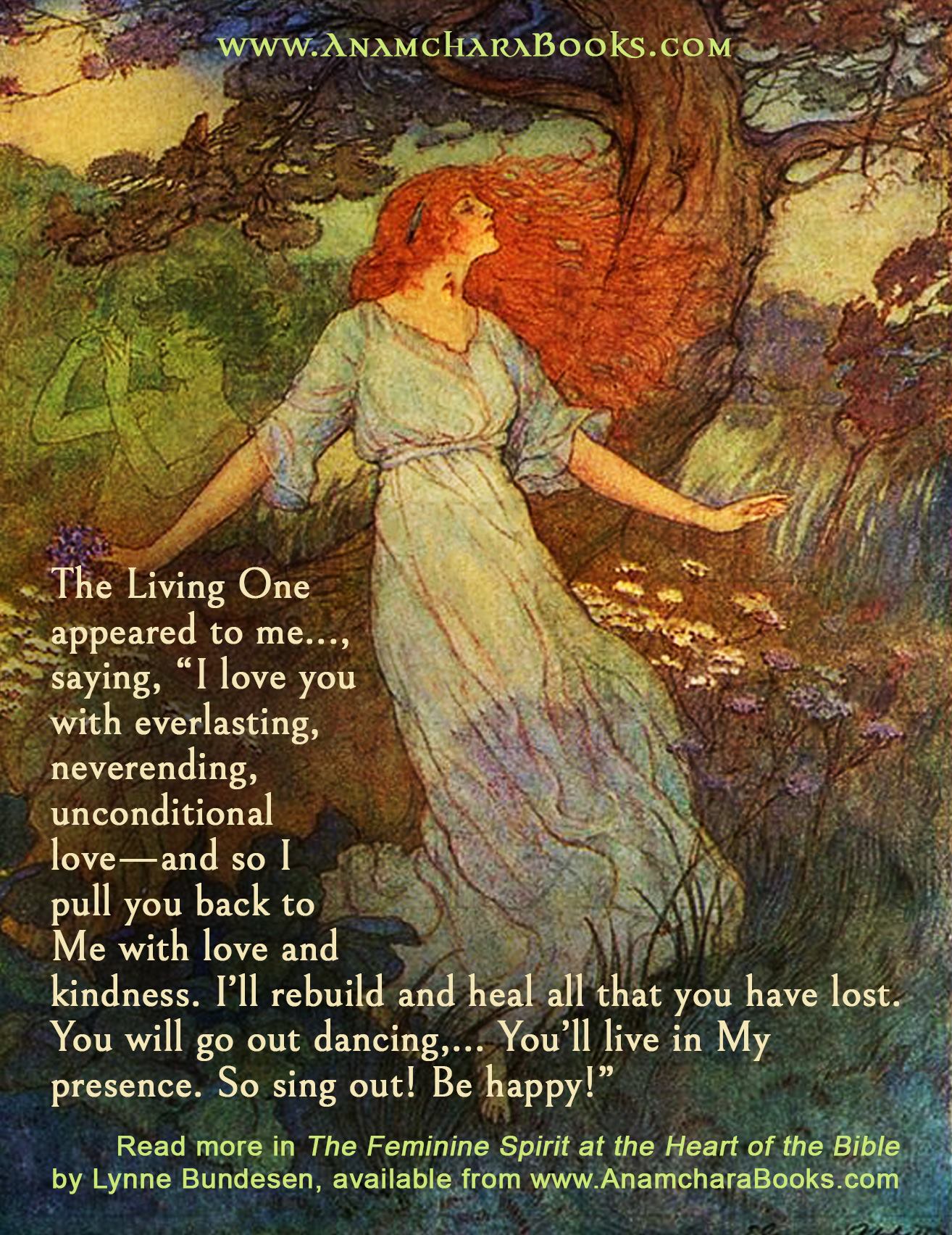
Vasalisa at the home of the Baba Yaga

The Baba Yaga has agreed to give Vasalisa the burning coal she requests. Now she states her terms. Vasalisa must serve her for three days, washing her clothes preparing her meals, performing whatever other chores are assigned. If Vasalisa does all to the Baba Yaga’s complete satisfaction, she will receive what she asks for. If not, she will DIE!

And so Vasalisa enters the strange house, and sets to work at once. On that and on the next evening, before she sets out on her haunts, the Baba Yaga assigns one further task so utterly impossible that Vasalisa is in despair. But as soon as the witch has gone, her doll says, “Rest now. I’ll help you with that task.” And in the morning when Vasalisa awakens, the impossible task is already done: sorting poppy seeds from dirt or sorting mildewed corn from good corn. On each day, Vasalisa devotes the hours before the Baba Yaga’s return to preparing her supper, cleaning her house, washing her clothes.

When the Baba Yaga returns, Vasalisa watches in wonder as a surprising thing happens. The crone summons hands from the air, hands that crush the poppy seeds into juice, hands that shuck the corn into neat piles, hands that then disappear.

The Baba Yaga appears both pleased and displeased by Vasalisa’s accomplishments. She softens enough to say, “Is there anything more you wish to ask me?” before adding crossly, “but take care what you ask, for too much knowledge makes one old before one’s time.”

Vasalisa asks about the three horsemen who passed her in the woods.

“Ah,” says the Baba Yaga, “you met my night, my dawn, my sunrise.

“What else do you ask?”

Vasalisa thinks of the mysterious hands that appear in the air to squeeze poppy seeds, to shuck corn. But the doll in her pocket whispers, “No”.

“There is nothing more,” Vasalisa answers, “for as you say yourself old mother, too much knowledge make one old before one’s time.”

At this the Baba Yaga almost smiles. “You are wise for your years. From whence comes this wisdom?”

“From the blessing my kind mother gave me before she died.” Vasalisa answers.

Hearing these words, the Baba Yaga flies into a rage. She roars, “Speak not to me of blessings or kind mothers. Get out! Get out! Get out!”

At the sound of her voice, her door flies open. The Baba Yaga shoves Vasalisa out into the night. Before the child can recover herself, the Baba Yaga is behind her. In her gnarled hands she holds a skull with a burning coal inside it. Seizing a bone from her fence, the Baba Yaga pushes the skull onto the bone and thrusts it into Vasalisa’s hands, shouting, “Here! Take your flame and go!”

The girl opens her mouth to say thank you, but her doll whispers, “No. Do as she says. Just go!”

And so she goes, returning home through the dark wood, guided by the doll in her pocket. The grinning skull frightens her so that she wants to throw it away. The doll in her pocket, sensing this, whispers, “No. Trust it. It will help you.”

As Vasalisa at last emerges from the woods, her father’s house stands in utter darkness. Her stepmother and sisters come running out to meet her.

 “We could not light the fire while you were gone,” the stepmother says.

 Vasalisa notices that the skull is looking intently at her stepmother and stepsisters, with a gaze full of knowing. Unaware of danger, the stepmother seizes the burning skull from her hands and runs indoors to light the fire.

When she wakens in the morning, Vasalisa comes downstairs to begin her day’s chores. At first, she can find no sign of her cruel stepmother and sisters. On the floor beside the stove she finds three burnt cinders.

A kind village woman takes Vasalisa into her home to await her father’s return from a distant land. While she stays with this woman, Vasalisa spins flax into thread. Her doll creates a loom so that she might weave the fine threads into linen.

Seeing the quality of the linen that Vasalisa is making, the old woman tells her that only the Tsar is worthy to wear clothes made from it. And so the old woman arranges for Vasalisa to make a dozen shirts for him.

So impressed is the Tsar with the quality of the shirts that he asks to see the seamstress.

At his first sight of Vasalisa, the Tsar falls in love with her and asks her to marry him.

The wedding is celebrated, and when Vasalisa’s father returns, he’s invited to live with his daughter and the Tsar. The old woman comes to live with them, too.  And Vasalisa keeps her doll in her pocket until the end of her days..

What is the meaning of the doll that is her dying mother’s gift to Vasalisa?

Vasalisa the Wise

Seeking the ancient footprints of the Sacred Feminine Presence, we take the path of myth and fairy tale.  Here we find beautiful maidens, loving mothers. Research by historians into the distant past has garnered glimpses of a time when the great goddess was honoured as both maiden and mother. In her guise as Mother, she holds all of life in her embrace even as the Earth does. She was known as the ground of being, the giver and taker of life. In her form as Maiden, she was seen as the power of regeneration, the rebirth experienced each spring.

Old stories are replete with maidens and mothers, but there is a third aspect of feminine power that we glimpse only briefly. She is the Wise One, the aged one-who-knows, the Cailleach. In Egypt, I encountered this fierce all-knowing one as Sekhmet. For the ancient Celts, this threefold aspect of the Sacred Feminine was honoured as the Trinity of Maiden, Mother, Crone. Patriarchal societies and religions could tame the maiden, subjugate her through submission to a father, then to a husband as his wife and mother of his children. But there is no subjugating of a crone. She claims her fierce power, her independence, her magic. When the castle doors fly open, kings and popes alike tremble.

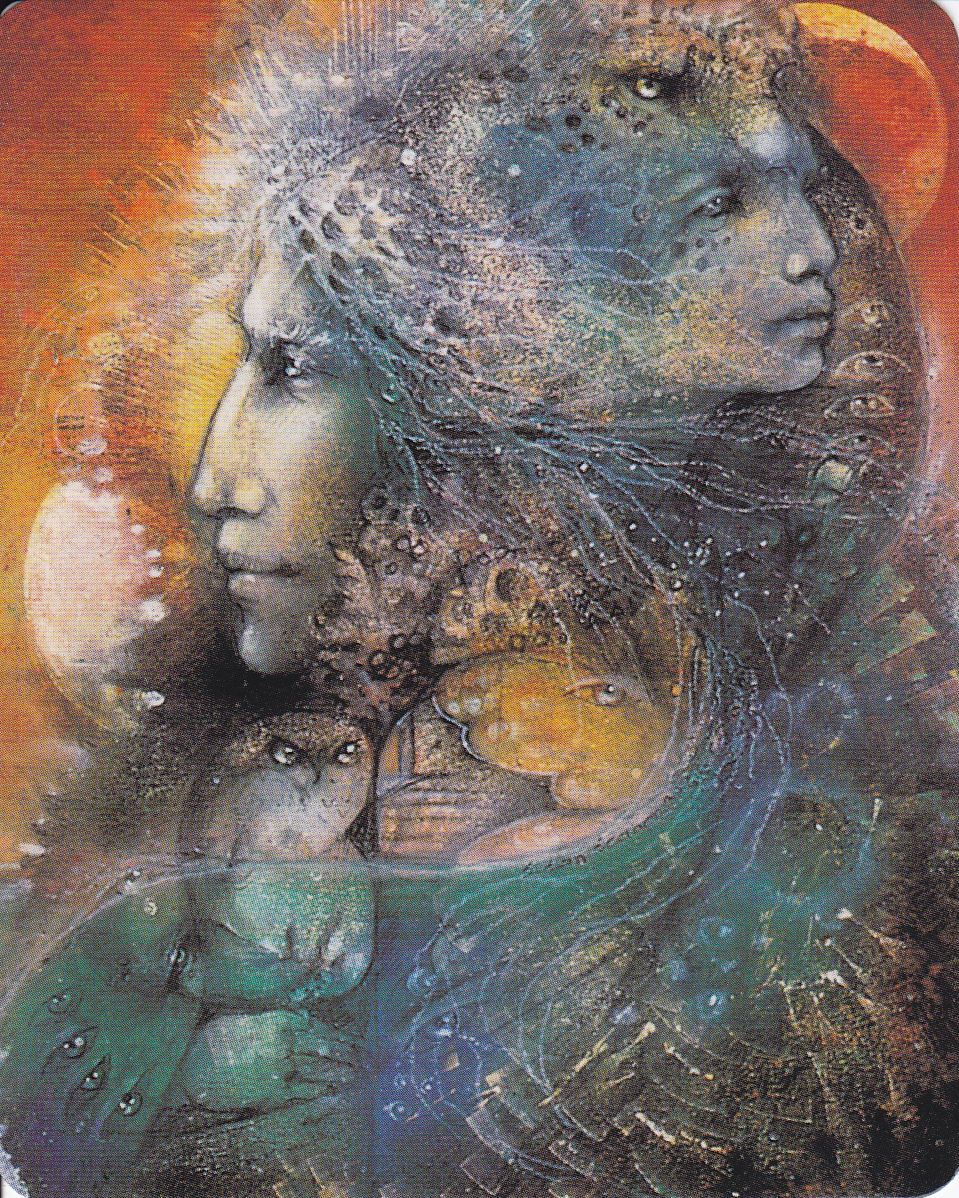
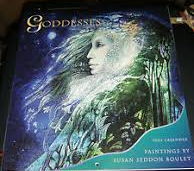
Athena Goddess of Wisdom by Susan Seddon Boulet

Here is an old Russian tale of the fierce crone, the Baba Yaga.

Vasalisa, a young maiden on the cusp of womanhood, is the most beautiful girl in the Russian village where she lived. On her feet are shiny red boots, ready to walk with her into a life of happiness. But Vasalisa is not happy. Her beloved mother has died, her father has remarried, and her stepmother and stepsisters, all smiles in his presence, treat the young Vasalisa with calculated cruelty in his absence. Envying her beauty, maddened by her sweet disposition, they try to rob her of both by giving her all the hardest tasks in the household: chopping firewood, lighting the stove, cleaning the floors, as well as all the cooking. Her hands are becoming raw, chapped and calloused, her complexion reddened by the stove’s flames, but Vasalisa still does not lose a drop of her sweetness. “Yes, of course”, “as you wish”, “right away”, she responds to their every order.

This sweetness is like poison to her stepmother. One day when Vasalisa is outdoors chopping wood, the stepmother speaks to her two daughters in a voice that is low and husky with rage: “Enough. I can stand no more of her. Let us contrive to make the fire go out. I shall send the girl into the deep woods to fetch a live coal from the fierce Baba Yaga. That witch will make short work of her. Her bones will be gnawed by the wild dogs before morning.”

So it is that as dusk deepens, Vasalisa is making her way into the heart of the forest in search of the Baba Yaga. If you look at her white face, her large frightened eyes, your heart will go out to her, but look more closely. There is courage in the child. Watch her reach into the pocket of her apron, nod slowly and smile….

Vasalisa has a secret, a gift from her dying mother, a tiny doll she carries always in her pocket. “Hide her. Feed her when she is hungry,” her mother had said. “And when you are uncertain or afraid, ask her to guide you.” 

At each turning of the forest path, at each fork and crossroad, Vasalisa touches the doll, and the doll guides her surely through the darkness.

A horseman dressed all in black rides by on a stallion dark as a starless night. Suddenly Phrygian night envelops the forest. Vasalisa walks on. Hours pass and another horseman, this one all in white upon a milky horse, appears and it is dawn. A third horseman, all in scarlet riding upon a roan red horse, gallops past her. The sun rises, red as flame.

In the full light of morning, Vasalisa comes upon a strange house that dances on chicken legs, its doors and windows securely latched with bones. “Is this the house we seek?” Vasalisa asks the doll. “Yes” says the doll, even as the Baba Yaga herself swoops out of the sky, home from her night’s revels. She hovers above the child in her cauldron, a gnarled and fiercesome creature more ugly than any nightmare could create.

“Who are you? What do you want?” the Baba Yaga roars.

Trembling, but standing firm, the child answers, “I come from the house beyond the woods. Our fire has gone out, and my stepmother sent me to you to ask for a live coal.”

The Baba Yaga snarls, “Careless people! Exactly what I would expect from you! And why should I give you a coal?”

Vasalisa answers as the doll in her pocket prompts her, “Because I ask.”

Something softens for an instant in the Baba Yaga. “Well that is the right answer.”

(to be continued)

Sophia and Samhain

This week I’m posting a guest blog from my friend Kate Fitzpatrick who lives in County Kerry, Ireland. To learn more about Kate’s “Mythic Voice” blog and her music go to : http://www.patreon.com/mythicvoice

“In crossing the threshold to Samhain on 31st October we have the ancient energies of the land coming to meet us and take us into the Cave again. This is a cave of transformation, rebirth, gestation. It is the death of the year and the beginnings of a new one taking form within. It is the Cave of the Feminine – the womb, and a time to surrender. 

“This year, I believe, we are being asked to become lighter, clearer and more in resonance with a higher light of the Divine Feminine. All patterns of Patriarchal control and domination of this earth are being demolished.

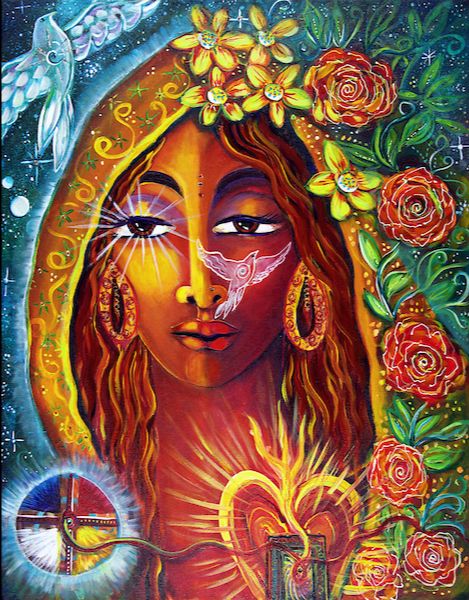
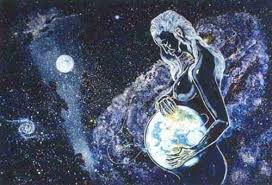
Artwork: Marie Osos

“And what I believe – is that the Gaia, our Earth Mother – is spitting out abusive patterns one by one. With Earthquakes, volcanoes, breakdowns in many systems, this is helped by the power of the other planets and the beings of light from many places in our Universe that are collectively committed to this evolutionary change. Gaia – within us and around us – is raising her vibration of Light. 

“Centuries of abuse are being purged from the Earth. In the mythic sense, I see it not as an issue of ‘Climate Change’ nor a need for ‘Climate Control’ but rather that Mother Earth is taking her power to become free of this horrendous abuse to her and all her children. She is settling this score once and for all. Humanity will no longer be able to use her riches to dominate and control the beauty of the earth, nor the creatures and kingdoms that live within it. As all patterns of abuse are being purged, we keep in step with her as we release our own issues and regrets. We can, therefore, go with her to a higher, healed place.

“What I imagine also happening – is that the Divine Feminine Light of Source is coming in more and more to meet the Earth Mother and she is rising up to meet this new light. When they meet – perhaps in 2022 as many would say- it will be a union of Earth and Heaven. By our steep climbing and resilience to let much go from our lives – we too we can be a part of this.

“We are a part of that flow and right now – every day – every step we take – we are helping to release the energies needed for that Union. A Healed Feminine will exist in one whole body of light. New Earth Risen. A healed Masculine energy rising from the ashes of old systems – is a phoenix reborn and ready to meet this liberated Divine Mother.

“I have journeyed for more than thirty years in the search of Feminine Healed light and her integration with a healed and whole Masculine that is held in divine union. On and on and on, harrowing and endless it seemed as we progressed through the years. Never, ever giving up that journey to the Light.

“In the past few months I have the ever-increasing sense that we have now arrived at what we were looking for. I cannot put this into words. I cannot even understand it myself. But in every cell of my body and in the flow of each precious day, I know this: In the clear-seeing of  patterns being shown to me, and as I tackle every challenge thrown in my path by the forces that would resist the upgrade of Earth to a place of light and truth and healing, I know, in the whole of my heart, that this world is changing forever and that what we have steadfastly held as our life’s vision for New Earth, is about to manifest. Blessed Be.”

Wisdom Sophia as Mother


So I prayed, and understanding

was given me:

I called upon God, and Wisdom came to me.

I preferred Her to scepters and thrones;

Vast wealth was nothing in

Comparison to Her.

Before Her, gold is like sand;

Silver like clay.

I loved Her above health and beauty,

And chose Her eternal radiance

Over the most scintillating light.

All good things came to me with Her,

And I took joy in them because of Her,

But I did not then know She was

Their Mother.

(Wisdom of Solomon 7:7-12)

Who is this wondrous being who so captivated the heart of Solomon? He writes of a living, an abiding presence, one capable of giving him “all good things”; yet the  joy he found in everything is because of Her. His relationship with this feminine being of “eternal radiance” is one of love. Moreover this love unfolds, evolves as do our best human friendships. For he tells us that there was a time when he knew less of Her, and a time when he understood more: he came to know this Sacred Presence as “Mother” of all the good that She brought to him.

This is astounding. If a clay jar holding these words had been unearthed only in this century, we would be amazed. Yet, the very familiarity of these Biblical passages may have blinded us to their full power. Perhaps we saw them as “metaphor” for a way of knowing, a quality termed “wisdom” not unlike other qualities such as “courage” or “kindness” or “honesty”…

Who can fall in love with a metaphor? Solomon fell in love with a Someone.

One of the more surprising insights in Rabbi Rami Shapiro’s book on the Divine Feminine is that “The Song of Songs”, attributed to King Solomon, is considered part of the Wisdom writings in the Hebrew Bible. Shapiro writes that the love affair described in exquisitely sensual images is between the “sage” (woman or man) and Wisdom/Sophia/Chochma.

You have captured my heart,

My sister, my bride,

You have captured my heart

With a single glance,

With one coil of Your necklace.

How sweet is Your love,

More intoxicating than new wine!

Your perfume more fragrant than the finest spice!

(Song of Songs 4:9-10)

In the midst of this global pandemic, in the urgent need to provide her people with safety, with guidelines, with assistance in this time of unprecedented danger and challenge, Jacinda Ardern, Prime Minister of New Zealand, was inspired to write a poem which she addressed to “Mother Earth”. Here are a few excerpts:

Rest now, e Papatūānuku (Mother Earth)
Breathe easy and settle
Right here where you are
We’ll not move upon you
For awhile

We’ll stop, we’ll cease
We’ll slow down and stay home
Draw each other close and be kind
Kinder than we’ve ever been.

Time to return
Time to remember
Time to listen and forgive
Time to withhold judgment
Time to cry
Time to think
About others
Remove our shoes
Press hands to soil
Sift grains between fingers
Gentle palms

Time to plant
Time to wait
Time to notice
To whom we belong
For now it’s just you
And the wind
And the forests and the oceans
and the sky full of rain

Prime Minister Ardern‘s poem expresses the leap in understanding that countless others across the globe are coming to: our home planet, our earth, is a living sentient being, of whose essence we are made, from whose body we are nurtured, without whom we would all perish.This is not a new understanding: ancient peoples, and those indigenous cultures who still live in this awareness, intuitively understood “to whom we belong.” They would have spoken in the same way to mother earth. They understood that finally it is “just you and the wind and the forests and the oceans and the sky full of rain”…

And they knew even more: They knew that within this sacred home dwells the divine energy/light/spark/love—whatever name they had for it—the Holy Heart of the Universe.

This is the wisdom we need to find once more in and for our time. If the Corona Virus opens us to that quest, it will be a gift of light within the darkness it has brought.

Walking with Wisdom/Sophia

Where do you seek wisdom? Do you have overflowing shelves where, like the nine layers of ancient Troy, recently acquired books hide earlier treasures? Do you seek teachers trained in ancient wisdom?  Do you select from among the many speakers now available on-line? Or have you been fortunate enough to find a truly wise teacher who leads you inward to your own source of deep wisdom? 

If so, you have already found Wisdom:  She has already found you.

Wisdom is bright, and does not grow dim.

By those who love her she is readily seen,

and found by those who look for her.

Quick to anticipate those who desire her,

she makes herself known to them.

Watch for her early and you will have no trouble;

you will find her sitting at your gates.

Even to think about her is understanding fully grown;

be on the alert for her

and anxiety will quickly leave you.

She herself walks about looking for

those who are worthy of her

and graciously shows herself to them as they go,

in every thought of theirs coming to meet them.

(Wisdom of Solomon 6:12-17 Jerusalem Bible)

Once we come to know and trust our inner “Sophia”, we have a treasure within us, and the eyes to recognize Her everywhere. The wisdom of the ages, of the sages, of the poets and the mystics takes on a vibrant clarity, a singing resonance, for we have an inner mirror that catches the light, reflecting the heart of reality.

Rabbi Rami Shapiro’s book, The Divine Feminine in Biblical Wisdom Literature (Skylight Illuminations, 2005) has opened my eyes as well as my heart to the myriad facets of Wisdom’s presence. I find Her in the natural world from its sunlit morning warmth to night’s radiant moon-path stretching across the river, to its wild winds, crashing thunder, its rain suddenly rushing from the skies, a Niagara of unseen source.

Within my own life, I have become aware of a presence of Wisdom, showing me the moonlit way through challenges in relationships, difficulties in my work, small or larger questions of “What now?” or “How next?” …  for, as The Wisdom of Solomon assures us:

Even to think about her is understanding fully grown;

be on the alert for her

and anxiety will quickly leave you.

I have experienced (as you must have done) how at times a day can suddenly open out in beauty, revealing patterns unseen until that moment, making sense of the journey of our life in ways we had not understood. 

While reflecting on the work I’m called to do in Spirituality, I was led by Wisdom-Sophia to Jean Houston’s talk on the fluidity of time from her Quantum Powers course.

Following Jean’s guidance, I stood before a curtain of time, allowing a moment in my life to reappear.

About a dozen years ago, I was invited into a new beginning. I have since believed that I had missed the moment, had not taken the road shown to me, had somehow lost the gift being offered. Now in sacred time, with the assistance of a true Wisdom teacher, I found that the invitation had taken me to just where I needed to be: to this place where I have everything I require for this work among you.  I experienced a moment of joy, a recovery of trust, finding the way right here under my feet, a yellow brick road, hiding under a layer of dust, dried autumn leaves, pinecones.

I share this with you, not that you need to know about my life, but that you may know more about your own, by learning to recognize your path, to find the joy of walking in it, companioned by Sophia.

We live now, as Jean Houston reminds us, in the time of the great confluence, when the wisdom of the ages, from many different sacred traditions, is available to us, along with the newest discoveries of the physicists, who have been called the mystics of our time. What we need is inner guidance to open our hearts so that we recognize wisdom when it presents itself to us.

Often for me, especially when my spirit is deflated, when the moon of my soul is obscured by clouds, light breaks through with poetry.

Sometimes I happen upon words of Hafiz:

You don’t have to act crazy anymore—

We all know you were good at that.

Now retire, my dear,

From all that hard work you do

Of bringing pain to your sweet eyes and heart.

Look in a clear mountain mirror—

See the Beautiful Ancient Warrior

And the Divine elements

You always carry inside

That infused this Universe with sacred Life

So long ago

And join you Eternally

With all Existence—with God!

(trans. Daniel Ladinsky in I Heard God Laughing)

Crater Lake, Oregon

May you too find that clear mountain mirror within,

kneel there beside Wisdom-Sophia

and be amazed at what you see,

O Beautiful Ancient Warrior, bearer of Divine elements.

Sophia and Discipline

In her magnificent book, The Search for the Beloved (Tarcher/Putnam New York, 1987) Jean Houston writes:

While the realm of the Beloved may still remain “other”, the distance can be bridged by bringing the extraordinary into the ordinary….

Although being porous to the Beloved increases the capacity to live in two realms, the growth and maintenance of this capacity seems to depend upon the faithful practice of a discipline. Discipline has had a very bad press. We must recognize that the high practice of a discipline gives enormous freedom, and with this freedom comes a greatly increased capacity to love. Often we do not love others, much less the Divine Beloved, because we are caught up with every whim, irritant, and distraction….

Brigid of Kildare taught about the need to focus on the Beloved

Discipline, conscious and mindful orchestration of the pieces of our lives, gives us a capacity to live in the depths as well as on the surface. Ideally, a discipline has a physical, mental, and spiritual component and is practiced each day. If, however, your discipline becomes compulsive…then it is time to consciously change it and do something funny or ironic. (pp. 132-3)

Rabbi Rami Shapiro cites words from Proverbs where Wisdom/ Chochma/Sophia speaks of discipline:

Listen to Me:

Follow Me and be happy.

Practice My discipline and grow wise….

(Proverbs 8: 32-33 NRSV Bible)

Commenting on this in his book The Divine Feminine in Biblical Wisdom Literature, he writes: “To listen, you must first be silent. When you are silent, the narrow mind, the small self of thought and language, melts into the spacious self of clarity and compassion. To be mindful is to be present. When you are present, the distracted self recedes and the greater self emerges. With this comes Wisdom, joy and happiness.”

Sometimes, and I find this usually happens just at the end of the brief listening time that is prayer, Love surprises us with a fresh thought, a somersault of insight, that lifts us to new place.

And when Love is wholly silent and I long for words, I open my book of poems by Hafiz, to find at times a gift that eases my heart. This opened to me on a day when my soul was dark and troubled:

I wish I could show you,

When you are lonely or in darkness,

The Astonishing Light

Of your own Being!

(Hafiz, I Heard God Laughing trans. Daniel Ladinsky)

 Truly, as Wisdom/Sophia/Chochma assures us in Proverbs:

Shapiro writes: You want to be embraced by Wisdom; you desire Her love as much as She desires to love you. A part of you may doubt and question; a part may seek to hide from your desire in cynicism, but at your core you want Her.

I bring joy to those who listen;

I bring happiness to those who are mindful of Me…

Find Me and find life,

Find Me and find grace… 

(Proverbs 8 NRSV Bible)

A single encounter with Wisdom is enough to lift you out of your desperately reasoned ego, and to leave you breathless with love and desire. Wisdom is not a cool intellectual exercise, but a hot embrace. Wisdom is not dispassionate, but the Way of passion. 

 As Rabbi Rami Shapiro explores the question of why Wisdom/ Sophia/Chochma is so little known, he writes:

Wisdom is a woman and women haven’t fared well in the Western religious tradition of the past three thousand years. While you can point out significant exceptions, the norm in Judaism, Christianity, and Islam is to downplay the role of women. One way to do that is to ignore the role of the Mother, Chochma, in creation and the life of us creatures.

It is no small thing to note that Wisdom is feminine. The original language of the texts, both Hebrew and Greek, make this very clear: Hebrew Chochma and Greek Sophia are both feminine nouns. The authors of the Wisdom books took this gender specificity seriously and envisioned Wisdom as Mother, God’s consort and bride, the Divine Feminine through which the masculine God fashioned all creation. Further, they saw in the union of masculine and feminine a powerful analogy for the greater unity of all in the ineffable Godhead that transcends our imagination.

Shapiro makes an important clarification around language when he adds:

I do not believe that God is literally male or that Chochma is literally female. We are not dealing with biological facts but with theological archetypes residing within each of us. What is needed is a marriage of the two within the individual.

The unity of these forces creates a new person, the divine anthropos. The fully integrated human is called the sage in these Wisdom books. The sage, regardless of gender, is married to Chochma; he or she is the partner of the Divine Feminine.

Shapiro calls on each of us to become a sage when he writes:

You and I have the capacity to be sages. As you read the teachings of Mother Wisdom, know that She is speaking to you, inviting you to Her home, to Her Hearth, to Her teachings that you may become a sage.

He encourages each of us to find the image of Chochma that most appeals to us:

As the Divine Feminine, Wisdom can appear to you as Mother, Lover, Bride, Sister or any number of feminine archetypal forms… Find the image that best suits you, and allow it to open you to the way that leads to the birth of the divine anthropos within you.

Aside from the feminine identity of Wisdom in Biblical writings, Shapiro believes there is another significant reason why the teachings of Chochma are ignored:

She is intrinsically antiestablishment and nonhierarchical. Wisdom is taught, so the student needs a teacher, but once She is learned there is a great leveling: Teacher and student share the same understanding.

Behold, days are coming…

when I will seal a new covenant

with the House of Israel and with the House of Judah…

I will place My Teaching within them

and I will write it on their heart…

They will no longer teach one another,

saying Know the Lord!

For everyone will know Me,

from the smallest to the greatest. (Jeremiah 31:30-33)

How might this change our way of relating to the Sacred Presence, to one another, to ourselves? 

(Reference: Rabbi Rami Shapiro, The Divine Feminine in Biblical Wisdom Literature, Skylight Illuminations, 2005)

Seeking Sophia

The new is giving birth to the old… the task is to give birth to the old in a new time—to the primordial ancient in a world that is new.  (Peter Kingsley)

Seven years ago, in October 2014, I began this weekly blog dedicated to giving new birth to the ancient knowing of the feminine principle of the Sacred whom some cultures have known by the name Sophia.

Today, I invite you once again to enter this quest with me.

As we set out to find Sophia, the missing feminine aspect of the Holy, we prepare for a long journey, following tracks that are millennia old. We learn to be adept at time travel, at exploring deep dusty caverns of pre-history, at unravelling, then reweaving, threads of ancient stories.

Sophia is nowhere precisely, yet everywhere subtly. Mythologies of many cultures abound with tales of her presence, her power, her sufferings, her diminishments. Old fairy tales hold glimpses of her that are both tender and terrifying. We will need to look into sacred wells, old ritual sites, ruined temples and sanctuaries. We will carefully examine fragments of poetry, shards of pottery, pieces of drums, tiny perfect feminine figures carved of stone, buried in the depths of the earth.

We are living today in the time of the great recovery. What has been hidden is being revealed to us. Scholars of ancient civilizations are writing of their findings: the traces of a sacred feminine presence within the stories, myths and ritual practices of people long vanished.

In A Brief History of The Celts, Peter Berresford Ellis writes of the Great Mother Goddess of the Ancient Celts, revealing the connection between the Celtic Goddess and the great rivers of Ireland, a sacred connection also found in India’s mythology:

the Celts believed their origins lay with the mother goddess Danu, ‘divine waters from heaven’. She fell from heaven and her waters created the Danuvius (Danube), having watered the sacred oak tree Bile. From there sprang the pantheon of the gods who are known as the Tuatha de Danaan (Children of Danu) in Irish and the Children of Don in Welsh myths. (Beresford Ellis p. 162)

Celtic writer Jen Delyth writes of the goddess Anu, also known as Danu and Aine: An ancient figure, venerated under many names, she is known as the womb of life. She is the spark and vitality of life. She is the seed of the sun in our veins. The Great Earth Mother is … the Mother whose breasts are the hills known as the “Paps of Anu” in Ireland. Her hair is the wild waves, the golden corn. Her eyes are the shining stars, her belly the round tors or earth barrows from which we are born. Like the cat, the sow, the owl, she eats her young if they are sick or dying. She is the cycle of life, the turning of the seasons. 

In rivers, waves, and corn, in stars and earth barrows, in the very seasons of our land, this sacred presence is embodied, immersed, implanted in the universe, around above, beneath, within us.

In Women of the Celts Jean Markale offers an overview of the decline of the Sacred Feminine presence as the Jewish/Christian religions became dominant, but he also hints at how her presence survives:

the disturbing and desirable figure of the Virgin Mary with her unexpected names: Our Lady of the Water, Our Lady of the Nettles, Our Lady of the Briars, Our Lady of the Mounds, Our Lady of the Pines. But in spite of the veneration accorded her over the centuries and the public declaration of successive dogmas related to Mary, the authorities of the Christian Church have always made her a secondary character, overshadowed and retiring, a model of what women ought to be. Now the pure and virginal servant of man, the wonderful mother who suffers all heroically, she is no longer the Great Goddess before whom the common herd of men would tremble, but Our Lady of the Night.

Our Lady of the Night! What a lovely, appropriate name for the presence we seek, the One who has so many different names… yet is being rebirthed now in our time.

The ways we are to seek her may seem arduous, but the starting place is deep within our souls: the search begins with our longing for her.

I long for You so much

I follow barefoot Your frozen tracks

That are high in the mountains

That I know are years old.

I long for You so much

I have even begun to travel

Where I have never been before.

(Hafiz, The Subject Tonight Is Love trans. Daniel Ladinsky)

Sophia and the Web of Life


 So much has altered since Covid 19 became a pandemic. The   interconnectedness of all of life has moved from a concept to a lived experience fraught with anxiety, yet also with an unprecedented coming together in co-operation across boundaries both geographic and political.  

In the first weeks of the pandemic, there was an already visible effect on our wounded planet. Photos from space showed a clearing in earth’s atmosphere, particularly above northern Italy. Astounded Venetians saw fish, dolphins, white swans swimming in suddenly clear canal water. Bird song was being heard in Wuhan, China, in air cleansed of dense pollution.

That we noticed these early signs of healing of the Earth was due in part to the seeds of new relationships of respect and love between humans and other forms of life planted and nurtured over decades before COVID. Harbingers of this newness: writers, teachers, parents, poets, as well as scientists and naturalists had been calling us into a new relationship with the earth, with all that lives within, on, around her. The feminist theologians, writing in the last third of the twentieth century, used their powerful intellects, their theological training, and their own experience to show that the “objective” masculine theological teachings, thought to apply to all humankind, actually reflected the masculine way to God.

The feminist theologians found the heart of the difference between the masculine and feminine ways to be within the perceived dualities found in Greek thought: spirit/matter, sky/earth, thought/ feeling, supernatural/natural, mind/body, spirituality/sexuality, man/woman. More than a separation, there is a perceived hierarchy. Spirit, sky, thought, the supernatural, mind, spirituality, man are viewed as separate from, superior to, matter, earth, feeling, nature, body, sexuality and woman. This is a worldview where God is separate from creation, from humanity. To find this God, we must soar above the human, above the natural world.

 Through the writings of the feminist theologians, I learned that to recover a sense of the sacredness of the feminine would be to recover as well a sense of the sacredness of the Earth, of the body, of feelings, of sexuality.

At this time in the story of our planet Earth, this recovery is vital. The Sacred Presence of Love lives within all of life, within the Earth herself, within the creatures that walk, swim, fly, crawl upon and within her. Only this knowing can give us the courage and the strength we need for the work we are called to do with the Earth as she heals from the ravages of our despoiling of her.

In the sixth chapter of her book, The Web of Life, theologian Carol Christ, who died recently, writes compellingly of this call: To know ourselves as of this earth is to know our deep connection to all people and beings. All beings are interdependent in the web of life….We feel deeply within ourselves that we are part of all that is, but we must learn to speak of what we know. We know, too, that we participate fully in the earth’s cycles of birth, death, and regeneration…. The fundamental insight of connection to all beings in the web of life is experienced by children, poets, mystics, and indeed, I suspect, by all of us, though we may lack the language to express what we feel….(p. 113)

Acknowledging the difficulty of speaking of this deep connection “in the face of criticism rooted in dualistic thinking”, Christ quotes Jewish theologian Martin Buber who wrote of his “I-Thou” relation to a tree:

I contemplate a tree.

I can accept it as a picture: as rigid pillar in a flood of light, or splashes of green traversed by the gentleness of the blue silver ground.

I can feel it as movement: the flowing veins around the sturdy, striving core, the sucking of the roots, the breathing of the leaves, the infinite commerce with earth and air – and the growing itself in its darkness…

But it can also happen, if will and grace are joined, that as I contemplate the tree I am drawn into a relation, and the tree ceases to be an It.  (Martin Buber, I and Thou trans. Walter Kaufmann, New York, Charles Scribner’s Sons, 1970 pp. 58-59)

In the writings of Susan Griffin we find a recognition of “This Earth” as intelligent and aware: I taste, I know, and I know why she goes on, under great weight, with this great thirst, in drought, in starvation, with intelligence in every act does she survive disaster. (Susan Griffin in Woman and Nature: The Roaring Inside Her New York, Harper and Row, 1978 p. 219)  

A beautiful reweaving of dualities into wholeness flows from our embrace of Sophia. Once we take our first turning towards a Sacred Feminine Presence, welcoming her into our lives, change begins. In Rebirth of the Goddess (1997), Carol P. Christ writes of how turning towards the presence she names the Goddess altered her life.

If Goddess is an intelligent power that is fully embodied in the world, then the notion that divinity, nature and humanity are three totally distinct categories collapses. If Goddess as fully embodied intelligent love is the ground of all being, then it makes sense to speak of intelligence and love as rising out of the very nature of being and of all beings as intelligent and infused with love. Human intelligence and our capacity to love do not separate us from nature. Instead, everything we are arises from the nature of being, from our grounding in the earth. (p. 123)

Today’s poets and writers are expressing these thoughts in the midst of our new reality. This piece written by Kitty O’Meara expresses the hope we may hold even in the grip of uncertainty, suffering and grief:

And the people stayed home. And read books, and listened, and rested, and exercised, and made art, and played games, and learned new ways of being, and were still. And listened more deeply.
Some meditated, some prayed, some danced. Some met their shadows. And the people began to think differently.
And the people healed. And, in the absence of people living in
ignorant, dangerous, mindless, and heartless ways, the earth began to heal.
And when the danger passed, and the people joined together again, they grieved their losses, and made new choices, and dreamed new images, and created new ways to live and heal the earth fully, as they had been healed.
    

Embracing the Sophia Presence

Sophiawakens September 24, 2021

As the Autumn Equinox arrives, darkness and light, night and day, winter and summer move into a delicate balance. Following her example, I allow the earth to guide my own balance of feminine and masculine both within and outside of myself. This prompts me to return once more to Rabbi Rami Shapiro, opening my heart to receive his translation of the “Song of Songs”, the Jewish text originally written in Greek somewhere in the second or first centuries BCE. Shapiro, in his book, Embracing the Divine Feminine, traces the history of rabbinical scholarship and offers his own insights into this poem of erotic love which he sees as “a celebration of the union of the seeker of wisdom with Lady Wisdom herself.”

In his Introduction, Shapiro writes: Given the centrality of Chochmah, Lady Wisdom, to this reading of the Song of Songs, we would be wise to take a moment to understand just who she is. According to the Book of Job, Wisdom is the means by which God created the universe. God looked and took note of her. (Job 28:27) In other words, God looked to Wisdom to discover both the form and function of the universe. Wisdom therefore is the very nature in nature.

Curious, I opened my Jerusalem Bible to the Book of Job and found these lines:

But tell me, where does wisdom come from? ….

God alone has traced (her) path

and found out where (she) lives….

When (God) willed to give weight to the wind

 and measured out the waters with a gauge,

When (God) made the laws and rules for the rain

and mapped a route for the thunderclaps to follow,

then (God) had Wisdom in sight, and cast (her) worth, 

assessed (her), fathomed (her). (Job 28:20, 23, 25-27)

Who is Lady Wisdom?

For answer, Shapiro offers his own translation of Proverbs 8: 22-32. (Remember Thomas Merton’s dream of a young girl named Proverbs who was for him the Sophia Presence?)

I am the deep grain of creation,

the subtle current of life.

God fashioned me before all things:

I am the blueprint of creation,

I was there from the beginning,

from before there was a beginning.

I am independent of time and space, earth and sky.

I was there before depth was considered,

before springs bubbled with water,

before the shaping of mountains and hills,

before God fashioned the earth and its bounty,

before the first dust settled on the lands.

When God prepared the heavens, I was there.

When the circle of the earth was etched into the face of the deep

I was there.

I stood beside God as firstborn and friend.

My nature is joy and I gave God constant delight.

Now that the world is inhabited, I rejoice in it.

I will be your true delight if you will heed my teachings.

Follow me and be happy.

Practice my discipline and grow wise.

Shapiro Comments:(T)he Hebrew is clear: the speaker is Chochma, Lady Wisdom, and hence all the pronouns and verbs referring to Wisdom in this passage are feminine. The grammar of this and every passage that speaks of, to, about, or for Wisdom always uses the feminine form.  

Shapiro invites us to consider the qualities of Wisdom usually associated with God. She is the “firstborn” of God and from her come the thousand things of creation. Her way is of truth and justice while her essence is pure delight. Wisdom delights in humanity and one who finds her finds life.

Shapiro compares this with Jesus who said, I am the way, the truth and the life. No one comes to the Father except through me. (John 14:6) Paul connects Jesus with Wisdom in Corinthians 1:24 when he writes: Christ is the power of God and the Wisdom of God.

Then Shapiro goes further: What becomes the male Christ in the Christian Scriptures was originally the female Chochmah in the Hebrew Bible.

He continues: Wisdom is the way God manifests in and as creation. Uniting with Wisdom, as the Song of Songs invites us to do, is a way of uniting with the life and the Source from which life arises.

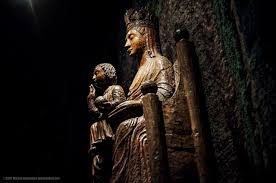
Statue of the Black Madonna with her child in Chartres Cathedral

Why do we personify Wisdom? Shapiro believes it is because “on a deep and subconscious level we know her to be the other with whom we long to unite. She is not an abstraction but our Beloved. She is not to be thought about but physically embraced in a manner that reveals YWVH to us.”

Shapiro offers us his translation of Proverbs: Chapter 9, 1-6:

Wisdom’s house rests on many pillars.

It is magnificent and easy to find.

Inside, she has cooked a fine meal and

sweetened her wine with water.

Her table is set.

She sends her maidens to the tallest towers to summon you.

To the simple they call: Come enter here.

To those who lack understanding they say:

Come eat my food, drink my wine,

Abandon your empty life and walk in the way of understanding.

Shall we accept her invitation?

.

travelling with sophia

Perhaps like you, I have begun to take road trips once more to visit with friends and family. On Saturday I set out with confidence on a journey to Southern Ontario, travelling along roads I’d been taking for more than twenty years. I knew where to find the essentials: gas stations, Tim Horton coffee stops en route, had a mask handy for each time I got out of the car. I had my GPS.

What more was needed?

For several hours, I drove past lush green scenery, towns, landmarks not seen in these seventeen months since COVID took up residence across the planet. There were changes since my last journey: the express route, 407, had been extended to link with the 115 South, shortening the trip by nearly an hour. I was within 30 minutes of my destination, London, Ontario, when I stopped for coffee, found a phone message from my sister warning of a major detour on the 401 for that night only.

Within minutes of my setting out again, a flashing sign warned that traffic ahead was stopped. The three-lane highway became a parking lot, with progress measured in metres, interspersed with stoppages. Full darkness had risen two hours later when we exited onto a side road whose winding ways would lead back to the 401 beyond the construction area.

Soon I was completely lost.

I pulled into a large, empty parking lot to get my bearings, reset my GPS. I backed up, heard the sound of crunching metal. I had backed into a narrow cement pole just a few centimetres above the ground, too low to register on my backup screen, though strong enough (as I would later discover) to deliver a strong punch to my back bumper…

Meanwhile, the confident voice of the GPS, apparently unaware of the detour, was guiding me to the exit to the 401 West. I was driving along in the opposite directions to a long line of cars, vans, giant transports, all leaving the 401.

One car waited while I made a graceless U-turn to join the line…

Two phone calls, combined with a less-trusting return to the GPS, brought me to my sister’s home where she was waiting for me outside her front door…

After a late dinner, after conversation with my sister and brother-in-law, I was alone in the guest room, seated for my evening prayer with Sophia. The tensions, the dangers of that dark journey swept through me. Paramount now was concern about repair costs for the bumper punch.

“WHY did that happen?” I asked.

In response, words of Rabbi Rami Shapiro, written about Chochma (Sophia) rose in me. This is how I remembered them: “Sophia will not tell you why things are as they are, but She will show you how to cut with the grain, tack with the wind…”

As though blown away by a gentle breeze within me, my tensions resolved. I knew I would, on my return, go about the steps involved in having the damage to the car assessed and repaired. Only then did I realize what love and care, what inner guidance, had kept me safe through a harrowing journey, where I did not panic even when I found myself going against the traffic.

Now that I am home, I have found the full passage from Rabbi Rami Shapiro’s book, The Divine Feminine in Biblical Wisdom Literature, that brought me comfort.

To know her, according to Shapiro, is to know the Way of all things and thus to be able to act in harmony with them. To know the Way of all things and to act in accord with it is what it means to be wise.To know Wisdom is to become wise. To become wise is to find happiness and peace:

Her ways are ways of pleasantness…all Her paths are peace. (Proverbs 3: 17) 

Wisdom is not to be taken on faith. She is testable. If you follow Her you will find joy, peace and happiness not at the end of the journey but as the very stuff of which the journey is made. This is crucial. The reward for following Wisdom is immediate. The Way to is the Way of.  

Chochma is not a reluctant guide or a hidden guru, Shapiro writes. She is not hard to find nor does she require any austere test to prove you are worthy of Her.

She stands on the hilltops, on the sidewalks, at the crossroads, at the gateways (Proverbs 8:1-11) and calls to you to follow Her. Wisdom’s only desire is to teach you to become wise.  Her only frustration is your refusal to listen to Her.

….To know Wisdom is to be her lover, and by loving Her, you become God’s beloved as well.

In our becoming partners, co-creating with Wisdom, Shapiro writes:

Wisdom will not tell why things are the way they are, but will show you what they are and how to live in harmony with them….Working with Wisdom, you learn how…to make small, subtle changes that effect larger ones. You learn how to cut with the grain, tack with the wind, swim with the current, and allow the nature of things to support your efforts. She will not tell you why things are the way they are, but She will make plain to you what things are and how you deal them to your mutual benefit.

In the Wisdom of Solomon, Chochma/Sophia is described in words that are not unlike those that define the GPS: “the Global Positioning System that tells you where you are on earth.”   

She embraces one end of the earth to the other, and She orders all things well. (Wisdom of Solomon 8:11)

awakening to the sacred feminine presence in our lives