Mary Magdalene: “Go to my brothers”

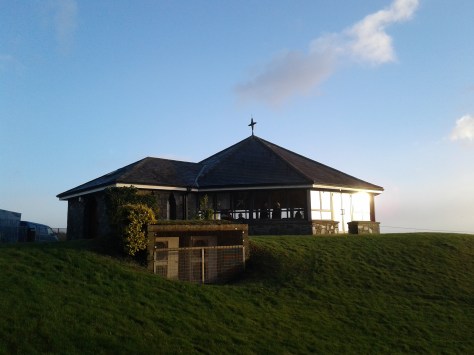
“High on an escarpment crowning the medieval walled city of Vezalay France, stands the magnificent basilica of St. Mary Magdalene”. That is how Episcopal priest and writer Cynthia Bourgeault opens her book, The Meaning of Mary Magdalene (Shambala, Boston and London, 2010). Bourgeault spent Holy Week of 2005 with the young monastic order in residence at the Cathedral of Vezalay. Here she had a stunning awareness of Mary Magdalene’s presence in the events of the death and resurrection of Jesus. She tells us:

This mixed community of men and women monks is well known for the imagination and beauty of its liturgy, and toward the end of the Good Friday Liturgy I witnessed an unusual ceremony that changed forever how I understood my Christianity….

The late afternoon shadows were already dimming the cathedral when we finished with communion, followed by the traditional stripping of the altar. And then came the ceremony I am speaking of. Two of the sisters brought forward a small corpus – the crucified Christ figure that traditionally hangs on Roman Catholic crosses. It was carved in wood, about two feet long. Tenderly they wrapped it in the altar cloth, laid it on the altar, and placed beside it an icon of the Shroud of Turin (the portrait of Jesus allegedly imprinted on his original burial shroud and revealed through radiocarbon dating). They set a small candle and incense burner at the foot of the altar. And then, as sunset fell, one of the monks began to read in French the burial narrative from the Gospel of Matthew.

Enchanted by the mystical beauty of all this – the smell of the incense, the final shafts of daylight playing against the great stone walls of the cathedral – I allowed the sonorous French to float by my ears while I drifted in and out, catching what I could. I heard the description of Joseph of Arimathea asking for the body of Christ, wrapping it (just as the sisters had just done) in a linen cloth, laying it in a tomb. And then out of the haze of words came “et Mary Magdalene et l’autre Marie restaient debout en face du tombeau…”

That’s when I did my double take. Mary Magdalene was there? That was in the scripture? Why hadn’t I ever noticed it before?
Thinking that maybe my French had failed me, I went back to my room that evening, took out my Bible, and looked it up. But yes, right there in Matthew 27:61 it reads: “And Mary Magdalene and the other Mary remained standing there in front of the tomb.”

Suddenly the whole picture changed for me. I’d thought I knew the tradition well. …. How could this key point have escaped my attention? No wonder Mary Magdalene came so unerringly to the tomb on Easter morning; she’d stood by in silent, unflinching vigil the whole time Jesus was being laid to rest there. Maybe she never left…. Since that moment I have literally not heard the Passion story in the same way. It inspired me to go back to the gospel and actually read the story in a new way. (pp.5-6)

Bourgeault reflects further that much of what we know of Mary Magdalene has been absorbed “through the dual filters of tradition and the liturgy, which inevitably direct our attention toward certain aspects of the story at the expense of others.” (p. 6)

Turning to the Gospels directly, Bourgeault focuses mainly on John’s account of the resurrection.
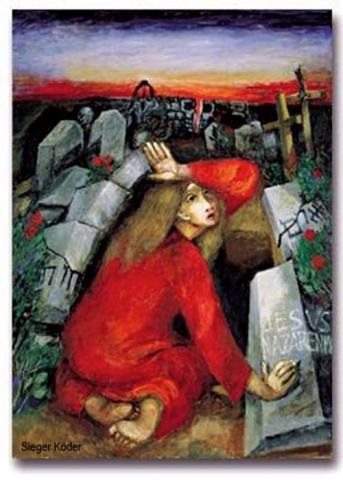
mary_magdalene by Sieger Koder

Mary (Magdalene) arrives alone at the tomb in the early hours of the morning to discover that the stone blocking the tomb has been rolled away. She hurries off to find Peter and “the disciple whom Jesus loved” who race each other to the site, discover the tomb empty and the grave cloths rolled up, and return home in bewonderment. After the two of them have gone their way, Mary stays behind, weeping beside the tomb. Then, in a unique and immortally reverberating encounter:

She turned around and saw Jesus standing there, but she did not recognize him. Jesus said, “Woman, why are you weeping? Who are you looking for?” She thought it was the gardener and answered him, “… if you have taken him away, tell me where you have put him and I will go and remove him.” Jesus said to her, “Mary.” She turned and said to him, “Rabboni” – which means Master. Jesus said to her, “Do not cling to me; you see I have not yet ascended to my Father. But go to my brothers and say to them: I am ascending to my Father and your Father, to my God and your God.”

So Mary went and announced to the disciples, “I have seen the Lord, and this is what he said to me. (John 20:14-18)

Bourgeault continues:

It is on the basis of this announcement that Mary earned the traditional title of “Apostle to the Apostles.” The first to witness to the resurrection, she is also the one who “commissions” the others to go and announce the good news of the resurrection. (p. 8)

images (3)


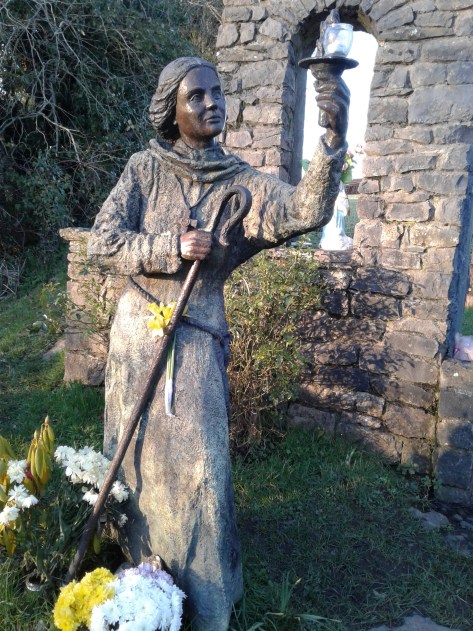
Mary Magdalene: statue on the grounds of Salisbury Cathedral, England

Waiting in Darkness


The ancient ritual of the Easter Vigil lures me after an absence of several years. The parish church doors open to invite us into the Phrygian darkness of night. We stand scrunched together at the back, among friends whose faces we cannot see, whose voices we do not hear. Then comes the flaring forth of vermilion flame as the Easter fire is birthed from flint. It could be the flaring forth of light at the dawn of this Universe, the primordial moment that the physicists cannot yet grasp.

26805062_1574000952685967_8259781870951261661_n

The priest uses the new fire to light the great Paschal Candle which stands taller than he does. He intones the ancient chant: three notes rising: “Christ our Light.” From the single flame, the candles held by all who have gathered this night bloom with yellow light, creating a halo that reveals each face. “Christ our Light”.

A cantor sings the “Exultet” the Hymn of Praise to the Risen Christ, echoing the words of Paul: “What good would life have been to us if Christ had not risen?”

Seven Readings follow from the Hebrew Scriptures, telling the old, old tales….

And this is where I begin to feel discomfort. I who love stories, the older the better, find myself rejecting the Genesis account of creation. Once I could overlook its scientific inaccuracies, defend them to others as poetry, not truth. But tonight I am comparing this account with the enchantment of the 13.8 billion year story of the unfolding, evolving, unfinished Universe.

I feel something like revulsion for this strange god who creates man in his own image, adding a woman only for the man’s sake, an after-thought, giving these latecomers dominion over all of life on our planet while forbidding them to eat the fruit of the tree that would give them wisdom.

Finally, pleased with himself, this god decides to take a day off.

When we meet him in the next reading, this god is asking Abraham to make a blood sacrifice of his only son. After the agony he puts the father through (no mention of Sarah, the mother), he says, “I was only testing you…”

As Moses and his people are fleeing from Egypt, this god “covers himself in glory” by drowning a people who were among the wisest who ever lived….

Who is this god?
I do not know him.

Joseph Campbell writes of him as a “local desert god”, a “thunder-hurler”. 1

Indo-European deities encountering warrior gods tended to have their goddesses marry the male gods. Campbell notes that this did not happen among the Semites who ruthlessly obliterated the local goddesses. He points out that a religious tradition with a father god but no mother god is one where we are separate from God, where God is separate from us, from nature. This is a God who is “out there” rather than within us. To find this God we need religious structures, laws, authorities. We are separated from nature, distrusting, even despising our own bodies. Beauty is itself suspect, a distraction, a seduction.

Still in the candle-lit darkness, I am working myself into a state of high dudgeon, wondering why I came, when the tone of the readings alters.

I begin to hear words of undeniable tenderness. I remember why for so many years my favourite biblical passages were the Hebrew prophets who knew, must have experienced, a Presence of Divine Love, what Julian of Norwich calls a Mothering God.

Isaiah invites all who thirst to come to the waters, to come without need of money for what the heart desires…

Hosea’s voice calls back from the desert an abandoned, heartbroken lover.

The seventh reading from the Hebrew Scriptures begins, one I do not recognize, do not remember having heard before.

I listen to words that tell of a presence who guides, who brings light and joy, when we follow… HER.
What is this?
It is the writing of the prophet Baruch.

Later, at home, I find the passage in my Jerusalem Bible:

Listen, Israel, to commands that bring life;
Hear and learn what knowledge means.
…….
Learn where knowledge is, where strength,
where understanding, and so learn
where length of days is, where life,
where the light of the eyes and where peace.
But who has found out where she lives,
Who has entered her treasure house?
…..
Who has ever climbed the sky and caught her
To bring her down from the clouds?
Who has ever crossed the ocean and found her
To gain her back in exchange for the finest gold?
No one knows the way to her,
No one can discover the path she treads.
But the One who knows all knows her… 2


And now we are hearing Paul’s words of promise, of hope, of assurance of our own Resurrection: Paul who never met the earthbound Jesus, who was hurled from his horse when the Risen Christ called his name, who fell in love with the Unseen One and spent the rest of his life carrying his message to others, who did not disdain to tell them he was in labour until Christ was born in them.

Suddenly the dark is rent by an eruption of light everywhere, flowers making a garden of the sanctuary, bells ringing. Two clear soprano voices lift in a duet sung in the pure tones of angels, “He is Risen. He is Risen.”

After the Celebration of the Easter Eucharist, I greet my friends, set off in the rain for home, awash in questions…. slowly I let them settle in me.

I remember Teilhard’s understanding that we live in an unfinished universe. We each have a part to play in bringing it nearer to completion. I recommit to my calling to invite others to join me in providing a space, a place, for the Sacred Feminine to dwell, embodied within us.

References:

1. Joseph Campbell Goddesses: Mysteries of the Feminine Divine (New World Library, Novato, California, 2013) p.xxii and pp. 86-87

2. Baruch 3: 9, 14, 15, 29-32


Awakening to the Easter Mystery

Through the cold, quiet nighttime of the grave underground,
The earth concentrated on him with complete longing
Until his sleep could recall the dark from beyond
To enfold memory lost in the requiem of mind.
The moon stirs a wave of brightening in the stone.
He rises clothed in the young colours of dawn.
John O’Donohue “Resurrection”

The Easter Mystery of life-death-life is at the heart of the universe, at the heart of life on our planet, in the deep heart of our own lives. From its birth out of the womb of a dying star, through its daily cycle of day/dusk/ night/dawn, its yearly cycle of summer/autumn/ winter/spring, the earth teaches us to live within the paschal mystery. Ancient peoples understood this mystery. Through their careful observations they constructed buildings such as the mound in Newgrange Ireland where a tiny lintel receives the first rays of dawn only on the winter solstice.

The ancients wove their understanding of life/death/life into their mythologies: the Egyptian story of Osiris, whose severed body was put together piece by piece by his wife Isis, then reawakened; the Sumerians tell of the great queen Inanna who descended to the underworld to visit her sister Erishkigal. There she was stripped of all her royal robes and insignia, and murdered by her sister who then hung her lifeless body on a hook. Three days later, Inanna was restored to life, all her honour returned to her.

The people of Jesus’ time would have known these and other great myths of the ancient Near East. What was so stunningly different in the Jesus story was that the mystery of life-death-life was incarnated in a historical person. The Resurrection of Jesus is at the heart of the Christian faith. As Paul wrote, “If Christ be not risen then our faith is in vain”.

In our lifetime, the explosion of new science shows us the life/death/mystery at the heart of the universe. Like exploding stars, our lives are continuously being rebirthed into a deeper more joyous existence. By allowing the death within ourselves of old habits, old mindsets and narrow ideas of who or what we may be, we open ourselves to the possibility of new life being birthed within us. As Jesus told his friends, “You will do what I do. You will do even greater things”.

“Resurrection is about being pulsed into new patterns appropriate to our new time and place,” Jean Houston writes in Godseed. For this to happen, we need to open in our deep core to “the Heart of existence and the Love that knows no limits. It is to allow for the Glory of Love to have its way with us, to encounter and surrender to That which is forever seeking us, and from this to conceive the Godseed.”

“The need for resurrection has increased in our time,” Jean continues. “We are living at the very edge of history, at a time when the whole planet is heading toward a global passion play, a planetary crucifixion.” Yet “the longing with which we yearn for God is the same longing with which God yearns for us…. the strength of that mutual longing can give us the evolutionary passion to roll away the stone, the stumbling blocks that keep us sealed away and dead to the renewal of life.” (Godseed pp.129-130)

The yearly miracle of Spring awakens within us the confidence and joy that this same rebirth is ours to accept and to live. We know our call to green our lives, our times, our planet:

healthy-spring-young-green-5865.jpg


The force that through the green fuse drives the flower
Drives my green age (Dylan Thomas)

Where in my life do I most experience the need for a rebirth?
What old habits and beliefs would I have to let die in order for this new life to be born?
How does knowing that the longing with which (I) yearn for God is the same longing with which God yearns for (me) make my life more joyful?
What would a resurrected life look like, feel like, for me? for those with whom my life is woven? for our planet?


Seeking the Woman-God

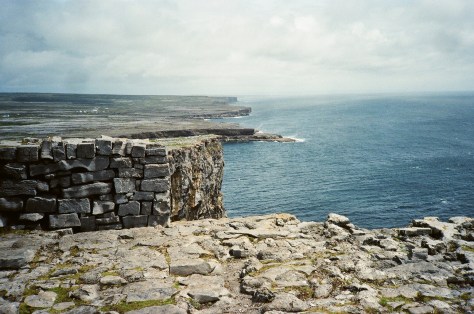
Where do you go looking when your soul longs for a Mothering God? Do you find her in poetry? ancient stories? In songs or rituals or art work or sacred dance? Do you look for wise and loving women who embody her? Do you seek her in your own wise and yearning heart? Or would you go out to explore the earth around you, seeking her in the beauty of spring flowers, in the grace of a flowing stream, in the tender presence of young birds in a nest? Would you look in wild places where the sea explodes into the rock face, pummels the cliffs, shapes stone into forms that resemble an ancient wise woman, a cailleach….


95950003

Atlantic Ocean greets cliffs of Dun Aengus on Inis M’or

Six weeks after my return from the Brigid of Faughart Festival in Ireland, I am still processing the insights, inspiration and experiences of those days. It is not surprising that what I found was sourced in the lives, the words, the stories, songs and poetry of the women I met there. The Sacred Feminine is an embodied presence. Yet of all that I learned, the thing that stirs me most was the way that women spoke of seeking, finding and being found by the Sacred Feminine in the land: in her sea and shore, her grass and trees, her wells and rivers, her mountains and ancient stones, her golden light and eerie darkness, her wild winds and gentle rains. I am captivated by this new understanding.

To honour the feminine presence, Wisdom Sophia, is to honour the planet which embodies her. From earliest days, from the time even before the arrival of the Celts, the people of Ireland honoured the goddess, whose ancient names include Aine or Anu. She was the one whose eyes held the light of the stars, whose hair rippled like the corn, flowed like the waves of the sea, whose body was the great earth barrows, her breasts the hills, called “the Paps of Anu”.

Before this recent visit to Ireland, I had thought these descriptors were lovely metaphors, a poetic honouring of the sacred presence. Yet on this journey I met women for whom the land, the sea, the rocks and rivers somehow embodied the goddess herself. This is not pantheism, making gods of nature, but rather panentheism, recognizing that the holy is present within all that lives, as Teilhard de Chardin taught.

Snowbound for days in this never-ending winter, I sat by the fire reading Kate Fitzpatrick’s book. Kate spoke during the Brigid Festival of her years of work through workshops, story-telling and powerful shamanic healing rituals, to help bring about peace in Northern Ireland. Her guide, counsellor and co-creative partner in this was Macha, the mythical Ulster Goddess.

In her book (Macha’s Twins: A Spiritual Journey with the Celtic Horse Goddess, Immram Publishing, Inishowen, Donegal, Ireland 2017) Kate describes encounters with Macha, mediated by the land and sea. While living on the island of Inis M’or off the west coast of Ireland near Galway, Kate writes:

I am exhilarated with the vital power of this island. The shifting clouds, the showers of rain. What I love about it is the changing light in each hour of the day. The land is bleak and barren. Yet the play of light makes it so beautiful.

I begin to see that Macha is the Wild Mother here. Every day in the raw vitality of wind and rain and sea I find her. Like her wild spirit, all here is dynamic and powerful. Restless and free. Seeping right in to my bones. I move through autumn and winter beckoned by this force. Every day I see more of the power of the feminine in the sea, the waves, and the rock. (p. 67)


95950007

Dun Aengus Inis M’or

In the years that follow, Kate experiences a call to return home to Northern Ireland, to assist the Sacred Feminine presence in the work of bringing healing and peace to the soul of Ulster.

By early June, it is becoming clear to me that the rocks, trees, stones and rivers, along with the elements and the sheer beauty of this glen, have, together, become an alchemical vessel to hold a wider healing of the soul of Ulster.
The sea, as I look out at it this morning, is playing its part in the offering of light, the blue of its holding, the high vibration of its silver water, the wildness of its dance. There is a fierce power of transformation in the rolling waves.(p. 169)

Knowing Macha’s presence with her, Kate writes:

I breathe deeply as she shows me pictures of the town in County Antrim where I grew up in the 1960’s. ‘There are many towns in the North that need healing,’ Macha tells me. ‘This is a journey to bring the heart home, to bring back the kindness lost to everyone in the shadows of war. For you, Daughter, concern yourself only with this.’ (p.169)

Kate’s work with the support of other women led to a tangible presence of light and peace in the land. Two decades after her time on Inis Mo’r, Kate knew that “the old patterns are going now and light is coming in, bringing forgiveness, beauty and joy”.

Then she describes this experience:
I sense a presence in the middle of the strand and when I look over, I see Macha walking in the shallow waters of puddles left on the sand. I see her bend down to pick up shells. As I walk towards her, she looks up, sees me and smiles….I sigh a deep breath and run towards her, power seeping into me from the very sand itself. As I approach her, she straightens up and, still holding the shells, opens her arms to welcome me. Her holding is of the ages. In the warmth and strength of her embrace, I weep.(pp. 237-8)

Macha’s Twins is available for online sales in Ireland, Europe, USA and and internationally.
KILDARE
Books.ie
http://www.books.ie/macha-s-twins-a-spiritual-journey-with-the-celtic-horse-goddess

GALWAY
Kennys Bookshop
https://www.kennys.ie/catalogsearch/result/?q=machas+twins

Brigid: Cailleach, Midwife to a New World

Part Three  by Dolores Whelan

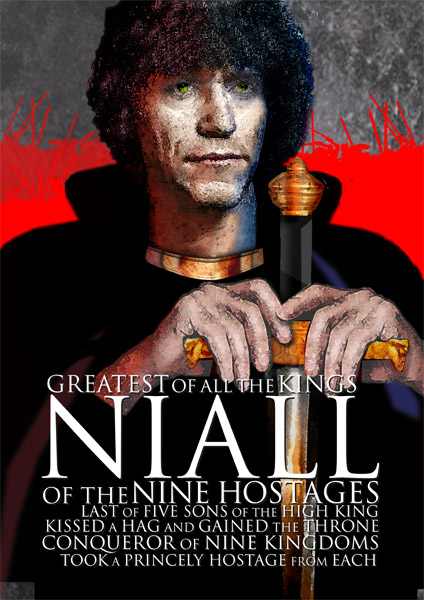
A story from the Celtic tradition that illustrates the importance of the cailleach and her energy is the story of Niall of the Nine Hostages.

Niall and his four brothers come to a well to get a drink of water. The well is being guarded by an old woman who represents the cailleach or hag. When the first brother goes to the well, she tells him that if he wants to drink the water, he must give her a kiss. He is horrified and refuses; she sends him away. The other three brothers go in turn on the same errand, and each refuses to kiss the hag. As the story goes:

Then it was Niall’s turn. Faced with the same challenge, he kissed the old hag and embraced her. When he looked again, she had changed into the most beautiful woman in the world. “What art thou?” said the boy. “King of Tara, I am Sovereignty . . . your seed shall be over every clan.”


Niall-N2


This story suggests that in order to have access to the life-enhancing energy represented by the water in the well, it is necessary for the young masculine to embrace this particular and perhaps unattractive aspect of the feminine energy. Why is this so? The cailleach represents the wisdom gathered by living in right relationship with the earth, something that requires reflection, stillness, and attentiveness. It knows more clearly what is needed and what is possible in each situation, and it is aware of the consequences of particular actions. It knows how to proceed slowly; it understands the value of times of waiting and times of allowing. It knows how to be and how to act.

So how can we, you and I, begin the journey back towards wholeness and balance?
Brigid in her cailleach form can help us to embrace these difficult and fearful aspects of our lives. The cauldron, a central image in both the Celtic and other traditions, is a vessel for transformation and transmutation. In many stories, the cauldron is first filled with unpalatable raw things, which then are used to create a nourishing soup using the transforming energy of the universe through the action of fire and water. The transformation of the contents of the cauldron is supervised by the cailleach energy, which works inwardly, quietly, and slowly to bring about an unforced and timely rebirth.

The transformation of the cauldron’s contents concentrates their essence and offers them back in a new and more suitable form. From this process, we learn that the possibility of transformation and re-birth always exists, no matter how devitalised something appears to be. A new rebirth can be achieved when we submit ourselves and our concerns to the inward and slow transformational energy of the cauldron and the cailleach.

Philosopher Richard Kearney in his poem Bridget’s Well speaks of the importance of this inward and downward journey and suggests that it is the only way to access the life- giving and inspiring fire of Brigid that lies underneath the water.

I will rest now at the bottom of Bridget’s well
I will follow the crow’s way
Footprint by footprint
In the mud down here
I won’t come up
Until I am calmed down
And the earth dries beneath me
And I have paced the caked ground
Until smooth all over
It can echo a deeper voice
Mirror a longer shadow (2)

This poem suggests the importance of that deep journey to the well where the source of new life and the fire of passion is found. At Imbolc (Feb 1st) the tiny spark of new light discovered in the deep womb darkness of the winter solstice has grown sufficiently to safely emerge from that inner world and begin to transform winter into spring !At this time Brigid appears as the fresh maiden of springtime emerging from the womb of the cailleach, queen of winter. Here Brigid embodies the energy that breathes life into the mouth of dead winter. The energy of Brigid at Imbolc is the energy of Yes, and it can only emerge from the place of stillness!

Brigid is also closely associated with the life giving aspect of fire, a fire that doesn’t burn but which can never be fully quenched. When this fire comes from a clear and deep space, as happens following the inward journey, it will be significant and filled with truth and potency. This life-giving fire will act within in individuals, within the land, in the relationships between the people and their land, fanning the fires of creative endeavour so that all of life forms can partake in the symphony of new life emerging each springtime! The fire discovered through this deep journey is an inner light which guides each of us to find our next step!

Richard Kearney in his poem “Brigit’s Well” also speaks of the re-emergence of a new fire born of a deeper place within

Then the fire may come again
Beneath me, this time
Rising beyond me
No narcissus- flinted spark
Behind closed eyes
But a burning bush
A fire that always burns away
But never is burnt out (3)

I believe that the archetypal energy of Brigid, the embodiment of the divine feminine, present within the essence of the Celtic tradition has the capacity to lead and support us in transforming the present wasteland into a new life sustaining society. For this to happen, it is necessary for us to understand that the archetypal energy that Brigid represents is a real aspect of the human psyche, one that has been largely dormant over the past few hundred years, but is now re-emerging. Each of us can become keeper of the Brigid flame by developing and living those qualities and values that distinguished her.

As we align ourselves with her archetypal energies, she supports us courageously and safely to face the demons of this time. She teaches us how to stand still in a wobbling world, to act as a unifying force, to hold the space of possibility and so become agents of transformation. So we ask for

The mantle of Brigid about us
The memory of Brigid within us
The protection of Brigid keeping us from harm from ignorance,
from heartlessness this day from dawn till dark (4)

When we embrace her energy Brigid will hold us and guide us through this transition. I believe she is the one who has the power to awaken in each of us An eye to see what is, the heart that feels what is, and the courage that dares to follow. (5)

1 Amergin Jan de Fouw Amergin Wolfhound Press Dublin 2000 ( afterword ) no page number
2 Richard Kearney quoted in Stephen J. Collins The Irish Soul in Dialogue the Liffey Press Dublin 2001 p 147
3 Richard Kearney quoted in Stephen J. Collins The Irish Soul in Dialogue the Liffey Press Dublin 2001 p 147
4 Poem source unknown
5 Celtic triad found extensively in the literature


Brigid: Cailleach and Midwife to a New World Part Two

  We continue this week with Dolores Whelan’s article on Brigid:

As we consider the qualities embodied by Brigid as reflected in the stories of her life as abbess of Kildare Ireland, it is obvious that these qualities are similar to those present in her incarnation as pre-Christian goddess.

Brigid is considered a threshold person, one who can straddle both sides and remain detached. This quality, which is central in her life, is highlighted in the stories of her birth, which attest that she was born on the threshold of the house, neither within nor without; that her father was a noble man, her mother a slave; and that he was a pagan, her mother a Christian. From her origins, she has this ability to stand in the void and remain centred within it, while holding the creative tension between two opposite perspectives. Many stories from her life portray her as a person capable of resolving conflicts in a healthy manner. Being centred and aligned within herself, she is detached and can grasp the energies of both sides clearly, thereby facilitating a resolution. She has the ability to stand still and remain focused, in spite of the uncertainty present in the outer world.

 the ability to stand still and remain focused

As a child and a young woman Brigid constantly challenged the accepted norms of her society, especially those expressed by her father when they opposed to her own values. This reflects Brigid as a person who lives her life from a place of deep inner knowing and inner authority. She also refused to marry any of the suitors that her father arranged for her, because she had chosen a different life path and destiny. She would not compromise her soul journey!

absolute faith in the abundance of the universe

Brigid’s generosity is legendary and is related in numerous stories of her giving away food and clothes to people who came to her monastery or whom she met along the way. This generosity was, it seems, based on her absolute faith in the abundance of the universe to provide all that was needed in each moment. Each time she gave away the butter or meat needed for the next meal it miraculously reappeared in time for that meal!

Brigid’s capacity to bring forth new life, to nourish, to create plenty in the crops or an abundance of the milk from cows, and to manifest or create ex nihilo is a reflection of the true abundance and with the prosperity of the society, living in relationship with the land , created by her. Her life and work thrived because of her deep trust and an absence of fear.

ability to be aligned heaven to earth

It is said that from the moment Brigid learned to know God her mind remained ever focused on God. She remained connected to God and the heavens while living on the earthly plane. Her power of manifestation was a result of this ability to be aligned heaven to earth. The strong connection between her inner and outer worlds allowed her to focus her energy onto a particular intention and ensure its manifestation.

The story how Brigid got the land for her monastery in Kildare is a wonderful example of her ability to manifest what is needed. She states clearly what she needs and asks the local lord for land. First he refused but she is not deterred by this. She pursues her request in a different way by asking, “Give me what land my mantle will cover.”

 a woman who can hold her intention clearly

He says yes! When she placed the mantle on the ground it grew until it covered enough land for the monastery .This reflects a woman who can hold her intention clearly, even when on the surface it seems that her request will not be met!! These inspiring stories of Brigid relate to her active life in the world, where she embodies and live true spiritual power! But what and where is the source of this power?

To fully understand the power and the qualities that Brigid embodied, as reflected in the many stories about her life, we need to begin with an exploration of the role of Brigid as Cailleach, the aspect of the Divine Feminine, that rules during the season of Samhain (winter) at the beginning of the Celtic year. This I believe is the wellspring from which Brigid’s power manifests in the world emerges.

the embodiment of tough mother love

What then is the energy associated with the hag, crone, or cailleach aspect of the divine feminine? The cailleach is the embodiment of the tough mother-love that challenges its children to stop acting in destructive ways. It is the energy that refuses to indulge in inappropriate personal or societal dreams. It is the energy that will bring death to those dreams and fantasies that are not aligned with our highest good.

the cailleach energy….will hold us safely

Yet, this cailleach energy also will support the emergence and manifestation in the world of the highest and deepest within us. It will hold us safely as we embrace the darkness within ourselves and our society. It is an energy that insists that we stand still, open our hearts, and feel our own pain and the pain of the earth. This is the energy that teaches us how to stay with the process when things are difficult. This energy will not allow us to run away!

20180129 Bhrigid Well Kildare.jpg

Her way of being is a slow, inwardly focused way, with minimum outward activity: a way that values times of active waiting that pays attention and allows life to unfold.

embracing the energy of surrender

An essential part of the journey that all the great heroes and heroines in world mythologies undertake includes facing and embracing the energy of surrender, darkness, and death. The hero or heroine learns the next step required in their outer world journey only by submitting to and being initiated into the dark world of the cailleach.

Through this initiation the mature masculine power can emerge and lead each one to find their true path. When this happens the action that follows will be in the service of the true feminine and bring forth wisdom and compassion creating new life, vitality, and sustainability.

However because western society is currently dominated by the young masculine energy, present in both men and women, characterised by its “can do” attitude, there is an urgent need for each of us to make this heroic journey with the cailleach, so that we will become agents for the transformation of our society.

Brigid: Cailleach and Midwife to a New World

This is the first of a three part article on Brigid and her importance to us at this crucial time, written by Dolores Whelan and used with her permission. 

dolores-img

Dolores Whelan

Reflecting on the turmoil present in the world today it is clear to all, but those steeped in denial, that all is not well. It seems that something ails us humans; something that causes us to live in ways that disrespect our mother, the living earth, and all our relatives. We ask what is it in us humans that creates such a restless world where there is little sense of belonging, nurture or home and which causes so many of the species with which we share this planet to suffer?

The exclusion of the Feminine energy in our naming and understanding of the Divine is reflected in a corresponding absence and valuing of feminine energy in all aspects of life in western society. The devaluing and exclusion of the feminine energy over the past centuries has created a distorted story about life which has resulted in a world whose shape and vibration create disharmony.

So how do we find our way back to a more harmonious way of life? If we know what is missing and what ails us, it may be possible for us to make the journey back towards wholeness and health.

In times of great danger and challenges, cultures often seek the wisdom for the journey ahead in the stories and myths that sustained them in an earlier time. However as Poet Nuala Ni Dhomhnail suggests this requires an understanding that “actual myths and stories themselves soar way above any uses to which they may have been put to already and can and must be retranslated by each generation in terms of their own need and thus liberated into a new consciousness.” (1)


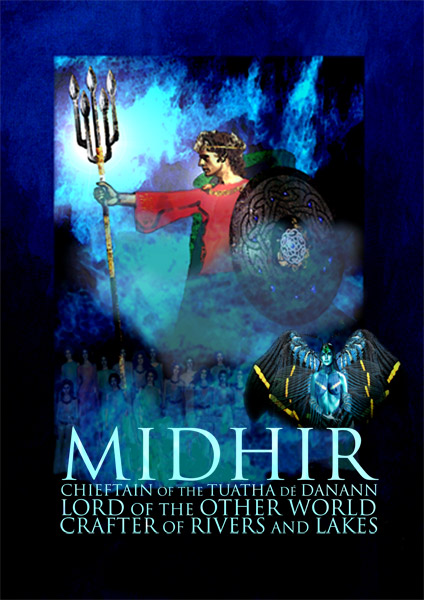
Midhir1


At the present time there is a wonderful re-emergence of aspects of ancient spiritual traditions by people all over the world. The reconnection and embodiment of these ancient spiritual traditions, myths and stories has the potential to release the spiritual power needed for us to become agents of transformation within our society.

At this time many people are becoming aware of the wisdom of the feminine. As this happens, the absence of genuine feminine energy present in most institutions, both religious and secular, throughout western culture, becomes obvious. To include the presence of the divine feminine energy in creating a world whose shape is more wholesome requires a fundamental reclaiming of the essential role of the feminine in all aspects of life. In order to create change within the physical world and in our society it is necessary to change the dreams and stories held within the imagination of a society.

My own journey over the past 25 years has been primarily within the Celtic spiritual tradition. This tradition has emerged over many millennia and continues to evolve. It includes the wisdom of the megalithic, the pre-Christian Celtic and the Christian Celtic traditions as they met and engaged with each other through the ages. I believe the rekindling of the flames of this tradition, which have lain dormant for many centuries, “like coals under the smooring awaiting a new kindling” holds a key to the recovery of the wisdom needed to create a more sane society.

“God is good and he has a great mother!” a statement sometimes heard in Ireland, reflects an important truth at the heart of the Celtic spiritual tradition, one that honours the presence of the divine feminine and understands that even God emerges out of the feminine energy of being-ness. The Divine Feminine is present at the heart of this spiritual tradition and plays a central role in both Celtic spirituality and Celtic culture. There are many goddesses within Celtic mythology; however Brigid, as both goddess and saint, occupies a central place as representative of the Divine Feminine within Celtic tradition. 20180129 Bhrigid statue at Solas Bhride

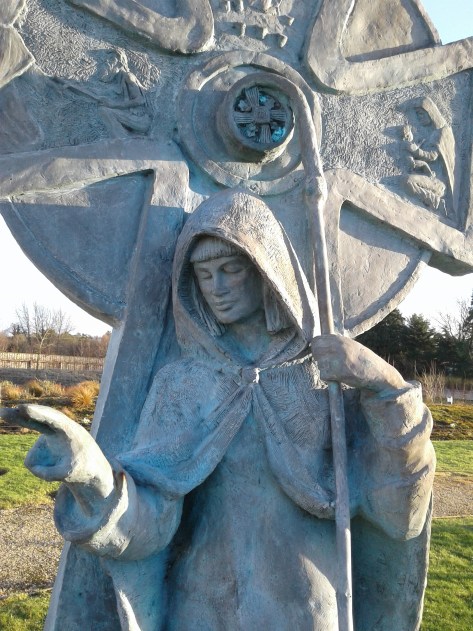
statue of Brigid at Solas Bhride, Kildare

Reconnecting with and re-membering the spirit and archetypal energy of Brigid, in both her Goddess and saint manifestations, is an essential task of this renaissance. Brigid, although normally associated with the maiden and mother aspects of feminine energy, is also expressed in the cailleach form, as indicated in the prayer “Molamid Brid an mhaighean; Molamid Brid an mhathair; Molamid Brid an cailleach” (Praise to Brigid, the maiden, the mother, and the crone).


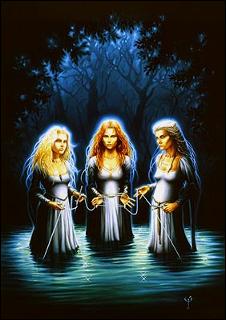
maiden_mother_crone_jpg_320_320_0_9223372036854775000_0_1_0

the maiden, the mother, the crone


These three different, but related manifestations, the maiden, the mother, and the cailleach, or crone, together create a divine feminine trinity. Each aspect of this trinity occupies a different role within the life, death, and rebirth continuum. The Feminine energy is both the harbinger and the birther of new life and is the destroyer of life that has been spent. It is experienced at the thresholds of life and death and rebirth.
In the past 20 years there has been a new awakening of the importance of Brigid and her place within our lives and our world. Her Feastday at Imbolc in now celebrated in many places in Ireland and all over the world. There is an understanding perhaps it is time for us individually and collectively to recover the qualities that Brigid embodied in her lifetime, marking her as a woman of true spiritual power.


1   Amergin  Jan  de Fouw   Amergin   Wolfhound Press  Dublin 2000  ( afterword )  no page number

A Spring Ritual for Imbolc

Dolores Whelan organized and led the Brigid of Faughart Festival which I attended in Ireland in late January/early February of this year. I first came to know Dolores through her book Ever Ancient, Ever New: Celtic Spirituality in the 21st Century (Columba Press, Ireland, 2006; Original Writing Dublin, 2010). That book became for me, and remains, my guide to the Celtic Year with its earth-related festivals.

Here is Dolores’ teaching on the Festival of Imbolc:

“Imbolc is synonymous with Brigid, Celtic Goddess and saint,
who embodies the energy of new life and of new beginnings.
She is the fertile aspect of the divine feminine energy,
which emerges from the hag or cailleach,
that dark barren aspect of the feminine energy.

“This transformation of the cailleach into the maiden
reflects the same mysteries which are happening
in the natural world as winter yields to spring.

“Brigid is the energy which at this time breathes life
into the mouth of dead winter.

“She is the fertility goddess
who embodies the neart or life force,
that raw primal feminine energy
which gives rise to all living beings.”

At the close of this year’s Brigid Festival, Dolores led us in a ritual which I shall reconstruct here for you in my own words:

“Tonight our ritual begins with a thank you and farewell to the cailleach who brought us into and through the darkness of winter where new life was being planted deep within each of us. As we prepare to thank the cailleach, we may reflect on what new seeds the darkness has quickened within us. Someone will carry the statue of the cailleach around our circle so that we may offer our thanks and our farewell.”


110283205_scaled_407x722

the cailleach

The bearer of the cailleach energy lifts the statue from the centrepiece and carries it to each woman in our circle, allowing time for each of us to quietly express our gratitude and say goodbye.


“Imbolc welcomes the maiden into our lives,” Dolores says. “Someone will now carry the image of the spring maiden around the circle so that we may welcome her into our lives. 20180204Spring Maiden Ritual Closing

Spring Maiden

“As we wait for our turn, we may become aware of the way the neart, the life force, is rising in us, breathing life into our being. How will our lives be different now?”

As the image of the maiden is carried around our circle, we welcome the life force of spring.

After we have each greeted the maiden of spring, Dolores speaks:

“Brigid has the ability to stand in the gap and remain centred within the uncertainty present in the outer world. This quality of being centred and aligned with one’s deep inner knowing is a quality that each of us can and must develop at this time.

“In a few moments, I will take the crios (a belt braided from strips of cloth and used in ancient times to assist in childbirth) and place it in the open space beside the centrepiece. I will invite you, each one of you as you feel ready, to come to the crios and imagine it as a womb of new life. Step into the crios womb and speak aloud your intention for this new springtime, the way you wish to stay centred. As each one speaks, we will respond: We support you in this. Then move forward to step out of the circle on the far side to symbolize your emergence from the womb.”

Dolores arranges the crios in a womb shape and asks, “Who would like to begin?”
One by one we, both women and men present, enter the crios, state our intention for this new springtime, receive the affirming support of our companions.

When everyone has completed the Crios Ritual, Dolores speaks once more:
“Brigid’s followers were charged with holding the seed of the fire on behalf of the community, that is holding the seeds of a life-enhancing energy on behalf of the people. This fire would not burn or be destructive so long as they remained focused, aligned with their own inner truth and undistracted by flattery, or by popular opinions.

“So for us people, in this time, who are charged with embodying the energy of Brigid, it is essential that we stay focused on our task which is to act, like Brigid, as midwives to a new era, a new day, a new way of being.”


Women Rising Rooted: Brigid’s Festival

If we surrendered
to Earth’s intelligence
we could rise up rooted,
like trees.
(Rainer Maria Rilke)

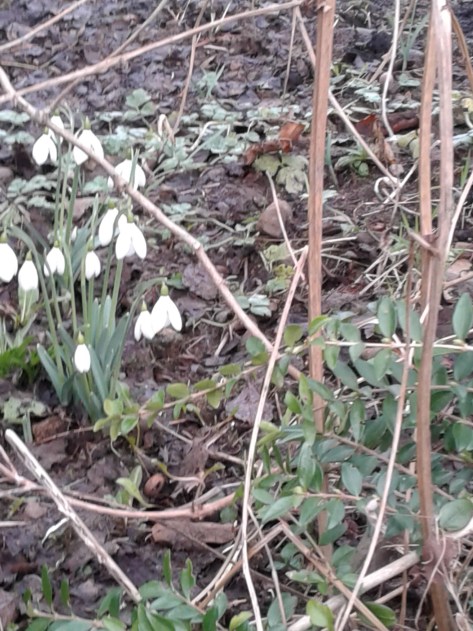
At the end of a frigid Canadian January, I have come to Ireland for Brigid’s Festival of Imbolc, the day that welcomes Spring. Brigid is the one who “breathes life into the mouth of dead winter”. In the front garden of my friend, Dolores Whelan, the first thing I see are snowdrops….then one purple crocus, two golden ones.

20180126snow drops in Ireland

snowdrops in Dolores Whelan’s garden

From a window on the upper floor, Dolores shows me that the Hill of Faughart can be seen, aligned with her home. Birthplace of Saint Brigid, 5th c. Abbess of Kildare, Faughart is ancient in memory, a place where the goddess Brigid was honoured in pre-Christian Ireland. Snow drop and crocus, saint and goddess, growing from this earth.

Brigid’s Festival honours both, and in the days that follow the two merge in my awareness, become intertwined, embodied in the fiery women whom I meet: Dolores and the volunteers who planned the events of the festival as well as the presenters, attendees, poets, artists, dancers, singers, writers… each woman aflame.

I listen as they tell their stories, either as a formal part of the festival’s program or casually in conversation over coffee or a meal, or in a pause between sessions.

I listen as Sharon Blackie tells the story recounted in her book If Women Rose Rooted (September Publishing 2016). With a PhD in Neuro-science Sharon found herself in a corporate job where her inner self was dying. Through a labyrinthine journey, one she describes as the feminine form of Joseph Campbell’s “Hero’s Journey”, Sharon followed the lure of her heart to the northwest of Scotland and on to Ireland, living on land near the sea where her soul finds a home.

I walk through Una Curley’s art installation of her own “Camino Walk”, her story of walking away from a life of successfully functioning in a corporate position that left her empty inside. Una chose instead the uncertainty and bliss of life as an artist. Una says the way to begin is to tie a piece of thread to a rusty nail and let the life you have designed, the life that no longer serves your soul, unravel… Part of her work traces the early flax industry of Ireland, rooted in the land, uniting the communities around the flax fields in a common endeavor.

Kate Fitzpatrick picks up her violin to express more profoundly than words her journey with women as they sought in the land and soul of Ireland the Healed Feminine. Kate’s quest was to bring peace and forgiveness to her people. The story of her spiritual journey with the Celtic Horse Goddess Macha is told in her book Macha’s Twins (Immram Publishing, Donegal, Ireland 2017)

Ann McDonald leads us in sacred movement, in breathing exercises, finding the power in our solar plexus. Deeply grounded, we release a voice that is resonant. Ann creates songs, receives songs that come to her while walking in pilgrimage or while holding sacred space. Her songs at the Ritual for Brigid’s Feast at Faughart come from deep within, inviting grace to embrace those present in the Oratory.


20180201Faughart Oratory

The Oratory on Faughart Hill on Brigid’s Day, February 1, 2018


Dolores, Una, Kate, Ann and Sharon are women whose lives differ on the outside. Yet I saw in each a life rooted in an inner passion, a deeply feminine connection with the land and a quiet walking away from cultural values that are out of harmony with and therefore destructive of the feminine soul.

I understand now that life can be found by returning to the ancient stories, the ancient spirituality that grew out of the land itself, a spirituality that honours women, that cares for the things of earth, that recognizes, as Rilke says, that we are of the same substance …here is his full poem:

How surely gravity’s law
strong as an ocean current
takes hold of even
the smallest thing
and pulls it toward
the heart of the world.

Each thing –
each stone, blossom, child –
is held in place

Only we in our arrogance
push out beyond what
we each belong to –
for some empty freedom.

If we surrendered
to Earth’s intelligence
we could rise up rooted,
like trees.

Instead we entangle ourselves
in knots of our own making
and struggle, lonely
and confused.

So, like children
we begin again
to learn from the things
because they are in
God’s heart,
they have never left him.

(Rainer Maria Rilke)

A Welcome for Brigid

The knocking on the wooden door is so loud it startles us, even though we are waiting for the sound. A woman’s voice, strong, certain, calls out from the other side: “I am Brigid. Do you have a welcome for me?”

We have our answer ready, “Yes, we do.” The door opens. The woman playing Brigid’s role enters. On this final morning of our weekend with Dolores Whelan at the Galilee Retreat Centre in 2014, we are enacting an ancient Celtic Ritual of Imbolc, February 1st, as we welcome Brigid in her Maiden form. Brigid, who “breathes life into the mouth of dead winter”, comes among us announcing spring.

Brighid by Jo Jayson

painting by Jo Jayson

Do we “have a welcome” for Brigid in our lives? What does it mean to answer her question with a resounding, “yes”?

This is a woman of great power, an archetype, an embodiment of energies of the sacred. Our welcome of her will open up our lives in ways we cannot foresee, cannot even imagine. But the hints are already given in the stories we have been recalling.

Two weeks ago we recalled the legend that angels carried Brigid over the seas from Ireland to Bethlehem so that she might be present for the birth of Jesus, assisting Mary as midwife. Brigid, who was born in the fifth century after the event….

Immediately we find ourselves in sacred time, in what today’s physicists, following Einstein, would call the simultaneity of time. Mystery. We suspend disbelief, allow our linear, logical brains to take a break, invite the story to offer us its teachings. Ask how this applies to our own lives. Listen.

Each one of us is asked, like Mary, to give birth to the Holy One. In Godseed, Jean Houston writes about the heart of our call, inviting us into a meditation, a visualization, of how this might be:

Lying down now and closing your eyes, imagine that you are dreaming. In your dreams, you see light, and into this light comes a Being of Light, a Bearer of Good News, a Resident from the Depths. This angel says to you, “Oh Child of God, fear not to take unto yourself the spiritual partnership, for that which is conceived in you is of the spiritual Reality. And this Reality, if nurtured, shall be born of you and shall help you to…bring the Godseed into the world.”
And now see what the angel sees—the fulfillment and the unfolding of this Child of Promise within you….
….see and feel and know the possibilities, indeed the future, of this Child in you, this Godseed that you are growing in the womb of your entire being, should you allow it to be nurtured and to grow and to be born into the world. (Jean Houston in Godseed Quest Books 1992 p.39)

This call to birth the Christ within us is as ancient as first century Paul, who wrote of being in labour until Christ is born in us. It is as modern as twentieth century eco-feminist theologian Yvonne Gebara who entreats us to give birth to the Christic Presence in the Universe.

Contemporary writer Diarmuid O’Murchu cites the words of the thirteenth century Dominican mystic Meister Eckhart: What does God do all day long? God lies on a maternity bed, giving birth all day long.

Reflecting on Meister Eckhart’s image, O’Murchu continues:

This is a metaphor we have known as a spiritual species for thousands of years, long before formal religions ever came into being….The Great Goddess of our Paleolithic ancestors was perceived as a woman of prodigious fecundity, birthing forth the stars and galaxies, the mountains and oceans and every life form populating planet earth today. God, the great life-giver in the pregnant power of creative Spirit, is probably the oldest and most enduring understanding of the Holy One known to our species.

O’Murchu concludes that: we are called to become co-birthers with our birthing God of the ongoing evolutionary re-creation of God’s world in justice, love, compassion and liberation. (Diarmuid O’Murchu Jesus in the Power of Poetry 2009 pp. 45-46)

When we say yes to our call to give birth, we are embracing a lifelong partnership with the Holy One of “prodigious birthing”, a responsibility that has the power to take over our lives, to demand of us everything, to offer us a life that is at once profoundly meaningful, and intimately engaged with the ongoing renewal of the universe. There will be suffering, there will be hard work, but there will also be times of ecstatic joy, tasting our oneness with the Love at the heart of life.

Dolores reminds us that: It is only in us, you and me, that the energy of Brigid will rise again, take form and become a force for transformation in our world. Dolores Whelan in Ever Ancient, Ever New Dublin 2010 p. 81

Brigid, midwife of this birthing, stands at the door. We hear her voice, “Do you have a welcome for me?”

What is our response?


awakening to the sacred feminine presence in our lives