Sophia in Egypt: Thirty-One

On our final night in Egypt, the sacred Sufi dances of ecstasy end. A wilder, joyous exuberance takes over within our group, an explosion of emotion, of deep gratitude, sharpened by awareness of the approaching ending.
Some of our company have prepared songs, rituals, presentations to honour our leaders, Jean and Peg, to thank Mohamed for his provision of private time for us in sacred places where we might experience prayer and ritual and to show our gratitude to Samai, our guide through Egypt.
Soon the audience spills onto the stage, and the Sufis are offering lessons in dance and movement. I watch the wildness of dance, wishing I felt free enough to express all the feelings that dance within me.

After we board the bus to return to the Mena House, I pass by Jean. I ask her if there might be a moment to talk with her before we leave Egypt.
The next morning, at breakfast in the Mena House dining room, I look for Jean, see that she is in conversation with someone. I have left my request too late. We are to leave immediately after breakfast for the airport. There will not be time to speak
with her, to share this sense that things have somehow come together in me. I feel a sharp disappointment. I want this resolution to happen
here in Egypt. I want to leave Egypt whole.

I am walking away from the dining room when Jean joins me. “You wanted to talk? Sit with me on the bus to the airport.”

And so it is that as Cairo’s exquisite ornamented mosques and modern buildings march past the bus windows, like a speeded-up time film moving from past to present, I speak with Jean.

Cairo_tcm294-2363745

Cairo, Egypt

This time I am telling her a story, one I finally understand in my heart, can see in my soul, where its separate pieces are quilted together in a pattern: beautiful, harmonious,
whole.

I begin by diving into the deep end of the pool, trusting that Jean will understand if I frame my experience in terms of durative and punctual time. I speak of my experience of an ending in Mystery School, at the final session of the year before, when I had then no hope of returning. How I came home grieving, aware only when I thought it was over, how important Jean’s presence was in my life. How I had been walking in the
woods beside my home when quite suddenly without thought or intent, I was aware of her presence with me, so real that I could converse with her. And how that presence has returned at rare moments, offering me guidance, words of direction when I lose focus, most often when I am leading retreats, sessions in spirituality with women. I have come to know this as a profound gift of her presence in durative time.

Then I tell her how difficult it is for me to reconcile the real Jean in punctual time, whose energies must flow in so many directions, with the Jean who, in durative time, is wholly present to me. I share the sacred experience at sunset on the deck of the Moon
Goddess. I tell her how I spoke with her imaginal presence even as I saw her clearly across the deck, in conversation with someone else.

I pause. This all sounds rather strange even to my ears. I wonder if Jean can receive it.  I look at her, seeking some sign of understanding. I see attentive presence. I see calm receptiveness.

But I see too the woman whom I wrapped in a shawl because she was cold and grieving outside the tomb at Abu Simbel. I see the woman who one evening had fallen into an
exhausted sleep on the felucca that was taking us back to the Moon Goddess. Then, I had looked at her, as surprised as if a statue of Isis had suddenly closed her eyes and nodded off into sleep. That night when we left the felucca, I had guided her up
the steps to the ship, fearing she would fall asleep again on her
feet. Leonard Cohen’s words come to me now, something about
there being a crack in everything that lets the light in.

This is an ordinary human beside me, extraordinarily gifted,
yes, a woman who has opened her life to be a passageway for the
Holy. My glimpses of the Holy in her have drawn me to her. She
has become for me, especially here in Egypt, an experience of
the sacred feminine, real in a way that Isis or Sekhmet or Hathor
could not be. I feel a deep gratitude along with a searing awareness
that to demand, even to expect, more than a glimpse is unfair, unloving.

No one, no matter how wise and generous and loving, can live always  in a state of being awash with divinity. And in that instant of knowing, I realize something else. This is
a woman whom I would choose as a friend, someone whom I will support with prayer and grateful love all my days.

The journey from the Mena House to the airport takes about an hour, but I have now no sense of time. I know (I have been well taught!) that there will be enough time, all the time I need, so I unfold the whole story. And Jean listens, receives.

“You are a very loving person,” Jean says. “Is that what attracted you to religious life?”
I am startled into complete honesty. “No. I came to find love.”

Later, I will understand that these words are the essence of my journey to Egypt. I came to find love. Later, I will write this discovery in a poem:

Egypt is where I learned about love.
Not a lost coin, forever sought in vain,
Not a boon for which I begged, helpless, empty,
Not a burden I placed on others who could not receive.
Rather, a gift, poured into me from Love
Until, overflowing with joy, I poured it forth.

That is Egypt’s gift to me. I know it has its origins in the Love within the Universe that I have come to call the feminine face of God, the tender love that brought me here, that revealed itself in so many ways, as Isis, as Hathor, as Sekhmet, as Jean, in tomb and temple, in pyramids, in the depths of the Red Sea, here on the bus approaching the Cairo Airport.

Now I know in my whole being the call from that sacred presence to finally Send Sorrow Packing, to release the inauthentic constructs of sorrow that have
clouded my relationships. I feel the harmony of a symphony whose opening chords in September have moved through darkness and light, to finally resolve in closing notes of quiet beauty.

I feel held by love.
Sophia in Egypt: Thirty

In the late afternoon we gather in one of the hotel’s lounges for a session, the last we shall have in Egypt. Tomorrow morning the community will part, like the fronds in fireworks, each soaring through a different place in the sky. Some of the group will journey on to countries in Europe; others, will return home to their own countries. Our own group who gathered at Garrison will return there for a final session.

Jean has invited a Muslim woman, Aisha Rafel, a renowned scholar of modern-day Egypt, to speak to us. We have seen few women in our travels throughout Egypt, other than the young girls, wearing the hijab, offering smiling service in the perfume, papyrus and clothing shops. On that dark night when we travelled by horse and buggy through the streets of Luxor to the Temple, we saw clusters of men out walking, conversing, sitting in groups outside houses, but we only glimpsed a few women, swathed in layers of black, in the doorways of their homes.

An intelligent, peaceful presence, dressed with the self-confident ease of a twenty-first century professional, Aisha incarnates what she tells us of the Egyptian woman. I wonder at her words, for she speaks of holding within her memory an ancient culture where a woman might rule as Pharaoh. (I think of the tomb in the Valley of Kings, where we experienced the resonant trembling as we sang, where I felt the presence of the feminine holy. It was dedicated to Queen Tausret, a woman who ruled as pharaoh in the nineteenth dynasty. I think of Hatshepsut, of Cleopatra . . .)

Yet the Egyptian woman, Aisha tells us, also holds the reality of the Ottoman culture that followed, an Arab culture that had a very different concept of woman. In her calm wise presence, in her words, I see no trace of rebellion, of anger, of resentment.

This is a woman who knows who she is, and where her strength resides.

Briefly, she speaks of her work, her writing, which is focussed on seeking interfaith understanding among the Muslims and Coptic Christians of Egypt. Aisha’s goal is a unity where all are seen as one, and a diversity that respects difference.  “This is all we write about,” she says.

After Aisha leaves, Jean offers some concluding thoughts on our own journey into the still-breathing spirit of a culture that stretches back more than five thousand years. “Here you have come home to durative Egypt,” Jean tells us, “an archetypal reality, a quality of mind and presence that continues in the midst of punctual time.” This is an enduring reality that contributes to a rising spirituality. Everybody borrowed from ancient Egypt, “the source-place of spirituality, sensitivity, sensibility.”

“Did things happen for you here?” Jean asks us. “The human essence is being remembered through personal dramatization of the human psyche, a sense of picking up memory . . . I was here before. Take home the sense of the mystery that you received here, that really is implicit in you: things are as they seem and they are not. There is within you a coded reality. Egypt will never desert you.”

Our last day in Egypt is swallowed by night. Like exotic flowers that bloom only in darkness, we gather in the lobby of the Mena House, a flaring forth of colour, the women in shawls, flowered dresses, or long skirts, the men in loose brightly patterned tunics over trousers. Mohamed refuses to tell us where we are going for dinner, promising a surprise.

In the restaurant, somewhere in downtown Cairo, we find places at long tables that extend in vertical lines outwards from a large stage. The food is Egyptian, served on platters, plentiful and delicious. Eggplant slices to dip in hummus, warm soft flatbreads, roasted lamb and chicken, bowls of rice. We eat hungrily, wanting to take inside of us as much of Egypt as we can . . .

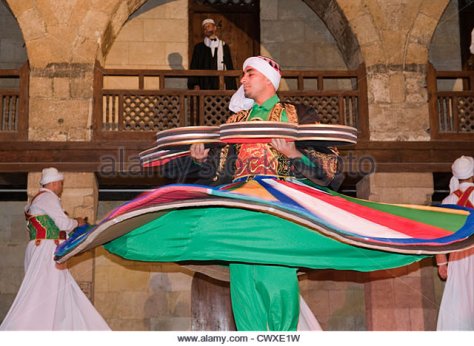
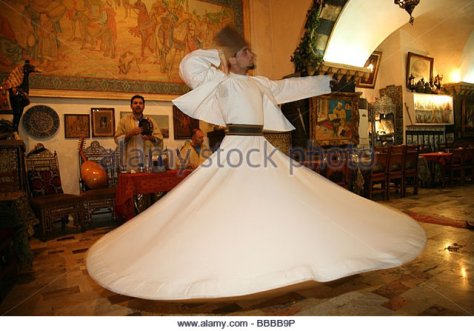
After we are sated with food, the performance begins. A man comes onto the stage dressed all in white, loose trousers, flowing tunic top. His dark luminous eyes, copper skin, raven wings of hair remind me of someone, of something . . . I realize he looks like a gypsy. Suddenly I understand the source of the generic name. He looks at us, his eyes full of joy. He begins a dance, accompanied by a singer, and four other men who play flutes, drums, other ancient sounding instruments. Slowly the dancer moves, circles, twirls . . . his eyes closed, his concentration rapt. He is dancing into ecstasy.


sufi-dancer-or-whirling-dervish-at-a-traditional-restaurant-damascus-bbbb9p

We are watching a Sufi dancer, a whirling dervish. It is spell-binding. We lose track of time, drawn into the majesty, into the beauty, into the other-place of the dance. Several young boys come onstage, wearing rainbow-hued tunics over their white robes. They enter into the dance and as the music swells, their colourful over-skirts twirl, lift up and over, becoming flying tents.

Watching, I am again in the King’s Chamber, and the feelings of that time arise within me, return in full force. The utter emptiness I felt, the sense of not being wanted, of being overlooked.

These emotions take over, filling my inner space.

Suddenly I recall a session in Mystery School at Garrison. Peg was speaking to us about Michael Singer’s book The Untethered Soul, about how there is within us a truer deeper self that is untouched by the pain of passing emotion. I try to recall the teaching, try to summon that untethered soul within me. As the overskirts twirl, lift, fly, my own soul uncertain, shy, eager, follows.

whirling dervish Sufi dancer

As the colourful tents are released into the air, some part of me is set free, an “I” who looks down upon that brooding presence in the King’s Chamber, knows that she is part of me, but not the deepest part of my soul. Slowly, slowly the pain clears. Slowly the happiness sidles in, and with it the hope that my prayers have been heard, my prayers that the Crocodile god Sobek would devour the darkness in me that prevents my loving freely, my prayers for the healing of the wounds of love that have been with me all my life. My senses, thoughts, feelings lift with
the music, the colour, the dance, transforming themselves into peace and recovered joy.

(from Called to Egypt on the Back of the Wind by Anne Kathleen McLaughlin Borealis Press Ottawa, Canada 2013) to order online go to: http://borealispress.com

Sophia in Egypt: Twenty -Nine

Inside the King’s Chamber (continued)

When everyone has been inside the sarcophagus, Jean invites us into a time of silence. I stay where I am, leaning against the base. I am neither praying nor thinking. Hope, desire, love… they seem to belong to another life, another time. I had read that sometimes initiates in this ceremony have felt an electrical charge surge through their bodies. I wonder if any of them had felt this utter nothingness. No thing ness.

Some words come at last, though I do not heed them, do not even know how to understand them. They are the stern, strong words I heard in the sanctuary of Isis, and before that in the ritual in our Community’s prayer room:  Send Sorrow Packing.

After an unmeasured time, I become aware of movement. My companions have begun to rise, to move towards the door. Peg is standing there, speaking to each one who leaves the chamber. I cannot hear what she is saying, but it sounds as though she is asking something. When I reach the door, Peg asks, “Anne Kathleen, is your heart now as light as a feather?”

Ah. It is the question put to the soul after death, when it is led to the great goddess of truth, its heart weighted against a feather on her scales. If the heart is heavier than that feather, the soul faces many difficult tasks ahead.

I know I should be able to say “yes”. But I cannot tell a lie to the goddess of truth. Because I cannot acknowledge the full truth, cannot bear to say “no”, I waver.

“It’s getting there,” I say, and walk out of the chamber, begin the descent.

The way down is no less treacherous than the climb upwards has been, though less taxing on the breath. We move with great care, having to resist gravity, the pull to hurry down, perhaps to stumble, fall, collide with those ahead of us.

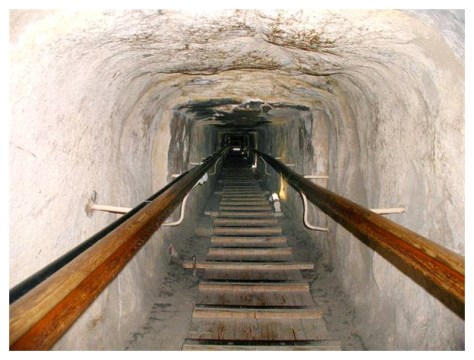
Pyramid of Giza Passage 39m 26 degrees

descent from the King’s Chamber

At last, still with backs bowed, we each emerge into the light, surprised to see the sun, surprised to see it is still morning. Surprised, too, to see a photographer with a serious-looking camera waiting to take a photo as each one of us appears.

The same photographer is now shepherding us into more or less tidy rows in front of the Great Pyramid. Jean comes to stand just behind me, and, though she has no shawl to place there, rests her hand lightly on my shoulder. I have the first feather-like hope that the deeper desire was also heard.

And in a beautiful play of Egyptian magic, the photo, when we receive it that evening, shows our group with the Sphinx, posing proudly behind us. Egyptian magic, assisted by photo-shop.

99590-004-9A5DCF21

We return to the Mena House where a late, longed-for, bounteous breakfast awaits. I join Suzanne at a table, and between mouthfuls of pomegranate, oranges, yogurt, sweet rolls and coffee, share my experience of the ritual, my feeling of being five years old, left out of the Christmas play. Suzanne tries to comfort me, saying that perhaps Valarie and Deirdre had offered to play the roles. I don’t believe this, though I appreciate Suzanne’s kindness in suggesting it. There is a pause.

Suddenly, I begin to smile, then to giggle, to laugh. The utter ridiculousness of my grief explodes within me, and soon we are both laughing, like schoolgirls.


We have the afternoon free to enjoy the hotel grounds, the glorious turquoise swimming pool. But Suzanne has a better idea. The Funky Store, where we shopped on our first day in Cairo, is just across the street from the hotel. Though Samai has warned us against leaving the hotel grounds, it seems the perfect way to leap over the traces, have a final Egyptian fling.  After all, I reason, if the Sphinx left me cold, and the King‘s Chamber left me empty, perhaps shopping will hold bliss.

We make our escape, walking easily out the front gate at the foot of the hotel’s entrance way. But when we see the store, our hearts waver. It beckons from the far side of a wide avenue that is alive with six erratic lanes of traffic. We stand still as small cars and trucks full of produce hurtle past.

Suddenly a uniformed Egyptian policeman is beside us. With knightly courtesy, he offers to assist us across.

Inside the store, I go directly to the place where the shawls hang in rich colours, in soft and silky fabrics. I choose two for friends, one in shades of turquoise and red, the other in a medley of greens. I check my remaining Egyptian pounds, decide I may choose one more.

I look for something that will draw me, something magical. Then I see it.  A white silken shawl patterned in the swirling rose I saw in my prayer to Isis. Some of my inner emptiness quietly fills.

We return to Mena House. I shall spend these final afternoon hours in Egyptian sunlight, first sitting beside the pool under the palm trees, writing in my journal, then swimming in the luscious tingling waters. The pool is as large as a ballroom, and I am the only dancer.

(If you are enjoying these excerpts from Called to Egypt on the Back of the Wind, why not go to http://borealipress.com to order the book?)


Sophia in Egypt Twenty-Eight

Ritual in the King’s Chamber

In this ancient place of initiation we are about to enact a sacred ritual. We are invited to enter into a time of silence, preparing our hearts to ask for what we most desire. I see two of my friends approach the sarcophagus. Clothed in long loose Egyptian galabeyas, they take their places at either end as Jean tells us that Deidre will play the role of Isis, Valarie that of her sister Nepthys, the two goddesses who regathered the scattered pieces of the body of Osiris. I remember now that we saw statues of Isis and Nepthys beside the container of the coffin of Tutankhamen in the Cairo Museum. Jean invites anyone else who is gifted in ritual to come forward. Ellyn rises to stand with others who gather around the sarcophagus.

Great Pyramid, Khufu burial chamber

inside the King’s Chamber with the Sarcophagus at the centre back

I feel empty, ungifted, unable to offer anything to others. I sit, carved in stone, as a rush of feelings, a NiIe flooding, sweeps over and through me. I am again five years old, watching as my friends are chosen for the Christmas Pageant, feeling bereft, invisible, unchosen by a beloved teacher.

This flood continues within me, unabated. I feel helpless to stem it, to bring any adult reason to the experience. Faintly, from far away, in a far-off time, a far-off country, I hear words from my beloved Bishop friend. “You have your own beauty, your own gifts.” I hear again the tenderness in his voice, the incomprehension. But an even older memory has taken hold, is gripping my heart. A child who feels she is not loved, because others are preferred.

I sit here, gripped by a grief I can neither understand nor overcome. I have forgotten Sekhmet’s warnings, as well as all that this journey has already given me: the joy, the gifts, the desire to be a presence of love for others. This is our final ritual and I am further from wholeness than I was when I arrived. Egypt has pared me down to this, cutting away all my illusions about being a loving person, a spirit-filled being, a light for others.

I look up to see Deidre standing at the end of the sarcophagus, eyes closed, radiant. I look to where the line of those approaching has dwindled to a final few. If don’t go now, I won’t be able to experience the ritual. I stand, walk over, join the line. I have no idea what to ask for.

I take refuge in an old ploy, one from the days of my first fervour, when I fancied myself quite adept at “holy indifference”. To the One listening, waiting, I say, “Give me what you desire me to have.”

But I have grown beyond such denial of my longings. I feel drawn to a deep inner honesty. I need to name what I want most at this moment, and as embarrassing, as trivial, as childish as my desire appears to me, I ask it anyway, in the silence of my heart. “I want to be seen. I want someone to wrap a shawl around my shoulders.”

And somehow, through my naming that wish, another arises within me. I recall the moment when I sat by the window of the Moon Goddess, looking out over the Nile, feeling the pure bliss of being held in love by the Holy, the true Beloved of my life, feeling a gratitude that drew tears of joy.

In the very nick of time, for now it is my turn to be helped into the sarcophagus, I ask silently for both these gifts. I have a vague understanding, an intuition, that if I were to be given the human gift I long for, I would know that the less tangible spiritual love would also be given.

I let myself be lifted, lowered, steered, manoeuvred into the sarcophagus. I am unable to assist Dwayne and Joan in this; my muscles are atrophied, frozen before such a task. I know I must be a lifeless weight to them.

Finally, I am lying in the deep base of the coffin, looking up as Jean holds bronze bells about a foot above my body, passing them along the areas of the chakras. I am like one who has already died, who can no more be touched by any human experience.

The brief ritual ends. I pull myself up into a sitting position. Once again Dwayne and Joan, with visible effort, assist me as I stand, as I climb out of the coffin.

Looking for somewhere where I might be hidden from view, I choose a place at the base of the sarcophagus where I sit leaning my back against its unreceptive granite. I lift up my hands, palms outwards, call on my own Ka energy, my spirit, to bring to life whatever needs to be born. I remember the swirling rose of love outpoured that I had visualized in the “Recrowning of Isis” ritual, just before our visit to Sekhmet.

While I lay in the coffin, the bronze bells that Jean rang above me may have activated that gift. I hope this might be true. But I feel nothing. Nothing at all.

Sophia in Egypt Twenty-Seven

The Great Pyramid

189745-004-16FD89FC

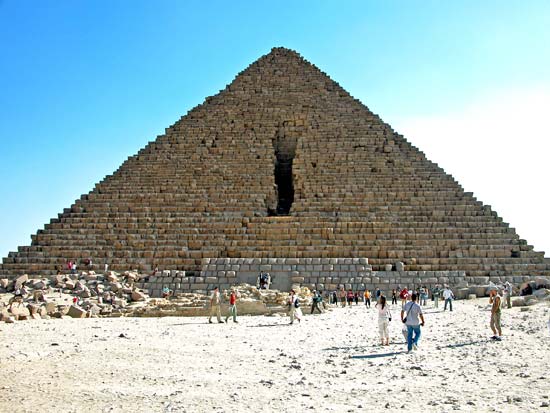
Though it is clearly visible across the wide expanse of sand, the Great Pyramid is too far from the Sphinx for a casual walk. We reboard the bus to travel to the place of our final Sacred Ritual in Egypt. Mohammed has arranged for our group to have this magnificent place to ourselves for the next two hours.

Up close to the Great Pyramid, all perspective is lost. I might be gazing upwards from the base of a mountain, its peak unseen. Except that this mountain has not grown up out of the earth but was placed upon it, block by block 4500 years ago. It is the largest building ever constructed, covering thirteen acres.

This pyramid functioned as an enormous sundial. Its shadow to the north, and its reflected sunlight to the south, accurately marked the annual dates of the solstices and the equinoxes. Once these weathered stones were young, fitted together with such precision that no breath could move between them, a seamless creation. Today, they are teeth worn down by time in the mouth of someone ancient of days. They are rounded, gaping. And they are not smiling.

Jean Houston leads us up a path that has been carved into the sides of this pyramid, with stone blocks for steps, crossing at an angle, leading into an entranceway. Later, I would see the analogy of entering a birth canal, climbing back up inside a womb. Now, I am aware only of being in a scarifyingly narrow stone passageway, drawing us upwards. The air is dusty, the light dim, the path morphing into an alarmingly steep tilt. Here we must bend our backs, lean forward to walk like ancestral apes to avoid the low ceiling. Our feet would surely slip, creating a dangerous domino effect on the people behind us, were it not for the placement of horizontal bars of wood, a ladder embedded in stone. At one point, we are invited to look down, down, down to our right, into a great carved hollow that is called the Queen’s Chamber. The climb is featureless, offering no indication of progress, no promise of soon reaching the end, no helpful wall maps that say You are here.

I feel tired, breathless, and wonder how my companions are managing. Soon I have energy only to concentrate on getting myself up, up, up into the highest chamber in the pyramid: the King’s Chamber.

Hope comes in song, as music drifts down towards us, at first only a faint chanting, increasing in volume and clarity as we climb towards our companions who are already within the chamber. Quite suddenly the passageway ends and I follow those ahead of me into a rectangular high-ceilinged room, as wide across and about half as long as the chapel at the Garrison Centre where we gather for Mystery School. Jean is leading the singing that I heard, leading the group in the sacred Egyptian chant of Sa, Sekhem, Sahu.

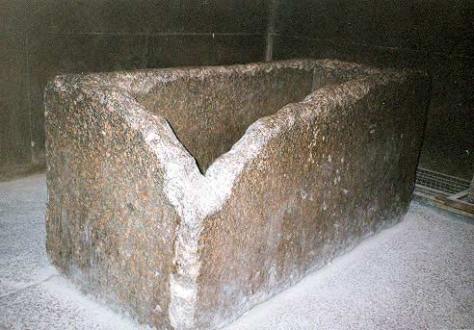
I join in, knowing now that singing activates the sacred space, remembering our resonant song in the tomb in the Valley of the Kings.Members of our group continue to come through the doorway, each finding a place to sit, backs resting against the stone walls, picking up the chant. As we sing, I gaze around the room. I am relieved to see the subtle glow of artificial lights, to hear the faint breath of an air exchange system. Without these amenities, it must have been a terrifying place for the ancient initiates. For this room was once a place of sacred ritual for Mystery School students. At one end of the room, to the right of the entrance way, a huge stone sarcophagus stands, open, waiting.

Jean and Peg explain the ritual. Each of us is invited to form a request, an inner desire, and then to approach the great sarcophagus. Two of our companions, Dwayne and Joan, will assist each of us to climb into the sarcophagus, creating a balance of masculine and feminine energies. We will lie there for a few moments, a ritual of passing through death, before rising, emerging into life. Unlike the ancient initiates, we will not spend a night in the coffin.

coffer

the Sarcophagus in the King’s Chamber made of red Aswan granite

(from Called to Egypt on the Back of the Wind by Anne Kathleen McLaughlin, Borealis Press, Ottawa, Canada, 2013) This book may be ordered online at http://borealispress.com

Sophia in Egypt Twenty-Six

We leave St. Catharine’s Monastery, begin our walk back down the hillside, pass a row of camels who sit waiting, perhaps for travellers who will hire them for explorations across the desert or up into the mountains. The camels have brightly woven rugs over their backs, modestly unaware of the fashion statement they make. Ahead of me on the steep downward climb, I hear Jean engage with Arthur in what sounds like a theological discussion. I catch up, join in.

“How did we get Yahweh so wrong?” I ask, telling Jean and Arthur about my conversation with Michael. Jean believes that the characterization of Yahweh is drawn in part from the fierce desert god, a god of wind and storm, who would have been known among the Israelites.

“And yet,” I say, “there is such great tenderness in Hosea and in Ezekiel. My favourite part of the Hebrew Scriptures is Ezekiel 16.”

“Recite it for us,” Jean asks.

I begin. I know this by heart, but nonetheless, the lines come out rather muddled.

I saw you in a field on the day you were born. You were lying in blood with no one to wash you, to rub you with salt. You were as unloved as that on the day you were born. I said to you, ‘Live and grow like the grass of the fields.’ Later I passed by again and saw that your time had come, the time for love. I wrapped my cloak around you. I made you my own…

The words, as always, stir me to delight. I spin around on the dusty road, my arms a windmill, saying, “What passionate love! There is nothing in the Gospels to touch it!”

“I like the funny parts,” Jean says. “My Dad was a comedy writer. Do you know that in the Beatitudes, the truer translation is not blessed are the poor in spirit but blessed are the debonair!”

Deidre has joined us, “But Jesus was so young,” she says. “He didn’t live long enough to get serious.”

“I’m glad we have lived long enough to live into joy!” I say.

We board the bus, now waiting for us after the return from the Bedouin market. I look back at a glorious view of the monastery, a garden nestled in the arms of the mountains.

We begin a seven hour journey across the Sinai to Cairo, still unaware of the border skirmishes, puzzled by our guide Samai’s unwillingness to make any stops. By late afternoon, we are hungry, thirsty. Samai relents, cautioning us to get something quickly in what looks like an Egyptian hamburger stand without the hamburgers, the food expensive and sparse. We continue on over mostly featureless land, driving through a tunnel that takes us under the Suez Canal.

When at last we reach Cairo, city lights pierce the darkness of full night. We enjoy a supper of char-broiled chicken at a comfortable, softly- lit restaurant. I am sitting near Suzanne, Rosemary and Marjorie, the woman who had led Chi-gong movements for us on the deck of the Moon Goddess. Our return to Cairo brings with it a sense of endings. “How do we talk about this when we return home?” The question hovers in the air above us, silencing us. How indeed…

It is Marjorie who responds, speaking with quiet assurance. “We come like Odysseus, like a beggar, listening to their stories of what went on in our absence, before we unfold our own stories.” There is a further silence as each of us recognizes the wisdom of Marjorie’s words, then imagines how that would be when we are home…

We return to the Mena House, whose marble halls welcomed us on our first night in Egypt. This time, the window of my room overlooks a busy Cairo street, a Mobil Oil station hovering protectively over its gas-thirsty cars and trucks. Egypt is already shedding itself of us, turning off some of its magic.

But not all of it. We’ll be up before dawn for a sunrise prayer between the paws of the Sphinx.

I waken at four, drawn into prayer, needing to prepare for this day, our visit to the Sphinx, our ritual in the Great Pyramid, our final day in Egypt. Time is running out for whatever miracles are still to happen. I catch myself getting caught in clock time, forgetting what I’ve learned of durative time. I remember that in the Gospel stories, people are sometimes only aware of a healing after they set out for home.

We are in the tour bus by 5:10, but Egyptian Security is still tight. After a long delay, we are given the necessary escort for the short journey.

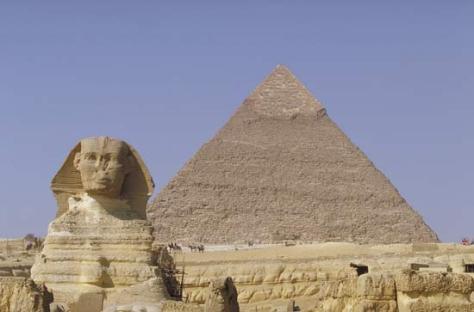
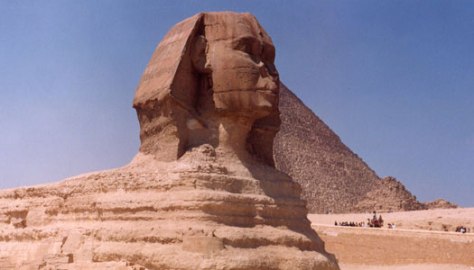
The moon is a cup half full of golden wine in a sky that sings of night when we reach the Giza Plateau. We walk towards the Sphinx, full of awe, watch it grow larger as we draw near. Its great paws were deeply buried in sand for millennia. Cleopatra would not have seen them. This majestic storied presence is distant, even when we are at last standing beneath its chest, leaning against stones ancient beyond anyone’s reckoning. The face carved on the Sphinx, thirteen feet wide, is now thought to be that of a woman with Negroid features. Samai tells us that the face is more recent than the base, for it had to be realigned with the stars. The Giza Pyramids are oriented towards Orion. Over perhaps nine thousand years, the sky map has changed.

great_sphinx_of_egypt

The Great Sphinx Egypt

I stand now in the generous space between stretched-out paws. I have to tilt my head back to see the face that looks out across the sands to a far horizon, unaware of me. There is no message that I can understand in the far-off gaze. Here there is no sense of presence, neither the gentle one of Isis, nor the joyous one of Hathor. Not even the fierce presence of Sekhmet.

But when I turn to look in the direction the Sphinx is facing, the sky is opening in mango and lemon. Ra the Sun appears.

At the moment of the sun god’s appearance, Jean invites us into a time of silence. I try to be present to this experience of no thing. Surreptitiously, I take two photos, but it feels like a desecration.

After our sunrise prayer, as I walk away, I hear Jean say, “How people can stand before a mystery and a wonder and just take photos amazes me!” I feel chastened, thinking of Eliot’s words. Have I also “had the experience but missed the meaning”? I decide that I was at least open to the wonder, to the mystery.

Later, I will discover that my photos are double-exposed, worthless.

Sophia in Egypt Twenty-Five

I sleep deeply for a few hours, not hearing the sounds of those who waken at 1:30 to set out to watch the sunrise on Mount Sinai. Sometime around three I am awake, awash in old fears and darkness. I call out for help, hardly knowing to whom I cry. I sleep again, waken in time to watch the sunrise from the window of my cabin. As I gaze at the glowing light in the eastern sky above the mountains, some peace, some joy trickles back into my soul.

mount-sinai-sunrise

sunrise from Mount Sinai

I recall a moment from yesterday’s visit to the Monastery of St. Catharine. Tiredness had emptied me of joy, and I found myself looking at the radiance of others, sensing I lacked some essential quality of openness, of wonder. Walking away from the monastery towards our bus, I fell in step with one of the men in our group, Arthur. “I see a glow about you… I just wanted to tell you that.” In that moment of inner darkness, his words were like a cup of cool white wine to me. In this dawn moment, I wonder now what prompted him to say that. I feel graced, knowing that some loving presence saw my need, reached out to me through Arthur.

My companions slowly drift back from their odyssey, arriving at breakfast with stories of the stunning views of the sunrise, and many adventures on camels, on foot. Suzanne is glowing with the experience, rode a camel part way up the mountain. At least my coat got to ride a camel! She has brought me a stone from Mount Sinai which I treasure.

It is two hours before everyone has finally returned, and a further wait as the last arrivals hurry to shower, to pack up, to prepare for our departure. Michael, the young doctor in our group, is suddenly standing near me, just outside the dining lodge. His face is a mask of regret, disappointment, something even darker.

“I wanted to go,” he says. “I really wanted to climb Mount Sinai. But I didn’t get a wake-up call, and missed the whole thing.”

I feel his deep distress, reach for something that might ease it. “Maybe you just needed some extra sleep,” I offer.

“No,” he says, angrily. “The Hebrew God really has it in for me. I know it.”
I am appalled at this. “Michael, we are held in love. I can see how tired you are, that you need rest. Why wouldn’t God see it too, and give you what you needed most?”

I can see that my words are not enough to overturn a lifetime of such thinking.

When at last the bus pulls away, Jean tells us we have an option : those who’d like to return to the Monastery to see the icons will be dropped off first, while the others will go on to a market where the Bedouins sell their handicrafts. I picture glorious woven shawls, rare carvings, the chance to meet these strange and elusive people. Then I think about the sacred icons that Jean has spoken about.

I feel unable to make a choice. I am sitting with Rosemary, and tell her my dilemma.

With her usual practical wisdom, Rosemary asks, “Do you plan to do any more shopping?”

Of course not. I have my Isis bracelet, gifts for my family and a few friends. “No,” I say, suddenly relieved and clear.

In the morning light, as we stand in the courtyard of the Monastery before the flowering bush with its flame-coloured flowers, my heart softens. I am open to the possibility that this is a descendant or relative of the Burning Bush that Moses encountered. The Holy One has chosen stranger places from which to speak…

Jean stands with our small group, invites us into a time of quiet meditation, suggests that we pray for healing for ourselves and for our world. For myself, I pray for the healing that has been the recurring theme of this journey, a healing of the wound which opens whenever I am drawn to love someone deeply. For the earth, I pray for the rising of feminine energy everywhere to heal and renew life. This morning the Monastery has a sacred feel to it.

Inside the Monastery we are allowed to enter the chapel to see the icons. I remember the heart-stopping beauty of a small collection of Greek icons I’d seen at Ottawa’s Museum of Civilization. There’d been one of the Madonna and Child that had captivated me there. I begin searching the walls aware that the icons here are dark, have a grimy appearance, as though the dust of centuries has been allowed to settle on them. But the piercing awareness of the eyes that look back at me from each painting soon makes me forget dust. And everything else. I feel drawn to an icon of Jesus, but as I look more closely what is emanating from the eyes is not love but fierceness, a force.


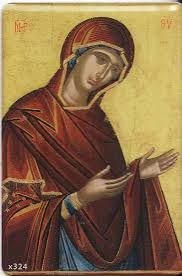
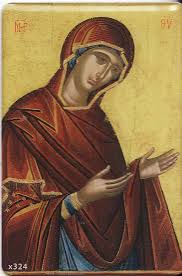
Two of Mary are compelling. One is the icon that I’ve known since childhood under the title, “Mother of Perpetual Help”. In another, Mary is holding out her arms as though embracing a child, but there is no child. I spend a long time standing before this image, wanting to be the one for whom her arms are reaching.

images

Icon of Mary, with arms open

Today, November 21st, is a feast of Mary, recalling her Presentation in the Temple when she was a child.

Sophia in Egypt Twenty-Four

Suddenly the mirage that was Sharm el Sheikh has disappeared and our bus makes its dusty way towards the Sinai Desert, passing the rough rock- built Bedouin homes, clustered together in small villages as though for protection against the harsh reality of sand, stone, sun and mountain. I become aware of a shift in mood, of tension on our guide’s face, of whispered conversations, of long unexplained delays as we move deeper into the Sinai. Only later will we come to know that border skirmishes with Israel, involving the Bedouins, have very nearly scuttled our journey.

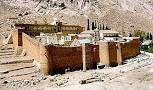
We arrive safely and without incident at the base of the long hill that climbs upwards towards the Greek Orthodox Monastery of Saint Catharine of Alexandria. Here the bus rests as we climb, gazing up at what looks like a fortified medieval town, protected by walls of sand-coloured stone that soar upwards to a height of perhaps eighty feet. St. Catharine’s is one of the oldest Christian Monasteries on the planet.

monastery-2

Saint Catharine’s Monastery


Tradition says it was on this height of land that God called out to Moses from a burning bush. Inside the walls, we go first to the place where, just above our heads, a rose bush, a hardy, long-lived strain native to the Sinai, spills out in blossoming welcome. The Monastery has a continual supply of fresh water from the Well of Moses which taps an underground spring. It is traditionally held to be the well where Moses met his future wife, Zipporah.

Helena, mother of the Emperor Constantine, was so impressed by the sacredness of this place that in the year 330 she had a small chapel built on the site, dedicated to the Blessed Virgin Mary. In 530, Emperor Justinian had a much larger basilica constructed, the Church of the Transfiguration. From that time, the monastery took on the character of a walled city. The Prophet Mohammed also visited the monastery, giving the place his personal pledge of protection.

Our delayed journey has brought us here outside visiting hours. Of the monastic community in residence, we see only a sandaled foot, a wind-whipped robe, as the men pass by. Like children outside a candy store, we peer through the darkened windows of the locked chapel door, trying to catch a glimpse of the magnificent icons on the walls. Jean is determined that we shall not miss this wonder, arranges a visit on the following morning. I am feeling heavy, tired, not open to this experience. Knowing there’ll be a second chance tomorrow feels like a reprieve.

Full darkness has risen like a cloak over earth and sky by the time we reach our accommodations. We emerge from the bus onto flat rock-strewn sand that spreads itself in homage at the feet of towering mountains of ancient, weather-sculpted stone. One of those hovering shadows is the place where Moses received the commandments of Yahweh. Tomorrow at dawn we’ll be there….

Tonight however, we make our way along paths that intersect a series of small stone dwellings, looking for the numbers we’ve been given that identify our lodgings for the night. Once settled, with time for a quick shower, a change of clothing, we gather in one of the larger buildings, a conference centre. Jean tells the story of Moses who led the Israelites out of Egypt, escaping the pursuing armies of Pharaoh.

Which Pharaoh?

For the first time, the question is an important one for me. What I have learned of Egypt gives a different weight to the Biblical story. Jean responds that most scholars believe it was Ramses the Second, the thirteenth-century BCE pharaoh who ruled Egypt for more than sixty-five years, whose statues and temples dominate the Egyptian landscape.

The theological questions are interesting. The Egyptians had honoured many gods, had, as we had learned earlier, gods or neters for almost every human activity, every need. They lived in an atmosphere where the spirit of the gods filled their lives. In the fourteenth century BCE, the Egyptian Pharaoh, Amenhotep IV, declared that God is One, the sun god, Aten. He changed his name to Akhenaten, and moved the capital of Egypt from Thebes to the newly-built city of Akhetaten (Tell -el- Amarna) to honour the Sun god. But his beliefs were widely opposed, and after his death his monuments were destroyed, his name removed from statues and reliefs.

Moses and the Israelites worshipped One God whom they knew as Yahweh.
Patriarchal Religion began here on Mount Sinai, a name that means “Moon”, suggesting the mountain may once have been a site of goddess worship.

From the conference building, we make our way across the rocky ground up a low hill to the building where supper is waiting. The large undecorated room echoes with voices of other groups who are here, including some Canadians on their way to Israel. The place has the look and feel of a hunting lodge. We take plates and fill them with from a table of basic foods, eggs, beans, bread. We find places on wooden benches at long tables. Conversation turns to plans to climb Mount Sinai. As the sunrise from the 7,500 foot summit is spectacular, and the climb will take two and a half hours on foot, less for those who are ready to pay for a camel for the journey, wake-up calls are arranged for one-thirty a.m.

Sunrise on Mount Sinai. A camel ride. Surely this is one of the highlights of the journey. Yet, when Jean asks whether I want to go, I feel uncertain, respond crossly, “I haven’t decided”. I am aching with fatigue, but there is something deeper, something harder to acknowledge. Egypt has shifted my spirituality away from patriarchs, from commandments carved on stone, from arduous climbs so beloved by the ascetics of my faith. Memories, sensations return of the more feminine spiritual experiences I have had on this journey: the magnificent coral, the rainbow coloured fish I saw under the Red Sea, the moment in a tomb, in the Valley of the Kings, when I felt a sweep of tenderness beside a wall painting of an ibex….I cannot summon desire to make this pilgrimage.

But those who plan to go are eager. The night will cool down considerably and there is a flurry of borrowing jackets or sweaters. Suzanne needs something warm to wear, and I offer her the long cotton coat I’ve brought. It feels like a blessing. Part of me at least will go with her. My last tinges of regret dissolve.
Jean herself will not go. From within my own fatigue I can see how tired she is. But she will stay awake, keeping vigil for those who are making the climb.
“Take care of one another,” Jean says.

mount-sinai2-sunrise

Sunrise from Mount Sinai

Sophia in Egypt: twenty-three

We return from Sekhmet’s Shrine in Karnak for a last evening on the Moon Goddess. Before dinner, several of us go to the upper deck to enjoy the cooler air, the stunning Monet colours of the evening sky. The events, the palette of emotion I have experienced since this morning, swirl within me. I have a longing so intense it must be visible to pour it all out in words. I wonder if I might speak with Jean, if she would understand if I said it all to her. But I see her deep in conversation with another woman in our group.

I choose a deck chair with a view of the western sky, lean back, invite the evening’s beauty to be my companion. From a mosque on the eastern shore behind me, I hear the call of the muezzin, followed by the deep resonant chanting of evening prayer. I lie still, my eyes filled with the colours of the sunset as the earth rolls eastwards, away from Ra.

With the suddenness of magic, Egyptian magic, I am no longer alone. Imaginary or imaginal, the presence I have summoned by my longing is with me, sitting at the end of the deck chair, waiting, ready to listen. At such moments, there is no point in trying to understand what is happening. Forster’s wisdom applies: “Do we find happiness so often that we can afford to throw it off the box when it happens to sit there?”

Simply, fully, gladly, I unfold the whole story in an inner dialogue. I sit with my eyes closed, still seeing the rose swirl of the evening sky, still hearing the melodious chanting from the mosque. During these sacred moments I speak all that is in my heart, feeling heard, being understood, being known. Warmly, gently, the time passes in a half-awake state. As easily at it began, it ends with an invitation to return at any time to this presence.


In full darkness, we depart the Moon Goddess, board a bus for the airport. Hours of waiting follow: frustration, flight delays. It is nearly two o’clock in the morning by the time we find our rooms in a hotel that might have flown straight out from a tale of the Arabian Nights. We have arrived at Sharm el Sheikh on the Red Sea.

red-sea-map

Sharm El Sheikh, called “The Peace City” in honour of the many peace conferences that have taken place there, is located on the tip of the Sinai Peninsula. It is a cosmopolitan Red Sea resort city, with red mountains, thirty-five miles of white sandy beaches, blue sea and coral gardens. Diving is the primary activity, for divers at all levels of skill, including none whatever.

It is only with the light of morning that we see the wonders of the place. It’s like waking up in paradise. Flowers flow from every stone archway, spilling in pale blues, in warm pinks above our heads, and at our feet everywhere we walk. As we make our way to breakfast, clusters of palm trees wave in the morning air, and beyond it all the glistening sun-kissed sea awaits.

We have a whole day here, a day out of time, without schedule or gatherings. A day to recover energy after journeys both mythical and actual. After breakfast, I am drawn to the sea’s edge, where I find Valarie. Under the shade of the palm trees, we talk, not about Egypt, not about goddesses and temples and pyramids, but about our lives, our families. Valarie’s mother is becoming frail; my own mother has recently died. We find storylines that intersect. It is comforting.

I return to my room, change into swimwear, meet Denise just returning from an underwater adventure, willing to loan me her mask and flippers.

I have never dived. Descending from the small pier, I have difficulty breathing underwater through the mask. But at my first glimpse of the magic that awaits me I am determined to stay. The coral is magnificent, treacherous. We’ve been warned not to get close to the razor sharp edges of this underwater flower garden. I gaze at clusters of white, red, pink coral, watch fish swim past in impossible shades of blue and green and red. I can hardly grasp that so much beauty exists only metres below the surface.

images

Afterwards, I shower to wash away the stickiness of salt, change into fresh clothing, and hurry to the amphitheatre where I settle onto the stone bench near others of our group. As waiters move among us offering red wine, Tchaikovsky’s music fills the night air. We watch a DVD of a 1989 performance by the Bolshoi Ballet of “The Sleeping Beauty” on a gigantic screen. A fairy tale. A love story that ends happily. The perfect antidote to an overdose of Egyptian mythology, and the not-so- subtle warnings of a goddess about my allurement to tragic romance. I take it all in, in a state of bliss.

Valarie, Denise and others of our group find an outdoor cafe and enjoy char-broiled calamari.

I fall asleep that night, restored by beauty and joy.

(excerpt from Called to Egypt on the Back of the Wind Anne Kathleen McLaughlin,
Borealis Press, Ottawa, Canada, 2013 http://borealispress.com)

Sophia in Egypt: Twenty-Two

Mohammed has arranged a private time for our group in the shrine of Sekhmet. As our group regathers, makes its slow way through the intense heat towards the shrine, there is an air of quiet, expectation, reverence. We come to a small stone building with two tiny rooms. Jean invites those who feel a particular connection to Sekhmet to join Peg and herself in the ritual.

Sekhmet is a mystery to me, one I have never sought to understand. My drawing has been towards the light, the loving feminine presence I have encountered whether as Mary, as Isis, as Hathor. Sekhmet, the fierce dark side of that sacred energy, has no allure for me. I wait outside with the others who, like me, move restlessly, aware that something sacred is happening within. I hear Jean’s voice and Peg’s in snatches of prayer, words of ritual.

Then something rises in me, some fierce desire to be part of this. I place my hands, palms down on a stone table, an ancient altar that stands just outside the open door. I say silently to myself,” I am here as high witness.”

A stillness rises among those of us who wait outside, as if the group has become one in that same desire. We are united in a space of utter soundlessness.

After a while, the members of our group who have been inside come outdoors and the rest of us are invited into the tiny sanctuary of Sekhmet. The room is so small that some of us must wait in the antechamber for our turn to enter the shrine.

When I enter the room, I look ahead to where she is seated, a woman of black granitee with a lion head, a face that is somehow both fierce and tender. She is naked but for a pectoral intricately carved, resting on her breast bone. A solar disk encircles her head, but the millennia or a more dedicated cruelty have gouged it so it looks wounded, like the stone heart I picked up earlier. Across her knees is a stone slab that may have been a book. Both her arms and one hand have been smashed. The remaining hand rests on the book. The walls behind are covered in hieroglyphs and paintings, so darkened with age that they are nearly silent.


XIR218945

Another Statue of Sekhmet

Whatever I expected, Sekhmet is more. I am not afraid of her. I watch as the people ahead of me approach her, as they reach a hesitant hand to touch her. I notice Jean standing beside the statue, watching each person closely, aware that anything might happen.
When at last I am face to face with Sekhmet, I lift my right hand, touch her cheek.
I know what I must ask. Only a few hours ago, I was offered a gift, a luminous globe of rose and white light, a gift that can fill my heart with a love that will both answer my own longing and pour itself out for others. The tears of grief and loss that followed the offering showed me that I am still caught in my old emptiness. Now I need to accept the gift. I must activate it now. Here. In the presence of the dark goddess, I have to say yes or face a lifetime of falling back into my old Sethian ways. I ask for strength to be my godded self.

All of this happens in an instant, in the time between the lifting of my hand and its tentative touch on the lion face. And in that instant, Sekhmet speaks to me clearly, fiercely: Give up the allure of tragic romance and all its amenities. Your sorrow will not draw love. It will not. You are holding onto old grief. Let it go.

Afterwards, walking away from the Shrine of Sekhmet, I fall into step with Jean and Michael, a young doctor who is part of our group. Jean is holding something in her hand, opens her palm to reveal a small nail. “Bob had a broken bone set with this when he was a child. I found it among his ashes.”
I knew that Jean had brought her husband’s ashes here to Karnak, to the Shrine of Sekhmet to whom he had been devoted, of whom he had written extensively.

Myths collide: Isis, Osiris, Jesus.
“You have invited all of us into your own mythic story,” I say, thinking of the ritual we’ve just had.

“Were you startled by Sekhmet?” Jean asks.

“She is very fierce, “I say, “but I see all aspects as one now, part of the Sacred Feminine.” Only as I speak the words do I realize I now know this in my bones.
“But she is startling.”

As we’ve been making our way along the open pathways back towards the main temple of Karnak, Aten, the Sun god, has been baking us. Michael and I have been drinking from our water bottles. Peg catches up to us, offering Jean a container of water. Absorbed by our conversation about myths and goddesses, I hadn’t even noticed that Jean didn’t have any water with her. I have a great deal to learn about the practice of loving.

(excerpt from Called to Egypt on the Back of the Wind  Anne Kathleen McLaughlin,
Borealis Press, Ottawa, Canada, 2013  http://borealispress.com)

awakening to the sacred feminine presence in our lives