Sophia in Egypt: Eleven

ancient-egypt-history3-imagech004885_lr004248


Before we leave the Temple at Edfu, my friend Ellyn draws me aside, excited to show me the birthing chamber. We stand together silently looking at the room where legend says Isis bore her son Horus. This is where royal women came to birth their children. Buried deep under the rubble of my joy, a memory stirs of Isis and my own birthing, the ritual in the prayer room in September, but I cannot summon it from the darkness.

When we are back on the ship, Ellyn is eager to see the full moon from the upper deck. I go with her, climbing the flight of steps that takes us up under the night sky. We choose reclining deck chairs, lying back with our gaze fixed on the moon. Always before I have thought of the moon as feminine, but tonight I think of Thoth, the Egyptian god of Truth, and as I sit below his gaze, Truth pierces me. I know now that this truth is a response to my prayer to Isis to show me how to make of my love a gift, not a burden. I remember something I read on a poster. “The truth will set you free, but first it will make you miserable”. I stay for a while under the gaze of the moon, reflecting upon all this.

Some of our friends are gathered here, sitting at the edge of the shallow pool, bare feet resting in the warm water. Ellyn and I go to join them, letting the water soothe our feet. Suzanne is here, Denise, the woman from Ireland, and Valarie whom I had met at the Social Artistry session in Oregon. The women are speaking about the different energies they felt in the temples of Isis and Horus. I listen, surprised, realize it is true that on the island dedicated to Isis, I felt a gentle peace that drew me to prayer, whereas in the temple of Horus, itself massive, with its many carvings of fierce battle, the energy was masculine. I have until now not been aware of such things.

Valarie suggests that we should have a ritual at some point during our journey to honour the men who have been brave enough to join this venture. This reminds me of a book I’ve recently read. I tell them about the Canadian man who wrote The Savage Breast. He travelled throughout Europe, seeking ancient sites of goddess worship and wrote a compelling book about his struggles to understand the feminine within himself. He found that many of these temples held birthing rooms.

It is by now long past midnight on this day that began for us before sunrise. Yet, none of us feels fatigue. When at last I do return to my room, I fall into a deep sleep.

I waken to a day of sailing, as we head towards Luxor. After breakfast, I make arrangements to use one of the ship’s laptops, hoping to send my first emails to friends and family. As I sit in the lobby, my efforts to engage the internet, to make connection, prove fruitless. Bent over the task, I become aware that Denise has come to sit beside me. There is at once a connection between us more vital, less complicated than the one I am trying to make with the internet.

“Last night on the upper deck, under the moon,” Denise says, “we were like a group of women in ancient Ireland sitting around the well.”

I agree that the talk was rich and deep, and at once I find I am sharing with Denise the pain and confusion that I had held silent within me the night before.

“Why don’t you speak with Jean about this?” Denise asks.

I recite my litany of reasons, my fear of weighing her down, placing my concerns on her, blowing her away”…

Denise gives me a look that must be the Irish equivalent of you’ve got to be kidding. “Jean looks pretty grounded to me. I think she can handle it.”

The sweet sanity of this dissolves the dark fear still lurking within me. After Denise leaves, I try again to connect with the internet, hear a question above me.

“Sending email?” I look up, see that Jean is here.

“Will you sit down for a moment?” I ask. When she does, I say, “When I asked you about projection yesterday, did you think it was a hypothetical question?”

Jean smiles. “Well, I thought perhaps you were referring to some poor priest.”

“Been there. Done that,” I say, relieved at the lightness in my heart. For an instant, the memory of a powerful love from my own springtime sweeps though me, a love that has endured to warm these autumn days, a love in which I trust.

We speak awhile about love, about how the God in us draws the God in another. “Surely this has happened to you in your work?” Jean says.

“Yes, it has,” I say, remembering, regretting now that I had not understood better at the time what was happening, been more compassionate. “But what you said yesterday, about not frightening people away. How can you love without being a burden to them? ”

Suddenly the response matters very much. I am again on the brink, the cliff’s edge, where I have stood so many times with other people in my life, awaiting the dark response: “I’m sorry. I cannot be your friend… we really don’t have enough in common….I am sorry, but no.”

I have gone back so far in memory to such long-forgotten miseries that I cannot hear what Jean is saying. I tune in to one word, “Impossible”. It is the word I have been expecting. I look at her, unsurprised.

“It’s impossible to blow me away. I’ve been around too long, experienced too much for that to happen with me.”

After Jean leaves, I give up the effort to connect on the internet. I have had two human encounters worth more than a thousand emails. I feel a burden lift from my heart. The sun rises and I can see clearly.

I tasted god like soup dripping from a ladle.
I felt his grace like three lyres humming…
I am made lively as onions and olives.
I walk at peace between lilies and stones.

Normandi Ellis in Awakening Osiris

“Sophia in Egypt” is excerpted from my novel, Called to Egypt on the Back of the Wind (Borealis Press, Ottawa, Canada 2013)     http://borealispress.comancient-egypt-history3-imagech004885_lr004248

Sophia in Egypt: Ten

As we have been listening to the story of Isis and Osiris, the Moon Goddess has been carrying us down the Nile to Edfu, a journey of sixty-five miles. We don warmer layers. Tonight we are to make a private visit to the temple dedicated to Horus. Edfu is one of Egypt’s newer temples, built during the time of the Ptolemies after the conquest by Alexander the Great. It has been restored to magnificence, one of the greatest achievements of the Minister of Antiquities, Dr. Hawass.

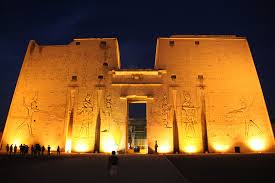
As we approach the temple we see it shimmering gold, majestic against the black night, lit from below with what might be a hundred torches. In another story, in another time, it would have been a fairytale castle. The ascending light illumines great carved figures stretching up along its outer walls. They call out their names, through the symbols they wear as crowns: Osiris, Seth, Horus… but I still cannot be certain who they are in the darkness of night, in my unknowing.

images

The Temple at Edfu

Inside, a statue of the falcon-headed god Horus, wearing a pharaoh’s crown, stands on a small pedestal, at our eye level, welcoming us to his temple.

horus-image

the falcon-headed god Horus


We wander through, find in one of the chambers the Sky Goddess Nut painted across the ceiling, her arms reaching along one side, her legs with a ballerina’s pointed toes, stretching to the other side. This is the first sight that would have greeted the dead king upon his awakening to eternal life. Nut would be there hovering above him, stars shining across her body. The Mother Goddess who births Ra at dawn and swallows him at dusk. The Mother Goddess who brings joy with sunrise, darkness with evening.


Samai shows us the Graeco-Roman bas-relief carvings, created by cutting around the figures, releasing them from stone. This requires great skill as it is far more difficult than cutting the figures into the stone. In one carving the king is wearing a transparent overskirt. Stone on stone with the delicacy of silk.

Some of the reliefs show parts of the story of Isis and Osiris, the great battles between Seth and Horus. Others show the annual festival of the first fruits at the time of the new moon which celebrated the sacred marriage of Horus and Hathor. The rejoicing lasted for fourteen days, until the waning of the full moon, when the statue of Hathor was returned to Dendera.

In the inner sanctuary we see the boat that was carried here by the king and the priests for the Celebration of the Royal Marriage. Made of wood, with poles on either side for ease in carrying, the boat is small, very like the conveyances used to carry statues of Mary in procession. On the front of the boat, a stone figurehead leans forward, wearing a carved pectoral, its once glorious colours faded to a small patch of blue.

“You are all here but your ancestors were here,” Jean Houston begins. “So we bring together the context of our ancestral lives. All of these things on the wall are the ancestral lives as they are coded not just to priests and priestesses, and kings and queens, but in the very gods, the great creative principles themselves…. Christ is certainly a descendent of Osiris. Buddha is a descendent of Thoth and so it goes, Athena of Neith, Mary of Hathor and of Isis. They’re all here and they’re here with us now.

“Look at your right hand and consider that to contain the world of the fathers, the males of the ancestry. Look at your left hand. Consider that to be the world of the mothers, and the grandmothers and the great grandmothers, going all the way back to those ancestors. Somehow between the worlds of the fathers on the right and the worlds of the mothers on the left, they got to meet each other, through the centuries, through the generations, yes, even through the millennia.
“Somehow they found each other to ultimately result in this unique pattern in space and time called you.

“We celebrate the coming together as we celebrate the coming together of Hathor and Horus, the coming together of your ancestral mothers and your ancestral fathers. But we do it with consciousness now.”

“We’ll meet them with their joyous meeting, their divine hieros gamos, their sacred marriage, their great conjunction.”

“Feel the merriment of the men and women finding each other, so that you may be. Feel the marriage celebrations, feel the birth of the babies, feel the dying and the reborning.

“ You are sending the message back to that world of the fathers on the right, and the world of the mothers on the left, and you are saying, Remember. Remember me. I come forth from you.”

For me, images of ancient Ireland replace those of Egypt, forefathers and foremothers going about the tasks of their daily lives, fisher folk, farmers, shepherds in that green land of soft mists, their faces bearing contours of my remembered aunts and uncles. I see Celtic versions of myself, a young woman in love, a storyteller, a wise older woman, a herbalist…

Jean invites us to look ahead to the future descendants of our bodies or our minds, receiving a blessing from them, accepting their gratitude for what we did for their lives. I think of my work, the deepening call to weave the new spirituality using the finest threads, the most brilliantly coloured, from the old in the pattern.

“So you are the term between, holding past and future, holding the ancestors. Then take the hand of the one in the future. Take the hand of the one in the past, and bring them here in the front of your heart and as with the knot of Isis, put those hands together. And world and time have been connected again, and in you.

“And from this moment forth, should you choose, you will have all of these great ones, small ones, low ones, mad ones, crazy ones, genius ones, children galore, all who have created you, together in you. And the wisdom and the essence of sheer livingness are contained in you now.

“We go out from here with a festival… a Sufi Islamic dance, to be done very slowly and very carefully. Right hand to right hand, and we’re going to sing. Our hands joined, we do a greeting dance, spinning in pairs in this small space, then joining hands in one great circle as we sing: All I ask of you is forever to remember me as loving you.”

After the ritual, there is more time to wander through the great temple, to take photos of the beautiful carvings. Gleaming golden in the soft lighting, carved in bas-relief, Hathor, goddess of love and joy, stands looking away from me as I take a photo.

(excerpt from  Called to Egypt on the Back of the Wind   Anne Kathleen McLaughlin Borealis Press Ottawa 2013 ( http://borealispress.com)

Sophia in Egypt:Nine

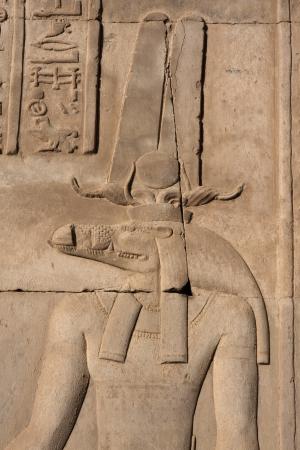
At the ruined temple of Kom Ombo, our guide Samei tells us that since the changes caused by the building of dams along the Nile, the crocodiles have disappeared forever from its waters. Sobek, the crocodile god, is the one whom the Ancient Egyptians honoured as the “great devourer”. They asked him to swallow the darkness that threatened their lives.


gettyimages-103579937

carving at the Temple of Kom Ombo of Sobek, the Crocodile God

We take time to wander around the temple area, to admire its massive carved walls and pillars, representation of the gods and pharaohs. I recognize Hathor by the hieroglyph of sun and two curved lines. I know when two incised figures are in conversation, though what they are saying to each other is inaccessible. I stare at the hieroglyphs, full of wonder and frustration.

The small shriveled mummies of the crocodiles are a source of wonder of another order… one has overhanging teeth.

A large flat rock, about a meter high, bearing the energy of Sobek, sits alone in a clear space. Jean Houston invites us to gather around it, to pray for the release of any darkness, any negativity we hold within us, to ask Sobek to devour it. Jean prays aloud on our behalf for the release of the way we humans treat the earth, for the crimes committed against women and children. We each touch the rock, make our silent, personal requests. I place my hand on the black surface, worn smooth, surprised to feel energy rising into my palm. “Devour the darkness in me that impedes my freedom to love,” I ask Sobek. For the second time that morning, I sense that my prayer is heard.


That afternoon, we gather in the captain’s lounge on the Moon Goddess to hear the great story of Isis and Osiris. We are sailing now, the shores of the Nile sweeping past, clearly visible through the round portholes on either side of the lounge. As a setting for this myth, it is pure magic. Jean begins by reminding us about the power of myth.

In pursuing the Mystery Play of Isis and Osiris, with its themes of love and loss, death and rebirth, revenge and reconciliation, we meet ourselves writ large. And that’s what a myth does. This is what the great journeys of the soul do. We no longer see ourselves as separate and isolated in our sorrows, our regrets, our burdens. Myths are always communal… not simply communal among us, but communal in that you are now part of this great journey that has been told for perhaps six thousand years, perhaps longer. Gradually we will discover as we enter into these profound universal themes, that these ancient stories are our own. Having been Isis and Osiris, we actually come back to our own lives with our energies and our abilities enhanced. That is the genius of the myth.

We watch as an ancient story trunk, jewel-encrusted, opens before us. From it rise the entwined figures of Nut the Sky and Geb the Earth, of Ra, the Sun who is their first born, Ra whose jealously refuses to allow his mother Nut to give birth on any day….Thoth the Moon who wins five days from Ra so that Isis, Osiris, Seth,Nephthys, and Horus may be born. With the lid now open wide, we see flowing from within and around their stories a swath of wisdom that has long been wrapped tightly. Set free, it shimmers and sways, a silken garment painted with butterflies. Every aspect of the story holds hieroglyphs of meanings, layer upon layer upon layer.

The five days out of time in which Nut gives birth remind us of the necessity to make time in our lives for the birthing of the holy within us. Whether we set aside an hour a day, a day a week, a week or a month each year, we must take time for the sacred within us to be born.

Isis and Osiris come in singing. As they travel through Egypt teaching agriculture: the planting of wheat, the crossbreeding of animals and plants; the weaving of cloth; they teach with song and dance, story and music. If we are to be the harbingers of newness for children, for our families and friends, for the new planetary culture being birthed today, we too must come in singing, offering joy and dance and story.

Seth represents in this myth the remnant of the hunter-gatherer society that rejects the new ways of agriculture, refusing to accept newness. He plots the entrapment and death of Osiris, encasing him in a jeweled box, sealed with lead. After this, he and his seventy-two co-conspirators carry the chest to the bank of the Nile, right where we were this morning, and cast it into the river where it joins the sea.

In Seth we see that force on the planet that tries to hold back growth and freedom, to prevent the birth of a planetary culture based on love.

Crushed by the loss of her husband and lover, her partner in co-creation, Isis cuts her hair, puts on robes of mourning, sets out to search for Osiris. In this part of the story, Isis embodies the energies of yearning that are part of the endless longing of the human heart.

Until now, I have been listening to the story’s unfolding as I might listen to a beloved piece of music, swaying to its rhythms, enchanted. Each note, each phrase is more beautiful by its familiarity.

But something alerts me, breaks the spell. I hear Jean say, Our soul is partnered. When one is born into time and space, as we’ve been, the other part of us remains as the beloved in the spiritual realm. The beloved is in the other realm, longing for us….And it is this deepest wounding of the heart, this yearning for the lost unified soul itself that will not leave Isis or ourselves in peace. And it is precisely that wound and sorrow that brings her then, through grace or time or love, into creating a reality in which something happens and the charge returns.

Many of us, throughout our lives, have a series of surrogates, noble and alas, not so noble, fill-ins between the spaces of that yearning. One mistake is that we place on the noble surrogate, the good friend, the spouse, the lover, that person we admire, we place on them that sense of twinning that properly belongs only to the Beloved of the soul.

Projection. The word is like the bite of the crocodile Sobek, sharp and sudden. But Sobek has exceeded his mandate. He has devoured not only my darkness but also my light. Somewhere inside me a vial of precious oil shatters. Lotus oil drains away and only the shards of glass remain.

(To read the entire story from which these “Sophia in Egypt” blogs have been taken, you may wish to order my book Called to Egypt on the Back of the Wind from Borealis Press: http://borealispress.com)


Sophia in Egypt: Eight

For five days, the Moon Goddess is our home, carrying us down the Nile to Luxor and its temples and tombs. From our “mother ship” we take smaller journeys such as the one to Philae and the Sanctuary of Isis, by felucca, the tiny sailing boats that have navigated the Nile for millennia.

f1000005

felucca on the Nile near Aswan

Today we set out for Elephantine Island, ancient center of the ivory trade, near Aswan. The island is the place of worship of the Egyptian god Khnum, the ram-headed god of the cataracts, of potters and of silt, who acted in trinity with the goddesses Satet, who personifies the star Sirius, whose rising signals the inundation of the Nile, and Anuket, nourisher of the fields.

I watch the elderly dark-skinned Nubian sailor orchestrate the thick ropes that control the sails of the felucca. Both his hands and his feet engage in the task, a graceful dance that he must have been performing for decades. A young sailor, black curls framing a strikingly beautiful face, sings a Nubian love song as we sail. He follows this with a lively, strongly- accented, “Comin’ Round the Mountain”, which he has learned, I think, to please American tourists. “What about Canada?” someone in our group asks. He smiles, ready, says confidently, “Canada Dry” ( naming a popular gingerale).

Samei takes a plastic cup, and, leaning over the edge of the felucca, fills it with Nile River water. He lifts it to his lips, drinks. The Nile is kept clean, he tells us, by a threat of six months in prison for fouling the water.

The felucca draws up to a pier with stairs leading to the surface of this island. We walk past stone houses, masses of pink flowers in the gardens, trees with delicate leaves. A goat is tethered nearby, placidly eating a flower. I take out my camera, hoping for a photo. She must be accustomed to such requests for she turns obligingly, looks directly at the camera while I press the shutter, then turns back to her flower.

Beneath the surface of Elephantine Island, archaeologists have found layers of ruined cities and have already unearthed twenty-four. Legend and artefacts testify that the Ark of the Covenant rested here for a time. This is the place where Isis came in disguise to a council of the gods.

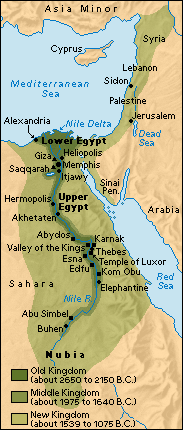
ancient-egypt-history3-imagech004885_lr004248

map of Egypt

We walk along a road that leads past the scattered ruins of ancient stone buildings until we reach the place dedicated to Khnum, whose name means, “to create”. Blocks of stone fitted together form a great arch that stretches high above our heads. We stand in silence before it, reaching into the distant past to touch the sacred intent of this place. Around us the ground is littered with scraps and shards of reddish pottery.

“From the clay of the Nile River, Khnum molded the bodies and souls of children on his potter’s wheel, and placed these in the mother’s womb,” Jean says. “Pick up a piece of the pottery, and scratch onto it a word or phrase that expresses what you want to create for the planet. What will be your great gift?”

I think of what I am experiencing, how the narrow limits of my childhood and early adulthood spirituality are being softened, expanded to include so much that is both new and ancient here. Isis and Mary are being rewoven together in my soul. I want to create a weaving that others may also embrace with joy.

“Weave,” I scratch onto the surface of a piece of broken clay. I reach down, dig a hole in the ground, bury my promise here on the island of the potter god. Jean invites us to call out a name of God, and mingling with our voices, we hear the cry of the muezzin.

After the ritual, we walk around the grey ruins, the sky a wash of palest pink, deepening to peach then to dusty rose. The moon appears, almost at full. We make our way back to the pier where we board the felucca for our return to the Moon Goddess.

On our way back to the ship, the full darkness of early evening descends. We make a stop at a Nubian perfume and essential oils factory store. We are invited in by the owners, given places to sit on comfortable couches, welcomed to a feast of scents, as one by one small containers of essential oils are opened, releasing aromas that perfumed the air of ancient Egypt: jasmine, lotus, rose, lavender. The scents of the flowers from which they were extracted enter my nostrils, creating visions of priestesses dancing in ceremony, blessing the air with their fragrance.

I want to create rituals when I return home, imagine blessing the women who come with these perfumed oils. I would like to take home a small vial of each, but when I ask the price I know I must choose only one. I choose lotus, the oil of the sixth Chakra, the third eye, wisdom. When we leave the store, I am carrying a tiny box, papered with a design of pyramids.

The next stop is the Nubian Market, a feast of bright fabrics, healing herbs, brilliant glass, wooden necklaces, spices….I draw in the sights, the scents, the festival atmosphere, but do not purchase anything. My vial of lotus oil is treasure enough for one day.

When we return to the ship, I decide to skip the dinner awaiting us in the dining room. I sit on the small deck that opens off my bedroom, gazing out at the Nile shimmering under the darkening sky, reflecting on the wonders of the past days, writing in my journal. I feel as though I am swimming in love.

Sophia in Egypt: Seven

After our ritual in the sanctuary of Isis, we make our way towards the shore, seeking out places to wait. Some of my companions cluster in groups, but I want to be alone, find a stone wall to sit on. Already the eastern sky is growing pearly, then striated in shades of pale mauve, peach, soft yellow, rose, preparing to welcome the sunrise.


Across the Nile, behind a crest of low hills that lie like a body outstretched, the fire appears. There is an opening between the hills at the place where the sun bursts forth. The words of Isis echo in me, “the day which shall be born from the womb of this darkness.”


There is a desire in my heart. As the sun rises, I hold it out in trust. “Let me be as you were, Isis. You were a teacher, you gave the women of ancient Egypt the song of the wheel, you taught them to weave, you gave them your love. I want to be a teacher, a weaver when I return.”The sacred moment ends, leaves me with a sense of being deeply heard.

I turn to walk back up to the monuments above the shore, ready to rejoin my companions. A woman from Ireland is standing near the sun-warmed stones. We had enjoyed a conversation at our late dinner under the Nubian sky on the night we visited Abu Simbel. Now  I see in her face a mirroring of the wonder and light that are within me. We speak of our joy at being here, take one another’s photos against the island’s beauty, wanting to hold the memory.

anne-kathleen-on-philae

I notice our group clustering around Samei. He walks us around the island’s great temples and colonnades, the stone glowing gold in the morning sunlight, holding the grace of Greek and Roman design in their shapely pillars. We see massive rows of Greek columns, towering structures, architectural beauty unlike any that I have ever seen. Standing under the great kiosk of the Roman Emperor Trojan, we look up at blue sky framed by an open roof of stone.

As we walk, Samei tells us the long story of Philae’s conquest by cultures and religions. Up close, as we examine the larger than life carvings incised into the outer walls of the temples, I am appalled to see that many of the faces of the Egyptian gods and goddesses have been savaged. Samei tells us it was Christians who ruthlessly chipped and chiseled away the faces of the gods. I feel horror, deep shame, as I imagine attacking hordes of Christians arriving in boats, descending upon Egypt from where?


Taking pity on what he sees in our faces, Samei softens the story a little, explaining it was the Egyptian people themselves who, becoming converts to Christianity, wanted to destroy the faces of their ancient gods.


As though in answer to the longing I felt in the sanctuary of Isis to read the hieroglyphs, Samei gives us a beginner’s lesson. Pointing to carvings high above us on an outer wall, he shows us that beside each figure are a series of hieroglyphs beginning with his or her name. Next to Isis, the hieroglyph of a throne; next to Horus, the sun; beside Hathor, wife of Horus, the hieroglyph of a sun with two curved lines above it reads, “House of Horus.” I am five years old again, beginning to learn the sounds of the alphabet. It feels wonderful.


“Don’t try to understand,” Samei counsels, “just experience. See, in this panel, the King is speaking to the goddess and she responds.” I look at the two carved figures, each focused on the other with a reverence, an intensity that is palpable. The series of hieroglyphs between them are words. I think of the words above characters in comics only this is elegant, noble, mysterious. I ache to read what they say.


f1000002


We leave this sacred island, with its still undeciphered messages, return to the ferry, then sail home to the Moon Goddess. Only later I realize we have come here on the 13th day of November. It was the 13th day of each month that Mary chose for her appearances to the children of Fatima, Portugal.

Sophia in Egypt: Six

On the morning following our visit to Abu Simbel, we board our ship, the Moon Goddess, which will carry us from Aswan to Luxor, stopping at temples and sacred sites on the way. The first night on board, I sit on the small deck that opens off my bedroom, gazing out at the Nile shimmering under the darkening sky, reflecting on the wonders of the past days, writing in my journal. I feel as though I am swimming in love. I sleep early, to prepare for our early morning wake up call, our journey to Philae Island, sacred to Isis.

The moon in her fullness creates a golden rippled path on the Nile at four in the morning. It is not yet dawn when we disembark, stepping onto the island. The terrain is of rough stones. I have a sense of hovering trees, low full-leaved bushes, great stone arches, pillars, columns, temples, more Greek than Egyptian. We move carefully in the darkness, following Jean into one of the vast stone temples, towards its sacred heart. A cat has shown up, leads us straight to the entrance, waits as each one enters.

“We know that we are well seen and well blessed,” Jean says. “So often the holy ones show up in the form of the animal.”

The sanctuary of Isis is so tiny that we stand together like people in an elevator. Within this chamber, at the centre and towards the back, there is a stone pedestal, incised with hieroglyphs. This is where the sacred boat of the goddess Isis once rested. The surrounding walls are intricately carved with hieroglyphs as well. I see a delicate fan of outspread wings, recognize the curve and grace as just what I saw on the papyrus of the winged Isis I bought in Cairo. I see on another part of the wall a snake, and then a hawk that is the symbol of Horus, son of Isis and Osiris. I look at the outpouring of carefully inscribed wisdom, feel something of the powerlessness, the utter frustration I felt as child before I knew how to read.

In the still darkness, Jean speaks of the writings of the second century Latin writer Lucius Apuleius. “In his story, The Golden Ass, Lucius has done some very naughty magic and has been turned into an ass. After strange adventures, he meets the goddess Isis who changes him back into his own humanity, but does so by giving an epiphany of who and what she really is.

“Here is how Lucius saw her: she had an abundance of hair that fell gently in dispersed ringlets upon the divine neck. A crown of interlaced wreaths and varying flowers rested upon her head; and in its midst, just over the brow, there hung a plain circlet resembling a mirror or rather a miniature moon – for it emitted a soft clear light. This ornament was supported on either side by vipers that rose from the furrows of the Earth; and above it blades of grain were disposed. Her garment, dyed many colours, was woven of fine flax. One part was gleaming white; another was yellow as the crocus; another was flamboyant with the red of roses.

But what obsessed my gazing eyes by far the most was her pitch-black cloak that shone with a dark glow. It was wrapped around her, passing from under the right arm over the left shoulder and fastened with a knot like the boss of a shield. Part of it fell down in pleated folds and swayed gracefully with a knotted fringe along the hem. Upon the embroidered edges and over the whole surface sprinkled stars were burning; and in the centre a mid-month moon breathed forth her floating beams. Lastly, a garland wholly composed of every kind of fruit and flower clung of its own accord to the fluttering border of that splendid robe.

Such was the goddess as, breathing forth the spices of pleasant Arabia, she condescended with her divine voice to address me: “Behold, Lucius,” she said, “moved by your prayer I come to you – I , the natural mother of all life, the mistress of the elements, the first child of time, the supreme divinity, the queen of those in hell, the first among those in Heaven, the uniform manifestation of all gods and goddesses– I who govern by my nod the crests of light in the sky, the purifying wafts of the ocean, and the lamentable silences of hell – I, whose single godhead is venerated all over the earth under manifold forms, varying rites, and changing names….

“But those who are enlightened by the earliest rays of that divinity the sun, the Ethiopians, the Arii, and the Egyptians who excel in antique lore, all worship me with their ancestral ceremonies and call me by my true name, Queen Isis.

“Behold, I am come to you in your calamity. I am come with solace and aid. Away then with tears. Cease to moan. Send sorrow packing. Soon through my providence shall the sun of your salvation rise. Hearken therefore with care unto what I bid. Eternal (spirituality) has dedicated to me the day which will be born from the womb of this present darkness.”

“The day which will be born from the womb of this present darkness,” Jean repeats. “This is the place of the birth of new hope, this is the place of the birthing of new life.”

We are invited to call out all the names of Isis as we know her. I hear the names flow like a litany….Mystical Rose, Mary in all her forms, Queen of Heaven and Earth, Queen of Creation, Great Protector, Mother Holy, Star of the Sea, Great Protector, Eyes of Wisdom, Neter of the Heart, Mama Mia, Great Mother Gaia, Inanna, Tower of Ivory, Sophia, the Black Madonna….

This outpouring of names concludes with the title: “She who calls out to us to be born.”

We cry out together a great OMMMMMMM.

“That sound was like one great voice,” Samei our guide tells us when we emerge. But he looks troubled. “I am sorry. I made a mistake. I never should have allowed your full group to enter at the same time. That chamber is much too small to hold so many people at once.”

But it did.


Sophia in Egypt : Five

On the day after our visit to the Step Pyramid, we fly from Cairo to Aswan. A long bus journey through the desert will take us to the Temple of Abu Simbel.

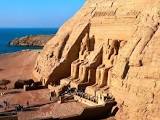
We arrive at Abu Simbel in full darkness, walk the lighted pathway from the entrance in silence, approaching from behind. I try to imagine this massive structure being totally dis-assembled on its original site, where it had been carved out of a mountain in the time of Ramses II.

images-of-abu-simbel

Temple of Abu Simbel

It was meticulously re-assembled, block by block, on a concrete frame, moved here in the 1960’s to save it from being inundated in the flooding caused by the Aswan Dam. The UNESCO project was generously funded by England and Germany, the reconstruction so exact that the rising sun on February 22 and October 22 still lights the faces of the four great statues within.

Inside, we see high walls and many chambers, well-lighted with raised floors for ease of walking. No formal rituals are planned for us within this temple. Instead we are free to wander, to take in the majesty, the stunning beauty of the artwork, the ancient stories on the walls around us. Our group is alone here, so we have silence, space to wander contemplatively.

I recognize the story of Ramses’ life in a set of painted carvings that take up the length of the walls of the main chamber. In one a chariot is pulled by an open-mouthed horse, the carving so precise I can see it breathing.

After a careful search, I find a carving of Isis in a small chamber. She stands with an arm on the shoulder of Osiris, while she holds in her other hand an ankh, the symbol of everlasting life.

I continue to explore the painted carvings in the many chambers. Again and again, I am drawn back to Isis, waiting. I do not know what I seek from her, what I expect. Maybe I just want to make a connection here with the sacred encounter I had with her in my community’s prayer room in September. When I return for the third time, I notice that there is a crack in the stone just where her eye appears and it holds light, so that I feel her gaze upon me.

“You remember,” I say to her. Sudden warmth fills my whole body. The words from the ritual I had performed on that day return to me: Know yourself…to have been recognized, honoured, and gifted by that principle of creativity, kindness and renewal that sometimes goes under the name of the Great Goddess.

Though no time has been set, people are beginning to move out of the temple towards the outdoor amphitheater that faces it. There is to be a sound and light show on the life and exploits of Ramses II. My companions and I choose a place together in the rows of stone benches facing the gigantic seated figures on the facade, to await the show.Thunderous music, voices, as a great story unfolds before us, light dancing on the face of stone. At some point, off to our right, a shooting star descends through the black Egyptian sky.

When the show ends, we make our way down the stone stairs towards the path that leads away. But suddenly a thousand flames of light erupt in the facade of the temple. Lights everywhere, subtle, creating shadowed mystery, illumining here a face, there a cleft. I stand awestruck before this, unable to move away. I try to assess the size of this monumental temple, comparing it with other large structures. I see it swallowing the centre block of Canada’s Parliament Buildings, burping, opening its mouth for more.


Finally I pull myself away, seeing the last of our group disappearing into the distance. Just before I enter the paved pathway, I stoop down, pick up a stone from the sand. In the light from the temple, I see it has the rough shape of a heart, although one of the rounded curves at its top is sliced open, releasing love.

In the few days we have been in Egypt, I have lost my inner sense of clock time. We have been hours here at Abu Simbel and it was already fully dark when we arrived. Yet we are now on our way to supper.

The bus stops before a small inn. Our hosts graciously allow us to use the bathroom in their own living quarters. We are shown to tables on an outdoor patio under the Nubian sky alive with stars. I recognize Cassiopeia, Orion and Sirius. The air embraces us, warm as our own breath.

Platters of food begin to arrive: a flavour-filled soup, bread and cumin dips, eggplant, fish stew, a sweet dessert. A carafe of red wine is poured into our cups. It is full-bodied, delicious and, Jean assures us, the true Egyptian vintage of ancient days. In this setting, with joy rising, visible on every face around our table, I am ready to believe that Isis and Osiris planted the vines.

Sophia in Egypt: Four

The next day our tour bus takes us to Saqqara on the West Bank of the Nile, about 18 miles south of Cairo. We walk over sand fields to see Old Kingdom Pyramids, some looking now like haphazard piles of stones. It is furnace-hot and we are reminded to drink lots of water.

We emerge from exploring a tomb, its walls alive with colourful scenes from the life of Mereruka, the man buried there. The sun is a cylinder of fire against a distant pyramid, then a copper coin in the darkening sky, as the earth rolls eastwards. By the time we reach the Step Pyramid, it is fully dark, and a pale moon is gathering her energy to light our way. I see a few faint stars, but do not recognize any constellations.

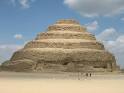
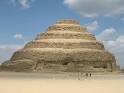
Our group gathers in silence before the entrance to the Step Pyramid, some five to six thousand years old, the first route of initiation in the ancient Egyptian Mystery Rites. In a rush of awareness, our reason for being in Egypt fills me. I am fully here.

With Jean Houston leading the way, we enter a long narrow passageway with tall pillars and a high roof. To our left and right, deep arches open out to the night, like the side altars in a cathedral. The wind is rising, stirring the air through which we walk, creating a pleasant coolness after the day’s heat. I reach into my backpack, pull out my shawl, glad of its warmth. I am aware of the burden of backpack, purse, water bottle, camera… items no ancient initiate would have carried. Ahead of us, Jean is emerging from the passageway, calling out to the ancient ones: Open yourselves to us as we open to you.

We are in an inner courtyard, already dusky in the failing light. Across an expanse of sand, the Step Pyramid huddles against the sky, a black shape, a mythic beast, a cave of unknowing, awaiting us. The doorway is narrow, and we enter single file.

step-pyramid

The Step Pyramid

Inside we walk along a corridor, stone walls and ceilings strengthened against calamitous collapse with steel bars, structures of wood. Here and there electric lights bless the darkness. We walk in silence, with great care, aware of danger.

Ahead, Jean is waiting for us at the edge of a sheer drop. One by one we are invited to look down. I stand at the edge, unprotected by any kind of barrier, leaning forward in order to see all the way down, some three or four stories, to the burial chamber. The cavernous darkness is unrelieved by any artificial light except that which seeps down from the high place where we stand.

I am looking into a walled chamber, the stone darkened by millennia of dampness, to the small stone floor where once Djoser’s body rested. I see only emptiness, an emptiness that is in its way more disturbing than seeing what belongs there. I see all of this in a glance, realize a glance is all I want.

 “Deep are the wells in our minds, our hearts, our being,” Jean says. “ Here we are in the land of depth, here in the oldest architectural structure known to humankind. There are many, many tunnels that bridge from here, three miles of tunnels in this the principal, first route of initiation.

“We think of so many things in which and to which we require initiation. For many of you the initiation is into new life, into new ways of being, into the emerging of what is possibly the end of times but it is also the opening time. Here in this ancient place which was the annunciation of the prophetic moment, is the annunciation that we have entered into a whole new order of civilization.

“Let us take it in our hearts that from this moment forth, from this primordial place, this great sacred mound, from which the genius of Imhotep emerged to create a structure that would be known from time out of mind, from this place of initiation, this place from which a great, great civilization grew … that this is the place from which we affirm, we say, we heartfully know that a great world civilization will begin again.We are in the ending times, we are in the closing times, we are in the opening times.

“Let us speak aloud the words of ancient Egypt: SA the creative breath of life, infusion of new life, energy, inspiration; SEKHEM the creative word of power, that can move in all of us so that we can take the fullness of our creative power into the world; SAHU the perfectly realized being within, the essence who holds the measuring, who holds the beginning and the end and the new beginning, that holds the love that moves the sun and all the stars, that creates the entrance to new life, the energy to be a vehicle of the patterning.”

We reach out to touch one another lightly, as might astronauts about to step out onto the moon.

“The new begins now,” Jean says. “The new that Teilhard de Chardin saw: The day will come when after harnessing space, the winds, tides and gravitation, we shall harness for God the energies of love. And on that day, for the second time in the history of the world, we shall have discovered fire.”                                                                                                                                        


We are again in the large sand covered courtyard, now in full darkness. Each of us is offered a candle, already lighted, to guide our way back. We are walking slowly, looking up to where the night sky is alive with stars. I am stunned at the beauty, seeing patterns as ancient as the universe, as new as my own breath.


As we enter the corridor of pillars, tears well up in my eyes, fall freely. An inner wave of emotion surges though my body, as the encounter with the Sacred Feminine in my community’s prayer room two months earlier takes on deeper meaning. I know now I am experiencing a triptych of healing that is a rebirthing: with my mother, with my community, with the Holy Feminine, whoever she is, by whatever name I call her: Mary? Isis? At this sacred moment, names do not matter.

Isis/Sophia in Egypt

I waken to a world of sunlight so strong that I need dark glasses and sun hat for the short walk to breakfast in the Mena House Hotel in Cairo. I pass the sun-soaked turquoise pool that sits like a small lake surrounded by palm trees, flowers in brilliant reds and yellows. I climb the marble stairs to the dining room, find breakfast spread out in silver bowls: pomegranate seeds, grapefruit, yogurt, abundance of muffins, breads, sweet rolls, coffee in silver urns on a long linen-covered


Immediately afterwards, we gather in one of the hotel’s elegant meeting rooms.
An Egyptian man, perhaps in his early fifties, stands at the front of the room. With shy pride he welcomes us to his country. “I am Mohamed Nazmy”, he says “and my company, Quest Travel, is making the arrangements for your time in Egypt. I know what it is you seek. I have been in communication with your teacher Dr. Jean Houston for several months, preplanning as much as we could, waiting for the time to be right for this sacred journey. My company guides only people like you who seek the spiritual heart of Egypt. But this,” and suddenly his shyness dissipates as a smile like a rising sun irradiates his face, “this will be our greatest challenge, and our deepest joy. Samei, though young, is an experienced and learned travel guide. He will go with you everywhere your journey takes you. I will accompany you when possible, and shall be in constant communication with Samei.

“I do not need to tell you that some of the places you will enter are dangerous, some carefully guarded. As far as possible, I am making arrangements for your group to have private visits inside the tombs, temples and pyramids to allow for the teaching and rituals that are part of your journey.” He pauses, then adds, “the only solitary visit I cannot arrange is to the Valley of the Kings where each day this month, the number of tourists will exceed ten thousand.” With a gracious wish for a safe and blessed journey, he concludes his talk, turns to speak quietly with Jean.


We return to the chairs at the front of the room and Jean introduces the guest who has come to speak to us this morning. “You’ve seen him on the Discovery Channel and on National Geographic Programs. He’s Egypt’s Minister of Antiquities, passionate about receiving, rescuing, restoring and retaining its ancient treasures. His ongoing archaeological work has earned him world-wide recognition and we can thank Mohamed, his close friend, for arranging this presentation by Dr. Zahi Hawass.”


“They call me the Indiana Jones of Egypt,” Dr. Hawass says, with a boyish grin. “They even say I wear an Indiana Jones hat, but the truth is that Indiana Jones wears a Zahi Hawass hat.”

With a power point he takes us with him as he is lowered by a rope into cavernous depths. “What did I find there?” he asks. “Not the wonderful things of Howard Carter’s experience in the tomb of King Tut, but the dung of centuries.”

These days, he’s working with a grant to study DNA from ancient mummies, seeking to trace relationships among King Tut, Hatshepsut, Nefertiti. He’s also excavating in the Valley of the Kings and seeking the burial site of Anthony and Cleopatra. He radiates joy and the passion of his commitment to work he loves. “With passion, any job can be the best in the world,” Dr. Hawass says.


“Egypt is a state of being that exists eternally in archetypal reality.” Dr. Hawass has gone, and Jean Houston is speaking to us now. “It is a quality of the psyche, of the intelligence, existing on the space/time continuum. Five thousand years ago, the essence of possibility entered into time”.


The magic has begun. I breathe in these words, not fully understanding, but knowing at a deep level their truth. This will be a journey of discovery even more enticing than those of Dr. Hawass.


“When in the thirteenth century St. Francis of Assisi visited Egypt, he sat with the Sultan in silence for hours before the Sphinx. At last Francis said, I know the answer. It is love.

“Now you are here as archaeologists of Egypt’s ancient spirit. We shall visit powerful sites, seeking matrix points for a world civilization, a world spirit. As the Ancient Egyptians dreamed a world, we shall, by use of imagination, bring forth a new reality that wants to emerge. We shall collect the broken pieces of our world and gather them into wholeness, as did Isis with the broken body of Osiris.

“And just as Hatshepsut restored the ruined temple of Hathor and created ceremonies of the Feasts of Light, we shall inaugurate ceremonies on behalf of our Temple of Earth.”

I listen intently, believing this to be possible, seeing it as absolutely achievable. It doesn’t occur to me then that a personal descent into cavernous inner places holding dung and wonderful things in equal measure, will be required of me.

“For today, you may be tourists”. Jean is saying now. “Samei will take you to a papyrus factory, then to some of the shops. After supper we’ll see the Egyptian Museum. Enjoy Cairo!”

In the papyrus factory store, we watch the process as papyrus stems are soaked, then soaped and placed under pressure to create paper. Young Muslim women wearing hijabs smilingly show us around the room’s collection of illustrated papyri.


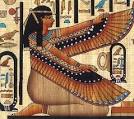
Hampered by my lack of Arabic (I am able thus far only to say “Shokran”, “thank you,”) I manage to convey to one of the young women that I am seeking a painting of Isis. After some searching, some reading of identifying hieroglyphs, the young store clerk smiles brilliantly, places a richly-painted papyrus of Isis in my hands. I take in the rich midnight blue of her robe, the throne-shaped silver crown on her head, the breadth of wing span in silver and gold beneath her arms, the mystery of the many-hued hieroglyphs of bird, snake, woman, throne, carefully arranged above beside and below her. I hand it back to the young woman who carefully rolls it, inserts it into a cardboard tube, then returns it to me. I am in awe at this beautiful treasure I now carry.

image of goddess Isis

Isis, with whom I began my journey two months earlier in a darkened room at my community’s retreat centre. ( to be continued)

from Called to Egypt on the Back of the Wind by Anne Kathleen McLaughlin Borealis Press 2013  (http://borealispress.com)

Sophia in Egypt


Part Three

That evening, as they share their meal, she looks carefully at her Sister companions, listens to the stories they tell of nieces and nephews, of work projects. She no longer expects them to understand her project, her summer journey, but she is comforted by the talk they share.


This is the pattern for the three months of her exile. The book opens at her touch, draws her inside where the story continues. She learns that for the Ancient Egyptians, life exists at once on several planes, and time is both clock time and lasting time. In the durative realm, she may visit events that occur in other times.

f1000002

One day, wandering like Isis, she comes in her Ka spirit to the place where shepherd children met the Virgin Mary in 1917, in Fatima, Portugal. She stands and watches as the story, familiar to her since her childhood, unfolds. She sees the light on the children’s faces, sees the solemn kindly being who greets them. She waits until the being looks finally at her. Then she asks what she must ask this Holy One: “Who are you?”

The radiant being smiles and says, “You know who I am.”

Isis brings Osiris to life
and conceives of him their child Horus.
But Seth captures Osiris
and hacks his body into fourteen pieces.
These he hurls into the Nile.
Isis and Nephthys together,
helped by the creatures of the river,
regather the scattered pieces of Osiris.
He goes to rest in the underworld, where he reigns as King.


The woman sees that the scattered pieces of her life are being sought out and rejoined in this mysterious adventure. She gives her trust to the journey, to its guide. For a long while now she has been aware that this guide is not the book’s author. She names her Isis, and strange though the name feels upon her lips, she is at home with this guiding presence who has known her, it seems, forever. Isis gives the woman new names for her body (companion), her mind (weaver), her emotions (seeker) and her spirit (Christa).


In a dream, Osiris instructs his son,
now grown to manhood, to defeat Seth.
A terrible battle rages for eighty years.
Horus wins, but Isis insists
that he not destroy Seth.
Horus is enraged and pulls
his mother’s crown from her head.
After a time, Horus gains wisdom.
He turns his heart to his mother
and recrowns her Queen of Earth and Heaven.


The room holds the darkness gently, and the darkness holds the woman. The days of her exile have almost ended, and she has come to the room where many years earlier she had sat as a young novice. The room is now a place of silent prayer and it watches her as she stands alone, holding in her outstretched hands a crown of mithril silver laced with emerald.


In her Ka, her spirit, she recrowns Isis.


She waits, knowing a gift will be offered in return. But at once she is overcome by shame. All her life she has been seeker, all her life she has been asking.


“Don’t give,” she says to the Holy presence. “Take something instead.” She doesn’t know where these words, this desire, have come from. “Take away this great emptiness that has made me a beggar of love for all my life.”


Even as she asks, she is afraid, for without this need, this longing, what would draw her to the Holy?


The fear dissolves in what is happening. She is being regifted in her birth. She is gushing forth, being presented to her mother, her mother who had been so afraid. But now another is there, pouring her love into child and mother both. And the woman thinks, “She is there in my birth blood. I am born into love and must ever now have more love than I can bear. I must give it as a mother with full aching breasts.”


The room yawns, believing nothing has happened.


A few days later, the woman, living once more in ordinary time, is visiting the city when a street woman approaches, begging. Grudgingly, she opens her purse, takes out a bill. Then for the first time she looks into the eyes of the other woman.


With no clear knowledge of what she will do or say, she embraces the street woman, holds her close and says, “Your life is so beautiful. Please, please take care of yourself.”
The street woman hugs her back. Both are startled. Then the woman who spent the summer lost in a book feels an astonished delight. Something wonderful has been born.


I have given you over recent weeks this three-part story,  first written under the title, “Portal to Egypt”. The very day I completed the final edit, I received a phone call. Beyond hope, beyond even my dreams, I learned that a place had opened on the waiting list, that I would now be travelling to Egypt. In fact, almost immediately.

Nine days later I emerged from the Cairo Airport with the companions who would, with me, and guided by Jean Houston, spend eighteen days in the heart of Egypt. On our visits to tombs, pyramids and sacred sites we were often the only group present, allowing Jean to teach us, guide us, lead us in a stunning experience of the myths, the spirituality, the rituals of ancient Egypt.

You may read of the whole journey in my book Called to Egypt on the Back of the Wind (Borealis Press, Ottawa, Canada, 2014)   http://borealispress.com    Anne Kathleen McLaughlin   
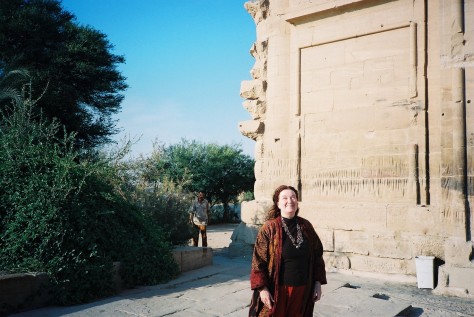
f1000003

awakening to the sacred feminine presence in our lives