Seeking Our Future in Ancient Wisdom

Sophiawakens for July 10, 2023

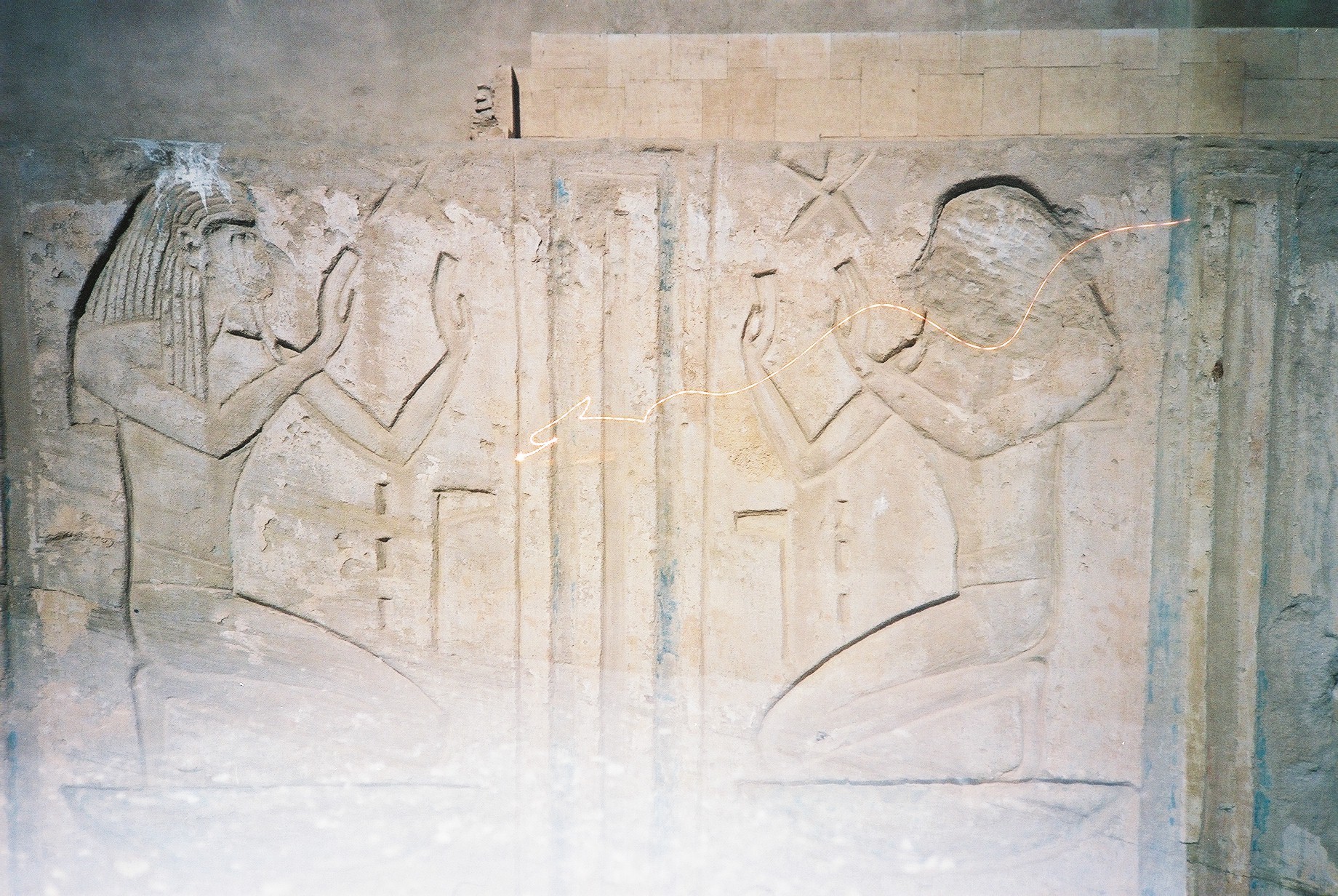
Carving in Egyptian Temple

If we want to understand the deep roots of our present environmental and spiritual crisis, we can find them in the loss of three important elements: the feminine image of spirit, the direct shamanic path of communion with spirit through visionary and shamanic experience, and the sacred marriage of the masculine and feminine aspect of the God-head and the Divine Ground…. The monotheism of the three Patriarchal religions has led to the situation today where the Earth is no longer viewed as sacred and we are confronted with the catastrophic effects of the loss of the Divine Feminine. (Anne Baring, pioneer of the Divine Feminine in our time, speaking on “Madonna Rises”, Ubiquity University, ZOOM program, August, 2020.)

Listening to this morning’s news on CBC Radio, Canada’s National Broadcaster, two stories caught my ear. The first was a report on the ice melting at a speeded-up rate in Antarctica, with a reference to the past month as the hottest June ever recorded “on Planet Earth”. My spirits rose. This was the first weather-related event I’ve ever heard spoken about as affecting our entire home planet. Have we finally understood we all share only one fragile, achingly beautiful, planetary home? That momentary euphoria was quickly replaced by news of yet another serious threat to the planet. With the justification of creating new technologies to offset planetary warming, mining companies are seeking freedom to pierce the deep seabed of the Pacific Ocean to access nickel and other minerals …

My body responded with a visceral knowing that this is wrong…

As out of control forest fires continue to ravage vast hectares of Canada’s forests, threatening air quality across North America, as rain creates flooding in the US East Coast putting nine million people under flood alert, we shake our heads and blame “Climate change.” Yet the “deep roots” that Anne Baring spoke of need to be understood if we are to survive as a species on Planet Earth. An Indigenous voice I heard on CBC Radio spoke of the real cause of the forest fire crisis in BC as a result of the forestry practices of “Clear cutting”….. Has no one warned us of this looming catastrophe?

Two years ago, the UN Secretary General Antonio Guterres said that we are sleepwalking our way into the destruction of our planet. For years David Suzuki on “The Nature of Things” has been telling us that what we do to our planet we do to ourselves. As early as 1988, eco-theologian Thomas Berry wrote: “Through human presence the forests of the earth are destroyed, fertile soils becomes toxic, and then wash away in the rain or blow away in the wind. Mountains of human-derived waste grow ever higher. Wetlands are filled in. Each year approximately ten thousand species disappear forever.”

Berry was clear that what was needed was “not simply adaptation to a reduced supply of fuels or some modification in our system of social or economic controls” but something far greater: “a radical change in our mode of consciousness. Our challenge is to create a new language, even a new sense of what it is to be human.” Berry’s words pierce our bubble of hope in new technologies to solve our problems: “(W)e are just emerging from a technological entrancement. During this period the human mind has been placed within the narrowest confines it has experienced since consciousness emerged from its Paleolithic phase.”

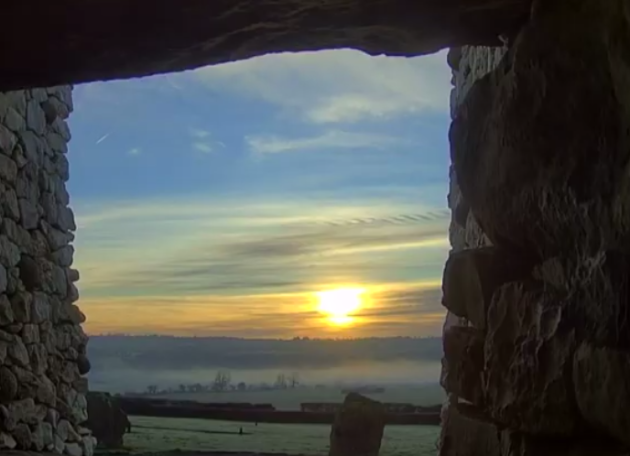
Winter Solstice at Newgrange , Ireland

Though we imagine humanity in our time to be vastly superior to earlier cultures, Berry noted, “Even the most primitive tribes have a larger vision of the universe, of our place and functioning within it, a vision that extends to the celestial regions of space and to interior depths of the human in a manner far exceeding the parameters of our own world of technological confinement.” In their celebrations of the seasons, of the earth’s natural rhythms, in creating spiritual centers “where the meeting of the divine, the natural and the human could take place”, our ancestors showed us how to live in partnership with our planet, not as its enemies and despoilers.

“What we need, what we are ultimately groping toward, is the sensitivity required to understand and respond to the psychic energies deep in the very structure of reality itself…This is the ultimate lesson in physics, biology, and all the sciences, as it is the ultimate wisdom of tribal peoples and the fundamental teaching of the great civilizations.”

Berry advised that we need to maintain “our intimate presence to the functioning of the earth community and to the emergent processes of the universe itself…. (t)he present situation is so extreme that we need to get beyond our existing cultural formation, back to the primary tendencies of our nature itself…”

Ecotheologian Thomas Berry

Thomas Berry, who died in 2009, did not leave us without hope: “(W) e are not left simply to our own rational contrivances. We are supported by the ultimate powers of the universe as they make themselves present to us through the spontaneities within our own beings….the universe is revealing itself to us in a special manner just now. Also the planet Earth and the life communities of the earth are speaking to us through the deepest elements of our nature.” (quotes from Thomas Berry in The Dream of the Earth: Our Way to the Future, Sierra Club, 1988, contained in the Foreword to The Dreamer of the Earth, Inner Traditions, Rochester Vermont, 2011, edited by Ervin Laszlo and Allan Combs)

Elinor Gadon, in her book, The Once and Future Goddess, as Anne Baring would later do, places at the heart of our present ecological crisis the loss of the wisdom of earlier cultures. In her closing chapter,The Promise of the Goddess: The Healing of our Culture” Gadon writes: “The taming of the Goddess under patriarchy led to the gradual erosion of sexuality, the cyclical regenerative powers of the cosmos…. The promised healing is that in honoring all that lives –women, the earth, its manifold creatures—we will no longer need to control, oppress, despoil our planet, to make war.

“We cannot—would not—wish to return to some golden prehistoric age, but in reclaiming our lost heritage we can build upon the values encoded in the prehistoric survivals. We do not have to look outside ourselves, outside our planet. What is needed is not new discoveries or technologies—only the willingness to change, to open up our hearts and honor what we already are.” (The Once and Future Goddess by Elinor Gadon, Harper Collins, New York, 1989)

Celebrating Julian of Norwich

On a February day in 1992 in the reconstructed anchorhold within the tiny Church of St. Julian in Norwich. I read : Thou art enough to me.

Looking back to that moment now, I wonder that I did not immediately turn around and exit by the door through which I’d just entered. Those five words struck me to the heart, challenging me to make a complete turn-around in my life, to let go of what I had until that moment considered necessary. I had left a place, a ministry. a friendship that had been the threefold source of my life’s happiness. Now I faced a future without all three. There was no way that I could accept that Julian’s unseen “Thou” could be enough.

I see now that I understood almost nothing of the One Julian addressed as “Thou” and even less of the meaning of “enough”. Yet in the year that followed, as I prepared to offer Julian’s words to others through James Janda’s play, I found the context for both:

For this is the loving yearning of the soul through the touch of the Holy Spirit, from the understanding which I have in this revelation: “God, of your goodness give me yourself, for you are enough for me, and I can ask for nothing which is less which can give you full worship. And if I ask anything which is less, always I am in want; but only in you do I have everything.” (Colledge and Walsh, Chpt. 5, p. 184)

Let’s look at the same passage in a different translation. Marion Glasscoe’s Julian of Norwich: A Revelation of Love is my personal favourite among the dozens of newer renderings of Julian’s “Showings” because it comes closest to the Middle English of Julian’s time (making my spell-check go into orbit!): For this is the kinde yernings of the soule by the touching of the Holy Ghost, as be the understondyng that I have in this shewing: “ God, of thy goodnesse, give me thyselfe; for thou art enow to me and I may nothing aske that is less that may be full worshippe to thee. And if I aske anything that is lesse, ever me wantith, but only in thee I have all.” (Glasscoe Chpt.5 pp.7-8)

Julian is not asking us to set aside our desires; she is not saying that to find God we must relinquish everything that we long for. Quite the opposite. Julian is saying that the deepest yearning of our souls will only be satisfied when we know the One who both made us to yearn and can alone fill that yearning. What Julian found for herself, she wants us to know:Only in you (the one to whom we entrust our longings) do I have everything, or in the Glasscoe translation: only in thee I have all.

This is a startling revelation for Julian, for each of us. As she says in Janda`s play:

Some of us believe that God is Almighty

And may do all,

And that God is All-Wisdom,

And can do all,

But that God is All-Love and will do all…..

There we stop short.

The second week of May holds two days that celebrate Julian of Norwich. A dispute over Roman numerals dating her night of visions of the Risen Christ led to this happy outcome: the Anglican Communion celebrates this amazing 14th century woman on May 8th (VIII) while the Catholic Church honours her on May 13 (XIII). ( I celebrate both!)

In her Revelations of Divine Love, Julian writes to us, her readers, as “kindred spirits.” How could she have imagined that it would be half a millennium before her writings became widely known!

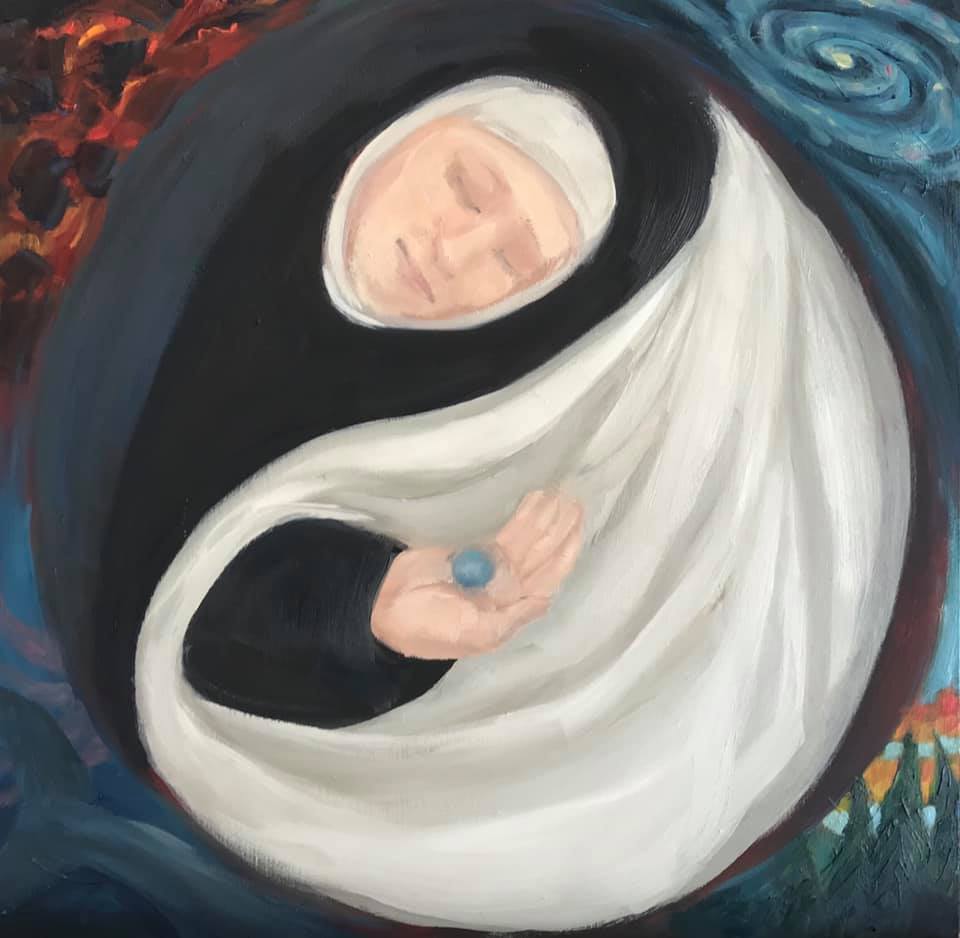
Artwork of Julian by Jane Joyner

The Presence of Love that we in the 21st Century are coming to know as permeating all of life in the metaverse, as well as in the depths of our own souls, our very being, may be differently imaged for us than it was for Julian. Yet our experience of that all-pervading Love within our lives is very like Julian’s. However we name that Love, however we call upon it, we can know ourselves held safe in its embrace. Our deepest yearnings are for Love, for knowing our life has meaning, that we matter to that Love, that our longings are not only understood, but even prompted by that same Love. Our task then, is to journey within those longings to find how they are drawing us into the embrace of the One who can satisfy them, who can fill us with the kind of joy that might lead us one day to say with Julian: Thou art enough to me.

In that same passage, Julian goes on to say:

And these words of the goodness of God are very dear to the soul, and very close to touching our Lord’s will, for his goodness fills all his creatures and all his blessed works full, and endlessly overflows in them. For he is everlastingness, and he made us only for himself, and restored us by his precious Passion and always preserves us in his blessed love; and all this of his goodness.

(Colledge and Walsh, Chpt. 5, p. 184)

We know that, for Julian, the Love “that moves the sun and all the other stars” (as Dante writes) was contained in the person of Jesus. I trust that Julian would allow me to rephrase her references to “God” in the way I now understand the Presence of Love in its feminine form as Sophia, the one who tells us in the Hebrew Scriptures:

“Yahweh created me, when his purpose first unfolded;

before the oldest of his works….

The deep was not, when I was born;

there were no springs to gush with water….”

(excerpts from Proverbs 8 in The Jerusalem Bible)

Kathleen Duffy writes that Sophia “seeks to capture our attention as she peers out from behind the stars, overwhelms us with the glorious radiance of a sunset, and caresses us with a gentle breeze.”

(Sophia) wishes to be seen, and She wishes to be sought,

and She wishes to be expected, and She wishes to be trusted.

If we have a desire to honour Julian on her feast days, perhaps the best way is to grow in awareness of the Love that holds us, even as it held Julian as she lived through outbreaks of black plague, religious and political wars, and yet trusted in that Love. These are the first words I read from Julian, on that same visit in February, 1992: “He did not say: ‘You shall not be tempest-tossed; you shall not be work-weary; you shall not be discomforted.’ But he said, ”You shall not be overcome.’ God wants us to heed these words so that we shall always be strong in trust, both in sorrow and in joy.” (Enfolded in Love: Daily Readings with Julian of Norwich)

Bealtaine 2023

The Month of May, most beautiful of all the year, when flowers abound, trees put forth leaves and the air itself is perfumed, was originally named for the Goddess Maia. Other Goddesses in the Celtic, Greek and Roman traditions were also celebrated in May. In the Catholic Tradition May is known as the month of Mary, Mother of Jesus.

Veiled in Mystery, and yet nearer to us than we are to ourselves, the Presence of Love that we are coming to know as the Sacred Feminine wants to be found. “Wild Woman” leaves a trail for us to follow: Perhaps we found her tracks across fresh snow in a dream. Or psychically, we noticed a bent twig here and there, pebbles overturned so that their wet sides faced upwards …we knew that something blessed had passed our way. We sensed within our psyches the sound of a familiar breath from afar, we felt tremors in the ground…we innately knew that something powerful, someone important, some wild freedom within us was on the move.” (C.P. EstesWomen Who Run with the Wolves, Random House, New York, 1992, p.457)

Pursuing this presence, lured by her tracks, we come upon not thick books, but rather small hints: the story of a brief encounter, the way that someone’s life has been upturned into joy by her, powerful clues put together by the wise about the way She manifests.

One such small clue has been a beacon in my own search for years. Jean Shinoda Bolen, Jungian analyst, author of Goddesses in Every Woman, wrote of a moment in her own life. One of her patients had unexpectedly died. She was filled with grief that had to be kept under wraps while she attended to the needs of another patient:

No one supposed that I needed any comforting, including me, until this woman who was my analysand sensed something and reached out with compassion to ask if I was all right. And when my eyes moistened with sudden tears, she broke out of role, got out of the patient’s chair to come over to mine, and held me. At that moment, I felt a much larger presence was there with the two of us. When this woman put her arms around me, I felt as if we were both being cradled in the arms of an invisible, divine presence. I was profoundly comforted and felt a deep ache in the center of my chest. This was before I had ever heard of a heart chakra, which I know now opened widely then. I now also know that this is a way that the Goddess (of whom I had no inkling) may manifest. It differed from the mystical experience I had had of God. Then, no other human presence was necessary… Here, in contrast, the compassion and arms of a woman were the means through which a numinous maternal presence was felt….

I now think of this profound moment as a Grail experience in which the Goddess was the Grail that held us. This, and what others have told me about their experiences of the Goddess in their lives, has made me think of the Goddess as a nurturer and comforter whose presence is evoked through human touch.

After recounting experiences of other women with whom she had been leading rituals and meditation, Bolen concludes: In these moments, when each of us felt held in the arms of the Mother Goddess, a compassionate woman mediated the experience, leading me to understand that this feminine divinity comes through the body and heart of a human woman, created in Her image. (Jean Shinoda Bolen, Crossing to Avalon, Harper Collins, New York1994(73-74, 77)

Almost 20 years after Women Who Run with the Wolves was published, Clarissa Pinkola Estes brought forth a new book: Untie the Strong Woman, SoundsTrue, BoulderColorado, 2011. The powerful mysterious feminine presence is seen by Estes as aligned with titles and qualities given in the Christian story to Mary, yet part of a much longer heritage.

In her opening paragraphs, Estes traces the lineage of THE GREAT MOTHER:

She is known by many names and many images and has appeared in different epochs of time to people across the world, in exactly the shapes and images the soul would most readily understand her, apprehend her, be able to embrace her and be embraced by her.She wears a thousand names, thousands of skin tones, thousands of costumes to represent her being patroness of deserts, mountains, stars, streams and oceans. If there are more than six billion people on earth, then thereby she comes to us in literally billions of images. Yet at her center is only one great Immaculate Heart.

Since we staggered out of the Mist eons ago, we have had irrevocable claim to Great Mother. Since time out of mind, nowhere is there a feminine force of more compassion and understanding about the oddities and lovability of the wild and wondrous variations to be found in human beings.

Nowhere is there found a greater exemplar, teacher, mentor than she who is called amongst many other true names, Seat of Wisdom.(C.P. Estes, Untie the Strong Woman, 2)

The Memorare, an ancient prayer calling on Mary in time of need, was learnt by many of us as children. It takes on richness and depth in this adaptation by Estes:

Have you forgotten? I am Your Mother. You are under my protection.” There is a promise Holy Mother makes to us, that any soul needing comfort, vision, guidance, or strength can cry out to her, flee to her protection, and Blessed Mother will immediately arrive with veils flying. She will place us under her mantle for refuge, and give us the warmth of her most compassionate touch, and strong guidance about how to go by the soul’s lights. (Untie the Strong Woman, inside cover)

How might our lives be different if we remembered,

if we then trusted in this promise?

Sophia for Earth Week April 16-22, 2023

Sophia for Earth Week April 16-22, 2023

Once we take our first turning towards a Sacred Feminine Presence, welcoming her into our lives, change begins. In Rebirth of the Goddess (1997), Carol P. Christ writes of how turning towards the presence she names the Goddess altered her life. Her book reflects her new view of religion, politics, ecology, life, death, relationships, morality, the meaning of existence….

Reading Christ’s book has led me to reflect on how my own life has been altered since coming to know Sophia. I realize that the change began when I first recognized that there is a feminine path to the Holy that differs in important ways from the masculine path. The masculine path was shown to me as I grew up in a Church where the teachers, priests, writers, theologians were mostly men and some women who had embraced the masculine way to holiness.

What a revelation it was for me to encounter, through their writings and at times through hearing them speak, the feminist theologians who rose to prominence in the last third of the twentieth century. These women used their powerful intellects, their theological training, and their own experience to show that the “objective” masculine teachings, thought to apply to all humankind, actually reflected the masculine way to God. The feminist theologians found the heart of the difference between the masculine and feminine ways to be within the perceived dualities found in Greek thought: spirit/matter, sky/earth, thought/ feeling, supernatural/natural, mind/body, spirituality/sexuality, man/woman. More than a separation, there is a perceived hierarchy. Spirit, sky, thought, the supernatural, mind, spirituality, man viewed as separate from, superior to, matter, earth, feeling, nature, body, sexuality and woman. This is a worldview where God is separate from creation, from humanity. To find this God, we must soar above the human.

Embracing this worldview, I had embraced an ideal of spiritual life that led me to distrust love, to be cautious with emotion, to value thought over feeling. I had learned to distrust my desires, my body, my sexuality, all of which, I’d been warned, would lead me astray, away from God. I learned to embrace an ideal of perfection, though I never succeeded in living it out.

Through the writings of the feminist theologians, I learned that recovering a sense of the sacredness of the feminine would assist me to recover a sense of the sacredness of the earth, of the body, of my feelings, of my sexuality.

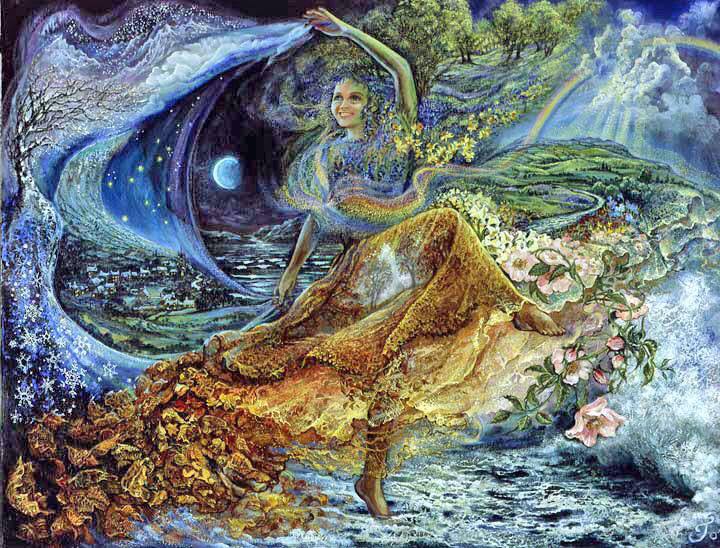
artwork by Josephine Wall

At this time in the story of our planet Earth, this recovery is vital. The sacred presence of love lives within all of life, within the earth herself, within the creatures that walk, swim, fly, crawl upon and within her. Only this knowing can give us the courage and the strength we need for the work we are called to do with the earth as she heals from the ravages of our despoiling her.

In the sixth chapter of her book, “The Web of Life”, Carol Christ writes compellingly of this call:

To know ourselves as of this earth is to know our deep connection to all people and beings. All beings are interdependent in the web of life….We feel deeply within ourselves that we are part of all that is, but we must learn to speak of what we know. We know, too, that we participate fully in the earth’s cycles of birth, death, and regeneration….

The fundamental insight of connection to all beings in the web of life is experienced by children, poets, mystics, and indeed, I suspect, by all of us, though we may lack the language to express what we feel….(p. 113)

Acknowledging the difficulty of speaking of this deep connection “in the face of criticism rooted in dualistic thinking”, Christ quotes Jewish theologian Martin Buber who wrote of his “I-Thou” relation to a tree:

I contemplate a tree.

I can accept it as a picture: as rigid pillar in a flood of light, or splashes of green traversed by the gentleness of the blue silver ground.

I can feel it as movement: the flowing veins around the sturdy, striving core, the sucking of the roots, the breathing of the leaves, the infinite commerce with earth and air – and the growing itself in its darkness…

But it can also happen, if will and grace are joined, that as I contemplate the tree I am drawn into a relation, and the tree ceases to be an It. The power of exclusiveness has seized me. (Martin Buber, I and Thou trans. Walter Kaufmann, New York, Charles Scribner’s Sons, 1970 pp. 58-59)

The writings of Susan Griffin recognize our Earth as intelligent and aware:

I taste, I know, and I know why she goes on, under great weight, with this great thirst, in drought, in starvation, with intelligence in every act, does she survive disaster. (Susan Griffin inWoman and Nature: The Roaring Inside Her New York, Harper and Row, 1978 p. 219)

A beautiful reweaving of dualities into wholeness flows from our embrace of Sophia/Sacred Feminine/Goddess. Here is Carol Christ’s celebration of the insight into oneness intuited by children, mystics and poets:

If Goddess is an intelligent power that is fully embodied in the world, then the notion that divinity, nature and humanity are three totally distinct categories collapses. If Goddess as fully embodied intelligent love is the ground of all being, then it makes sense to speak of intelligence and love as rising out of the very nature of being and of all beings as intelligent and infused with love. Human intelligence and our capacity to love do not separate us from nature. Instead, everything we are arises from the nature of being, from our grounding in the earth. (p. 123)

As we celebrate Earth Week in 2023, may the eyes of our mind, the intelligence of our heart recognize, perhaps for the first time, that Planet Earth is truly Our Mother, the source, sustainer and unifier of all that lives upon and within her.

The Easter Mystery 2023

Through the cold, quiet nighttime of the grave underground,

The earth concentrated on him with complete longing

Until his sleep could recall the dark from beyond

To enfold memory lost in the requiem of mind.

The moon stirs a wave of brightening in the stone.

He rises clothed in the young colours of dawn.

(John O’Donohue “Resurrection”)

The Easter Mystery of life-death-life is at the heart of the universe, at the heart of life on our planet, in the deep heart of our own lives. From its birth out of the womb of a dying star, through its daily cycle of day/dusk/ night/dawn, its yearly cycle of summer/autumn/ winter/spring, the earth teaches us to live within the paschal mystery. Ancient peoples understood this mystery. Through their careful observations they constructed buildings such as the mound in Newgrange Ireland where a tiny lintel receives the first rays of dawn only on the winter solstice.

The ancients wove their understanding of life/death/life into their mythologies: the Egyptian story of Osiris, whose severed body was put together piece by piece by his wife Isis, then reawakened; the Sumerians tell of the great queen Inanna who descended to the underworld to visit her sister Erishkigal. There she was stripped of all her royal robes and insignia, and murdered by her sister who then hung her lifeless body on a hook. Three days later, Inanna was restored to life, all her honour returned to her.

The people of Jesus’ time would have known these and other great myths of the ancient Near East. What was so stunningly different in the Jesus story was that the mystery of life-death-life was incarnated in a historical person. The Resurrection of Jesus is at the heart of the Christian faith. As Paul wrote, “If Christ be not risen then our faith is in vain”.

In our lifetime, the explosion of new science shows us the life/death/mystery at the heart of the universe. Like exploding stars, our lives are continuously being rebirthed into a deeper more joyous existence. By allowing the death within ourselves of old habits, old mindsets and narrow ideas of who or what we may be, we open ourselves to the possibility of new life being birthed within us. As Jesus told his friends, “You will do what I do. You will do even greater things”.

“Resurrection is about being pulsed into new patterns appropriate to our new time and place,” Jean Houston writes in Godseed. For this to happen, we need to open in our deep core to “the Heart of existence and the Love that knows no limits. It is to allow for the Glory of Love to have its way with us, to encounter and surrender to That which is forever seeking us, and from this to conceive the Godseed”.

“The need for resurrection has increased in our time,” Jean continues. “We are living at the very edge of history, at a time when the whole planet is heading toward a global passion play, a planetary crucifixion.” Yet “the longing with which we yearn for God is the same longing with which God yearns for us…. the strength of that mutual longing can give us the evolutionary passion to roll away the stone, the stumbling blocks that keep us sealed away and dead to the renewal of life”. (Godseed pp.129-130)

The yearly miracle of spring awakens within us the confidence and joy that this same rebirth is ours to accept and to live. We know our call to green our lives, our times, our planet:

The force that through the green fuse drives the flower

Drives my green age (Dylan Thomas)

Where in my life do I most experience the need for a rebirth?

What old habits and beliefs would I have to let die in order for this new life to be born?

How does knowing that the longing with which (I) yearn for God is the same longing with which God yearns for (me) make my life more joyful?

What would a resurrected life look like, feel like, for me? for those with whom my life is woven? for our planet?

May Sophia, the feminine presence of Sacred Wisdom, gently guide us through the death of what no longer serves us into the joy of the rebirth for which our hearts yearn.

Singing Your Soul Awake

Explore the new cosmology with its roots in the sacred core of spiritual traditions, in ancient wisdom from the mystic path, from ritual, from mythology and story http://sophiawakens.com

Anne Kathleen McLaughlin, author of four novels published by Borealis Press, Ottawa, Canada http://borealis press.com

A Place Called Morning (2001)

Planted in the Sky (2006)

Called to Egypt on the Back of the Wind (2013)

Singing the Dawn: Rebirth of the Sacred Feminine (2022)

Singing the Dawn

Anne Kathleen McLaughlin’s novel “Singing the Dawn” is now available for online orders: http://www.borealispress.com/BookDetail/rid/1137/Singing%20the%20Dawn 

A small community of women living as hermits on islands off the west coast of Ireland, “beyond the ninth wave” gather to celebrate the earth festivals of the Celtic Year. Their shared calling is to prepare for the Rebirth of the Sacred Feminine in our time. These seven women who form the Communion of Star of the Sea in the twenty-first century are the inheritors of a way of life founded in the ninth century by Maire, a woman forced by a Viking Raid on the Monastery of Kildare, to flee to the west. On the shores of Lough Corrib, Maire encounters a Woman who gives her the task of beginning a Community whose role will be to prepare for a future time when once more the Feminine Sacred will be honoured on the earth. The story begins in 2012 with a new arrival, mysteriously drawn to the islands.

Here is an excerpt from the Prologue:

You cannot tell how long you’ve been journeying. The sky has lightened to rose, to rose-gold, to gold-blue to pale blue. The sun has climbed to its zenith, wandered back down. The light is dimming now.

You know, the old tales have instructed you, you must pass beyond the ninth wave to reach the otherworld. But who knows how far beyond that? You stopped counting somewhere near the nine-hundredth.

Bread, cheese, fruit, you’ve eaten through the hours. Your water-skin still holds more than half its fullness.

It’s the time of dusk, when shapes become less distinct, when the horizon holds uncertain promises. Yet, surely, ahead, that is an island?

Hope strengthens as you draw nearer. Promise of dry land, trees, bushes, fruit and berries, a clear stream. Shelter under boughs and branches.

You’re almost there. The approaching shore is low and sandy with a smattering of pebbles, a scattering of stones, larger rocks. Somehow you know you won’t be alone here.

Sandals hung on your shoulder, you step from the currach. The water is shallow, cooling your bare feet. With surprising ease, the small boat allows itself to be pulled up onto the shore. You hide it behind some gorse bushes, careful to avoid the sharp prickles of the branches, stow the oars, remove your bundle. You gaze around the shore, note exactly where you have hidden the currach.

You begin walking.

A clear path leads from the shore into the small island, curving towards the west. Others have walked this way before you, perhaps many others, for years longer than you could count or imagine.

You feel safe and yet a tingle of excitement tells you there’s mystery here. Magic even. You know you will be guided. You sense something or someone awaits you.

You look back over your shoulder out over the sea… Then you see it. The seven-pointed star, just beginning to glow silver in the cobalt blue of the evening sky. It has guided you here though its light has been hidden all this day long. You whisper your thanks.

Dancing with Sophia

Sunday Morning. Just a few hours until the dance session begins on ZOOM. I haven’t registered yet, nor have I attended these classes in recent months, not since Banafsheh, our Persian born teacher of Sacred Dance, invited us to dance in support of the young people of Iran engaged in a revolution to set their country free of oppression. Young people being sentenced to death for their involvement in peaceful protests. I tell myself I can’t take on another nation’s suffering. Not with the war in Ukraine, not with the devastation of the planet. There’s too much darkness already. I stop attending dance class….

Yet somehow I am feeling drawn to today’s class.

I reread the invitation from Banafsheh:

Join us to celebrate Spring and renewal, and dance to put a transformative poem by Rumi into motion, so you can balance the joy and the sorrow in a wide-open heart with self-authority…grounded in the security of our Mother.

Spring, Renewal, Rumi’s Poetry, Balancing Joy and Sorrow…alluring as these references are, I know it’s the last phrase that’s drawing me: grounded in the security of our Mother. It’s what first drew me to Banafsheh’s teaching: her commitment to the Sacred Feminine in her many guises, under her many names.

My life is also committed to this Sacred Presence, whom I name Sophia.

I register for the dance.

Banafsheh begins with photos of young women and men, radiant with youth, with beauty, with intelligence, with nobility. Each picture is surrounded by flowers, adorning a gravesite. The photos remind me of my young adult nieces and nephews. What would I be feeling now if my own beloved ones were put to death for attending a peaceful protest?

Suddenly I know.

I feel my heart breaking within me.

Words are rising silently. I know this voice. The one Banafsheh named Mother, the one I know as Sophia says: “They all belong to me.”

And I get it. This is not the agony of strangers. This is our agony.

In an instant, everything changes. And we begin to dance…

Only later do I realize this is happening on Palm Sunday.

With the rising of the full Paschal Moon on April 6th, we re-enter the Sacred Days of the Passion Play the yearly re-living of the final act in the life of Jesus on earth, his agony and death, his resurrection.

For years, decades, I approached Holy Week with a kind of dread, knowing I must engage once more in the agony of Jesus, his sufferings, his death, followed by the long tomb-time of his absence before I could even remember the truth of Resurrection…. I would get up during the night after the Holy Thursday Eucharist to spend an hour in prayer, remembering Jesus in the Garden of Gethsemane, his friends asleep around him, as he faced the certitude of his coming death.

It was a Mystery Play, perhaps not unlike the ancient Greek and Roman Mystery Rituals, but the emotions were manufactured. The darkness I experienced through these intense feelings of grief and loss was real, as was the physical discomfort of fasting. Yet some part of me knew it was play-acting: both the terrible loss of Good Friday and the exploding joy of Easter. Jesus IS risen and will never die again; the Christ is with us always.

Nine years ago, something shifted. I wakened in the deep heart of Holy Thursday night. Yet I was drawn in prayer, not to the Garden of Gethsemane, but to the Earth herself, in agony, dying. I sat through that hour with her suffering.

Later I came upon this lovely meditation by Susan Griffin which spoke to my heart:

As I go into the Earth, she pierces my heart. As I penetrate further, she unveils me. When I have reached her center, I am weeping openly. I have known her all my life, yet she reveals stories to me, and these stories are revelations and I am transformed. Each time I go to her, I am born like this. Her renewal washes over me endlessly, her wounds caress me. I become aware of all that has come between us, the blindness, of something sleeping between us. Now my body reaches out to her. They speak effortlessly, and I learn that at no instant does she fail me in her presence. She is as delicate as I am, I know her sentience, I feel her pain and my own pain comes into me, and my own pain grows large and I grasp this pain with my hands, and I open my mouth to this pain, I taste, I know and I know why she goes on, under great weight, with this great thirst, in drought, in starvation, with intelligence in every act does she survive disaster. This earth is my sister, I love her daily grace, her silent daring, and how loved I am, how we admire this strength in each other, all that we have lost, all that we have suffered, all that we know: we are stunned by this beauty, and I do not forget what she is to me, what I am to her. (Susan Griffin in The Body of Earth)

Since that time of awakening, I experience these Sacred Days of the Paschal Mystery, the Mystery of life/death/life that is at the Holy Heart of the Universe, in a new and deeper way. The suffering is now for me a reawakening to the raw suffering, the unaccountable losses, the seeking for light and hope in darkness that is the Mystery Play of our lives in this year of 2023 on Planet Earth.

This is why we need a Sacred Feminine Presence that is more than sweetness and light, One who is also fierce, strong, capable of holding us in the darkness in which our lives are shrouded. The Dark Mother, Who was present in the very chaos in which our Universe was birthed, strong enough to remain through eons of destruction and rebirth, still with us, within us.

May the Dark Mother hold each of us as we stand in this moment of darkness, raising the chalice of kindness to bless our earth and all that lives upon and within her, all that belongs to the Mother.

The Sacred Marriage

My Beloved lifts up his voice,

he says to me,

“Come then, my love,

My lovely one come.

For see, winter is past,

The rains are over and gone.

The flowers appear on the earth.”

(The Song of Songs 2:10-12, Jerusalem Bible)

On the theme of the Sacred Marriage, Anne Baring writes: Four thousand years ago in the courtyards of the great temples on the banks of the Nile the Sacred Marriage of goddess and god was celebrated. The theme of the Sacred Marriage has come down to us in myth, in fairy tales like Cinderella and the Sleeping Beauty, and in the Biblical Song of Songs. Alchemy sets the supreme quest for the treasure in the context of a marriage between the lunar and solar aspects of the soul, the fiery gold of the masculine element and the volatile silver of the feminine one, a union between our mind and our soul, our head and our heart, between the solar King and the lunar Queen. This marriage also united the invisible dimension of the subtle world of spirit and the material world of our experience, rendering the latter transparent to spirit. The Sacred Marriage is the age-old image of this mysterious double union. (The Dream of the Cosmos: A Quest for the Soul, 2013, 470-472)

Anne Baring tells of the alchemists’ understanding of how this inner marriage would take place: … in order for consciousness to be transformed from base metal into gold, both king and queen have to undergo a process of dissolution and transformation… resulting in the birth of the child of the new consciousness.

To awaken the consciousness personified by the king to the values associated with the wisdom of the soul, he has to undergo a symbolic death, vividly described by the shamanic initiation. He makes a descent into the watery realm of the soul, the realm of the emotions, feelings, instincts, that has never been associated with anything of value and has been both feared and despised and has consequently remained largely dissociated from consciousness…(and) largely undeveloped.

The queen as the personification of the soul is also transformed as the king enters into a conscious relationship with her. She is no longer forced to remain in a dissociated state. She is no longer in thrall to the deficient values and limited perception represented by the Old King; nor is she any longer bound by the powerful unconscious drives of blind instinct to which he also was bound. The values of the heart begin to be heard and strengthened. Feeling begins to function in a more conscious related way as both king and queen are transformed.

Anne Baring notes that in our time this process as described by the alchemists is necessary for both man and woman: … woman has been educated in the same way as man, has absorbed the same values and has been imprinted with the same ideas and may give the highest value to the masculine principle and the rational mind, knowing nothing of the deeper dimension of the soul and the invisible dimension of reality.

There is another kind of Sacred Marriage associated with the king and the land. In her program on Celtic Shamanism, (Shift Network, 2019), Jane Burns speaks of the ancient custom in Ireland: When the rightful king was sworn in, he was said to marry the land, because it was to the earth goddess, the goddess Sovereignty, he was to pay homage, make personal sacrifices and give allegiance. Here we return to this notion of the marriage of the masculine, the king, and the feminine, the goddess, as a necessity if prosperity is to reign. This is a marriage of equals. That marriage… must exist within us if we are to be sovereign and prosperous.

Referring to the teachings of esoteric astrologer William Meade, Jane said: If we are going to achieve mastery of our soul, we all have to bring into balance within us the divine masculine and divine energies and potential that are resident there….Each strength, the masculine and feminine, has its own contribution to the soul’s pathway to mastery. Each has their own wisdom. What (William Meade) says is that the divine feminine knows what to do and the divine masculine knows how to do it. It’s a very necessary marriage. The divine feminine holds the potential. She creates the design, conceives the design, nurtures it. She knows what the purpose is. The divine masculine executes the design or brings it into manifestation. It’s the same agreement as the relationship between the goddess Sovereignty and the king who serves her. The feminine…what are its attributes? It observes. It receives. It nurtures. It embodies. It grows and flourishes. Through that experience comes the wisdom of what to do. The masculine acts. It changes the circumstance. It fixes things, it executes things, it puts things into play because it has this greater connection to the world. That affords it the opportunity to know how to do it.

The Spring Equinox invites us to reflect on our inner marriage, the union of our feminine and masculine qualities needed for wholeness. At this season when darkness and light, night and day are in balance, how might we come to a healthier, more joyous balance between our inner feminine and masculine? Might we consider creating for ourselves a ritual of “Inner Marriage” with music, poetry, flowers, dance?

Entering the Rose Garden: Four

Reflection for March 9, 2023

Where might we who yearn to find the lost Divine Feminine seek for her? Anne Baring concluded her presentation on the Shekinah with directions for our quest.

Mary, Untier of Knots

Her first suggestion will be familiar to us: The Biblical Books of Proverbs, Ecclesiasticus and Wisdom. These we have encountered in our earlier exploration of Rabbi Rami Shapiro’s writings in The Divine Feminine in Biblical Wisdom Literature.  From this rich source, Anne Baring cites these examples:

In the Book of Proverbs (8: 23-31), Wisdom tells us she is the Beloved of God, with Him from the beginning, before the foundation of the world. She speaks from the deep ground of life as the hidden law which orders it and as the Craftswoman of creation. In the Sistine Chapel, Michelangelo has painted her tucked into the crook of God’s arm. With their vivid imagery, these passages transform the idea of the Holy Spirit, speaking as Divine Wisdom, from abstract idea into living presence.

In the Book of Wisdom…Wisdom is described as sitting by the throne of the Lord in heaven (9:10) and is spoken of as the Holy Spirit (9:17).

Elsewhere, Wisdom speaks as though, like the Shekinah, she were here, in this dimension, dwelling with us in the midst of her kingdom, accessible to those who seek her out. She is unknown and unrecognized, yet working within the depths of life, striving to open our understanding to the divine reality of her presence, the sacredness of her creation, her justice, wisdom, love and truth. In the Book of Ben Sirach (Ecclesiasticus) Wisdom, perhaps recalling the time when she was honoured and worshipped in the First Temple, proclaims herself to be the soul and intelligence of the cosmos, rooted in tree, vine, earth and water and active in the habitations of humanity. She is the principle of justice that inspires human laws. She appeals to all those who are desirous of her to fill themselves with her fruits, “For my memorial is sweeter than honey, and mine inheritance than the honeycomb.” (24:20)

Anne Baring calls this “the language of the immanence of the Divine Feminine in the world”.  Anne continues: “To those who, like Solomon, prized her more highly than rubies, Wisdom was their wise and luminous guide.”

I prayed and understanding was given me: I called upon God, and the Spirit of Wisdom came to me…I loved her above health and beauty, and chose to have her instead of light, for the light that cometh from her never goeth out…For she is the breath of the power of God, and a pure influence flowing from the glory of the Almighty… She is the brightness of the everlasting Light, the unspotted mirror of the power of God, and the image of His goodnessShe is more beautiful than the sun, and above all the order of stars: being compared with the Light, she is found before it… I loved her, and sought her out from my youth. I desired to make her my spouse, and I was a lover of her beauty. (Wisdom of Solomon 7: 7,10, 25, 26, 29, 8:2).        

Anne Baring’s treasure map leads to another source where knowledge of the Shekinah may be found:

During the last fifty years or so, it has become increasingly clear that there was a great underground stream of human experience which flowed from the thriving city of Alexandria into several different channels—into the writings of the early Christian Gnostics discovered at Nag Hammadi, into the Hermetic Tradition and the later Alchemists, and the transmitters, both Jewish and Christian, of the ancient cosmology of Kabbalism. Hellenistic Egypt in the second and third centuries AD was the ultimate source of all these traditions yet we now know that the roots lie deeper, in the temple teachings of a far older time, whether in Palestine or Egypt. Alexandria was a Greek city, the meeting place of East and West – a vibrant crucible for the exchange of ideas and teachings between Egyptians, Greeks, Syrians and Jews, and also sages from far-away Persia and India….In Alexandria Divine Wisdom and the Holy Spirit was called Sophia –the Greek word for Wisdom – a name which descended to the time when the emperor Justinian built the great Christian Basilica in Constantinople called Hagia Sophia.  

The Gnostics were a group of early Christians, some descended from the Jews who fled Jerusalem in 70 AD following the destruction of the temple by the Romans. They claimed to have the secret teaching of Jesus, given by him to his closest disciples, including James and Mary Magdalene. There were many Gospels circulated among them in addition to the four we now know. One of these: “The Gospel of the Beloved Companion” attributed to Mary Magdalene, found its way to France from Alexandria in the First Century. This book has recently been translated from the Greek by Jehanne de Quillan.

Anne Baring quotes from Elaine Pagels (The Gnostic Gospels) on the fate of these other Gospels by the close of the second century AD: Every one of the secret texts which gnostic groups revered was omitted from the canonical collection, and branded as heretical by those who called themselves orthodox. By the time the process of sorting the various writings ended…virtually all the feminine imagery for God had disappeared from the orthodox Christian tradition.

As Anne Baring tells us, until 1977 with the publication of the texts discovered in 1945 at Nag Hammadi, “no one knew that some groups of early Christians had an image of the Divine Mother whom they had named ‘The Invisible within the All.’”  

In the Christian era, the “further and final loss of the Divine Feminine” was brought about. In AD 325, the Church Council of Nicaea associated Wisdom with Christ as the Logos, the Divine Word. 

From this time the Christian image of the Trinity of Father, Son and Holy Spirit became wholly identified with the masculine archetype.  The ancient connection between the Holy Spirit and the Divine Feminine was irrevocably and, for western civilization, tragically lost. The monotheism of the three Patriarchal religions has led to the situation today where the Earth is no longer viewed as sacred and we are confronted with the catastrophic effects of the loss of the Divine Feminine.      

     Anne Baring offers this question for our Reflection:

“What difference would there be in your life if the Shekinah-Sophia was a living presence for you?”

Entering the Rose Garden Part Three

March 3, 2023

Whatever their ways,

they are all in love with you,

Each comes, by a path, to the Rose Garden

Niyazi Misri

(This is the third Reflection based on the opening talk Anne Baring gave to Ubiquity University’s online course: “Madonna Rising” in August 2020. I am grateful to Anne Baring for making her lecture notes available to participants. Direct quotes are designated by quotation marks, or for longer sections, by the use of italics.)

The Feminine Face of the God-Head

In the mystical tradition of Judaism, the Shekinah or feminine face of the god-head is named as Cosmic Womb, Palace, Enclosure, Fountain, Apple Orchard and Mystical Garden of Eden. She is named as the architect of worlds, source or foundation of our world, also as the Radiance, Word or Glory of the unknowable ground or godhead. Text after text uses sexual imagery and the imagery of light to describe how the ray which emanates from the unknowable ground enters into the womb—the Great Sea of Light—of the Celestial Mother and how she brings forth the male and female creative energies which, as two branches of the Tree of Life, are symbolically King and Queen, Son and Daughter. A third branch of the Tree descends directly down the centre, unifying and connecting the energies on either side….The Heart centre of these three branches or pillars…is called Tiphareth.

Spiral Galaxy : Birthing Womb of the Universe

As “the indwelling and active Holy Spirit”, the Shekinah is both “divine guide and immanent presence”. She it is who frees us from beliefs that separate us from our source, restoring the world to “union with the divine ground.” By bringing into being all that is ensouled by the divine source, “she generates the manifest world we know”, remaining here until “the whole creation is enfolded once again into its source.”

Kabbalism sees “the divine Mother-Father image…expressed as the male and female of all species”.

Humanity, female and male, is therefore the expression of the duality-in-unity of the god-head. The Shekinah is forever united with her beloved Spouse in the divine ground or heart of being and it is their union in the god-head that holds life in a constant state of coming into being. Yet she is also present—here with us—in the material reality of our world. The sexual attraction between man and woman and the expression of true love between them is the enactment or reflection at this level of creation of the divine embrace at its heart that is enshrined in the cherished words of the Song of Songs: “I am my beloved’s and my beloved is mine.”(6:3)  Human sexual relationship, enacted with love, mutual respect and joy, is a sacred ritual that is believed to maintain the ecstatic union of the divine pair.

Sacred Marriage: image by Meinrad Craighead

Dwelling as divine presence in all that is, the Shekinah assures that “nothing is outside spirit.”

In the radiance of that invisible cosmic Sea of Light, everything is connected to everything else as through a luminous circulatory system. Moreover, the Shekinah is deeply devoted to what she has brought into being, as a mother is devoted to the well-being of her child. All life on earth, all levels and degrees of consciousness, all forms of what we  see and name as “matter” are the creation of the primal fountain of Light, and are therefore an expression of divinity.

The colours associated with the Shekinah are blue and gold. She is the ground of the human soul, its “light body”, its “outer garment, the physical body, and its animating spirit or consciousness.” The Shekinah is “the holy presence of the ‘glory of God’ within everyone.”

We, all of us, moving from unconsciousness and ignorance of this radiant ground to awareness of and relationship with it, live in her being and grow under her power of attraction until we are reunited with the source, discovering ourselves to be what in essence we always were but did not know ourselves to be—sons and daughters of God, living expressions of divine spirit.

Like Isis, widowed, mourning, searching for her beloved Osiris, the Shekinah wears a black robe. This signifies “the darkness of the mystery which hides the glory of her Light.” This imagery “was carried forward to the Black Madonna.”

The imagery of Kabbalism may also be discerned in fairy tales. The forgotten image of the Divine Feminine, the veiled Shekinah appears as the Fairy God-mother who “presides over her daughter’s transformation from soot-blackened drudge to royal bride”.

Might Cinderella represent, as Harold Bayley suggests in The Lost Language of Symbolism, “the human soul as it moves from ’rags to riches’.”

Cinderella’s three splendid dresses, which could be equated with the “robe of glory” of certain kabbalist and gnostic texts, represent the soul’s luminous sheaths or subtle bodies, as dazzling as the light of moon, sun and stars.

Just as the soot-blackened girl in the fairy tale puts on her three glorious dresses to reveal herself as she truly is, so does the human soul don these “robes of glory” as she moves from the darkness of ignorance into the revelation of her true nature and parentage.

awakening to the sacred feminine presence in our lives