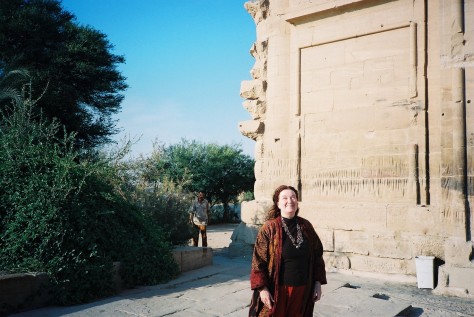
All posts by amclaughlin2014

Member of Community of Grey Sisters of Pembroke; Masters Degree in Religious Communication, Loyola University, Chicago; Author: Called to Egypt on the Back of the Wind (2013) Planted in the Sky (2006) both published by Borealis Press, Ottawa Canada www.borealispress.com Retreat facilitator: The Wooing of the Soul (2013) The Sophia Salons, beginning in February 2016, offer journeys to one's own inner wisdom for small groups of women. For information: amclaughlin@sympatico.ca

Sophia in Egypt: Six

On the morning following our visit to Abu Simbel, we board our ship, the Moon Goddess, which will carry us from Aswan to Luxor, stopping at temples and sacred sites on the way. The first night on board, I sit on the small deck that opens off my bedroom, gazing out at the Nile shimmering under the darkening sky, reflecting on the wonders of the past days, writing in my journal. I feel as though I am swimming in love. I sleep early, to prepare for our early morning wake up call, our journey to Philae Island, sacred to Isis.

The moon in her fullness creates a golden rippled path on the Nile at four in the morning. It is not yet dawn when we disembark, stepping onto the island. The terrain is of rough stones. I have a sense of hovering trees, low full-leaved bushes, great stone arches, pillars, columns, temples, more Greek than Egyptian. We move carefully in the darkness, following Jean into one of the vast stone temples, towards its sacred heart. A cat has shown up, leads us straight to the entrance, waits as each one enters.

“We know that we are well seen and well blessed,” Jean says. “So often the holy ones show up in the form of the animal.”

The sanctuary of Isis is so tiny that we stand together like people in an elevator. Within this chamber, at the centre and towards the back, there is a stone pedestal, incised with hieroglyphs. This is where the sacred boat of the goddess Isis once rested. The surrounding walls are intricately carved with hieroglyphs as well. I see a delicate fan of outspread wings, recognize the curve and grace as just what I saw on the papyrus of the winged Isis I bought in Cairo. I see on another part of the wall a snake, and then a hawk that is the symbol of Horus, son of Isis and Osiris. I look at the outpouring of carefully inscribed wisdom, feel something of the powerlessness, the utter frustration I felt as child before I knew how to read.

In the still darkness, Jean speaks of the writings of the second century Latin writer Lucius Apuleius. “In his story, The Golden Ass, Lucius has done some very naughty magic and has been turned into an ass. After strange adventures, he meets the goddess Isis who changes him back into his own humanity, but does so by giving an epiphany of who and what she really is.

“Here is how Lucius saw her: she had an abundance of hair that fell gently in dispersed ringlets upon the divine neck. A crown of interlaced wreaths and varying flowers rested upon her head; and in its midst, just over the brow, there hung a plain circlet resembling a mirror or rather a miniature moon – for it emitted a soft clear light. This ornament was supported on either side by vipers that rose from the furrows of the Earth; and above it blades of grain were disposed. Her garment, dyed many colours, was woven of fine flax. One part was gleaming white; another was yellow as the crocus; another was flamboyant with the red of roses.

But what obsessed my gazing eyes by far the most was her pitch-black cloak that shone with a dark glow. It was wrapped around her, passing from under the right arm over the left shoulder and fastened with a knot like the boss of a shield. Part of it fell down in pleated folds and swayed gracefully with a knotted fringe along the hem. Upon the embroidered edges and over the whole surface sprinkled stars were burning; and in the centre a mid-month moon breathed forth her floating beams. Lastly, a garland wholly composed of every kind of fruit and flower clung of its own accord to the fluttering border of that splendid robe.

Such was the goddess as, breathing forth the spices of pleasant Arabia, she condescended with her divine voice to address me: “Behold, Lucius,” she said, “moved by your prayer I come to you – I , the natural mother of all life, the mistress of the elements, the first child of time, the supreme divinity, the queen of those in hell, the first among those in Heaven, the uniform manifestation of all gods and goddesses– I who govern by my nod the crests of light in the sky, the purifying wafts of the ocean, and the lamentable silences of hell – I, whose single godhead is venerated all over the earth under manifold forms, varying rites, and changing names….

“But those who are enlightened by the earliest rays of that divinity the sun, the Ethiopians, the Arii, and the Egyptians who excel in antique lore, all worship me with their ancestral ceremonies and call me by my true name, Queen Isis.

“Behold, I am come to you in your calamity. I am come with solace and aid. Away then with tears. Cease to moan. Send sorrow packing. Soon through my providence shall the sun of your salvation rise. Hearken therefore with care unto what I bid. Eternal (spirituality) has dedicated to me the day which will be born from the womb of this present darkness.”

“The day which will be born from the womb of this present darkness,” Jean repeats. “This is the place of the birth of new hope, this is the place of the birthing of new life.”

We are invited to call out all the names of Isis as we know her. I hear the names flow like a litany….Mystical Rose, Mary in all her forms, Queen of Heaven and Earth, Queen of Creation, Great Protector, Mother Holy, Star of the Sea, Great Protector, Eyes of Wisdom, Neter of the Heart, Mama Mia, Great Mother Gaia, Inanna, Tower of Ivory, Sophia, the Black Madonna….

This outpouring of names concludes with the title: “She who calls out to us to be born.”

We cry out together a great OMMMMMMM.

“That sound was like one great voice,” Samei our guide tells us when we emerge. But he looks troubled. “I am sorry. I made a mistake. I never should have allowed your full group to enter at the same time. That chamber is much too small to hold so many people at once.”

But it did.
 

Sophia in Egypt : Five

On the day after our visit to the Step Pyramid, we fly from Cairo to Aswan. A long bus journey through the desert will take us to the Temple of Abu Simbel.

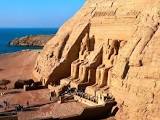
We arrive at Abu Simbel in full darkness, walk the lighted pathway from the entrance in silence, approaching from behind. I try to imagine this massive structure being totally dis-assembled on its original site, where it had been carved out of a mountain in the time of Ramses II.

images-of-abu-simbel

Temple of Abu Simbel

It was meticulously re-assembled, block by block, on a concrete frame, moved here in the 1960’s to save it from being inundated in the flooding caused by the Aswan Dam. The UNESCO project was generously funded by England and Germany, the reconstruction so exact that the rising sun on February 22 and October 22 still lights the faces of the four great statues within.

Inside, we see high walls and many chambers, well-lighted with raised floors for ease of walking. No formal rituals are planned for us within this temple. Instead we are free to wander, to take in the majesty, the stunning beauty of the artwork, the ancient stories on the walls around us. Our group is alone here, so we have silence, space to wander contemplatively.

I recognize the story of Ramses’ life in a set of painted carvings that take up the length of the walls of the main chamber. In one a chariot is pulled by an open-mouthed horse, the carving so precise I can see it breathing.

After a careful search, I find a carving of Isis in a small chamber. She stands with an arm on the shoulder of Osiris, while she holds in her other hand an ankh, the symbol of everlasting life.

I continue to explore the painted carvings in the many chambers. Again and again, I am drawn back to Isis, waiting. I do not know what I seek from her, what I expect. Maybe I just want to make a connection here with the sacred encounter I had with her in my community’s prayer room in September. When I return for the third time, I notice that there is a crack in the stone just where her eye appears and it holds light, so that I feel her gaze upon me.

“You remember,” I say to her. Sudden warmth fills my whole body. The words from the ritual I had performed on that day return to me: Know yourself…to have been recognized, honoured, and gifted by that principle of creativity, kindness and renewal that sometimes goes under the name of the Great Goddess.

Though no time has been set, people are beginning to move out of the temple towards the outdoor amphitheater that faces it. There is to be a sound and light show on the life and exploits of Ramses II. My companions and I choose a place together in the rows of stone benches facing the gigantic seated figures on the facade, to await the show.Thunderous music, voices, as a great story unfolds before us, light dancing on the face of stone. At some point, off to our right, a shooting star descends through the black Egyptian sky.

When the show ends, we make our way down the stone stairs towards the path that leads away. But suddenly a thousand flames of light erupt in the facade of the temple. Lights everywhere, subtle, creating shadowed mystery, illumining here a face, there a cleft. I stand awestruck before this, unable to move away. I try to assess the size of this monumental temple, comparing it with other large structures. I see it swallowing the centre block of Canada’s Parliament Buildings, burping, opening its mouth for more.


Finally I pull myself away, seeing the last of our group disappearing into the distance. Just before I enter the paved pathway, I stoop down, pick up a stone from the sand. In the light from the temple, I see it has the rough shape of a heart, although one of the rounded curves at its top is sliced open, releasing love.

In the few days we have been in Egypt, I have lost my inner sense of clock time. We have been hours here at Abu Simbel and it was already fully dark when we arrived. Yet we are now on our way to supper.

The bus stops before a small inn. Our hosts graciously allow us to use the bathroom in their own living quarters. We are shown to tables on an outdoor patio under the Nubian sky alive with stars. I recognize Cassiopeia, Orion and Sirius. The air embraces us, warm as our own breath.

Platters of food begin to arrive: a flavour-filled soup, bread and cumin dips, eggplant, fish stew, a sweet dessert. A carafe of red wine is poured into our cups. It is full-bodied, delicious and, Jean assures us, the true Egyptian vintage of ancient days. In this setting, with joy rising, visible on every face around our table, I am ready to believe that Isis and Osiris planted the vines.

Sophia in Egypt: Four

The next day our tour bus takes us to Saqqara on the West Bank of the Nile, about 18 miles south of Cairo. We walk over sand fields to see Old Kingdom Pyramids, some looking now like haphazard piles of stones. It is furnace-hot and we are reminded to drink lots of water.

We emerge from exploring a tomb, its walls alive with colourful scenes from the life of Mereruka, the man buried there. The sun is a cylinder of fire against a distant pyramid, then a copper coin in the darkening sky, as the earth rolls eastwards. By the time we reach the Step Pyramid, it is fully dark, and a pale moon is gathering her energy to light our way. I see a few faint stars, but do not recognize any constellations.

Our group gathers in silence before the entrance to the Step Pyramid, some five to six thousand years old, the first route of initiation in the ancient Egyptian Mystery Rites. In a rush of awareness, our reason for being in Egypt fills me. I am fully here.

With Jean Houston leading the way, we enter a long narrow passageway with tall pillars and a high roof. To our left and right, deep arches open out to the night, like the side altars in a cathedral. The wind is rising, stirring the air through which we walk, creating a pleasant coolness after the day’s heat. I reach into my backpack, pull out my shawl, glad of its warmth. I am aware of the burden of backpack, purse, water bottle, camera… items no ancient initiate would have carried. Ahead of us, Jean is emerging from the passageway, calling out to the ancient ones: Open yourselves to us as we open to you.

We are in an inner courtyard, already dusky in the failing light. Across an expanse of sand, the Step Pyramid huddles against the sky, a black shape, a mythic beast, a cave of unknowing, awaiting us. The doorway is narrow, and we enter single file.

step-pyramid

The Step Pyramid

Inside we walk along a corridor, stone walls and ceilings strengthened against calamitous collapse with steel bars, structures of wood. Here and there electric lights bless the darkness. We walk in silence, with great care, aware of danger.

Ahead, Jean is waiting for us at the edge of a sheer drop. One by one we are invited to look down. I stand at the edge, unprotected by any kind of barrier, leaning forward in order to see all the way down, some three or four stories, to the burial chamber. The cavernous darkness is unrelieved by any artificial light except that which seeps down from the high place where we stand.

I am looking into a walled chamber, the stone darkened by millennia of dampness, to the small stone floor where once Djoser’s body rested. I see only emptiness, an emptiness that is in its way more disturbing than seeing what belongs there. I see all of this in a glance, realize a glance is all I want.

 “Deep are the wells in our minds, our hearts, our being,” Jean says. “ Here we are in the land of depth, here in the oldest architectural structure known to humankind. There are many, many tunnels that bridge from here, three miles of tunnels in this the principal, first route of initiation.

“We think of so many things in which and to which we require initiation. For many of you the initiation is into new life, into new ways of being, into the emerging of what is possibly the end of times but it is also the opening time. Here in this ancient place which was the annunciation of the prophetic moment, is the annunciation that we have entered into a whole new order of civilization.

“Let us take it in our hearts that from this moment forth, from this primordial place, this great sacred mound, from which the genius of Imhotep emerged to create a structure that would be known from time out of mind, from this place of initiation, this place from which a great, great civilization grew … that this is the place from which we affirm, we say, we heartfully know that a great world civilization will begin again.We are in the ending times, we are in the closing times, we are in the opening times.

“Let us speak aloud the words of ancient Egypt: SA the creative breath of life, infusion of new life, energy, inspiration; SEKHEM the creative word of power, that can move in all of us so that we can take the fullness of our creative power into the world; SAHU the perfectly realized being within, the essence who holds the measuring, who holds the beginning and the end and the new beginning, that holds the love that moves the sun and all the stars, that creates the entrance to new life, the energy to be a vehicle of the patterning.”

We reach out to touch one another lightly, as might astronauts about to step out onto the moon.

“The new begins now,” Jean says. “The new that Teilhard de Chardin saw: The day will come when after harnessing space, the winds, tides and gravitation, we shall harness for God the energies of love. And on that day, for the second time in the history of the world, we shall have discovered fire.”                                                                                                                                        


We are again in the large sand covered courtyard, now in full darkness. Each of us is offered a candle, already lighted, to guide our way back. We are walking slowly, looking up to where the night sky is alive with stars. I am stunned at the beauty, seeing patterns as ancient as the universe, as new as my own breath.


As we enter the corridor of pillars, tears well up in my eyes, fall freely. An inner wave of emotion surges though my body, as the encounter with the Sacred Feminine in my community’s prayer room two months earlier takes on deeper meaning. I know now I am experiencing a triptych of healing that is a rebirthing: with my mother, with my community, with the Holy Feminine, whoever she is, by whatever name I call her: Mary? Isis? At this sacred moment, names do not matter.

Isis/Sophia in Egypt

I waken to a world of sunlight so strong that I need dark glasses and sun hat for the short walk to breakfast in the Mena House Hotel in Cairo. I pass the sun-soaked turquoise pool that sits like a small lake surrounded by palm trees, flowers in brilliant reds and yellows. I climb the marble stairs to the dining room, find breakfast spread out in silver bowls: pomegranate seeds, grapefruit, yogurt, abundance of muffins, breads, sweet rolls, coffee in silver urns on a long linen-covered


Immediately afterwards, we gather in one of the hotel’s elegant meeting rooms.
An Egyptian man, perhaps in his early fifties, stands at the front of the room. With shy pride he welcomes us to his country. “I am Mohamed Nazmy”, he says “and my company, Quest Travel, is making the arrangements for your time in Egypt. I know what it is you seek. I have been in communication with your teacher Dr. Jean Houston for several months, preplanning as much as we could, waiting for the time to be right for this sacred journey. My company guides only people like you who seek the spiritual heart of Egypt. But this,” and suddenly his shyness dissipates as a smile like a rising sun irradiates his face, “this will be our greatest challenge, and our deepest joy. Samei, though young, is an experienced and learned travel guide. He will go with you everywhere your journey takes you. I will accompany you when possible, and shall be in constant communication with Samei.

“I do not need to tell you that some of the places you will enter are dangerous, some carefully guarded. As far as possible, I am making arrangements for your group to have private visits inside the tombs, temples and pyramids to allow for the teaching and rituals that are part of your journey.” He pauses, then adds, “the only solitary visit I cannot arrange is to the Valley of the Kings where each day this month, the number of tourists will exceed ten thousand.” With a gracious wish for a safe and blessed journey, he concludes his talk, turns to speak quietly with Jean.


We return to the chairs at the front of the room and Jean introduces the guest who has come to speak to us this morning. “You’ve seen him on the Discovery Channel and on National Geographic Programs. He’s Egypt’s Minister of Antiquities, passionate about receiving, rescuing, restoring and retaining its ancient treasures. His ongoing archaeological work has earned him world-wide recognition and we can thank Mohamed, his close friend, for arranging this presentation by Dr. Zahi Hawass.”


“They call me the Indiana Jones of Egypt,” Dr. Hawass says, with a boyish grin. “They even say I wear an Indiana Jones hat, but the truth is that Indiana Jones wears a Zahi Hawass hat.”

With a power point he takes us with him as he is lowered by a rope into cavernous depths. “What did I find there?” he asks. “Not the wonderful things of Howard Carter’s experience in the tomb of King Tut, but the dung of centuries.”

These days, he’s working with a grant to study DNA from ancient mummies, seeking to trace relationships among King Tut, Hatshepsut, Nefertiti. He’s also excavating in the Valley of the Kings and seeking the burial site of Anthony and Cleopatra. He radiates joy and the passion of his commitment to work he loves. “With passion, any job can be the best in the world,” Dr. Hawass says.


“Egypt is a state of being that exists eternally in archetypal reality.” Dr. Hawass has gone, and Jean Houston is speaking to us now. “It is a quality of the psyche, of the intelligence, existing on the space/time continuum. Five thousand years ago, the essence of possibility entered into time”.


The magic has begun. I breathe in these words, not fully understanding, but knowing at a deep level their truth. This will be a journey of discovery even more enticing than those of Dr. Hawass.


“When in the thirteenth century St. Francis of Assisi visited Egypt, he sat with the Sultan in silence for hours before the Sphinx. At last Francis said, I know the answer. It is love.

“Now you are here as archaeologists of Egypt’s ancient spirit. We shall visit powerful sites, seeking matrix points for a world civilization, a world spirit. As the Ancient Egyptians dreamed a world, we shall, by use of imagination, bring forth a new reality that wants to emerge. We shall collect the broken pieces of our world and gather them into wholeness, as did Isis with the broken body of Osiris.

“And just as Hatshepsut restored the ruined temple of Hathor and created ceremonies of the Feasts of Light, we shall inaugurate ceremonies on behalf of our Temple of Earth.”

I listen intently, believing this to be possible, seeing it as absolutely achievable. It doesn’t occur to me then that a personal descent into cavernous inner places holding dung and wonderful things in equal measure, will be required of me.

“For today, you may be tourists”. Jean is saying now. “Samei will take you to a papyrus factory, then to some of the shops. After supper we’ll see the Egyptian Museum. Enjoy Cairo!”

In the papyrus factory store, we watch the process as papyrus stems are soaked, then soaped and placed under pressure to create paper. Young Muslim women wearing hijabs smilingly show us around the room’s collection of illustrated papyri.


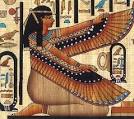
Hampered by my lack of Arabic (I am able thus far only to say “Shokran”, “thank you,”) I manage to convey to one of the young women that I am seeking a painting of Isis. After some searching, some reading of identifying hieroglyphs, the young store clerk smiles brilliantly, places a richly-painted papyrus of Isis in my hands. I take in the rich midnight blue of her robe, the throne-shaped silver crown on her head, the breadth of wing span in silver and gold beneath her arms, the mystery of the many-hued hieroglyphs of bird, snake, woman, throne, carefully arranged above beside and below her. I hand it back to the young woman who carefully rolls it, inserts it into a cardboard tube, then returns it to me. I am in awe at this beautiful treasure I now carry.

image of goddess Isis

Isis, with whom I began my journey two months earlier in a darkened room at my community’s retreat centre. ( to be continued)

from Called to Egypt on the Back of the Wind by Anne Kathleen McLaughlin Borealis Press 2013  (http://borealispress.com)

Sophia in Egypt


Part Three

That evening, as they share their meal, she looks carefully at her Sister companions, listens to the stories they tell of nieces and nephews, of work projects. She no longer expects them to understand her project, her summer journey, but she is comforted by the talk they share.


This is the pattern for the three months of her exile. The book opens at her touch, draws her inside where the story continues. She learns that for the Ancient Egyptians, life exists at once on several planes, and time is both clock time and lasting time. In the durative realm, she may visit events that occur in other times.

f1000002

One day, wandering like Isis, she comes in her Ka spirit to the place where shepherd children met the Virgin Mary in 1917, in Fatima, Portugal. She stands and watches as the story, familiar to her since her childhood, unfolds. She sees the light on the children’s faces, sees the solemn kindly being who greets them. She waits until the being looks finally at her. Then she asks what she must ask this Holy One: “Who are you?”

The radiant being smiles and says, “You know who I am.”

Isis brings Osiris to life
and conceives of him their child Horus.
But Seth captures Osiris
and hacks his body into fourteen pieces.
These he hurls into the Nile.
Isis and Nephthys together,
helped by the creatures of the river,
regather the scattered pieces of Osiris.
He goes to rest in the underworld, where he reigns as King.


The woman sees that the scattered pieces of her life are being sought out and rejoined in this mysterious adventure. She gives her trust to the journey, to its guide. For a long while now she has been aware that this guide is not the book’s author. She names her Isis, and strange though the name feels upon her lips, she is at home with this guiding presence who has known her, it seems, forever. Isis gives the woman new names for her body (companion), her mind (weaver), her emotions (seeker) and her spirit (Christa).


In a dream, Osiris instructs his son,
now grown to manhood, to defeat Seth.
A terrible battle rages for eighty years.
Horus wins, but Isis insists
that he not destroy Seth.
Horus is enraged and pulls
his mother’s crown from her head.
After a time, Horus gains wisdom.
He turns his heart to his mother
and recrowns her Queen of Earth and Heaven.


The room holds the darkness gently, and the darkness holds the woman. The days of her exile have almost ended, and she has come to the room where many years earlier she had sat as a young novice. The room is now a place of silent prayer and it watches her as she stands alone, holding in her outstretched hands a crown of mithril silver laced with emerald.


In her Ka, her spirit, she recrowns Isis.


She waits, knowing a gift will be offered in return. But at once she is overcome by shame. All her life she has been seeker, all her life she has been asking.


“Don’t give,” she says to the Holy presence. “Take something instead.” She doesn’t know where these words, this desire, have come from. “Take away this great emptiness that has made me a beggar of love for all my life.”


Even as she asks, she is afraid, for without this need, this longing, what would draw her to the Holy?


The fear dissolves in what is happening. She is being regifted in her birth. She is gushing forth, being presented to her mother, her mother who had been so afraid. But now another is there, pouring her love into child and mother both. And the woman thinks, “She is there in my birth blood. I am born into love and must ever now have more love than I can bear. I must give it as a mother with full aching breasts.”


The room yawns, believing nothing has happened.


A few days later, the woman, living once more in ordinary time, is visiting the city when a street woman approaches, begging. Grudgingly, she opens her purse, takes out a bill. Then for the first time she looks into the eyes of the other woman.


With no clear knowledge of what she will do or say, she embraces the street woman, holds her close and says, “Your life is so beautiful. Please, please take care of yourself.”
The street woman hugs her back. Both are startled. Then the woman who spent the summer lost in a book feels an astonished delight. Something wonderful has been born.


I have given you over recent weeks this three-part story,  first written under the title, “Portal to Egypt”. The very day I completed the final edit, I received a phone call. Beyond hope, beyond even my dreams, I learned that a place had opened on the waiting list, that I would now be travelling to Egypt. In fact, almost immediately.

Nine days later I emerged from the Cairo Airport with the companions who would, with me, and guided by Jean Houston, spend eighteen days in the heart of Egypt. On our visits to tombs, pyramids and sacred sites we were often the only group present, allowing Jean to teach us, guide us, lead us in a stunning experience of the myths, the spirituality, the rituals of ancient Egypt.

You may read of the whole journey in my book Called to Egypt on the Back of the Wind (Borealis Press, Ottawa, Canada, 2014)   http://borealispress.com    Anne Kathleen McLaughlin   

f1000003

Sophia in Egypt

(Continued from last week…)

After the rapture of sunrise, she goes indoors, makes coffee, hurries to her room, climbs back into the book.

She is once again in the story circle. She arranges herself on the cushion, smiles at her guide already seated beside her, and turns again to the storyteller.
Ra, the firstborn, burns with jealousy.
He decrees that no child may come forth
from the womb of Nut on any day of his year.
The Sky writhes in torment,
her full belly unable to release life.
In her womb, Isis and Osiris become lovers,
Seth rages, Horus, the twice-born,
and their dark sister Nephthys wait.
Wise Thoth challenges Ra to a game of checkers.
Skillfully, the moon wins bits of light
until he has five days.
On each of these days, Mother Sky gives birth.

The guide gestures towards another room. “It is the place before time and beyond time. Go inside and look at your life as it was before your birth, and as it is now.”

The woman goes inside, allows herself to be taken into no time. The formless loneliness that fills her has been with her all her life. It has led her to seek love in many places, led her to become one of a community of women. In this timeless realm, she finds herself in the womb of Nut, waiting to be reborn. It is a comfort, though she cannot think why it should be.


From far away a bell startles her, breaks into her thoughts, and she finds herself again in the community residence. The light suggests early evening, time for supper with the others who live here. She has no idea what she will say should they ask her how she spent the afternoon.


That night the woman dreams she is held in an embrace of love more tender than any she has known. She wakens glad, eats a hurried breakfast and steps back into the book.

Isis and Osiris travel across Egypt giving gifts.
Osiris teaches the secrets of the Nile,
the taming of cattle, the planting of seed,
the guiding of the plough.
At night he plays his reed pipe,
enchanting the people with the songs of Mother Sky.
Isis teaches the women the moon’s cycles,
the shapes of the stars,
the rhythms of the seasons.
She dances with them under the moon’s soft light.
In Ra’s light, she teaches them to weave,
to transform flax to thread, thread to linen.
She gives them the song of the wheel.
She loves them into beauty.


When they are alone again, the guide tells her it is time to learn the secret lore of the ancient Egyptians. She teaches her the skill of placing her spirit, her Ka, in an imaginary way in a tree or a bird, then looking back at the self through wise eyes.


The woman places her thought in a mountain she has loved, and imagines the mountain gazing at her, seeing her power for movement and speech, for singing and dancing, for growth and change, gifts the mountain does not possess. Through that ancient gaze, the woman sees how wasteful she is of her immense possibilities, her capacity for fulness of life, how she is always seeking and discontent. It seems the mountain looks on her with compassion, and says, “Just rest for awhile and enjoy the beauty.”

P1000637

The woman learns to make simple hieroglyphs, pictures that carry levels of meaning. She shapes a message: I alone in nature sense the Holy. The Holy embraces me with love. Again alone beside a tree I weep for loss. The Holy returns. A bird sings. I know I am not alone in nature. The woman smiles at the childish drawings that have just told her the story of her life.

When they next return to the room of storytelling, the luminous days of the reign of Isis and Osiris are ending.

Seth rages at the lovers.
From gold and precious gems, he crafts a coffin
and tricks Osiris into lying in it.
He seals the coffin and hurls it into the Nile.
Isis cuts her hair, disguises herself as a beggar
and sets out to search for her husband.
In the far land of Byblos,
the coffin has been caught in a tamarisk tree.
Magically, the tree grows around it.
So great is this wonder that the King
takes it as a pillar for his great hall.
Weary and worn, no longer beautiful,
Isis comes at last to the King’s Hall.
She enters by the back door,
asks to be a servant,
to care for the children of the King.
Her love wins her the release of the coffin
from the pillar of tamarisk.


A touch on her arm from her guide and they leave the story room. “Today you must find the places in your story where you have been seeking a lost beloved,” she tells her. “I’m going to take you into a larger room where you may walk, dance if you like, and let the memories return. Don’t be afraid.”

The woman is neither afraid nor expectant. In her long search for understanding, she has often visited the place of memory. But the memory that comes is one buried in the dust of forgetfulness.

She is a high school student, perhaps thirteen. On her way home from school, she has come to pray in the large stone Church. It is cool and quiet here. She likes it. Sometimes she walks around the Church praying at each of the carved scenes that tell the story of the sufferings and death of Jesus. She likes to think of how much he must love her, to go through all that for her.

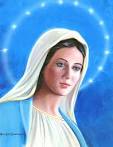
Mary


But today she happens to look at the marble statue of the Virgin Mary. That word virgin sounds as cold to her as the marble from which the image was carved. She shivers a bit and looks away. On the bench beside her, someone has left a prayer book. She glances at an open page, sees the words, “I am your mother, Mary”. If the marble statue had broken open to show her a beating human heart, the effect would not have been any more powerful.

Encounter with Sophia in Egypt

It is nearly two years since I began to write these weekly blogs about the Awakening of Sophia, the Sacred Feminine Presence. This awakening is happening in many different ways, in many different places around our planet, among people of many religious backgrounds as well as people who have no connection with any formal religion. The awakening is pervasive, subtle, invitational, gentle, powerful, loving, alluring… it slips the bonds of theology, psychology, sociology. It is too elusive for formal religions to catch hold of it, to define or tame it.


Yet for those who open their hearts to its call, for those who listen with trust, who begin to follow its gentle guidance, its winding pathways, this awakening is blossoming into a relationship of loving, co-creative partnership with a Sacred Presence. This presence has been known on our Earth for Millennia. Though she was forgotten for a time, she is returning in our time because we need her and she needs us. Her Time is Now.


Joseph Campbell, writing of the presence the Sacred Feminine, notes that:
By the time of the birth of Christ, there was an exchange, not only of goods, but also of beliefs, throughout the civilized world. The principal shrine of the Goddess at that time in the world of the Near East was Ephesus, now in Turkey, where her name and form were of Artemis; and it was there, in that city, in the Year of our Lord 431, that Mary was declared to be what the Goddess had been from before the first tick of time: Theotokos (Mother of God).

Campbell adds this compelling question:

And is it likely, do you think, after all her years and millennia of changing forms and conditions, that she is now unable to let her daughters know who they are? (in Goddesses :“Mysteries of the Feminine Divine” p. xxvi; Copyright Joseph Campbell Foundation, New World Library, Novato Calif. 2013)

It is time now for me to begin to share with you my own journey with this Sacred Feminine Presence. The startling overture came by way of a Journey to Egypt. Here is the story:

It is night. It is always night when a story is told. But this night is part of the story, envelops and transforms it, embraces the ending.

The room holds the darkness gently, the darkness holds the woman. The room watches her as she stands alone, holding in her outstretched hands a crown of mithril silver laced with emerald. The woman bows before the image of Isis, then places the crown on the head of the Queen of Earth and Heaven. The room does not see Isis or the silver shimmer of the crown. It sees only the woman. It has seen so many others come and go. The room sighs, feeling bored, unaware of the story, unimpressed with its quiet ending.


image of goddess Isis

image of the Goddess Isis

To find the beginning, leave the dark room, go back three months, take the stairway to the left. On the second floor, follow the corridor signed “Sisters’ Residence”. Halfway along, on the left side, enter the room where a woman sits alone. It is years, decades, since she has lived in her community’s central house. The days and weeks before she can return to her quiet house by the river stretch before her like a featureless desert.


“I need an adventure,” she says aloud, and before the words have ceased to bounce in the room’s quiet, her eyes have found what she needs. On the shelf above her writing desk, sitting among the dozen volumes she has brought with her, is a book about Ancient Egypt, written by her guide and teacher, Jean Houston: The Passion of Isis and Osiris: Gateway to Transcendent Love . The woman reaches for the book, surprised by its weight in her hand, opens it. There is a soft sucking noise as all the air in the room vanishes and the light disappears.


The passageway is dark, the air thick with dust and something much older. The woman is aware of the need for caution, but she feels no fear. Someone is walking beside her and though she cannot see the face, she knows the voice of her guide who whispers, “Hurry. The storyteller is waiting.”


Amber light draws them forward into a small cave-like room. Some dozen others, children, women and men, are seated in a circle around a wizened woman robed entirely in red. The old one smiles as they enter, gesturing towards cushions on the floor.

The storyteller lifts her head, closes her eyes and begins to speak in a voice both intimate and eons away, as though she is reading a story painted on the walls of a royal tomb in Ancient Egypt. Her words fall like bright jewels upon the room’s silence.

There is at first only One, Atum, the Perfect One.
But Atum is lonely, and creates the story.
Atum makes Air and Wetness, Earth and Sky.
Geb, the Earth and Nut, the Sky become lovers.
Nut gives birth to Ra, the sun
and Thoth, the silver moon.

The guide whispers that they must leave now. “Write down all that you saw and heard and understood. In the morning, go outside while it is still dark. You must see the sunrise.”
Then she is gone and the woman steps out of the book, back to her room.


Next morning, the sky is still black as the woman walks outside. A suffused light swallows the darkness. The woman feels both expectant and unsure, as people must have felt as they waited for the dawn millennia ago. It has come before, but can she be certain it will come again? Light is embracing the earth, drawing trees, low bushes, the tall flowers into silhouette. Earth herself waits, as the woman waits, hopeful, patient. And then it comes, a sliver of fire in the eastern sky, a vermillion burning. The woman and the earth together move under its passionate presence. It fills their gaze with rose red rapture. This is Holy, the woman thinks, for the first time. She looks around the mist-soaked morning and wonders how anyone could despair, as she herself so often does.

images

She goes indoors, makes coffee, hurries to her room, climbs back into the book.

(to be continued)

Sophia: Her Design in the Universe

Last week, we saw

Sophia/Wisdom (as) the divine order patterning all creation,
from the ancient oceans to this morning’s dew.

Ever since we humans gazed, astonished, at the stars, we have intuited a pattern in the Universe. We have wondered at the pattern maker for eons of time. Have we understood that there is Love within every aspect of this many-faceted reality?

English poet-mystic Edwina Gately speaks of this:

They stretched beyond my sight —

millions of tiny pebbles,

broken stones, and smooth rocks

thrown together,

heaped, it seemed,

in careless huddles,

then washed apart

and rushed into new places

to nudge against

other, different shapes,

falling together

in patterns ever changing.

But over all,

in never-ceasing constancy,

flowed the great water,

drenching and shifting

great and small,

stretching out

in wondrous unfolding

of Wisdom’s great design. 

(Growing into God, Sheed and Ward, Franklin Wisconsin, 2000 p.38.)

Do we experience that great water of Wisdom flowing over the smooth rocks, the pebbles, the broken stones of our lives, forming fresh new patterns? When we dare to name the pattern-maker Sophia, when we come to know her as Wisdom in the Universe, we experience her loving guidance in the small everyday moments of our lives. We sense that we are held in a tenderness that can be, at times, overwhelming.

Joyce Rupp, in her Prayers to Sophia (Innisfree Press, Philadelphia, 2000) writes of knowing and living within the awareness of Sophia’s guidance:

Trusted Guide,

you are my Mentor, my Inspiration,

my Home of good choices and decisions.

You help me to search with confidence

as I find my way to inner peace.

Please gather your wisdom around me.

Guide me carefully as I make choices

about how to use my energy positively.

Place your discerning touch on my mind

so that I will think clearly.

Place your loving fingers on my heart

so I will be more fully attentive

to what is really of value.

Teach me how to hear your voice,

to be aware of what is in my mind and heart,

to attend to your wisdom in those around me,

to acknowledge my intuitions and ponder my dreams,

to listen to earth and all of life,

for in each piece of my existence you are guiding me.

Guide of my life,

thank you for all you have given to me.

Reveal my spiritual path 

and direct me in the living of it.

Lead me to inner peace and oneness with you.

Joyce Rupp invites us to reflect on Sophia’s guidance in our lives:

Search your present life situation. Where is it that you most need Sophia’s Guidance?”

Go to Sophia. Find her sitting in her chair of wisdom. Ask her to lead and direct you.”

Receive her wisdom.”

Sophia’s Presence in the Universe

In recent weeks, we have been reflecting upon the Powers of the Universe
as they have been described in Brian Swimme’s teachings: allurement and emergence,
cataclysm, synergy, transmutation, transformation… In the Hebrew Scriptures Sophia speaks of being present in the very beginning of the Universe,  an inherent part of the whole amazing story of its unfolding.

In the Book of Proverbs we read:

(Sophia/Wisdom) is the divine order patterning all creation,
from the ancient oceans to this morning’s dew.

In the song-prayer “Ancient Love” composed by Carolyn McDade, we find a
beautiful tribute to the Sacred Feminine Presence in the Universe:

Long before the night was born from darkness
Long before the dawn rolled unsteady from fire
Long before She wrapped her scarlet arm around the hills
There was a love, this ancient love was born.

Long before the grass spotted green the bare hillside
Long before a wing unfolded to wind
Long before She wrapped her long blue arm around the sea
There was a love, this ancient love was born.

Long before a chain was forged from the hillside
Long before a voice uttered freedom’s cry
Long before She wrapped her bleeding arms around a child
There was a love, this ancient love was born.

Long before the name of a God was spoken
Long before a cross was nailed from a tree
Long before She laid her arm of colours ‘cross the sky
There was a love, this ancient love was born.

Wakeful our night, slumbers our morning
Stubborn the grass sowing green wounded hills
As we wrap our healing arms to hold what her arms held
This ancient love, this aching love, rolls on.

T
And in this meditation written by Bridget Mary Meehan, we find an invitation to embrace this loving presence of Sophia, to make space for her within our lives:

I therefore determined to take Sophia to share my life,
knowing she would be my counsellor in prosperity,
my comfort in cares and sorrow…
When I go home I shall take my ease with her,
for nothing is bitter in her company,
when life is shared with her, there is no pain,
gladness only, and joy.

(Book of Wisdom, Chapter 8)

“Take a deep breath, as if you were breathing through your toes
and let your breath be carried up through your feet, legs,
abdomen, lungs, mouth, nose – your entire body.

“As you breathe in, say silently, ‘Sophia’ while taking in
whatever you need from Sophia: wisdom, knowledge,
strength, joy, courage, comfort, peace, love….

“Do you remember a time when you felt whole?
… peaceful?…strong? … joyful? …loving?…

“Do you remember a time when you felt alienated? …
broken?…hurt?…angry?
lonely?… guilty?…

“How did you feel? What was it like? Why were these experiences
significant for you? How have these experiences continued to influence you?

“Did you experience comfort and counsel in any new way because of these experiences?

“Image Sophia, God’s Wisdom, as Counselor, wise guide,
who helps you discover meaning in your experience
and aids you in recognizing these experiences
as important touchstones of your unique spirituality.

“Image Sophia as Comforter who assists you to find
your own identity and strength in the midst of disappointments and sorrows of your life.

“As you reflect on your experiences what insights, feelings, thoughts,
images, memories, sensations, are you conscious of?”

Choose a creative way to record your insights, feelings, thoughts, images, memories, sensations, whether in poetry, art,song, writing, dance or any way you wish.

( Meditation adapted from Bridget Mary Meehan: Exploring the Feminine Face of God

pp 28-9 Sheed and Ward Kansas City Missouri 1991)

Coming to Know Sophia

I have been enchanted in these summer weeks by the book Goddesses:”Mysteries of the Feminine Divine” (New World Library, Novato, California,2013) a compilation of lectures, articles and workshops offered by the late Joseph Campbell, mostly in the 1980’s. In all the richness Campbell offers from ancient mythology throughout time and around the planet, there is but one brief reference to the Hebrew Scriptures, the source book for Muslims, Jews and Christians:


The biblical and  Goddess traditions were radically against each other, and while the biblical has remained the authorized tradition, there has been in European culture this waterway of the living Mother Earth flowing underneath. In the Old Testament, we read in early Genesis: “Remember thou art dust and to dust thou shalt return”. Well, the Earth is not dust, the earth is life, vital, and this intrusive god who comes in late, wanting to take everything over to himself, he denigrates the Earth itself and calls it dust? What he tells you there is, “You really are your mother’s child and you’ll go back to her. She’s nothing but dust, however.” Similarly, you read in Genesis 1:1 , “When God created, the breath (or Spirit) of the Lord brooded over the waters.” It doesn’t say he created the waters. The waters are the Goddess — she was there first.

Turn to Proverbs and there she comes back as the wisdom goddess Sophia, and she says, “When he prepared the heavens, I was there.” She says it. What you have is the same old mythology that the Babylonians and the Sumerians had of two powers, the female and the male power in tension, relationship and creative co-action. But what happened in the Bible was that the male power was anthropomorphized in the form of a man and the female power was reduced to an elemental condition — just water. It says, “God’s breath brooded over the waters.” It doesn’t say the waters of the Goddess, it just says the waters. She’s screened out, but she always comes back. (pp.234-5)

In these words of Joseph Campbell, I find the heart of my work, the inspiration which led me to begin this blog in October of 2014: the intuition that Sophia/ the Divine Feminine Presence is rising in and among us. Her awakening is the underlying theme of all I write.

In her book, Praying with the Women Mystics, (Columba Press, Ireland, 2006) Mary T.Malone offers us a poem in Sophia’s voice, based on Proverbs 8:27-31:

When God established the heavens I, 

Sophia, WomanGod, was there.

When God drew a circle on the face of the deep,

When God assigned to the sea its limit…

When God marked out the foundations of the earth,

There I was beside Him like a master-worker.

And I was daily God’s delight, rejoicing before Him always,

Rejoicing in the inhabited world 

And delighting in the human race. 


Sophia is present within all that lives, the beating heart of the planet. We glimpse “Sophia in Splendour” in this poem of Mary Malone’s, based on Wisdom: 7:26-8:11

For Sophia is the splendour of eternal light
And immaculate mirror of God’s majesty,
And image of God’s goodness…
For she is more beautiful than the sun,
And above all the order of the stars.
Compared with the light, she is found before it…
Therefore she reaches from end to end mightily
And orders all things sweetly.

Jean Houston in her book Godseed  takes us on an imaginal  “Visit to the Sophia”:

After a long spiraling journey upwards, you find yourself at the very top of a high mountain. You go inside the mountain to a path that travels downward in a spiral. Moving along the path down and around within the inner mountain spiral, you pass scenes of your own life, from your earliest infancy. You see or sense yourself being born. Continuing on the path down and around, to your earliest childhood, you see yourself taking your first steps, forming words, reaching out and grasping things, learning to feed yourself. Further down you see yourself learning to tie your own shoes and attending your first days at school. Continuing down, you see yourself learning games and reaching out to other children. As you continue, you see yourself growing up fast and learning many things. You see your adolescence. Further along you observe stages of your life until today………..

Suddenly you find yourself at the very bottom of the inside of the mountain. There you discover a door of baked mud. Going through it, you find that it leads to a hallway and to a door of water. You pass through the door of water, and it leads to a door of fire. You pass through the door of fire, and it leads to a door of winds. You lean against the winds and pass through. This door leads to a door of bronze, and you pass through. This door leads to a door of silver. You pass through the door of silver and find a door of gold.

At the door of gold there is a shining figure who says to you: “Through this door is the Sophia. Through this door is the Wise One herself, the incarnation of Wisdom. When you pass through this door, you will be in the presence of the Sophia. There you must ask your question. You may see her or you may sense her. But know that she is there. She who is Wisdom itself.” When you are in her ambience, whether you see her or hear her or sense her or feel her, ask your question. Her answers may come in words or in images or even in feelings.

You now have four minutes of clock time, equal to all the time you need, to be in the presence of the Sophia and ask your question and receive her answers.

Thanking the Sophia for her wisdom and kindness, and knowing that you can always return to visit her again, begin now to go back through the door of gold, the door of silver, the door of bronze, beyond the doors of winds, of fire, of water, of earth, beyond the spiral of the stages of your own life, reaching the top of the mountain. Now take the spiral path back down from the mountain. Find yourself here in this moment, in the Garden of Iona. Open your eyes, sit up and stretch, and if you wish, write your experiences in a journal or make a drawing or sketch of what you found with the Sophia…