Category Archives: Sacred Feminine

Sophia and Thomas Merton

A mysterious presence introduces herself to us in the Hebrew Scriptures without revealing her name. In the Book of Proverbs, she tells us:

Yahweh created me when his purpose first unfolded,
before the oldest of his works.
From everlasting I was firmly set,
From the beginning, before earth came into being.
The deep was not, when I was born,
there were no springs to gush with water.
Before the mountains were settled,
before the hills, I came to birth;
….
I was by his side, a master craftsman,
delighting him day after day,
ever at play in his presence,
at play everywhere in the world…

Solomon speaks of this presence as “Wisdom”(Hebrew, “Chochma”, Greek, “Sophia”)

Although She is one,
She does all things.
Without leaving Herself
She renews all things.
Generation after generation She slips into holy souls
Making them friends of God, and prophets,
for God loves none more than they who dwell with Wisdom.
(Wisdom of Solomon 7: 27-28)

While in Louisville Kentucky attending the “Festival of Faiths” in late April, a visit to Thomas Merton’s Hermitage on the grounds the Abbey of Gethsemane, reawakened my fascination with this man whose writings reveal him to be poet and prophet, mystic and theologian.

P1010334

Thomas Merton’s Hermitage on the grounds of the Abbey of Gethsemane

Yet Merton remained an alluringly earth-bound human being, passionately engaged with the darkness and suffering of the 1960’s, seeking to create within his own being a wholeness between East and West, Christianity and other faiths, black and white, feminine and masculine aspects of God.

This latter aspect of his life and work was the greatest surprise of my re-enchantment with Merton. It arrived by way of a book: Christopher Pramuk’s Sophia: The Hidden Christ of Thomas Merton (Liturgical Press, Collegeville, Minnesota, 2009)

Today I sat by the river to read the opening chapter of Pramuk’s book. When I began to write, I called this Reflection, “Thomas Merton and Sophia”. But that didn’t seem right. I changed it to “Sophia and Thomas Merton”. Already in Chapter One I had discovered that the initiative in the relationship came from Sophia who “slips into holy souls/ making them friends of God and prophets.”

So how did Sophia slip into Merton’s soul? Pramuk tells us it happened in the final decade of his life, before his sudden death in1968. Sophia came to him in dreams, and in a variety of human presences…

First, there was a dream (February 28, 1958) in which a young Jewish girl named “Proverb” came to embrace him….
She then came to him in the crossroads of a great city ( March 18, 1958)

Of this epiphany Merton would later write:

“In Louisville, at the corner of Fourth and Walnut, in the center of the shopping district, I was suddenly overwhelmed with the realization that I loved all these people. That they were mine and I theirs, that we could not be alien from one another even though we were total strangers…There is no way of telling people that they are all walking around shining like the sun.” (Thomas Merton Conjectures of a Guilty Bystander)

Pramuk continues:
(Sophia) found him again in the burning woods near Gethsesmane (March 19, 1959), this time in the face of local farm children, “poor little Christs with…sweet, sweet voices.” Over a year later (July 2, 1960) on the Feast of the Visitation, she came in the guise of a nurse, whose gentle whispers awakened him one morning as he lay in the hospital.

Merton writes:
“… and it was like awakening for the first time from all the dreams of my life – as if the Blessed Virgin herself, as if Wisdom had awakened me. We do not hear the soft voice, the gentle voice, the feminine voice, the voice of the Mother: yet she speaks everywhere and in everything. Wisdom cries out in the market place — ‘If anyone is little, let him come to me’.”

Pramuk cites two passages in Merton’s Journal in the winter of 1965 that show his nearness to Sophia:
Merton wrote on his fiftieth birthday, January 31, 1965… from Wisdom 8:16: …”When I go home, I shall take my ease with her, for nothing is bitter in her company, when life is shared with her there is no pain, nothing but pleasure and joy.” Though he complains of suffering bitterly from the “fierce cold all night, certainly down to zero,” he expresses joy in the fact that “I woke up in a hermitage!” Then hearkening to the Wisdom text, Merton wonders: “But what more do I seek than this silence, this simplicity, this ‘living together with wisdom?’ For me this is nothing else…”

(February 4, 1965) “Last night I had a curious and moving dream about a “Black Mother.” I was in a place (where? Somewhere I had been as a child…) and I realized that I had come there for a reunion with a Negro foster mother whom I had loved in my childhood. Indeed, I owed, it seemed, my life to her love so that it was she really, and not my natural mother, who had given me life. As if from her hand had come a new life and there she was. Her face was ugly and severe, yet great warmth came from her to me, and we embraced with great love (and I with much gratitude). What I recognized was not her face but the warmth of her embrace and of her heart, so to speak. We danced a little together, I and my Black Mother, and then I had to continue the journey I was on…”

Pramuk comments that what Merton recognized in this dream was the same “presence”, he was striving to recognize in everyone: the warmth of her embrace and of her heart.

… (O)ne of the most striking themes in all these encounters is Merton’s experience of himself as the object of Wisdom’s attention. Her embrace is transitive… breaking in “from her to me,” yet coming in the form of this concrete person or thing before him right now: the flight of an escaping dove, a lone deer feeding among the trees outside the hermitage, the faces of passersby on a busy street corner. For she is “playing in the world, obvious and unseen, playing at all times before the Creator.” (Pramuk: pp.13-16)

images

Thomas Merton and Sophia

While in Louisville Kentucky to attend the “Festival of Faiths” in late April, I had the good fortune to visit the Hermitage in the woods near the Abbey of Gethsemane where  Thomas Merton ( Father Louis) would go for times of solitude and prayer, nature walks and contemplation which nourished his soul and inspired his writings on Spirituality and Justice.

P1010334

Thomas Merton’ s Hermitage in the woods near the Monastery of Gethsemane, Kentucky

Though I knew of Merton’s life and writings, of his fierce cries for Social Justice, his passionate opposition to the Vietnam War, while visiting Gethsemane I learned of a poignant footnote to his life. In December of 1968, Merton had been on a pilgrimage, his quest to integrate insights of both Western and Eastern religious thought. While attending a monastic conference in Bangkok Thailand, Merton died suddenly. His body was transported home to the US in a plane carrying soldiers who had died in the Vietnam war.

But I was to learn something that was of immense importance to my own quest for the Sacred Feminine Presence: Merton had written compellingly of Sophia. I brought home from the Festival of Faiths Christopher Pramuk’s book: Sophia: The Hidden Christ of Thomas Merton (Liturgical Press, Collegeville, Minnesota, 2009)

Pramuk tells of a visit made by Merton to an artist friend, Victor Hammer, in nearby Lexington. Hammer was working on a triptych with a  central panel showing the boy Christ being crowned by a dark-haired woman. When Merton asked his friend who the woman was, the artist replied that he did not yet know. Merton said, “She is Hagia Sophia, Holy Wisdom, who crowns Christ.”

At Hammer’s request, Merton expanded on this insight in a letter written May 14, 1959:

The first thing to be said, of course, is that Hagia Sophia is God Himself. God is not only a Father but a Mother….(T)o ignore this distinction is to lose touch with the fullness of God. This is a very ancient intuition of  reality which goes back to the oldest Oriental thought…. for the “masculine-feminine” relationship is basic to all reality — simply because all reality mirrors the reality of God.

Pramuk continues to quote from this letter where he senses Merton writing in a stream of consciousness as though his friend’s question had opened ” a kind of conceptual and imaginative floodgate”:

Over the next five or six paragraphs, he identifies Sophia as “the dark, nameless Ousia (Being)” of God, not one of the Three Divine Persons, but each “at the same time, are Sophia and manifest her.”  She is “the Tao,the nameless pivot of all being and nature …that which is the smallest and poorest and most humble in all.” She is “the ‘feminine child’ playing before Him at all times, playing in the world.’ (Proverbs 8) ”  Above all, Sophia is unfathomable mercy, made manifest in the world by means of the incarnation, death and resurrection of Jesus Christ.   

Merton identifies Sophia as God’s love and mercy coming to birth in us.”In the sense that God is Love, is Mercy, is Humility, is Hiddenness, He shows Himself to us within ourselves as our own poverty, our own nothingness (which Christ took upon Himself, ordained for this by the Incarnation in the womb of the Virgin) ( the crowning in your picture), and if we receive the humility of God in our hearts, we become able to accept and embrace and love this very poverty which is Himself and His Sophia.” 

(Christopher Pramuk : Sophia: The Hidden Christ of Thomas Merton pp.193-4. Quotes from Merton are from“Witness to Freedom”: The Letters of Thomas Merton in Times of Crisis, ed. William H. Shannon ( New York: Harcourt Brace, 1995)  

In 1962, six years before his death, Merton composed a poem to “Hagia Sophia/ Holy Wisdom” in the form of the Monastic Office, a  Prayer recited in Community to mark the times of day: Dawn: The Hour of Lauds; Early Morning : The Hour of Prime; High Morning; The Hour of Tierce; Sunset: The Hour of Compline.

Here is how Merton’s  Prayer at Dawn begins:

There is in all visible things an invisible fecundity, a dimmed light, a meek namelessness, a hidden wholeness. This mysterious Unity and Integrity is Wisdom, the Mother of all, Natura naturans. There is in all things an inexhaustible sweetness and purity, a silence that is a fount of action and joy. It rises up in wordless gentleness  and flows out to me from the unseen roots of all created being, welcoming me tenderly, saluting me with indescribable humility. This is at once my own being, my own nature, and the Gift of my Creator’s Thought and Art within me, speaking as Hagia Sophia, speaking as my sister, Wisdom.  

I am awakened, I am born again at the voice of this my Sister, sent to me from the depths of the divine fecundity.

P1010324

Icon of Sophia, Holy Wisdom, in Merton’s Hermitage Chapel

Waiting in Darkness


The ancient ritual of the Easter Vigil lures me after an absence of several years. The parish church doors open to invite us into the Phrygian darkness of night. We stand scrunched together at the back, among friends whose faces we cannot see, whose voices we do not hear. Then comes the flaring forth of vermilion flame as the Easter fire is birthed from flint. It could be the flaring forth of light at the dawn of this Universe, the primordial moment that the physicists cannot yet grasp.

26805062_1574000952685967_8259781870951261661_n

The priest uses the new fire to light the great Paschal Candle which stands taller than he does. He intones the ancient chant: three notes rising: “Christ our Light.” From the single flame, the candles held by all who have gathered this night bloom with yellow light, creating a halo that reveals each face. “Christ our Light”.

A cantor sings the “Exultet” the Hymn of Praise to the Risen Christ, echoing the words of Paul: “What good would life have been to us if Christ had not risen?”

Seven Readings follow from the Hebrew Scriptures, telling the old, old tales….

And this is where I begin to feel discomfort. I who love stories, the older the better, find myself rejecting the Genesis account of creation. Once I could overlook its scientific inaccuracies, defend them to others as poetry, not truth. But tonight I am comparing this account with the enchantment of the 13.8 billion year story of the unfolding, evolving, unfinished Universe.

I feel something like revulsion for this strange god who creates man in his own image, adding a woman only for the man’s sake, an after-thought, giving these latecomers dominion over all of life on our planet while forbidding them to eat the fruit of the tree that would give them wisdom.

Finally, pleased with himself, this god decides to take a day off.

When we meet him in the next reading, this god is asking Abraham to make a blood sacrifice of his only son. After the agony he puts the father through (no mention of Sarah, the mother), he says, “I was only testing you…”

As Moses and his people are fleeing from Egypt, this god “covers himself in glory” by drowning a people who were among the wisest who ever lived….

Who is this god?
I do not know him.

Joseph Campbell writes of him as a “local desert god”, a “thunder-hurler”. 1

Indo-European deities encountering warrior gods tended to have their goddesses marry the male gods. Campbell notes that this did not happen among the Semites who ruthlessly obliterated the local goddesses. He points out that a religious tradition with a father god but no mother god is one where we are separate from God, where God is separate from us, from nature. This is a God who is “out there” rather than within us. To find this God we need religious structures, laws, authorities. We are separated from nature, distrusting, even despising our own bodies. Beauty is itself suspect, a distraction, a seduction.

Still in the candle-lit darkness, I am working myself into a state of high dudgeon, wondering why I came, when the tone of the readings alters.

I begin to hear words of undeniable tenderness. I remember why for so many years my favourite biblical passages were the Hebrew prophets who knew, must have experienced, a Presence of Divine Love, what Julian of Norwich calls a Mothering God.

Isaiah invites all who thirst to come to the waters, to come without need of money for what the heart desires…

Hosea’s voice calls back from the desert an abandoned, heartbroken lover.

The seventh reading from the Hebrew Scriptures begins, one I do not recognize, do not remember having heard before.

I listen to words that tell of a presence who guides, who brings light and joy, when we follow… HER.
What is this?
It is the writing of the prophet Baruch.

Later, at home, I find the passage in my Jerusalem Bible:

Listen, Israel, to commands that bring life;
Hear and learn what knowledge means.
…….
Learn where knowledge is, where strength,
where understanding, and so learn
where length of days is, where life,
where the light of the eyes and where peace.
But who has found out where she lives,
Who has entered her treasure house?
…..
Who has ever climbed the sky and caught her
To bring her down from the clouds?
Who has ever crossed the ocean and found her
To gain her back in exchange for the finest gold?
No one knows the way to her,
No one can discover the path she treads.
But the One who knows all knows her… 2


And now we are hearing Paul’s words of promise, of hope, of assurance of our own Resurrection: Paul who never met the earthbound Jesus, who was hurled from his horse when the Risen Christ called his name, who fell in love with the Unseen One and spent the rest of his life carrying his message to others, who did not disdain to tell them he was in labour until Christ was born in them.

Suddenly the dark is rent by an eruption of light everywhere, flowers making a garden of the sanctuary, bells ringing. Two clear soprano voices lift in a duet sung in the pure tones of angels, “He is Risen. He is Risen.”

After the Celebration of the Easter Eucharist, I greet my friends, set off in the rain for home, awash in questions…. slowly I let them settle in me.

I remember Teilhard’s understanding that we live in an unfinished universe. We each have a part to play in bringing it nearer to completion. I recommit to my calling to invite others to join me in providing a space, a place, for the Sacred Feminine to dwell, embodied within us.

References:

1. Joseph Campbell Goddesses: Mysteries of the Feminine Divine (New World Library, Novato, California, 2013) p.xxii and pp. 86-87

2. Baruch 3: 9, 14, 15, 29-32


Seeking the Woman-God

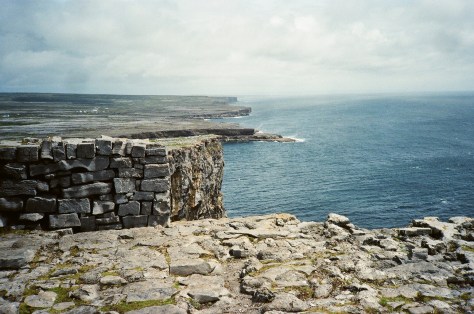
Where do you go looking when your soul longs for a Mothering God? Do you find her in poetry? ancient stories? In songs or rituals or art work or sacred dance? Do you look for wise and loving women who embody her? Do you seek her in your own wise and yearning heart? Or would you go out to explore the earth around you, seeking her in the beauty of spring flowers, in the grace of a flowing stream, in the tender presence of young birds in a nest? Would you look in wild places where the sea explodes into the rock face, pummels the cliffs, shapes stone into forms that resemble an ancient wise woman, a cailleach….


95950003

Atlantic Ocean greets cliffs of Dun Aengus on Inis M’or

Six weeks after my return from the Brigid of Faughart Festival in Ireland, I am still processing the insights, inspiration and experiences of those days. It is not surprising that what I found was sourced in the lives, the words, the stories, songs and poetry of the women I met there. The Sacred Feminine is an embodied presence. Yet of all that I learned, the thing that stirs me most was the way that women spoke of seeking, finding and being found by the Sacred Feminine in the land: in her sea and shore, her grass and trees, her wells and rivers, her mountains and ancient stones, her golden light and eerie darkness, her wild winds and gentle rains. I am captivated by this new understanding.

To honour the feminine presence, Wisdom Sophia, is to honour the planet which embodies her. From earliest days, from the time even before the arrival of the Celts, the people of Ireland honoured the goddess, whose ancient names include Aine or Anu. She was the one whose eyes held the light of the stars, whose hair rippled like the corn, flowed like the waves of the sea, whose body was the great earth barrows, her breasts the hills, called “the Paps of Anu”.

Before this recent visit to Ireland, I had thought these descriptors were lovely metaphors, a poetic honouring of the sacred presence. Yet on this journey I met women for whom the land, the sea, the rocks and rivers somehow embodied the goddess herself. This is not pantheism, making gods of nature, but rather panentheism, recognizing that the holy is present within all that lives, as Teilhard de Chardin taught.

Snowbound for days in this never-ending winter, I sat by the fire reading Kate Fitzpatrick’s book. Kate spoke during the Brigid Festival of her years of work through workshops, story-telling and powerful shamanic healing rituals, to help bring about peace in Northern Ireland. Her guide, counsellor and co-creative partner in this was Macha, the mythical Ulster Goddess.

In her book (Macha’s Twins: A Spiritual Journey with the Celtic Horse Goddess, Immram Publishing, Inishowen, Donegal, Ireland 2017) Kate describes encounters with Macha, mediated by the land and sea. While living on the island of Inis M’or off the west coast of Ireland near Galway, Kate writes:

I am exhilarated with the vital power of this island. The shifting clouds, the showers of rain. What I love about it is the changing light in each hour of the day. The land is bleak and barren. Yet the play of light makes it so beautiful.

I begin to see that Macha is the Wild Mother here. Every day in the raw vitality of wind and rain and sea I find her. Like her wild spirit, all here is dynamic and powerful. Restless and free. Seeping right in to my bones. I move through autumn and winter beckoned by this force. Every day I see more of the power of the feminine in the sea, the waves, and the rock. (p. 67)


95950007

Dun Aengus Inis M’or

In the years that follow, Kate experiences a call to return home to Northern Ireland, to assist the Sacred Feminine presence in the work of bringing healing and peace to the soul of Ulster.

By early June, it is becoming clear to me that the rocks, trees, stones and rivers, along with the elements and the sheer beauty of this glen, have, together, become an alchemical vessel to hold a wider healing of the soul of Ulster.
The sea, as I look out at it this morning, is playing its part in the offering of light, the blue of its holding, the high vibration of its silver water, the wildness of its dance. There is a fierce power of transformation in the rolling waves.(p. 169)

Knowing Macha’s presence with her, Kate writes:

I breathe deeply as she shows me pictures of the town in County Antrim where I grew up in the 1960’s. ‘There are many towns in the North that need healing,’ Macha tells me. ‘This is a journey to bring the heart home, to bring back the kindness lost to everyone in the shadows of war. For you, Daughter, concern yourself only with this.’ (p.169)

Kate’s work with the support of other women led to a tangible presence of light and peace in the land. Two decades after her time on Inis Mo’r, Kate knew that “the old patterns are going now and light is coming in, bringing forgiveness, beauty and joy”.

Then she describes this experience:
I sense a presence in the middle of the strand and when I look over, I see Macha walking in the shallow waters of puddles left on the sand. I see her bend down to pick up shells. As I walk towards her, she looks up, sees me and smiles….I sigh a deep breath and run towards her, power seeping into me from the very sand itself. As I approach her, she straightens up and, still holding the shells, opens her arms to welcome me. Her holding is of the ages. In the warmth and strength of her embrace, I weep.(pp. 237-8)

Macha’s Twins is available for online sales in Ireland, Europe, USA and and internationally.
KILDARE
Books.ie
http://www.books.ie/macha-s-twins-a-spiritual-journey-with-the-celtic-horse-goddess

GALWAY
Kennys Bookshop
https://www.kennys.ie/catalogsearch/result/?q=machas+twins

Brigid: Cailleach, Midwife to a New World

Part Three  by Dolores Whelan

A story from the Celtic tradition that illustrates the importance of the cailleach and her energy is the story of Niall of the Nine Hostages.

Niall and his four brothers come to a well to get a drink of water. The well is being guarded by an old woman who represents the cailleach or hag. When the first brother goes to the well, she tells him that if he wants to drink the water, he must give her a kiss. He is horrified and refuses; she sends him away. The other three brothers go in turn on the same errand, and each refuses to kiss the hag. As the story goes:

Then it was Niall’s turn. Faced with the same challenge, he kissed the old hag and embraced her. When he looked again, she had changed into the most beautiful woman in the world. “What art thou?” said the boy. “King of Tara, I am Sovereignty . . . your seed shall be over every clan.”


Niall-N2


This story suggests that in order to have access to the life-enhancing energy represented by the water in the well, it is necessary for the young masculine to embrace this particular and perhaps unattractive aspect of the feminine energy. Why is this so? The cailleach represents the wisdom gathered by living in right relationship with the earth, something that requires reflection, stillness, and attentiveness. It knows more clearly what is needed and what is possible in each situation, and it is aware of the consequences of particular actions. It knows how to proceed slowly; it understands the value of times of waiting and times of allowing. It knows how to be and how to act.

So how can we, you and I, begin the journey back towards wholeness and balance?
Brigid in her cailleach form can help us to embrace these difficult and fearful aspects of our lives. The cauldron, a central image in both the Celtic and other traditions, is a vessel for transformation and transmutation. In many stories, the cauldron is first filled with unpalatable raw things, which then are used to create a nourishing soup using the transforming energy of the universe through the action of fire and water. The transformation of the contents of the cauldron is supervised by the cailleach energy, which works inwardly, quietly, and slowly to bring about an unforced and timely rebirth.

The transformation of the cauldron’s contents concentrates their essence and offers them back in a new and more suitable form. From this process, we learn that the possibility of transformation and re-birth always exists, no matter how devitalised something appears to be. A new rebirth can be achieved when we submit ourselves and our concerns to the inward and slow transformational energy of the cauldron and the cailleach.

Philosopher Richard Kearney in his poem Bridget’s Well speaks of the importance of this inward and downward journey and suggests that it is the only way to access the life- giving and inspiring fire of Brigid that lies underneath the water.

I will rest now at the bottom of Bridget’s well
I will follow the crow’s way
Footprint by footprint
In the mud down here
I won’t come up
Until I am calmed down
And the earth dries beneath me
And I have paced the caked ground
Until smooth all over
It can echo a deeper voice
Mirror a longer shadow (2)

This poem suggests the importance of that deep journey to the well where the source of new life and the fire of passion is found. At Imbolc (Feb 1st) the tiny spark of new light discovered in the deep womb darkness of the winter solstice has grown sufficiently to safely emerge from that inner world and begin to transform winter into spring !At this time Brigid appears as the fresh maiden of springtime emerging from the womb of the cailleach, queen of winter. Here Brigid embodies the energy that breathes life into the mouth of dead winter. The energy of Brigid at Imbolc is the energy of Yes, and it can only emerge from the place of stillness!

Brigid is also closely associated with the life giving aspect of fire, a fire that doesn’t burn but which can never be fully quenched. When this fire comes from a clear and deep space, as happens following the inward journey, it will be significant and filled with truth and potency. This life-giving fire will act within in individuals, within the land, in the relationships between the people and their land, fanning the fires of creative endeavour so that all of life forms can partake in the symphony of new life emerging each springtime! The fire discovered through this deep journey is an inner light which guides each of us to find our next step!

Richard Kearney in his poem “Brigit’s Well” also speaks of the re-emergence of a new fire born of a deeper place within

Then the fire may come again
Beneath me, this time
Rising beyond me
No narcissus- flinted spark
Behind closed eyes
But a burning bush
A fire that always burns away
But never is burnt out (3)

I believe that the archetypal energy of Brigid, the embodiment of the divine feminine, present within the essence of the Celtic tradition has the capacity to lead and support us in transforming the present wasteland into a new life sustaining society. For this to happen, it is necessary for us to understand that the archetypal energy that Brigid represents is a real aspect of the human psyche, one that has been largely dormant over the past few hundred years, but is now re-emerging. Each of us can become keeper of the Brigid flame by developing and living those qualities and values that distinguished her.

As we align ourselves with her archetypal energies, she supports us courageously and safely to face the demons of this time. She teaches us how to stand still in a wobbling world, to act as a unifying force, to hold the space of possibility and so become agents of transformation. So we ask for

The mantle of Brigid about us
The memory of Brigid within us
The protection of Brigid keeping us from harm from ignorance,
from heartlessness this day from dawn till dark (4)

When we embrace her energy Brigid will hold us and guide us through this transition. I believe she is the one who has the power to awaken in each of us An eye to see what is, the heart that feels what is, and the courage that dares to follow. (5)

1 Amergin Jan de Fouw Amergin Wolfhound Press Dublin 2000 ( afterword ) no page number
2 Richard Kearney quoted in Stephen J. Collins The Irish Soul in Dialogue the Liffey Press Dublin 2001 p 147
3 Richard Kearney quoted in Stephen J. Collins The Irish Soul in Dialogue the Liffey Press Dublin 2001 p 147
4 Poem source unknown
5 Celtic triad found extensively in the literature


Women Rising Rooted: Brigid’s Festival

If we surrendered
to Earth’s intelligence
we could rise up rooted,
like trees.
(Rainer Maria Rilke)

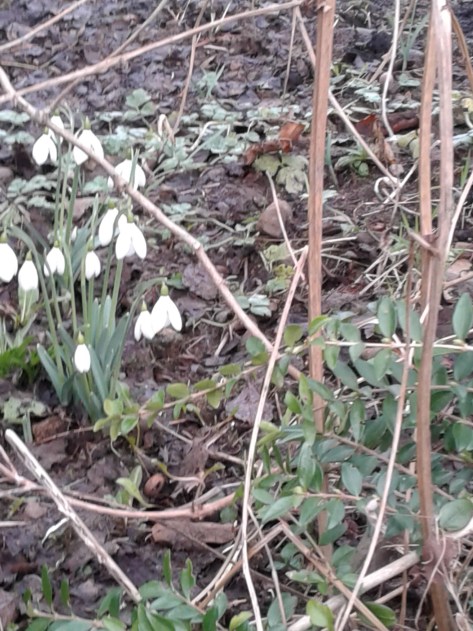
At the end of a frigid Canadian January, I have come to Ireland for Brigid’s Festival of Imbolc, the day that welcomes Spring. Brigid is the one who “breathes life into the mouth of dead winter”. In the front garden of my friend, Dolores Whelan, the first thing I see are snowdrops….then one purple crocus, two golden ones.

20180126snow drops in Ireland

snowdrops in Dolores Whelan’s garden

From a window on the upper floor, Dolores shows me that the Hill of Faughart can be seen, aligned with her home. Birthplace of Saint Brigid, 5th c. Abbess of Kildare, Faughart is ancient in memory, a place where the goddess Brigid was honoured in pre-Christian Ireland. Snow drop and crocus, saint and goddess, growing from this earth.

Brigid’s Festival honours both, and in the days that follow the two merge in my awareness, become intertwined, embodied in the fiery women whom I meet: Dolores and the volunteers who planned the events of the festival as well as the presenters, attendees, poets, artists, dancers, singers, writers… each woman aflame.

I listen as they tell their stories, either as a formal part of the festival’s program or casually in conversation over coffee or a meal, or in a pause between sessions.

I listen as Sharon Blackie tells the story recounted in her book If Women Rose Rooted (September Publishing 2016). With a PhD in Neuro-science Sharon found herself in a corporate job where her inner self was dying. Through a labyrinthine journey, one she describes as the feminine form of Joseph Campbell’s “Hero’s Journey”, Sharon followed the lure of her heart to the northwest of Scotland and on to Ireland, living on land near the sea where her soul finds a home.

I walk through Una Curley’s art installation of her own “Camino Walk”, her story of walking away from a life of successfully functioning in a corporate position that left her empty inside. Una chose instead the uncertainty and bliss of life as an artist. Una says the way to begin is to tie a piece of thread to a rusty nail and let the life you have designed, the life that no longer serves your soul, unravel… Part of her work traces the early flax industry of Ireland, rooted in the land, uniting the communities around the flax fields in a common endeavor.

Kate Fitzpatrick picks up her violin to express more profoundly than words her journey with women as they sought in the land and soul of Ireland the Healed Feminine. Kate’s quest was to bring peace and forgiveness to her people. The story of her spiritual journey with the Celtic Horse Goddess Macha is told in her book Macha’s Twins (Immram Publishing, Donegal, Ireland 2017)

Ann McDonald leads us in sacred movement, in breathing exercises, finding the power in our solar plexus. Deeply grounded, we release a voice that is resonant. Ann creates songs, receives songs that come to her while walking in pilgrimage or while holding sacred space. Her songs at the Ritual for Brigid’s Feast at Faughart come from deep within, inviting grace to embrace those present in the Oratory.


20180201Faughart Oratory

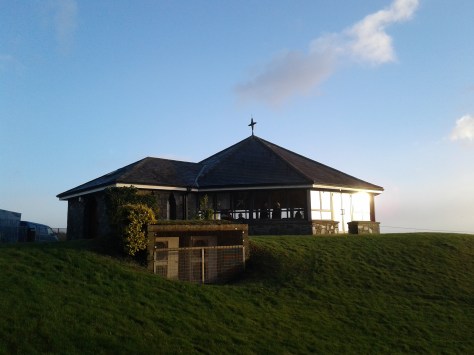
The Oratory on Faughart Hill on Brigid’s Day, February 1, 2018


Dolores, Una, Kate, Ann and Sharon are women whose lives differ on the outside. Yet I saw in each a life rooted in an inner passion, a deeply feminine connection with the land and a quiet walking away from cultural values that are out of harmony with and therefore destructive of the feminine soul.

I understand now that life can be found by returning to the ancient stories, the ancient spirituality that grew out of the land itself, a spirituality that honours women, that cares for the things of earth, that recognizes, as Rilke says, that we are of the same substance …here is his full poem:

How surely gravity’s law
strong as an ocean current
takes hold of even
the smallest thing
and pulls it toward
the heart of the world.

Each thing –
each stone, blossom, child –
is held in place

Only we in our arrogance
push out beyond what
we each belong to –
for some empty freedom.

If we surrendered
to Earth’s intelligence
we could rise up rooted,
like trees.

Instead we entangle ourselves
in knots of our own making
and struggle, lonely
and confused.

So, like children
we begin again
to learn from the things
because they are in
God’s heart,
they have never left him.

(Rainer Maria Rilke)

Our Journey Towards Radiance: Part Three

1513851_10155814472155285_2883105051202678217_n
Transmutation, as we have seen, is slow, gradual change occurring over time.

Transformation is sudden. The Irish poet WB Yeats expresses it well:

… changed, changed utterly. A terrible beauty is born.

When we experience transformation in our lives, we need to look for guidance from the mystics, writers and poets who have experienced it. We welcome beauty into our lives. We have within us a visionary process which is a source for the re-coding of the planet. All the codings for the life of the unborn future are available in us. We are the recoding, the reset button.

The twentieth century mystic Caryll Houselander writes of her experience of transformation. After a long illness, suffering as well from scrupulosity, she had an experience of God that removed her obsessive fears and gave her a profound peace:

It was in the evening, I think. The room was dark, and the flames of firelight dancing on the wall seemed almost to cause me pain when I opened my eyes….I no longer attempted to translate my torment as particular sins; I had realized in a dim, intuitive way that it was not something I had done that required forgiveness, but everything I was that required to be miraculously transformed.

Interrelatedness: Rather than removing us from concern for others, the experience of transformation fires us with a vision of caring, with a sense of the whole, an invitation from the cosmos to see all of life as interconnected. This is how the mystics see life, how today’s physicists see life. It is what the astronauts experienced when they saw earth from space:

From space I saw Earth –indescribably beautiful
with the scars of national boundaries gone.
Muhammad Ahmad Faris Syria

During a space flight, the psyche of each astronaut is reshaped.
Having seen the sun, the stars and our planet, you become more full of life, softer.
You begin to look at all living things with greater trepidation
and you begin to be more kind and patient with the people around you.
At any rate, that is what happened to me. 
Boris Volynov, USSR

We need an overarching vision that is so simple and alluring that we can see what the world can be…. What does a world look like that really works for everyone? This is an incredible grace and opportunity for us, born on this beautiful planet at this time in history.


Radiance: The sun gives off messages as gravitons that pull us to the sun; the sun interacts with the moon and new gravitons feed us; the earth responds with a flood of gravitons…. We are frozen light…

Brian Swimme says that every being you meet holds fourteen billion years of radiance. Radiance is the primary language of the universe. We develop a container that can respond to the beauty of the other. We enter into resonance with the radiance of the universe, and that is the primary form of prayer. You become the radiance that is flooding the world.

Radiance, the tenth Power of the Universe, is celebrated in the Book of Wisdom where Solomon says of the Wisdom/Sophia Presence: I loved her more than health or beauty, preferred her to the light, since her radiance never sleeps. (Jerusalem Bible 7: 10)
She is indeed more splendid than the sun, she outshines all the constellations; compared with light she takes first place, for light must yield to night, but over Wisdom, evil can never triumph.(7: 29,30)

Teilhard de Chardin, the French Jesuit priest and paleontologist who died in 1955, wrote:

Throughout my whole life during every moment I have lived, the world has gradually been taking on light and fire for me, until it has come to envelop me in one mass of luminosity, glowing from within…The purple flash of matter fading imperceptibly into the gold of spirit, to be lost finally in the incandescence of a personal universe…This is what I have learnt from my contact with the earth- the diaphany of the divine at the heart of a glowing universe, the divine radiating from the depth of matter a-flame. (The Divine Milieu)

Hildegard of Bingen, the astonishing 12th c. abbess and genius, tells us this:

From my infancy until now, in the 70th year of my age, my soul has always beheld this Light, and in it my soul soars to the summit of the firmament and into a different air….The brightness which I see is not limited by space and is more brilliant than the radiance around the sun…. I cannot measure its height, length, breadth. Its name, which has been given me, is “Shade of the Living Light”….Within that brightness I sometimes see another light, for which the name “Lux Vivens” (Living Light) has been given me. When and how I see this, I cannot tell; but sometimes when I see it, all sadness and pain is lifted from me, and I seem a simple girl again, and an old woman no more!

And so, empowered by the Universe itself, we shine on!


Wisdom in the Universe

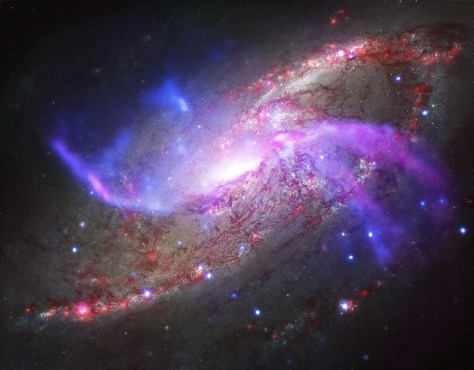
Evolutionary Cosmologist Brian Swimme writes that “the cosmological Powers of the Universe are coursing through us moment by moment. To become aware of these powers is to touch the Source of Life.”
1513214_10155814472145285_5248696702093065973_n
In his DVD set “The Powers of The Universe”, Swimme offers this summary of the ten powers, held together in Seamlessness:

Centration: the coming together in one life of the entire evolutionary development

Allurement: what holds it all together; in societies, the values and ideals that help them cohere

Emergence: the Universe is a story, not a place or a thing, always bringing forth newness

Homeostasis: the Universe holds onto its achievements: the oyster shell – it works!

Cataclysm: the Universe sometimes destroys its achievements purposely in addition to accidental destruction

Synergy: complexification as things come together; diversity creates more complex systems

Transmutation: newness begins, builds

Transformation: always, always newness is being created

Inter-relatedness: when diversity and commonality come together, as now on the planet: people are discovering diverse gifts, beginning to have common concerns

Radiance: a new evolutionary reality, as Teilhard de Chardin foresaw, something beyond what has been until now.

Out of seamlessness, a person is here (centration) seeing the universe involved in her unfolding. Through allurement, she begins to pursue dreams which emerge in relationships. Through homeostasis she finds her role in society, where she fits in …

But then cataclysm arrives where things fall apart… marriage, health, job… One way or another, the person’s cataclysm will relate to the present cataclysm of the planet. The collapse of what one thought was real eliminates illusion, a glimmer of the need for synergy, a larger vision for the community and for others.

Transmutation comes from awareness that I need to change parts of my life (consumerism? militarism? competition?) This can lead to a deep unlearning, a metanoia, metamorphosis, connecting one to the origins of things, developing a creative vision for moving forward, a vision that itself needs to be tested internally against the other powers of the universe…moving one towards transformation where inter-relatedness happens at a more elegant level as one sees the light in the other, and finally radiance.

Recalling that we are beings in whom the Universe resides, we begin our exploration of Swimme’s teaching with the first power that he identifies in the Universe: Centration.

CENTRATION, Swimme teaches, is the coming together in one life of the entire evolutionary development. What if? he asks, what if the role of the human after 13.8 billion years, is to allow the Powers of the Universe to be enhanced and advanced though us? What if we understood that the Universe is centered on us, with the aim of bringing forth another form of life, one that will draw life itself forward? Our challenge, Swimme says, is to learn how to participate in this process by removing obstacles so that the power of centration can proceed. The main obstacle, he says, is that modern individual consciousness prevents our appreciation that the WHOLE is real, and has its own intentions.

How would our lives look if we opened ourselves to allow the power of centration to grow in us? The shift in consciousness, should we as a species open ourselves to this fully, would rival the shift that occurred when, in the sixteenth century Copernicus declared that the earth revolved around the sun, not the sun around the earth….

In 1905, Einstein realized that life is not boxed in with a clock ticking beside it but rather that space and time in the Universe depend upon the observer, that the Universe rises up with respect to a particular orientation. Half a century later, Carl Jung would understand that each of us experiences the universe in our own way.

The story of the evolution of life holds the teachings we require to allow the power of centration to be enhanced through us. Life created the membrane to allow creation to withstand the onslaught of the sea. Swimme advises that in this time when our planet is threatened with destruction we too need to develop a permeable barrier whose intelligence will determine what goes through and to find a way to keep out what is leading to degradation, refusing to give entry.

We need also to identify and amplify what we do want to pass through the membrane: those elements which will enhance our journey into ourselves.

The second thing required for the development of life is a catalyst that, like the molecule, accelerates the process. For this, Swimme suggests we find a way to contact the primordial energy of nature, to drop into contact with the Universe, knowing that the Universe is longing to center itself in a new way. Spend time in a storm, by the waves of a shore, beside a birdfeeder, Swimme suggests. Find a way to channel this energy of 13.8 billion years.11261593_1064331516930152_2458458929397885903_n

Reflecting on Centration:

What would change in my life if I were more fully open to the power of Centration, understanding that my life is part of a WHOLE? How would my life be different if I saw it as a journey for which the UNIVERSE holds intention, holds a hope for something far beyond what I can see or imagine?

How do I /we develop an intelligent sieve, a membrane with wisdom to keep out of my consciousness what would harm me while recognizing and allowing the passage of elements that will enhance and assist the journey to the sacred centre of my life?

What ways have I found and which do I seek that will bring me into closer contact with the power of nature? Knowing that the Universe is longing to be more fully centred in me, how do I encourage this closeness?

Wisdom Imaged in Nature

The ancient writers see in Wisdom’s flowing, all-pervasive presence an outpouring like rain or floodwaters:

Who knows the root of Her?
Who fathoms Her subtleties?
There is only one so wise and so wondrous – God!
He created Her and saw her true nature
God gave Her life and poured Her out
Upon all creation.
She is with you according to your ability to know Her;
For God has given Her to all who love Him.

(Wisdom of Jesus Ben Sirach 1: 6-10)

Of these wonderful images, Shapiro writes:

Wisdom is the way God lays out the foundation of creation….She is both the field and the rain that nurtures the field.
And just as rain falls on all, so too Wisdom. You do not deserve Her; you do not earn Her. You simply receive Her. And yet…
She is with you according to your ability to know Her. It is as if you were begging for pennies in the street without realizing that your pockets were stuffed with hundred dollar bills. Your love of God and your ability to know Wisdom are connected. Knowing Wisdom is the way you love God, and loving God is the way you know Wisdom.
(pp.18-19 in The Divine Feminine in Biblical Wisdom Literature Rabbi Rami Shapiro, Skylight Illuminations, Woodstock, Vermont 2005)

In the following passage, Wisdom speaks to us of Herself as Cosmic Being:

I am the breath of the Most High,
blanketing the earth like mist,
filling the sky like towering clouds.
I encompass distant galaxies,
and walk the innermost abyss.
Over crest and trough,
over sea and land,
over every people and nation
I hold sway.
(Wisdom of Jesus Ben Sirach 24:3-6)

Shapiro notes the many water metaphors that hint at Sophia’s nature:
She is poured out, She falls like mist, She rises like clouds. Like water, Wisdom is yielding, and yet, like water She is capable of wearing down the hardest stone. She holds sway not by attacking but by embracing.

In these qualities, Shapiro finds resonance with the “highest good” described in Chapter 8 of the Tao Te Ching:

The highest good imitates water,
Giving life to all without struggle or striving.
She flows in places you dismiss and in this She is like the Tao.

Shapiro adds:

There is no struggle in Wisdom’s way. She does not exert Herself, but simply is Herself. When you act in accordance with Wisdom, you act without coercion. You act in sync with the moment, engaging what is to nurture what can be. (pp. 20-21)

In our time, when we are beginning to grasp the truth that we are all interconnected, it is Wisdom-Sophia who draws us together:

She arises in God
and is with Him forever…
Established before beginnings,
She transcends time.
She is God’s word, a fountain of understanding;
Her ways are timeless, linking each to all,
and all to One.
(Wisdom of Jesus Ben Sirach 1: 1-5)

Shapiro finds here another parallel with the Tao:

The valley spirit never dies;
She is woman, primal mother.
Her gateway is the root of heaven and earth.
She is like a sheer veil, translucent, almost transparent.
Use her; She will never fail.
(Tao Te Ching: Chapter 6)

Wisdom arises in God, and is the gateway to God writes Shapiro. Referencing the Tao, Chapter 11, he adds:

She is the foundation of all things and the Way of all things. Wisdom is both timeless and timely, open to you now and capable of lifting you to eternity. She is the center that holds the periphery, just as the spokes of a wheel share a single hub. (pp. 16-7)

Wisdom is honoured as “Mother” in the Hebrew Scriptures:

I am the Mother of true love,
wonder,
knowledge, and
holy hope.
Beyond time, I am yet given to time,
a gift to all My children:
to all that He has named.
(Wisdom of Jesus Ben Sirach 24:18)

Shapiro writes: Wisdom is the Mother of quality as well as quantity. Wisdom is the Mother of the metaphysical as well as the physical. Wisdom is not only the Mother of the rose, but the Mother of the delight that arises when you smell one.

Wisdom is a gift to all God has named. The named are the seemingly separate things of the natural world. Until a thing is named, it is undefined and not fully alive. In Hebrew the root of the words “speak,” “word,” and “thing” is the same: dvr. Until the word is spoken, until the thing is addressed, it does not truly exist. Wisdom is the ability to reverse the process, to speak the name in such a way as to return to the silence of God that preceded it. (pp 24-25).

Sophia reflects light and goodness as a mirror of the divine:

She is God’s spotless mirror,
Reflecting eternal light,
and the image of divine goodness.
(Wisdom of Solomon 7: 24-26)

Shapiro comments: The Mirror of God reflects all things and is none of them. She reflects whatever is: good and bad, hope and horror. Wisdom is not one thing or another, but the Way to deal with all things in their time. (pp. 30-31)


Weaving our Days with Wisdom-Sophia

Being faithful to a spiritual practice of deep listening brings about a change in our daily living. We notice a presence of Loving Wisdom that embraces us in the ordinary moments of each day, assisting in decisions and choices, lifting our spirits when clouds obscure our inner light, opening us to see the beauty in the life, the beings, around us. She befriends us in every activity, every aspect of our lives.

As Rabbi Rami Shapiro unpacks the Wisdom Literature of the Bible, we learn that the sages who honour Sophia/Chochma have known this guidance, this companionship for millennia.

Although She is one,
She does all things.
Without leaving Herself
She renews all things.
Generation after generation She slips into holy souls
Making them friends of God, and prophets,
for God loves none more than they who dwell with
Wisdom.
(Wisdom of Solomon 7: 27-28)


Commenting on this passage, Shapiro writes: This is what Wisdom can make of you: a friend and prophet of God. A friend of God is one who dwells in Wisdom. A prophet of God is one who shows others how to do the same. To dwell in Wisdom is to see the ground from which all things come. To see the ground is to open yourself to what is rather than what you desire. Opened to what is, you engage the Way of things in this very moment. Things arise from the conditions that precede them, but options are always present. The prophet works with the current embedded in the conditions to nurture justice rather than injustice, compassion rather than cruelty. (pp.32-3 The Divine Feminine in Biblical Wisdom Literature Rabbi Rami Shapiro Skylight Illuminations. Woodstock Vermont 2005)


images

“To dwell in Wisdom is to see the ground from which all things come.”

Long before the words about Wisdom Sophia were recorded in the Bible, long before recorded history of any kind, Wisdom was present in the human heart, though never possessed fully:

The first human did not know Wisdom fully,
Nor will the last ever fathom Her.
For Her mind is more spacious than the sea,
Her counsel more deep than the great abyss.
(Wisdom of Jesus Ben Sirach: 28:29)

Wisdom cannot be contained, Shapiro writes, and that which cannot be contained cannot be known completely….Wisdom is the ground out of which you come, and cannot be separated from your self …. You can no more know Her than your nose can smell itself or your ear can hear itself. Wisdom is not a thing you can know but a Way you can follow…. The way to follow Wisdom is to surrender narrow mind to spacious mind— the mind that knows to the knowing itself. (pp. 26-7)

Yet Wisdom’s overflowing presence extends far beyond the humans who honour her:

She is more beautiful than the sun,
And the constellations pale beside Her.

Compared to light, She yet excels it.
For light yields to dark,
while She yields to nothing.
She stretches mightily throughout the cosmos,
and guides the whole universe for its benefit.
(Wisdom of Solomon: 7:29-8:1)

Reflecting on this passage, Shapiro comments: What is to your benefit? To be wise, to immerse yourself in the Way of Wisdom. Wisdom’s desire is for you; She wants what is best for you, and that is for you to embrace Her. (pp.34-5)

Wisdom is not only all-pervasive, but also timeless:

Before time,
At the beginning of beginnings,
God created Me.
And I shall remain forever.
(Wisdom of Jesus Ben Sirach 24: 9)

Referring to the English language translation of Genesis:

In the beginning God created…(Gen 1:1)

Shapiro writes: This is a misreading of the Hebrew. A more precise translation would be, By means of beginning, God created… Creation is the stuff of beginnings. There is no beginning unless there is something that begins.
Wisdom is said to have been created before beginnings. This shows the limits of language, for in fact this cannot be. If She is created, then there is a beginning. What, then, is this Wisdom Who was created before the things of creation? She is the pattern of creation, the Way of God’s unfolding from eternity into time. (pp. 22-23)

Wisdom is the earth’s foundation,
and understanding the sky’s pillar
She is the divine order patterning all creation,
from the ancient oceans to this morning’s dew. (Proverbs 3: 19-20)

Reflecting on the way Wisdom patterns all creation, Shapiro writes:

Wisdom is not separate from creation; She is the order of creation. She is the grain of wood, the currents of wind and sea. Everything rests on a metaphysical order, a principle that patterns all reality. While the world you encounter is impermanent, the principle of Wisdom is limitless. To know Wisdom is to know the current in the midst of the chaos….There is a guiding principle that orders even that which appear as random. That guiding principle is Chochma….

Using the metaphor of a game of dice, Shapiro suggests:

The extent to which you fixate on any one throw is the extent to which you are lost in chaos. As you step back and see the pattern, you are free to engage the game with equanimity. (pp. 14-5)