Category Archives: Sacred Feminine

Sophia in Egypt: Thirty-Four

The four of us respond enthusiastically to Ellyn’s suggestion for a ritual.

“Let’s ask Jean and Peggy now, before we break for lunch,” Rosemary suggests, as she gestures to our teachers, inviting them to join us.

When Ellyn tells them her idea, Jean groans theatrically. “I don’t have a single song, dance, poem or prayer left in me, but maybe Peggy does.”

I look at Peg, see her fatigue, mingled with her wish to help us. “No need,” I say quickly. “We’ll plan it ourselves. The two of you only need to show up, at, let’s say, 7:30?”

“Over lunch, we’ll talk to the rest of the group,” Ellyn says. “We’ll invite them to work with us on this.”

“I have something you may wish to use in your preparations,” Peg tells us. “Normandi Ellis has a book of Rituals based on the Egyptian Mysteries. It’s called Feasts of Light.”

Towards the end of lunch, Ellyn makes an announcement about the ritual, inviting everybody who wants to take part in the planning to gather in the Meditation Room at four o’clock, bringing their Egyptian robes, the galabiyyas given us by Mohamed, as well as any perfumed oils, jewellery and small statues from Egypt that could be used in the ritual. Then the five of us agree to meet around three o’clock to look through the Normandi Ellis book, and do some pre-planning.

There is something I must do first. I find a pair of thin cotton socks to wear inside my sandals, put on my long cotton coat, and venture out into the wintry universe. The sun by now has melted the snow on the roadway so that, with care, I can make my way to the parking lot. My car is still buried under a foot of fresh soft snow, which I sweep off the trunk with the sleeves of my coat. I open the trunk and reach inside, fumbling around until I locate the heavy fleece-lined boots I’ve brought from home. With a graceless, one-footed dance I manage to step out of my sandals, into the boots.

I feel around again in the depths of the trunk, pull out a cloak of thick cotton fleece. Grateful for its weight, though the fabric is ice-cold to the touch, I pull it on.

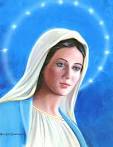
The Garrison Institute sits on a height of land that rolls downwards in a gentle sweep from the driveway at its front entrance to the cliff atop the Hudson River. On Mystery School weekends, in spring, summer and early autumn, my companions and I often walked here on the grass, among the flowers, beside trees so ancient that they still hold memories of Benedict Arnold’s famous flight. On a stroll one spring morning, I had discovered an empty stone grotto, tucked in under the stones that support the driveway, hidden by a richly verdant vine of three-lobed leaves. The Capuchin Monastery was named in honour of Mary Immaculate. The monks must have built this grotto. Her statue must once have graced it.

Today, I make my careful way down the snowy stairs to find the grotto. Its vines are barren of leaves, brittle, yet blossoming! Snow has settled on the tiny twigs in soft puff balls, creating an illusion of branches budding with May flowers. A hymn from my childhood, one I’ve not sung in decades, comes back to me: Oh Mary, we crown thee with blossoms today . . . Queen of the Angels, Queen of the May . . .
Mary

I stand here for a long while, thinking, wondering. The love I’d known both for and from the spiritual presence whom I called Mary found me and touched me in Egypt under names that were strange to me. But I do not now doubt that the love I experienced there had the same source. Nor do I now doubt that my life has been transformed by that love. This mystery seems to me now so deep, so vast, that I can’t begin to comprehend its ramifications for my life, for my faith, for the planet, for the universe. But a mystery does not ask for understanding. It asks only for trust. And trust is the gift I carry home from Egypt.

It is after three o’clock when I return to the Meditation Room where my friends are gathered, already excitedly making plans. Ellyn waves the Normandi Ellis book at me. “I’ve been reading this ever since Peg gave it to me just after lunch. It’s all here, what we were sharing together about how we were each connected to different aspects of the goddess, the sacred feminine. So here’s what we’ve been thinking. . .”

I listen, growing as excited as my friends. This is truly amazing, a last great gift from Egypt. “So, each of us will portray a face of the goddess, and invite everyone to carry aspects or gifts of the goddess out into the world?”

They nod enthusiastically. “Kathleen has agreed to portray Nephthys, Rosemary will be Ma’at, Suzanne will be Isis, I’ll be Hathor. . .” Ellyn pauses. “And you can represent—”
“. . . Sekhmet!” I am ridiculously pleased.

But there is something missing. “What about music?” I ask. “Shouldn’t there be dancing?”
I wait, and when no one else seems to have a suggestion, I say, “What about Tchaikovsky’s Sleeping Beauty? Remember that night at Sharms, watching a film of the ballet under the stars?”

And already others of our companions are arriving, ready to join in the planning.

(to be continued)

Sophia in Egypt: Twenty-One

Following our reflections on Seth and Horus, we move into the final ritual, the recrowning of Isis, the ritual I experienced alone in my community’s prayer room two months earlier. Now I enter into it, companioned by the group with whom I have shared a mythic journey.

Yet, in the final moments, standing before the presence of the Sacred Feminine, I feel alone, wrapped in mystery. At the moment of the gifting in September I had asked for something to be taken away, the great emptiness that had made me a beggar of love.

Today, I open myself to receive something from this presence. There is a moment of utter stillness. Then I see an inner image, a ball of swirling fire, a glass globe of rose and white light, and it is within me, in my own deep centre. I am being filled with love.

There is no time to reflect on this wonder, to take it in with gratitude.

The morning session is over. Lunch awaits us in the dining room, and afterwards we are to visit the great Temple of Karnak.

An hour later, we are gathered in the lobby, ready to leave the ship to board the bus. I am suddenly overtaken by a grief so intense that, to my shame, tears are pouring down my cheeks. I quickly turn away, but not quite soon enough to escape Jean’s glance. I pretend interest in one of the paintings on the wall.

As if that encounter with love in the ritual only an hour before had never happened, I am empty.

This grief is human, a keen awareness of an ending, prefatory to further endings, knowing this magic cannot return, knowing I shall never again be here in the presence of the teacher from whom I have received the reweaving of my life. The remembered words of Tolkien’s Gimli, leaving Galadriel of the Golden Woods, rise within me: I would not have come had I known the danger of light and joy. Now I have taken my worst wound in this parting.

The intense heat of the mid-day sun devours us like some fiery Sobek as we enter the massive courtyard before the Temple of Karnak. An oddly-shaped stone just ahead of my sandaled foot catches my eye. I pick it up, turn it over in my palm, see a lumpy heart shape with an open wound across the top.

We move quickly inside the towering walls, eager to find some protective shade. Our guide Samai gathers us beneath a huge leafy tree to speak about this temple. He tells us it is constructed so that the sun appears to travel through the day along the line of its one hundred and thirty-four columns, moving from Karnak to Luxor and across the Nile to Deir-el-Bahari. As I listen to Samai, the inner grief weighs down my heart. I become aware of Jean’s presence, a little distance behind where I am standing.

Awhile later, wandering alone in the temple precincts, I notice the grief has dissolved, that it left me there, under the leafy tree. With a lightened heart, once again open to receive beauty, I pause beside a small lake encircled by a low stone wall. It is the place where priests were purified in ancient times in preparation for ritual. The water is so clear that a tall palm tree gazes down at itself, perfectly reflected. A huge stone scarab, seven times my size, sits atop a circular plinth three metres above me. It was here at the Karnak Temple that the scarab was declared a symbol of eternal life.

download-of-scarab

Scarab at Karnak: symbol of Eternal Life

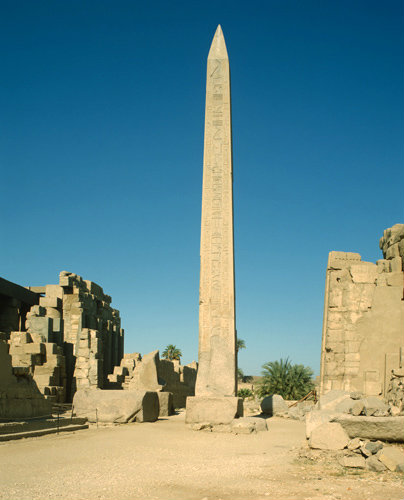
Soaring above the temple walls like a great tower of Rapunzel, stands the only remaining obelisk of Hatshepsut, the woman pharaoh whose successors tried to obliterate all memory of her.

eg51-9-17


Behind Karnak’s main temple complex and through five gateways stands a small Sekhmet shrine that still holds the original statue of the beautiful, fierce, serene, lion-headed goddess. Those who seek her at her Karnak shrine invariably have powerful experiences orchestrated by a statue created as a vessel for the divine presence of Sekhmet. Skilled craftsmanship and sacred rites opened the statue to the goddess’ spiritual attributes. Three thousand years later, the power of Sekhmet captured in basalt endures.

Nikki Scully, musician, energy healer and leader of shamanic pilgrimages to Egypt, speaks of Sekhmet’s call to our time: When we embrace this power, something happens to us at a cellular level. It’s as though the energy enters into our field and then into our very cells. A person who is receiving this feels as though every molecule and cell is suddenly coming out of an ancient atrophy and malaise, and awakening, becoming alert.
I believe this awakening is a part of the conscious evolutionary process we’re engaged in, bringing forth the aspects of the power of the Divine Feminine that are required in order to achieve the balance we’re seeking at this time.

(Next: Encounter with Sekhmet)

(excerpt from Called to Egypt on the Back of the Wind Anne Kathleen McLaughlin, Borealis Press, Ottawa, Canada, 2013  http://borealispress.com)

Sophia in Egypt: Twenty


Note to the reader: If you wonder how Sophia, the Wisdom presence of the Holy in the Hebrew Scriptures, relates to the ancient Egyptian story of Isis and Osiris, or how she is part of this 21st century  journey to Egypt, this segment may begin to offer enlightenment. Isis, Hathor, Ma’at and Sehkmet are aspects of the Sophia, the Sacred Feminine presence who is making herself known in our time.


After last night’s visit to the Luxor Temple, I fell asleep with columns of hieroglyphs on yellow sandstone moving across my eyelids. Then a clear image of Hathor appeared, goddess of love and joy. I awaken to this new day thinking of the light of Ra, the gift of love that shines equally on all.

goddess-hathor

Hathor: Goddess of Love and Joy

After breakfast, some of us gather on the upper deck of the Moon Goddess where Marjorie and Paul, a married couple in our group, lead us in Chi-Gong movements. Afterwards, I sit cooling my feet in the pool, looking over at the Valley of the Kings on the West Bank.

In the peace of the moment, remembered words of Jesus rise up within me:

John was a lamp, alight and shining,and for a time you were content to rest in his light.

There is a hint of something here. This light, in which I am just learning to rest, is only for a time. But I don’t follow the thought where it might lead. I cling instead to this present moment, wanting it to last, not looking beyond this day, our final one on the Moon Goddess.

At ten o’clock in the Captain’s Lounge, we re-enter the story, find ourselves in the midst of the eighty-year battle waged by Horus against Seth, the principle of entrapment and limitation. Jean Houston invites us to see how we need to activate the inner muscular Horus within us to stand up to recalcitrance, both within and outside of us, and do battle. People who are entrapped by, limited to the status quo, are living out of their reptilian brains. If we remain working with them, we can only become assistant dinosaurs. To advance the world, the individuated wilful Horus must emerge.

Within ourselves the opposites, the Seth principle of limitation and the Horus principle of abundance, are often at war. We enact a ritual battle between the Seth and the Horus within us, partnering with another to give voice to each aspect of the self. Denise, the woman from Ireland, offers to play Seth to my Horus. I tell her of wanting to travel the earth, working with women to help them find their deep spirit.

“Do you think you can be like Jean Houston?” she mocks. Our role play, as fierce on my side as on hers, leads us into a deep sharing about the need we have both felt for inner guidance, the longing of a woman who feels herself unmothered.

In their epic battle, Seth and Horus shape-shift, become hippos and bears and lions, enduring terrible wounds. Such battles arise, in our time, Jean believes, in cultures that lack guiding principles. Yeats describes it in “The Second Coming”:

Things fall apart; the centre cannot hold;

Mere anarchy is loosed upon the world,

The blood-dimmed tide is loosed, and everywhere

the ceremony of innocence is drowned;

The best lack all conviction, while the worst

Are full of passionate intensity….

And what rough beast, its hour come round at last,

Slouches towards Bethlehem to be born?

That rough beast is Seth, Jean suggests.

As in the Iliad, the gods take sides in this great battle. Ma’at, the principle of truth, withdraws, goes underground and lives with Osiris. She chooses to leave the battle to go into the higher order of the unconscious. We, too, when we cannot make sense of things, retreat into the unconscious, taking Ma’at with us.

After the battle, when Isis realizes that she cannot kill Seth, Horus seizes her crown, tearing it from head. Later, he repents and recrowns his mother, giving her the cow-headed crown of the goddess Hathor.

Seth tries to seduce Horus. Jean comments that even after we think we’ve won the battle, we keep meeting our same old issues, again and again, but at increasingly complex levels. We are seduced by our own Seth, given these struggles to strengthen us. Each time we find ourselves in these same old patterns, we might think of them as trenches in the brain, something we need to over-ride. Dealing with these as fractals of the eternal return, old ditches we must cross, helps us to get on with the new story.

The ancient story concludes with Isis tricking the ferryman into taking her to the council of the gods on Elephantine Island. Disguising herself as a beautiful woman, Isis persuades Seth to acknowledge his crime and make restitution. The gods order him to create a barge that will carry the high spirit of Osiris into the depth world.

Rather than what traps us in time, our Seth principle of appropriate limitation becomes the vehicle to carry us into eternity.

The story became a transformational ritual in Egypt, a ritual of the soul. In it, the four principles of movement, fertility (Isis), inspiration (Osiris), limitation (Seth), and growth (Horus) are engaged in the big turn-around and fall becomes resurrection. What is destroyed is transmuted into a deepened quality, rising like the djed pillar in us as compassion, as empathy.

The transformational journey of the soul is the basis of the Mystery Rituals. In a Hellenized version, the Mysteries of Isis and Osiris were celebrated throughout the Graeco-Roman world. Many themes of the Isis/Osiris/Seth/ Horus story reappear in Christianity: the woman, impregnated by a father in the spiritual world; the threat that the newborn child will be destroyed; the tree as vehicle of death. Isis is the virgin/mother /crone who was worshipped in Greece and Rome for centuries. Some ancient black madonnas are actually Isis with Horus in her lap. Many qualities of Isis are subsumed into Mary.

Jesus was like Osiris, living out the Egyptian mystery of the dying/rising God, taking on the full ancient archetypal myth of the Mystery Religions while existing in space and time. No wonder, Jean concludes, he became Jesus Christ Superstar!

After the story, we take time to reflect more deeply on its meaning for our lives.

What vulnerable quality within us can be transformed from a negative Sethian glitch to a deeper potential, as the barge of Seth became transformative for Osiris?

I sit in silence with this question, wondering how my longing for a particular love can be transformed into a love that overflows from within me to others. It is for me the fractal of the eternal return, the question that continues to arise in my life, always from a deeper place, ever more complex.

( excerpt from Called to Egypt on the Back fo the Wind Anne Kathleen McLaughlin Borealis Press, Ottawa, 2013 http://borealispress.com )


Sophia in Egypt: Fifteen

In the Valley of the Kings

Now it is late evening. In my room on the Moon Goddess, I write about our visit to Abydos, sacred to Osiris, about Hathor’s temple at Dendera. I write of resurrection and greening, of partnership and the sacred marriage within the self, of joy and rebirth. As I write, tiredness drains the feelings of joy, like wine spilling from an overturned goblet.

I pray that tomorrow will bring some fresh magic when we visit the Valley of the Kings.

Four o’clock. The wake-up call sounds. There is just time to shower and dress, to gather in the ship’s lobby for coffee, before we board the feluccas to cross the Nile. The waning moon is still bright, lighting our way as she descends from her midnight perch. On the far shore, the bus waits to take us to a gorge once hidden among rocky ravines, now accessible by roads.


Some thirteen thousand visitors are expected today in the Valley of the Kings, Samai tells us. Yesterday there were seventeen thousand. Though we reach the entrance just before the gates open at six a.m., two other buses are there ahead of us, their passengers already climbing out.

download

the Valley of the Kings


Beyond the entrance, we walk a dusty roadway under the looming mountains, still in the grip of darkness. Small signs on posts identify tombs that have been found here and excavated over the past century and a half. I had expected something like a street of tombs in tidy rows; instead I see a muddle of up and down, wide spaces between some, others close together. Choices may have been based on where an entrance could be made, a deep passage dug, hiddenness valued over order or relative closeness to another tomb.

A small opening in the side of the stone hill leads into the tomb of Ramses IX. Inside, we walk along a raised floor made of wooden planks, holding guide ropes on either side. I think of the fictional Amelia Peabody, that intrepid nineteenth century explorer of tombs and pyramids, who gloried in the dust and danger and bat droppings … ours is a more sanitized, less dramatic, journey inwards. The walls of the entrance way are inscribed, floor to ceiling, with a plethora of hieroglyphs, a whole book it appears. What story accompanies this pharaoh on his way to eternity?

tst2

interior of  a tomb in the Valley of the Kings


The hallway opens into a room dominated by a great sarcophagus made of granite. I wonder how long the pharaoh’s body rested here before being unceremoniously taken away, hurled by the tomb robbers of Gurnah into a jumbled heap with the mummies of many other luminous pharaohs. In 1881 the hidden bodies were found by the Deputy Director of the Cairo Museum, after intense questioning of one of the descendants of millennia of tomb robbers. A week later, two hundred men arrived to carefully pack up the mummies and carry them to the Nile where a ship was waiting to take them to the Cairo Museum. Where, I realize suddenly, we saw them on our second night in Egypt.


After the briefest of visits, really just a circular walk in and out again, we move towards another tomb entrance. A marker near the open doorway identifies the tomb as belonging to Tausert, a little-known Pharaoh Queen, a descendant of the great Ramses 11. This tomb is spacious, welcoming, and as we move into the deeper room where the sarcophagus, long emptied of its occupant, rests, I have a sense of beauty, of colour in the wall paintings.
Jean gathers us into a circle around the empty coffin, invites us to send forth from this place a blessing of peace. Standing here in the tomb’s heart, our voices lift in song, chanting the single word Shan-ti.

Suddenly we are in darkness. Our song, a living thing, resonates, moves in waves around the tomb. As we send this blessing into the universe, the darkness feels choreographed, part of the planning for this ritual. I wonder who found the switch, turned off the inner lights.

We move out from the tomb’s centre to a larger open space, where we pause to experience the quiet. I am standing close to the left wall, beside a luminous painting, a woman’s body, blue-winged, with the head of an ibex, like the deer who greeted me in my roadway the night before I left for Egypt. The wingspread reminds me of my Isis bracelet.

tst5

wall painting of ibex with outspread wings in the tomb of Tausert

Suddenly I sense, I know, here in this ancient place, the presence of a great overarching, protective, loving, being. A Sacred One. I know this with my entire self, and the knowing fills me with surprise and joy. I taste the Holy and I am crying.


Slowly, returning to awareness of the group, I realize that on the far side of the room, there is a rustling, a whispering. Cinder, one of our Mystery School companions who has in recent years been losing her eyesight, calls out, “I can see clearly”. Jean invites us to sing the Pachelbel Canon. Our voices rise together, in several harmonic parts, as though we’d been rehearsing for weeks. I open my throat and a rich sound pours out. “Al-le-lu-ia”. Something wonderful is happening here. I don’t begin to understand it, nor do I feel, for once, any need to understand.


We emerge from the tomb. The large group of Japanese tourists who had been waiting to enter has vanished. Samai is looking rather shaken. He tells us that our singing made the tomb tremble and the Japanese ran off in terror.
Jean appears unsurprised by this. “These tombs were built for resonance. They were meant to be sung in.”

Asked about the sudden darkness, Samia is puzzled. No one had turned off the lights.

(to be continued)

(taken from Called to Egypt on the Back of the Wind, Anne Kathleen McLaughlin, Borealis Press Publishers, Ottawa, Canada 2013     http://borealispress.com )

Sophia in Egypt: Fourteen

denderah-court

We are standing in the court before the Egyptian Temple dedicated to Hathor.

Jean Houston has just acknowledged the men who have had the courage to be part of this journey of mostly women.

“We know that Sekhmet, that great fierce extraordinary goddess, the one who existed before time was, danced wildly here in happiness,” Jean says. “We have among us some very fierce women.”

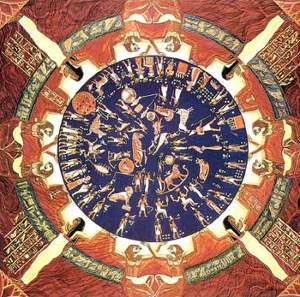
“What we would like to do for you here in this great temple of connection, of love, in the great temple of Dendera, which is also the temple of the Zodiac… is to dance zodiacly and maniacly around you with the fierce energy that is the rising feminine and to honour these men for being willing to recognise us in our true partnership emergence.


denderazodiac

Zodiac in the Temple of Hathor

“ This is the time, I believe, of the new hieros gamos, the sacred union of the evolved male and the evolved female who can face each other with glory, and no longer with ambiguity.”

So we dance wildly, in a zodiacal form, honouring our male companions on the journey. Wild dogs watching from a nearby hill bark encouragement, approval.

“Thank you for being born at the same time we are. Thank you for coming on this wild journey,” Peg says to the men. “ Thank you all of us for having lived long enough to see this day in this place with that lady of grace, Hathor, and her sister, her other aspect, which is Sekhmet, because she did so love and honour the masculine.”

Jean invites, “Let us intone a great appreciative ahhhh in their honour, and in modern parlance, Wow! Wow! Wow!”

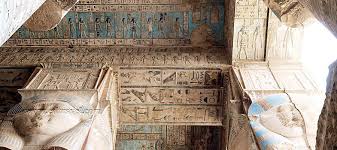
We move into the vast temple, gathering in a small chamber. Above us on the painted ceiling, the Sky Goddess, Mother Nut, awaits us, her outstretched body alive with stars.

images

Ceiling in the temple of Hathor

Peg leads an invocation: “For Hathor, for the restoration of joy in our souls, for the restoration of dancing in our feet, no matter how slowly they may move on these stones, for the restoration of greening in the world, for again and again and again the promise of love between human beings and between all life forms, the engendering love, the love that creates, so between us we create something beautiful on behalf of the world. Underneath this night sky glory, this mother of us all, who swallows the sun, and sends it through her beautiful body and gives birth to it in the day.

“This is the house, this huge temple, the house of the lady, Hathor, whose own name, as we’ve been told, means the House of Horus, so there is an engendering power of male and female here that is filled with inebriation, drunken love, drunken happiness and delight at every level.”

Jean calls us into a reflection on the inner feminine and masculine. “The House of Hathor, the House of Horus. The bridal chamber of the two here under the great begetting goddess Nut.

“Your right hand, your right foot: Horus; your left hand, your left foot: Hathor.”

Honouring the masculine and feminine sides of our bodies, we stamp our feet, gesture with our hands, first right, then left, again and again as the chant continues: Horus… Hathor… Horus… Hathor… Horus… Hathor… Horus… Hathor…

“Bring them closer,” Jean invites. “Crossing your hands across your breast. Horus and Hathor. This is the place of the marriage of the self in time with the eternal beloved. It is also the place of the marriage or the great sacred hieros gamos, of yourself with your soul, and as well as many other dyads between you, within you, of you : male and female, spirit and nature, matter and time. And I ask you the questions: Do you take onto yourself this marriage of self and soul, of male and female, of matter and spirit, of nature and time? Do you?”

And we respond “I do”.

“Will you promise to love, to honour, to support, to sustain, to keep the holy ignition bright and flaming?

“Do you agree to a life committed from this moment forth to the joy of such union?

“Do you agree to bring the joy and the power, the enormous fertility and fecundity, as we see from Mother Nut, into this world and time?….and to bring this joy and creativity into the simple things in your life as well as the middling things, as well as the great ones?

“Do you agree to be a fertile vessel of the emergence of the world that is coming now?

“Do you agree to be a spiritual channel for all that is now fertile, fecundating,
a joyful thing, a winged gift? Do you agree to be the bearer of this winged gift now?

“Then celebrate, celebrate, celebrate this union now.”

There is an explosion of sound. A joyous energy courses though the chamber, soars up past Mother Nut, moves through the great temple, delighting the lady of the house. Hathor. Herself.

(from  Called to Egypt on the Back of the Wind  by Anne Kathleen McLaughlin, Borealis Press, Ottawa, Canada 2013  http://borealispress.com)

Sophia in Egypt: Seven

After our ritual in the sanctuary of Isis, we make our way towards the shore, seeking out places to wait. Some of my companions cluster in groups, but I want to be alone, find a stone wall to sit on. Already the eastern sky is growing pearly, then striated in shades of pale mauve, peach, soft yellow, rose, preparing to welcome the sunrise.


Across the Nile, behind a crest of low hills that lie like a body outstretched, the fire appears. There is an opening between the hills at the place where the sun bursts forth. The words of Isis echo in me, “the day which shall be born from the womb of this darkness.”


There is a desire in my heart. As the sun rises, I hold it out in trust. “Let me be as you were, Isis. You were a teacher, you gave the women of ancient Egypt the song of the wheel, you taught them to weave, you gave them your love. I want to be a teacher, a weaver when I return.”The sacred moment ends, leaves me with a sense of being deeply heard.

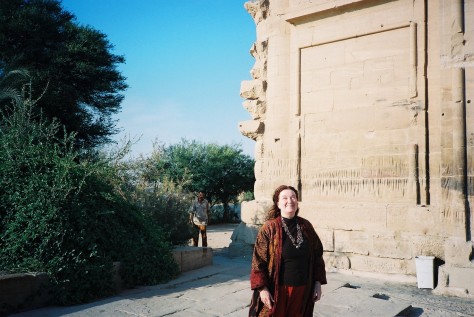
I turn to walk back up to the monuments above the shore, ready to rejoin my companions. A woman from Ireland is standing near the sun-warmed stones. We had enjoyed a conversation at our late dinner under the Nubian sky on the night we visited Abu Simbel. Now  I see in her face a mirroring of the wonder and light that are within me. We speak of our joy at being here, take one another’s photos against the island’s beauty, wanting to hold the memory.

anne-kathleen-on-philae

I notice our group clustering around Samei. He walks us around the island’s great temples and colonnades, the stone glowing gold in the morning sunlight, holding the grace of Greek and Roman design in their shapely pillars. We see massive rows of Greek columns, towering structures, architectural beauty unlike any that I have ever seen. Standing under the great kiosk of the Roman Emperor Trojan, we look up at blue sky framed by an open roof of stone.

As we walk, Samei tells us the long story of Philae’s conquest by cultures and religions. Up close, as we examine the larger than life carvings incised into the outer walls of the temples, I am appalled to see that many of the faces of the Egyptian gods and goddesses have been savaged. Samei tells us it was Christians who ruthlessly chipped and chiseled away the faces of the gods. I feel horror, deep shame, as I imagine attacking hordes of Christians arriving in boats, descending upon Egypt from where?


Taking pity on what he sees in our faces, Samei softens the story a little, explaining it was the Egyptian people themselves who, becoming converts to Christianity, wanted to destroy the faces of their ancient gods.


As though in answer to the longing I felt in the sanctuary of Isis to read the hieroglyphs, Samei gives us a beginner’s lesson. Pointing to carvings high above us on an outer wall, he shows us that beside each figure are a series of hieroglyphs beginning with his or her name. Next to Isis, the hieroglyph of a throne; next to Horus, the sun; beside Hathor, wife of Horus, the hieroglyph of a sun with two curved lines above it reads, “House of Horus.” I am five years old again, beginning to learn the sounds of the alphabet. It feels wonderful.


“Don’t try to understand,” Samei counsels, “just experience. See, in this panel, the King is speaking to the goddess and she responds.” I look at the two carved figures, each focused on the other with a reverence, an intensity that is palpable. The series of hieroglyphs between them are words. I think of the words above characters in comics only this is elegant, noble, mysterious. I ache to read what they say.


f1000002


We leave this sacred island, with its still undeciphered messages, return to the ferry, then sail home to the Moon Goddess. Only later I realize we have come here on the 13th day of November. It was the 13th day of each month that Mary chose for her appearances to the children of Fatima, Portugal.

Sophia in Egypt: Six

On the morning following our visit to Abu Simbel, we board our ship, the Moon Goddess, which will carry us from Aswan to Luxor, stopping at temples and sacred sites on the way. The first night on board, I sit on the small deck that opens off my bedroom, gazing out at the Nile shimmering under the darkening sky, reflecting on the wonders of the past days, writing in my journal. I feel as though I am swimming in love. I sleep early, to prepare for our early morning wake up call, our journey to Philae Island, sacred to Isis.

The moon in her fullness creates a golden rippled path on the Nile at four in the morning. It is not yet dawn when we disembark, stepping onto the island. The terrain is of rough stones. I have a sense of hovering trees, low full-leaved bushes, great stone arches, pillars, columns, temples, more Greek than Egyptian. We move carefully in the darkness, following Jean into one of the vast stone temples, towards its sacred heart. A cat has shown up, leads us straight to the entrance, waits as each one enters.

“We know that we are well seen and well blessed,” Jean says. “So often the holy ones show up in the form of the animal.”

The sanctuary of Isis is so tiny that we stand together like people in an elevator. Within this chamber, at the centre and towards the back, there is a stone pedestal, incised with hieroglyphs. This is where the sacred boat of the goddess Isis once rested. The surrounding walls are intricately carved with hieroglyphs as well. I see a delicate fan of outspread wings, recognize the curve and grace as just what I saw on the papyrus of the winged Isis I bought in Cairo. I see on another part of the wall a snake, and then a hawk that is the symbol of Horus, son of Isis and Osiris. I look at the outpouring of carefully inscribed wisdom, feel something of the powerlessness, the utter frustration I felt as child before I knew how to read.

In the still darkness, Jean speaks of the writings of the second century Latin writer Lucius Apuleius. “In his story, The Golden Ass, Lucius has done some very naughty magic and has been turned into an ass. After strange adventures, he meets the goddess Isis who changes him back into his own humanity, but does so by giving an epiphany of who and what she really is.

“Here is how Lucius saw her: she had an abundance of hair that fell gently in dispersed ringlets upon the divine neck. A crown of interlaced wreaths and varying flowers rested upon her head; and in its midst, just over the brow, there hung a plain circlet resembling a mirror or rather a miniature moon – for it emitted a soft clear light. This ornament was supported on either side by vipers that rose from the furrows of the Earth; and above it blades of grain were disposed. Her garment, dyed many colours, was woven of fine flax. One part was gleaming white; another was yellow as the crocus; another was flamboyant with the red of roses.

But what obsessed my gazing eyes by far the most was her pitch-black cloak that shone with a dark glow. It was wrapped around her, passing from under the right arm over the left shoulder and fastened with a knot like the boss of a shield. Part of it fell down in pleated folds and swayed gracefully with a knotted fringe along the hem. Upon the embroidered edges and over the whole surface sprinkled stars were burning; and in the centre a mid-month moon breathed forth her floating beams. Lastly, a garland wholly composed of every kind of fruit and flower clung of its own accord to the fluttering border of that splendid robe.

Such was the goddess as, breathing forth the spices of pleasant Arabia, she condescended with her divine voice to address me: “Behold, Lucius,” she said, “moved by your prayer I come to you – I , the natural mother of all life, the mistress of the elements, the first child of time, the supreme divinity, the queen of those in hell, the first among those in Heaven, the uniform manifestation of all gods and goddesses– I who govern by my nod the crests of light in the sky, the purifying wafts of the ocean, and the lamentable silences of hell – I, whose single godhead is venerated all over the earth under manifold forms, varying rites, and changing names….

“But those who are enlightened by the earliest rays of that divinity the sun, the Ethiopians, the Arii, and the Egyptians who excel in antique lore, all worship me with their ancestral ceremonies and call me by my true name, Queen Isis.

“Behold, I am come to you in your calamity. I am come with solace and aid. Away then with tears. Cease to moan. Send sorrow packing. Soon through my providence shall the sun of your salvation rise. Hearken therefore with care unto what I bid. Eternal (spirituality) has dedicated to me the day which will be born from the womb of this present darkness.”

“The day which will be born from the womb of this present darkness,” Jean repeats. “This is the place of the birth of new hope, this is the place of the birthing of new life.”

We are invited to call out all the names of Isis as we know her. I hear the names flow like a litany….Mystical Rose, Mary in all her forms, Queen of Heaven and Earth, Queen of Creation, Great Protector, Mother Holy, Star of the Sea, Great Protector, Eyes of Wisdom, Neter of the Heart, Mama Mia, Great Mother Gaia, Inanna, Tower of Ivory, Sophia, the Black Madonna….

This outpouring of names concludes with the title: “She who calls out to us to be born.”

We cry out together a great OMMMMMMM.

“That sound was like one great voice,” Samei our guide tells us when we emerge. But he looks troubled. “I am sorry. I made a mistake. I never should have allowed your full group to enter at the same time. That chamber is much too small to hold so many people at once.”

But it did.


Sophia in Egypt: Four

The next day our tour bus takes us to Saqqara on the West Bank of the Nile, about 18 miles south of Cairo. We walk over sand fields to see Old Kingdom Pyramids, some looking now like haphazard piles of stones. It is furnace-hot and we are reminded to drink lots of water.

We emerge from exploring a tomb, its walls alive with colourful scenes from the life of Mereruka, the man buried there. The sun is a cylinder of fire against a distant pyramid, then a copper coin in the darkening sky, as the earth rolls eastwards. By the time we reach the Step Pyramid, it is fully dark, and a pale moon is gathering her energy to light our way. I see a few faint stars, but do not recognize any constellations.

Our group gathers in silence before the entrance to the Step Pyramid, some five to six thousand years old, the first route of initiation in the ancient Egyptian Mystery Rites. In a rush of awareness, our reason for being in Egypt fills me. I am fully here.

With Jean Houston leading the way, we enter a long narrow passageway with tall pillars and a high roof. To our left and right, deep arches open out to the night, like the side altars in a cathedral. The wind is rising, stirring the air through which we walk, creating a pleasant coolness after the day’s heat. I reach into my backpack, pull out my shawl, glad of its warmth. I am aware of the burden of backpack, purse, water bottle, camera… items no ancient initiate would have carried. Ahead of us, Jean is emerging from the passageway, calling out to the ancient ones: Open yourselves to us as we open to you.

We are in an inner courtyard, already dusky in the failing light. Across an expanse of sand, the Step Pyramid huddles against the sky, a black shape, a mythic beast, a cave of unknowing, awaiting us. The doorway is narrow, and we enter single file.

step-pyramid

The Step Pyramid

Inside we walk along a corridor, stone walls and ceilings strengthened against calamitous collapse with steel bars, structures of wood. Here and there electric lights bless the darkness. We walk in silence, with great care, aware of danger.

Ahead, Jean is waiting for us at the edge of a sheer drop. One by one we are invited to look down. I stand at the edge, unprotected by any kind of barrier, leaning forward in order to see all the way down, some three or four stories, to the burial chamber. The cavernous darkness is unrelieved by any artificial light except that which seeps down from the high place where we stand.

I am looking into a walled chamber, the stone darkened by millennia of dampness, to the small stone floor where once Djoser’s body rested. I see only emptiness, an emptiness that is in its way more disturbing than seeing what belongs there. I see all of this in a glance, realize a glance is all I want.

 “Deep are the wells in our minds, our hearts, our being,” Jean says. “ Here we are in the land of depth, here in the oldest architectural structure known to humankind. There are many, many tunnels that bridge from here, three miles of tunnels in this the principal, first route of initiation.

“We think of so many things in which and to which we require initiation. For many of you the initiation is into new life, into new ways of being, into the emerging of what is possibly the end of times but it is also the opening time. Here in this ancient place which was the annunciation of the prophetic moment, is the annunciation that we have entered into a whole new order of civilization.

“Let us take it in our hearts that from this moment forth, from this primordial place, this great sacred mound, from which the genius of Imhotep emerged to create a structure that would be known from time out of mind, from this place of initiation, this place from which a great, great civilization grew … that this is the place from which we affirm, we say, we heartfully know that a great world civilization will begin again.We are in the ending times, we are in the closing times, we are in the opening times.

“Let us speak aloud the words of ancient Egypt: SA the creative breath of life, infusion of new life, energy, inspiration; SEKHEM the creative word of power, that can move in all of us so that we can take the fullness of our creative power into the world; SAHU the perfectly realized being within, the essence who holds the measuring, who holds the beginning and the end and the new beginning, that holds the love that moves the sun and all the stars, that creates the entrance to new life, the energy to be a vehicle of the patterning.”

We reach out to touch one another lightly, as might astronauts about to step out onto the moon.

“The new begins now,” Jean says. “The new that Teilhard de Chardin saw: The day will come when after harnessing space, the winds, tides and gravitation, we shall harness for God the energies of love. And on that day, for the second time in the history of the world, we shall have discovered fire.”                                                                                                                                        


We are again in the large sand covered courtyard, now in full darkness. Each of us is offered a candle, already lighted, to guide our way back. We are walking slowly, looking up to where the night sky is alive with stars. I am stunned at the beauty, seeing patterns as ancient as the universe, as new as my own breath.


As we enter the corridor of pillars, tears well up in my eyes, fall freely. An inner wave of emotion surges though my body, as the encounter with the Sacred Feminine in my community’s prayer room two months earlier takes on deeper meaning. I know now I am experiencing a triptych of healing that is a rebirthing: with my mother, with my community, with the Holy Feminine, whoever she is, by whatever name I call her: Mary? Isis? At this sacred moment, names do not matter.

Sophia in Egypt


Part Three

That evening, as they share their meal, she looks carefully at her Sister companions, listens to the stories they tell of nieces and nephews, of work projects. She no longer expects them to understand her project, her summer journey, but she is comforted by the talk they share.


This is the pattern for the three months of her exile. The book opens at her touch, draws her inside where the story continues. She learns that for the Ancient Egyptians, life exists at once on several planes, and time is both clock time and lasting time. In the durative realm, she may visit events that occur in other times.

f1000002

One day, wandering like Isis, she comes in her Ka spirit to the place where shepherd children met the Virgin Mary in 1917, in Fatima, Portugal. She stands and watches as the story, familiar to her since her childhood, unfolds. She sees the light on the children’s faces, sees the solemn kindly being who greets them. She waits until the being looks finally at her. Then she asks what she must ask this Holy One: “Who are you?”

The radiant being smiles and says, “You know who I am.”

Isis brings Osiris to life
and conceives of him their child Horus.
But Seth captures Osiris
and hacks his body into fourteen pieces.
These he hurls into the Nile.
Isis and Nephthys together,
helped by the creatures of the river,
regather the scattered pieces of Osiris.
He goes to rest in the underworld, where he reigns as King.


The woman sees that the scattered pieces of her life are being sought out and rejoined in this mysterious adventure. She gives her trust to the journey, to its guide. For a long while now she has been aware that this guide is not the book’s author. She names her Isis, and strange though the name feels upon her lips, she is at home with this guiding presence who has known her, it seems, forever. Isis gives the woman new names for her body (companion), her mind (weaver), her emotions (seeker) and her spirit (Christa).


In a dream, Osiris instructs his son,
now grown to manhood, to defeat Seth.
A terrible battle rages for eighty years.
Horus wins, but Isis insists
that he not destroy Seth.
Horus is enraged and pulls
his mother’s crown from her head.
After a time, Horus gains wisdom.
He turns his heart to his mother
and recrowns her Queen of Earth and Heaven.


The room holds the darkness gently, and the darkness holds the woman. The days of her exile have almost ended, and she has come to the room where many years earlier she had sat as a young novice. The room is now a place of silent prayer and it watches her as she stands alone, holding in her outstretched hands a crown of mithril silver laced with emerald.


In her Ka, her spirit, she recrowns Isis.


She waits, knowing a gift will be offered in return. But at once she is overcome by shame. All her life she has been seeker, all her life she has been asking.


“Don’t give,” she says to the Holy presence. “Take something instead.” She doesn’t know where these words, this desire, have come from. “Take away this great emptiness that has made me a beggar of love for all my life.”


Even as she asks, she is afraid, for without this need, this longing, what would draw her to the Holy?


The fear dissolves in what is happening. She is being regifted in her birth. She is gushing forth, being presented to her mother, her mother who had been so afraid. But now another is there, pouring her love into child and mother both. And the woman thinks, “She is there in my birth blood. I am born into love and must ever now have more love than I can bear. I must give it as a mother with full aching breasts.”


The room yawns, believing nothing has happened.


A few days later, the woman, living once more in ordinary time, is visiting the city when a street woman approaches, begging. Grudgingly, she opens her purse, takes out a bill. Then for the first time she looks into the eyes of the other woman.


With no clear knowledge of what she will do or say, she embraces the street woman, holds her close and says, “Your life is so beautiful. Please, please take care of yourself.”
The street woman hugs her back. Both are startled. Then the woman who spent the summer lost in a book feels an astonished delight. Something wonderful has been born.


I have given you over recent weeks this three-part story,  first written under the title, “Portal to Egypt”. The very day I completed the final edit, I received a phone call. Beyond hope, beyond even my dreams, I learned that a place had opened on the waiting list, that I would now be travelling to Egypt. In fact, almost immediately.

Nine days later I emerged from the Cairo Airport with the companions who would, with me, and guided by Jean Houston, spend eighteen days in the heart of Egypt. On our visits to tombs, pyramids and sacred sites we were often the only group present, allowing Jean to teach us, guide us, lead us in a stunning experience of the myths, the spirituality, the rituals of ancient Egypt.

You may read of the whole journey in my book Called to Egypt on the Back of the Wind (Borealis Press, Ottawa, Canada, 2014)   http://borealispress.com    Anne Kathleen McLaughlin   

f1000003

Encounter with Sophia in Egypt

It is nearly two years since I began to write these weekly blogs about the Awakening of Sophia, the Sacred Feminine Presence. This awakening is happening in many different ways, in many different places around our planet, among people of many religious backgrounds as well as people who have no connection with any formal religion. The awakening is pervasive, subtle, invitational, gentle, powerful, loving, alluring… it slips the bonds of theology, psychology, sociology. It is too elusive for formal religions to catch hold of it, to define or tame it.


Yet for those who open their hearts to its call, for those who listen with trust, who begin to follow its gentle guidance, its winding pathways, this awakening is blossoming into a relationship of loving, co-creative partnership with a Sacred Presence. This presence has been known on our Earth for Millennia. Though she was forgotten for a time, she is returning in our time because we need her and she needs us. Her Time is Now.


Joseph Campbell, writing of the presence the Sacred Feminine, notes that:
By the time of the birth of Christ, there was an exchange, not only of goods, but also of beliefs, throughout the civilized world. The principal shrine of the Goddess at that time in the world of the Near East was Ephesus, now in Turkey, where her name and form were of Artemis; and it was there, in that city, in the Year of our Lord 431, that Mary was declared to be what the Goddess had been from before the first tick of time: Theotokos (Mother of God).

Campbell adds this compelling question:

And is it likely, do you think, after all her years and millennia of changing forms and conditions, that she is now unable to let her daughters know who they are? (in Goddesses :“Mysteries of the Feminine Divine” p. xxvi; Copyright Joseph Campbell Foundation, New World Library, Novato Calif. 2013)

It is time now for me to begin to share with you my own journey with this Sacred Feminine Presence. The startling overture came by way of a Journey to Egypt. Here is the story:

It is night. It is always night when a story is told. But this night is part of the story, envelops and transforms it, embraces the ending.

The room holds the darkness gently, the darkness holds the woman. The room watches her as she stands alone, holding in her outstretched hands a crown of mithril silver laced with emerald. The woman bows before the image of Isis, then places the crown on the head of the Queen of Earth and Heaven. The room does not see Isis or the silver shimmer of the crown. It sees only the woman. It has seen so many others come and go. The room sighs, feeling bored, unaware of the story, unimpressed with its quiet ending.


image of goddess Isis

image of the Goddess Isis

To find the beginning, leave the dark room, go back three months, take the stairway to the left. On the second floor, follow the corridor signed “Sisters’ Residence”. Halfway along, on the left side, enter the room where a woman sits alone. It is years, decades, since she has lived in her community’s central house. The days and weeks before she can return to her quiet house by the river stretch before her like a featureless desert.


“I need an adventure,” she says aloud, and before the words have ceased to bounce in the room’s quiet, her eyes have found what she needs. On the shelf above her writing desk, sitting among the dozen volumes she has brought with her, is a book about Ancient Egypt, written by her guide and teacher, Jean Houston: The Passion of Isis and Osiris: Gateway to Transcendent Love . The woman reaches for the book, surprised by its weight in her hand, opens it. There is a soft sucking noise as all the air in the room vanishes and the light disappears.


The passageway is dark, the air thick with dust and something much older. The woman is aware of the need for caution, but she feels no fear. Someone is walking beside her and though she cannot see the face, she knows the voice of her guide who whispers, “Hurry. The storyteller is waiting.”


Amber light draws them forward into a small cave-like room. Some dozen others, children, women and men, are seated in a circle around a wizened woman robed entirely in red. The old one smiles as they enter, gesturing towards cushions on the floor.

The storyteller lifts her head, closes her eyes and begins to speak in a voice both intimate and eons away, as though she is reading a story painted on the walls of a royal tomb in Ancient Egypt. Her words fall like bright jewels upon the room’s silence.

There is at first only One, Atum, the Perfect One.
But Atum is lonely, and creates the story.
Atum makes Air and Wetness, Earth and Sky.
Geb, the Earth and Nut, the Sky become lovers.
Nut gives birth to Ra, the sun
and Thoth, the silver moon.

The guide whispers that they must leave now. “Write down all that you saw and heard and understood. In the morning, go outside while it is still dark. You must see the sunrise.”
Then she is gone and the woman steps out of the book, back to her room.


Next morning, the sky is still black as the woman walks outside. A suffused light swallows the darkness. The woman feels both expectant and unsure, as people must have felt as they waited for the dawn millennia ago. It has come before, but can she be certain it will come again? Light is embracing the earth, drawing trees, low bushes, the tall flowers into silhouette. Earth herself waits, as the woman waits, hopeful, patient. And then it comes, a sliver of fire in the eastern sky, a vermillion burning. The woman and the earth together move under its passionate presence. It fills their gaze with rose red rapture. This is Holy, the woman thinks, for the first time. She looks around the mist-soaked morning and wonders how anyone could despair, as she herself so often does.

images

She goes indoors, makes coffee, hurries to her room, climbs back into the book.

(to be continued)