Category Archives: Sophia as Archetype of Spiritual Wisdom

Merton’s Prayer-poem to High Wisdom, “Hagia Sophia”: Hours of Terce and Compline

June 24, 2018

Hagia Sophia is a prose poem that celebrates divine Wisdom as the feminine manifestation of God.Structured in four parts based on the canonical hours of prayer, it is Merton’s most lyrical expression of “Christ being born into the whole world,”especially in that which is most “poor” and “hidden.” It is a hymn of peace.

(Christopher Pramuk in Sophia: the Hidden Christ of Thomas Merton Liturgical Press, Collegeville, Minnesota, 2009 )

III. High Morning. The Hour of Terce.

The Sun burns in the sky like the Face of God, but we do not know his countenance as terrible.

His light is diffused in the air, and the light of God is diffused by Hagia Sophia.

We do not see the Blinding One in black emptiness. He speaks to us gently in ten thousand things, in which His light is one fullness and one Wisdom.

Thus He shines not on them but from within them. Such is the loving kindness of Wisdom.

F1000009

All the perfections of created things are also in God; and therefore He is at once Father and Mother.

As Father He stands in solitary might surrounded by darkness.

As Mother His shining is diffused, embracing all his creatures with merciful tenderness and light. The Diffuse Shining of God is Hagia Sophia.

We call her “glory.” In Sophia His power is experienced only as mercy and as love.

(When the recluses of fourteenth century England heard their Church Bells and looked out upon the wolds and fens under a kind sky, they spoke in their hearts to “Jesus our Mother.” It was Sophia that had awakened their childlike hearts.)

Perhaps in a certain very primitive aspect Sophia is the unknown, the dark, the nameless Ousia.

Perhaps she is even the Divine Nature, One in Father, Son and Holy Ghost.

And perhaps she is infinite light unmanifest, not even waiting to be known as Light. This I do not know.

Out of the silence Light is spoken. We do not hear it or see it until it is spoken.

In the Nameless Beginning, without Beginning, was the Light. We have not seen this Beginning.

I do not know where she is, in this Beginning. I do not speak of her as a Beginning, but as a manifestation.

Now the Wisdom of God, Sophia, comes forth, reaching from “end to end mightily.”

She wills to be also the unseen pivot of all nature, the center and significance of all the light that is in all and for all.

That which is poorest and humblest, that which is most hidden in all things is nevertheless most obvious in them,and quite manifest, for it is their own self that stands before us, naked and without care.

Sophia, the feminine child, is playing in the world, obvious and unseen, playing at all times before the Creator. Her delights are to be with the children of men.

She is their sister. The core of life that exists in all things is tenderness, mercy, virginity, the Light, the Life considered as passive, as received,as given, as taken, as inexhaustibly renewed by the Gift of God.

Sophia is Gift, is Spirit, Donum Dei. She is God-given and God Himself as Gift.

God as all, and God reduced to Nothing: inexhaustible nothingness…. Humility as the source of unfailing light.

Hagia Sophia in all things is the Divine Life reflected in them, considered as a spontaneous participation, as their invitation to the Wedding Feast.

Sophia is God’s sharing of Himself with creatures. His outpouring, and the Love by which He is given, and known, held and loved.

She is in all things like the air receiving the sunlight. In her they prosper. In her they glorify God. In her they rejoice to reflect Him.

In her they are united with him. She is the union between them. She is the Love that unites them.

She is life as communion, life as thanksgiving, life as praise, life as festival, life as glory.

Because she receives perfectly there is in her no stain. She is love without blemish, and gratitude without self-complacency.

All things praise her by being themselves and by sharing in the Wedding Feast. She is the Bride and the Feast and the Wedding.

The feminine principle in the world is the inexhaustible source of creative realizations of the Father’s glory.

She is His manifestation in radiant splendor! But she remains unseen, glimpsed only by a few. Sometimes there are none who know her at all.

Sophia is the mercy of God in us.

She is the tenderness with which the infinitely mysterious power of pardon turns the darkness of our sins into the light of grace.

She is the inexhaustible fountain of kindness, and would almost seem to be, in herself, all mercy.

So she does in us a greater work than that of Creation: the work of new being in grace, the work of pardon, the work of transformation from brightness to brightness….

She is in us the yielding and tender counterpart of the power, justice, and creative dynamism of the Father.

When you have read through Merton’s reflective prayer for the Hour of Terce, I invite you to re- read it from your own heart.

Seek an image or a phrase or a line that draws you. See how it resonates with your experience.

Spend time with just the small piece of the poem that chose you. You may wish to paint or draw or write of this afterwards.


IV. Sunset. The Hour of Compline. Salve Regina.

 

mount-sinai2-sunrise

Now the Blessed Virgin Mary is the one created being who enacts and shows forth in her life all that is hidden in Sophia.

Because of this she can be said to be a personal manifestation of Sophia, Who in God is Ousia rather than Person.

Natura in Mary becomes pure Mother. In her, Natura is as she was from the origin from her divine birth.

In Mary Natura is all wise and is manifested as an all-prudent, all-loving, all-pure person: not a Creator, and not a Redeemer, but perfect Creature, perfectly Redeemed, the fruit of all God’s great power, the perfect expression of wisdom in mercy.

It is she, it is Mary, Sophia, who in sadness and joy, with the full awareness of what she is doing, sets upon the Second Person, the Logos, a crown which is His Human Nature. Thus her consent opens the door of created nature, of time, of history, to the Word of God.

God enters into His creation. Through her wise answer, through her obedient understanding, through the sweet yielding consent of Sophia,

God enters without publicity into the city of rapacious men.

She crowns Him not with what is glorious, but with what is greater than glory: the one thing greater than glory is weakness, nothingness, poverty.

She sends the infinitely Rich and Powerful One forth as poor and helpless, in His mission of inexpressible mercy, to die for us on the Cross.
The shadows fall. The stars appear. The birds begin to sleep. Night embraces the silent half of the earth.

A vagrant, a destitute wanderer with dusty feet,finds his way down a new road. A homeless God, lost in the night, without papers, without identification, without even a number, a frail expendable exile lies down in desolation under the sweet stars of the world and entrusts Himself to sleep.

(Thomas Merton 1962)


Merton’s Poem to Sophia

Hagia Sophia is a prose poem that celebrates divine Wisdom as the feminine manifestation of God. Structured in four parts based on the canonical hours of prayer, it is Merton’s most lyrical expression of “Christ being born into the whole world,” especially in that which is most “poor” and “hidden.” It is a hymn of peace. Christopher Pramuk in Sophia: the Hidden Christ of Thomas Merton Liturgical Press, Collegeville, Minnesota, 2009

 Reflecting on Merton’s poem to Sophia, Pramuk writes:

What would it feel like to walk and pray with a God who is not fixed like a Great Marble Statue in the elite or far-away spaces where power is exercised but who enters without reserve into the stream of our humble tasks, decisions, and everyday commitments? Such a God—Sophia—would ignite our hope, the capacity to breathe, and to imagine again.

“Gentleness comes to him when he is most helpless and awakens him, refreshed, beginning to be made whole. Love takes him by the hand, and opens to him the door to another life, another day.”

Chris-Pramuk-Merton-and-Hagia-Sophia-e1420820188367

O Wisdom, bear us this day in the silence of your friendship, and help us awaken healing and hope in Your world, beginning with our very selves. O come, Sophia, come.

In an earlier reflection we looked at The Hour of Lauds. The second part of Merton’s poem is based on the Hour of Prime:

The Hour of Prime (prayer at the first hour of daylight: 6 am)

O blessed, silent one, who speaks everywhere!

We do not hear the soft voice, the gentle voice, the merciful and feminine.

We do not hear mercy, or yielding love, or nonresistance, or non-reprisal. In her there are no reasons and no answers. Yet she is the candor of God’s light, the expression of His simplicity.

We do not hear the uncomplaining pardon that bows down the innocent visages of flowers to the dewy earth. We do not see the Child who is prisoner in all the people, and who says nothing. She smiles, for though they have bound her, she cannot be a prisoner. Not that she is strong, or clever, but simply that she does not understand imprisonment.

The helpless one, abandoned to sweet sleep, him the gentle one will awake: Sophia.

All that is sweet in her tenderness will speak to him on all sides in everything, without ceasing, and he will never be the same again. He will have awakened not to conquest and dark pleasure but to the impeccable pure simplicity of One consciousness in all and through all: one Wisdom, one Child, one Meaning, one Sister.

The stars rejoice in their setting, and in the rising of the Sun. The heavenly lights rejoice in the going forth of one man to make a new world in the morning, because he has come out of the confused primordial dark night into consciousness. He has expressed the clear silence of Sophia in his own heart. He has become eternal.

Though at Lauds, we have been awakened by Sophia, “refreshed, beginning to be made whole”, by the Hour of Prime, Pramuk notes, “Wisdom’s invitation has been roundly spurned. In this hour of “prime efficiency” We do not hear the soft voice, the gentle voice, the merciful and feminine. As Merton writes elsewhere, “We face our mornings as (people) of undaunted purpose” and we do not hear the blessed, silent one, who speaks everywhere.

Pramuk suggests that the poem questions us: “Can anyone still hear the song of Nature made wise by God’s Art and Incantation? Who sees the uncomplaining pardon that bows down the … flowers to the dewy earth? Yet Sophia remains the candor of God’s light, the expression of His simplicity, recreating herself in generous splendor – natura naturans—moment to moment, year after year, despite human disregard and exploitation.” (Pramuk in Sophia p. 199)


June2015 033

the uncomplaining pardon that bows down the … flowers to the dewy earth

Pramuk notes that the image of “the Child”, one that Merton returns to often in his writings is  “the secret beauty within every person’s heart, the core of their reality, the person that each one is in God’s eyes.”  (p.200)

The Child has been taken captive and yet:  She smiles, for though they have bound her, she cannot be a prisoner.

Pramuk takes this further: No matter how badly the divine image in humanity has been mocked and desecrated, there remains an elemental goodness and divine light rising up in the hidden fabric of countless lives that can never be extinguished. Often in conditions that would merit hatred and despair, love abounds and overflows in human hearts, resisting “the Unspeakable”. As Merton professes in an impromptu prayer offered in Calcutta, shortly before his death, “Love has overcome. Love is victorious. Amen.” (p.201)

Describing the ending of The Hour of Prime as “lyrical”, Pramuk writes that it invokes “the Spirit of gentleness and creativity, truth and nonviolence that lives hidden in all things. This fount of action and joy – one Wisdom, one Child, one Meaning, one Sister flows out from the roots of all created being and awaits our yielding consent. When we say yes, our lives become the life story of God, and our simple acts of love fill the vast expanses of the universe.  (p. 202) (phrases in italics from Merton’s Disputed Questions 1960)

The stars rejoice in their setting, and in the rising of the Sun. The heavenly lights rejoice in the going forth of one man to make a new world in the morning, because he has come out of the confused primordial dark night into consciousness. He has expressed the clear silence of Sophia in his own heart. He has become eternal.

Sophia and Teilhard de Chardin

Born in 1881, Pierre Teilhard de Chardin lived, studied, worked and wrote mainly in the first half of the twentieth century. As a scientist, he knew Darwin’s work in Evolution; as a paleontologist, he spent time excavating the story of evolution inscribed within the earth; as a mystic he was captivated with the wonder of an unfinished universe being drawn from within into a radiant future by a sacred presence of love.

Teilhard was convinced that until theology fully embraced the concept of an evolving universe, it would remain inadequate, crippled by its outdated worldview. He wrote: “Who will at last give evolution its own God?”

In the sixty plus years since Teilhard’s death, science has taken massive leaps of understanding, and theology is only beginning to catch up. In From Teilhard to Omega (edited by Ilia Delio, Orbis Books, Maryknoll, New York 2014), thirteen scholars take up Teilhard’s challenge.

“Sophia: Catalyst for Creative Union and Divine Love” by Kathleen Duffy, SSJ, offers us a glimpse into Teilhard’s relationship with Sophia.

Though a dedicated scientist, Teilhard calls on his mystic and poetic gifts to describe divine love at work in the cosmos. In his book Writings in Time of War (translated by Rene Hague, London: Collins, and New York: Harper & Row, 1968), Teilhard writes of a feminine presence drawn from the wisdom literature of the Bible, particularly the Book of Proverbs, (8: 22-31).

Teilhard’s poem opens at the beginning of time, at the moment when Sophia is embedded into the primordial energy that is already expanding into the space-time of the early universe. Only half formed and still elusive, she emerges as from the mist, destined to grow in beauty and grace (WTW, 192). As soon as the first traces of her presence become apparent, she assumes her mandate to nurture creation, to challenge it, to unify it, to beautify it, and ultimately to lead the universe back to God. With this mission as her guide, she attends to her work of transforming the world, a world alive with potential. (Duffy p. 27)

Duffy reweaves Teilhard’s poem, working through its shining threads new insights from science, wisdom literature and the work of many “who have contemplated the divine creativity at work at the heart of matter”.  Duffy names the feminine presence in Teilhard’s poem “Sophia”, from the Greek word for Wisdom.


images

“Who then is Sophia?” Duffy asks. Her magnificent response to this question is worth the price of the whole book. Here are segments:

She is the presence of God poured out in self-giving love, closer to us than we are to ourselves, ever arousing the soul to passion for the Divine. From the very depths of matter, she reveals herself to us as the … very nature of God residing within the core of the cosmic landscape.

Attempting always to capture our attention, Sophia peers out at us from behind the stars, overwhelms us with the radiance of a glorious sunset, and caresses us with a gentle breeze….Shining through the eyes of the ones we love, she sets our world ablaze.

Sophia is the mercy of God in us….She sits at the crossroads of our lives, ever imploring us to work for peace, to engage in fruitful dialogue, and to find new ways of connecting with the other. She longs to open our eyes to the presence of pain and suffering in the world, to transform our hearts and to move us to action. (pp. 31-32)

Duffy says that Teilhard experienced this presence “with nature, with other persons, and with the Divine”:

He began gradually to recognize her everywhere — in the rocks that he chiselled, in the seascapes and landscapes that he contemplated, and in the faces of the dying soldiers to whom he ministered during the war….Teilhard came to know Sophia as the cosmic Love that is holding all things together. (p. 33)

Teilhard came to understand that Sophia can be known “only in embodied human actions”.

Duffy concludes her illuminative essay with these words:

Sophia was the source of Teilhard’s life…. Her constant care for creation during so many billions of years gave him confidence she would continue to be faithful… Teilhard vowed to steep himself in the sea of matter, to bathe in its fiery water, to plunge into Earth where it is deepest and most violent, to struggle in its currents, and to drink of its waters. Filled with impassioned love for Sophia, he dedicated himself body and soul to the ongoing work needed to transform the cosmos to a new level of consciousness and to transformative love. (p. 34)


Merton’s Love Affair with Wisdom-Sophia


As I continue to read Christopher Pramuk’s Sophia: The Hidden Christ of Thomas Merton (Liturgical Press, Collegeville, Minnesota, 2009), I am moved by Merton’s growing, deepening relationship with Wisdom/Sophia. I am discovering that the experience was for him more than an idea, a theological construct. It was for Merton an encounter on the human/divine level that each of us knows as our reality.

 Pramuk writes:”One has only to read the journals from 1957 through 1961 to be struck by the frequency and poignancy with which the Wisdom figure of the Hebrew Scriptures began to haunt Merton’s religious imagination, thanks largely to his close study of Russian Orthodox sophiology . …Merton recognizes in sophiology not merely a speculative theology but a bold theological anthropology, a view of human life, history and culture as bound together in the ‘life story of God.’ ”


Thomas Merotn photo

Thomas Merton

Merton wrote: Our life is a powerful Pentecost in which the Holy Spirit, ever active in us, seeks to reach through our inspired hands and tongues into the very heart of the material world created to be spiritualized…  (Pramuk p. 153)

As we saw earlier, Sophia came to Merton in a dream on February 28, 1958 and later on a crowded city street in Louisville. Here is Merton’s fuller account of that experience, shared in a letter to Boris Pasternak (Russian poet, novelist, author of Doctor Zhivago):

“Shall I perhaps tell you how I know Lara, where I have met her?”  Merton asks, then tells Pasternak of his dream:

a very young Jewish girl…embraced me so that I was moved to the depths of my soul. I learned that her name was “Proverb,” which I thought very simple and beautiful. And also I thought: “She is of the race of Saint Anne.” I spoke to her of her name, and she did not seem to be proud of it, because it seemed that the other young girls mocked her for it. But I told her that it was a very beautiful name, and there the dream ended. A few days later I happened to be in a nearby city, which is very rare for us. I was walking alone in the crowded street and suddenly saw that everybody was Proverb and that in all of them shone her extraordinary beauty and purity and shyness, even though they did not know who they were and were perhaps ashamed of their names – because they were mocked on account of them. And they did not know their real identity as the Child so dear to God, who, from the beginning was playing in His sight all days, playing in the world. (Pramuk, p. 150)

A week after his dream of “Proverb”, Merton writes what Pramuk describes as “a love letter of surprising intimacy and devotion”:

How grateful I am to you for loving in me something which I thought I had entirely lost, and someone who, I thought, I had long ago ceased to be… I must be careful what I say, for words cannot explain my love for you, and I do not wish, by my words, to harm that which in you is more real and more pure than in anyone else in the world – your lovely spontaneity, your simplicity, the generosity of your love… In your marvelous, innocent, love you are utterly alone; yet you have given your love to me, why I cannot imagine…Dearest Proverb, I love your name, its mystery, its simplicity and its secret, which even you yourself seem not to appreciate. ( p. 157)

On March 18, 1958, the “Louisville Epiphany”, (as it has come to be known) followed. Pramuk writes that Merton continued to reflect upon the event:

As he later recasts the account in Conjectures of a Guilty Bystander, Merton is “suddenly overwhelmed with the realization that I loved all those people, even though we were total strangers.” Proverb, it seems, had reclaimed in Merton an innocence that he thought he “had entirely lost”, awakening in him a new capacity to “see” and embrace that which remains pure in every person…that “point or spark which belongs entirely to God,” which shines “like a pure diamond, blazing with the invisible light of heaven.”

Pramuk continues:” In the original journal account Merton reflects on his feeling for the women he sees in light of his vow of chastity: It is as though by chastity I had come to be married to what is most pure in all the women of the world…each one secret and good and lovely in the sight of God and to taste and sense the secret beauty of their girl’s hearts as they walked in the sunlight.”

(T)he central theme of Merton’s realization at Fourth and Walnut is the “secret beauty” and “innocence” not only of the women passing by but of all persons, or human beings as such. If any one moment can mark the birth of Merton’s far-reaching Christian humanism, this is it: Thank God! Thank God! I am only another member of the human race, like all the rest of them.” (Pramuk p. 158)

The incursion of Sophia into Merton’s life led to a recovery of a sense of himself which he thought lost. His writings would do the same for others:

“Her subsequent remembrance in his writings is bound to Christianity’s communal memory and experience of Jesus Christ, …her dawning presence in his consciousness also reflects his desire to make old things new, to reinvigorate a biblical and poetic vision of life in which the individual is not lost in the cosmos and in society but found in them. Like Heschel,* Merton sought to awaken the experience of God in a people for whom, like a tree torn from the soil or a river separated from its source, the term “God,” and perhaps even “Christ” had become a name, but no reality.” (Pramuk p. 147, citing Abraham Joshua Heschel in Man’s Quest for God, New York, Scribner’s, 1954)

Merton would write: “If only they could all see themselves as they really are. If only we could see each other that way all the time.” (Pramuk, p.159)

images


Sophia and Thomas Merton

A mysterious presence introduces herself to us in the Hebrew Scriptures without revealing her name. In the Book of Proverbs, she tells us:

Yahweh created me when his purpose first unfolded,
before the oldest of his works.
From everlasting I was firmly set,
From the beginning, before earth came into being.
The deep was not, when I was born,
there were no springs to gush with water.
Before the mountains were settled,
before the hills, I came to birth;
….
I was by his side, a master craftsman,
delighting him day after day,
ever at play in his presence,
at play everywhere in the world…

Solomon speaks of this presence as “Wisdom”(Hebrew, “Chochma”, Greek, “Sophia”)

Although She is one,
She does all things.
Without leaving Herself
She renews all things.
Generation after generation She slips into holy souls
Making them friends of God, and prophets,
for God loves none more than they who dwell with Wisdom.
(Wisdom of Solomon 7: 27-28)

While in Louisville Kentucky attending the “Festival of Faiths” in late April, a visit to Thomas Merton’s Hermitage on the grounds the Abbey of Gethsemane, reawakened my fascination with this man whose writings reveal him to be poet and prophet, mystic and theologian.

P1010334

Thomas Merton’s Hermitage on the grounds of the Abbey of Gethsemane

Yet Merton remained an alluringly earth-bound human being, passionately engaged with the darkness and suffering of the 1960’s, seeking to create within his own being a wholeness between East and West, Christianity and other faiths, black and white, feminine and masculine aspects of God.

This latter aspect of his life and work was the greatest surprise of my re-enchantment with Merton. It arrived by way of a book: Christopher Pramuk’s Sophia: The Hidden Christ of Thomas Merton (Liturgical Press, Collegeville, Minnesota, 2009)

Today I sat by the river to read the opening chapter of Pramuk’s book. When I began to write, I called this Reflection, “Thomas Merton and Sophia”. But that didn’t seem right. I changed it to “Sophia and Thomas Merton”. Already in Chapter One I had discovered that the initiative in the relationship came from Sophia who “slips into holy souls/ making them friends of God and prophets.”

So how did Sophia slip into Merton’s soul? Pramuk tells us it happened in the final decade of his life, before his sudden death in1968. Sophia came to him in dreams, and in a variety of human presences…

First, there was a dream (February 28, 1958) in which a young Jewish girl named “Proverb” came to embrace him….
She then came to him in the crossroads of a great city ( March 18, 1958)

Of this epiphany Merton would later write:

“In Louisville, at the corner of Fourth and Walnut, in the center of the shopping district, I was suddenly overwhelmed with the realization that I loved all these people. That they were mine and I theirs, that we could not be alien from one another even though we were total strangers…There is no way of telling people that they are all walking around shining like the sun.” (Thomas Merton Conjectures of a Guilty Bystander)

Pramuk continues:
(Sophia) found him again in the burning woods near Gethsesmane (March 19, 1959), this time in the face of local farm children, “poor little Christs with…sweet, sweet voices.” Over a year later (July 2, 1960) on the Feast of the Visitation, she came in the guise of a nurse, whose gentle whispers awakened him one morning as he lay in the hospital.

Merton writes:
“… and it was like awakening for the first time from all the dreams of my life – as if the Blessed Virgin herself, as if Wisdom had awakened me. We do not hear the soft voice, the gentle voice, the feminine voice, the voice of the Mother: yet she speaks everywhere and in everything. Wisdom cries out in the market place — ‘If anyone is little, let him come to me’.”

Pramuk cites two passages in Merton’s Journal in the winter of 1965 that show his nearness to Sophia:
Merton wrote on his fiftieth birthday, January 31, 1965… from Wisdom 8:16: …”When I go home, I shall take my ease with her, for nothing is bitter in her company, when life is shared with her there is no pain, nothing but pleasure and joy.” Though he complains of suffering bitterly from the “fierce cold all night, certainly down to zero,” he expresses joy in the fact that “I woke up in a hermitage!” Then hearkening to the Wisdom text, Merton wonders: “But what more do I seek than this silence, this simplicity, this ‘living together with wisdom?’ For me this is nothing else…”

(February 4, 1965) “Last night I had a curious and moving dream about a “Black Mother.” I was in a place (where? Somewhere I had been as a child…) and I realized that I had come there for a reunion with a Negro foster mother whom I had loved in my childhood. Indeed, I owed, it seemed, my life to her love so that it was she really, and not my natural mother, who had given me life. As if from her hand had come a new life and there she was. Her face was ugly and severe, yet great warmth came from her to me, and we embraced with great love (and I with much gratitude). What I recognized was not her face but the warmth of her embrace and of her heart, so to speak. We danced a little together, I and my Black Mother, and then I had to continue the journey I was on…”

Pramuk comments that what Merton recognized in this dream was the same “presence”, he was striving to recognize in everyone: the warmth of her embrace and of her heart.

… (O)ne of the most striking themes in all these encounters is Merton’s experience of himself as the object of Wisdom’s attention. Her embrace is transitive… breaking in “from her to me,” yet coming in the form of this concrete person or thing before him right now: the flight of an escaping dove, a lone deer feeding among the trees outside the hermitage, the faces of passersby on a busy street corner. For she is “playing in the world, obvious and unseen, playing at all times before the Creator.” (Pramuk: pp.13-16)

images

Thomas Merton and Sophia

While in Louisville Kentucky to attend the “Festival of Faiths” in late April, I had the good fortune to visit the Hermitage in the woods near the Abbey of Gethsemane where  Thomas Merton ( Father Louis) would go for times of solitude and prayer, nature walks and contemplation which nourished his soul and inspired his writings on Spirituality and Justice.

P1010334

Thomas Merton’ s Hermitage in the woods near the Monastery of Gethsemane, Kentucky

Though I knew of Merton’s life and writings, of his fierce cries for Social Justice, his passionate opposition to the Vietnam War, while visiting Gethsemane I learned of a poignant footnote to his life. In December of 1968, Merton had been on a pilgrimage, his quest to integrate insights of both Western and Eastern religious thought. While attending a monastic conference in Bangkok Thailand, Merton died suddenly. His body was transported home to the US in a plane carrying soldiers who had died in the Vietnam war.

But I was to learn something that was of immense importance to my own quest for the Sacred Feminine Presence: Merton had written compellingly of Sophia. I brought home from the Festival of Faiths Christopher Pramuk’s book: Sophia: The Hidden Christ of Thomas Merton (Liturgical Press, Collegeville, Minnesota, 2009)

Pramuk tells of a visit made by Merton to an artist friend, Victor Hammer, in nearby Lexington. Hammer was working on a triptych with a  central panel showing the boy Christ being crowned by a dark-haired woman. When Merton asked his friend who the woman was, the artist replied that he did not yet know. Merton said, “She is Hagia Sophia, Holy Wisdom, who crowns Christ.”

At Hammer’s request, Merton expanded on this insight in a letter written May 14, 1959:

The first thing to be said, of course, is that Hagia Sophia is God Himself. God is not only a Father but a Mother….(T)o ignore this distinction is to lose touch with the fullness of God. This is a very ancient intuition of  reality which goes back to the oldest Oriental thought…. for the “masculine-feminine” relationship is basic to all reality — simply because all reality mirrors the reality of God.

Pramuk continues to quote from this letter where he senses Merton writing in a stream of consciousness as though his friend’s question had opened ” a kind of conceptual and imaginative floodgate”:

Over the next five or six paragraphs, he identifies Sophia as “the dark, nameless Ousia (Being)” of God, not one of the Three Divine Persons, but each “at the same time, are Sophia and manifest her.”  She is “the Tao,the nameless pivot of all being and nature …that which is the smallest and poorest and most humble in all.” She is “the ‘feminine child’ playing before Him at all times, playing in the world.’ (Proverbs 8) ”  Above all, Sophia is unfathomable mercy, made manifest in the world by means of the incarnation, death and resurrection of Jesus Christ.   

Merton identifies Sophia as God’s love and mercy coming to birth in us.”In the sense that God is Love, is Mercy, is Humility, is Hiddenness, He shows Himself to us within ourselves as our own poverty, our own nothingness (which Christ took upon Himself, ordained for this by the Incarnation in the womb of the Virgin) ( the crowning in your picture), and if we receive the humility of God in our hearts, we become able to accept and embrace and love this very poverty which is Himself and His Sophia.” 

(Christopher Pramuk : Sophia: The Hidden Christ of Thomas Merton pp.193-4. Quotes from Merton are from“Witness to Freedom”: The Letters of Thomas Merton in Times of Crisis, ed. William H. Shannon ( New York: Harcourt Brace, 1995)  

In 1962, six years before his death, Merton composed a poem to “Hagia Sophia/ Holy Wisdom” in the form of the Monastic Office, a  Prayer recited in Community to mark the times of day: Dawn: The Hour of Lauds; Early Morning : The Hour of Prime; High Morning; The Hour of Tierce; Sunset: The Hour of Compline.

Here is how Merton’s  Prayer at Dawn begins:

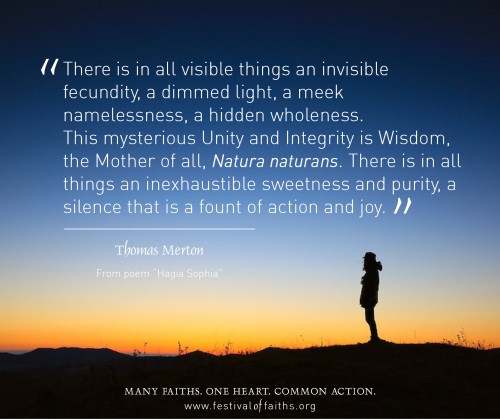
There is in all visible things an invisible fecundity, a dimmed light, a meek namelessness, a hidden wholeness. This mysterious Unity and Integrity is Wisdom, the Mother of all, Natura naturans. There is in all things an inexhaustible sweetness and purity, a silence that is a fount of action and joy. It rises up in wordless gentleness  and flows out to me from the unseen roots of all created being, welcoming me tenderly, saluting me with indescribable humility. This is at once my own being, my own nature, and the Gift of my Creator’s Thought and Art within me, speaking as Hagia Sophia, speaking as my sister, Wisdom.  

I am awakened, I am born again at the voice of this my Sister, sent to me from the depths of the divine fecundity.

P1010324

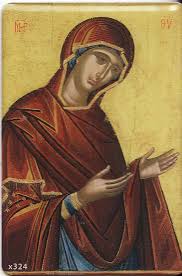
Icon of Sophia, Holy Wisdom, in Merton’s Hermitage Chapel

Our Journey Towards Radiance: Part Three

1513851_10155814472155285_2883105051202678217_n
Transmutation, as we have seen, is slow, gradual change occurring over time.

Transformation is sudden. The Irish poet WB Yeats expresses it well:

… changed, changed utterly. A terrible beauty is born.

When we experience transformation in our lives, we need to look for guidance from the mystics, writers and poets who have experienced it. We welcome beauty into our lives. We have within us a visionary process which is a source for the re-coding of the planet. All the codings for the life of the unborn future are available in us. We are the recoding, the reset button.

The twentieth century mystic Caryll Houselander writes of her experience of transformation. After a long illness, suffering as well from scrupulosity, she had an experience of God that removed her obsessive fears and gave her a profound peace:

It was in the evening, I think. The room was dark, and the flames of firelight dancing on the wall seemed almost to cause me pain when I opened my eyes….I no longer attempted to translate my torment as particular sins; I had realized in a dim, intuitive way that it was not something I had done that required forgiveness, but everything I was that required to be miraculously transformed.

Interrelatedness: Rather than removing us from concern for others, the experience of transformation fires us with a vision of caring, with a sense of the whole, an invitation from the cosmos to see all of life as interconnected. This is how the mystics see life, how today’s physicists see life. It is what the astronauts experienced when they saw earth from space:

From space I saw Earth –indescribably beautiful
with the scars of national boundaries gone.
Muhammad Ahmad Faris Syria

During a space flight, the psyche of each astronaut is reshaped.
Having seen the sun, the stars and our planet, you become more full of life, softer.
You begin to look at all living things with greater trepidation
and you begin to be more kind and patient with the people around you.
At any rate, that is what happened to me. 
Boris Volynov, USSR

We need an overarching vision that is so simple and alluring that we can see what the world can be…. What does a world look like that really works for everyone? This is an incredible grace and opportunity for us, born on this beautiful planet at this time in history.


Radiance: The sun gives off messages as gravitons that pull us to the sun; the sun interacts with the moon and new gravitons feed us; the earth responds with a flood of gravitons…. We are frozen light…

Brian Swimme says that every being you meet holds fourteen billion years of radiance. Radiance is the primary language of the universe. We develop a container that can respond to the beauty of the other. We enter into resonance with the radiance of the universe, and that is the primary form of prayer. You become the radiance that is flooding the world.

Radiance, the tenth Power of the Universe, is celebrated in the Book of Wisdom where Solomon says of the Wisdom/Sophia Presence: I loved her more than health or beauty, preferred her to the light, since her radiance never sleeps. (Jerusalem Bible 7: 10)
She is indeed more splendid than the sun, she outshines all the constellations; compared with light she takes first place, for light must yield to night, but over Wisdom, evil can never triumph.(7: 29,30)

Teilhard de Chardin, the French Jesuit priest and paleontologist who died in 1955, wrote:

Throughout my whole life during every moment I have lived, the world has gradually been taking on light and fire for me, until it has come to envelop me in one mass of luminosity, glowing from within…The purple flash of matter fading imperceptibly into the gold of spirit, to be lost finally in the incandescence of a personal universe…This is what I have learnt from my contact with the earth- the diaphany of the divine at the heart of a glowing universe, the divine radiating from the depth of matter a-flame. (The Divine Milieu)

Hildegard of Bingen, the astonishing 12th c. abbess and genius, tells us this:

From my infancy until now, in the 70th year of my age, my soul has always beheld this Light, and in it my soul soars to the summit of the firmament and into a different air….The brightness which I see is not limited by space and is more brilliant than the radiance around the sun…. I cannot measure its height, length, breadth. Its name, which has been given me, is “Shade of the Living Light”….Within that brightness I sometimes see another light, for which the name “Lux Vivens” (Living Light) has been given me. When and how I see this, I cannot tell; but sometimes when I see it, all sadness and pain is lifted from me, and I seem a simple girl again, and an old woman no more!

And so, empowered by the Universe itself, we shine on!


Wisdom in the Universe

Evolutionary Cosmologist Brian Swimme writes that “the cosmological Powers of the Universe are coursing through us moment by moment. To become aware of these powers is to touch the Source of Life.”
1513214_10155814472145285_5248696702093065973_n
In his DVD set “The Powers of The Universe”, Swimme offers this summary of the ten powers, held together in Seamlessness:

Centration: the coming together in one life of the entire evolutionary development

Allurement: what holds it all together; in societies, the values and ideals that help them cohere

Emergence: the Universe is a story, not a place or a thing, always bringing forth newness

Homeostasis: the Universe holds onto its achievements: the oyster shell – it works!

Cataclysm: the Universe sometimes destroys its achievements purposely in addition to accidental destruction

Synergy: complexification as things come together; diversity creates more complex systems

Transmutation: newness begins, builds

Transformation: always, always newness is being created

Inter-relatedness: when diversity and commonality come together, as now on the planet: people are discovering diverse gifts, beginning to have common concerns

Radiance: a new evolutionary reality, as Teilhard de Chardin foresaw, something beyond what has been until now.

Out of seamlessness, a person is here (centration) seeing the universe involved in her unfolding. Through allurement, she begins to pursue dreams which emerge in relationships. Through homeostasis she finds her role in society, where she fits in …

But then cataclysm arrives where things fall apart… marriage, health, job… One way or another, the person’s cataclysm will relate to the present cataclysm of the planet. The collapse of what one thought was real eliminates illusion, a glimmer of the need for synergy, a larger vision for the community and for others.

Transmutation comes from awareness that I need to change parts of my life (consumerism? militarism? competition?) This can lead to a deep unlearning, a metanoia, metamorphosis, connecting one to the origins of things, developing a creative vision for moving forward, a vision that itself needs to be tested internally against the other powers of the universe…moving one towards transformation where inter-relatedness happens at a more elegant level as one sees the light in the other, and finally radiance.

Recalling that we are beings in whom the Universe resides, we begin our exploration of Swimme’s teaching with the first power that he identifies in the Universe: Centration.

CENTRATION, Swimme teaches, is the coming together in one life of the entire evolutionary development. What if? he asks, what if the role of the human after 13.8 billion years, is to allow the Powers of the Universe to be enhanced and advanced though us? What if we understood that the Universe is centered on us, with the aim of bringing forth another form of life, one that will draw life itself forward? Our challenge, Swimme says, is to learn how to participate in this process by removing obstacles so that the power of centration can proceed. The main obstacle, he says, is that modern individual consciousness prevents our appreciation that the WHOLE is real, and has its own intentions.

How would our lives look if we opened ourselves to allow the power of centration to grow in us? The shift in consciousness, should we as a species open ourselves to this fully, would rival the shift that occurred when, in the sixteenth century Copernicus declared that the earth revolved around the sun, not the sun around the earth….

In 1905, Einstein realized that life is not boxed in with a clock ticking beside it but rather that space and time in the Universe depend upon the observer, that the Universe rises up with respect to a particular orientation. Half a century later, Carl Jung would understand that each of us experiences the universe in our own way.

The story of the evolution of life holds the teachings we require to allow the power of centration to be enhanced through us. Life created the membrane to allow creation to withstand the onslaught of the sea. Swimme advises that in this time when our planet is threatened with destruction we too need to develop a permeable barrier whose intelligence will determine what goes through and to find a way to keep out what is leading to degradation, refusing to give entry.

We need also to identify and amplify what we do want to pass through the membrane: those elements which will enhance our journey into ourselves.

The second thing required for the development of life is a catalyst that, like the molecule, accelerates the process. For this, Swimme suggests we find a way to contact the primordial energy of nature, to drop into contact with the Universe, knowing that the Universe is longing to center itself in a new way. Spend time in a storm, by the waves of a shore, beside a birdfeeder, Swimme suggests. Find a way to channel this energy of 13.8 billion years.11261593_1064331516930152_2458458929397885903_n

Reflecting on Centration:

What would change in my life if I were more fully open to the power of Centration, understanding that my life is part of a WHOLE? How would my life be different if I saw it as a journey for which the UNIVERSE holds intention, holds a hope for something far beyond what I can see or imagine?

How do I /we develop an intelligent sieve, a membrane with wisdom to keep out of my consciousness what would harm me while recognizing and allowing the passage of elements that will enhance and assist the journey to the sacred centre of my life?

What ways have I found and which do I seek that will bring me into closer contact with the power of nature? Knowing that the Universe is longing to be more fully centred in me, how do I encourage this closeness?

Wisdom Imaged in Nature

The ancient writers see in Wisdom’s flowing, all-pervasive presence an outpouring like rain or floodwaters:

Who knows the root of Her?
Who fathoms Her subtleties?
There is only one so wise and so wondrous – God!
He created Her and saw her true nature
God gave Her life and poured Her out
Upon all creation.
She is with you according to your ability to know Her;
For God has given Her to all who love Him.

(Wisdom of Jesus Ben Sirach 1: 6-10)

Of these wonderful images, Shapiro writes:

Wisdom is the way God lays out the foundation of creation….She is both the field and the rain that nurtures the field.
And just as rain falls on all, so too Wisdom. You do not deserve Her; you do not earn Her. You simply receive Her. And yet…
She is with you according to your ability to know Her. It is as if you were begging for pennies in the street without realizing that your pockets were stuffed with hundred dollar bills. Your love of God and your ability to know Wisdom are connected. Knowing Wisdom is the way you love God, and loving God is the way you know Wisdom.
(pp.18-19 in The Divine Feminine in Biblical Wisdom Literature Rabbi Rami Shapiro, Skylight Illuminations, Woodstock, Vermont 2005)

In the following passage, Wisdom speaks to us of Herself as Cosmic Being:

I am the breath of the Most High,
blanketing the earth like mist,
filling the sky like towering clouds.
I encompass distant galaxies,
and walk the innermost abyss.
Over crest and trough,
over sea and land,
over every people and nation
I hold sway.
(Wisdom of Jesus Ben Sirach 24:3-6)

Shapiro notes the many water metaphors that hint at Sophia’s nature:
She is poured out, She falls like mist, She rises like clouds. Like water, Wisdom is yielding, and yet, like water She is capable of wearing down the hardest stone. She holds sway not by attacking but by embracing.

In these qualities, Shapiro finds resonance with the “highest good” described in Chapter 8 of the Tao Te Ching:

The highest good imitates water,
Giving life to all without struggle or striving.
She flows in places you dismiss and in this She is like the Tao.

Shapiro adds:

There is no struggle in Wisdom’s way. She does not exert Herself, but simply is Herself. When you act in accordance with Wisdom, you act without coercion. You act in sync with the moment, engaging what is to nurture what can be. (pp. 20-21)

In our time, when we are beginning to grasp the truth that we are all interconnected, it is Wisdom-Sophia who draws us together:

She arises in God
and is with Him forever…
Established before beginnings,
She transcends time.
She is God’s word, a fountain of understanding;
Her ways are timeless, linking each to all,
and all to One.
(Wisdom of Jesus Ben Sirach 1: 1-5)

Shapiro finds here another parallel with the Tao:

The valley spirit never dies;
She is woman, primal mother.
Her gateway is the root of heaven and earth.
She is like a sheer veil, translucent, almost transparent.
Use her; She will never fail.
(Tao Te Ching: Chapter 6)

Wisdom arises in God, and is the gateway to God writes Shapiro. Referencing the Tao, Chapter 11, he adds:

She is the foundation of all things and the Way of all things. Wisdom is both timeless and timely, open to you now and capable of lifting you to eternity. She is the center that holds the periphery, just as the spokes of a wheel share a single hub. (pp. 16-7)

Wisdom is honoured as “Mother” in the Hebrew Scriptures:

I am the Mother of true love,
wonder,
knowledge, and
holy hope.
Beyond time, I am yet given to time,
a gift to all My children:
to all that He has named.
(Wisdom of Jesus Ben Sirach 24:18)

Shapiro writes: Wisdom is the Mother of quality as well as quantity. Wisdom is the Mother of the metaphysical as well as the physical. Wisdom is not only the Mother of the rose, but the Mother of the delight that arises when you smell one.

Wisdom is a gift to all God has named. The named are the seemingly separate things of the natural world. Until a thing is named, it is undefined and not fully alive. In Hebrew the root of the words “speak,” “word,” and “thing” is the same: dvr. Until the word is spoken, until the thing is addressed, it does not truly exist. Wisdom is the ability to reverse the process, to speak the name in such a way as to return to the silence of God that preceded it. (pp 24-25).

Sophia reflects light and goodness as a mirror of the divine:

She is God’s spotless mirror,
Reflecting eternal light,
and the image of divine goodness.
(Wisdom of Solomon 7: 24-26)

Shapiro comments: The Mirror of God reflects all things and is none of them. She reflects whatever is: good and bad, hope and horror. Wisdom is not one thing or another, but the Way to deal with all things in their time. (pp. 30-31)


Weaving our Days with Wisdom-Sophia

Being faithful to a spiritual practice of deep listening brings about a change in our daily living. We notice a presence of Loving Wisdom that embraces us in the ordinary moments of each day, assisting in decisions and choices, lifting our spirits when clouds obscure our inner light, opening us to see the beauty in the life, the beings, around us. She befriends us in every activity, every aspect of our lives.

As Rabbi Rami Shapiro unpacks the Wisdom Literature of the Bible, we learn that the sages who honour Sophia/Chochma have known this guidance, this companionship for millennia.

Although She is one,
She does all things.
Without leaving Herself
She renews all things.
Generation after generation She slips into holy souls
Making them friends of God, and prophets,
for God loves none more than they who dwell with
Wisdom.
(Wisdom of Solomon 7: 27-28)


Commenting on this passage, Shapiro writes: This is what Wisdom can make of you: a friend and prophet of God. A friend of God is one who dwells in Wisdom. A prophet of God is one who shows others how to do the same. To dwell in Wisdom is to see the ground from which all things come. To see the ground is to open yourself to what is rather than what you desire. Opened to what is, you engage the Way of things in this very moment. Things arise from the conditions that precede them, but options are always present. The prophet works with the current embedded in the conditions to nurture justice rather than injustice, compassion rather than cruelty. (pp.32-3 The Divine Feminine in Biblical Wisdom Literature Rabbi Rami Shapiro Skylight Illuminations. Woodstock Vermont 2005)


images

“To dwell in Wisdom is to see the ground from which all things come.”

Long before the words about Wisdom Sophia were recorded in the Bible, long before recorded history of any kind, Wisdom was present in the human heart, though never possessed fully:

The first human did not know Wisdom fully,
Nor will the last ever fathom Her.
For Her mind is more spacious than the sea,
Her counsel more deep than the great abyss.
(Wisdom of Jesus Ben Sirach: 28:29)

Wisdom cannot be contained, Shapiro writes, and that which cannot be contained cannot be known completely….Wisdom is the ground out of which you come, and cannot be separated from your self …. You can no more know Her than your nose can smell itself or your ear can hear itself. Wisdom is not a thing you can know but a Way you can follow…. The way to follow Wisdom is to surrender narrow mind to spacious mind— the mind that knows to the knowing itself. (pp. 26-7)

Yet Wisdom’s overflowing presence extends far beyond the humans who honour her:

She is more beautiful than the sun,
And the constellations pale beside Her.

Compared to light, She yet excels it.
For light yields to dark,
while She yields to nothing.
She stretches mightily throughout the cosmos,
and guides the whole universe for its benefit.
(Wisdom of Solomon: 7:29-8:1)

Reflecting on this passage, Shapiro comments: What is to your benefit? To be wise, to immerse yourself in the Way of Wisdom. Wisdom’s desire is for you; She wants what is best for you, and that is for you to embrace Her. (pp.34-5)

Wisdom is not only all-pervasive, but also timeless:

Before time,
At the beginning of beginnings,
God created Me.
And I shall remain forever.
(Wisdom of Jesus Ben Sirach 24: 9)

Referring to the English language translation of Genesis:

In the beginning God created…(Gen 1:1)

Shapiro writes: This is a misreading of the Hebrew. A more precise translation would be, By means of beginning, God created… Creation is the stuff of beginnings. There is no beginning unless there is something that begins.
Wisdom is said to have been created before beginnings. This shows the limits of language, for in fact this cannot be. If She is created, then there is a beginning. What, then, is this Wisdom Who was created before the things of creation? She is the pattern of creation, the Way of God’s unfolding from eternity into time. (pp. 22-23)

Wisdom is the earth’s foundation,
and understanding the sky’s pillar
She is the divine order patterning all creation,
from the ancient oceans to this morning’s dew. (Proverbs 3: 19-20)

Reflecting on the way Wisdom patterns all creation, Shapiro writes:

Wisdom is not separate from creation; She is the order of creation. She is the grain of wood, the currents of wind and sea. Everything rests on a metaphysical order, a principle that patterns all reality. While the world you encounter is impermanent, the principle of Wisdom is limitless. To know Wisdom is to know the current in the midst of the chaos….There is a guiding principle that orders even that which appear as random. That guiding principle is Chochma….

Using the metaphor of a game of dice, Shapiro suggests:

The extent to which you fixate on any one throw is the extent to which you are lost in chaos. As you step back and see the pattern, you are free to engage the game with equanimity. (pp. 14-5)