Brigid of Kildare

Who is Brigid for us today? We take inspiration from her, and yet we are separated from her life by a millennium and a half. We don’t live in a monastery, or in a way of life intimately tied to the land and its cycling seasons.

In her book Praying with Celtic Holy Women Bridget Mary Meehan writes that “the force of (Brigid’s) Celtic soul is a rich lodestone of the Celtic feminine which continues to challenge each new generation.” (p.29) Consider the word Meehan chooses: a lodestone, a magnet, a thing that attracts….
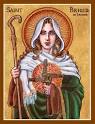
 

Brigid


What is it in Brigid’s story that so attracts us after so many centuries? I will give my own answer, inviting each of you to give yours. What I see in Brigid is that she matters to the time in which she lives, and to the people whom she serves, as I hope I do in some way.

But she also matters to (maters as in mothers) the Church where her leadership was strong, recognized and luminous. As a woman living in the 21st century in the Roman Catholic Church, I do not matter. I write, I teach, I offer retreats, and am largely ignored by the Institutional Church. Until now, I have not minded. It allows a certain freedom.

Something in Brigid’s story makes me wonder if perhaps it does matter very much indeed that the Church to which I have belonged since infancy does not appear to need or even notice women. How does the Celtic Feminine as expressed in Brigid’s life challenge me/us in this matter?

In last week’s Reflection on Brigid, we saw how old Bishop Mel, guided by the Holy Spirit, accidently consecrated Brigid as a bishop. We know that her monastery in Kildare was a double monastery, housing consecrated women and men, as was the way in the Celtic expression of Christianity. Brigid would have governed as Abbess/Bishop to both women and men. The development of Irish Monasticism appears to have been richly differentiated, a garden of wild profusion and endless variety. So there is no way of knowing how or when or why Brigid’s monastery of women began to welcome men. But here is a story I found that tells how it may have happened: One day a group of men, for whom Brigid’s faithful spirit and generous heart were as a lodestone, came knocking at the door of the Kildare Monastery, requesting that they be allowed to join the community. Brigid consulted with her Sisters. They were aghast! What? Men! Noisy, unruly, bothersome. No way! Brigid’s first assistant sealed the matter with the words that have frequently put an end to something new: “It’s never been done before.”

Still not at ease with the decision, Brigid went outside and sat near the holy well. Something urged her to look deeply into its dark waters, recalling as she did so that imagination dwells in the dark places. Brigid picked up a tiny stone and dropped it into the well. Down, down it fell, until a small splash in the deep told her it had reached the water. But there was still nothing to be seen in the well’s depths. She picked up another stone and dropped it into the well. Just at that moment the noonday sun at its highest place in the sky illumined the water where the stone had struck. Brigid saw tiny circles rippling out from where the stone had pierced the water.

In the depths of her own imagination, Brigid saw a circle widening. She thought about this: “Because it’s never been done before does not mean it can never be done.” And it was so. Kildare become a monastery for both men and women, drawn by the depth of Brigid’s holiness.

Seeking a meaning for the word lodestone I notice another word: lodestar. This refers to the star by which a ship navigates, usually the pole star. Symbolically it refers to a guiding principle. This illumines something for me, shining into the wells of legend and story that flow around Brigid’s life. Under the tales there is a guiding principle that will illumine our lives if we look deeper.

What was the lodestar of Brigid’s life, the star by which she navigated the uncertainties and challenges that faced her each day

In another legend , a sea creature in great danger had cried out to Brigid for help and she came to its aid. Brendan the Navigator was much offended and asked Brigid why the creature did not cry out to him instead. Brigid asked, “What do you think of when you are out in your boat Brendan?”

He answered that he thought about the waves, the tides, the movement of the fish, the weather… all the things a fisherman must be aware of….

Brigid said to him, “From the first moment I met the Holy my thoughts have never left her. That is why the sea creature called to me instead of to you.”

Such focus is important in our lives. I had to admit to her how easily I lose focus, forget the One who began this work in me, let the Holy One slip from my gaze, from my path, from my heart. I realized then that it is the fire of a passionate love for the Holy that has been lit within me, a fire I must tend faithfully. A fire tender must first of all take care that the flame of her love burns bright. All else, for each one of us, flows from that.


Brigid: Celtic Face of Sophia

Edinburgh was coated in light snow on that February day, twenty-five years ago, the air a raw biting cold, as I set out to explore the ancient city. The National Gallery of Scotland lured me within, down a narrow staircase to an explosion of beauty, wildly out of proportion to the size of its modest rooms, its small wall space. I hold vague memories of standing in awe before landscapes, clusters of children in a garden, beautiful women, solemn portraits of men whose painted faces gazed back at me.

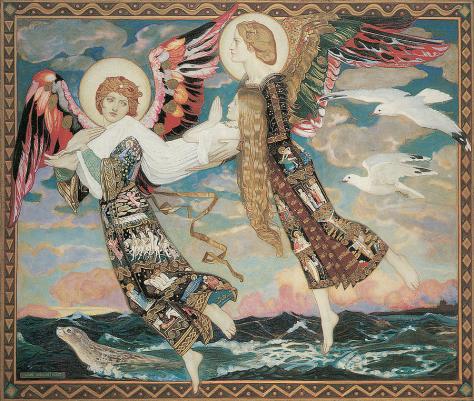
But one image remains etched in rich detail in my mind. I stopped, breathless, before John Duncan’s 1913 painting called, “St. Bride”. Two angels in gloriously patterned robes, whose miniature tapestries held scenes from Celtic mythology, were carrying a white-robed maiden, her hands joined in prayer. One angel supported her back with his hands, as her golden hair falling in great waves towards the sea. The other angel held her ankles while her knees rested on his shoulders. The angels’ wings were a symphony of colour from scarlet to rose to pale pink, shaded with greens, golds, midnight blues. The angels’ toes just brushed the surface of the sea where a seal swam ahead of them.
I had no idea what I was seeing.

st-bride-john-duncan

“St. Bride” by John Duncan 1913

That evening, in the home of the friend with whom I was staying, I learned the story of Brigid. Legend tells that she was carried by angels across the seas from Ireland to Bethlehem in Judea, to be present at the birth of Jesus, that she became his foster mother. Other tales add that Brigid served Mary as mid-wife, and that when Herod was seeking the Child to destroy him, Brigid distracted the soldiers by running through the streets, allowing Mary and Joseph to escape with Jesus.

As I am sure you recognize, we are in the realm of story. But as I hope you realize, it is the story that matters, that lures us, inspires us, teaches us what we need to understand about life, about the sacred feminine aspect of the Holy.

Brigid, who was born in Ireland in 457 AD and founded a double monastery in Kildare sometime before her death in 524 AD, left no writings of her own. But there is a cauldron of stories that were carried in the oral tradition until Cogitosus, a monk of Kildare, wrote his “Life of Brigid” around 650 AD. At the time of his writing, Cogitosus noted that in the Kildare monastery, the nuns still guarded her sacred fire.

According to Cogitosus, Brigid was the daughter of Dubhthach, a pagan noble of Leinster, while her mother Brocseach was a Christian. Baptized at an early age, Brigid was fostered by a Druid. The stories of Brigid reveal her spirit of compassion for the poor: one day when she was a child, after she had milked the cows, she gave away the milk to some poor persons who were passing. She feared her mother’s reproof, but when she arrived home, her milk pail was found to be even fuller that that of the other maidens.

The adult Brigid approached a rich landowner, asking for land where she might grow food for the poor. The landowner agreed to give her as much land as she could cover with her cloak. Brigid lay down her cloak and it expanded until it covered many, many acres. Another story tells of Brigid’s father preparing for her marriage to a nobleman while Brigid herself wanted to become a nun. Through the intervention of the Christian King of Leinster, Brigid’s desire was granted. With seven other young women Brigid was consecrated to Christ. In a wonderful tale, during the Ceremony for Consecration of a woman to Christ, the very old Bishop Mel of Ardagh mistakenly read for Brigid the words for Consecration of a Bishop. When his mistake was pointed out to him by co-presider Bishop MacCaille of Longford, Mel insisted that the Consecration would stand, as it must have been the work of the Holy Spirit, and that Brigid would be the only woman to hold the episcopal office in Ireland.
In the book Miniature Lives of the Saints, I came upon this explanation for Brigid’s title, “The Mary of the Gael”: At a synod held near Kildare, during the lifetime of the saint, says an old legend, one of the fathers declared that he had seen a vision, and that the Blessed Virgin would on the morrow appear among them. Next day Brigid arrived with her companions, and the father immediately exclaimed, “There is the holy Mary whom I saw in my dream.” Brigid accordingly came to be called “The Mary of the Gael,” that is, of the Irish; for so pure was she in spirit, so holy in every action, so modest, so gentle, so filled with mercy and compassion, that she was looked on as the living image in soul and body of Mary the Mother of God. (London, Burns and Oates, 1959)

Legend says that Brigid’s mother gave birth to her on the doorstep of their home, one foot within, one foot outside the home. This would seem to be a prophecy for a life that would become a threshold, bridging pagan and Christian, woman and man, rich and poor….Goddess and Saint.

For the story of Brigid, founder of the Christian Monastery of Kildare is interwoven with the ancient Irish goddess who shares her name. As goddess, Brigid is known as maiden, mother and crone. And the Feast of Saint Brigid, February 1st, coincides with the ancient Celtic Festival of Imbolc, the beginning of spring. It is Brigid who “breathes life into the mouth of dead winter”. It is Brigid who holds the Cailleach energy, the energy of the cauldron where our lives, individually and communally, need to be transformed through the power of her fire, her water. We are now halfway through the dark time of the year, the feminine days within the transformative cauldron. This is the time when, as Celtic teacher Dolores Whelan says, winter is pregnant with summer.

As we celebrate Brigid’s Day we turn our eyes, our hearts, towards the maiden aspect of the sacred feminine, awaiting the return of the young days of spring, the promise of new life within as well as outside of us.


Mary’s Silence

Like Harry Potter, I stand with you before an ordinary brick wall in a London train station, gathering courage to push the luggage cart through and beyond to Platform 9 ¾, where the Hogwarts Train awaits us. That’s how it feels to re-enter the mystical, yet more-than-real, world of spirit, journeying into the mystery of Mary’s story, seeking there guidance for the mystery of our own stories, our own lives.


We have just celebrated the twelfth day of Christmas, Feast of the Epiphany. Three wise persons from the East followed a star to Bethlehem. Not one word exists about that encounter between the young mother, her faithful husband and the ones who came to honour the Child. Of the four evangelists, only Matthew even tells the story of the Epiphany.


images


But there is one stunningly-beautiful moment in Luke’s Gospel about other visitors that gives a hint.

In the countryside close by there were shepherds who lived in the fields and took it in turns to watch their flocks during the night. The angel of the Lord appeared to them and the glory of the Lord shone round them. They were terrified, but the angel said, “Do not be afraid. Listen. I bring you news of great joy, a joy to be shared by the whole people. Today in the town of David a Saviour has been born to you; he is Christ the Lord. And here is a sign for you: you will find a baby wrapped in swaddling clothes and lying in a manger.” And suddenly with the angel there was a great throng of the heavenly host, praising God and singing: “Glory to God in the highest heaven, and peace to (those) who enjoy (God’s) favour.”

 Now when the angels had gone from them into heaven, the shepherds said to one another, “Let us go to Bethlehem and see this thing that has happened which the Lord has made known to us.” So they hurried away and found Mary and Joseph, and the baby lying in the manger. When they saw the child, they repeated what they had been told about him, and everyone who heard it was astonished at what the shepherds had to say. As for Mary, she treasured all these things and pondered them in her heart. (Luke: 2: 8-19 JB) 

The angel, the heavenly host, the shepherds, all have lines to say.

Mary has only her silence.

But there is in her silence a shining gift of twofold guidance for us. What do we “treasure” from the days of this Christmas? How does the creative act of “pondering” these treasures deepen our awareness, our gratitude, our surprise and wonder? open our eyes to the gifts that are around us each day?

We might carry these questions within us as we move beyond the Christmas Season into the cold winter of ordinary time.

Here, from the poet Jan L. Richardson, is an Epiphany Reflection: “Wise Women Also Came”

 Wise women also came.

The fire burned

in their wombs

long before they saw

the flaming star

in the sky.

They walked in shadows,

trusting the path

would open

under the light of the moon.

Wise women also came,

seeking no directions,

no permission

from any king.

They came

by their own authority,

their own desire,

their own longing.

They came in quiet,

spreading no rumors,

sparking no fears

to lead

to innocents’ slaughter,

to their sister Rachel’s

inconsolable lamentations.

Wise women also came,

and they brought

useful gifts:

water for labor’s washing,

fire for warm illumination,

a blanket for swaddling.

Wise women also came,

at least three of them,

holding Mary in the labor,

crying out with her

in the birth pangs,

breathing ancient blessings

into her ear.

Wise women also came,

and they went,

as wise women always do,

home a different way.

Jan L. Richardson  (www.janrichardson.com)


On the Ninth Day of Christmas

Ever since Christmas, icy winds from Siberia have been sweeping across most of Canada. Sitting by my wood stove, cocooned in blankets, I have been content to be housebound, resting from the activity of travel and Christmas celebrations with friends and family.

All this week, CBC radio has offered Classical Music themed for Christmas. Once each hour a newscast breaks the spell. Mostly I manage to ignore reports so far removed from my life and concerns, until one item alerts me. It is repeated on each successive newscast, without variation, without comment.

Perhaps you heard the report. Perhaps you too feel the rawness of the dissonance: A group of refugees fleeing from Syria, hoping to enter the European Union, reached the borders of Croatia. Many had walked on Christmas Day in frigid weather along railway tracks. At the edge of Croatia armed border guards refused them entry…. Croatian officials blamed aid workers in Syria for this flood of refugees, claiming they had encouraged the refugees to approach Croatia as it is a Catholic country and would receive them.

In these post-Christmas days, I have been trying to process this happening, so at odds with the theme of the season’s songs, music, films, stories, with its powerful mythology of the birth of love on earth in a stable…..

All this day, I have been delving through segments of books, articles, poems, seeking others who are asking the same kind of questions: hoping to find a poet, a mystic, a theologian who might offer guidance. This is the first poem I found:

Christmas Poem
by Mary Oliver
Says a country legend told every year:
Go to the barn on Christmas Eve and see
what the creatures do as that long night tips over.
Down on their knees they will go, the fire
of an old memory whistling through their minds!
[So] I went. Wrapped to my eyes against the cold
I creaked back the barn door and peered in.
From town the church bells spilled their midnight music,
and the beasts listened –
yet they lay in their stalls like stone.
Oh the heretics!
Not to remember Bethlehem,
or the star as bright as a sun,
or the child born on a bed of straw!
To know only of the dissolving Now!
Still they drowsed on –
citizens of the pure, the physical world,
they loomed in the dark: powerful
of body, peaceful of mind,
innocent of history.
Brothers! I whispered. It is Christmas!
And you are no heretics, but a miracle,
immaculate still as when you thundered forth
on the morning of creation!

As for Bethlehem, that blazing star
still sailed the dark, but only looked for me.
Caught in its light, listening again to its story,
I curled against some sleepy beast, who nuzzled
my hair as though I were a child, and warmed me
the best it could all night.
_

It was comforting but could not heal the fracture I still felt of human failure to live the Christmas mystery.

I recall listening to the Brazilian theologian, Ivone Gebara, who spoke at Saint Paul University in Ottawa several years ago. I saw a woman whose heart had been pierced by the failure of her lifelong efforts to obtain justice for women in her own country. I went looking for what Ivone had written in her book Longing for Running Water about the mystery of the coming of Christ. I found this:

When we say Jesus is the symbol who fulfils our dreams, this does not mean that in him everything was worked out or fully accomplished. It is to say that we need to entrust our dreams to this man because we need these dreams, and we hope that their fulfillment is possible. We turn over to Jesus, a man, flesh of our flesh, the concrete possibility of a better world and of more just and equal relationships among people. Because of him, we throw in our lot for a world that embodies greater solidarity— but all the while we know this decision is our own. (p. 187)

(Jesus) is the symbol of the vulnerability of love, which in order to be alive, ends up being murdered, killed …and which then rises again in those who love him, in order to revive the vital cycle of love.

Jesus comes from here: from this earth, this body, this flesh, from the evolutionary process that is present both yesterday and today in this Sacred Body within which love resides. It continues in him beyond that, and it is turned into passion for life, into mercy and justice….

(T)he criteria of “giving life” and of fostering the “flowering” of life in dignity, diversity and respect are quite enough to give us the collective authority to speak in a different way of our experience as partners of Jesus. (p. 190)

As I re-read these words today, I feel a stirring of hope. All is not lost, not in vain. The task is still ours, the witness of a life lived wholly in love is still shining. Our failures are evidence that we have a long, long way to travel towards love. As long as our hearts can still be broken, we will keep walking towards the light revealed by one who lived in love.

Enchantment, dis-enchantment, re-enchantment….the Christmas experience works its yearly miracle of the heart, taking us back once again to the fragile radiant child for whom, in Christina Rossetti’s poem “a breast full of milk and a manger full of hay” are enough. Heartened, I look with fresh eyes at Mary Oliver’s poem about Christmas.

As for Bethlehem, that blazing star
still sailed the dark, but only looked for me.
Caught in its light, listening again to its story,pexels-photo-753561.jpeg
I curled against some sleepy beast, who nuzzled
my hair as though I were a child, and warmed me
the best it could all night.
_


Mary Giving Birth

It is a breach birth. The child’s life hangs on a breath. The young mother, screaming with the pain, understanding the danger, is overtaken by terror. “No!” she shouts, “don’t let my baby die!” The young nurse, clothed in the white habit of a nun, uses all her skill to turn the baby, to draw him alive, whole, and show him to his mother.

This fragment from the 2013 film “Philomena”, brings alive the raw pain and terror that can accompany giving birth, raising some new questions within me about Mary’s birthing of Jesus.

But this is Philomena’s story. I watch the film, and wonder, was Mary standing near this achingly young woman, so terrified, so alone? Was she perhaps standing behind her, holding her, as Philomena gave birth to her son Anthony? Was Mary guiding the skilled hands of the young nun who delivered him?

If so, I believe her heart would have broken at the unfolding story as did Philomena’s. Mary would have wept tears of compassion to see Anthony taken away by his American adoptive parents from the Irish convent where he was born, where he lived for a few short years, while his mother worked off her “debts” in the Convent Laundry, permitted only one hour with her son each day.

The true story of Philomena is a wrenching tale of a fifty-year search for her son, finally ending when a journalist takes on the search with her in hopes of a good story.

Secret dealings. Cover-ups. Burned records. As the treachery of the “Sisters of Little Mercy” is revealed, what is most horrifying is the cold righteousness of an older nun who justifies it all because these young women got what they deserved for their sins, whereas she herself, true to her lifelong vow of celibacy, is ready to welcome the Lord Jesus…
In what I consider the best line of the film, the journalist tells her that when Jesus does come, “he will overturn that (^&*%ing) wheelchair and dump you on the floor.”

“Philomena” shows the power, the passion, the aching tenderness of a mother’s love for her child, love enough to fuel a lifetime’s search and longing.

Philomena’s all-consuming love for her child sheds light for me on Mary’s passionate love for her infant son. The film brings emotional intensity to an aspect of Mary’s life that can be missed when the story focuses on the struggles of Joseph to understand, on the dangerous, cold, uncomfortable journey to Bethlehem. We sigh over the no-star accommodations in the stable, the rough bedding, the hovering odours of the animal companions, but do we ever really take time to focus on the heart of the story?

What must it have been for Mary to embrace the beloved one, drawn forth from her body, to press his small mouth to her full breast?

John O’Donohue comes closest to imagining both the pain and the bliss:

No man reaches where the moon touches a woman.
Even the moon leaves her when she opens
Deeper into the ripple in her womb
That encircles dark to become flesh and bone.

Someone is coming ashore inside her.
A face deciphers itself from water
And she curves around the gathering wave,
Opening to offer the life it craves.

In a corner stall of pilgrim strangers,
She falls and heaves, holding a tide of tears.
A red wire of pain feeds through every vein
Until night unweaves and the child reaches dawn.

Outside each other now, she sees him first.
Flesh of her flesh, her dreamt son safe on earth.
(John O’Donohue Conamara Blues)

To carry us through these post-Christmas days, let us hold this fragment within us:

il_340x270.1305628857_1e3i

“She sees him first, flesh of her flesh, her dreamt son safe on earth.”


Mary: Seeking a Friend in Mystery


Mary set out at that time and went as quickly as she could to a town in the hill country of Judah. She went into Zechariah’s house and greeted Elizabeth. Now as soon as Elizabeth heard Mary’s greeting, the child leapt in her womb and Elizabeth was filled with the Holy Spirit. She gave a loud cry and said, “Of all women you are the most blessed, and blessed is the fruit of your womb. Why should I be honoured with a visit from the mother of my Lord? For the moment your greeting reached my ears, the child in my womb leapt for joy. Yes, blessed is she who believed that the promise made her by the Lord would be fulfilled.” (Gospel of Luke: 1:39-45)

This moment in Mary’s story is so familiar that we may miss its deeper meaning. As a child, I was taught that it was about Mary being so unselfish that her first act following the angel’s visit was to rush over to assist Elizabeth who was six months pregnant.

I see it differently now. Now I know that when annunciation happens, when life is upturned with an unexpected invitation to gestate, nurture, birth newness, our hearts, like Mary’s, long for the presence of someone with whom to share the joy. Each of us experiences in those moments the absolute requirement of being with someone who knows mystery in the depths of her own being, as Elizabeth does.

Would not each one of us set out at that time and (go) as quickly as (we) could to the embrace of a friend whose gaze mirrors our wonder and delight?
Irish poet John O’Donohue puts words to Mary’s longing in this poem:

The Visitation
In the morning it takes the mind a while
To find the world again, lost after dream
Has taken the heart to the underworld
To play with the shades of lives not chosen.
She awakens a stranger to her own life,
Her breath loud in the room full of listening.
Taken without touch, her flesh feels the grief
Of belonging to what cannot be seen.
Soon she can no longer bear to be alone.
At dusk she takes the road into the hills.
An anxious moon doubles her among the stone.
A door opens, the older one’s eyes fill.
Two women locked in a story of birth.
Each mirrors the secret the other heard.
(John O’Donohue in Conamara Blues)

As we take this fragment of Mary’s story, holding it in the light, seeking for a likeness between her story and ours, what do we glimpse? How does her song resonate with ours? When have we known what it is to awaken as “a stranger to (our) own life”?
Is there not in each one of us the fragility of something so utterly unimagined, yet wholly real, appearing in a morning’s glimpse, disappearing in evening’s shadow…. that we require a mirroring presence to affirm its existence?

Each of us is invited to provide the inner space for newness to gestate in preparation for birth. Each of us knows the need to nurture this newness in times of solitude. Yet we know also the absolute requirement of being companioned by one another if our hearts are to remain open, nourished, and (as Hildegard says) juicy!

Each of us, like Mary, is walking a wholly new path, one whose gifts, ecstatic joys, shuddering griefs, are as unknown to us as Mary’s were to her. But I believe Elizabeth would bless each one of us as she did Mary:

Blessed is she who believed that the promise made her by the Lord would be fulfilled.


Mary Waited

Mary. Waited.

I write these two words, and come to the end of what I know about this time in Mary’s life, as she awaits the birth of her promised son. It is not possible for me to imagine myself into her time of waiting, nor to summon up any experience in my own life that might help me to understand what was in Mary’s heart as she waited.

Frustrated, I put on high boots and a warm jacket. I go outdoors on this snow-blessed day to walk along the Nature Trail that winds between stands of evergreens to the ruined railway bridge above the Bonnechere River.

What I notice first is utter stillness. Not only the trees, their limbs, branches, twigs and needles, but even the left-over tall weeds of autumn are motionless.

Waiting, I think. They are waiting. But for what? for whom? and why?

As my boots sink deep into wet snow, creating a fresh pattern beside the marks left by animals, I continue to wonder about the trees. There is a quality of presence in these woods that speaks of quietly-held strength, invisible energy.

A memory returns from late last winter, when there was still no visible sign of spring. I was standing beside a delicate silver maple that hovers just at the river’s edge. I had placed my palm on the strong slim trunk that erupted above me into a rack of apparently dead branches. I wondered how the tree felt knowing she appeared to be so lifeless. As though she were responding to my question, I suddenly knew that the tree’s sense of herself came not from this barren outer form but from her inner life, her sap already rising, preparing for the new life of spring. She knew herself by her energy, by the movement of life within, only barely contained, ready to push beyond this apparent death out into fullness of life.

That evening, I came across a poem from the 12th century Sufi Mystic Hafiz, a promise to the tree, to me:

Light
Will someday split you open
Even if your life is now a cage,
For a divine seed, the crown of destiny,
Is hidden and sown in an ancient fertile plain
You hold the title to.
Love will surely bust you wide open
Into an unfettered, blooming new galaxy…
A life–giving radiance will come,
The Friend’s gratuity will come…..

(Daniel Ladinsky trans. in The Subject Tonight Is Love)

Now, today, as I begin the walk home, the early darkness already rising around me, I feel I have begun to understand something about waiting: the trees’ waiting, Mary’s waiting and my own. Expectant waiting is an active experience. It is rich with joyous anticipation, strengthened with deep trust in the promises given, and busily engaged in the work of nurturing the “divine seed” that Hafiz speaks about.

For “Love will surely bust (us) wide open into an unfettered blooming new galaxy” bringing “a life–giving radiance”, bringing “the Friend’s gratuity”.

This time of waiting in Mary’s life invites us to wait with her, companioned by her barely-contained anticipation.

But there is more.

For, if we can begin to know that Mary has become for us in our time, when our need is so great, an expression, a manifestation, a presence of the One in whom ancient peoples lived and moved and had their being, our waiting is turned inside out! Then we glimpse that the winter trees, the snow-covered earth, the entire aching planet, and we ourselves are held within a womb, nurtured from the life, the body, of the Great Mother. And that what we are each awaiting is our own birth into the fullness of life to which we are called.

The mystic-poet Jessica Powers expresses this beautifully:

I live my Advent in the womb of Mary.
And on one night when a great star swings free
from its high mooring and walks down the sky
to be the dot above the Christus i,
I shall be born of her by blessed grace.

I wait in Mary-darkness, faith’s walled place,
with hope’s expectance of nativity.

I knew for long she carried me and fed me,
guarded and loved me, though I could not see.

But only now, with inward jubilee,
I come upon earth’s most amazing knowledge:
someone is hidden in this dark with me.
(Jessica Powers 1948)

We. Wait.


Mary: Re-Enchanting Advent

The First Sunday of Advent dawns in mist, a cold damp day. No snow softens the grim greyness of earth, river, sky. Geese, ducks have flown. Birdsong no longer blesses the air.
Inside my cottage, no Advent Wreath of green boughs, planted with purple candles, stands ready to light the darkness that will descend with early evening.

Living in a Universe whose beginning is still visible in deep space, knowing that what Teilhard de Chardin calls the Christic Presence, the Love at the heart of the Universe, has been here from the first moment in time, makes Advent seem to me superfluous. Why imagine a world awaiting the birth of Love? I stay away from ritual celebrations that open the four weeks of Advent.

At mid-day, I open my computer, tune into the live streaming of a panel led by Jean Houston on “Living in Cosmic Consciousness”.
“We are the microcosm of the macrocosm of consciousness,” Jean says. “We are called to implant the new codings for an emerging spirituality. We are encoded with the Universe Herself…”

Something new, yet old and very familiar is rising in me. A sense of call, an eagerness, an excitement, a knowing that something wonderful is about to happen, and that I /we /all of us are called to bring it to birth…

The day moves on. I sit by the fire, writing in my journal, as the windows of my cottage slowly fill with darkness. Is that when it happens? A remembering, a knowing that is as old as my first memory of Christmas, and yet suddenly new. The story of a young pregnant woman making an uncomfortable journey to a strange town. She does not know where, how, when she will give birth.

This is Advent.

And you and I are being called to be Mary in our time, to give birth to “an emerging spirituality”. Not knowing the where or how or when of it. But eager as she must have been, to see the new life.

What was the moment in time when we agreed to this? Do we resonate with the way poet John O’donohue imagines Mary’s moment in time?

Cast from afar before the stones were born
And rain had rinsed the darkness for colour,
The words have waited for the hunger in her
To become the silence where they could form.

The day’s last light frames her by the window,
A young woman with distance in her gaze,
She could never imagine the surprise
That is hovering over her life now.

The sentence awakens like a raven,
Fluttering and dark, opening her heart
To nest the voice that first whispered the earth
From dream into wind, stone, sky and ocean.

She offers to mother the shadow’s child;
Her untouched life becoming wild inside.

Where does our story touch Mary’s? Where are the meeting points? What are the words waiting for the hunger in us “to become the silence where they could form”? When our hearts open, will they also become a nest for a new birthing of the Holy?

From Jean Houston, I have learned that the urgent needs of our time require a “yes” to the conception, followed by the birthing, of newness.

Reflecting upon the call of Mary, the call that is like our own, Jean writes:

Just think of the promise, the potential, the divinity in you, which you have probably disowned over and over again because it wasn’t logical, because it didn’t jibe, because it was terribly inconvenient (it always is), because it didn’t fit conventional reality, because… because… because….
What could be more embarrassing than finding yourself pregnant with the Holy Spirit? It’s a very eccentric, inconvenient thing to have happen.
(Jean Houston in Godseed p. 38)

Eccentric. Inconvenient. Perhaps. But nonetheless it is our call. Mary’s story gives us the courage to say “yes” without knowing where that “yes” may lead. It is enough to know with certainty that our own life will become, like Mary’s, “wild inside”.


stock-photo-mary-kissing-the-baby-jesus-59597146

Mary: Companion for a Dark Journey

Egypt. November 2008. With my co-travellers on this spiritual journey, led by Jean Houston, I am on the Island of Philae in the Nile River. As we stand crowded together in the tiny sanctuary dedicated to Isis, Jean is reading aloud from the writings of Apuleius, a second century Roman, not a Christian.

Sanctuary of Isis

Sanctuary of Isis on Philae Island, Egypt

In the story, a hapless magician named Lucius has cried out to Isis for help. She responds. The way the Sacred One identifies herself to Lucius startles me: “ I, the natural mother of all life, the mistress of the elements, the first child of time, the supreme divinity…. I, whose single godhead is venerated all over the earth under manifold forms, varying rites, and changing names… “Behold, I am come to you in your calamity. I am come with solace and aid. Away then with tears. Cease to moan. Send sorrow packing. Soon through my providence shall the sun of your salvation rise. Hearken therefore with care unto what I bid. Eternal religion has dedicated to me the day which will be born from the womb of this present darkness.”

After the reading, we are invited to call out all the names by which we have known the Sacred Feminine. I hear voice after voice calling out wonderful names. Many of these names are familiar to me, titles I’d learned as a child, and they refer to Mary. I listen: Mystical Rose. Tower of Ivory. Gate of Heaven. My own voice calls out: Star of the Sea. I hear Jean’s voice, strong, certain: Mary in all her forms.

Mary, in all her forms….

For these darkest days of the year, we are companioned by Mary of Nazareth, the woman  wrapped in silence, the one who waits in the shadow for the great birthing, who  “ponders in her heart” the wonders that follow upon the coming of her child.  Mary has left us no written word. The little we know of her from the Gospels is sketchy at best, her appearances brief, her words cryptic. Yet her influence on Christian spirituality is staggering in its power. Who is this woman, and how has she risen from a quiet life in the outposts of the Roman Empire to become, as the Church proclaims her, “Queen of Heaven and Earth”?

If you grew up Catholic in the years before the Second Vatican Council, chances are Mary was at the very heart of your faith. You prayed the “Hail Mary” many times daily; you sang hymns to Mary as you walked in May processions carrying flowers to decorate her statue; in every trouble and doubt, in every dark moment of your own life, you turned to her as to a mother whose love for you was unconditional. You probably knew by heart the “Memorare”, a prayer to Mary that says, in part, “Remember…Mary, that never was it known that anyone who fled to your protection, implored your help or sought your intercession was left unaided…”

Mary

At the call of Pope John 23rd, 2600 Roman Catholic Bishops gathered in Rome for the Second Vatican Council in the mid-1960’s. Believing they were restoring a balance, they invited Mary to step from her throne, and guided her gently to a place among the faithful, the followers of her son, Jesus. The “excesses” of Marian devotion were curbed… and then what happened?

Over the past fifty years we have seen a burgeoning of interest in the “Sacred Feminine”; a recovery of ancient stories of the Goddess; archaeological finds that create renewed interest in the time when the Sacred One was honoured as a woman; an explosion of writing among theologians, historians, cultural storytellers, seeking to understand the power and presence of “Mary” in the Christian story. I will cite a few here: The Virgin by Geoffrey Ashe; Missing Mary by Charlene Spretnak; Untie the Strong Woman by Clarissa Pinkola Estes and Truly Our Sister by Elizabeth Johnson.

Though I am no theologian, I have a consuming interest in the many aspects of this mystery. What I glimpse is this: the human heart longs for a divine mothering presence. Ancient cultures honoured a feminine divine who over millennia was called by many names: Isis in Egypt; Inanna in Sumeria; Ishtar in Babylon; Athena, Hera and Demeter in Greece, Anu or Danu among the ancient Celts; Durga, Kali and Lakshmi in India; for the Kabbalists, Shekinah; for the gnostics, Sophia or Divine Wisdom.

Christianity had no “Mother God” to put in the place of the Goddesses whose worship it was determined to eradicate. Geoffrey Ashe’s theory is that Mary’s gradual ascension in Christianity was not an initiative of Church Leadership, but rather a response to the hunger of the early Christians for a sacred feminine presence. How it came about is less interesting to me than the reality that Mary became for us an opening to a loving feminine sacred presence. Or, put another way, a loving sacred feminine presence responded to the cries of her people when they called her “Mary”, just as that presence had responded over the millennia to other names cried out in love or sorrow or desperate need.

Over these darkening days as we descend to the longest night of the year at the Winter Solstice, Mary will be our companion. We reflect on her pregnancy, her waiting, her uncertainty, the doubts of those who love her, the trust that sustains her while she opens “Deeper into the ripple in her womb That encircles dark to become flesh and bone,” as John O’Donohue has written.

This is profound mystery. For Mary. For each one of us who carries the Holy within, seeking a place of birth. We walk the dark road, with Mary, in trust.We walk companioned by one who knows our struggles to maintain our trust in the face of inner doubts and outer calamity. We walk with one who loves us and encourages us until we are ready to welcome “the day which will be born from the womb of this present darkness.”


Our Journey Towards Radiance: Part Five

When we come awake to the mystery and beauty of the story of our evolving universe, it is necessary for us to pause, to breathe deeply. Then, in trust and in joy, we set about the task of reweaving the fabric of our lives to reflect this newness.

1513851_10155814472155285_2883105051202678217_n


As we approach the Feast of Christmas, how can we re-imagine its spiritual importance in the light of our new cosmic awareness?

The great spiritual teacher of our time, Jean Houston, offers guidance:

Christmas is about yearning for something to come into the world. It’s the story of the birth of love, of hope, of a Holy Child in huge danger of being destroyed, bringing a new order of possibility into the world, needing to be protected and nurtured so it may grow into a free and luminous, numinous being. What is new in our time is the birthing of a whole new order of thought through the discoveries of the new cosmology creating a new mind with interconnectedness with so many sources of ancient wisdom.

Jean invites us to touch into our own yearning. What is the new life we long for in ourselves? What is ready to be seeded in the darkness of these pre-Christmas Days so that we come to the feast pregnant with new life?

The Winter Solstice  was the inspiration for marking the Birth of Christ during the days when the sun’s light begins to strengthen. Solstice evokes YEARNING for the light, for new birth within ourselves, within all whom we love. We desire this newness for life on the planet, for the planet herself. We desire that we and all that we love be made new with “the love that moves the sun and the other stars” l’amor che muove il sole e l’altre stele as Dante writes.

The song “Born of a Star” written by Carolyn McDade to reflect on the Solstice, assists us to know the gift that is at the heart of Christmas:

Return, return to the darkness return,
this longest night of wonder
Return, return to the dream, return,
This holy night to ponder
Deep in the night, listen, listen
Turn to the light, waken, waken
Deep in the night, turn to the light
Waken to sun’s ancient summons
We who are born of star, who then are We?
We who are loved by star, who then love We?
Deep in the night, listen, listen
Turn to the light, waken, waken
Deep in the night, turn to the light
Waken to sun’s ancient summons
We who are born of star, who then are We?

In Jesus in the Power of Poetry (2009) Diarmuid O’Murchu suggests a new metaphor in our understanding of the feast of Christmas. He finds it in the writings of the thirteenth century Dominican mystic Meister Eckhart:

“What does God do all day long? God lies on a maternity bed, giving birth all day long.”

O’Murchu reflects: “The infancy narratives, therefore, need to be approached afresh….as an archetypal statement of the God of prodigious birthing.”

“(W)e are called to become co-birthers with our birthing God of the ongoing evolutionary re-creation of God’s world in justice, love, compassion and liberation. Incarnation becomes an empowering and liberating dynamic, and Christians, instead of fleeing the world, are now challenged to embrace it in its full embodied existence.” (pp 45-6)

Advent invites us into the wonder of pregnancy. We prepare ourselves for the new gifts which our birthing God wants to offer in and through us. We enter the heart’s season of longing, awakening desires we thought long tamed, desires that lead us to the birthing of the deepest dreams of our hearts.

Jan Richardson offers this prayer to the birthing God:

In the enclosure of your heart,
O God,
enfold me
and give me
the courage of Bear:
to enter the cave
in the season of slumber,
to lie down defenseless
in your gathering dark,
to know your sustaining
as my soul is made ready,
to give myself over
to dreaming of birth.

And to whom are we called to give birth? To the God who dwells within.
The fourteenth century Sufi poet Hafiz encourages us with these words:
No one can keep us from carrying God
Wherever we go.
No one can rob His Name
From our hearts as we try to relinquish our fears
And at last stand — Victorious.
We do not have to leave Him in the mosque
Or church alone at night;

We do not have to be jealous of tales of saints
Or glorious masts, those intoxicated souls
Who can make outrageous love with the Friend.
We do not have to be envious of our spirits’ ability
Which can sometimes touch God in a dream.

Our yearning eyes, our warm-needing bodies,
Can all be drenched in contentment
And Light.

No one anywhere can keep us
From carrying the Beloved wherever we go.
No one can rob His precious Name
From the rhythm of my heart —
Steps and breath.


awakening to the sacred feminine presence in our lives