Sophia in Egypt

(Continued from last week…)

After the rapture of sunrise, she goes indoors, makes coffee, hurries to her room, climbs back into the book.

She is once again in the story circle. She arranges herself on the cushion, smiles at her guide already seated beside her, and turns again to the storyteller.
Ra, the firstborn, burns with jealousy.
He decrees that no child may come forth
from the womb of Nut on any day of his year.
The Sky writhes in torment,
her full belly unable to release life.
In her womb, Isis and Osiris become lovers,
Seth rages, Horus, the twice-born,
and their dark sister Nephthys wait.
Wise Thoth challenges Ra to a game of checkers.
Skillfully, the moon wins bits of light
until he has five days.
On each of these days, Mother Sky gives birth.

The guide gestures towards another room. “It is the place before time and beyond time. Go inside and look at your life as it was before your birth, and as it is now.”

The woman goes inside, allows herself to be taken into no time. The formless loneliness that fills her has been with her all her life. It has led her to seek love in many places, led her to become one of a community of women. In this timeless realm, she finds herself in the womb of Nut, waiting to be reborn. It is a comfort, though she cannot think why it should be.


From far away a bell startles her, breaks into her thoughts, and she finds herself again in the community residence. The light suggests early evening, time for supper with the others who live here. She has no idea what she will say should they ask her how she spent the afternoon.


That night the woman dreams she is held in an embrace of love more tender than any she has known. She wakens glad, eats a hurried breakfast and steps back into the book.

Isis and Osiris travel across Egypt giving gifts.
Osiris teaches the secrets of the Nile,
the taming of cattle, the planting of seed,
the guiding of the plough.
At night he plays his reed pipe,
enchanting the people with the songs of Mother Sky.
Isis teaches the women the moon’s cycles,
the shapes of the stars,
the rhythms of the seasons.
She dances with them under the moon’s soft light.
In Ra’s light, she teaches them to weave,
to transform flax to thread, thread to linen.
She gives them the song of the wheel.
She loves them into beauty.


When they are alone again, the guide tells her it is time to learn the secret lore of the ancient Egyptians. She teaches her the skill of placing her spirit, her Ka, in an imaginary way in a tree or a bird, then looking back at the self through wise eyes.


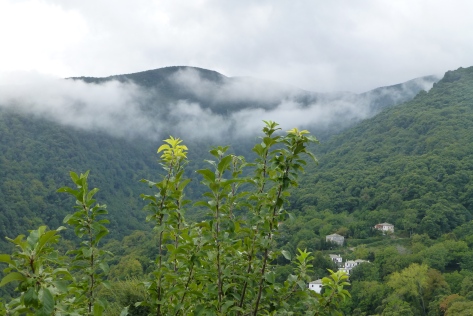
The woman places her thought in a mountain she has loved, and imagines the mountain gazing at her, seeing her power for movement and speech, for singing and dancing, for growth and change, gifts the mountain does not possess. Through that ancient gaze, the woman sees how wasteful she is of her immense possibilities, her capacity for fulness of life, how she is always seeking and discontent. It seems the mountain looks on her with compassion, and says, “Just rest for awhile and enjoy the beauty.”
P1000637

The woman learns to make simple hieroglyphs, pictures that carry levels of meaning. She shapes a message: I alone in nature sense the Holy. The Holy embraces me with love. Again alone beside a tree I weep for loss. The Holy returns. A bird sings. I know I am not alone in nature. The woman smiles at the childish drawings that have just told her the story of her life.

When they next return to the room of storytelling, the luminous days of the reign of Isis and Osiris are ending.

Seth rages at the lovers.
From gold and precious gems, he crafts a coffin
and tricks Osiris into lying in it.
He seals the coffin and hurls it into the Nile.
Isis cuts her hair, disguises herself as a beggar
and sets out to search for her husband.
In the far land of Byblos,
the coffin has been caught in a tamarisk tree.
Magically, the tree grows around it.
So great is this wonder that the King
takes it as a pillar for his great hall.
Weary and worn, no longer beautiful,
Isis comes at last to the King’s Hall.
She enters by the back door,
asks to be a servant,
to care for the children of the King.
Her love wins her the release of the coffin
from the pillar of tamarisk.


A touch on her arm from her guide and they leave the story room. “Today you must find the places in your story where you have been seeking a lost beloved,” she tells her. “I’m going to take you into a larger room where you may walk, dance if you like, and let the memories return. Don’t be afraid.”

The woman is neither afraid nor expectant. In her long search for understanding, she has often visited the place of memory. But the memory that comes is one buried in the dust of forgetfulness.

She is a high school student, perhaps thirteen. On her way home from school, she has come to pray in the large stone Church. It is cool and quiet here. She likes it. Sometimes she walks around the Church praying at each of the carved scenes that tell the story of the sufferings and death of Jesus. She likes to think of how much he must love her, to go through all that for her.
Mary


But today she happens to look at the marble statue of the Virgin Mary. That word virgin sounds as cold to her as the marble from which the image was carved. She shivers a bit and looks away. On the bench beside her, someone has left a prayer book. She glances at an open page, sees the words, “I am your mother, Mary”. If the marble statue had broken open to show her a beating human heart, the effect would not have been any more powerful.

Encounter with Sophia in Egypt

It is nearly two years since I began to write these weekly blogs about the Awakening of Sophia, the Sacred Feminine Presence. This awakening is happening in many different ways, in many different places around our planet, among people of many religious backgrounds as well as people who have no connection with any formal religion. The awakening is pervasive, subtle, invitational, gentle, powerful, loving, alluring… it slips the bonds of theology, psychology, sociology. It is too elusive for formal religions to catch hold of it, to define or tame it.


Yet for those who open their hearts to its call, for those who listen with trust, who begin to follow its gentle guidance, its winding pathways, this awakening is blossoming into a relationship of loving, co-creative partnership with a Sacred Presence. This presence has been known on our Earth for Millennia. Though she was forgotten for a time, she is returning in our time because we need her and she needs us. Her Time is Now.


Joseph Campbell, writing of the presence the Sacred Feminine, notes that:
By the time of the birth of Christ, there was an exchange, not only of goods, but also of beliefs, throughout the civilized world. The principal shrine of the Goddess at that time in the world of the Near East was Ephesus, now in Turkey, where her name and form were of Artemis; and it was there, in that city, in the Year of our Lord 431, that Mary was declared to be what the Goddess had been from before the first tick of time: Theotokos (Mother of God).

Campbell adds this compelling question:

And is it likely, do you think, after all her years and millennia of changing forms and conditions, that she is now unable to let her daughters know who they are? (in Goddesses :“Mysteries of the Feminine Divine” p. xxvi; Copyright Joseph Campbell Foundation, New World Library, Novato Calif. 2013)

It is time now for me to begin to share with you my own journey with this Sacred Feminine Presence. The startling overture came by way of a Journey to Egypt. Here is the story:

It is night. It is always night when a story is told. But this night is part of the story, envelops and transforms it, embraces the ending.

The room holds the darkness gently, the darkness holds the woman. The room watches her as she stands alone, holding in her outstretched hands a crown of mithril silver laced with emerald. The woman bows before the image of Isis, then places the crown on the head of the Queen of Earth and Heaven. The room does not see Isis or the silver shimmer of the crown. It sees only the woman. It has seen so many others come and go. The room sighs, feeling bored, unaware of the story, unimpressed with its quiet ending.


image of goddess Isis

image of the Goddess Isis

To find the beginning, leave the dark room, go back three months, take the stairway to the left. On the second floor, follow the corridor signed “Sisters’ Residence”. Halfway along, on the left side, enter the room where a woman sits alone. It is years, decades, since she has lived in her community’s central house. The days and weeks before she can return to her quiet house by the river stretch before her like a featureless desert.


“I need an adventure,” she says aloud, and before the words have ceased to bounce in the room’s quiet, her eyes have found what she needs. On the shelf above her writing desk, sitting among the dozen volumes she has brought with her, is a book about Ancient Egypt, written by her guide and teacher, Jean Houston: The Passion of Isis and Osiris: Gateway to Transcendent Love . The woman reaches for the book, surprised by its weight in her hand, opens it. There is a soft sucking noise as all the air in the room vanishes and the light disappears.


The passageway is dark, the air thick with dust and something much older. The woman is aware of the need for caution, but she feels no fear. Someone is walking beside her and though she cannot see the face, she knows the voice of her guide who whispers, “Hurry. The storyteller is waiting.”


Amber light draws them forward into a small cave-like room. Some dozen others, children, women and men, are seated in a circle around a wizened woman robed entirely in red. The old one smiles as they enter, gesturing towards cushions on the floor.

The storyteller lifts her head, closes her eyes and begins to speak in a voice both intimate and eons away, as though she is reading a story painted on the walls of a royal tomb in Ancient Egypt. Her words fall like bright jewels upon the room’s silence.

There is at first only One, Atum, the Perfect One.
But Atum is lonely, and creates the story.
Atum makes Air and Wetness, Earth and Sky.
Geb, the Earth and Nut, the Sky become lovers.
Nut gives birth to Ra, the sun
and Thoth, the silver moon.

The guide whispers that they must leave now. “Write down all that you saw and heard and understood. In the morning, go outside while it is still dark. You must see the sunrise.”
Then she is gone and the woman steps out of the book, back to her room.


Next morning, the sky is still black as the woman walks outside. A suffused light swallows the darkness. The woman feels both expectant and unsure, as people must have felt as they waited for the dawn millennia ago. It has come before, but can she be certain it will come again? Light is embracing the earth, drawing trees, low bushes, the tall flowers into silhouette. Earth herself waits, as the woman waits, hopeful, patient. And then it comes, a sliver of fire in the eastern sky, a vermillion burning. The woman and the earth together move under its passionate presence. It fills their gaze with rose red rapture. This is Holy, the woman thinks, for the first time. She looks around the mist-soaked morning and wonders how anyone could despair, as she herself so often does.

images

She goes indoors, makes coffee, hurries to her room, climbs back into the book.

(to be continued)

Sophia: Her Design in the Universe

Last week, we saw

Sophia/Wisdom (as) the divine order patterning all creation,
from the ancient oceans to this morning’s dew.

Ever since we humans gazed, astonished, at the stars, we have intuited a pattern in the Universe. We have wondered at the pattern maker for eons of time. Have we understood that there is Love within every aspect of this many-faceted reality?

English poet-mystic Edwina Gately speaks of this:

They stretched beyond my sight —

millions of tiny pebbles,

broken stones, and smooth rocks

thrown together,

heaped, it seemed,

in careless huddles,

then washed apart

and rushed into new places

to nudge against

other, different shapes,

falling together

in patterns ever changing.

But over all,

in never-ceasing constancy,

flowed the great water,

drenching and shifting

great and small,

stretching out

in wondrous unfolding

of Wisdom’s great design. 

(Growing into God, Sheed and Ward, Franklin Wisconsin, 2000 p.38.)

Do we experience that great water of Wisdom flowing over the smooth rocks, the pebbles, the broken stones of our lives, forming fresh new patterns? When we dare to name the pattern-maker Sophia, when we come to know her as Wisdom in the Universe, we experience her loving guidance in the small everyday moments of our lives. We sense that we are held in a tenderness that can be, at times, overwhelming.

Joyce Rupp, in her Prayers to Sophia (Innisfree Press, Philadelphia, 2000) writes of knowing and living within the awareness of Sophia’s guidance:

Trusted Guide,

you are my Mentor, my Inspiration,

my Home of good choices and decisions.

You help me to search with confidence

as I find my way to inner peace.

Please gather your wisdom around me.

Guide me carefully as I make choices

about how to use my energy positively.

Place your discerning touch on my mind

so that I will think clearly.

Place your loving fingers on my heart

so I will be more fully attentive

to what is really of value.

Teach me how to hear your voice,

to be aware of what is in my mind and heart,

to attend to your wisdom in those around me,

to acknowledge my intuitions and ponder my dreams,

to listen to earth and all of life,

for in each piece of my existence you are guiding me.

Guide of my life,

thank you for all you have given to me.

Reveal my spiritual path 

and direct me in the living of it.

Lead me to inner peace and oneness with you.

Joyce Rupp invites us to reflect on Sophia’s guidance in our lives:

Search your present life situation. Where is it that you most need Sophia’s Guidance?”

Go to Sophia. Find her sitting in her chair of wisdom. Ask her to lead and direct you.”

Receive her wisdom.”

Sophia’s Presence in the Universe

In recent weeks, we have been reflecting upon the Powers of the Universe
as they have been described in Brian Swimme’s teachings: allurement and emergence,
cataclysm, synergy, transmutation, transformation… In the Hebrew Scriptures Sophia speaks of being present in the very beginning of the Universe,  an inherent part of the whole amazing story of its unfolding.

In the Book of Proverbs we read:

(Sophia/Wisdom) is the divine order patterning all creation,
from the ancient oceans to this morning’s dew.

In the song-prayer “Ancient Love” composed by Carolyn McDade, we find a
beautiful tribute to the Sacred Feminine Presence in the Universe:

Long before the night was born from darkness
Long before the dawn rolled unsteady from fire
Long before She wrapped her scarlet arm around the hills
There was a love, this ancient love was born.

Long before the grass spotted green the bare hillside
Long before a wing unfolded to wind
Long before She wrapped her long blue arm around the sea
There was a love, this ancient love was born.

Long before a chain was forged from the hillside
Long before a voice uttered freedom’s cry
Long before She wrapped her bleeding arms around a child
There was a love, this ancient love was born.

Long before the name of a God was spoken
Long before a cross was nailed from a tree
Long before She laid her arm of colours ‘cross the sky
There was a love, this ancient love was born.

Wakeful our night, slumbers our morning
Stubborn the grass sowing green wounded hills
As we wrap our healing arms to hold what her arms held
This ancient love, this aching love, rolls on.

T
And in this meditation written by Bridget Mary Meehan, we find an invitation to embrace this loving presence of Sophia, to make space for her within our lives:

I therefore determined to take Sophia to share my life,
knowing she would be my counsellor in prosperity,
my comfort in cares and sorrow…
When I go home I shall take my ease with her,
for nothing is bitter in her company,
when life is shared with her, there is no pain,
gladness only, and joy.

(Book of Wisdom, Chapter 8)

“Take a deep breath, as if you were breathing through your toes
and let your breath be carried up through your feet, legs,
abdomen, lungs, mouth, nose – your entire body.

“As you breathe in, say silently, ‘Sophia’ while taking in
whatever you need from Sophia: wisdom, knowledge,
strength, joy, courage, comfort, peace, love….

“Do you remember a time when you felt whole?
… peaceful?…strong? … joyful? …loving?…

“Do you remember a time when you felt alienated? …
broken?…hurt?…angry?
lonely?… guilty?…

“How did you feel? What was it like? Why were these experiences
significant for you? How have these experiences continued to influence you?

“Did you experience comfort and counsel in any new way because of these experiences?

“Image Sophia, God’s Wisdom, as Counselor, wise guide,
who helps you discover meaning in your experience
and aids you in recognizing these experiences
as important touchstones of your unique spirituality.

“Image Sophia as Comforter who assists you to find
your own identity and strength in the midst of disappointments and sorrows of your life.

“As you reflect on your experiences what insights, feelings, thoughts,
images, memories, sensations, are you conscious of?”

Choose a creative way to record your insights, feelings, thoughts, images, memories, sensations, whether in poetry, art,song, writing, dance or any way you wish.

( Meditation adapted from Bridget Mary Meehan: Exploring the Feminine Face of God

pp 28-9 Sheed and Ward Kansas City Missouri 1991)

Coming to Know Sophia

I have been enchanted in these summer weeks by the book Goddesses:”Mysteries of the Feminine Divine” (New World Library, Novato, California,2013) a compilation of lectures, articles and workshops offered by the late Joseph Campbell, mostly in the 1980’s. In all the richness Campbell offers from ancient mythology throughout time and around the planet, there is but one brief reference to the Hebrew Scriptures, the source book for Muslims, Jews and Christians:


The biblical and  Goddess traditions were radically against each other, and while the biblical has remained the authorized tradition, there has been in European culture this waterway of the living Mother Earth flowing underneath. In the Old Testament, we read in early Genesis: “Remember thou art dust and to dust thou shalt return”. Well, the Earth is not dust, the earth is life, vital, and this intrusive god who comes in late, wanting to take everything over to himself, he denigrates the Earth itself and calls it dust? What he tells you there is, “You really are your mother’s child and you’ll go back to her. She’s nothing but dust, however.” Similarly, you read in Genesis 1:1 , “When God created, the breath (or Spirit) of the Lord brooded over the waters.” It doesn’t say he created the waters. The waters are the Goddess — she was there first.

Turn to Proverbs and there she comes back as the wisdom goddess Sophia, and she says, “When he prepared the heavens, I was there.” She says it. What you have is the same old mythology that the Babylonians and the Sumerians had of two powers, the female and the male power in tension, relationship and creative co-action. But what happened in the Bible was that the male power was anthropomorphized in the form of a man and the female power was reduced to an elemental condition — just water. It says, “God’s breath brooded over the waters.” It doesn’t say the waters of the Goddess, it just says the waters. She’s screened out, but she always comes back. (pp.234-5)

In these words of Joseph Campbell, I find the heart of my work, the inspiration which led me to begin this blog in October of 2014: the intuition that Sophia/ the Divine Feminine Presence is rising in and among us. Her awakening is the underlying theme of all I write.

In her book, Praying with the Women Mystics, (Columba Press, Ireland, 2006) Mary T.Malone offers us a poem in Sophia’s voice, based on Proverbs 8:27-31:

When God established the heavens I, 

Sophia, WomanGod, was there.

When God drew a circle on the face of the deep,

When God assigned to the sea its limit…

When God marked out the foundations of the earth,

There I was beside Him like a master-worker.

And I was daily God’s delight, rejoicing before Him always,

Rejoicing in the inhabited world 

And delighting in the human race. 


Sophia is present within all that lives, the beating heart of the planet. We glimpse “Sophia in Splendour” in this poem of Mary Malone’s, based on Wisdom: 7:26-8:11

For Sophia is the splendour of eternal light
And immaculate mirror of God’s majesty,
And image of God’s goodness…
For she is more beautiful than the sun,
And above all the order of the stars.
Compared with the light, she is found before it…
Therefore she reaches from end to end mightily
And orders all things sweetly.

Jean Houston in her book Godseed  takes us on an imaginal  “Visit to the Sophia”:

After a long spiraling journey upwards, you find yourself at the very top of a high mountain. You go inside the mountain to a path that travels downward in a spiral. Moving along the path down and around within the inner mountain spiral, you pass scenes of your own life, from your earliest infancy. You see or sense yourself being born. Continuing on the path down and around, to your earliest childhood, you see yourself taking your first steps, forming words, reaching out and grasping things, learning to feed yourself. Further down you see yourself learning to tie your own shoes and attending your first days at school. Continuing down, you see yourself learning games and reaching out to other children. As you continue, you see yourself growing up fast and learning many things. You see your adolescence. Further along you observe stages of your life until today………..

Suddenly you find yourself at the very bottom of the inside of the mountain. There you discover a door of baked mud. Going through it, you find that it leads to a hallway and to a door of water. You pass through the door of water, and it leads to a door of fire. You pass through the door of fire, and it leads to a door of winds. You lean against the winds and pass through. This door leads to a door of bronze, and you pass through. This door leads to a door of silver. You pass through the door of silver and find a door of gold.

At the door of gold there is a shining figure who says to you: “Through this door is the Sophia. Through this door is the Wise One herself, the incarnation of Wisdom. When you pass through this door, you will be in the presence of the Sophia. There you must ask your question. You may see her or you may sense her. But know that she is there. She who is Wisdom itself.” When you are in her ambience, whether you see her or hear her or sense her or feel her, ask your question. Her answers may come in words or in images or even in feelings.

You now have four minutes of clock time, equal to all the time you need, to be in the presence of the Sophia and ask your question and receive her answers.

Thanking the Sophia for her wisdom and kindness, and knowing that you can always return to visit her again, begin now to go back through the door of gold, the door of silver, the door of bronze, beyond the doors of winds, of fire, of water, of earth, beyond the spiral of the stages of your own life, reaching the top of the mountain. Now take the spiral path back down from the mountain. Find yourself here in this moment, in the Garden of Iona. Open your eyes, sit up and stretch, and if you wish, write your experiences in a journal or make a drawing or sketch of what you found with the Sophia…


Celtic Festival of Lughnasadh

A woman’s voice with an unmistakable Irish lilt says, “In the Celtic Calendar, summer is already at an end. Do you know of Lughnasadh, the festival that welcomes Autumn? We celebrate it on August 1st.”

dolores-img

Dolores Whelan

The woman who is speaking is Dolores Whelan. Most of what I have learned about Celtic Festivals comes from her wonderful book, Ever Ancient, Ever New. Dolores has taught us about Brigid’s Festival, Imbolc, which ushers in Spring, and about the Winter and Summer Solstices, the Spring and Autumn Equinoxes, and the fiery Festival of Bealtaine….

“Shall I tell you of Lugh and his festival?”

For answer, we settle ourselves comfortably, awaiting the tale with eagerness.

“The Celtic god Lugh is known as the samildanach, the many-gifted one. Lugh represents the skilled masculine energy, with its ability to hone, shape, bring to harvest the fruits of the seeds planted at Samhain and nurtured during the dark giamos time by the feminine energy.


At Lughnasadh, as in many of the other festivals, the important dance of opposite energies and roles is beautifully expressed. Tailtiu, the foster mother of Lugh, is the goddess who cleared away the wilderness, making the plains and fields ready for crops to be grown. She died from her efforts and is also remembered at this time; Lugh is said to have inaugurated this festival in her honour.


“In the wheel of the Celtic Year, Lughnasadh stands directly opposite Imbolc, where Brigid, embodying the primal creative energy, occupied the central role. Bron Trogain, an older name for this festival, may mean the sorrow of Trogain or the sorrow of the fertile earth. This may mean that the fertility of the harvest is linked with the death that follows its completion, again bringing together the polarities of life and death. The successful harvest requires that Lugh appease his adversary, Crom Dubh, who represents the aspect of the land that does not wish to be harvested or subjected to the rule and energy of Lugh.


“The two-week Lughnasadh festival was a very important meeting time for the tribe, bringing people together to test their skills in many different disciplines. They challenged each other in a variety of contests and games held during the annual fairs in Lugh’s honour. The rituals at this festival included the acknowledgement of the triumph of Lugh, the harvesting and enjoyment of the first fruits, and the acknowledgement of the end of summer. It was a time of great merriment, especially for young people, who wore garlands of flowers and went into the hills to pick bilberries or blueberries. Marriages were traditionally held at this time of year.


“High places in the land, where earth and sky met, were considered the appropriate place to honour Lugh. At the ritual site, many of the characteristics and gifts of Lugh were enacted by mummers. The first sheaf of wheat, barley or corn was ceremonially cut, milled, and baked into cakes. These were eaten along with the wild blueberries or bilberries. The young folks’ garlands of flowers were buried to signify the end of summer.”

Dolores pauses as we take this in.

One of the younger women says, “It seems so sad. Burying the garlands, such a sad ending to the beauty of summer.”

Dolores turns to her, and says gently, “In the wheel of the Celtic year there is no ending that is not also a new beginning. Remember that when the bright days of the masculine summer fade, diminish, we are getting ready to welcome Samhain, the season of the feminine winter. The days of womb-like preparation, the dark days of incubation that will themselves end with Brigid’s Festival of Imbolc on February 1st welcoming Spring.”


Another asks, “Is Lughnasadh still celebrated in Ireland?”


“Many of these ritual practices have died out,” Dolores tells her, “but an essential aspect of the Lughnasadh ritual is enacted each year with the annual pilgrimage to Croagh Patrick in County Mayo on the last Sunday of July. Puck Fair held in Kilorglin in County Kerry each August is another remnant of the Lughnasadh festival.”

Someone calls out, “Look. Up there on the high ground. It must be the setting sun, but it looks like someone has lit a bonfire!”

We are all gazing westward up towards the hill. Something flames there.

When Dolores speaks, her voice is so soft that we almost miss her words:
“That is no fire, nor is it a sunset. That is Lugh, come to bless you, to promise to bring to fruition and harvest the seeds you yourselves planted in the dark engendering days of the long winter. Take his blessing with you until we meet here again.”


Lugh

Lugh: Celtic God of Creativity


Mary Magdalene honoured as “Apostle to the Apostles”

On June 3rd in this year of 2016, an announcement came from Pope Francis that you may not have heard. In its way it is more startling than most of what passes for daily news. Francis proclaimed that from now on Mary Magdalene is to be honoured as the “apostle to the apostles” and “first witness to the Resurrection of Jesus”. Her feast day, July 22nd, has been elevated to an Apostolic Feast of high honour commensurate with her male counterparts, to whom Jesus sent Mary saying, “Go and find the brothers and tell them: I am ascending to my Father, and your Father, to my God and Your God.” (John 20: 17)

images (3)

This Magnificent statue created by artist Elizabeth Frink on the grounds of the Salisbury Cathedral in England shows the strong, purposeful Magdalene striding forth on her apostolic journey as “Apostle to the Apostles”.


“High on an escarpment crowning the medieval walled city of Vezalay France, stands the magnificent basilica of St. Mary Magdalene”. That is how Episcopal priest and writer Cynthia Bourgeault opens her book, The Meaning of Mary Magdalene (Shambala, Boston and London, 2010). Bourgeault spent Holy Week of 2005 with the young monastic order in residence at the Cathedral of Vezalay. Here she would have a stunning awareness of Mary Magdalene’s presence in the events of the death and resurrection of Jesus.

Bourgeault tells us:

This mixed community of men and women monks is well known for the imagination and beauty of its liturgy, and toward the end of the Good Friday Liturgy I witnessed an unusual ceremony that changed forever how I understood my Christianity….

The late afternoon shadows were already dimming the cathedral when we finished with communion, followed by the traditional stripping of the altar. And then came the ceremony I am speaking of. Two of the sisters brought forward a small corpus – the crucified Christ figure that traditionally hangs on Roman Catholic crosses. It was carved in wood, about two feet long. Tenderly they wrapped it in the altar cloth, laid it on the altar, and placed beside it an icon of the Shroud of Turin (the portrait of Jesus allegedly imprinted on his original burial shroud and revealed through radiocarbon dating). They set a small candle and incense burner at the foot of the altar. And then, as sunset fell, one of the monks began to read in French the burial narrative from the Gospel of Matthew.

Enchanted by the mystical beauty of all this – the smell of the incense, the final shafts of daylight playing against the great stone walls of the cathedral – I allowed the sonorous French to float by my ears while I drifted in and out, catching what I could. I heard the description of Joseph of Arimathea asking for the body of Christ, wrapping it (just as the sisters had just done) in a linen cloth, laying it in a tomb. And then out of the haze of words came “et Mary Magdalene et l’autre Marie restaient debout en face du tombeau…”
That’s when I did my double take. Mary Magdalene was there? That was in the scripture? Why hadn’t I ever noticed it before?

Thinking that maybe my French had failed me, I went back to my room that evening, took out my Bible, and looked it up. But yes, right there in Matthew 27:61 it reads: “And Mary Magdalene and the other Mary remained standing there in front of the tomb.”

Suddenly the whole picture changed for me. I’d thought I knew the tradition well. …. How could this key point have escaped my attention? No wonder Mary Magdalene came so unerringly to the tomb on Easter morning; she’d stood by in silent, unflinching vigil the whole time Jesus was being laid to rest there. Maybe she never left…. Since that moment I have literally not heard the Passion story in the same way. It inspired me to go back to the gospel and actually read the story in a new way. (pp.5-6)

Bourgeault reflects further that much of what we know of Mary Magdalene has been absorbed “through the dual filters of tradition and the liturgy, which inevitably direct our attention toward certain aspects of the story at the expense of others.” (p. 6)

Turning to the Gospels directly, Bourgeault focuses mainly on John’s account of the resurrection. Here is the story:

Mary (Magdalene) arrives alone at the tomb in the early hours of the morning to discover that the stone blocking the tomb has been rolled away. She hurries off to find Peter and “the disciple whom Jesus loved” who race each other to the site, discover the tomb empty and the grave cloths rolled up, and return home in bewonderment. After the two of them have gone their way, Mary stays behind, weeping beside the tomb. Then, in a unique and immortally reverberating encounter:

She turned around and saw Jesus standing there, but she did not recognize him. Jesus said, “Woman, why are you weeping? Who are you looking for?” She thought it was the gardener and answered him, “… if you have taken him away, tell me where you have put him and I will go and remove him.” Jesus said to her, “Mary.” She turned and said to him, “Rabboni” – which means Master. Jesus said to her, “Do not cling to me; you see I have not yet ascended to my Father. But go to my brothers and say to them: I am ascending to my Father and your Father, to my God and your God.”
So Mary went and announced to the disciples, “I have seen the Lord, and this is what he said to me. (John 20:14-18)

Bourgeault continues, pre-empting the June announcement from the Vatican:

It is on the basis of this announcement that Mary earned the traditional title of “Apostle to the Apostles.” The first to witness to the resurrection, she is also the one who “commissions” the others to go and announce the good news of the resurrection. (p. 8)

One small synchronicity I would like to point out: the verse in the Gospel of John cited above: Jesus said to her, “Mary.” is numbered John 20:16. The year of Mary Magdalene’s full recognition….

Powers of the Universe: Radiance


The mystics intuited Radiance long before the physicists described it. Hildegard of Bingen, the astonishing 12th c. abbess and genius, wrote:

From my infancy until now, in the 70th year of my age, my soul has always beheld this Light, and in it my soul soars to the summit of the firmament and into a different air….The brightness which I see is not limited by space and is more brilliant than the radiance around the sun …. I cannot measure its height, length, breadth. Its name, which has been given me, is “Shade of the Living Light”….Within that brightness I sometimes see another light, for which the name “Lux Vivens” (Living Light) has been given me. When and how I see this, I cannot tell; but sometimes when I see it, all sadness and pain is lifted from me, and I seem a simple girl again, and an old woman no more!

All the powers of the universe are one, seamlessly involved with one another, present everywhere in the universe, coursing through us, trying to bring forth Radiance. In his concluding talk in the DVD series, “The Powers of the Universe” Brian Swimme speaks about Radiance.

The most powerful presence of Radiance is the sun. In its core, the sun creates helium out of compressed hydrogen, releasing light. The process of fusion generates photons. Light emanates in waves which collapse into photon particles, creating light. The sun is also giving off messenger particles called gravitons that mediate the gravitational interaction by penetrating the earth, pulling the earth to the sun. We see the light, and feel the gravitational pull.

The moon also has Radiance, but not from creating light through fusion as the sun does.

11207377_1057164617646842_3761611266869826195_n


The photons that come from the moon are created by the sun’s activity on the moon. The moon releases the light thus created, also bathing us with gravitons, to which the earth responds, as in the tides of the seas.

It is an ongoing activity of the universe to radiate. Even in the depths of the earth, everything radiates LIGHT. Radiance is the primary language of the universe.

We are frozen light… Brian Swimme says that every being we meet holds fourteen billion years of radiance. The twentieth century mystic Thomas Merton saw with clarity the gap between this stunning reality and our capacity to see it, and wondered how we might tell people that they are walking around shining like the sun!

Yet, by a willingness to see deeply, we can develop a subtle spirit that responds to the depths of spirit in another, a container that responds to the beauty of the other. The archetypal example of this kind of depth perception, Swimme says, is a mother beholding her child. What is a mother seeing in the eyes of her child? This is the depth perception of beauty. When we look into the eyes of another do we see colour and shape only as in a surface, machine-like mentality or do we see flowing, radiating out of the eyes, the essence, the fullness of the person, his or her depth? Light is a flow of emotions: light as joy, sadness, pouring out from another. Think what can happen with one glance where we fall in love so deeply that the rest of our life is changed: we contain the Radiance that is streaming out of another.

When, on a sleepless night, Swimme suggests, we go outdoors and see the stars, difficulties melt away and we are smothered with deep peace. Something glorious is streaming into us, something so deeply felt that we find peace in our at-homeness in the universe. When we look down and see fireflies (flashing to interest their mates) we realize we are participating in an amazingly sacred event.

We are drawn into the depth of things and when we go there we find the future direction of the universe. The earth makes rubies and sapphires out of elements that come together, that explode and sparkle with Radiance, as though the universe is trying to tell us something about our aliveness in the realm of possibility!

We sit by the ocean, drawn into what is really real, something that is attempting to establish a deep bond with us. The magnificence of ocean/sand/sky wants to sparkle forth like a sapphire. We feel what reverberates out, Swimme says, as if completing the beauty that’s there.

11261593_1064331516930152_2458458929397885903_n

We enter into relationship with the Radiance of the universe through resonance and that is the primary form of prayer. Reverberation is the primary sacrament. We become the radiance that is flooding the world. If the resonance is deep enough, it fills our being so that we reverberate with the being of the other. The Radiance becomes the being. We are resonant with another when we begin to reverberate with the one we see. We are then in a non-dual relationship with another. There is great joy in developing this level of interaction with life.

Teilhard de Chardin, the French Jesuit priest and paleontologist who died in 1955, wrote:

Throughout my whole life during every moment I have lived, the world has gradually been taking on light and fire for me, until it has come to envelop me in one mass of luminosity, glowing from within…The purple flash of matter fading imperceptibly into the gold of spirit, to be lost finally in the incandescence of a personal universe…This is what I have learnt from my contact with the earth – the diaphany of the divine at the heart of a glowing universe, the divine radiating from the depth of matter a-flame. (The Divine Milieu)


Powers of the Universe: Interrelatedness

Along the lane that leads to my house, there are many many trees, evergreen as well as deciduous, including several ancient apple and crab-apple trees. Year after year, I had driven past them, scarcely noticing their flowering, their fruitfulness, their quiet winter sleep. In the late summer of 2013, some combination of factors led to an explosion of fruitfulness for one crab-apple tree just where the lane ends at my driveway.

I had noticed the tree the day before, saw that its two large branches were split near the trunk, their massive burden of crab-apples hovering just above the ground. I thought the tree might have been struck by lightning or else pummeled by winds in a recent storm.

I began to fill a large bin with crab-apples, so eager to be picked that they nearly leapt from their branches. I worked quickly, mindlessly, concerned only that these small apples should be “used” before they fell to the earth to rot.

After nearly an hour of moving heavy branches that hung all askew, picking as many apples as I could reach, I decided I could do no more. I was hot, sticky, and being slowly devoured by a local chapter of mosquitoes who had found me out.

Then, I happened to look up at the tree. Something shifted in me. I was aware of a presence, a dim dark knowing, that moved my heart. Above me, the two split branches hung like almost-severed arms, and above them there was no great trunk. This was it. The tree was hopelessly broken, and would not bear again. Somehow I knew that it hadn’t been lightning or fierce winds but the sheer weight of this huge crop of apples that had broken her branches. This feast of fruit she offered as her dying gift.

Did I acknowledge that? Offer my thanks? I think so, but it was a brief act. I was eager to get out of the sun, away from the mosquitoes, into my swimsuit.

Walking through the woods to where a stairway of carefully-placed flat rocks leads down into the Bonnechere River, I sought relief from furnace-like heat.
Embraced by the slowly moving river, I felt at first only the bliss of coolness, buoyancy. But gradually there came again the dim knowing that I had experienced beside the tree. A presence, a something, a someone, cooling me, embracing me, welcoming me into its life…

White Buffalo Calf Woman taught her people that all things are interrelated, so they must reverence all of life. This, Jean Houston teaches, is what the power of Interrelatedness is about: a vision of caring with a sense of the whole; we need an overarching vision that is so simple and alluring that we can see what can be, not from many different perspectives (science, art, religion, etc.) but from an all-inclusive vision. Jean sees the Power of Interrelatedness as an incredible invitation from the cosmos to create deep caring.
Interrelatedness or Care has been at work in the universe for 13.8 billion years, says Brian Swimme. Without it, the universe would fall apart.

Parental care emerged as a value in the universe because it made survival more likely when the mother and father fish care for their young. As reptiles evolved, Swimme speculates that either they discovered caring, or perhaps it evolved along with them. Reptiles watch over their young and do not eat them (as do some fish). The amazing power of care deepens with the arrival of mammals, whose care continues sometimes for a lifetime. This, says Swimme, is the universe showing what it values, enabling mammals to spread out.

IMG_0079

While travelling in South Africa, my friend Debra Hawley took this photo. Notice the baby elephant to the left. Mother Elephants care for their offspring for fifty years.

In some species of mammals, the female selects among her suitors the male who offers the best chance of having her offspring survive. The female is behaving in a way that will affect the next generation. Through her, the universe is working to extend care. An intensive study of baboons led researchers to find that when a female chose a sexual partner, one of the qualities she sought was tenderness. Thus life seeks to deepen and extend care.

In a human person in whom the Power of Interrelatedness is strongly present, we see a psyche attuned to relatedness, with the capacity to identify another’s worth, and to be sensitive to the needs of others. Care can result in true devotion, service, nurturance. However Swimme cautions that this power needs to be balanced with the Power of Centration, lest one become so absorbed in the needs and values of others that there is a loss of the self.

Care has to be evoked. A mother sea-lion establishes relationship with her pup by licking, nuzzling, thus evoking her own motherhood. It is the same for us humans, says Swimme. We need to find ways to activate these deep cosmological powers so that we can interact with the universe. This requires imagination. The power of care is evoked out of the plasma of the early universe. How do we enter into that process of evoking care? Just becoming aware is to participate.

How we position ourselves within our relationships with all of life is crucial, and is an act of imagination. To position ourselves in order to USE life leads to the extinction of countless species. Even 100 million years of parental care was not enough to save many species of fish from extinction. The shaping of our imagination by economic, educational and manufacturing systems that see use as the primary mode or orientation towards life on the planet, also views children in schools as “products” to be shaped, (or views a tree’s bounty of crab-apples as something that must be “used”.)

What would be another way?

Swimme notes the amazing capacity of humans to care, a power that is coded in our DNA, where life has extended its care through us. But we also have, through the power of language and symbol, through our conscious self-awareness, the capacity for empathy. We can learn to experience care for another species, even as we can imaginatively occupy another place, and extend our care to other cultures. With deepening compassion we move outside of our own boxed-in perspective.

Seeing that cosmological care is built in from the very beginning of the universe, some people today speak of the Great Mother or Mother Earth. This, says Swimme, is the cosmological power of care employing a powerful image or symbol to reflect upon itself through the human. Paraphrasing Meister Eckhart, Swimme says that “the eye we are using to regard care in the universe is the same eye that care is using to regard itself”. He asks: Is the role of the human to provide the vessel for a comprehensive care to come forth in the universe? The space in which this will take place is within the human.

On that September day, I was given the gift of experiencing interrelatedness directly in the self-giving bounty of a crab-apple tree, in the welcoming, cooling embrace of a gently-flowing river. Great Mother felt very close, inviting me, in Jean Houston’s words, into “a vision of caring with a sense of the whole”.

Powers of the Universe:Transformation

Transformation is among the most stunning of the powers of the universe. Unlike the power of transmutation which creates small changes over time, transformation is sudden, dramatic.

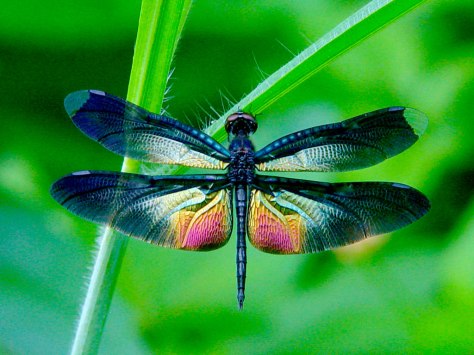
A few summers ago, at our community’s holiday place, Mary noticed a nymph crawl out of the lake to attach itself to a plant. Mary, who has spent some twenty summers tending our lake, observing the life it contains, clearing deadwood, decay and weeds from its floor, knew what was about to happen. She carefully carried the plant with the nymph still attached up to the lodge. Then she invited everyone to come and watch the miracle. Within an hour the adult nymph had shed its tight skin, expanded its new body. Before our wondering eyes, this pale, fragile, newly-emerged creature, its transparent wings delicate, took flight as a dragonfly. Transformation.


wazz1

In his DVD series “Powers of the Universe”, Brian Swimme notes that while transmutation is the power of change at the individual level, transformation is change that is worked into the whole universe by the individual.

Scientists believe that the universe was aiming towards life from the beginning, yet the universe had to transform itself over and over through almost 10 billion years to get to LIFE. Early events in the universe are present in the early structures to which they gave birth. Within stars, the birth of the universe is re-evoked, returning to its earlier stages.

Galaxies come to birth holding different eras in their structures. Galaxies enable planets which enable life.

These are transformative events leading to a time when more of the universe is present in one place.

Life is a way of holding a memory of an event. For example, in photosynthesis cells learn how to interact with the sun. That learning process is remembered in the genes so it can be folded back out. Now that whole event of photosynthesis is here. It’s not a “one-off”. More of the universe is folded into it. The memory is passed on by cells.

With the invention of sexuality, two beings fuse, the memories they carry shuffled together in new ways. The ancestral tree remembers, folds itself into a new being, shuffling events, shuffling genes so new combinations can arise.

The energy that permeates the solar system has been there for all time. Elements of the earth came from the stars. Life holds together all these ancient events.

A colossal interweaving enables this moment to exist. We can’t say the universe is simply here “by luck”. Swimme says that the universe is aiming to participate in the creation of community, attempting to become involved in a four-dimensional way in every place to activate community. We have to orient ourselves to the reality that the universe is aiming towards this.

We are invited into a huge responsibility as part of this unfolding. An individual’s experience can become the source for the recoding of the planet. All of cultural DNA can be recoded. The way in which we organize ourselves is recoding the genetics of other species. With the appearance of the human we have the possibility of the transformation of the planet.

The mystics and poets intuited this before the scientists sought proof. The poet Rainer Maria Rilke wrote a century age that, We are the transformers of Earth. Our whole being, and the flights and falls of our love, enable us to undertake this task.

Swimme asks what laws we are proud of: ending slavery? votes for women? laws to protect animals?
Where else do we see possibilities for transformation?

And what of the seismic shifts happening in our purchase of food? What of our growing need to know where our food comes from? Our choices based on local sourcing? farmers’ markets sprouting everywhere? What of clothing purchases now that we know more of the sweat shops in Bangladesh and China?

From small transmutations in our personal lives, we can consciously seek the larger changes that will alter the planet, testing them for their coherence within the powers of the universe, asking whether these changes will contribute to the enhancement of life, becoming transformative. We are part of the unfolding of the four dimensions of the universe. The universe is present now, enfolded in the work we do.

One of the clearest descriptions of the experience of transformation at the personal level comes to us from the 20th century mystic, Caryll Houselander. After a long illness, a bout of scrupulosity, Caryll had an experience of God that removed her obsessive fears and gave her a profound peace. She writes:

It was in the evening, I think. The room was dark, and the flames of firelight dancing on the wall seemed almost to cause me pain when I opened my eyes….I no longer attempted to translate my torment as particular sins; I had realized in a dim, intuitive way that it was not something I had done that required forgiveness, but everything I was that required to be miraculously transformed.

Jean Houston advises that when we are moving into an experience of transformation we should go looking for guidance from the mystics, writers and poets who have experienced this. Welcome beauty into our lives. Know that we have within us a visionary process which is a source for the recoding of the planet. All the codings for the life of the unborn future are available in us.

We are the recoding, the reset button.

Dragonfly3

We are the transformers of Earth. Our whole being, and the flights and falls of our love,

enable us to undertake this task.(Rainer Maria Rilke)

awakening to the sacred feminine presence in our lives